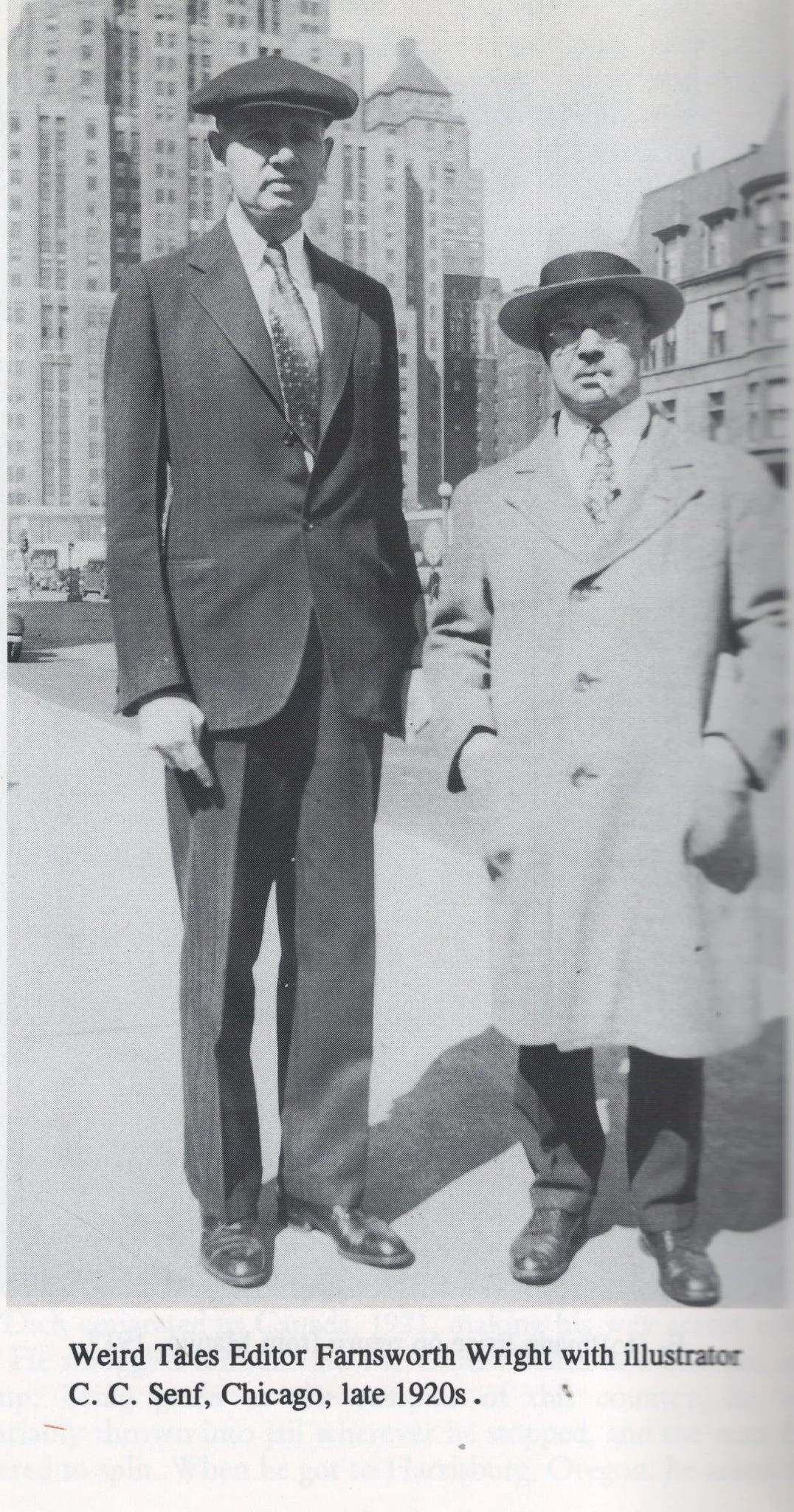
“Enemies” by Farnsworth Wright was published in The Overland Monthly (Feb 1917).
※
Enemies
by Farnsworth Wright
ARMAND’S baggy red trousers, dirty though they were after weeks of fighting, shone resplendent in the rays of the rising Belgian sun. The French uniforms worn during the first months of the Great War, undoubtedly made a gorgeous show on parade, but they were excellent rifle targets—a fact which the French government had not yet learned.
Armand’s rifle was slung carelessly over his shoulder. He walked slowly towards a well in a deserted farmyard. All the farms in that region were abandoned. The panic-stricken Belgian peasants, taking with them what household goods they could carry, were in wild flight westward towards Antwerp or northward into Holland.
Armand was tired and thirsty. He had a slight wound on the back of his hand, hardly more than a scratch, it is true, but very dirty, and needing to be washed and bound. He was alone, for he had become separated from his regiment a few hours before, during a night encounter with the Germans.
When the Great War broke out with the suddenness of an earthquake, Armand had nearly completed the military training which the French republic requires from each of its able-bodied citizens. But now he must continue to serve until peace should be declared, unless he should be killed or crippled before that time.
He had been hurried into Belgium with the first French troops sent to that unhappy country. Pressed northward by the onsweep of the German tidal wave, his company found itself attached to a Belgian regiment near the frontier of Holland, with the whole of Belgium lying between it and the armies of France. Now he was separated even from the Belgian troops.
Inexpressible hate for the invaders filled his breast. They were trying to murder his country. They had brought this unwelcome change into his life. Had it not been for this inexcusable war (Armand swelled with rage at the thought) he would now be back in his native village in southern France, there to take charge of his father’s shop and live out the rest of his life in obscurity and peace.
One thing more. There was a not bad looking girl of his acquaintance in the village. She would make him an excellent wife. It was high time he was getting married, for would he not be master of his father’s shop and
thus be in business for himself? He was well able to support a wife, indeed, and this girl would not be bad! But now it could not be. The Germans—they were to blame for it all!
As Armand drew near the well a bullet hummed by him. He unslung his rifle at once, and looked around to locate his assailant. His first thought was that the farmhouse concealed a sniper, but the crack of the rifle did
not come from that direction. Another bullet made him hastily seek what shelter he could find behind a large bush.
Cursing the French government for making living targets of its soldiers, he attentively examined the landscape to find his enemy. At length he caught sight of a spiked helmet peering from behind the trunk of a lone poplar, not more than four hundred yards away.
He fired at once, but the helmet disappeared behind the tree trunk. Every time it appeared again, Armand fired, and each time the helmet was quickly withdrawn.
The German soldier who had made Armand the target for his fire at length hit on an expedient to outwit him. He carefully notched the tree with his knife. Then he placed his spiked helmet on his bayonet, and wedged the bayonet into the gash in the tree trunk. The helmet projected to one side, as if some one were trying to
peer around the trunk.
Armand fired twice, and missed. Then the German leaped to the opposite side of the tree and fired three times before he retired behind the trunk again.
All morning the duel continued. Every few minutes the German sprang out to one side or the other from behind the tree and fired at Armand.
Armand returned the fire. But the tension irritated him almost beyond measure, and at times he could hardly see the sights on his rifle, so full of rage was he.
Who was this German? Why did he keep up this senseless fray? Why did he not decently come out and surrender, or at least go away? He must see that his shooting was accomplishing nothing! He had no business in this country anyway! He was a Boche, an invader, a tool of that accursed military despotism which so long had threatened France, and now had little Belgium back against the wall, fighting for life!
A bitter smile curled Armand’s lips at the thought that the Boche was having equally as bad a time of it as he himself.
“The coward!” he thought. “He brought it on himself! To shoot at an unwarned man! No brave man would do such a thing. And he gave me no chance to defend myself!”
Then the thought intruded: “I would have done the same thing! If I had seen him first I would have shot, for this is war! But then he is a Boche! It is these red trousers that gave him his chance!”
Spitefully he blazed away at the German’s helmet until he knocked it down. Then he felt quite satisfied with himself, as if he had shot the German instead of only his helmet. But when his enemy sprang out and fired again, Armand was beside himself with rage.
He was hungry and thirsty, and very angry. The wound in his hand was beginning to pain him. Already the sun was past its zenith.
He decided to stop this foolish fray, in which neither side was winning. He took from his pocket a large handkerchief, but at once put it back again. He wanted something white, but one would never suspect that his handkerchief had once been of that color. He opened his uniform and tore a large piece from his shirt. This he tied to his bayonet, to be a flag of parley. Fixing the bayonet to his rifle, he slowly waved the gun from side to side, and waited for the German to show himself.
When the enemy again leaped from behind the poplar he caught sight of Armand’s improvised flag of truce and did not fire. Armand slowly advanced, waving the white flag.
As he approached the German, he groped in his memory for suitable German words in which to ask for an armistice. He had studied his enemy’s language and even had written to correspondents in Germany before the war broke out.
The German held his rifle ready for use in case Armand should make any threatening move. But Armand, although burning with suppressed anger and indignation, had not come to kill. He wanted to eat and drink and wash his wounded hand.
“Qu’est ce que c’est?” the German called out as Armand drew near.
“Sie sprechen Fransoesisch!”
Armand exclaimed in astonishment.
“Yes, I speak French a little bit,” the German answered slowly, in guttural French. “And you speak also my language, is it not so?”
“I have studied German a little,” Armand replied in German. “But I never have talked it.”
“This German may not be such a bad fellow, after all,” he thought. “He speaks French, too! Still, he tried to kill me when my back was turned! I had best be on my guard.”
Anger filled his heart.
He explained, in broken German, that he was tired of this shooting, and thought it might be well to declare an
armistice until they had eaten and drunk and rested. The German willingly fell in with the scheme.
“Je ne veux pas vous—vous—toeten,” he said.
So the two enemies suspended their strife and went together to the well. They shared each other’s food and
drank to each other’s health, yet each hated the other in his heart.
“Prosit!” said Armand, lifting his cup of water.
“A votre sante!” replied the German.
Armand washed his wounded hand, and was about to bind it with his dirty handkerchief, but the German prevented him. He took from his knapsack a bandage. He sterilized Armand’s wound, and bound the bandage tightly around the injured hand of his enemy.
Armand thanked him and asked him his name.
“Friedrich Krogoll,” replied his enemy; “but my acquaintances all call me Fritz.”
“Then I, too, will call you Fritz, Boche,” said Armand. “I am called Armand Roullier.”
“Freue mich,” said Fritz, relapsing into his own tongue. He extended his hand, and Armand grasped it.
“I was afraid you might try to kiss me,” laughed Fritz.
“Oh, I know where you get your idea of our customs,” said Armand. “You have been visiting the cinema! A
Frenchman doesn’t exchange kisses with a stranger, especially if the stranger is a German.”
And he thought: “This Boche is a good sport, even though he does murder our beautiful language. But he
will bear watching.”
“You come from Paris?” asked Fritz.
Each spoke in the language of the other, filling in the gaps in his vocabulary from his mother-tongue.
“No, I come from the south,” said Armand. “And you?”
“From Munich. I am a Bavarian. But for two years now I am an instructor in the University at Goettingen. I teach entomology.”
“So?” said Armand. “I never could go to the university. I had to work in my father’s shop. My father is old, and I will manage the shop when I get back, if I escape being killed.”
“Ah, this terrible slaughter!” said Fritz. “War is so terrible! The young men, they are the victims. No nation can spare its young men.”
“That is fine talk for a German!” thought Armand. “Why did they begin this war if that is the way they feel?”
But he did not say this aloud.
“Why are you not with your regiment?” asked Fritz, seating himself on the ground.
Armand explained how he had become separated from his comrades in arms.
“I got lost from my regiment because I was too deeply interested in my profession,” said Fritz. “In short, I was chasing a large night beetle. It flew several times, and each time I ran after it. It was not yet light, and I was behind our lines.
“Suddenly I heard the Belgians coming. They charged, yelling like all the devils of hell. They came between me and my command. I was afraid to fire, for fear I might hit my comrades. So I drew away, and thought only of how I could get back to my company. I went far back of the lines, out of the fighting, but it was darker than an Ethiopean Hades, and I did not go the right way. The firing stopped, and I walked a long distance trying to get back to my comrades. But when it was light, I found myself here. And the German soldiers—where are they? I don’t know.”
“I was one of the attacking party,” said Armand. “How the fight turned out I don’t know any more than you do. But—did you find that beetle?”
“Oh, no!” laughed Fritz. “I entirely forgot about the beetle when the Belgians charged. “You and the Belgians, I suppose I ought to say.”
“What were you going to do with it?”
“The beetle? Oh, I was only curious. I could not be certain, in the dark, whether I had seen one like it before. I have a big collection of beetles at Goettingen, beetles from all over the world. Do insects interest you? Your fellow countryman, Fabre, has made a marvelous study of insect life.”
“They don’t interest me very much,” said Armand. “I never collected them, not even butterflies. But I collect postage stamps and coins. It was to help my collecting that I studied German. I write to several collectors in your country, and I correspond regularly with a philatelist in Munich. That is, we corresponded before the war. His name is Franz Link. Did you know him?”
“No. Munich is a large city, and, besides, I have not lived there for several years. My father sent me to
Goettingen, where his brother is a professor of languages. There I did so well that I am now helping to teach in the entomology courses. It is a great study, entomology. But you should learn English, if you are a philatelist. In that language you can correspond all over the world—in Canada, India, the United States, Egypt, Africa and the islands of the Pacific Ocean. It must be very interesting, if one has the time to give to it. Tell me about your village. What is it like in that place?”
Armand told him all the interesting things he could think of about the village. “Professor” Fritz, as he dubbed the youthful looking assistant, then told long tales of the student life in his beloved Goettingen.
Each laughed at the other’s ridiculous errors of speech, for each was speaking a foreign tongue. In the absorbing interest of their conversation they took no note of the lapse of time.
“Hey, Professor Fritz,” Armand at last exclaimed, “I do believe the sun is about to set. It is time to eat again. Please give me some more of that delicious marmalade. And here is a big slice of that cheese you like so much. My father sent it to me out of his shop.”
“The marmalade was made by my mother in Munich,” said Fritz. “How she will laugh when I write her how I
shared it with a Frenchman! Won’t she, though!”
He threw back his head and laughed heartily.
“How my father would rage if he knew his cheese was being eaten by a Boche! He had to send it by way of
England to get it to me.”
Both laughed long and loudly. The German suddenly became very serious.
“Look!” he cried out. “The sun is setting! We must part.”
“Yes,” cried Armand. “We must part. Your way lies yonder. I must go west, but I don’t know whether there are Germans between me and the Belgian troops. If there are, then I must go north.”
“North!” cried Fritz. “That way lies Holland, and you can’t get back until the war is over, if you cross the Dutch frontier.”
“I must go west then,” Armand replied.
“The Dutch frontier is only four or five miles distant, for we have both come north since we left our regiments. And now, my friend”—his face became very grave—“I pray God we may never meet again while the war lasts. You are a good fellow, but we are enemies.”
“Enemies?” exclaimed Fritz. “We were enemies. But now? Tell me, my friend, do you really want to shoot me?”
“I have already said,” Armand answered with emotion, “that I pray God we may never meet again in this war.
It would be murder. It would be like killing one’s brother. It is a terrible thought.”
Fritz stood in silence and listened to the distant roar of cannon. He thought of the lives that were being
blotted out at the minute.
“Holland?” he said at last. “You say it is not far?”
“Not far,” said Armand. “Six miles—perhaps—but maybe only three.”
He saw his own thought reflected in the German’s face.
“Allons, mon ami,” said Fritz, after a minute of silence.
“Come!” said Armand.
* * * *
They had been walking perhaps an hour, in silence, when they heard the pounding of hoofs. Through the deepening darkness they made out a troop of Belgian lancers, galloping west.
“Ha,” said Armand to himself. “I am the master now. I will capture this fine fellow who was going to shoot me down without warning!”
But one look into his companion’s smiling face shamed him from the unworthy attempt. He did not hail the
cavalrymen, and they passed by in the dusk without seeing him.
The two continued north until they were stopped by a Dutch sentry. He could not converse with them, for he
knew neither French nor German. An officer was called.
Armand explained that they had crossed the border into Holland to avoid having to shoot each other. The
officer listened contemptuously, and sent them away under guard.
They were deserters, and their friends would call them traitors. Yet their minds were at peace, for a ray
of light from that nobler age of which poets dream had fallen into their souls. So they smiled as they were led away. The Dutch officer stood looking after them. Perhaps he was touched, perhaps he was only puzzled. At any rate, a mist came over his eyes, but it suddenly vanished, and he turned abruptly on his heel.
“Fools!” he muttered. ‘What would happen if all the soldiers should do that?”
※
While reporting for Musical America, he started selling fiction to the Overland Monthly, placing two well-crated short stories in 1917. Both are war stories centered in Belgium. Both express a staunchly pacifistic perspective and both incorporate the idea of language creating barriers that must be overcome, ideas that flow directly from his engagement with the universal language of Esperanto.
—John Locke, The Thing’s Incredible! The Secret History of Weird Tales 46
The world in 1917 was in the third year of the Great War. Farnsworth Wright, who had grown up during the peace and dedicated time and energy to Esperanto and its society and literature, wrote a war story where the heroic action was not to kill or maim the opponent, but just to end the ceaseless slaughter. It may seem an odd beginning for an editor that would one day deal with werewolves, vampires, cultists, and Conan the Cimmerian, but for all of its idealism, it also shows a solid understanding of the tension and drama in the scenario of two enemies meeting one another, and wondering how far either can trust the other.
Bobby Derie is the author of Weird Talers: Essays on Robert E. Howard and Others and Sex and the Cthulhu Mythos.
Deep Cuts in a Lovecraftian Vein uses Amazon Associate links. As an Amazon Associate I earn from qualifying purchases.

