The ‘Not at Night’ series was originally conceived by its editor on the top of a bus one evening when it became clear that a money maker was needed for the firm of Selwyn & Blount, the original publishers. It was one of those brilliant ideas that grew and grew over a period of some ten or eleven years ending with an Omnibus voluming containing the pick of the stories (in the opinion of the editor) and the War, which put a final end to its existence. During its long and honourable life over a quarter of a million copies were sold and the little 2/- volumes were seen in the stalls of almost every railway station, as well as in the bookshops.
—Christine Campbell Thomson, introduction to Not At Night (1960)
During the interwar period, American pulps became increasingly popular, both at home and abroad, being exported to Canada, the United Kingdom, Australia, and other countries—but were largely seen as disposable fiction. Very few stories in the pulps were republished in anthologies between hardcovers. Which makes Christine Campbell Thomson’s decision in 1925 to edit and publish a collection of horror fiction, much of it culled from the pages of Weird Tales, all the more innovative.
What’s more, the book was a success. Not At Night (1925) reportedly was republished ten times in the next three years, spawned ten direct sequels, at least one imitator, an omnibus, and even had a brief paperback reprint revival in the 1960s and 70s. It was the first hardback publication for the fiction of many Weird Tales writers, and the list of those published within its pages includes H. P. Lovecraft and many in his circle of correspondence, notably Frank Belknap Long, Robert E. Howard, Clark Ashton Smith, Henry S. Whitehead, and Seabury Quinn.
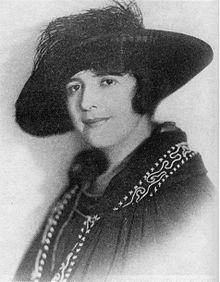
Christine Campbell Thomson herself was an author, editor, and literary agent. In 1924 she had been agent to Oscar Cook, and shepherded his memoir Borneo: Steal of Hearts (1924) to great success; they were married a month after its release. Cook held a controlling interest in the publishing firm of Selwyn & Blount, and Thomson was working for that company when she hit on the idea of a cheap collection of horror stories, mostly reprints, aimed at the bustling book-stall market. As she told it:
The first book, Not At Night, came out in October, 1925—a tremendously exciting moment! For the idea had been conceived on the top of a bus (they were open-decked buses in those days) just as it pulled away from its Oxford Circus stop about six o’clock one evening. I was on that bus with the then Director of Selwyn & Blount, Ltd. He was, I remember, lamenting, like every other publisher, that he waned something new and couldn’t find it…and something popular. I believe that he claims the bright moment when Not at Night took birth, but I think that it was a case of two minds on the same thought at the same moment—at any rate, I know that I am responsible for the title of the Series!
The price of the projected book was a matter of fierce argument. Finally we agreed upon two shillings in the belief that Not at Night would be the kind of book that a man would buy at a railway-bookstall, throwing down a single coin and running for his train. We wanted, above all, to produce books that would be within the reach of a very large number of people….
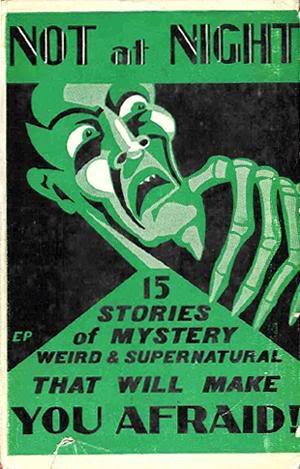
The jacket for this first volume (and for many of the later ones), was designed by that clever advertising-agent, Betty Prentis, who was then working as a freelance artist under her trade-name Eliza Pyke. It was “Eliza”, with her sense of dramatic colour, who contributed not a little toward a “brighter bookstalls” movement!
Publication-day dawned and we held our hands in trepidation. Were we backing a wrong horse? Within a week we knew that we were on the right one. Not At Night was launched and we daringly planned a second and a third to follow in the ensuing years. For originally this was a one-book scheme. The popularity of the Series never waned, and it became a matter of pride to make each subsequent volume equal the quality of the previous one; for—in our modest opinion—it was impossible to surpass it!
—Christine Campbell Thomson, introduction to Not At Night Omnibus (1936) 9-10
Thomson wrote little more than this on the Not At Night series; there are no introductions to the original volumes except the omnibus, and her memoir I Am A Literary Agent (1951) while full of fascinating anecdotes, leaves off most of her time as an editor at Selwyn & Blount. However, a fairly extensive correspondence regarding the series (and their appearances therein) survives from Lovecraft and his contemporaries, giving us a unique opportunity to see what they thought about their book appearances, in their own words, and a hint at some of what was happening behind the scenes.
Not At Night (1925) & More Not At Night (1926)

The first two Not at Night volumes were comprised primarily of stories from Weird Tales in 1925 and 1926—quite literally hot off the press—and include two stories by Lovecraft’s friend and Mythos originator Frank Belknap Long, one by August Derleth, and the first Jules de Grandin episode from Seabury Quinn. Lovecraft was not present in these volumes, and appears to have been generally ignorant of their existence: while popular in the United Kingdom, the books were not imported into the United States in large numbers.
By the way—Long has had two stories of his reprinted from Weird Tales in British anthologies of weird fiction. “Death Waters” appears in “Not At Night”, & “The Sea-Thing” in “More Not At Night”. These collections, he tells me, he’s only just received copies himself) are very good, & I shall ask him for the loan of them.
—H. P. Lovecraft to August Derleth, 11 Mar 1927, Essential Solitude1.74
The two collections containing Long’s tales are called, respectively, “Not At Night” & “More Not At Night”. As soon as I ascertain the publisher I’ll let you know.
—H. P. Lovecraft to August Derleth, 16 Mar 1927, ES1.75
As a mark of their debt to Weird Tales editor Farnsworth Wright, whose agent in London Charles Lovell apparently provided the materials for these and subsequent volumes in the series, Thomson included a dedication in More Not at Night and several subsequent volumes:
The Editor desires to record her acknowledgements to Weird Tales by whose kind permission these stories are reprinted.
You’ll Need A Night Light (1927)
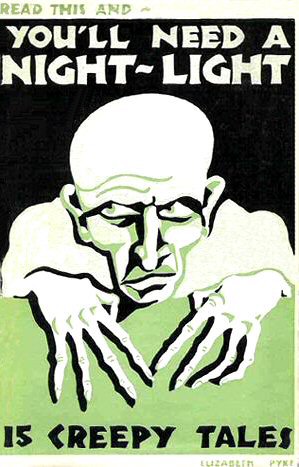
The third Not At Night volume was the first hardback publication of a Lovecraft Mythos story: “The Horror at Red Hook.” The book also marks the appearance of stories from Thomson (under the name Flavia Richardson) and her husband Oscar Cook; both had submitted and published their work in Weird Tales.
A third pleasure is given me by the news of Red Hook’s anthological reprinting; and I’d like to see the book if you can get me a copy later on. I can most emphatically and advantageously use any royalties, be they ever so humble, which may chance to trickle in from Mr. Lovell. I’ve been meaning to ask Belknap whether he obtained anything for the two stories reprinted in previous issues.
—H. P. Lovecraft to Farnsworth Wright, 16 July 1927, Selected Letters 2.155, Lovecraft Annual 8.11
I also learn to my great pleasure that the British “Not at Night” anthology which reprinted two of Belknap’s tales has used one of mine—”Red Hook”—in its third issue. This will bring enough of a royalty to keep me in postage stamps if Belknap’s experience by any criterion.
—H. P. Lovecraft to August Derleth, 26 July 1927, ES1.100
I’ve forgotten the name of the British firm that issues the “Not at Night” anthologies, but Wright could tell you quickly enough. It’s like an average publisher to choose a writer’s worst tale for particular preference. “Red Hook” was so poor that I hesitated in sending it to Wright in the first place, but he thought it was one of my best!
—H. P. Lovecraft to August Derleth, 4 Aug 1927, ES1.101-102
I have never tried my luck with the British market, but I believe I will later take advantage of your much-appreciated suggestion. No—I have patronised no agents in England, although I am told that Weird Tales’s London representative systematically endeavours to re-market all the contents of that dubious congeries of mediocrity on the other side. As a result of this arrangement, they tell me that one of my poorest printed effusions—”The Horror at Red Hook”—is about to be reprinted in the latest number of the Selwyn & Blount “Not At Night” anthology—an institution which has already used two stories by Frank Belknap Long.
—H. P. Lovecraft to Vincent Starrett, 23 Aug 1927, Letters to Maurice W. Moe 523
At Cook’s I saw the two “Not at Night” anthologies, & asked the name of the publishers. It is Selwyn & Blount.
—H. P. Lovecraft to August Derleth, 5 Sep 1927, ES1.104
Anthologies, by the way, are right in my line. I’ve just received the 3d. of the Selwyn & Blount “Not at Night” series with my “Horror at Red Hook” as the last story in the book. This is my first—if not my last—appearance between cloth covers.
—H. P. Lovecraft to Donald Wandrei, 19 Dec 1927, Mysteries of Time & Spirit 195-196, SL2.211
I duly received the Selwyn and Blount anthology which you forwarded. Not half bad! My first appearance between cloth covers, save for prefaces to two books of other people’s poetry which I’ve edited. I note that their illiterate proofreader copies the misprinted punctuation of the Latin quotation—the comma after tali which so lacerated my heart in Weird Tales.
—H. P. Lovecraft to Farnsworth Wright, 22 Dec 1927, SL2.212, LA8.16
You’ll Need A Night Light is not technically Lovecraft’s first appearance in hardcover, since he had previously had material appear in The Poetical Works of Jonathan E. Hoag (1926) and White Fire (1927), both tributes and collections of work of notable amateur journalists that Lovecraft had edited, but it was his first fiction appearance in an anthology. While happy to be in the anthology and pleased at the idea of royalties, Lovecraft’s estimation of the book’s literary value was low:
Your inclusion in the last “Not at Night” volume also gave me great pleasure, but you should have been there before with “The Outsider” or one of your more important tales than “The Horror at Red Hook.”
—Donald Wandrei to H. P. Lovecraft, 15 Jan 1928, MTS 199
As for that ‘Not at Night’—that’s a mere lowbrow hash of absolutely no taste or significance. Aesthetically speaking, it doesn’t exist.
—H. P. Lovecraft to Donald Wandrei, 20 Jan 1928, MTS 202
In fact, a hallmark of the Not At Night series under Thomson’s editorship was going for the grue, so to speak. She often picked not the best of the stories from Weird Tales, but some of the most vivid and visceral, such as Eli Colter’s “The Last Horror” and Seabury Quinn’s “The House of Horror”—a far cry from Lovecraft’s preferred aesthetic, but the readers ate it up.
Gruesome Cargoes (1928)
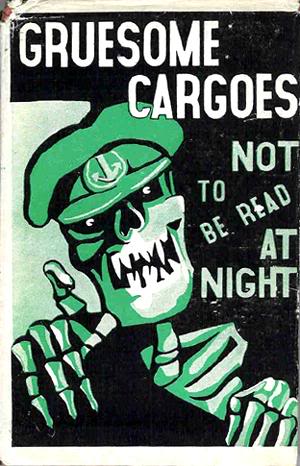
The fourth Not At Night volume consisted primarily of original stories and reprints from Hutchinson’s Mystery-Story Magazine and Ghost Stories, rather than reprints from Weird Tales. The volume’s publication apparently coincided, more or less, with some financial difficulty at Selwyn & Blount, which led directly to their acquisition by another British publishing company, Hutchinson’s, with which Oscar Cook had some association (his stories appeared in several of their magazines). Selwyn & Blount were maintained as an imprint or associated company, and continued to produce the Not At Night series.
As for the “Not at Night” anthologies—your mention of the Asbury book coincides with special timeliness with a note just received from Weird Tales’ London agent. Selwyn & Blount have failed, & no royalties can be paid their authors before next March. Another company has taken over the sale of the remaining books—but I fancy that the new “Gruesome Cargoes” will end the series unless this Asbury person finds a way to take over its good-will.
—H. P. Lovecraft to August Derleth, 5 Oct 1928, ES1.160
So “Gruesome Cargoes” isn’t taken from W.T.! Maybe they wouldn’t have failed if they’d stuck to their good old source! Home you get some royalties from the defunct S & B in the end.
—H. P. Lovecraft to August Derleth, 17 Oct 1928, ES1.165
The Asbury that Lovecraft mentions involves the other Not at Night book published in 1928…and one not edited by Christine Campbell Thomson or published by Selwyn & Blount.
Not at Night! (1928)
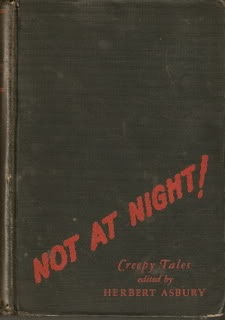
In 1928, the American publishing firm of Macy-Masius produced their own Not at Night! volume, edited by Herbert Asbury and with contents drawn from the first three books of the British Not at Night series. This volume was apparently unauthorized—whether the publishers knowingly violated copyright law or there was a misunderstanding regarding the license to use certain stories from Weird Tales is not entirely clear, although based on the disclaimer at the front of the book the publishers appear entirely ignorant of the original provenance of the stories in an American pulp magazine:
These stories were originally printed in England in “Weird Tales,” and were selected and arranged for the English edition by Christine Campbell Thomson.
Asbury’s introduction underlines his basic ignorance of Weird Tales:
And a whole new school of writers has arisen to contribute to the scores of magazines in this country and England which specialize in tales of horror and the occult. All of these periodicals appear to be enormously successful, and their number is rapidly increasing. […] Most of the authors represented in this collection appear to be comparatively unknown in this country (Seabury Quinn is the only one whose work I have ever seen before), and scholars and critics will look in vain for evidences of the skill and erudition displayed by such masters of the horror story as Edgar Allan Poe, Ambrose Bierce and Algernon Blackwood. But any such comparison would be manifestly unfair, for the only criteria applied in selecting these tales from the many which were available were shock and gruesomeness.
—Herbert Asbury, introduction to Not at Night! (1928) 10-11
Seabury Quinn was also regularly published in Real Detective, where Asbury likely read him. The book republishes Lovecraft’s “The Horror at Red Hook,” in addition to stories from Ausut Derleth and Frank Belknap Long. Its appearance caused consternation, and a legal challenge from Farnsworth Wright, editor of Weird Tales, and Macy-Massius withdrew it from the stands.
I am indeed interested to hear of the proposed action regarding Not at Night, and certainly hope the matter can be properly straightened out. It seems rather a tangle—I never heard of this Jeffries before; but was told last September by the agent Lovell that a certain Hutchinson and Co. had bought the edition of the book containing Red Hook, and that I would receive from them such royalties as would have been due me from the late lamented Selwyn and Blount. At that time nothing was said of any other sale of rights, British or American. I fancied that Macy-Massius might have later bought the rights from Hutchinson—and bought the rights to the earlier books from the receiver of the deceased corporation—but in any case it seemed to me that something was due the various authors represented.
As to including me in the list of plaintiffs—I suppose it’s all right so long as there is positively no obligation for expense on my part in case of defeat. My financial stress is such that I am absolutely unable to incur any possible outgo or assessment beyond the barest necessities; so that, unsportsmanlike though it may seem, I cannot afford to gamble on any but a “sure thing”—sure, that is, not to involve loss. If, however, the guarantee of non-assessment on your part is to be taken literally as covering all possible expenses both principal and incidental, I suppose it would be foolish not to stand behind the action and reap whatever royalties might be due me in case of victory. I certainly need all such things that human ingenuity can collect.
Therefore—it being understood that I am in no position to share in the burthens of defeat—you may act for me if you wish; though I doubt if my profits will amount to very much in case of victory. I will pass on your letter to Little Belknap, and fancy he will extend similar authorisation.
—H. P. Lovecraft to Farnsworth Wright, 15 Feb 1929, SL2.260-261, LA8.20
No—I didn’t notice the “Not at Night” advertisement you mention. Bold plagiarism of titles—but I suppose it’s a different anthology. I must look it up.
—H. P. Lovecraft to August Derleth, 27 Sep 1928, ES1.159
This will be my second appearance between cloth covers, one other anthology having used a tale of mine a year ago.
—H. P. Lovecraft to Elizabeth Toldridge, 20 Nov 1928, Letters to Elizabeth Toldridge & Anne Tillery Renshaw 22 SL2.253-254
It rather tickled me to see this Herbert Asbury claiming editorship of a book which he merely took as he found it—but maybe he changed the punctuation in some of the tales. I suppose “Red Hook” must be in it—& if so, I am wondering if I ought to get any royalties. Maybe I’ll write the London agent Lovell & see.
—H. P. Lovecraft to August Derleth, Dec 1928, ES1.169
Residual current honours are purely anthological. I believe I last winter appris’d you, that my “Horror at Red Hook” had been included in the British weird anthology “Not at Night”—published by the now unhappily deceased London firm of Selwyn & Blount. Well, Sir, that anthology has just been republished in America, (Macy-Masius, $2.00) & I am still in it.
—H. P. Lovecraft to Maurice W. Moe, 13 Dec 1928, LMM 196
This fame business would be rather expensive if it were followed up—O’Brien’s book $2.50, the Asbury “Not at Night” perhaps $2.00, & the O. Henry thing I don’t know how much! […] I’ve just wondered, though, if Long & I oughtn’t to get some royalties from the Asbury affair. We kept our book rights, & Selwyn & Blount have either paid or promised a legitimate return—even posthumously. How come this Asbury person git so much fo’ nuffin’? But then—Gawd knows I’m no business man. Your account of the new “Not at Night” sounds very attractive, & I may yet fall for it. The copies to be autographed have not yet come, but I’m prepared for quick action when they do. Asbury’s geographical mistakes are somewhat amusing. Really, I’ll have to emigrate to the States if there’s a chance of getting well known over there some day! Beastly fog, this—I can hardly see St. Paul’s dome from my Bloomsbury upper window as I write!
—H. P. Lovecraft to August Derleth, 14 Dec 1928, ES1.170
I thought the appearance of the volume delightful, but did not care much for Asbury’s slighting reference to the artistic & scholastic merit of the contents. I was tempted to answer his slur about scholarship by pointing out that his own lordly erudition was not sufficient to detect & delete the mispunctuation which destroys the sense of the quotation from Delrio—the comma after tali which the British anthologist stupidly copied from the original misprint in Weird Tales. I’m not sure yet wether or not I’ll buy the book. Belknap has put in an order for a used copy at the nearest Womrath Library—since they sell books rather cheap after withdrawing them from circulation.
—H. P. Lovecraft to August Derleth, 26 Dec 1928, ES1.173
Yeah—that Asbury goof sure gives a dirty dig in his praefatio. And then, after jeerin’ at bum scholarship, he goes & retains the misprinted punctuation in my Delrio quote!
—H. P. Lovecraft to James F. Morton, 26 Dec 1928, Letters to James F. Morton 171
It was interesting to hear of your new professor’s acquaintance with “Not At Night”—& flattering to learn his opinion of “Red Hook.” I can’t like that yarn at all, myself, & wouldn’t be inclined to place it first even in the Asbury compilation.
—H. P. Lovecraft to August Derleth, 1 Feb 1929, ES1.180
Wright is going to sue Macy-Masius for printing (under an invalid contract) the contents of “Not at Night”, & wants Long & me to let him include us among the complainants. I think I’ll let him—I surely wouldn’t mind some extra royalty!
—H. P. Lovecraft to August Derleth, 15 Feb 1929, ES1.184
As for Wright’s lawsuit—I suppose the rights sold to Selwyn & Blount were British rights only, so that reprinting in the U.S. is illegal. Wright said something about a defective & unauthorised contract which Macy-Masius had made with somebody named Jeffries—but I couldn’t quite get the drift of the situation, since the explanation seemed to assume my possession of information which in truth was never given to me. However, I wish Wright luck, & hope that Belknap & I can get something out of it. Too bad you relinquished all rights on those older tales of yours which are represented.
—H. P. Lovecraft to August Derleth, 25 Feb 1929, ES1.185
By coincidence, I have also just received as a gift a copy of the Asbury “Not at Night” volume.
—H. P. Lovecraft to August Derleth, 20 Aug 1929, ES1.208
Herbert Asbury edited the pirated American “Not at Night” anthology (containing my “Horror at Red Hook”) which Macy-Masius withdrew from the market rather than pay royalty or damages to Weird Tales.
—H. P. Lovecraft to Carl Ferdinand Strauch, 5 Nov 1931, LJVS 302
By Daylight Only (1929)

Lovecraft’s third anthology appearance was “Pickman’s Model” in By Daylight Only, which also included stories by H. Warner Munn and August Derleth. Whether for cost or other reasons, Thomson had returned to reprinting the “best” (or at least, most grisly) Weird Tales had to offer. It also appears to have used a simplified royalty system, offering a lump sum payment to writers (probably minus an agent fee) rather than residuals based on sales.
Also, [Wright] says that the successors of the late Selwyn & Blount are going to issue another anthology of W.T. stuff, & intend to include “Pickman’s Model.”
—H. P. Lovecraft to August Derleth, 2 Aug 1929, ES1.206
I wouldn’t be at all surprised if the new Not at Night annual had a goodly quota of your material. I trust that I may get a free copy, as I did of the issue containing “Red Hook”.
—H. P. Lovecraft to August Derleth, 13 Aug 1929, ES1.207
Did you get “By Daylight Only” free, or did you have to buy it? I haven’t seen a copy, & had no idea it was out, although Wright lately sent me a cheque for $21.25 to cover “Pickman’s Model.” Where does one get it? I’d sort of like to own it, since I’m represented therein.
—H. P. Lovecraft to August Derleth, 15 Dec 1929, ES1.236
I’d like the address of the place you got “By Daylight Only” if you have it conveniently at hand. I’m too broke to buy it now, but sooner or later I’d relish its presence on my shelves. […] Too bad you let Wright have all rights on “The Tenant”. Got $21.50 for the use of “Pickman’s Model”—the arrangement in this case being one outright payment instead of the dribbling royalty system used in connexion with the earlier “Not at Nights”.
—H. P. Lovecraft to August Derleth, 22 Dec 1929, ES1.238
If I get “By Daylight Only” it will probably be from the Argus—whose catalogues have reached me regularly for many years. What is their price? Not much more, I imagine, than the ultimate cost when ordered from England, if all the duties & incidentals be counted in. Munn—represented by “the Chain”—tells me he has a copy; & I am asking him whether or not he had to pay for it.
—H. P. Lovecraft to August Derleth, 27 Dec 1929, ES1.239
I’ll probably purchase “By Daylight Only” from the Argus. It ought to be worth a dollar & a quarter!
—H. P. Lovecraft to August Derleth, Jan 1930, ES1.243
Switch On The Light! (1931)
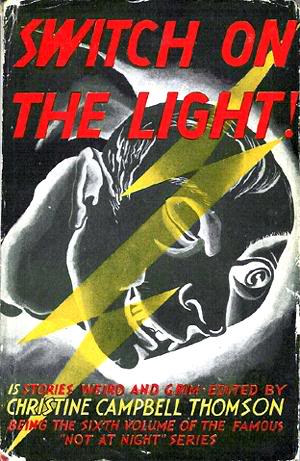
While at this point considered an “annual” tradition, the tides of publishing mean schedules sometimes slip. So it is that there appears to have been no new Not at Night volume published in 1930, but two volumes in 1931. The first of these, Switch on the Light! includes Lovecraft’s “The Rats in the Walls” (which had recently been republished in Weird Tales, and led to his correspondence with Robert E. Howard) as well as one of his stories ghost-written for revision client Zealia Brown Reed Bishop, “The Curse of Yig.” August Derleth and Frank Belknap Long are also both present.
Belknap’s Visitor from Egypt & my Rats in the Walls will appear in the new British “Not at Night” anthology.
—H. P. Lovecraft to Clark Ashton Smith, Nov 1930, Dawnward Spire, Lonely Hill 269
This reminds me that your “Pacer” will be companioned in the “Not at Night” anthology by Belknap’s “Visitor from Egypt” & my own “Rats in the Walls”—the remuneration for each of which seems to be the same as yours.
—H. P. Lovecraft to August Derleth, 21 Nov 1930, ES1.287
Glad the new “Not at Night” is a decent specimen of its kind. I shall wait till the publishers send me a copy. Shall be very glad to see your “Pacer” between cloth covers, & hope you will be equally well represented in whatever 1931 volume the firm may publish.
—H. P. Lovecraft to August Derleth, 29 May 1931, ES1.344
Why don’t I publish my things in book form? Because no publisher wants to buy them for that purpose! […] Stories of mine in anthologies, aside from “Red Hook” & “Cthulhu”, are “Pickman’s Model” (Not at Night, London 1929) & “The Rats in the Walls” (“ “ 1930).
—H. P. Lovecraft to J. Vernon Shea, 19 Jul 1931, Letters to J. Vernon Shea 21
M R James, the Not at Nights, &c., were all most enthusiastically welcome.
—H. P. Lovecraft to August Derleth, 3 Aug 1931, ES1.354
I’ll wait a while before buying the Rat-containing Not at Night—for it seems to me they did send me a belated copy once. Moreover, they very definitely promised me a copy of the present anthology this spring. Same with Belknap—who has received none so far.
—H. P. Lovecraft to August Derleth, 9 Oct 1931, ES1.393
In 1930 Wright reprinted [“The Rats in the Walls”] in W T, & in 1931 it was included in the British “Not at Night” anthology.
—H. P. Lovecraft to F. Lee Baldwin, 16 May 1934, Letters to F. Lee Baldwin 87
Hope your mother will be able to get you the Not-at-Night with the Rats.
—H. P. Lovecraft to Robert Bloch, Sep 1934, LRBO 112
At this point, the success of the Not At Night series may have inspired similar efforts in America—less blatant that Macy-Masius’ volume, but strongly indicative. Weird Tales attempted to publish a reprint anthology of its own, The Moon Terror & Other Stories (1927), which performed poorly, still being advertized for sale into the 1940s. More successful was Beware After Dark (1929), edited by T. Everett Harré and including Lovecraft’s “The Call of Cthulhu”, and another possible influence is Creeps by Night (1931), edited by Dashiell Hammett and including Lovecraft’s “The Music of Erich Zann.” In the 1930s, Weird Tales author E. Hoffmann Price also tried to get a Weird Tales anthology published, without success. Lovecraft mentions these briefly:
I’d be glad enough to have them use “Pickman’s Model”, which was included in the British “Not at Night” series, but has not seen book publication in America.
—H. P. Lovecraft to Robert E. Howard, 12 Sep 1931, A Means to Freedom 1.213
I’m very glad that “Pickman’s Model” has been used in a British publication, and will gladder when it appears in American covers.
—Robert E. Howard to H. P. Lovecraft, Oct 1931, MF1.228, Collected Letters of Robert E. Howard 2.269
My “Call of Cthulhu” is in “Beware After Dark”, edited by T. Everett Harre & published by the Macaulay co., & the British “Not at Night” collections (published annually) usually include me among their contents.
—H. P. Lovecraft to Carl Ferdinand Strauch, 10 Oct 1931, LJVS 299-300
At Dead of Night (1931)

Nothing by Lovecraft appeared in At Dead of Night, though it had a story (“Passing of a God”) from his friend, correspondent, and collaborator Henry S. Whitehead. Lovecraft and his associates were still struggling to get copies.
At Dead of Night, the new Selwyn & Blount anthology, has come; it has Prince Borgia’s Mass, and is a lousy collection. I was glad to see Passing of a God here, however.
—August Derleth to H. P. Lovecraft, 15 Jan 1932, ES2.442
Thanks for the Not at Night information—my order goes to the Argus in this mail. But I do think Charles Lovell was a damn cheap sport not to send us free copies after promising to do so last May. Is there anything by our gang in the latest number?
—H. P. Lovecraft to August Derleth, 27 Jan 1932, ES2.444
Thus all the “Not at Nights” have done their reprinting directly from W.T. without any notification of the respective authors.
—H. P. Lovecraft to August Derleth, 2 Feb 1932, ES2.447
I am informed by the Argus that the stock of “Switch on the Light” is exhausted, but that a fresh lot is due within a week. Therefore they are retaining my dollar & promising as early delivery as possible. I doubt if I’ll get the current annual.
—H. P. Lovecraft to August Derleth, 2 Feb 1932, ES2.448
The Argus had not yet sent my Not at Night, but I presume they will not forget to do so when it comes in. Sorry you aren’t being paid for your story in the latest issue. I believe you said there is nothing of mine in this one.
—H. P. Lovecraft to August Derleth, 25 Feb 1932, ES2.458
Grim Death (1932)

The eighth entry in the series saw the first hardcover publication of the fiction of Texas pulpster Robert E. Howard, with his Cthulhu Mythos tale “The Black Stone.” Howard had been corresponding with Lovecraft for two years at this point, and had turned his hand to a few pieces of Mythos fiction, but this was the first Mythos story written by someone other than Lovecraft to appear in book form.
No—I fancy the gang aren’t represented at all in the new “Not at Night”, for nobody’s been notified, & cheques usually precede publication.
—H. P. Lovecraft to August Derleth, 28 Oct 1932, ES2.506
Glad the new Not at Night has “The Black Stone”—but it isn’t a volume I’d like to buy.
—H. P. Lovecraft to August Derleth, Nov 1932, ES2.513
(N. B. I suppose you know that your “Black Stone” is in the new “Not at Night” anthology.)
—H. P. Lovecraft to Robert E. Howard, 7 Nov 1932, MF1.463
Don’t spare the new “Not at Night” from your library if you have any conceivable use for it—though of course I’ll be glad to have it if it is a question of Grandpa or the ash-dump! When I said I was glad Howard’s story was included, that was from a personal rather than a literary angle—for I concede that our Master of Massacre has by no means escaped from the crude & the conventional, despite the undeniable power of some of his suggestions of a monstrous & unhallowed antiquity.
—H. P. Lovecraft to August Derleth, 12 Nov 1932, ES2.523
I shall greet both of the volumes you mention with profound gratitude. Those “Not at Nights” are surely growing into an ambitious five-foot shelf of mediocrity!
—H. P. Lovecraft to August Derleth, 19 Nov 1932, ES2.525
No, I didn’t know my “Black Stone” had landed in the “Not At Night” anthology.
—Robert E. Howard to H. P. Lovecraft, Dec 1932, MF1.494, CL2.497
By the way, could you give me the address of the “Not at Night” people?
—Robert E. Howard to H. P. Lovecraft, Dec 1932, MF1.510, CL2.581
So you didn’t know “The Black Stone” had landed in the “Not at Night” anthology? That’s odd, for you ought to have received a small cheque from Charles Lovell (W.T.’s London agent) for the reprint rights. Better ask Wright about it. The address of the “Not at Night” firm is as follows: Selwyn & Blount, Paternoster House, Paternoster Row, London, E.C.4., Eng.
—H. P. Lovecraft to Robert E. Howard, 21 Jan 1933, MF2.524
Glad you liked “The Black Stone.” It appeared in the British Not at Night anthology for 1932. Yes, I wrote the verses attributed to “Justin Geoffrey.” Glad you liked them.
—Robert E. Howard to Emil Petaja, 6 Mar 1935, CL3.304
Lovecraft’s general derision of the contents is not without some justification; most of the contents of the anthologies have rested in obscurity, though some like Howard’s “The Black Stone” and Dr. David H. Keller’s “The Thing in the Cellar” have gone on to be regarded as classics. Issues of payment, notification of authors, and copies of the work continued to plague the Weird Tales gang, for whom anthology appearances were still a novelty.
Keep On The Light (1933)

Robert E. Howard returned again for the ninth entry in the Not At Night series, with the Mythos-related story “Worms of the Earth.” This volume also included Clark Ashton Smith’s first anthology appearance with “The Isle of the Torturers” set in Zothique, and Whitehead returned with “The Chadbourne Episode.” Other Weird Tales notables a little outside the Lovecraft circle included in this volume are Hugh B. Cave and Mary Elizabeth Counselman.
Selwyn and Blount, London publishers, who bring out a yearly anthology of weird tales under the title of Not at Night, have recently selected “The Isle of the Torturers” for inclusion in their next collection.
—Clark Ashton Smith to Ray & Margaret St. Clair, 23 May 1933, Selected Letters of Clark Ashton Smith 208
[…] a few of my things have been printed in anthologies, hence may be obtainable if one is willing to lay out the price of a whole book for each story. […] “The Rats in the Walls” is in “Switch on the Light” (one of the Selwyn & Blount “Not at Night” series published in London & probably obtainable for a dollar each through the Argus Book Shop of Chicago). Other tales of mine in Selwyn & Blount anthologies are “The Horror at Red Hook” in “You’ll Need a Night Light”, & “Pickman’s Model” in “By Daylight Only”.
—H. P. Lovecraft to Robert Bloch, 22 April 1933, Letters to Robert Bloch 19
I understand that “Worms of the Earth” is to appear in the “Not at Night” series. I’ve been laying off to get the book that published my “Black Stone” but haven’t ever got around to it.
—Robert E. Howard to H. P. Lovecraft, Sep 1933, MF2.634, CL3.108
I am delighted to hear that “Worms of the Earth” will appear in the new “Not at Night”. With “The Black Stone” last year, you are surely becoming quite a fixture!
—H. P. Lovecraft to Robert E. Howard, 2 Nov 1933, MF2.655
I have, by the way, ordered […] the [Christine Campbell] Thomson anthology, Keep on the Light, which contains my yearn, The Isle of the Torturers. These have not yet arrived.
—Clark Ashton Smith to H. P. Lovecraft, Jan 1934, DS 522, SLCAS 247
And by the way—let me congratulate you on the inclusion of “The Isle of the Torturers” in the latest “Not at Night.”
—H. P. Lovecraft to Clark Ashton Smith, 11 Feb 1934, DS 524
I received also the new Not at Night anthology, Keep on the Light, and was struck by the immense superiority of the items taken from Weird tales, over others which, I presume, are by British authors. Howard’s Worms of the earth and Whitehead’s The Chadbourne Episode were the leaders.
—Clark Ashton Smith to H. P. Lovecraft, Mar 1934, DS 535, SLCAS 251
I can loan you The Green Round and the new Not at Night, if you have not yet seen them.
—Clark Ashton Smith to H. P. Lovecraft, Mar 1934, DS 537
The new Not at Night sounds good, although “The Chadbourne Episode” is by no means good Canevin’s best. I don’t believe I’ll bother you to lend that, since I’ve probably read everything in it that’s any good. Your “Isle of the Torturers” & Two-Gun Bob’s “Worms of the Earth” are undoubtedly the headliners.
—H. P. Lovecraft to Clark Ashton Smith, 9 Mar 1934, DS 538-539
Where do you get your Not at Night anthologies? I’ve been trying to locate a firm that handles them, but without success.
—Robert E. Howard to Clark Ashton Smith, Mar 1934, CL3.199
Glad you’ve got ahead of Lavell with the 1934 Not at Night. Is the 1933 one any good? I believe it contains Klarkash-Ton’s “Isle of the Torturers”.
—H. P. Lovecraft to August Derleth, 11 Mar 1934, ES2.626
Thanks very much for the tip on the Argus House. I ordered the Not at Night books I wanted, but they were out of them, and had to send to England for them. I haven’t yet received them.
—Robert E. Howard to Clark Ashton Smith, 21 May 1934, CL3.208
As a note, the list of books in Robert E. Howard’s library at the time of his death does not include any of the Not At Night series, so presumably he was unable to acquire them by mail order.
Terror By Night (1934)
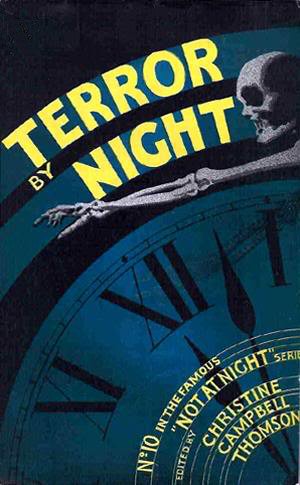
“The Horror in the Museum” was another of Lovecraft’s revision tales, ghostwritten for Hazel Heald, who became much-lauded in Weird Tales; it became the second of Lovecraft’s revisions to see print in a Not At Night volume. The other notable stories from the Lovecraft circle were Robert E. Howard’s Conan story “Rogues in the House”—the first Conan story to see publication in book form—and August Derleth’s “The Metronome.”
Yes—a number of tales nominally by others have had my hand behind them “the Curse of Yig” was reprinted in the S & B (London) “Not at Night” anthology some years ago, & “The Horror in the Museum” is scheduled for such reprinting this year.
—H. P. Lovecraft to Duane W. Rimel, 13 Apr 1934, LFLB 167
And, before I forget to mention it, Wright did another of his right-about-faces and took The Metronome, English rights to which you will remember I previously sold to the Not at Night series.
—August Derleth to H. P. Lovecraft, 15 Jun 1934, ES2.644
I haven’t yet gotten a copy of the Terror by Night, but intend to shortly.
—Robert E. Howard to August Derleth, Oct 1934, CL3.255
I liked your story in the Not at Night Anthology. I was rather surprized that the book didn’t include one of Lovecraft’s stories. Any anthology of weird fiction should include his work
—Robert E. Howard to August Derleth, 11 Dec 1934, CL3.258
Nightmare By Daylight (1936)

The eleventh and last of the regular series holds nothing of particular interest for fans of the Mythos; like Grusome Cargoes, the contents are mostly original rather than drawn from Weird Tales, with the exception of the reprint of David H. Keller’s “The Dead Woman.”
For example—it develops that he turned down Keller’s splendidly realistic story of insanity, “The Dead Woman”, which Schwartz later used & which has been reprinted in the latest British “Not at Night”.—H. P. Lovecraft to Duane W. Rimel, 22 Dec 1934, LFLB 242
We can only guess at why Christine Campbell Thomson chose to go with original stories over more Weird Tales reprints once again; the pulp fiction had been a staple of the series since the beginning and probably contributed to its overall success. Even Lovecraft noted that inclusion had almost become a tradition:
I have never made efforts to market stories in England, but several have been reprinted in anthologies there. There is a weird anthology series—”Not at Night”—appearing every year in London, & several of my tales have been in that.
—H. P. Lovecraft to Henry Kuttner, 12 Mar 1936, Letters to C. L. Moore 235
Not At Night Omnibus (1937)
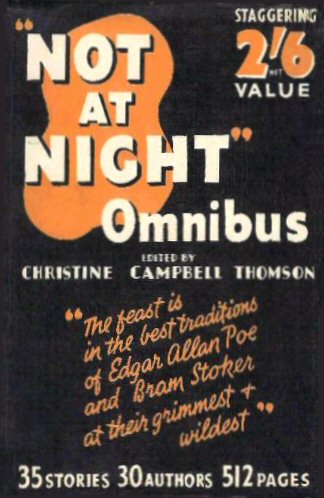
The end of the Not At Night era came in a massive, somewhat more expensive omnibus edition. Here at last Thomson broke her usual editorial silence to offer an introduction, and our only real insight into her editorial process:
Choosing the stories for this and the previous eleven volumes had been a fascinating business, and has not dulled one’s appreciation of the macabre. It has been interesting, too, to see how the horror-story, as such, has developed during the last ten years. From the first, I set myself against “literature”; the story was the thing, and no amount of style could persuade me to select a story that lacked genuine, unadulterated horror. For those who wanted something more high-brow there was plenty. And I think our courage in meeting a requirement of this sort has done much towards getting rid of the politely watered “thriller.”
In choosing the stories for the present omnibus I have been guided by three things: first, that no author should be represented more than twice, in fairness to others; second, that the stories should as far as possible be evenly picked from the eleven preceding volumes of the Series, and third, that the type of story should be both mixed and representative.
This Not at Night Omnibus has been a dream of my own for some time now, but it could not come true until there were a certain number of individual volumes from which to select material. I only hope that most readers will like at least a large proportion of what I have chosen, and that no one will imagine that non-inclusion is any disparagement of quality. And if you like this collection and have not yet read the previous volumes, may I add that they are all still available for those who want them?
—Christine Campbell Thomson, introduction to Not At Night Omnibus 10
As it happens, Thomson knowingly or unknowingly broke her own rule, because she included three stories by Lovecraft: “Pickman’s Model” under his own name, “The Curse of Yig” as by Zealia Brown Reed, and “The Horror in the Museum” as by Hazel Heald. Lovecraft did not live to enjoy the irony; he died on 15 March 1937, and never saw the book in print.
My “Pickman’s Model” is going to be reprinted again—in England, in a “Not at Night” omnibus.
—H. P. Lovecraft to Willis Conover, 4 Dec 1936, LRBO 406
“Pickman’s Model” is to be reprinted again—this time in a “Not at Night Omnibus” to be published in London next spring.
—H. P. Lovecraft to Wilson Shepherd, 15 Dec 1936, LRBO 366
“Pickman’s Model” is to be printed again—this time in a “Not at Night” omnibus to be published in London next spring.
—H. P. Lovecraft to Duane W. Rimel, 20 Dec 1936, LFLB 341
One small item to the good (the modest extent of precisely £1 sterling) is the prospective reprinting of “Pickman’s Model” in British “Not at Night Omnibus” to be issued next spring. I hope they use the real text, & not the emasculated one with the “Oh, gracious me!” ending which Wright put over on me in the recent reprint.
—H. P. Lovecraft to Clark Ashton Smith, 5 Feb 1937, DS 663
Wright informs me that Pickman’s Model is about to be reprinted again—in a Special coronation Omnibus of the Not at Night series. The material reward will be only £1 sterling—but it will gratify me to be connected in any way with the enthronement of our new Sovereign. God Save the King!
—H. P. Lovecraft to James F. Morton, March 1937, LJFM 400, SL5.432
Christine Campbell Thomson divorced Oscar Cook in 1937 or 1938; whether this is coincidental to the ending of the series or if the end of the personal relationship carried over into the business side of publishing, or if as she maintained the beginning of World War II in 1939 is responsible, is unknowable. All we can say is that while Thomson and Lovecraft’s views on weird fiction were polar opposites, there is no doubt that her inclusion of Lovecraft & other Weird Tales writers in the popular series brought them to the attention of a wider and more appreciative audience:
Osmond Robb writes from Edinburgh, Scotland: “Just a short appreciation of your magazine, which has given me many hours of delightfully blood-curling enjoyment. My first acquaintance with the work of your star authors was made not through the medium of WT itself but via the famous Not at Night series of carefully selected reprint shockers, published in England, many of which were from your magazine. Eli Colter—Seabury Quinn—H. P. Lovecraft—these names were strange to me when I encountered them in the pages of the little red books with the gruesome titles, By Daylight Only, Not at Night, Grim Death, etc. I must confess that then, as now, the unvarnished blood-and-thunders which sought to revolt the reader by nauseous details of putrefaction and slimy abomination left me cold. I wanted other-worldly horror, the chill dread of what may lie beyond the farthest outposts of our cognizance, not the cheap revulsion of rotting cadavers. This eery, authentic thrill the late lamented H. P. L. provided, and the first story I ever read by this exquisite literary craftsman established me as one of his fans. The Horror at Red Hook, with its muttering crones, its vile incantations and its final glimpse into the shadows of an all-too-realistic inferno sent shivers up and down my spine. Since that date I have never been disappointed by a Lovecraft story.
—Weird Tales, Nov 1938
Not At Night (1960), More Not At Night (1961), & Still Not At Night (1962)
In the 1960s, the Not at Night series received a brief resurrection in the form of three paperbacks. The contents of the three volumes were not identical to the 1925 and 1926 books of the same title, but selected from the corpus of Not At Night stories, with the addition of brief introductions by Thomson, who wrote:
Now the publishers of Arrow Books have had the brilliant idea of staging a ‘comeback’ with an ‘Arrow’ Not at Night; the stories in it have again been selected by the original editor, Christine Campbell Thomson, and she confidently believes that they will be as popular now as then. It is illuminating and comforting to find how many stories that might have been considered old-fashioned have stood the test of approximately thirty years—more than a generation—and read as well now as they did then. In this collection an attempt has been made to cover all types of the stories used from the scientific experimental to the period ghost and the plain horror.
To re-read the old books has been wonderful and in some ways a sentimental experience akin to having a grandchild and this little volume foes to the world with the belief that the modern readers will be as pleasantly terrified as were those who originally bought each issue.
—Christine Campbell Thomson, introduction to Not At Night (1960)
Among the old favorites was “The Curse of Yig” by Lovecraft and Zealia Bishop.
Before the first volume of the Arrow ‘Not at Night’ was officially on sale, the publishers were asking for a second. Nothing, of course, could be a more fitting tribute to the quality of the good old stories nor more pleasing to the editor.
Here, then, is the second collection from those long-ago favourites. Again, it has been a selection that proved difficult owing to the quality and claims of so many rivals. But the choice has been made on a basis of trying to find something for everyone; from the supernatural to the natural; from the realms of the gorgeous East to the modest homes of the Middle West of America. Here you have a collection which is honestly believed to be as good as the first one.
—Christine Campbell Thomson, introduction to More Not At Night (1961)
This second volume had nothing by Lovecraft in it, though it included Robert E. Howard’s “Rogues in the House.” Still Not At Night contains no material from Lovecraft. It is tempting to think the reason for the exclusion may have more to do with Arkham House’s effective control of the Lovecraft estate and copyrights and efforts to reprint Lovecraft in paperback than Thomson deciding, after so many years, that she simply didn’t care to reprint any more of his stories.
The series had one final revival, in the form of two reprints under different titles and covers: More Not At Night (1961) was republished as Never At Night (1972), and Still Not At Night (1962) was reprinted as Only By Daylight (1972). Horror writer Ramsey Campbell, who was a young teenager when the Arrow reprints first hit the stands, later recalled:
It was in my very early teens, perhaps even earlier, that I bought a paperback of one of Christine Campbell Thomson’s Not at Night anthologies and found it dismally unsatisfactory, not in lacking gruesomeness—the book was a trough of that—but in the utter absence of good prose. I later encountered Thomson’s boast ‘From the first, I set my face against literature’ but believe me, I didn’t need to be told. Her influence was apparent in the increasingly pornographic and decreasingly literate Pan Books of Horror Stories before Steve Jones and David Sutton rescued them from their downward trend, and her regrettable tradition may be seen in a more recent teeming of writers bent on outdoing each other in disgustingness.
—Ramsey Campbell and Modern Horror Fiction 4
Which brings us around, finally, to the weird editorial legacy of Christine Campbell Thomson. As an anthologist, there is no doubt that she was a sound businessperson, and her literary instincts were aimed squarely at providing the public with cheap collections of gore and grue, as affordably as she could. The covers were garish and eye-catching, the construction of the books often relatively shabby, though at least some of the printings used good paper. She constructed a product, and did so as economically as possible; of the 178 stories in the Not At Night series, 100 were reprints from Weird Tales, several were written by Thomson or her husband, and others still were reprints from other pulps or British magazines. Very little of the contents were original, and those were the books which appeared at the two points the series floundered, in 1928 and 1936.
We never get a sense of Thomson’s appreciation or lack thereof for individual writers: she had no direct contact with them and does not appear to have played favorites, publishing women as well as men, tales of supernatural fiction as well as weird terror or science fiction. Even the Weird Tales authors never really mention her: their focus is entirely on the product, seeing their name in print in hardcover was a kind of magic, the thing that happened so seldom in the pulps.
Yet as materialistic as Thomson’s aims might have been, and as pointed as her focus was in providing a product for the masses, whatever else she accomplished with the Not At Night series she succeeded in two things: bringing Lovecraft & co. to the attention of a wider audience than Weird Tales, and helping to establish the financial viability of the pulp reprint and standalone horror anthology. While these things might have happened on their own, Thomson’s editorial success at Not At Night is undeniable, if only for the number of “firsts” she managed to publish over those eleven books in the initial series.
Bobby Derie is the author of Weird Talers: Essays on Robert E. Howard & Others (2019) and Sex and the Cthulhu Mythos (2014).