The Colour Out of Space (2016) by H. P. Lovecraft & Amy Borezo

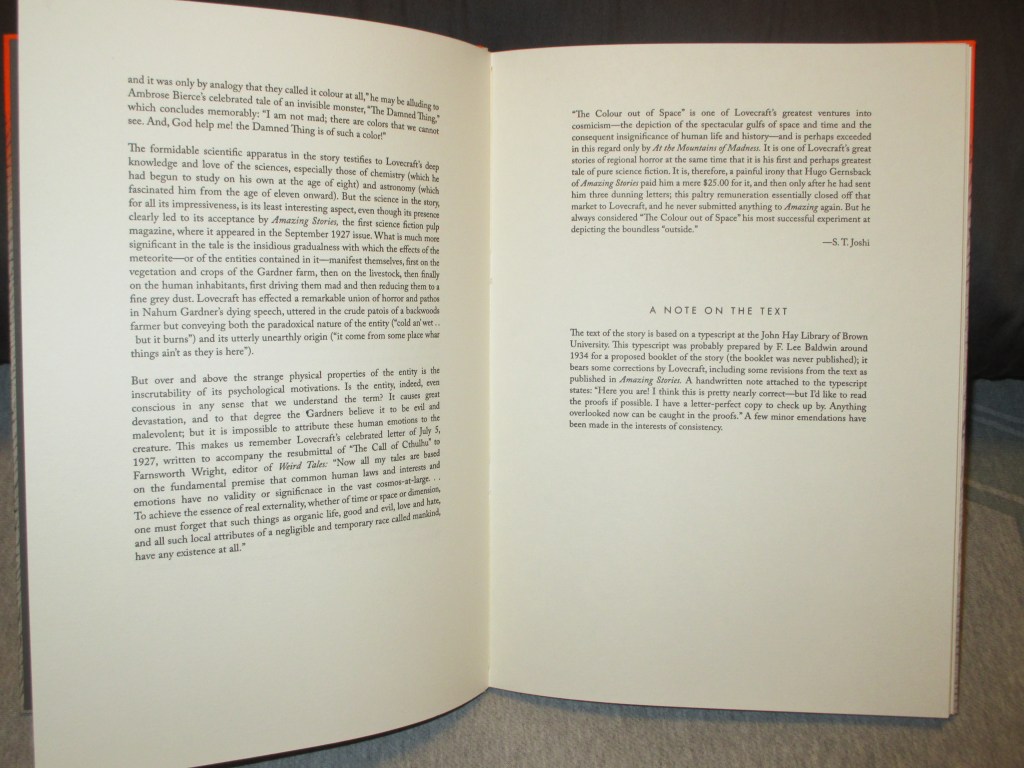
In 2016, artist Amy Borezo published a very limited illustrated edition of H. P. Lovecraft’s story “The Colour Out of Space.” To quote from Shelter Bookworks’ original page:

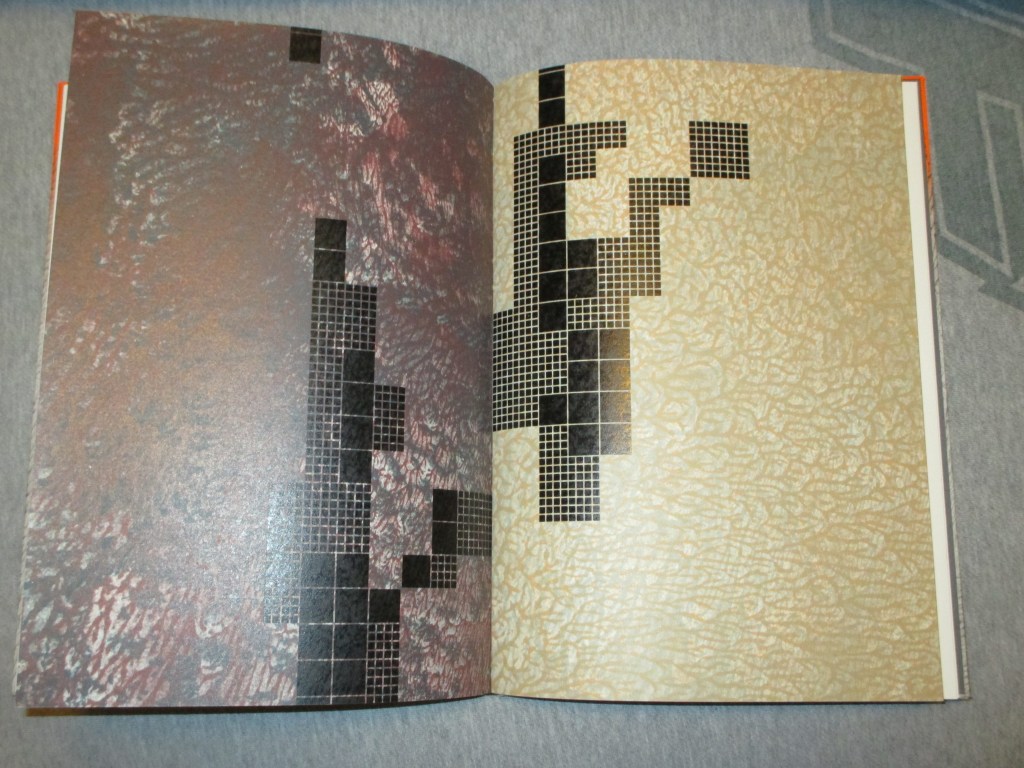
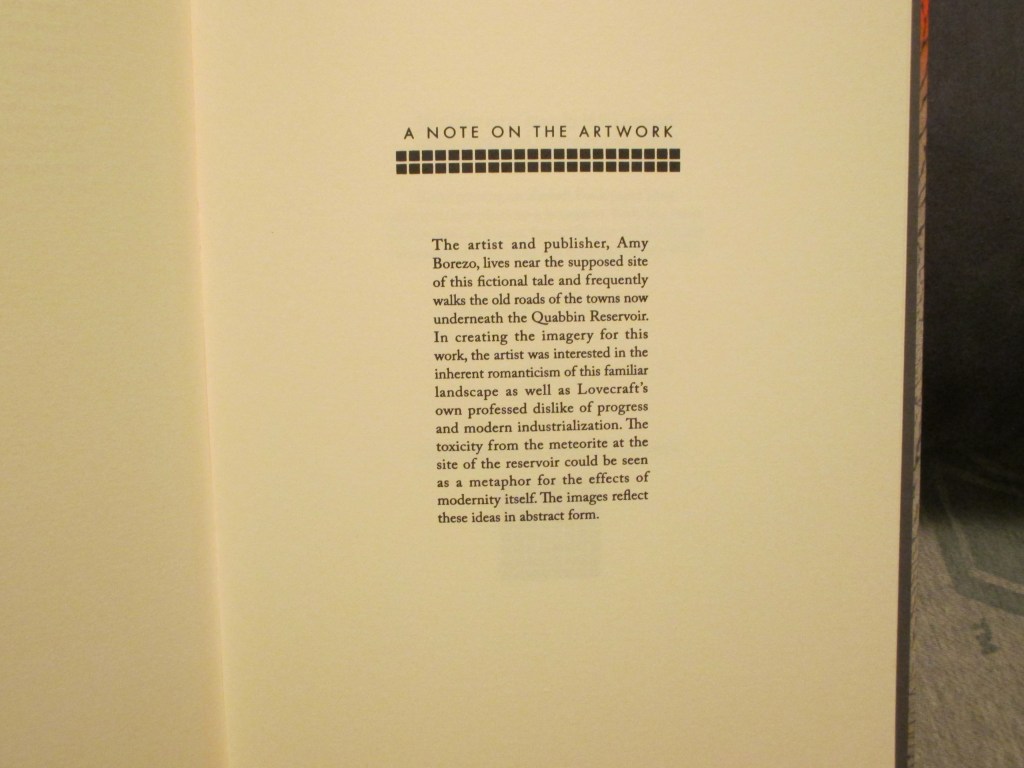
This hybrid artist’s book/contemporary fine press edition of the 1927 horror/sci-fi story by HP Lovecraft includes an introduction by Lovecraft scholar S.T. Joshi and 14 color images by Amy Borezo. The artist lives near the supposed site of this fictional tale and frequently walks the old roads of the towns written about in this story. In creating the imagery for this work, the artist is interested in evoking the complexity of the local landscape in abstract form with the construction of the reservoir overlaid visually through geometric blocks.

The text for this edition was provided by S.T. Joshi from his recent publication, H. P. LOVECRAFT: COLLECTED FICTION: A VARIORUM EDITION [Hippocampus Press, 2015] and is derived from a typescript at Brown University, evidently prepared by F. Lee Baldwin for a proposed reprint of the story (c. 1934) that never happened. It has some revisions in pen by Lovecraft, so presumably it represents his final wishes for the story.
_____________________

Relief printing on Zerkall Book paper from photopolymer plates on a letterpress. Body text set in Caslon, titles in Futura. Pages sewn onto a shaped concertina. Paste paper over boards with a buffalo suede spine. Housed in a presentation box. Special thanks to Lisa Hersey who assisted in printing and binding.

The edition, despite the relatively high cost (US$500 + shipping in 2016), sold out. It arrived in an attractive clamshell box, with a paper label. Inside, the colors on the paper are bright and vivid in a way that the light and the camera don’t really catch, the backstrip soft, the paper creamy and the text sharp. In your hands, the brilliant orange seems to leak through around the edges of the pages. A title page, a brief introduction by S. T. Joshi. The text and illustrations are on alternate pages, distinct, the images vivid but abstract. A word on the artist, a colophon and numbering page, and then the book is at an end.

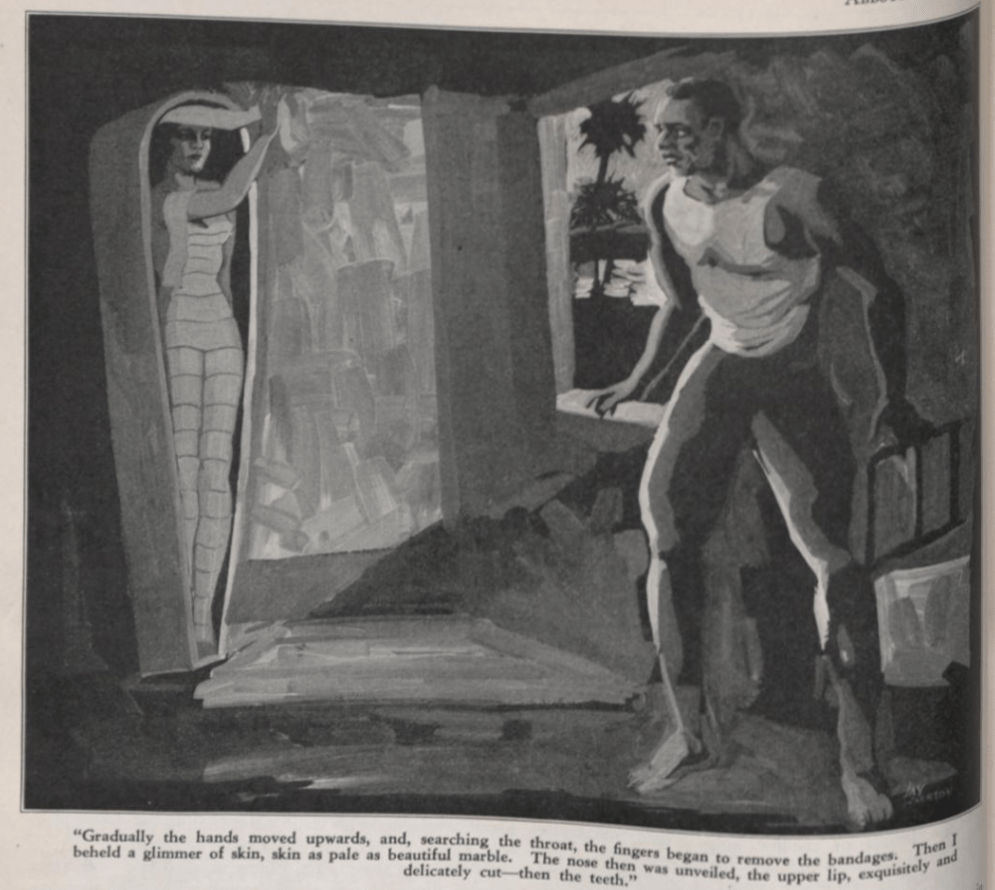
Amy Borezo’s illustrated edition is, in a very real sense, a piece of art that you can read. The text itself is meticulous in its accuracy, but you can read the same text in Hippocampus Press’ variorum edition, you can read the same text for free online. If you must have a physical copy of a book in your hand, you are spoiled for choice: “The Colour Out of Space” is one of Lovecraft’s most reprinted works, and there are innumerable illustrations for the story from various artists, from J. M. de Aragon in the pages of Amazing Stories in 1927 and Virgil Finlay in Famous Fantastic Mysteries in 1941 to many others of the current day.

This massive plurality of choice, the sheer number of editions, touches on an issue that many readers and would-be readers of Lovecraft deal with: where do you start? What is the best edition? What if you want a really nice copy of a book? Which one of all the hundreds of titles should you go for, and why, and how much will it cost?

If that sounds like more of a collector’s issue than a reader’s issue, then congratulations, you’ve hit on one of the fundamental problems facing not only Lovecraft, but most popular authors in the contemporary period.

When Lovecraft was alive, he was primarily published in the amateur press, pulp magazines, some reprint anthologies like the British Not at Night series, and a couple of very small privately printed editions of The Shunned House (never bound or formally released during his lifetime) and The Shadow over Innsmouth (which was, but the binding was shoddy). There were no finely bound editions of Lovecraft with the embellishments of the bookmaker’s art available to the general public, no leather covers, no gilt lettering, no raised bands (caveat: one copy of The Shunned House was specially bound by R. H. Barlow as a gift for Lovecraft).

Early collectors of Lovecraft often focused on posthumous publications, like the first publications of Arkham House, and little obscurities like the edition of Lovecraft’s commonplace book put out by the Futile Press in 1938. Even ultra-small press editions were typically not “fine” in the sense of lavish materials, artwork, or presentation, but were often considered valuable simply because of the small size of their edition, the ease with which copies perished, and subsequent rarity in the face of growing demand. That demand came from Lovecraft’s own growing popularity; the mass market paperback reprints of Arkham House collections, the armed services editions, and foreign reprints in hardback and paperback vastly increased the audience for Lovecraft’s work.

Until quite recently, fancy fine press editions were not normal for living authors. Before mass literacy, books were often bought unbound and then the author could bind them however they liked; really rich people could commission books that were themselves works of art in every sense of the word, involving whatever costly materials or decorations they cared for. As the commercial basis of book reading and publishing became more egalitarian, fancy editions often became more about the skill of the bookmaker and/or any associated artist, for fine press editions, and the materials shifted.

So when you look at what constituted a really nice Lovecraft edition in, say 1980, you’re likely looking at the output of Roy A. Squires’ press. These were meticulously crafted letterpress editions, usually on high-quality handmaid paper, sometimes featuring tipped-in photographs or other illustrations. Where a normal chapbook from Necronomicon Press or a fan press might be published on an Apple II printer and stapled together, everything about Squires’ production was done by hand.

The slightly bourgeoisie desire for something fancier still nagged the science fiction and fantasy market. Arkham House paved the way in the late 1930s and 40s by showing that a small press publisher specializing in genre books was viable (the presses they inspired apparently didn’t know how often Arkham House founder August Derleth was running in the red, or how long it took for his small, relatively expensive books to sell). Most of these products weren’t fine press; they were solid books, aimed and priced at a select market. Very few of them produced anything that might be described as a luxury edition of Lovecraft; the choicest example might be the 1976 edition of Démons et Merveilles by French publisher Opta, which came bound in leather, with slipcase, and illustrations by Philippe Druillet. The translation has its issues (Lovecraft’s “ghouls” is rendered as “vampires,” to give one notable example), but compared to the rather plain but sturdy Arkham House editions, it’s gorgeous.

Easton Press (founded in 1975 as a division of MBI, Inc.) took up the gauntlet of producing, for lack of a better term, what not-rich people think of as rich people’s books: bound in letter, embossed in 22k gilt, very snazzy to look at. In practice, while Easton Press has consumed many acres of cowhide, the actual books they produce tend not to be very special: they’re reprints of existing books, often not anything particularly rare or obscure, with no additional editorial guidance or notes (and sometimes bad misprints). The books themselves are usually solid, but less than beautiful; their editions of Lovecraft show evidence of corner-cutting and mass production.

There is a niche market for really nice editions of books, at a price affordable to middle-class bibliophiles. Over the last twenty years or so, that niche market has exploded. Centipede Press, Subterranean Press, the Folio Society, etc. are names that are familiar now for deluxe editions of Lovecraft and/or other authors, typically reprinting older works instead of presenting anything original, and typically publishing in limited editions of a few hundred copies. Quality and presentation vary, although are generally pretty high—not quite the same production value as, for example, letterpress outfits like Pegana Press which continue the fine press tradition, but for high-end versions of books that you might otherwise buy at Barnes & Nobles…

…and that is kind of the rub. While there are some exceptions, most of these presses aren’t gambling on producing anything new. There might be new artwork, there might be a new introduction by Alan Moore or S. T. Joshi, but there is no experimentation, there is often nothing unique about these particular editions. There are some exceptions; Centipede Press has produced some original compilations like Conversations with the Weird Tales Circle that collects many rare, obscure, and out-of-print materials; and the art book A Lovecraft Retrospective is pretty much unparalleled. Helios House Press has published some original scholarship among the reprints (full disclosure: they’ve paid me for a few essays and other work).

For most of these companies, however, the text itself isn’t special. The production quality might not be much better than any other mass-produced hardcover. They might be pretty, but from a strictly objective standpoint they don’t offer much new or exciting. They’re just very expensive.

So what exactly are you, the reader, paying for?

Which is what you need to answer for yourself. If you’re a scholar or academic looking for a text that’s pure Lovecraft, you’re probably better off buying the Hippocampus Press variorum editions. If you’re a casual reader, the Penguin paperbacks are cheap and almost as good. If you’re a poor student, stick to the online editions at https://hplovecraft.com. If you want a fancy edition…well, you’ve got options. Lots of them, for every price point. Handmade Japanese paper, bound in leather, with silk bookmarks, signed in blood.

It’s all available for the right price.

So what sets Amy Borezo’s book apart? Normally, based on the materials, the quality of the printing and craftsmanship, I would qualify this as a fine press product. However, in the marketing, the presentation, this is a little different. It is a book, and can be read as a book, but it is also a work of art, and can be experienced and appreciated like buying a lithograph print from a series. If you’re a fan of Lovecraft, you know the words, you’ve read the story a hundred times. Many artists have tried to capture a colour that lies beyond human perception, to depict the events of the story in some fixed form. Only Borezo has gone to such effort to capture that feel in an entire book production, not just as isolated images.

The beauty of Borezo’s art is that it is abstract; it doesn’t try to impose meaning on the text, readers have to stare at it for themselves. Some might not like it, others might get it but not care for the idea, but for me there’s a certain tactile experience with that nearly radioactive orange that seems to seap through and around the pages at times. Yes, it could just be the collector in me, trying to justify the hundreds of dollars this book cost, but in a real way that is the experience we buy with every book, above and beyond the text itself. The feel of it in your hands, the smell of the paper, the crackle of the spine. It’s different, when you’re holding an old pulp whose brittle and yellowed pages are as fragile as a papyrus from a mummy’s tomb, or an old worn paperback whose tanned pages are as soft as toilet paper, or a crisply printed new edition with ink that almost looks still wet.

From a scholar’s perspective, from a historian’s perspective, the focus is usually on the text, not necessarily the visceral experience surrounding how the text is read and received. Yet it is important not to lose touch with that. In an age where Lovecraft is in the public domain, generative AI, and print-on-demand publishing, we are going to see a vast proliferation of books—many of which are going to be strictly hypothetical until someone orders them—and our eyeballs will see cover art generated by some pseudointellectual property theft engine and with text scraped off of somewhere online (errors and all), and pre-packaged to try and appeal to someone that wants to read Lovecraft—and whatever the end product is, the one thing I can guarantee is that it is not going to be anything like Amy Borezo’s edition of The Colour Out of Space.


Bobby Derie is the author of Weird Talers: Essays on Robert E. Howard and Others and Sex and the Cthulhu Mythos.

Deep Cuts in a Lovecraftian Vein uses Amazon Associate links. As an Amazon Associate I earn from qualifying purchases.
“Sob As Trevas” (2020) by Douglas Freitas & Chairim Arrais and “Aeons” (2019) by Salvador Sanz

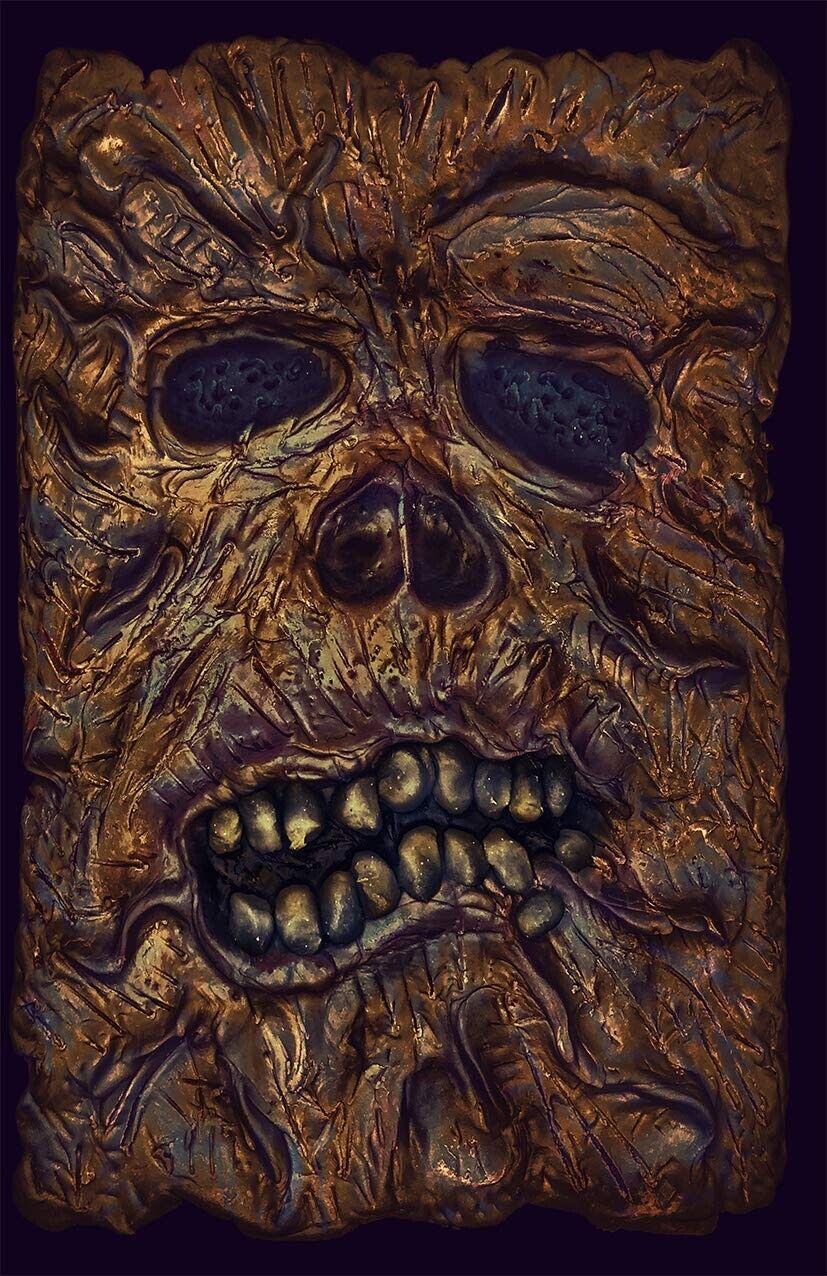
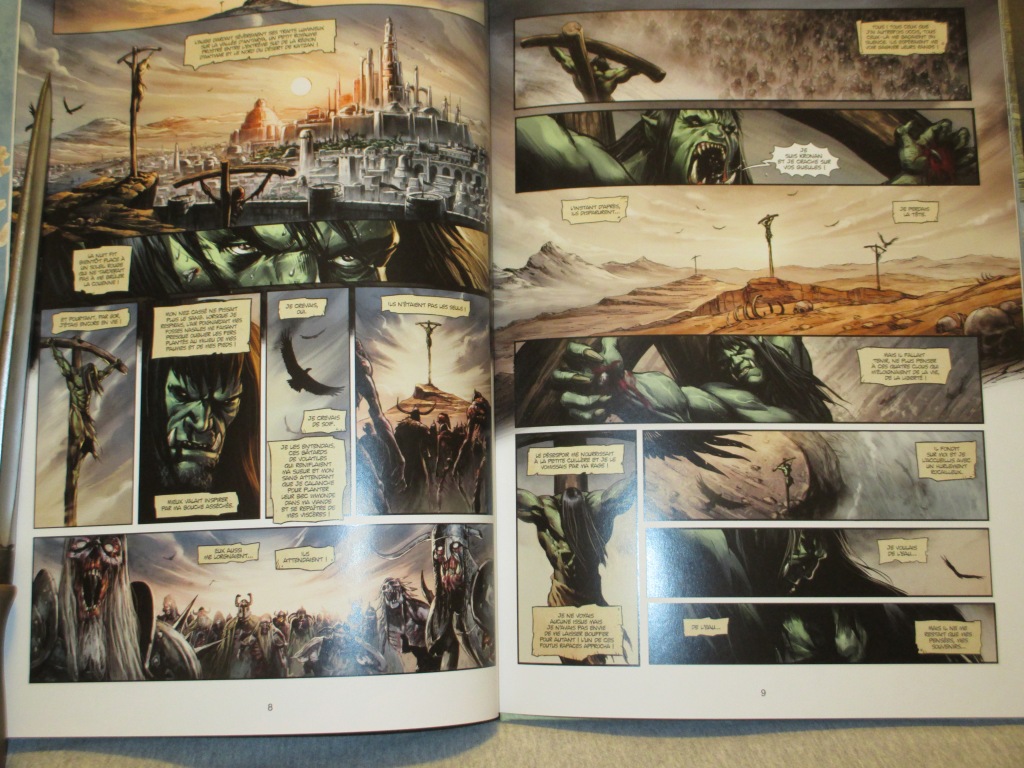
Os Mitos de Lovecraft (2020) is a crowdfunded Brazilian black-and-white graphic anthology edited by Douglas P. Freitas and published by Skript, probably best known for the deluxe hardcover edition which has a cover modeled on the bound-in-human-skin Necronomicon ex Mortis from Evil Dead 2 and Army of Darkness. Like its fellow Brazilian Lovecraftian anthology O despertar de Cthulhu em Quadrinhos (2016), while there is a common theme in terms of subject, the style and tone of the individual works inside varies considerably. Every style of comic art and horror can be represented under the broad remit of Lovecraftian comics, from straight adaptations of Lovecraft in exquisite realistic depiction to splatterpunk-esque gore fests with plenty of airbrush-style gore streaks to lighter works with more cartoonish tentacled Cthulhu-esque characters.

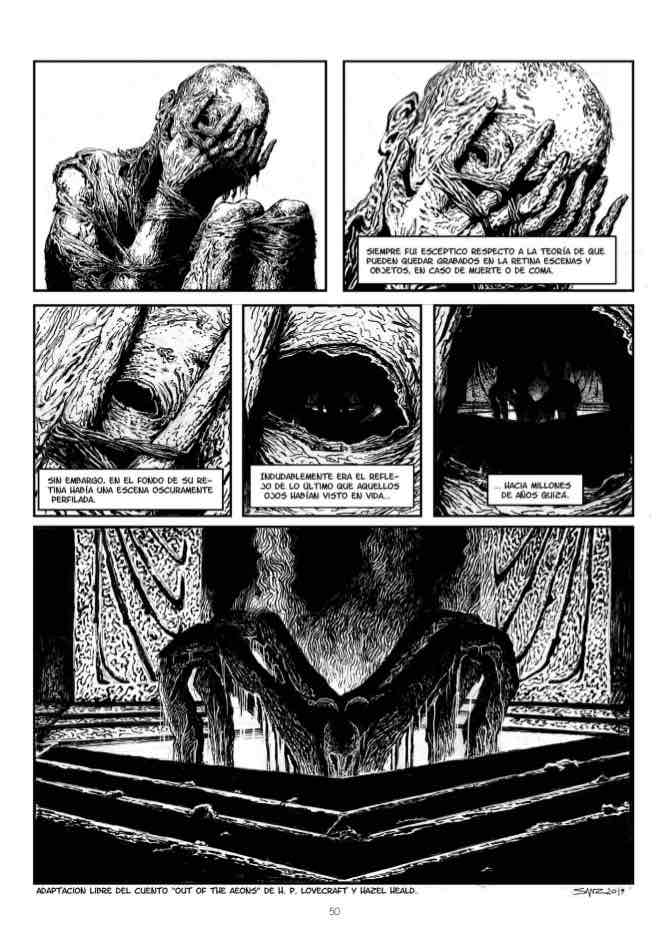
The anthology begins with an absolute masterpiece in two pages, by Argintenean artist Salvador Sanz, which originally appeared in the Spanish-language graphic horror anthology Cthulhu 23; for this anthology, it was translated into Brazilian Portuguese by Aline Cardoso and re-lettered by Johnny C. Vargas. This is a distillation of “Out of the Æons” (1935) by Hazel Heald & H. P. Lovecraft, subtracting all the human characters, the drama, and the fantastic history deciphered from the scroll in exchange for focusing on a masterful rendering of the mummy who caught a glimpse of Ghatanothoa—and paid the price.

In a cinematic journey, the reader is taken closer and closer to the ancient petrified horror. The panels zoom in on the one eye that peeks out between gnarled fingers. To the dark image that is still captured there, on the retina. The detail on the art, the pacing, and the execution of the concept, which boils down the essence of the Lovecraft/Heald horror story into two pages, is exquisite.

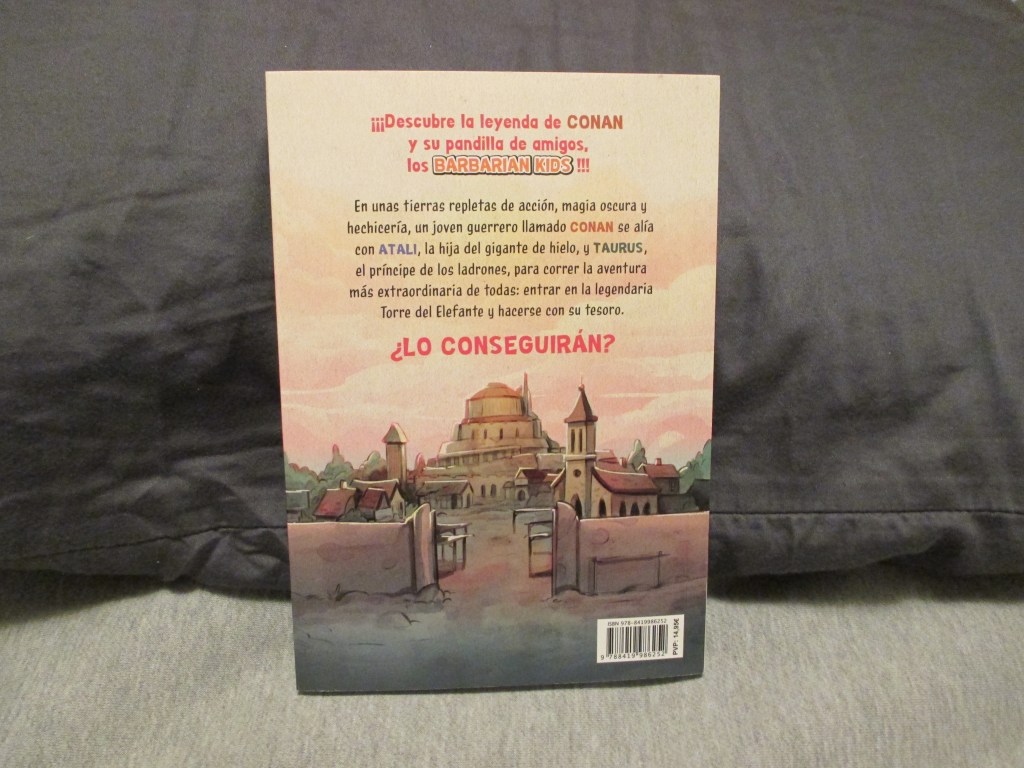
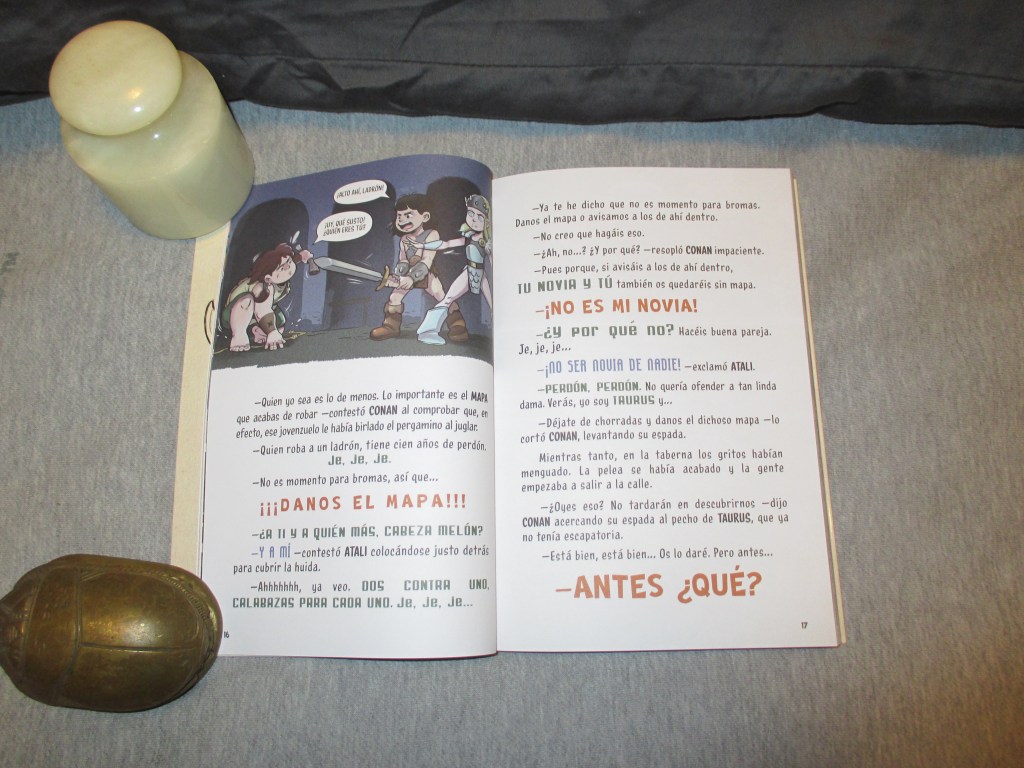
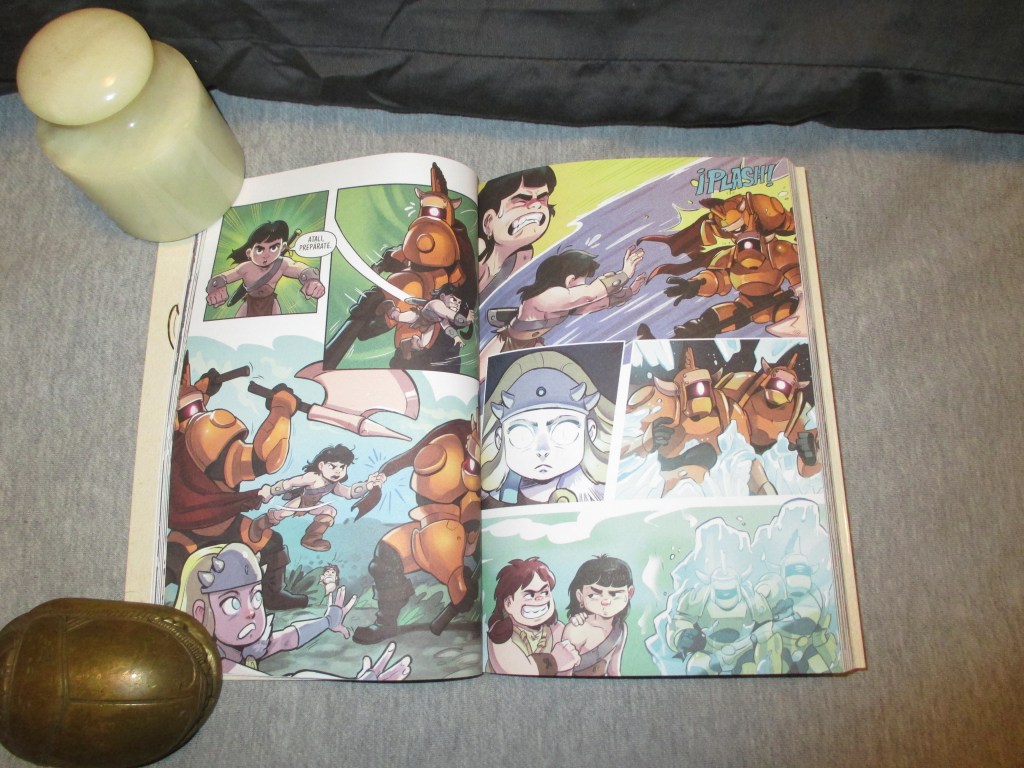
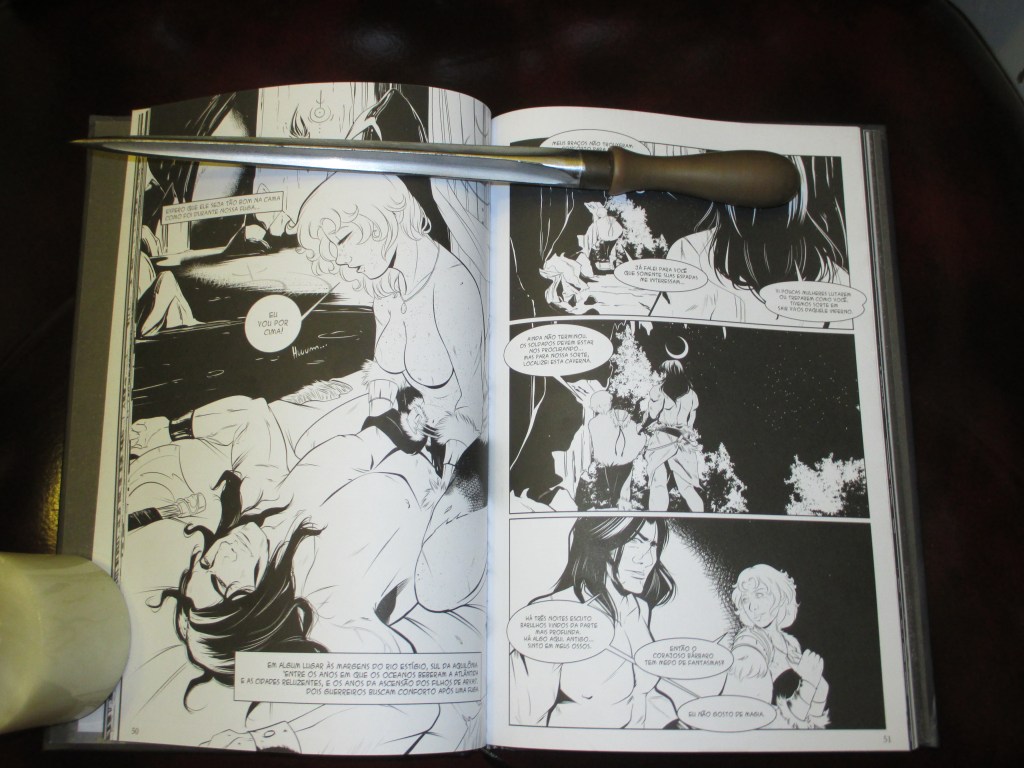
Freitas’ own contribution to Os Mitos de Lovecraft is “Sob As Trevas” (“Beneath the Darkness”), in collaboration with illustrator and comic creator Chairim Arrais. This is a tongue-in-cheek 8-page sword & sorcery story involving a nameless Cimmerian warrior and their female partner Ruivas (“Red”/”Red-hair”). Freitas & Arrais are clearly referencing Robert E. Howard’s most famous creation, Conan the Cimmerian, and aren’t coy about it:

Os Mitos de Lovecraft pp.51-52
Em algum lugar às margens do rio Estígio, sul da Aquilônia, ‘entre os anos em que os oceanos beberam a Atlântida e as cidades reluzentes, e os anos da ascensão dos filhos de Aryas’. Dois guerreiros buscam conforto após uma fuga.Somewhere on the banks of the River Styx, south of Aquilonia, ‘between the years when the oceans drank Atlantis and the gleaming cities, and the years of the rise of the sons of Aryas’. Two warriors seek comfort after an escape.
Os Mitos de Lovecraft page 51English Translation
“KNOW, oh prince, that between the years when the oceans drank Atlantis and the gleaming cities, and the years of the rise of the Sons of Aryas […]”
—Robert E. Howard, “The Phoenix on the Sword”

The character Ruivas is depicted similarly to the eponymous character in Arrais’ standalone comic “Red+18”; whether this is intended as an unofficial crossover, an Easter egg for fans of Arrais’ work, or just a coincidence—the character could as easily be a play on Red Sonja for the Marvel Comics, albeit sans the trademark mail bikini—is unclear, and maybe unimportant.

The story itself is fairly slight and straightforward: after successfully stealing a jewel, the pair of thieves hide out in a convenient cavern…which ends up being occupied by some nameless eldritch horror.

Ei, Chefe!

Te-tem a-a-a-algo es-es-tranho!
Hey, Boss!

Th-there’s s-s-something s-strange!
Os Mitos de Lovecraft page 54English translation

The story really wanted more pages; there’s little opportunity to really develop any atmosphere before the tentacles emerge from the darkness, and the action sequences are correspondingly cramped and staccato-like, crammed into increasingly more panels per page. With the in media res debut, the titillation, and the swift conclusion, this is strongly reminiscent of the kind of back-up feature that sometimes ran in Savage Sword of Conan, more of a sketch of an interlude than a full-fledged story.

Yet what there is there is fun. The writing is light-hearted, the chemistry between legally-not-Conan and Ruivas is alternately playful and rocky, and Arrais’ artwork does everything the script calls for. The brief sword & sorcery interlude sets a different tone than the other stories in the anthology, featuring more sex and action than horror or outright comedy. While I would have liked for it to delve more into the Howardian vibe of horror that permeated tales like “Xuthal of the Dusk” or “Red Nails,” limitations of space have to be acknowledged. Still, it would be nice if Freitas & Arrais had the opportunity to revisit the idea at a longer length more suitable to develop the characters and story at some point.


Bobby Derie is the author of Weird Talers: Essays on Robert E. Howard and Others and Sex and the Cthulhu Mythos.

Deep Cuts in a Lovecraftian Vein uses Amazon Associate links. As an Amazon Associate I earn from qualifying purchases.

“Candlewax” (1990) by W. H. Pugmire & Ashleigh Talbot

Eldritch Fappenings
This review deals in part with artwork that includes nudity and/or sexuality explicit content.
As such, please be advised before reading further.


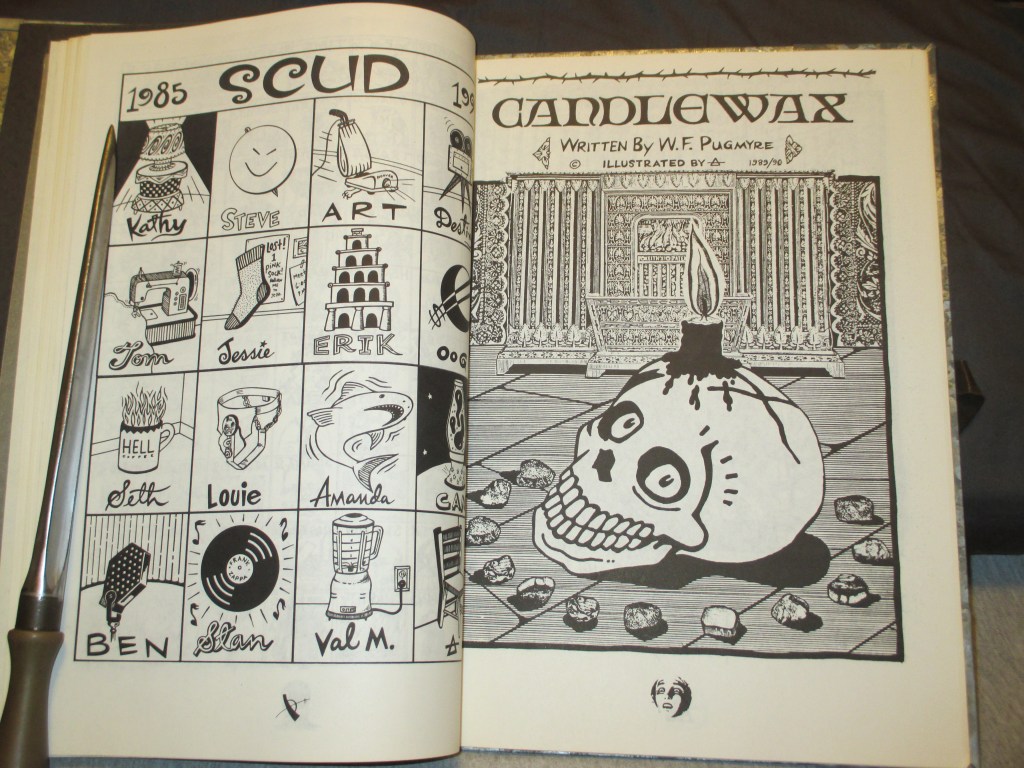
In the 1985 Christmas supplement to the fanzine Fungi, W. H. Pugmire‘s story “Candlewax” first saw publication. This was one of Pugmire’s earliest efforts at Mythos fiction, and is a part of his Sesqua Valley cycle—his own corner of Lovecraft country set in the Pacific Northwest, populated by characters like Simon Gregory Williams. While Pugmire would go on to write many more tales of Sesqua Valley, which have been collected and published in various volumes, “Candlewax” is one of the comparatively rarer tales, having been reprinted only a handful of times—and, most interestingly, in an illustrated edition.

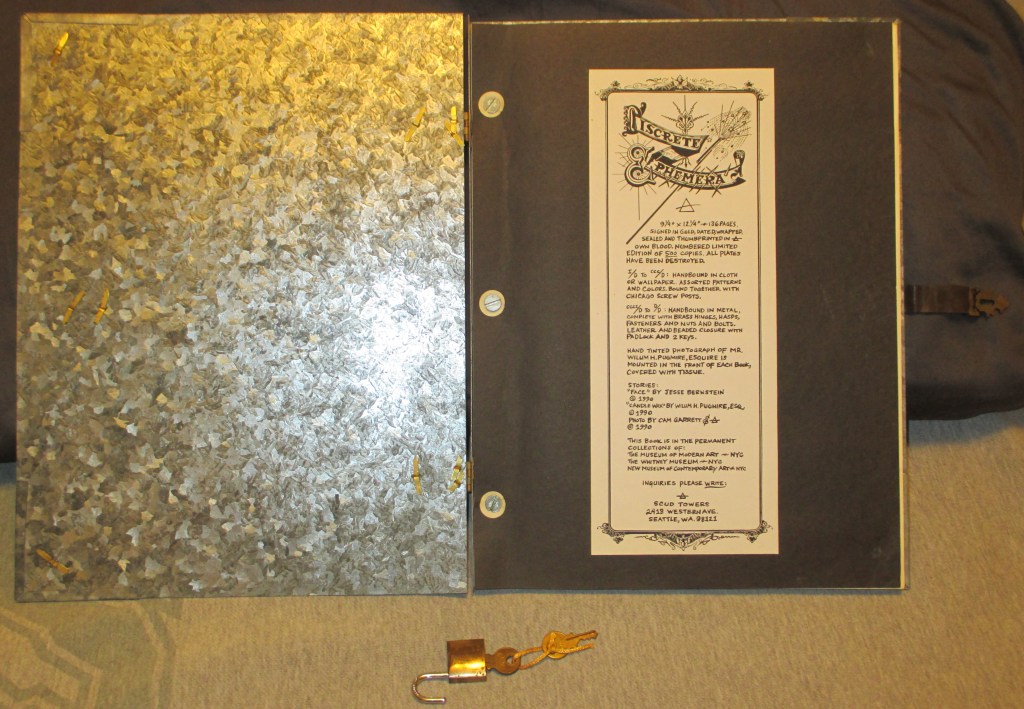
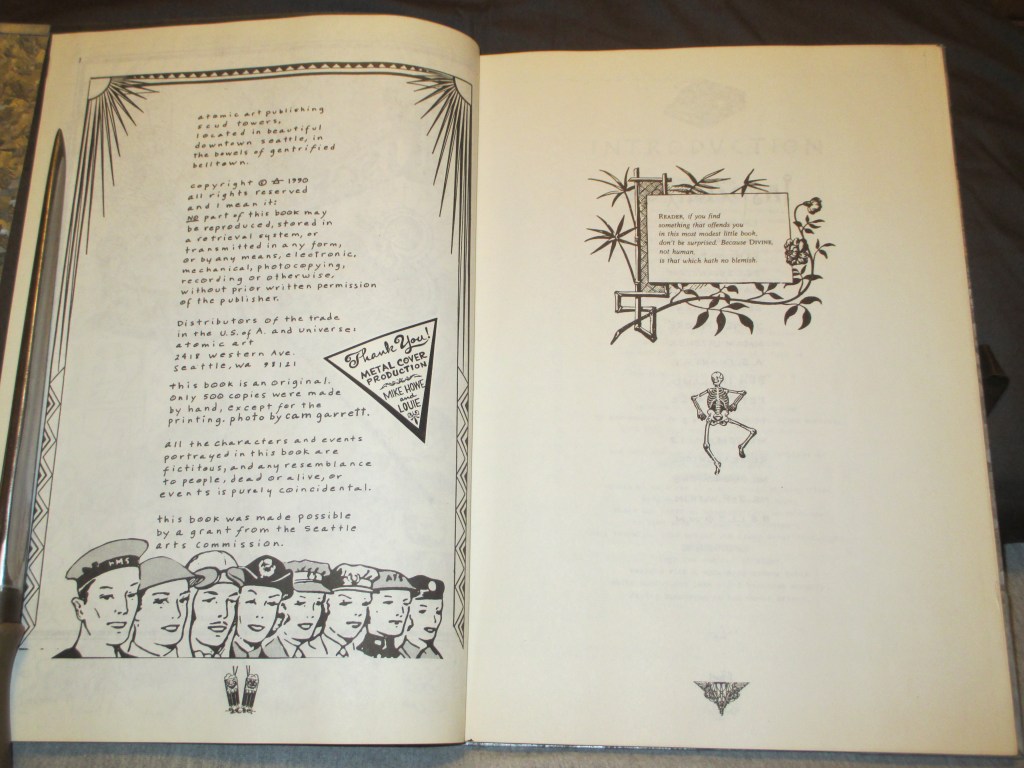
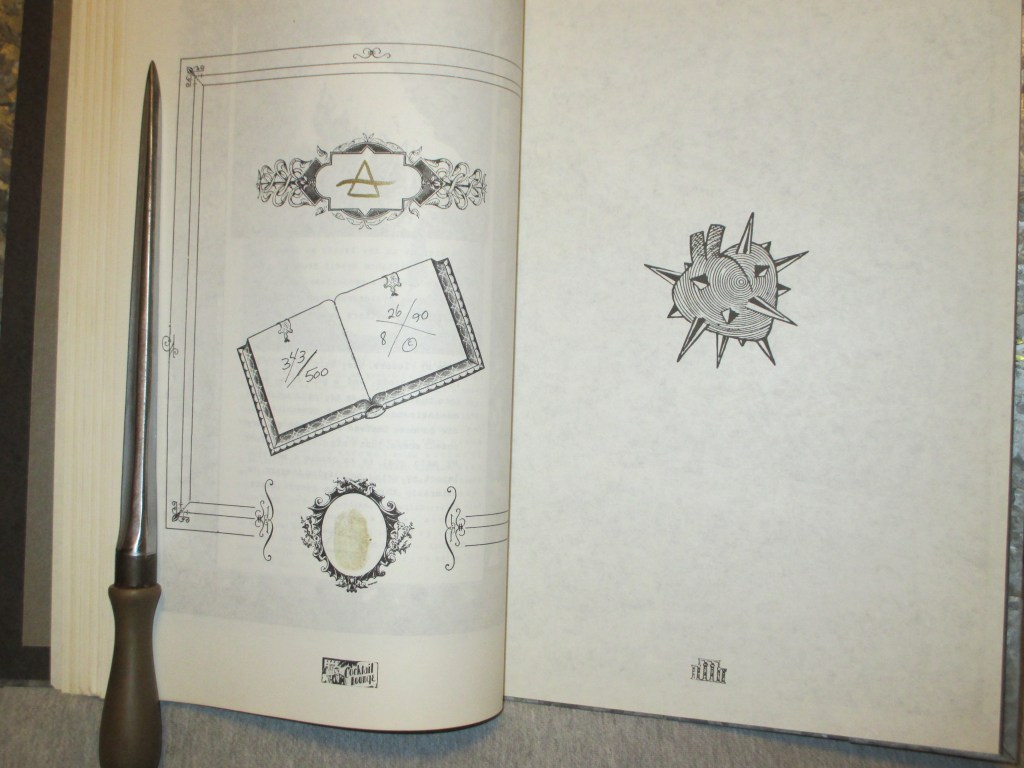
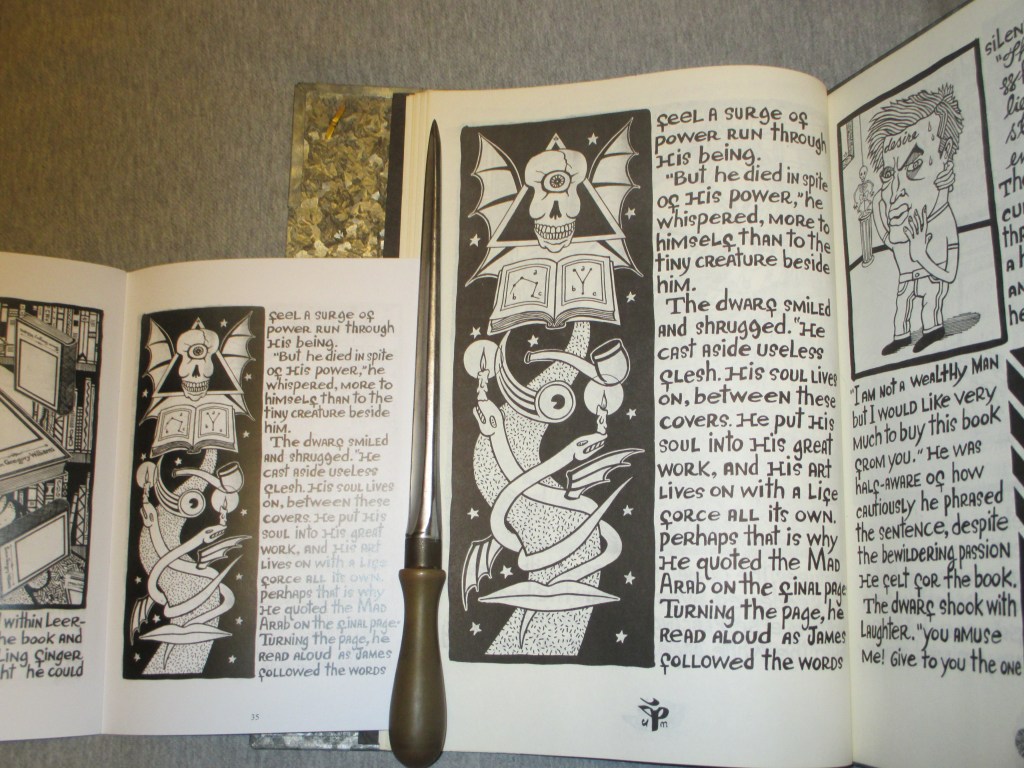
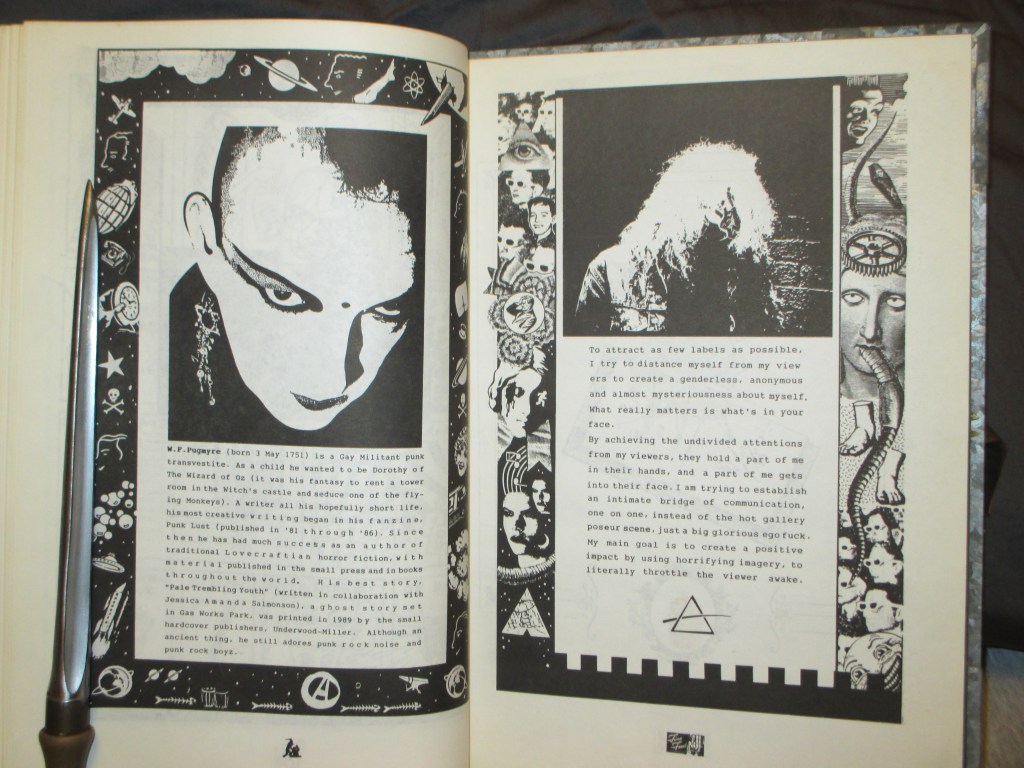
Discrete Ephemera (1990) is a limited edition (500 copies) book art project by Ashleigh Talbot, and illustrated texts by Steven J. Bernstein (“Face”) and W. H. Pugmire (“Candlewax,” as “W. F. Pugmire”), made possible by an art grant. Madame Talbot is presented throughout via a symbol:

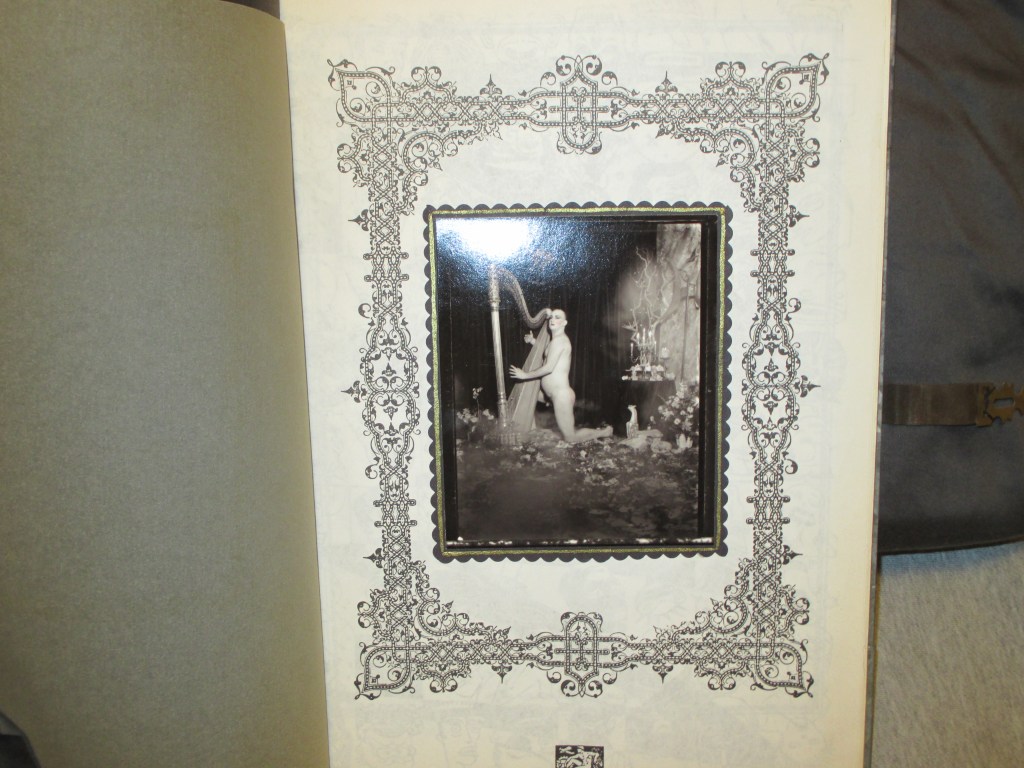
The book exists in different states. My copy of 136 unnumbered sheets is bound between sheet metal plates with a small brass padlock, while others are bound in textured wallpaper; with a fingerprint imprint in gold ink (some listings say blood, but it looks like gold ink to me) on the limitation page, and a tipped-in photo of Pugmire in the nude. The overall aesthetic is strongly reminiscent of underground comix, punk zines, and copybooks of the 1960s-1980s, with an emphasis on cut-and-paste techniques, surreal imagery, the presentation of familiar images in unfamiliar contexts or subtly distorted, and a Burroughs-esque eye for the unfiltered and sometimes teratophiliac reality presented by medical textbooks and cabinets of curiosity.

Example of the wallpaper cover from the Mullen Books listing.

The illustrated version of Pugmire’s “Candlewax” is distinct from the rest of the project, but mostly because it has a coherent, linear narrative, with a darker, more Gothic tone than the more stylized kaleidoscope of images that preceeded this section, or the much more comic-strip style collaboration “Faces” with Bernstein. While Talbot continues to use the same distinctive style, the illustrations work to complement the text, at times a strict depiction, and at times more abstract and evocative.

The story itself is a sketch in miniature of bibliomania, murder, necromancy, hubris, and revenge. A fitting snapshot of the kind of obsession that has characterized aspects of the Mythos (and readers of the Mythos) from the beginning.

At least two versions of the “Candlewax” text have seen print. Pugmire had a tendency to rewrite his stories when they were reprinted, and this seems to be the case here as well. To give the flavor of the difference:

The man was a dwarf. His bent and twisted frame, disfigured by age and nameless ailments, seemed perpetually trembling. Drool moistened thin black lips, and yellow pus oozed from reddened eyes. A skeletal finger tapped the book that lay before him, and he addressed his visitor in a whispered voice.

“His name was Simon Gregory Williams. He wrote this book of spells in the late 1960s. That in itself makes it unique. Most of my books are ancient tomes, crumbling and worm-infected. But, as you see, this looks almost new.”
The tiny man bent his twisted frame toward the curious tome. Drool moistened his thin grey lips; yellow pus oozed from his reddened eyes. A skeletal finger tapped the yellow cover of the book. He addressed his visitor in a low whispered voice.

“His name was Simon Gregory Williams. He wrote this book of spells thirty years ago, while visiting the poet William Davis Manly, in your curious Sesqua Valley.” Here he opened the book and turned to various illustrated pages. He stopped at a vivid depiction of a tremendous mountain of white stone, the twin peaks of which resembled wings folded up on a daemon’s shoulders. “The infamous Mount Selta, of which I’ve heard so much. And below, in purple ink, the name ‘Khroyd’Hon’; such a strange name.”
“Candlewax” in Discrete Ephemera (1990)“Candlewax” in Mythos Tales & Others #1

The 1996 text deals much more with the Sesqua Valley cycle, probably to better incorporate it into the loose collection of stories and the Mythos that Pugmire would continue to build on in tales like “An Imp of Aether” (1997). Readers hunting this particular text may find themselves like the protagonist Oscar James, hunters of arcane lore about that mysterious vale and its even more mysterious occupants.

Left: Sesqua Rising, right: Discrete Ephemera

With an edition of only 500 copies, Discrete Ephemera and its illustrated version of “Candlewax” is very scarce and relatively expensive. Graeme Phillips reprinted the entire illustrated story in the chapbook Sesqua Rising (2016), but that was limited to only 50 copies, and is even scarcer, making this one of the rarest of Pugmire’s collaborations.

Madame Talbot also collaborated with Pugmire on some illustrated prose poems, and wrote:

I was thrill’d when one of my early Mythos stories, “Candlewax”, appear’d fully illustrated in one of Ashleigh’s hand-made books. There is nothing more thrilling than working on projects with outstanding artists 

W. H. Pugmire, “In Collaboration with Genius” (2016)

What is Discrete Ephemera and “Candlewax”? A collaboration of talents, a cross-pollination of ideas, attitudes, and styles. Discrete Ephemera is a kind of punkish grimoire, an art object to be experienced more than a text to be read and consumed, and in that sense “Candlewax” almost feels like a metatext…or, perhaps, a warning. For now, this copy is in my library. In time, it will be passed on to someone else. Hopefully, someone who gets it.


Bobby Derie is the author of Weird Talers: Essays on Robert E. Howard and Others and Sex and the Cthulhu Mythos.

Deep Cuts in a Lovecraftian Vein uses Amazon Associate links. As an Amazon Associate I earn from qualifying purchases.
“The Adventurer’s Wife” (2015) by Premee Mohamed

Whatever by the case, it is clear the African ethnology and history are a tangled and obscure affair; involving many a dramatic surprise for the future historian and archaeologist. It is not for nothing that Africa has been labelled a continent of mystery.

H. P. Lovecraft to Robert E. Howard, 30 Jan 1931, A Means to Freedom 1.141

We have better maps of Africa today than they did in 1931. Archaeologists have excavated the ancient cities, dug up the bones of primal ancestors. A few have even listened to the indigenous peoples, to take down their own history in their own words. With colonization and de-colonization, the myth of Africa has greatly retreated. Like the Old West, the period of the White Explorer Archetype and the Scramble for Africa is long over—and like the Old West, the tales spun out of that period have continued for far longer than the actual time when they might have held a grain of truth.

“The Adventurer’s Wife” by Premee Mohamed is a deliberate play on the established tropes. Details are deliberately a bit vague; if Mohamed drew any inspiration from any of the “African Mythos” stories like “Winged Death” (1934) by Hazel Heald & H. P. Lovecraft, she kept it largely off the page. There are old gods, and there are shoggoths, but no proper names to conjure by or places on the map a reader can point to and say “yes, this is where things happened.”

The vagueness is no doubt deliberate; in the great jigsaw puzzle of the Cthulhu Mythos, the story is a piece that can fit into many different puzzles, and become a part of many different pictures. The ambiguity plays to the strengths of the storytelling; the protagonist Mr. Greene, here to interview the adventurer’s wife, has preconceptions and prejudices that are set up and knocked down…and there is much that is hinted at but not spoken of openly, and some interestingly subtle subversion.

In many stories featuring the white explorer archetype, the focus is on the explorer: they are the protagonist, they are the adventurer. Allan Quartermain is one of the most famous, though Tarzan has likely eclipsed him. Even in stories where the explorer is dead, the focus is generally on their exploits, as revealed by journals or diaries, or as in the case of “Facts Concerning the Late Arthur Jermyn and His Family,” in wilder stories, gossip, and legend. Notably, we rarely get the viewpoint of the adventurer’s wife, someone who shared in the adventure and had their own viewpoint. It is hard to say more without giving the game away entirely, and the story is slight enough as it is that would be a disservice to those who haven’t read it.

Published in She Walks In Shadows (2015), it is a story that benefits from its place in the anthology as much as the anthology benefits from its inclusion. The theme of this being a woman’s story, a woman’s perspective, an often ignored and unspoken side of the narrative, serves it well in relation to other stories of that type. If it wasn’t in a Mythos anthology, it might feel out of place, or having made too many assumptions for the casual reader; but in that context, alongside stories like “Magna Mater” (2015) by Arinn Dembo, it feels like another facet on a jewel, another piece in a puzzle that may never be complete, but which is all the more intriguing because a few pieces have gone missing.

“The Adventurer’s Wife” was first published in She Walks In Shadows (2015), and has since been reprinted in the US paperback reprint Cthulhu’s Daughters (2016), online where it may be read for free at Nightmare Magazine (Apr 2017), adapted as an audiobook in Far-Fetched Fables No. 152 (2017), and in Premee Mohamed’s collection No One Will Come Back For Us and Other Stories (2023).

Premee Mohamed’s other Lovecraftian fiction includes “Fortunate” (2017, Ride The Star Wind), “The Evaluator” (2017, A Breath From The Sky), and “Us and Ours” (2019, A Secret Guide To Fighting Elder Gods).


Bobby Derie is the author of Weird Talers: Essays on Robert E. Howard and Others and Sex and the Cthulhu Mythos.

Deep Cuts in a Lovecraftian Vein uses Amazon Associate links. As an Amazon Associate I earn from qualifying purchases.
“The Green Book” (1936) by Duane W. Rimel

Duane W. Rimel (1915-1996) was still in high school when he came into correspondence with H. P. Lovecraft in 1933. Rimel came from a working-class background and the Great Depression hit his family hard, but Lovecraft’s letters and science fiction fandom gave him a creative outlet that he might not otherwise have found. With Lovecraft’s encouragement (and sometimes a bit of Lovecraft’s help), Rimel published stories like “The Sorcery of Alphar” and “The Disinterment” in fan magazines and even in Weird Tales; “The Tree on the Hill” is often counted among Lovecraft’s revision stories.

Yet there is a gap in the published letters of H. P. Lovecraft and Duane W. Rimel; and a gap too in his published fiction. In the October 1936 issue of the Fantasy Fiction Telegram, Rimel’s short story “The Green Book” was published, with little fanfare. While there is no mention of the story in Lovecraft’s letters, Lovecraft did write that he received a copy of the fanzines:

The other day I received a copy of The Fantasy Fiction Telegram (hectographed), published in Philadelphia, which I had never seen before.

H. p. Lovecraft to Wilson Shepherd, 21 Jan 1937, Letters to Robert Bloch & Others 367

The Fantasy Fiction Telegram was the organ of the Philadelphia Science Fiction Society. Fanzines of the period were often produced by amateur printers, who could not afford traditional letterpress printing and made use of cheap printing methods such as spirit duplication, hectograph, and mimeograph. All of these printing methods had their advantages (typically, low cost for set up) and drawbacks:

My first issue is hectographed, not mimeographed. Letters on the typewriter clog because the ink on the ribbon is very thick and such letters as “a”, “e”, “o”, “d”, “b”, “s”, “n” and etc. clog very easily. The letters “a” and “e” clog very much. An example of such a thing is found in the Fantasy Fiction Telegram.

John Weir to H. P. Lovecraft, 4 Feb 1937, Letters to Hyman Bradofsky and Others 461

Weir was himself a fan-printer whose publications would include Fantasmagoria, which published “An Heir to the Mesozoic” (1938) by Hazel Heald. His description of “clogging” letters is accurate, but this is frankly the very least of problems, at least in terms of durability and legibility.

The problem with hectographing is that the ink is impressed on the page very lightly, and worse, fades very swiftly under ultraviolet light. Combined with the often cheap and acidic paper that such ‘zines were printed on, and the text on the fragile pages is often illegible, or fades to almost transparency. Even scanning such paper can be troublesome and insufficient to read the text.

In March 2024, my friend Matthew Carpenter asked if I had a copy of Rimel’s “The Green Room”; the story had never been reprinted since its first appearance in 1936, and the only scan online was particularly poor on some of those pages. I did not have a copy of the Fantasy Fiction Telegram #1 then, but soon acquired one that was fortuitously on sale on eBay. Unfortunately, I soon ran into the exact same problem: parts of the story were almost completely illegible.

The header illustration is by John V. Baltadonis (JVB), and was probably produced by mimeograph; mixed printing methods were not uncommon in ‘zines during the 1930s. Nevertheless, between the two versions it is just possible to make out a more-or-less full transcription of this very obscure story…with a few caveats.

Any text in [parentheses] is largely illegible, but there is enough of the word to make a reasonable guess at what it is. Any text in [bold] inside parentheses represents words that are completely or almost completely illegible and are filled in based on context, length, and the few letter shapes that can be discerned. With the understanding that these may not be 100% accurate, but are as best as can be read under the circumstances.

The Green Book
by Duane W. Rimel

“It is a curious book,” Arnold was saying, as he fingered the green-covered tome on the table, “I picked it up at a book store down town for a nominal sum.”

“And the title?” I inquired, eyeing the object with growing relish, since I had already recognized signs of great age upon it. One glance was enough to arouse my interest.

“Apparently the thing has none—though the subjects it covers might give a hint as to a name. So far I have read only two chapters, and both of these are about a sort of mystic symbol. In a sense it is a physical study—and in places not altogether pleasant.”

“Is the book dated?” I took my eyes from it and looked about the large room which served Arnold as a combination study and library.

“No,” he replied, “and that makes it all the more puzzling—though the value is greatly reduced in spite of its apparent age. It might have been written anywhere between the sixteenth and the seventeenth centuries, and the English is very crude and ponderous.”

“I would like to read it some time,” I said quite truthfully, “but surely you can tell me more after reading the chapters—”

“Well, it dwells at length upon an unseen God of vague description, and it even gives crazy formulae for communicating with it . . .”

“Very interesting,” I said, though inwardly I decided that I would not, after all, care to peruse the volume. I had heard of such nonsense before.

I left some time later, learning nothing more about the book, but making Arnold promise to call us immediately if he found any points of real interest, for though I still feigned a longing for it, I was, in reality, quite suspicious of the thing. Knowing Arnold’s sensitive temperament; his obsession for obscure mental experiments and kindred twaddle, I could not comfortably associate him with an unknown work on the subject. Despite my own disbelief in the practice, I nevertheless held a half-hearted respect for certain branches of the study. His reluctance to discuss the book’s contents was not a good sign either.

With these thoughts in mind, I proceeded homeward, and as it was already late evening, I secluded myself in the library to read. But I could not keep my attention on the novel and soon cast it aside. It was near midnight, I think, when the phone rang. As I expected, Arnold was on the wire, and in a considerable state of excitement which he tried unpretentiously to hide.

“I’ve been experimenting with those formulae,” he said.

“Cut it out,” I replied sternly, “and leave the book alone”.

“But [listen]”,  he went on, “I am getting [results!] The symbol—in the form of a [tangled] cord about a heart—has resolved out [into the air!]”

“Good God,” I cried, “stop it or—.”

“And,” he continued, disregarding my frantic plea, “there seemed to be something [behind] the symbol, but I couldn’t make out make out [sic] what it was . . . I think I’ll try again. . . .”

My protests were out shone his by his act of hanging up. In some heat I dashed from the room and made my way to his house, several blocks down the street. Perhaps I [could] tell little more of that fateful [evening] for when I finally reached Arnold’s study he was dead, with the strange green book open [on] the table before him. On his forehead [was] the mark of a pale red heart, and about [his] neck were dark welts like a [twisted] cord might have left. There had been little [struggle].

My first act upon recovering from the shock of reality was to secret the green book in my clothing. Then [retreating] from his house, I went home once more, for I [did] not want to be discovered near the place [where] Arnold met his death. I met no one along the way.

I placed the book in a secluded [corner] of my library, where it will not be readily noticed. Since Arnold’s passing I have often wondered just how far he had read in that green-covered volume, and some day I shall take it from the shelf and find out. Perhaps I may be able to discover the real cause of my friend’s death. . . .

Even though some of the most interesting parts of the story are the least legible, Rimel’s nearly-forgotten story does have a bit of a Lovecraftian flavor to it, with the eponymous Green Book suitable for shelving next to the Necronomicon, Book of Eibon, or Unaussprechlichen Kulten. It is hard to imagine that Rimel wouldn’t have shown it to Lovecraft in some form, but unfortunately any letter commenting on the matter seems to have been lost with the passage of years.

The entire scan of Fantasy Fiction Telegram #1 can be downloaded as a zip file at this link. In practice, it’s better to work with the actual pages, since different angles of light on the paper sometimes highlight the shapes of faded and nigh-illegible letters better, but in the absence of the real thing, a scan is often the only thing to work with.


Bobby Derie is the author of Weird Talers: Essays on Robert E. Howard and Others and Sex and the Cthulhu Mythos.

Deep Cuts in a Lovecraftian Vein uses Amazon Associate links. As an Amazon Associate I earn from qualifying purchases.

“Notes for Revision of an Unidentified Mystery Story” (1984) by H. P. Lovecraft

Thousands of pulp writers pounded out millions of words of pulp fiction during the 20s and 30s. Every week, hundreds of thousands of issues hit the newsstands of the United States of America, and found their way into Canada, the United Kingdom, and other countries. The vast majority of these writers and their work are utterly forgotten today—no more than a name and a list of titles in some dusty index or online database. A bare few have been remembered, as individuals and for their work. H. P. Lovecraft is an exception: the extensive investigation of his life and letters began shortly after his death in 1937, and continues to this day.

Early efforts by August Derleth and Arkham House were focused on identifying unpublished Lovecraft stories to get them into print. This included stories that were rejected during Lovecraft’s lifetime, such as The Case of Charles Dexter Ward (first published in Weird Tales May-July 1941), stories technically published but in obscure amateur journals or fanzines such as “The Alchemist” (Lovecraft’s first published story, from The United Amateur Nov 1916), to those works that Lovecraft revised or ghostwrote for others, such as “The Mound” (1940) by Zealia Bishop & H. P. Lovecraft, “The Horror in the Burying-Ground” (1937) by Hazel Heald & H. P. Lovecraft, and even those stories Lovecraft only had an oblique hand in, such as “Satan’s Servants” (1949) by Robert Bloch. Bits and pieces from Lovecraft’s letters were published as standalone works, such as “The Very Old Folk” (Scienti-Snaps Summer 1940) and “The Evil Clergyman” (Weird Tales Apr 1939). Even when Lovecraft’s files seemed exhausted, the demand remained—hence “posthumous collaborations” like “The Murky Glass” (1957) as by August Derleth & H. P. Lovecraft.

At this point, decades after Lovecraft’s death, there is little expectation of any new complete story to be discovered. While some interesting variant texts like “Surama of Atlantis” and “The Automatic Electric Executioner” (1953) by H. P. Lovecraft & Adolphe Danziger de Castro exist, a close study of Lovecraft’s letters and papers don’t suggest that many major “lost” stories remain to be found. Scholars might look for some juvenalia that Lovecraft claimed to have burned; meditate on the title of a novel that Lovecraft probably never started (or which turned into something else); read accounts of dreams which no one has yet excerpted as standalone works (e.g. the dream quoted in Frankenstein; or, The Modern Prometheus (1818) by Mary Wollstonecraft Shelley), etc. If there are any new works left to be discovered, they probably exist outside the corpus of Lovecraft papers—and consist of works associated with various revision clients.

There is no exhaustive list of Lovecraft’s revision clients, or what he worked on. Lovecraft typically only mentioned revision work in passing, and rarely named clients, unless they happened to overlap with other interests or appeared in Weird Tales, which was the case with Adolph de Castro, Zealia Brown Reed Bishop, and Hazel Heald. Others remain unidentified, and perhaps unidentifiable. For example:

Am utterly swamped with revision—from a rather quaint & interesting ex-westerner now living in Florida, whom Whitehead sic’d on to me. The fellow is fairly clever in a naive, semi-illiterate way, & I really think I can make something of one or two of his tales.

H. P. Lovecraft to Clark Ashton Smith, 23 Aug 1931, Dawnward Spire, Lonely Hill 321

Lovecraft never mentions this prospective client’s name, and all attempts to identify him are speculative. Even with Lovecraft’s known revision clients, we are aware that there are works Lovecraft revised or gave feedback on which were either not published or are lost, such as a revision of “In the Confessional” (1892) by Adolphe Danziger de Castro and “The Unchaining” by Zealia Bishop. There are other works by these clients that are lost that Lovecraft may have had a hand in, such as “In the Gulf of N’Logh” (193?) and “Lair of Fungous Death” (193?) by Hazel Heald, and others which he may not have, such as “An Heir to the Mesozoic” (1938) by Hazel Heald.

One of the more obscure scraps of Lovecraft’s revision works was offered for sale in A Catalog of Lovecraftiana: The Grill/Binkin Collection (1975), where entry 550 is listed as:

LETTER: HPL’s suggestions for revision of a detective story entitled “Robert Is Ill,” about which no more is known by this author. Two pages, written on the back of a letter to Lovecraft in Brooklyn from a European bookseller.

Nine years later, a second listing with more detail appears in The Book Sail 16th Anniversary Catalogue (1984), where entry 360 is listed as:

Two pages of suggestions for revision of an untitled mystery story, author unknown. 8 ½” x 11″, holograph, on the rectors of each page. Approximately 800 words. (No date, but the versos of each page comprise a letter to HPL from a Munich publisher dated November, 1926). Both pages twice folded. Fine.

Unfortunately, the manuscript appears to be in a private collection, so cannot be examined for further clues, but the catalogue did reproduce the complete text of these notes:

The Complete Text of Lovecraft’s Notes for Revision of an Unidentified Mystery Story, Author Unknown

Of course these are only vague suggestions—which you can use or not, just as you choose. I’m no expert in the field of the detective story.

Changes beginning with Chapter V
Robert is Ill

Robert screams in the night and is found ill as stated—but don’t give any imputation of his guilt so far. Don’t use the words “supernatural fear” or “insane fire”. Sympathise with him, and even hint that his illness may be due to the same enemy who murdered his step-father.

Omit the long description of the illness by the specialist—having him merely say it is Rocky Mountain spotted fever, without reference to the medium of contagion. Do not permit Curtiss’s excitement to become manifest—mention his intense interest (as if he suspected that poison might be involved) but give no clue to the coming revelation. Remember that Curtiss has himself looked up the disease after having had the insect identified…and is quite convinced from the date and nature of the illness that the insect is the cause.

Of course, this opinion must flash over him only when the illness is announced: for before this he does not know that anybody has been bitten, and has therefore read about the disease only casually in connection with the general properties of the insect. The seizure of Robert, then, is a shock of surprise which connects in a moment with the previous conception and leads to the dawn of an idea. Grasp this psychological situation and make the most of it without giving anything away. Let the doctor state the gravity of the disease and let the mother’s grief be visible to the reader’s sympathy.

Chapter VI
Knotting Up Loose Ends

Change the beginning to have the police strongly suspect Arnold. Introduce, if necessary, some bit of damaging appearance which leads the chief to insist on Arnold’s arrest. Have Curtiss protest that there are almost certain reasons to deem him innocent, but let the detective keep silent regarding those reasons, realizing that the chief would consider them flimsy.

Now have Robert Lester’s illness take a turn for the worse, so that the entire family—Arnold among them—is summoned to his bedside. The police have gone to Arnold’s office to arrest him; but upon hearing that he is at the Van Allen house, follow him there. Curtiss is with them and prevails upon them to give him time for an experiment before making the arrest. They arrive, and at Curtiss’s suggestion override the Doctor’s objections and enter the sick room where the family is all assembled. Robert sees the party, notes that one is in uniform and realizes what they are. Arnold displays uneasiness; but only such, of course, as the suspense and painfulness of the general situation call for.

Curtiss now advances to the bed and speaks to Robert with gentle firmness.

“Lester you can’t last long. That bug in the vial that broke in the laboratory on the night of the murder is pretty surely fatal nine days after it bites. We’ve pieced the whole thing out, and your sickness is the clincher. You might as well save us trouble before you pass out and tell us why you killed Professor Van Allen.”

Tableau

Lester turns pale despite his fever, nods helplessly and mumbles weakly—”There’s nothing to say—envelope in the safe deposit vault—”.

The police recognize the state of affairs and stand inactive. The doctor advances in alarm, feels the patient’s pulse and orders them out of the room. They retire to the library, and in a few moments a nurse emerges to say that Robert is dead. Curtiss says—”The case is closed”, and the police party leave, stopping at the safe deposit vault which Arnold tells them is the one used by the family. After getting Lester’s papers they return to the station where Curtiss explains the mystery to his colleagues. Make all this very brief, for the climax is over.

Now let Curtiss do his explaining as briefly as possible, telling of his inquiries in the West and of his researches anent the properties of the insect. After this, have Lester’s envelope opened and the confession read. Boil down this confession enormously, confining it wholly to skeletonic essentials. Have Lester say he wrote it for the sake of relieving his mind, etc. Cut out the conversation, etc. Let the key be in the envelope with the confession.

And have virtually nothing after the reading of the confession. That is logically

The End

Retain however the rumor about the insect being the detective.

P.S. If the existence of a written confession seems unconvincing to you, you can vary Robert’s response to a simple admission of guilt and have him write the confession then and there, just before he dies. Then—cutting out the stop at the safe deposit vault—you can end the tale just as in the synopsis with reading the confession at the very last. In that case, have the key found in the coat.

What can we make of all of this? Not much. The character names and bare plot outlined do not match with any known published tale, nor can they be conclusively tied to any published letters with known correspondents. The Munich publisher who wrote to Lovecraft is unidentified; however, November 1926 might be about the right date to have heard from such a publisher:

If I ever type “Sarnath” I’ll see that you have a copy. I did type it once, but that MS. is in the hands of the man (J. C. Henneberger of Chicago, connected with W.T.) who says he is trying to get my stuff placed with some book publisher.

H. P. Lovecraft to August Derleth, 19 Nov 1925, Essential Solitude 1.50

While that doesn’t lead us any closer to the identity of the mystery author, it establishes that the revision notes probably date from December 1926 or later—it not being unusual for Lovecraft to re-use paper in this fashion, especially when writing to friends. That suggests this might not have been intended for a formal revision client, but for one of his friends or fans; Lovecraft was well known to freely offer feedback and suggestions for would-be writers. On the other hand, while Lovecraft is best known for effectively ghostwriting stories for his clients, in practice much of his work appears to have been simply giving detailed feedback, and letting the clients rewrite the story repeatedly until it made the grade.

While it is clear that this is essentially a pure detective story, Lovecraft’s suggestions for the plot echo some of his other revision stories: the element of murder-by-insect bite is reminiscent of “Winged Death” (1934) by Hazel Heald & H. P. Lovecraft, while the deathbed confession recalls “The Last Test” (1928) by Adolphe de Castro & H. P. Lovecraft. It is interesting to note that the suggestions for tightening up the wordcount are very practical, and the essential format—a climactic death/reveal, followed by an abbreviated denouement—echoes several of Lovecraft’s own stories, such as “The Dunwich Horror” (1929).

Which is perhaps more interesting than the bare outline of the tail-end of a story that appears to have never been published: the insight into Lovecraft’s process, his characteristic approach to the narrative. While we can’t read the original work he is critiquing, the impression given is something overwritten, a narrative bogged down in exposition and over-explanation, a common feature of amateur writers, and probably a common aspect of the stories that Lovecraft read for his friends and fans, as well as clients. How Lovecraft approached those corrections is an insight into how Lovecraft constructed his own stories, the way he looked at how a story was structured as much as the details (the key apparently being a key plot point).

Readers hoping for “The Statement of Randolph Carter II: Loveman’s Revenge” to turn up are probably doomed to disappointment, but if expectations can be moderated…perhaps, in some private collection, there are still a few scraps of Lovecraft waiting to be discovered.


Bobby Derie is the author of Weird Talers: Essays on Robert E. Howard and Others and Sex and the Cthulhu Mythos.

Deep Cuts in a Lovecraftian Vein uses Amazon Associate links. As an Amazon Associate I earn from qualifying purchases.

“Nymph of Darkness” (1935) & “Yvala” (1936) by C. L. Moore & Forrest J Ackerman

C. L. Moore (1911-1987) made her debut in Weird Tales with “Shambleau” (1933); and her stories were immediately lauded for their vivid language and distinctive imagination. With her marriage to Henry Kuttner in 1940, Moore would appear to vanish from the scene—she and her husband formed a prolific writing team, with most of their shared output published under his name or one of their joint pseudonyms. Yet during that period when Moore was on her own, she also collaborated on a round robin titled “The Challenge From Beyond” (1935) with A. Merritt, H. P. Lovecraft, Robert E. Howard, and Frank Belknap Long, Jr.; “Quest of the Starstone” (1937) with Henry Kuttner; and two stories with Forrest J Ackerman: “Nymph of Darkness” (1935) and “Yvala” (1936).

Forrest J Ackerman (1916-2008) was the early archfan of science fiction; he became heavily involved in organized science fiction fandom (notably engaging in a brief flame war with Clark Ashton Smith and H. P. Lovecraft in the pages of The Fantasy Fan), a cornerstone of the Los Angeles Science Fiction Society, and closely involved with science fiction and fantasy filmmaking and reporting in Hollywood—notably as editor of Famous Monsters of Filmland (1958-1983). He also co-created the character of Vampirella and was very briefly editor of a revamped Weird Tales in 1984.

Forry had the advantage over Moore in that he lived longer, and had more opportunities to weigh in on their collaborations in the 1930s. Yet from what has emerged, we can see that it was an interesting—if brief—partnership, which Ackerman continued to capitalize on for decades.

“Nymph of Darkness” (1935)

I’ll send you a drawing I’ve just made for FANTASY MAGAZINE. In collaboration with Forrest J. Ackerman, who’s been writing to me for some time, I’ve written a story for them, and Mrs. Schwartz, who edits the magazine, is going to fix things up so he can publish the illustration for it to. All this gratis, of course, for the WT issue of FANTASY. Mr. Ackerman’s idea was so good I just had to write the story. He seems to be bulging with good ideas, and wants to team up with me for WT, but I won’t be able to. Have so little time to write I have to cash in on every minute of it, and as long as I have ideas of my own can’t afford to use someone else’s and split the profits.

Let’s see now. That’s the JULHI drawing, BRIGHT ILLUSION and NYMPH OF DARKNESS I’ve promised. If I can find them. You can keep them all if you want. All three will be the original trial drawing, so I shan’t have any copy of my own, and I suppose you’ll return them if by any remote chance I need them again. I’m far too lazy to make copies of them, and anyhow will be glad to get rid of the things. They just clutter up my already unspeakably cluttered files (what I need is a nice, neat-minded secretary) and [. . .]

C. L. Moore to R. H. Barlow, 31 Dec 1934 – 11 Feb 1935, MSS. John Hay Library

“Nymph of Darkness” by C. L. Moore and Forrest J Ackerman first appeared in Fantasy Magazine April 1935, the Weird Tales special issue. Fantasy Magazine was a neatly-published semiprozine put together by Julius Schwartz (who would go on to become Lovecraft’s agent, and later an editor of DC comics), the same that would publish “The Challenge from Beyond.” It isn’t clear when exactly Moore and Ackerman came into correspondence, although it was probably 1934, possibly through The Fantasy Fan or another fanzines, possibly through Farnsworth Wright at Weird Tales, who sometimes forwarded fan mail to authors.

It was probably Ackerman that had the idea for a collaboration; while he was an avid fan of science fiction and wrote considerable prose, he wasn’t particularly noted as a fiction writer, and he had managed to collaborate with other writers by providing an initial idea and criticism on the work—while the writer did all the writing. Ackerman confirmed this as the general process in a letter:

Thank you for your complimentary remarks about NYMPH OF DARKNESS, which was from my plot. I contrived Nyusa, and her pursuer, and Dolf, et.c, and sent suggestions as Catherine while she was working on the story. After it was all finished and in New York and I had an autographed copy, I thot of the part at the conclusion about Nyusa giving NW a kiss, and C. was so enthusiastic about it and said it gave the story just the proper punch, etc., that she typed an extra page-insert about it and rusht off to FM.

Forrest J Ackerman to Mrs. Burnhill, 7 May 1935

In a 1948 issue of Ackerman’s fanzines Shangri-LA #4, he published “The ‘Nymph’ o’ Maniack,” which reprints some of Ackerman and Moore’s correspondence involved in the process. While labeled as being from 1936, these letters were probably from early 1935:

“Dear Forrie: Happy New Year. And by the way, if you heard a new year’s horn blowing extra loudly just at midnight, your time, and couldn’t locate it—that was me. I blew a special blast for you at about 2:00 a.m. or thereabouts, as nearly as I can remember now—of New Year’s morning just as the radio announced that it was at that moment midnight in Los Angeles. I never quite believe things like that—different times, I mean. Of course, know that you lose a day going round the world, and all that—but somehow can’t quite [268] believe it anyway. I read a story somewhere once in which someone in New York phoned someone in London, and over the wire ‘the late afternoon New York traffic vibrated weirdly in the stillness of the London night.’ It seems impossible, if you see what I mean.

[. . .]

Here is the outline I sent to Catherine when she was living in Indianapolis and working in a bank vault:

THE NYUSA NYMPH—One short and exciting experience in the adventure-filled life of Northwest Smith . . . Of a fleeing figure in the nite that bumped into NW at the Venusian waterfront—an unseen form—that of Nyusa, the girl who was born invisible! Further details: The business of the squat creature who came swiftly slinking thru the street, short on the heels of the figure in NW’s arms, with the strange lite-tube in its hands flashing from side to side (it would have caused Nyusa to become visible, you know—the lite from the tube) . . . and of Nyusa, whose abnormally high body-temperature kept her comfortable free from clothing; so that invisible she remained, as born—And from what she fled, and how NW was of service to her, etc.—I will leave to you.

MOORE to Ackerman: I think I know why the pursuer’s flash made Nyusa visible. Did you ever notice the peculiar colors one’s skin turns under different lights? A violet-ray machine turns lips and nails—as I remember—a sickly green, adn the blue lights they use in photographers shops, sometimes, make you purple. I once figured out why, but can’t remember and haven’t time now to go  into it. Something about complementary colors and mixing yellow and blue, and whatnot. Well, you remember in Bierce’s The Damned Thing his invisible monster was a color outside our range of perception. Coudln’t this flash-light be of some shade which, combined with Nyusa’s peculiar skin-tone, produce a visible color? * And Venus is the Hot Planet anyhow, so no need to increase her body temperate above normal tomake it possible fo there to run about in the altogether. * Smith had met her in the absolute black dark of the starless Venusian night. She came tearing down the street and bumped into him, and, tho considerably astonished to find his arms full of scared and quite unadorned girl, he of course didn’t realize her invisibility then. Afterward came this squat, dark pursuer, flashing his greenish glowing ray to and fro. When he’d gone by she heard another sound—origin yet unknown, to me or anyone else—which [269] so alarmed her that she pulled Smith into a run and guided him at top speed thru [the spellings “thru” & “tho” are Catherine’s] devious byways and into an unlighted room. “Lift me up,” said she, “so I can reach the light.” ANd when it goes on he realizes that he is holding in midair a beautifully muscular, firmly curved armful of nothingness. He had just dropped her onto the floor and staggered back, doubting his sanity. What happens next I don’t know. * If you have any more ideas, they’ll be welcome. This is the stage of a story when I usually sweat blood for several days, racking an absolutely sterile brain for ideas. Thens something takes fire and the whole story just gallops, with me flying along behind trying to keep up with it. Very strenuous. & Think hard and see if you can find any possible reasons, sane or insane, as to what the noise was she had heard, why it alarmed her so, whether she is invisible just by a freak of nature or whether by some mysterious mastermind’s intent. I suspect she is in the power of some insiduous villain, but I don’t know yet. * All thru the preface of the story I’ve made some veiled hint about the nameless horrors which stalk by night along the waterfront of Ednes, that said villain might be almost anything—some horror out of the ages before man, or some super-brain of the far advanced races we know nothing of, or an unhappy medium like the Alendar. (That reminds me—Vaudir is the infinitive of–as I remember my college days—the French verb wish. I presume Nyusa is purely original with you, so you deserve more credit than I, for it’s a grand name.) [“Thank you kindly, ma’am,” said the 18-year-old lad. “There is no truth to the rumor that I made it up from the initials of our major metropolis, N.Y. U.S.A.”]

[…]

MOORE to Ackerman: Thanks for the further suggestions. I had already gone on past my stopping point when I wrote you, so can’t use all your ideas, but have incorporated Dolf and the dancing-girl idea. It seems Nyusa is—sorry—really innately invisible, being the daughter of a Venusian woman and a Darkness which is worshipped by a queer race of slug-like, half-human beings which dwell under the Venusian city of Ednes. (Incidentally, Ednes, the city where in the Minga stood, is simply lifted bodily out of the middle of Wednesday.) Anyhow, Nyusa is forced by the preists to dance in their ritual worship under a peculiar light which renders her visible in a dim, translucent way. And because of her mixed breed she has access into other worlds from which her masters bar her out by their own strange mental powers because she’d never return to dance for them if she once got away. Dolf guards her for the same reason. I think now that Nyusa’s captors drive her too far sometime, and she realizes that after all she is half divine, and calls upon the strain of Darkness within her to burst [270] the bonds they have imposed. Smith, attacked by Dolf as he hides in their temple watching the ritual dance, fights with the worshippers and kills the high priest, whereupon their power over Nyusa is weakened and she exerts her demi-divinity to escape. Thus, tho Smith doesn’t get the fortune you suggested, he at least is spared the expense of buying her any clothes, which was a very practical idea on your part.

ACKERMAN to Moore: I have a suggestion about the ending. Shambleau stunned Smith; to this day he had probably not forgotten “it.” Sweet, was the girl of the Scarlet Dream. While in the Black Thirst, he gazed upon beauty incredible. But Shambleau was to be shunned; and the girl of the Dream . . . Vaudir dissolved. So, let the Nymph—Nyusa—just before she escapes . . . couldn’t she—kiss Smith? A kiss never to be forgotten: a kiss . . . so cool, with a depth drawn out of Darkness. And yet, a kiss of fire—from her Venusian strain—hot, alive, searing Northwest’s lips. A kiss, of delicious semi-divinity . . . a fond caress of frozen flame. Making it, under your care, Catherine, a kiss smothering with extra-mundane emotion, leaving the readers gasping. Smith’s reward, the kiss becomes famous and concludes the story.

MOORE to Ackerman: I do wish I had had your suggestion about the parting kiss before I finished. I wasn’t able to expand the idea as fully as I’d have liked to, both because of the space-saving necessity and because to give it the attention it deserved I’d have had to write the story toward it from the beginning. It was a grand idea and would have given the story just the punch it needed at the end. Oh well, no story of mine is complete unless I leave out some major point until too late. I meant to make Shambleau’s eyes shine in the dark, and to play up the idea of the Guardians in Black Thirst.

Ackerman republished this account in Gosh! Wow (Boy-oh-Boy)! Science Fiction (1982), Echoes of Valor II (1989), and the Ackermanthology! (1997), Expanded Science Fiction Worlds of Forrest J Ackerman and Friends (2002), and quite possibly other places, often accompanied by “The Genesis of an Invisible Venusienne: Afterward to ‘Nymph of Darkness'” (first published in Echoes of Valor II). A truncated comment was published as “A Forry-Word” when “Nymph” was republished in Fantasy Book vol. 3, no. 1 (Mar 1984), which includes the snippet:

Conceived and plotted in my den of scientifiction in San Francisco, the actual writing was done by Catherine Moore 3000 miles away at lunchtime in the vault of the bank where she worked as a clerk. (76)

It is not too much to say that Forry’s version of events has essentially been the only one put forward…but there is a bit more to the story. The initial reaction to “Nymph of Darkness” in Fantasy Magazine wasn’t entirely positive:

I read “Nymph of Darkness” in Leedle Shoolie’s mag, & wonder how much Price had to to with it. Full of hokum, & inclined to repeat parts of “Black Thirst”, yet not without a touch of the vividness & originality which one may regard as typically Mooresque.

H. P. Lovecraft to R. H. Barlow, 20 Apr 1935, O Fortunate Floridian 252

“Price” is E. Hoffmann Price, a fellow-pulpster, friend, and correspondent of H. P. Lovecraft, C. L. Moore, Clark Ashton Smith, Robert E. Howard, and others. Unlike Lovecraft, who was an auteur, Price in the 1930s dedicated himself to becoming ap professional pulp author who could make a living off of his fiction writing—reasoning that you cannot eat artistic sensibilities. While that commercial mindset served him for a while, it came at the detriment to his fiction; Lovecraft worried about Price’s influence on the young and impressionable Moore, who showed tremendous promise as a writer.

After Lovecraft’s death in 1937, Weird Tales editor Farnsworth Wright arranged with August Derleth to publish some of Lovecraft’s fiction that had appeared in fan magazines. Due to copyright law at the time, this work was technically in the public domain, but the modest sum would go toward Lovecraft’s surviving aunt. Seeing these stories published gave Ackerman the idea that maybe there was an opportunity to earn a few bucks on his own:

How’s about submitting Nymph of Darkness to Weird Tales? I’ll supply U a copy, if U’r in accord; I suggest the title b changed to Nyusa (like Yvala), I want my name to appear without the period after “j”, & I’d recommend, in order to enhance the value of the original, that U do not include Ur illustration for Nod’s first public appearance. Now . . . as for the check (if any): Accurately as I can recall U were responsible for about 4/5ths the story—so simply a proportionate 20% to me?

Forrest J Ackerman to C. L. Moore, 2 August 1938 (draft letter)
“4e” had a fondness for simplified spelling.

What kind of arrangement Moore and Ackerman came to is not clear, but Wright apparently accepted it by September 1938, and “Nymph of Darkness” was published in slightly expurgated form over a year later in Weird Tales December 1939—one of Wright’s final issues. While there are a few changes in formatting, punctuation, and spelling between the Fantasy Magazine and Weird Tales versions, the most notable difference between the two texts is a handful of changes to remove reference to Nyusa’s nudity:

Fantasy MagazineWeird Tales
His startled arms closed about a woman—a girl—a young girl, beautifully made, muscular and firmly curved under his startled hands—and quite naked.His startled arms closed about a woman—a girl—a young girl, beautifully made, muscular and firmly curved under his startled hands.
I did not know you, save that I think you are of Earth, and perhaps—trustworthy.I did not know you, save that I think you are of Earth, and perhaps trustworthy.
“No. But a Martian, or one of my own countrymen, would not so quickly have released a girl who dashed into his arms by night—as I am.”

In the dark Smith grinned. It had been purely reflexive, that release of her when his hand realized her nudity. But he might as well take credit for it.
“No. But a Martian, or one of my own countrymen, would not so quickly have released a girl who dashed into his arms by night.”

In the dark Smith grinned.

It was a blasphemy and an outrage against the eyes, against all that man hopes and believes and is. The darkness of the incredible, the utterly alien and opposed.It was a blasphemy and an outrage against the eyes, against all that man hopes and believes and is; the darkness of the incredible, the utterly alien.

The readers of Weird Tales received this new Northwest Smith story more positively, but possibly Moore sided more with Lovecraft—or simply didn’t care for the collaboration. It is notable that “Nymph of Darkness” was not included in any of the English-language collections of Moore’s Northwest Smith stories during her lifetime, and really only reprinted near the end, in the Denvention II program book, where Moore was scheduled as a guest of honor.

After Moore died in 1987, Ackerman and others published the story (which was in the public domain) more widely; and in most instances the text used was the unexpurgated version from Fantasy Magazine, with afterword and explanatory essay by Forry. In Sci-Fi Womanthology (2002) and Expanded Science Fiction Worlds of Forrest J Ackerman and Friends, Ackerman even managed to finally give it the title he wanted: “Nyusa, Nymph of Darkness.”

As far as the story itself…to say that the idea of a lithe, naked, invisible young woman that falls into the hero’s arms is a very Ackerman conceit would be an understatement. Forry would revisit the idea several times in other stories, most notably in “The Girl Who Wasn’t There” (1953) by Tigrina & Ackerman, and “The Naughty Venusienne” (1956) by Morgan Ives (Marion Zimmer Bradley) and “Spencer Strong” or “Otis Kaye” (Ackerman), depending on the publication. The idea is fairly fannish, forcing a slightly antiheroic sci fi series character into close quarters with a naked young woman.

The prose, however, is all Moore’s, and Moore takes the idea and runs with it. While not as original as many of her other stories from the 30s, “Nyusa” falls firmly into the science-fantasy field, where a rogue of the space ways might well encounter the cult of an obscure god and the hybrid child. While it isn’t quite “Northwest Smith goes to Dunwich,” there are broadly similar ideas that are being repurposed into a space opera concept, and Moore does her best with the bare bones of a plot that Forry provided.

“Yvala” (1936)

Unlike “Nymph of Darkness,” C. L. Moore’s Northwest Smith story “Yvala” was first published in Weird Tales February 1936 issue—and under her own byline, with no mention of Ackerman’s involvement. Unlike “Nymph of Darkness,” “Yvala” made the cut for the 1954 collection Northwest of Earth that collected most of Moore’s other non-collaboration Smith stories, and it was reprinted several times during her lifetime. We get a hint of Ackerman’s involvement in “Yvala” from his 1938 letter to Moore above (“suggest the title b changed to Nyusa (like Yvala)”). After Moore died in 1987, Ackerman wrote:

En passant, it is a virtually forgotten fact—except by Sharane Yvala Dewey, a woman I knew as a little girl, who was so named by her science fiction author father G. Gordon Dewey, who was captivated by the name of A. Merritt’s heroine in The Ship of Ishtar and the Yvala of Catherine Moore’s Northwest Smith adventure of the same name—it is a practically unknown fact that I created the character (pronounced Ee-vah-lah). I hope it’s not unchivalrous to suggest it, with dear Catherine so mentally decimated by Alzheimer’s disease that she has not known me or herself of what she wrote for two years or more (1987), but reflecting on the origin of the story it occurs to me I might retroactively be entitled to a byline on “Yvala” because in retrospect I feel I contributed about as much inspiration and plot gimmick to it as I did to “Nymph.” I will not belabor the point, however, since Catherine’s memory is a blank book and she is in no position to agree or disagree with my observation.

Forrest J Ackerman, “The Genesis of an Invisible Venusienne,” Ackermanthology 267, Echoes of Valor II 90-91

A decade and change later, Ackerman published the story as by “C. L. Moore and Amaryllis Ackerman,” and slightly expanded on this explanation:

Amaryllis? I confess: ’tis I, FJA. Had I been born a girl, that is the name my parents had selected for me. So what is my byline doing on this strange interplanetary story from the pages of Weird Tales in 1936? Because I have just walked up to the realization, 66 years later, that I was as much a collaborator on this story as on “Nyusa, Nymph of Darkness”! I contacted Catherine, under the spell of the Russian screen siren Anna Sten, and outlined the plot and named the character. Some years later when I met a Mr. & Mrs. G. Gordon Dewey, I recognized the name of one of their daughters, Julhi, as being a CLMoore name, but the middle name of Sharane (Merritt’s The Ship of Ishtar heroine) beffled me. “Eve-uh-lah? How do you spell that?” “Y-v-a-l-a.” “Ee-vah-la!” I exclaimed. “Why, I made up that name!” Today Sharane Yvala Dewey is nicknamed Syd and is a grandmother living in the Hawaiian islands. Yvala’s inspiratory, glamorous Anna Sterm (whose first husband was an Esperanto korespondanto of mine in Kiev)—ascended to anglehood several years ago—but not before being on all-fours in my living room playing with out cat Meetzi.

Forrest J Ackerman, Expanded Science Fiction Worlds of Forrest J Ackerman and Friends (2002), 59

No details on the inspiration or writing of “Yvala” have appeared in any of Moore’s surviving correspondence that I have seen, so we really have only Forry’s word on it. Reading the story, it is difficult to pick out Ackerman’s influence, except possibly by the seediness—Smith and Yarol are hired to go to an alien planet to kidnap women into sex slavery. That slavery exists in the Northwest Smith series was firmly established in “Black Thirst,” so that’s not necessarily unusual; but where that was something like an Oriental harem out of the Thousand and One Nights set, this one is closer to a sex trafficking tale of the more unpleasant pulp variety. There is something of “Black Thirst” too in the character of Yvala, a kind of embodiment of the inhuman beauty sought by the Alendar in that tale.

What saves “Yvala” is pure description and characterization; Moore throws herself into the description of Smith, the spaceport, and the strange alien world they land on. The climactic battle of wills echoes similar contests in “Shambleau,” “Werewoman,” and other stories. If it isn’t one of Moore’s better stories of the period, it is only because it is a little too derivative in the nature of the threat and the final conflict, which Northwest Smith once again barely survives.

We do not know why the “collaborations” did not continue, although the date “Yvala” was published might give a clue: February 1936 was when C. L. Moore’s fiance died from a self-inflicted gunshot wound to the head, and she was depressed and unable to write for some months afterward—and then she came into correspondence with Henry Kuttner.

A Word on Forrest J Ackerman & #MeToo

In 2018 during the #MeToo movement, allegations surfaced of Forrest J Ackerman sexually harassing female fans, at least some of whom were underage. Given some of Ackerman’s proclivities over the decades, including his preference for young and scantily-clad or unclad women, this doesn’t really come as a huge surprise in hindsight. At the time it came as a shock to many that “Uncle Forry,” who had long been a public face for fandom of science fiction and monsters in general, subjected women and girls to unwanted sexual touching and other forms of harassment.

Does this knowledge change how we read “Nymph of Darkness,” “Yvala,” and the whole relationship of collaboration between a young Forrest J Ackerman and C. L. Moore? Is there a certain additional skeeviness to the depiction of Nyusa, whose age is never given, as being naked all the time…or is that a more garden-variety bit of taboo-daring sensuality that Moore was happy to roll with? Given that Ackerman had several more decades to put forth his narrative on these stories, we may never know the full details of their collaboration, whether Ackerman’s account is accurate, or what other interactions they had when they met in person or through continued correspondence.

In The Forrest J Ackerman Oeuvre (2012) by Christopher M. O’Brien, one particular entry caught my eye:

[“C. L. Moore.” Perret, Patti. The Faces of Science Fiction: Intimate Portraits of the Men and Women Who Spahe the Way We Look at the Future. New York: Bluejay Books, 1984.] (Ackerman ghosted this piece for the then-ailing Moore.)

The page in question can be viewed online. I don’t know O’Brien’s source for this claim, though it is believable. Moore suffered terribly from Alzheimer’s in her last few years, with failing memory; Ackerman also has a piece in the book; and Moore’s piece itself seems to be stitched together from bits and pieces of what she had written elsewhere about herself over the years, not really adding anything new. Yet even if written with the best of intentions, it showcases the way in which Forry was still shaping the narrative, and it adds a layer of distrust.

We know so little of Moore’s later life, that we have no idea what her actual relationship with Forry was like after the 1930s. Whether they had a falling-out or drifting-apart, if they remained friends, if he did something inappropriate…we don’t have Moore’s side of the story. Lacking that, and with Ackerman’s own known proclivities to emphasize his part, and even to put words in Moore’s mouth—how much do we really know about these stories and their collaboration at all?


Bobby Derie is the author of Weird Talers: Essays on Robert E. Howard and Others and Sex and the Cthulhu Mythos.

Deep Cuts in a Lovecraftian Vein uses Amazon Associate links. As an Amazon Associate I earn from qualifying purchases.

Unfinished Autobiography Fragment (1982) by C. L. Moore

There is no full biography of C. L. Moore.

This may seem a little weird, considering how immensely popular C. L. Moore and her fiction were during the heyday of Weird Tales. After her marriage to fellow writer Henry Kuttner in 1940, Moore’s profile dips—not because she was writing less, but because much of their shared output was published either under Kuttner’s name, or one of their shared pseudonyms such as Lewis Padgett. Her writing career shifted as she began to write for television in the 50s. After Henry Kuttner’s death in 1958, she remarried again to Thomas Reggie, and her writing career largely ceased, though publications of her previous work, and the occasional foreword or introduction, continued.

The last years of her life are a bit murky. Biographical focus has always been on her working years, and the fiction she wrote, the romance of her first marriage. Awareness of her work, and the degree of her collaboration with Kuttner, grew by leaps and bounds among fans, and in 1981 she won the World Fantasy Award for lifetime achievement, and was nominated for the Gandalf Grand Master award (the only woman to ever be so nominated). Yet Catherine withdrew from conventions and meetings; her interactions with friends and fandom dwindled, ceased giving interviews. Alzheimer’s disease was the diagnosis. She died in 1987.

This is not to say that no biographical materials exist for C. L. Moore. “An Autobiographical Sketch of C. L. Moore” was published in the May 1936 issue of Fantasy Magazine. Various reference works have given the raw data of at least a part of her life, including:

  • “Genius to Order” by Damon Knight in In Search of Wonder (1956)
  • “C. L. Moore: Catherine the Great” by Sam Moskowitz in Amazing (Aug 1962), which was reworked into a chapter of Seekers of Tomorrow (1966)
  • “Modern Masters of Science Fiction: 12: Henry Kuttner and C. L. Moore” by William Gillings in Science Fiction Monthly (Jun 1975)
  • “Henry Kuttner, C.L. Moore, Lewis Padgett et al.” by J. Gunn in Voices for the Future: Essays on major science fiction writers, vol. 1 (1976)
  • Moore’s entry in The Encyclopedia of Science Fiction and Fantasy, M-Z (1978)
  • “C. L. Moore and Henry Kuttner” by Frederick Shoyer in Science Fiction Writers (1982)
  • Moore’s entry in Contemporary Writers vol. 104 (1982), which includes a long interview by Jean W. Ross
  • “C. L. Moore” by Russell Letson in Supernatural Fiction Writers Fantasy and Horror vol. 2 (1985)
  • Moore’s entry in the Encyclopedia of Pulp Writers (2002) by Lee Server
  • Moore’s entry in Fifty Key Figures in Science Fiction (2009) by Brian Attebery

Among many other entries. Most of these are very outdated; some get facts wrong, most don’t cite their sources as well as they might be hoped to. A full picture of C. L. Moore’s life and work simply hasn’t been put together at this time. Other secondary sources tend to be scattered; works like C. L. Moore and Henry Kuttner: A Working Bibliography (1989) by Virgil Utter are convenient, but a good deal of bibliographical work has shifted to online sources like ISFDB.org and philsp.com…and while those sites may be useful, they are rarely complete or completely accurate. Critical literature about Moore’s fiction is more robust, especially that focused on her position as a woman science fiction writer, though her work is so mixed with Kuttner that no truly comprehensive assessment has ever been attempted.

Which isn’t to say there isn’t ample material for a fuller biography.

A handful of interviews conducted during Moore’s lifetime have seen print; there are some biographical snippets in her introductions and afterwords to various books; letters to and from H. P. Lovecraft and Robert E. Howard have been published, and among the unpublished letters known to survive a cache of correspondence from C. L. Moore at Brown University. Memoirs lurk in odd places; E. Hoffmann Price included reminiscences of C. L. Moore in his chapter on Henry Kuttner in his Book of the Dead. Fanzines [PDF], newspapers, and genealogical databases all contain useful and interesting information, including never-republished interviews [PDF] and letters to records of her marriages, details of her workplace, family data, etc. Letters to and from friends, editors, fans, and literary agents may yet linger in some archive, waiting to be re-discovered.

There is also the open question of what files or papers may yet survive, either in the possession of C. L. Moore’s heirs or collectors. When Frederick Shoyer wrote the entry on Moore and Kuttner for Science Fiction Writers, he quotes both from Henry Kuttner’s diary and from the “manuscript of [an] unfinished autobiography of Moore”:

Hank and I were hooked on the glorious feeling of having a story take the typewriter in its teeth and tearing off into the distance, we panting along trying to keep up—pages rolling up out of the typewriter and falling to the floor before we knew it was down to the bottom of the page. To be panting along behind a headstrong story like that is one of life’s major glories—a high better than drugs or drink. You summon it like a God to his altar, and He descends in his glory and inhabits the brain until the mind ceases to be a thing in itself and becomes part of a tremendous on-rushing stream. your only contribution being to hang in there and type fast enough to keep up.

Probably you have to train your mind to function this way, unconsciously of course, but it does trian itself because the reward is so glorious. When Hank finished a story, he felt at the time that it was not only the best he had ever written, but probably the best anyone had ever written. Re-reading usually brought second thoughts, but not always, sometimes it really was!

The glow of triumphant complacence can last for days. You have to let the story get cold before you re-read it critically, to catch the small errors which infest every rough first draft, the repetition, the unclear sentences, the spots that need cutting or expanding. As if the words which had come white hot from the crucivile were too hot from the creator to defile with one’s own crassly human alterations until the heavenly glow and heat had died out of them.

Science Fiction Writers 164

When was this written? Henry Kuttner is spoken of in the past tense, so sometime after his death in 1958, and probably before the decline of Alzheimer’s set in completely. Given the date, Shoyer may have gotten the materials from Moore herself; whether they still survive as part of her estate, or were lost with the passage of years, is unknown. All that was ever published was this fragment.

How nice it would be, to have more of C. L. Moore’s story in her own words.

For those involved with pulp studies, the fans and scholars of H. P. Lovecraft and Robert E. Howard are spoiled for choice when it comes to biographies and the raw materials. Many writers have assayed to capture their life, several publishers have worked hard to catalogue their writing, print and re-print their every word. Few other writers of the 1930s received anything like that attention; the full letters of Dashiell Hammet have never been published, for instance, and while you might find a biography of Walter B. Gibson (creator of The Shadow), there has never been a full biography of Seabury Quinn (creator of Jules de Grandin).

Most pulp authors linger in semi-obscurity; some are lost for good, remembered only by a few stories and bylines in crumbling pulp magazines. C. L. Moore has not suffered that fate—if anything, her star has been on the rise lately, with the Black God’s Kiss RPG and a new, authorized Jirel of Joiry story by Molly Tanzer for New Edge Sword & Sorcery magazine.

Perhaps someone will finally put all the pieces together and give a full biography of C. L. Moore. All the pieces are there.


Bobby Derie is the author of Weird Talers: Essays on Robert E. Howard and Others and Sex and the Cthulhu Mythos.

Deep Cuts in a Lovecraftian Vein uses Amazon Associate links. As an Amazon Associate I earn from qualifying purchases.

Quest for the Green Hills of Earth (1995) by Ned Brooks

Chacal: Rumor has it that you didn’t particularly care for the story in which Jirel met Northwest [Smith], “Quest for the Star Stone.” Could you give us a little background on the tale; the how and why of it?

Moore: I’d forgotten that I maybe like “Quest of the Star Stone” least—that doesn’t mean I dislike. If I said so, I expect it’s true. And if true, my guess would be that in this first Kuttner/Moore collaboration the machinery of working together had to be refined and worked over more before it functioned well. Hank and I had met, I think, a short time before this. Or had we met at all? Or only corresponded? Anyhow, he was urging me to do another Jirel and sent on a kind of opening situation to see if I would feel any interest. I did and we sent the Ms. back and forth to the best of my very dim recollection until we were ready to submit it. remember this was all 40 years ago and a lot has happened since.

“Interview: C. L. Moore Talks To Chacal” in Chacal #1 (1976), 28

They were not yet married. Catherine Lucille Moore had broken into Weird Tales with “Shambleau,” the first story of Northwest Smith, interstellar outlaw, in 1933; her fantasy heroine Jirel of Joiry followed in “Black God’s Kiss” in 1934. Henry Kuttner broke into Weird Tales with “The Graveyard Rats” in 1936. Both Moore and Kuttner were correspondents of H. P. Lovecraft. After C. L. Moore’s fiance died in February 1936, through Lovecraft she and Kuttner came into correspondence…and not immediately, but over time, that grew into something more. They married in 1940, and would go on to become one of the most famous writing teams in science fiction. Yet their first collaboration was one of their weirdest, and has arguably the oddest legacy.

“Quest of the Starstone” was published in the November 1937 issue of Weird Tales; the two characters Northwest Smith and Jirel of Joiry had heretofore occupied completely separate settings with no connective elements, but there was a precedent for an author bringing two disparate characters together. Robert E. Howard had brought the Pictish king Bran Mak Morn and King Kull of Atlantis together in “Kings of the Night” (Weird Tales November 1930). Howard had a habit of developing common themes, backgrounds, and connective elements between many of his stories, so that such a chance meeting was less incongruous than it might have been.

Weird Tales Oct 1937 advert

Moore was nowhere near as devoted to building a consistent setting, but she had one advantage. Her stories of Northwest Smith and Jirel of Joiry never drew a hard line between science fiction and fantasy. It was not uncommon for Jirel to end up in some other dimensional, dealing with an alien entity; nor was it strange for Northwest Smith to turn his raygun against alien gods or sorcerers. In both stories, science and sorcery were part of the same spectrum, and either worked well as an explanation. Henry Kuttner, especially early in his career, was adept at pastiche and able to turn his hand to nearly anything. While that did mean he sometimes struggled to find his own voice, when it came to collaboration, his prose often flowed seamlessly with his partner’s.

As their first collaboration, “Quest of the Starstone” is a bit stiff. While the prose is competent, neither Kuttner or Moore is at their best, and the sensual, often dreamlike prose that characterized Moore’s solo efforts at both characters is often missing in a rather straightforward plot to get the two heroes to meet, team-up, and overcome a mutual for in a way that would become familiar to generations of superhero comics fans. Yet there is one passage in particular that had a longer and odder life.

Homesickness he would not have admitted to anyone alive, but as he sat there alone, morosely facing his dim reflection in the steel wall, he found himself humming that old sweet song of all Earth’s exiled people, The Green Hills of Earth:

Across the seas of darkness
The good green Earth is bright—
Oh, star that was my homeland
Shine down on me tonight. . . .

Words and tune were banal, but somehow about them had gathered such a halo of association that the voices which sang them were sweeter and softer as they lingered over the well-remembered phrases, the well-remembered scenes of home. Smith’s surprizingly good baritone took on undernotes of a homesick sweetness which he would have died rather than admit:

My heart turns home in longing
Across the voids between,
To know beyond the spaceways
The hills of Earth are green. . . .

What wouldn’t he give just now, to be free to go home again? Home without a price on his head, freedom to rove the blue seas of Earth, the warm garden continents of the Sun’s loveliest planet? He hummed very softly to himself,

—and count the losses worth
To see across the darkness
The green hills of Earth. . . .

C. L. Moore & Henry Kuttner, “Quest of the Starstone”

Who wrote this bit? Moore was the poet of the pair, but Kuttner was no slouch, and the title itself is a callback to two previous tales. In “Shambleau” Moore wrote: “[…] he hummed The Green Hills of Earth to himself in a surprisingly good baritone”; and in “The Cold Gray God” (1935):

No one sang Starless Night any more, and it was the Earth-born Rose Robertson’s voice which rang through the solar system in lilting praise of The Green Hills of Earth.

That could be the kind of detail that a good pasticheur like Kuttner would pick up and expand upon. Yet it wouldn’t be surprising if they both had a hand in the final version of this scene.

“Quest” was also almost the final appearance for both characters. Northwest Smith’s final appearance would be in “Song in a Minor Key” (1940), where Moore alludes to his exile and spoke of Earth as “a green star high in alien skies.” When Jirel of Joiry returned in “Hellsgarde” (1939), she does not mention Northwest Smith…but then, chronological continuity was seldom the strong point in either the Northwest Smith or Jirel of Joiry stories, except that “Black God’s Shadow” followed “Black God’s Kiss.” Like oil and water, the two characters drew apart.

For many years thereafter the story was quite scarce—Moore did not collect it in any her Northwest Smith or Jirel of Joiry collections in the 1950s or 60s. However, Sam Moskowitz claims:

When Robert Heinlein read the story, he never forgot the phrase which became the title of one of his most famous short stories and of a collection, The Green Hills of Earth.

Sam Moskowitz, Seekers of Tomorrow (1967), 312

“The Green Hills of Earth” ran in The Saturday Evening Post for 8 Feb 1947, and provided the title for Heinlein’s 1951 collection of science fiction. Heinlein himself claimed that he didn’t consciously realize he had lifted the phrase until after the story was published:

Two weeks after the sale was made, Vida Jameson was in bed with a cold, and Heinlein dug out some of his old Weird Tales pulps so she could read his favorite Northwest Smith stories by C. L. Moore. In the middle of reading, she sat up in bed, startled: she had discovered the title of Heinlein’s Post story in a passage in “Shambleau” where Northwest Smith is humming “The Green Hills of Earth” to himself.

Heinlein immediately apologized to Catherine Kuttner for unconsciously appropriating her intellectual property and asked for a formal release to use the song title.

The Kuttners, too, were delighted to learn about the sale to the Post and happy to make the release. They wrote him gloating congratulations.

William H. Paterson, Robert A. Heinlein: In Dialogue with His Century, Volume 1 (2010) 403

Subsequent publications would include the acknowledgment:

The phrase The Green Hills of Earth derives froma story by C. L. Moore (Mrs. Henry Kuttner), and is used here by her gracious permission

Heinlein did not reiterate Moore & Kuttner’s verses, but came up with his own—and attributed it to an author, the blind poet Rhysling. Both “The Green Hills of Earth” (song) and Rhysling would be mentioned in some of Heinlein’s other works, such as Farmer in the Sky (1950) and Time Enough for Love (1973). Heinlein’s work gained much more recognition than Moore and Kuttner’s, and his fictional poet Rhysling would in 1978 lend their name to the Rhysling Awards, an annual award for the best science fiction, fantasy, or horror poem—and in an unknown number of poems and filk music devoted to that enigmatic but evocative song, “The Green Hills of Earth.”

This is where Quest of the Green Hills of Earth (1995) comes in. Edited by Ned Brooks and illustrated by Alan Hunter, this is the kind of standalone chapbook that is a hallmark of science fiction and fantasy fandom. It reprints “Quest of the Starstone” in its entirety, Heinlein’s verses from “The Green Hills of Earth,” and three fan-made versions—one by Chuck Rein, George Heap, “and other fans of the 1960s”; one by Don Markstein (“late 60s”), and one by Steve Sneyd (Oct 1992). There is a brief article by Brooks tracing various recensions of the song to various tunes, both original and familiar—it has been sung to everything from “Greensleeves” to “Puff, the Magic Dragon,” and various dramatic presentations of “The Green Hills of Earth” or its song have been made and even marketed commercially. Brooks ends the booklet with sheet music for two versions, one composed by George Heap and the other by Joseph Kaye.

Curious listeners can listen to several versions of these songs, most based on Heinlein’s verses.

Why does it work? Why do just a few simple words strung together resonate with the hardboiled Northwest Smith, who could never go home again; and the blind poet Rhysling burned by radiation; and for all those generations of fans? I like to think it works because Moore, Kuttner, and Heinlein recognized a key aspect of science fiction: more than the hard science, the human emotion, the narrative of what it feels like to a person to go out to that distant frontier, matters.

I had thought that going into space would be the ultimate catharsis of that connection I had been looking for between all living things—that being up there would be the next beautiful step to understanding the harmony of the universe. In the film “Contact,” when Jodie Foster’s character goes to space and looks out into the heavens, she lets out an astonished whisper, “They should’ve sent a poet.” I had a different experience, because I discovered that the beauty isn’t out there, it’s down here, with all of us. Leaving that behind made my connection to our tiny planet even more profound.

William Shatner, “William Shatner: My Trip To Space Filled Me With Sadness,” Variety 6 Oct 2022

As it turns out, before we ever had an astronaut in orbit, a few poets did launch themselves into the great dark…for a little while, anyway…and captured something of that longing for home.


Bobby Derie is the author of Weird Talers: Essays on Robert E. Howard and Others and Sex and the Cthulhu Mythos.

Deep Cuts in a Lovecraftian Vein uses Amazon Associate links. As an Amazon Associate I earn from qualifying purchases.
“Shambleau” (1955) by C. L. Moore & Jean-Claude Forest

In 1933, C. L. Moore burst into the pages of Weird Tales with “Shambleau,” to immediate acclaim. The story was reprinted a couple of times over the ensuing decades, and formed the headline of Shambleau and Others (1953, Gnome Press), Moore’s first hardcover collection of her early Weird Tales fiction. The first foreign translation was in France in 1954, when it was translated for the anthology Escales dans l’infini (“Stopovers in Infinity”), translated by editor Georges H. Gallet.

The next year, Gallet’s translation was reprinted in V Sélections Été (Summer) 1955 issue.

V began publication as a weekly magazine in France in 1944 and went through several different names and editorial regimes, including V, V magazineVoir magazineVoirMLN illustrated magazine, and L’Hebdomadaire du reportage. V also spun-off several sister-titles, including V Cocktail, V Sélections, and V Spécial. All of the magazines in the V family seem to have shared the prominent feature of the female form, usually as a pin-up on the cover and as black-and-white photographs, illustrations, and cartoons throughout. G. H. Gallet was the editor-in-chief of the magazines.
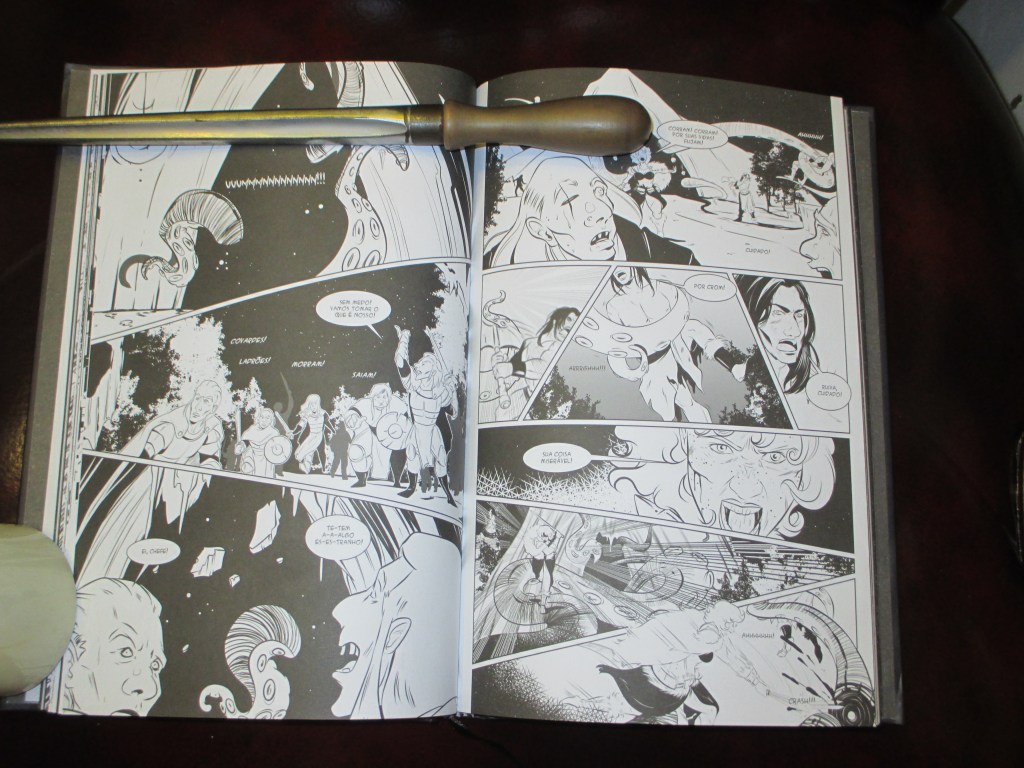
The overall tone and audience is often hard to judge at this remove, like American men’s magazines of about a decade later, they appear to be a mix of general interest articles, fiction, slightly racy featurettes with nudes, and the kind of mildly risque cartoons that seem a bit innocent today. These were not, by any stretch of the imagination, pornography: each issue featured tasteful nudes, pin-ups, and bawdy jokes intermixed with a great deal of other articles, interviews, and features…and they had an eye for talent, sometimes featuring artists who would go on to a bit of fame and notoriety.

Jean-Claude Forest was born in 1930, and began working as an illustrator in the early 1950s. Like Gallet, Forest had a deep love of science fiction, and would become a renowned cover artist for the French sci-fi paperback series Le Rayon Fantastique, and achieve international fame for his sexy sci-fi epic Barbarella, created for V in 1962—his list of works, achievements, projects, and accolades is too long to go into here. Yet before Barbarella, he illustrated “Shambleau.”


Forest’s illustrations are a classic example of raygun gothic sensibility, and the same clear, sparse line work, framing, and figure-work will be familiar to fans of his comic strips. Yet he also took the opportunity to emphasize the sensuality and horror that is Shambleau, the scattered layout adds a certain dynamism to the blocks of justified text—and when Shambleau stands revealed, the text almost seems to give way before the tentacle-writhed woman who stands bold and stark on the page, eyes shadowed, rough as a crayon-sketch in places.

Forest seems to have taken relatively little inspiration from previous illustrations in Weird Tales—may not even have seen them—but appears to have at least been aware of the 1953 Gnome Press cover. Compare, for example, the characteristic shape of the “S” in the title at the opening of the story, and the “S” on the cover of the 1953 Gnome Press collection by Ric Binkley:

There is a certain irony to the fact that while non-English-reading audiences sometimes have to wait longer to get classic works of English-language weird fiction (and vice versa), sometimes when those works are finally made available, they are graced with the creative energies of more skilled artists and dedicated designers and editors. The original audience rarely gets a chance to appreciate this kind of art, since it is rarely translated back into English-language products.

Fortunately, in 2023, the original art by Forest was combined with Moore’s English-language text and an introduction by Jean-Marc Lofficier, and published by Hexagon Comics and Black Coat Press as The Illustrated Shambleau. While this lacks the dynamic swatches of grey and the distinct layout of the original, English-language readers who want to appreciate Forest’s art and Moore’s prose together can finally do so.

Better scans of the original pages can be seen at Cool French Comics, and those curious about the full magazine that “Shambleau” first appeared in can download it from here.


Bobby Derie is the author of Weird Talers: Essays on Robert E. Howard and Others and Sex and the Cthulhu Mythos.

Deep Cuts in a Lovecraftian Vein uses Amazon Associate links. As an Amazon Associate I earn from qualifying purchases.