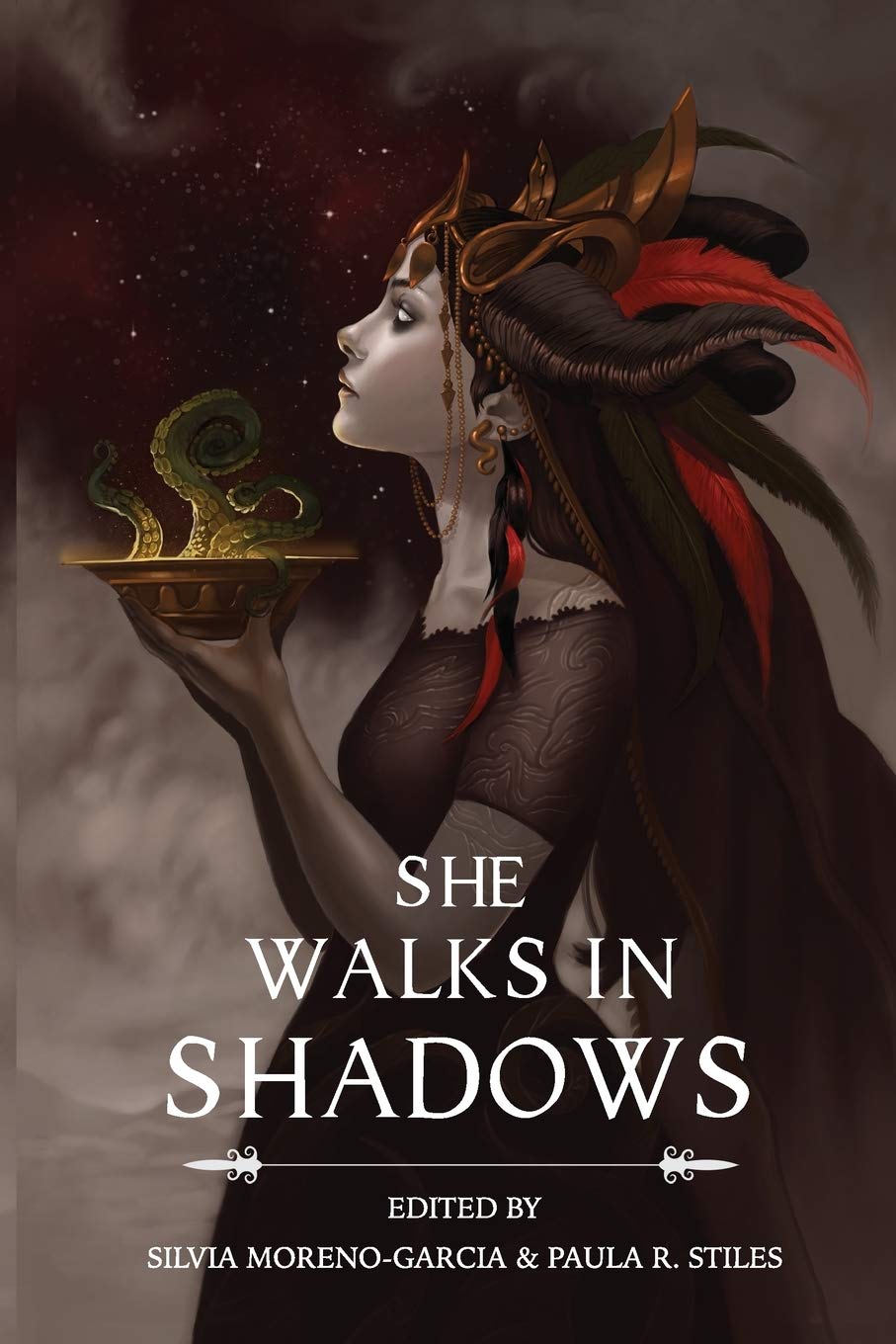
“Violet is the Color of Your Energy” (2015) by Nadia Bulkin

Absence of much conversation is probably a permanent feature of my style, because the tales I write concern phenomena much more than they concern people.
—H. P. Lovecraft to Natalie H. Wooley, 24 Oct 1933, LRBO 193

“The Colour Out of Space” is one of Lovecraft’s most evocative and best-loved stories. It has been interpreted by different folks as an environmental horror, as a rural Gothic, a precognitive flash of the dangers of nuclear radiation. It was not set in the far ago and the long away; H. P. Lovecraft set most of his horrors in his here and now. In the 1920s and 30s, close to home in Rhode Island, Massachusetts, and New York. They were horrors of the moment, and while he largely eschewed flappers and rumrunners, they took on the syntax of the time and place.

Which makes them interesting to update. How many horror stories would be different, if they took place after the invention of cell phones, or the advent of the internet, birth control pills, the Civil Rights Movement? How might that change the story? Not the phenomenon itself, but the people’s response to the phenomenon. Their perspective and understanding of it.

As is appropriate for a story that’s a reworking of H.P. Lovecraft’s “The Colour Out of Space,” “Violet is the Color of Your Energy” is named after two songs centered on color: 311’s laidback, beachy “Amber,” and Hole’s angry, feminist “Violet.” I doubt that MRA types would like this story. In my defense, though, “The Colour Out of Space” practically demanded a feminist revision. It’s fundamentally a story about a cranky farmer who keeps his family increasingly isolated, then imprisoned, resulting in the deaths of all. There’s a neighbor who seems to check in a lot. Oh yeah, and something’s off about the water and the crops. And the woman locked in the attic is the crazy one?
—Nadia Bulkin, “Violet is the Color of Your Energy” [The Playlist]

Nadia Bulkin’s “Violet is the Color of Your Energy” is, in effect, a contemporary re-telling of “The Colour Out of Space.” One that leaves out Arkham, and shifts the point of view focus to Abigail Gardner (née Cuzak), who followed her college-educated husband to Cripple Creek to try and make a go of an old-fashioned family farm. The shift in time and space and perspective skews the story from the phenomenon (Lovecraft’s interest) to the individual. Zeroes in from the impersonal observation of everything going on to the very personal look at how this phenomenon affects Abby and her relationship with her husband and children.

“Are you sleeping with him?”

“What?” her voice broke. “Nate, the boys are right . . . .”

His shout punched down like a hammer of God. “Answer me, Abby! Was this some whore’s bargain? Said you’d jump into bed if he’d just cut your poor idiot husband a break?”
—Nadia Bulkin, “Violet is the Color of Your Energy” in She Walks In Shadows 39

The result is something like Christina’s World by Andrew Wyeth in prose. Things said and unsaid. A woman trapped by the decisions she’s made, the man she trusted, until she has no decisions left at all; yet this is not a morality play about a woman who made the wrong decision. Something is happening, something he won’t tell her about. This isn’t just a tale of spousal abuse, or stress turned to paranoia. Something happened, in the opening paragraph, reverberating throughout the short story. Something that works, unseen, on the corn, the animals, the water, her husband…and her.

If you haven’t read “The Colour Out of Space,” the ending might be confusing. A Shirley Jackson-esque non sequitur, like a needle skipping across a record, jumping straight to the last track. It is like a variant telling of an old and familiar myth, reminiscent of “His Mouth Will Taste Of Wormwood” (1990) by Poppy Z. Brite in that sense. Not a replacement for Lovecraft’s story, but a complement to it; an old campfire tale told to a new generation of campers, a riff on the old motif, recycled and made new again.

Boys and dogs alike asked for things—food, drink—and eventually, after the sun began to set, Teddy put down his American History book and asked for an explanation of Croatoan.
—Nadia Bulkin, “Violet is the Color of Your Energy” in She Walks In Shadows 39

There is a certain synchronicity between “Violet is the Color of Your Energy” and the 2019 film The Color Out of Space; both seek to update and adapt Lovecraft’s text, both keep the story small, centered on what a small family farm looks like in the 2010s, the breakdown that occurs as something happens beyond their control or capability to understand. The beats are not the same, but they’re working in a similar groove with a sense of isolation and desperation. Of things that have suddenly and inexplicably gone wrong, and the added stress has cracked the facade of normality, to show that maybe, things weren’t right this entire time.

“Violet is the Color of Your Energy” by Nadia Bulkin was first published in She Walks In Shadows (2015), and republished in the paperback edition Cthulhu’s Daughters (2016), as well as Year’s Best Weird Fiction: Volume Three (2016), and Bulkin’s collection She Said Destroy (2017).


Bobby Derie is the author of  Weird Talers: Essays on Robert E. Howard and Others  and  Sex and the Cthulhu Mythos .

Deep Cuts in a Lovecraftian Vein uses Amazon Associate links. As an Amazon Associate I earn from qualifying purchases.
Harlem Hellfighters Never Die (2023) by Queen’s Court Games

Tabletop roleplaying has always had a performative aspect; the players and gamemasters were encouraged to embody their characters to some extant, and to be able to interact in character. The early community spaces around roleplaying games like Dragon Magazine (1976-2013) and Gen Con (1968-) were built on the shared experiences of gaming in small groups, and much of the early humor in gaming periodicals and associated media dealt with the peculiar quirks of players and rules interacting during a live session—as well as recounting the epic adventures characters underwent at those tables. This has been the basis of a good deal of media surrounding gaming, including comics like Knights of the Dinner Table (1990-) and Dork Tower (1997-), and the Japanese phenomenon of the replay, or transcripts of a gaming session packaged and sold for entertainment.

This performative aspect has been especially notable when gaming was done in public, before an audience, such as when participating in a tournament at a gaming convention or when doing live-action roleplay in any public space. There have been various efforts over the years to expand this practice in different media; for example some of the Knights of the Dinner Table strips were animated and voice actors brought in to provide short episodes like “Scream of Kachooloo,” based on the popular Call of Cthulhu Roleplaying Game. With the advent and popularity of YouTube (2005-), Twitch (2011-) and other streaming services, video and audio became increasingly popular media for gaming of all stripes, from video game let’s plays to various efforts to dramatize and/or capture the performance of a gaming session, which gelled into a format called actual play.

At its most basic, this can be as simple as group with a webcam and a cheap microphone recording a session at the kitchen table; at its most sophisticated, talented gamers/actors from around the world with their own high-end recording set-ups can collaborate on a gaming session together, and the whole professionally edited, produced, and with music or visuals into a viable product. The more high-end actual plays tend to have associated websites, social media, patreons, tipjars, and maybe even advertisements or sponsors to help defray the cost of production or run a modest profit for the gamers/actors involved. Shows like Critical Role (2015-) and its episodes CelebriD&D (2015-2020) have effectively migrated the concept from amateur or semi-professional to professional productions, but the community that generates and watches actual play primarily remains, first and foremost, dedicated hobbyist gamers who want to share the roleplaying experience.

While many actual plays focus on popular game systems like Dungeons & Dragons 5th Edition or particularly popular and notable published campaigns like Horror on the Orient Express, the format is democratic and allows for diverse gaming groups to run through any scenario or campaign, published or homebrew. This sometimes gives the rare opportunity to see, for example, a group of Black gamers play through roleplaying game designed for primarily Black player characters.

Queen’s Court Games (web, YouTube, Twitch, Bluesky, Patreon, etc.) is an award-winning actual play web series with a diverse cast; their byline is “Character-focused. Rules-light. Banter-free. Never D&D.” and they deliver. In 2023, the group (Noir Enigma, Jas Brown, Robert Madison II, Christian McKinzie, and Laura Tutu) played through the scenario Harlem Hellfighters Never Die by Chris Spivey, a scenario that came with Harlem Unbound (2017) by Darker Hue Studios (2nd edition). The actual play is spread out over six sessions/episodes, each of which is 2-3 hours long, with Noir Enigma playing the Keeper and the five gamers each as a single player character as they play through the scenario.

The performative aspect of actual play sometimes lends a scripted air to most proceedings, but the Queen’s Court Games group feels much more natural in their delivery. There is a conscientiousness to the performance, because the players all give each other space to talk, rarely trying to talk over one another, getting into little asides, etc. The Keeper, Noir Enigma, gets an oversized amount of attention because the Keeper is the driver for the scenario, the one which all the players have to interact with regularly and who has to set the pace and maintain the flow of the session for hours on end. Of the cast, Laura Tutu stands out as the most dramatic of the players. While they did practice some of their lines before play, there’s very much an improv group feel to the whole production, and the cast plays off each other well.

What sticks out the most is how much the players seem to enjoy the Harlem Unbound setting, and to inhabit those characters. It is not unusual to see Call of Cthulhu gaming groups that are all white people playing white characters and going through scenarios where anybody described as “dark” or “swarthy” is likely to wear a robe and wave a sacrificial dagger, so there is a different dynamic to having an all-Black group playing Black characters, the kind of humor they can bring (Christian McKinzie and Enigma Noir in particular get many of the funnier interactions, which have the other players in stitches with McKinzie’s self-deprecating humor and animated style). It is a playstyle that is conscious of and avoids the worst expressions of racism during the period, without playing down that racism and discrimination were prevalent at the time.

Spread out as Queen’s Court Games is over different channels, it is difficult to get a handle on viewership numbers and how well-received it was, but it is notable that the NZ Web Fest selected Harlem Hellfighters Never Die among its 2024 video actual plays.


Bobby Derie is the author of Weird Talers: Essays on Robert E. Howard and Others and Sex and the Cthulhu Mythos.

Deep Cuts in a Lovecraftian Vein uses Amazon Associate links. As an Amazon Associate I earn from qualifying purchases.
The Colour Out of Space (2016) by H. P. Lovecraft & Amy Borezo

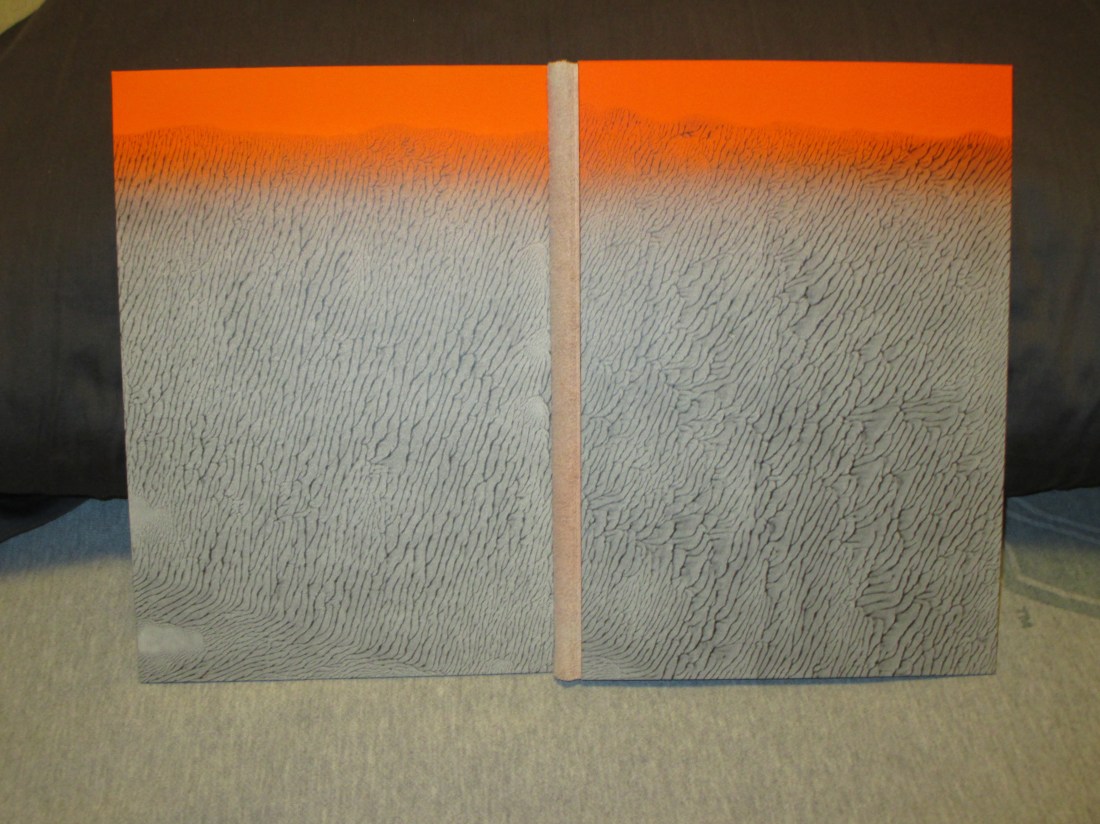
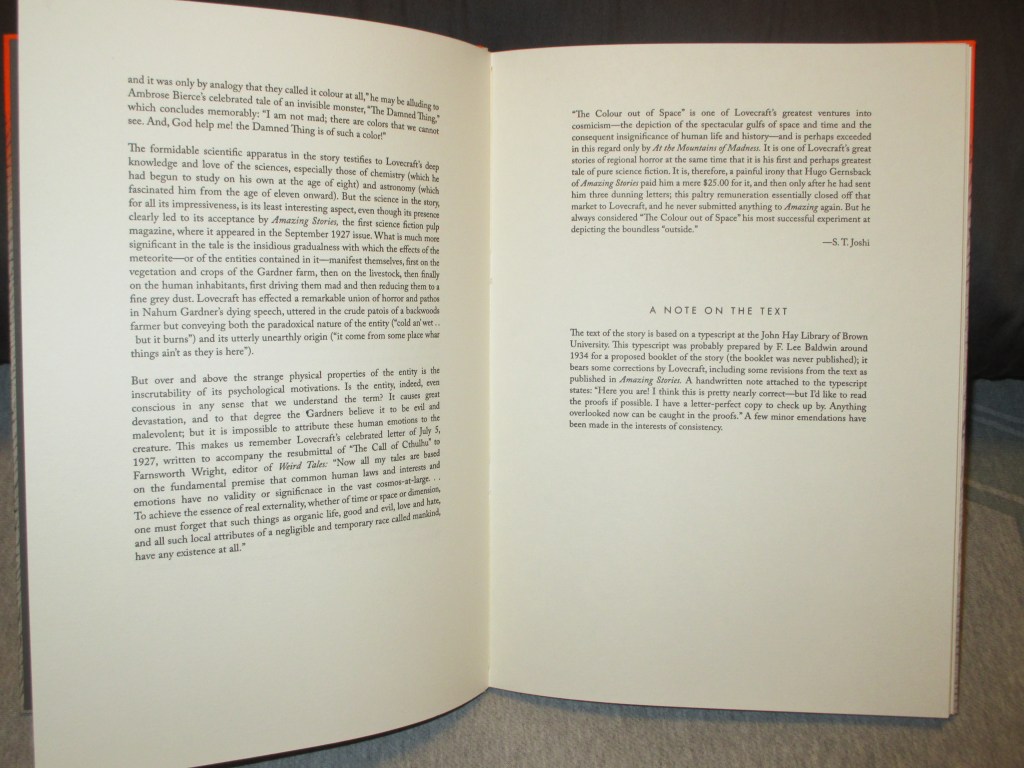
In 2016, artist Amy Borezo published a very limited illustrated edition of H. P. Lovecraft’s story “The Colour Out of Space.” To quote from Shelter Bookworks’ original page:

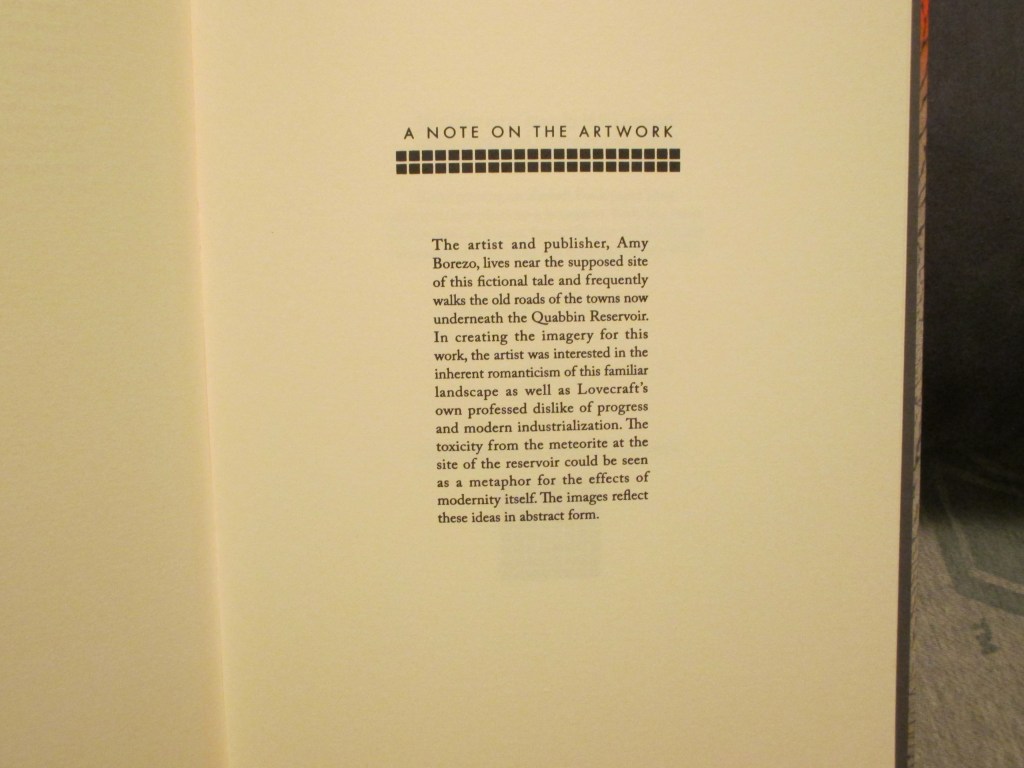
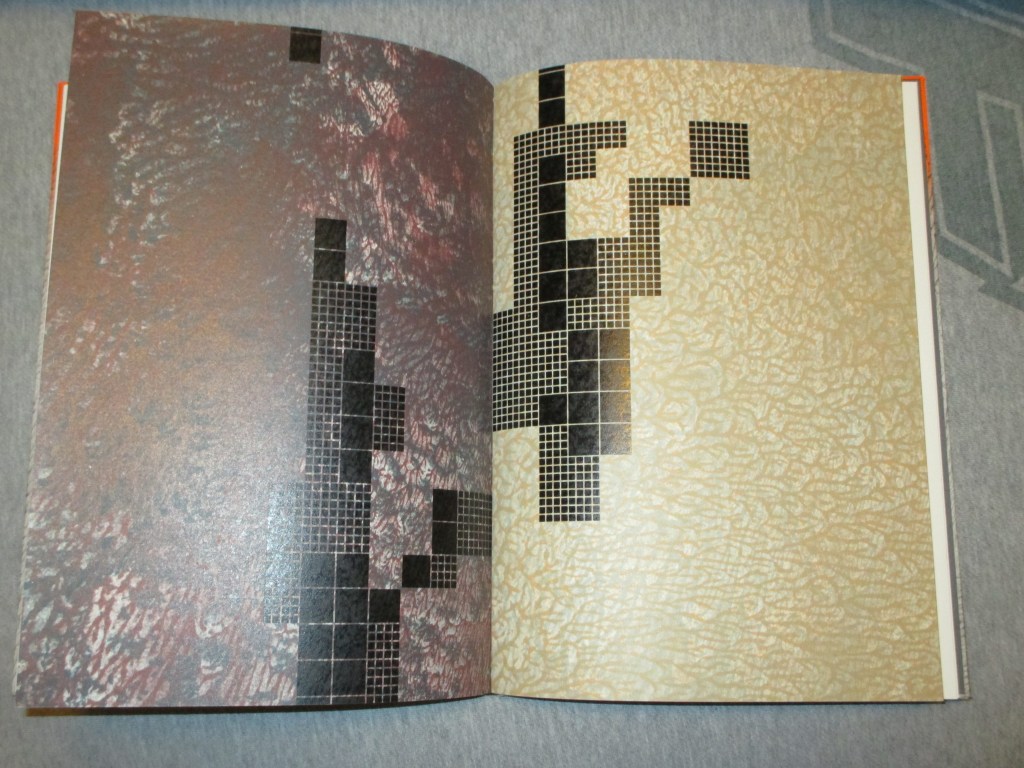
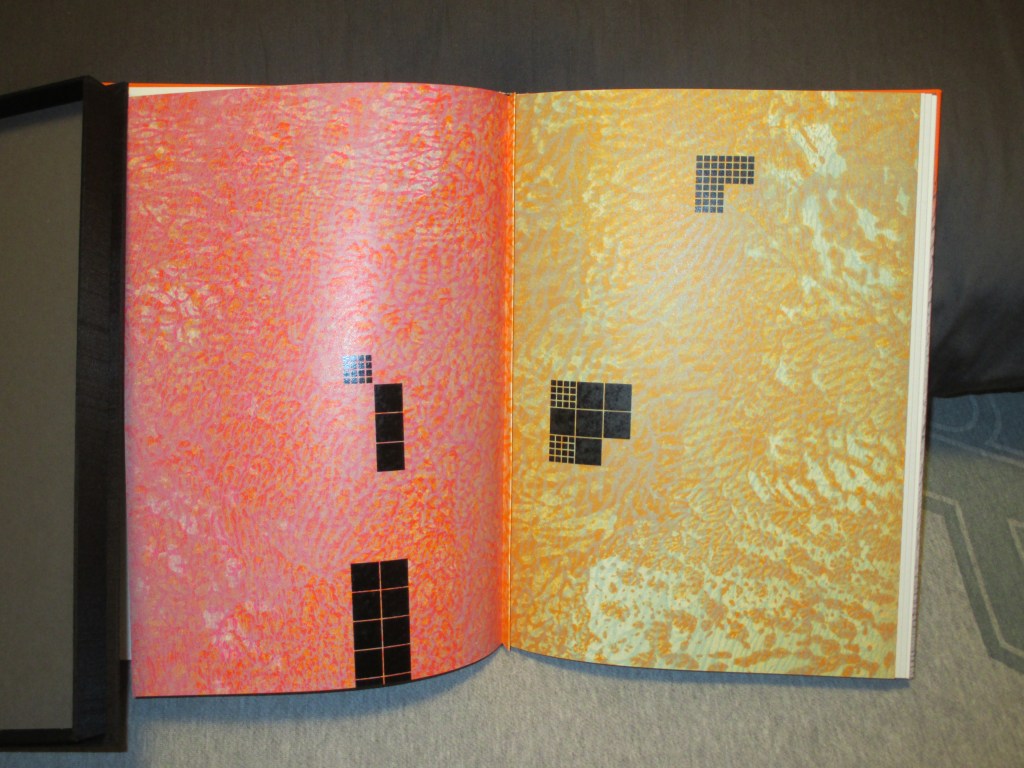
This hybrid artist’s book/contemporary fine press edition of the 1927 horror/sci-fi story by HP Lovecraft includes an introduction by Lovecraft scholar S.T. Joshi and 14 color images by Amy Borezo. The artist lives near the supposed site of this fictional tale and frequently walks the old roads of the towns written about in this story. In creating the imagery for this work, the artist is interested in evoking the complexity of the local landscape in abstract form with the construction of the reservoir overlaid visually through geometric blocks.

The text for this edition was provided by S.T. Joshi from his recent publication, H. P. LOVECRAFT: COLLECTED FICTION: A VARIORUM EDITION [Hippocampus Press, 2015] and is derived from a typescript at Brown University, evidently prepared by F. Lee Baldwin for a proposed reprint of the story (c. 1934) that never happened. It has some revisions in pen by Lovecraft, so presumably it represents his final wishes for the story.
_____________________

Relief printing on Zerkall Book paper from photopolymer plates on a letterpress. Body text set in Caslon, titles in Futura. Pages sewn onto a shaped concertina. Paste paper over boards with a buffalo suede spine. Housed in a presentation box. Special thanks to Lisa Hersey who assisted in printing and binding.

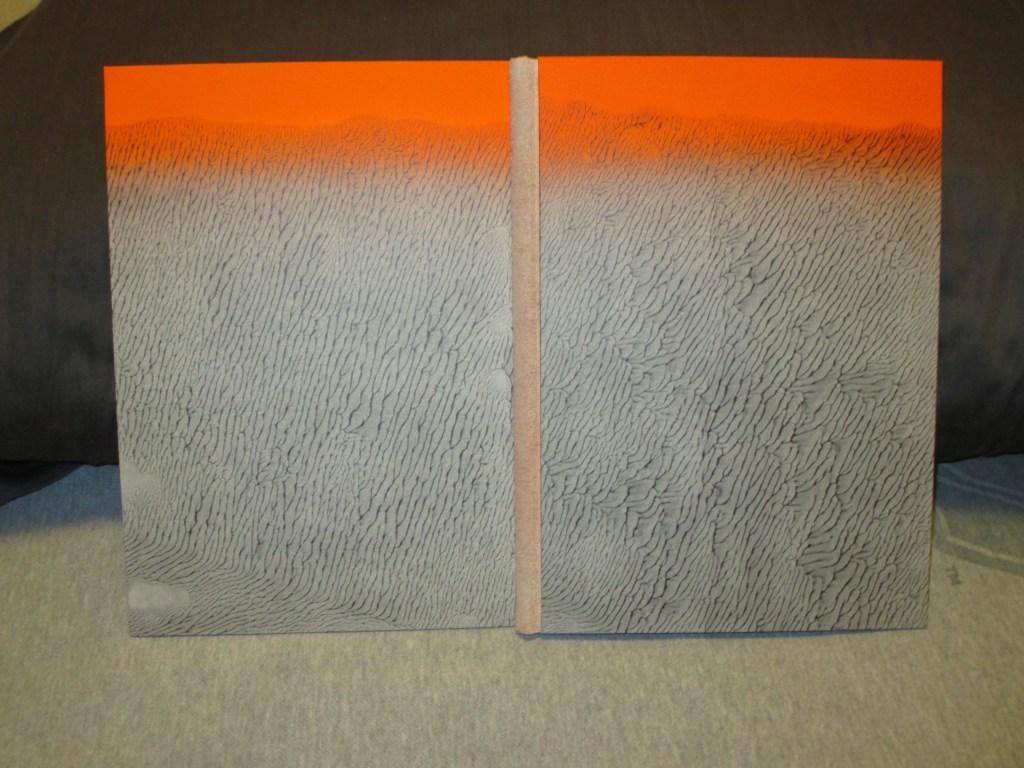
The edition, despite the relatively high cost (US$500 + shipping in 2016), sold out. It arrived in an attractive clamshell box, with a paper label. Inside, the colors on the paper are bright and vivid in a way that the light and the camera don’t really catch, the backstrip soft, the paper creamy and the text sharp. In your hands, the brilliant orange seems to leak through around the edges of the pages. A title page, a brief introduction by S. T. Joshi. The text and illustrations are on alternate pages, distinct, the images vivid but abstract. A word on the artist, a colophon and numbering page, and then the book is at an end.

Amy Borezo’s illustrated edition is, in a very real sense, a piece of art that you can read. The text itself is meticulous in its accuracy, but you can read the same text in Hippocampus Press’ variorum edition, you can read the same text for free online. If you must have a physical copy of a book in your hand, you are spoiled for choice: “The Colour Out of Space” is one of Lovecraft’s most reprinted works, and there are innumerable illustrations for the story from various artists, from J. M. de Aragon in the pages of Amazing Stories in 1927 and Virgil Finlay in Famous Fantastic Mysteries in 1941 to many others of the current day.

This massive plurality of choice, the sheer number of editions, touches on an issue that many readers and would-be readers of Lovecraft deal with: where do you start? What is the best edition? What if you want a really nice copy of a book? Which one of all the hundreds of titles should you go for, and why, and how much will it cost?

If that sounds like more of a collector’s issue than a reader’s issue, then congratulations, you’ve hit on one of the fundamental problems facing not only Lovecraft, but most popular authors in the contemporary period.

When Lovecraft was alive, he was primarily published in the amateur press, pulp magazines, some reprint anthologies like the British Not at Night series, and a couple of very small privately printed editions of The Shunned House (never bound or formally released during his lifetime) and The Shadow over Innsmouth (which was, but the binding was shoddy). There were no finely bound editions of Lovecraft with the embellishments of the bookmaker’s art available to the general public, no leather covers, no gilt lettering, no raised bands (caveat: one copy of The Shunned House was specially bound by R. H. Barlow as a gift for Lovecraft).

Early collectors of Lovecraft often focused on posthumous publications, like the first publications of Arkham House, and little obscurities like the edition of Lovecraft’s commonplace book put out by the Futile Press in 1938. Even ultra-small press editions were typically not “fine” in the sense of lavish materials, artwork, or presentation, but were often considered valuable simply because of the small size of their edition, the ease with which copies perished, and subsequent rarity in the face of growing demand. That demand came from Lovecraft’s own growing popularity; the mass market paperback reprints of Arkham House collections, the armed services editions, and foreign reprints in hardback and paperback vastly increased the audience for Lovecraft’s work.

Until quite recently, fancy fine press editions were not normal for living authors. Before mass literacy, books were often bought unbound and then the author could bind them however they liked; really rich people could commission books that were themselves works of art in every sense of the word, involving whatever costly materials or decorations they cared for. As the commercial basis of book reading and publishing became more egalitarian, fancy editions often became more about the skill of the bookmaker and/or any associated artist, for fine press editions, and the materials shifted.

So when you look at what constituted a really nice Lovecraft edition in, say 1980, you’re likely looking at the output of Roy A. Squires’ press. These were meticulously crafted letterpress editions, usually on high-quality handmaid paper, sometimes featuring tipped-in photographs or other illustrations. Where a normal chapbook from Necronomicon Press or a fan press might be published on an Apple II printer and stapled together, everything about Squires’ production was done by hand.

The slightly bourgeoisie desire for something fancier still nagged the science fiction and fantasy market. Arkham House paved the way in the late 1930s and 40s by showing that a small press publisher specializing in genre books was viable (the presses they inspired apparently didn’t know how often Arkham House founder August Derleth was running in the red, or how long it took for his small, relatively expensive books to sell). Most of these products weren’t fine press; they were solid books, aimed and priced at a select market. Very few of them produced anything that might be described as a luxury edition of Lovecraft; the choicest example might be the 1976 edition of Démons et Merveilles by French publisher Opta, which came bound in leather, with slipcase, and illustrations by Philippe Druillet. The translation has its issues (Lovecraft’s “ghouls” is rendered as “vampires,” to give one notable example), but compared to the rather plain but sturdy Arkham House editions, it’s gorgeous.

Easton Press (founded in 1975 as a division of MBI, Inc.) took up the gauntlet of producing, for lack of a better term, what not-rich people think of as rich people’s books: bound in letter, embossed in 22k gilt, very snazzy to look at. In practice, while Easton Press has consumed many acres of cowhide, the actual books they produce tend not to be very special: they’re reprints of existing books, often not anything particularly rare or obscure, with no additional editorial guidance or notes (and sometimes bad misprints). The books themselves are usually solid, but less than beautiful; their editions of Lovecraft show evidence of corner-cutting and mass production.

There is a niche market for really nice editions of books, at a price affordable to middle-class bibliophiles. Over the last twenty years or so, that niche market has exploded. Centipede Press, Subterranean Press, the Folio Society, etc. are names that are familiar now for deluxe editions of Lovecraft and/or other authors, typically reprinting older works instead of presenting anything original, and typically publishing in limited editions of a few hundred copies. Quality and presentation vary, although are generally pretty high—not quite the same production value as, for example, letterpress outfits like Pegana Press which continue the fine press tradition, but for high-end versions of books that you might otherwise buy at Barnes & Nobles…

…and that is kind of the rub. While there are some exceptions, most of these presses aren’t gambling on producing anything new. There might be new artwork, there might be a new introduction by Alan Moore or S. T. Joshi, but there is no experimentation, there is often nothing unique about these particular editions. There are some exceptions; Centipede Press has produced some original compilations like Conversations with the Weird Tales Circle that collects many rare, obscure, and out-of-print materials; and the art book A Lovecraft Retrospective is pretty much unparalleled. Helios House Press has published some original scholarship among the reprints (full disclosure: they’ve paid me for a few essays and other work).

For most of these companies, however, the text itself isn’t special. The production quality might not be much better than any other mass-produced hardcover. They might be pretty, but from a strictly objective standpoint they don’t offer much new or exciting. They’re just very expensive.

So what exactly are you, the reader, paying for?

Which is what you need to answer for yourself. If you’re a scholar or academic looking for a text that’s pure Lovecraft, you’re probably better off buying the Hippocampus Press variorum editions. If you’re a casual reader, the Penguin paperbacks are cheap and almost as good. If you’re a poor student, stick to the online editions at https://hplovecraft.com. If you want a fancy edition…well, you’ve got options. Lots of them, for every price point. Handmade Japanese paper, bound in leather, with silk bookmarks, signed in blood.

It’s all available for the right price.

So what sets Amy Borezo’s book apart? Normally, based on the materials, the quality of the printing and craftsmanship, I would qualify this as a fine press product. However, in the marketing, the presentation, this is a little different. It is a book, and can be read as a book, but it is also a work of art, and can be experienced and appreciated like buying a lithograph print from a series. If you’re a fan of Lovecraft, you know the words, you’ve read the story a hundred times. Many artists have tried to capture a colour that lies beyond human perception, to depict the events of the story in some fixed form. Only Borezo has gone to such effort to capture that feel in an entire book production, not just as isolated images.

The beauty of Borezo’s art is that it is abstract; it doesn’t try to impose meaning on the text, readers have to stare at it for themselves. Some might not like it, others might get it but not care for the idea, but for me there’s a certain tactile experience with that nearly radioactive orange that seems to seap through and around the pages at times. Yes, it could just be the collector in me, trying to justify the hundreds of dollars this book cost, but in a real way that is the experience we buy with every book, above and beyond the text itself. The feel of it in your hands, the smell of the paper, the crackle of the spine. It’s different, when you’re holding an old pulp whose brittle and yellowed pages are as fragile as a papyrus from a mummy’s tomb, or an old worn paperback whose tanned pages are as soft as toilet paper, or a crisply printed new edition with ink that almost looks still wet.

From a scholar’s perspective, from a historian’s perspective, the focus is usually on the text, not necessarily the visceral experience surrounding how the text is read and received. Yet it is important not to lose touch with that. In an age where Lovecraft is in the public domain, generative AI, and print-on-demand publishing, we are going to see a vast proliferation of books—many of which are going to be strictly hypothetical until someone orders them—and our eyeballs will see cover art generated by some pseudointellectual property theft engine and with text scraped off of somewhere online (errors and all), and pre-packaged to try and appeal to someone that wants to read Lovecraft—and whatever the end product is, the one thing I can guarantee is that it is not going to be anything like Amy Borezo’s edition of The Colour Out of Space.


Bobby Derie is the author of Weird Talers: Essays on Robert E. Howard and Others and Sex and the Cthulhu Mythos.

Deep Cuts in a Lovecraftian Vein uses Amazon Associate links. As an Amazon Associate I earn from qualifying purchases.

“Sob As Trevas” (2020) by Douglas Freitas & Chairim Arrais and “Aeons” (2019) by Salvador Sanz

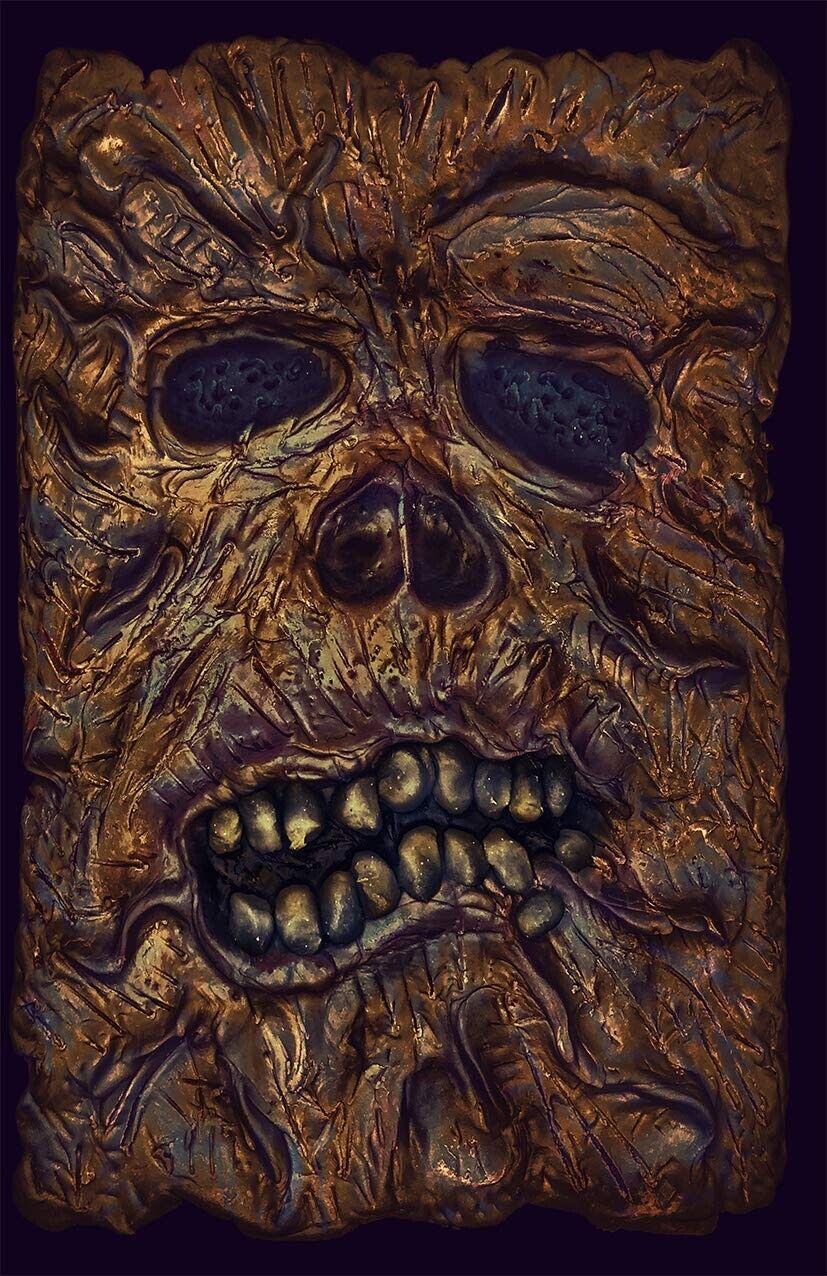
Os Mitos de Lovecraft (2020) is a crowdfunded Brazilian black-and-white graphic anthology edited by Douglas P. Freitas and published by Skript, probably best known for the deluxe hardcover edition which has a cover modeled on the bound-in-human-skin Necronomicon ex Mortis from Evil Dead 2 and Army of Darkness. Like its fellow Brazilian Lovecraftian anthology O despertar de Cthulhu em Quadrinhos (2016), while there is a common theme in terms of subject, the style and tone of the individual works inside varies considerably. Every style of comic art and horror can be represented under the broad remit of Lovecraftian comics, from straight adaptations of Lovecraft in exquisite realistic depiction to splatterpunk-esque gore fests with plenty of airbrush-style gore streaks to lighter works with more cartoonish tentacled Cthulhu-esque characters.

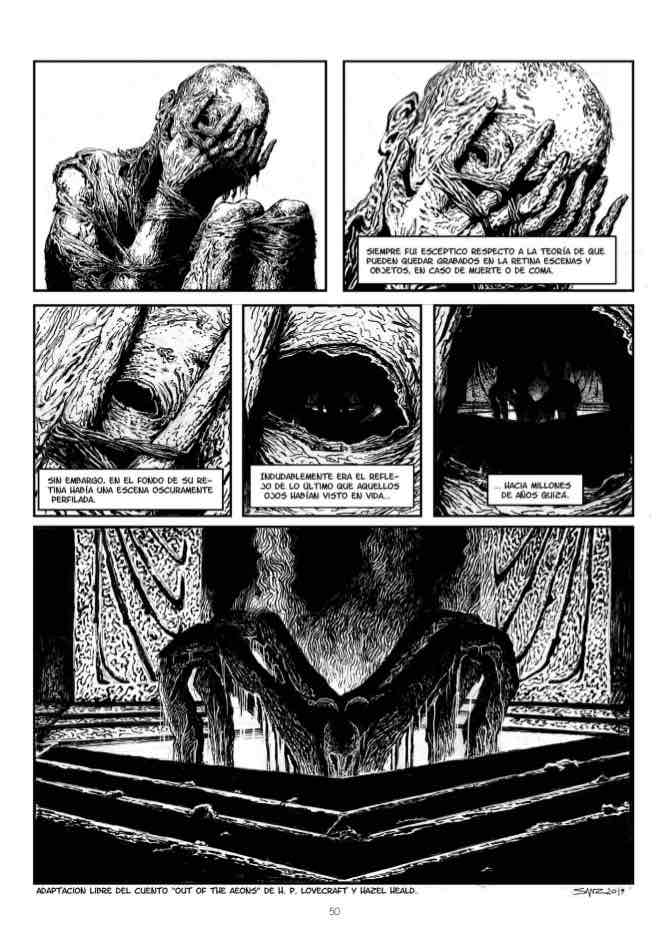
The anthology begins with an absolute masterpiece in two pages, by Argintenean artist Salvador Sanz, which originally appeared in the Spanish-language graphic horror anthology Cthulhu 23; for this anthology, it was translated into Brazilian Portuguese by Aline Cardoso and re-lettered by Johnny C. Vargas. This is a distillation of “Out of the Æons” (1935) by Hazel Heald & H. P. Lovecraft, subtracting all the human characters, the drama, and the fantastic history deciphered from the scroll in exchange for focusing on a masterful rendering of the mummy who caught a glimpse of Ghatanothoa—and paid the price.

In a cinematic journey, the reader is taken closer and closer to the ancient petrified horror. The panels zoom in on the one eye that peeks out between gnarled fingers. To the dark image that is still captured there, on the retina. The detail on the art, the pacing, and the execution of the concept, which boils down the essence of the Lovecraft/Heald horror story into two pages, is exquisite.

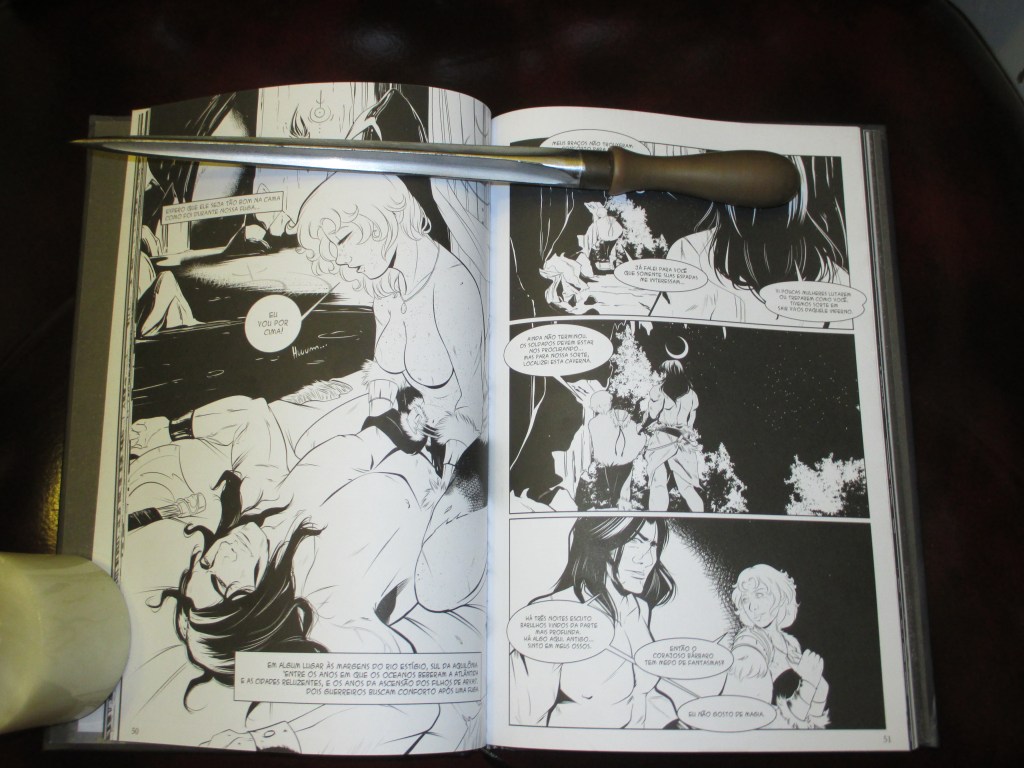
Freitas’ own contribution to Os Mitos de Lovecraft is “Sob As Trevas” (“Beneath the Darkness”), in collaboration with illustrator and comic creator Chairim Arrais. This is a tongue-in-cheek 8-page sword & sorcery story involving a nameless Cimmerian warrior and their female partner Ruivas (“Red”/”Red-hair”). Freitas & Arrais are clearly referencing Robert E. Howard’s most famous creation, Conan the Cimmerian, and aren’t coy about it:

Os Mitos de Lovecraft pp.51-52
Em algum lugar às margens do rio Estígio, sul da Aquilônia, ‘entre os anos em que os oceanos beberam a Atlântida e as cidades reluzentes, e os anos da ascensão dos filhos de Aryas’. Dois guerreiros buscam conforto após uma fuga.Somewhere on the banks of the River Styx, south of Aquilonia, ‘between the years when the oceans drank Atlantis and the gleaming cities, and the years of the rise of the sons of Aryas’. Two warriors seek comfort after an escape.
Os Mitos de Lovecraft page 51English Translation
“KNOW, oh prince, that between the years when the oceans drank Atlantis and the gleaming cities, and the years of the rise of the Sons of Aryas […]”
—Robert E. Howard, “The Phoenix on the Sword”

The character Ruivas is depicted similarly to the eponymous character in Arrais’ standalone comic “Red+18”; whether this is intended as an unofficial crossover, an Easter egg for fans of Arrais’ work, or just a coincidence—the character could as easily be a play on Red Sonja for the Marvel Comics, albeit sans the trademark mail bikini—is unclear, and maybe unimportant.

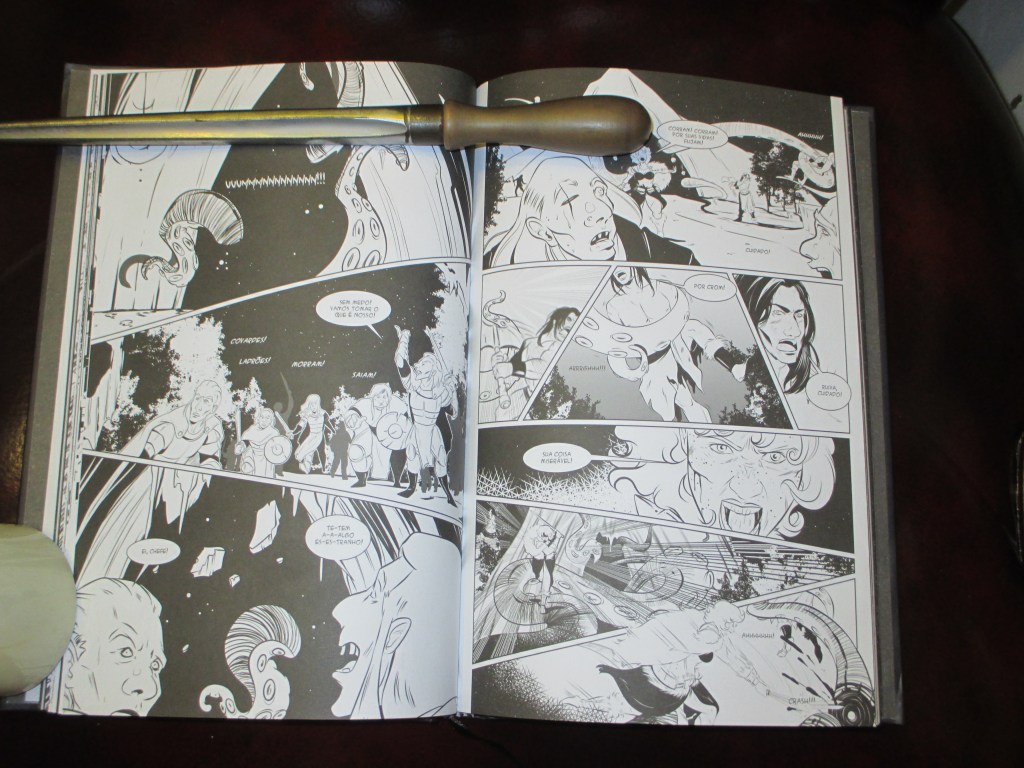
The story itself is fairly slight and straightforward: after successfully stealing a jewel, the pair of thieves hide out in a convenient cavern…which ends up being occupied by some nameless eldritch horror.

Ei, Chefe!

Te-tem a-a-a-algo es-es-tranho!
Hey, Boss!

Th-there’s s-s-something s-strange!
Os Mitos de Lovecraft page 54English translation

The story really wanted more pages; there’s little opportunity to really develop any atmosphere before the tentacles emerge from the darkness, and the action sequences are correspondingly cramped and staccato-like, crammed into increasingly more panels per page. With the in media res debut, the titillation, and the swift conclusion, this is strongly reminiscent of the kind of back-up feature that sometimes ran in Savage Sword of Conan, more of a sketch of an interlude than a full-fledged story.

Yet what there is there is fun. The writing is light-hearted, the chemistry between legally-not-Conan and Ruivas is alternately playful and rocky, and Arrais’ artwork does everything the script calls for. The brief sword & sorcery interlude sets a different tone than the other stories in the anthology, featuring more sex and action than horror or outright comedy. While I would have liked for it to delve more into the Howardian vibe of horror that permeated tales like “Xuthal of the Dusk” or “Red Nails,” limitations of space have to be acknowledged. Still, it would be nice if Freitas & Arrais had the opportunity to revisit the idea at a longer length more suitable to develop the characters and story at some point.


Bobby Derie is the author of Weird Talers: Essays on Robert E. Howard and Others and Sex and the Cthulhu Mythos.

Deep Cuts in a Lovecraftian Vein uses Amazon Associate links. As an Amazon Associate I earn from qualifying purchases.

“Candlewax” (1990) by W. H. Pugmire & Ashleigh Talbot

Eldritch Fappenings
This review deals in part with artwork that includes nudity and/or sexuality explicit content.
As such, please be advised before reading further.


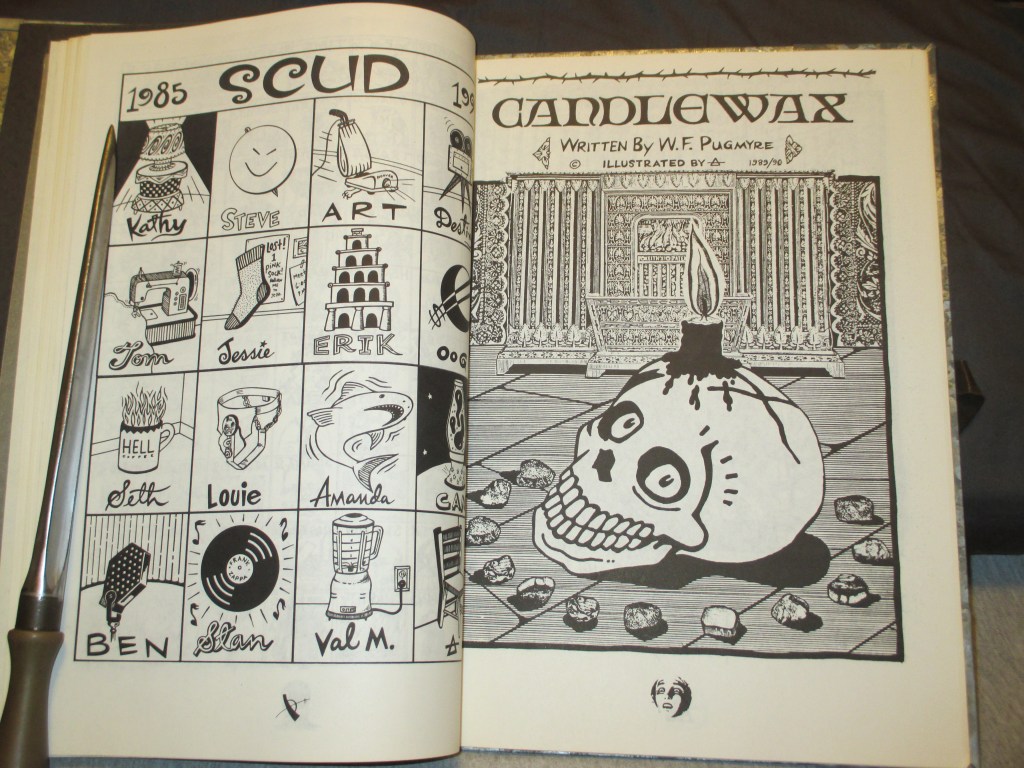
In the 1985 Christmas supplement to the fanzine Fungi, W. H. Pugmire‘s story “Candlewax” first saw publication. This was one of Pugmire’s earliest efforts at Mythos fiction, and is a part of his Sesqua Valley cycle—his own corner of Lovecraft country set in the Pacific Northwest, populated by characters like Simon Gregory Williams. While Pugmire would go on to write many more tales of Sesqua Valley, which have been collected and published in various volumes, “Candlewax” is one of the comparatively rarer tales, having been reprinted only a handful of times—and, most interestingly, in an illustrated edition.

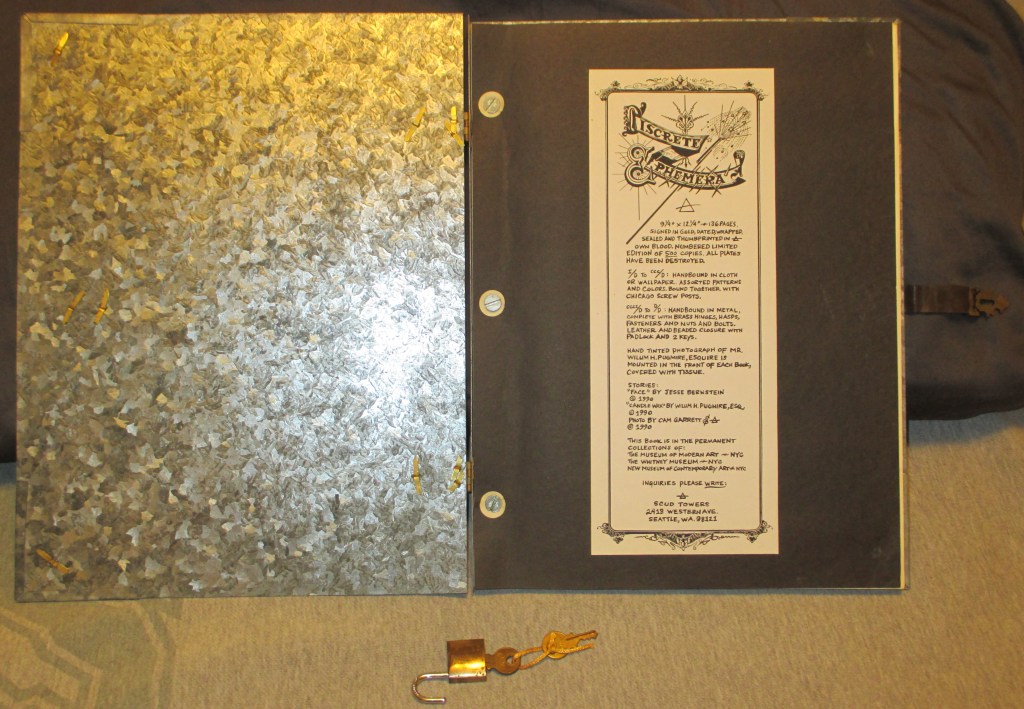
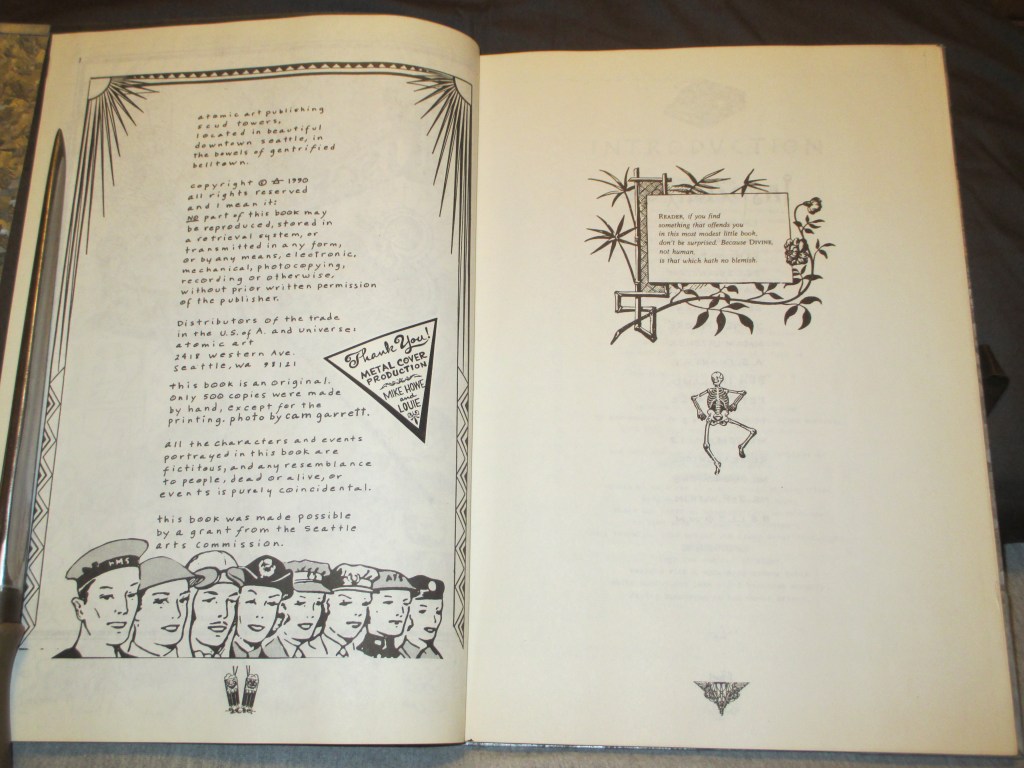
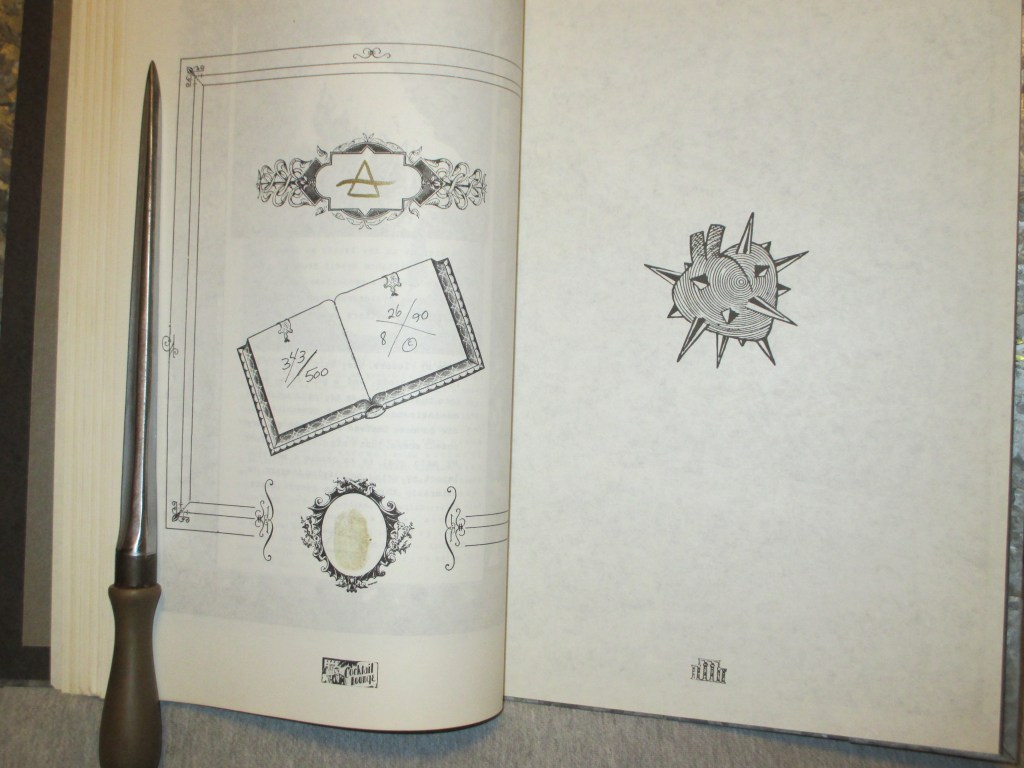
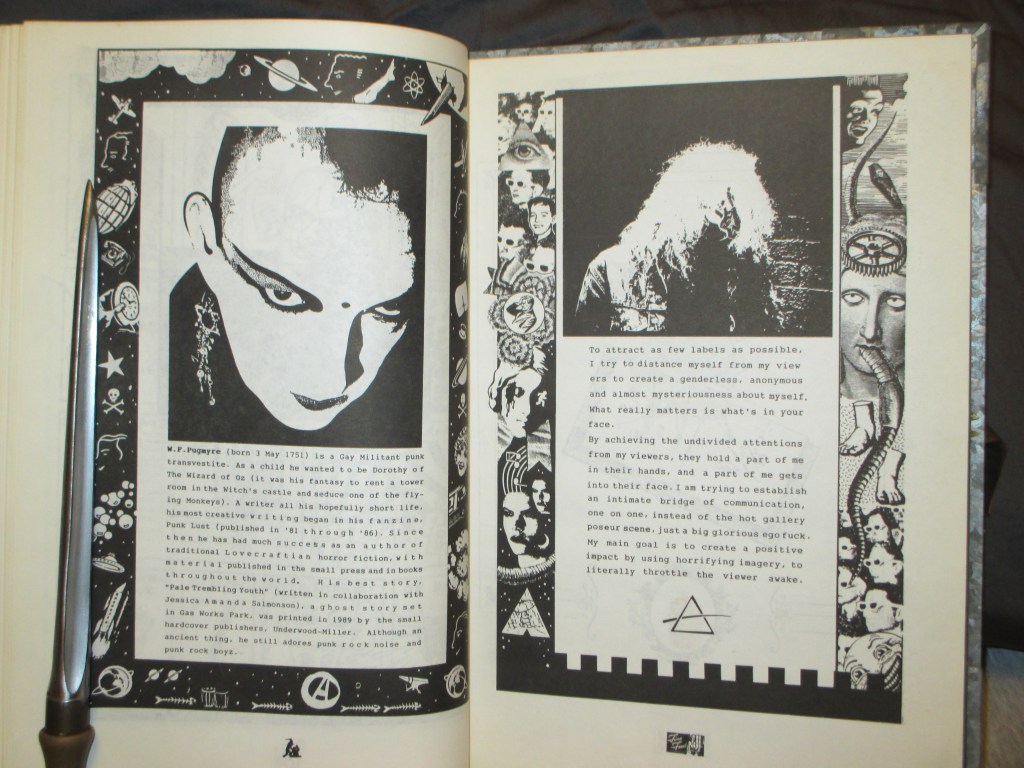
Discrete Ephemera (1990) is a limited edition (500 copies) book art project by Ashleigh Talbot, and illustrated texts by Steven J. Bernstein (“Face”) and W. H. Pugmire (“Candlewax,” as “W. F. Pugmire”), made possible by an art grant. Madame Talbot is presented throughout via a symbol:

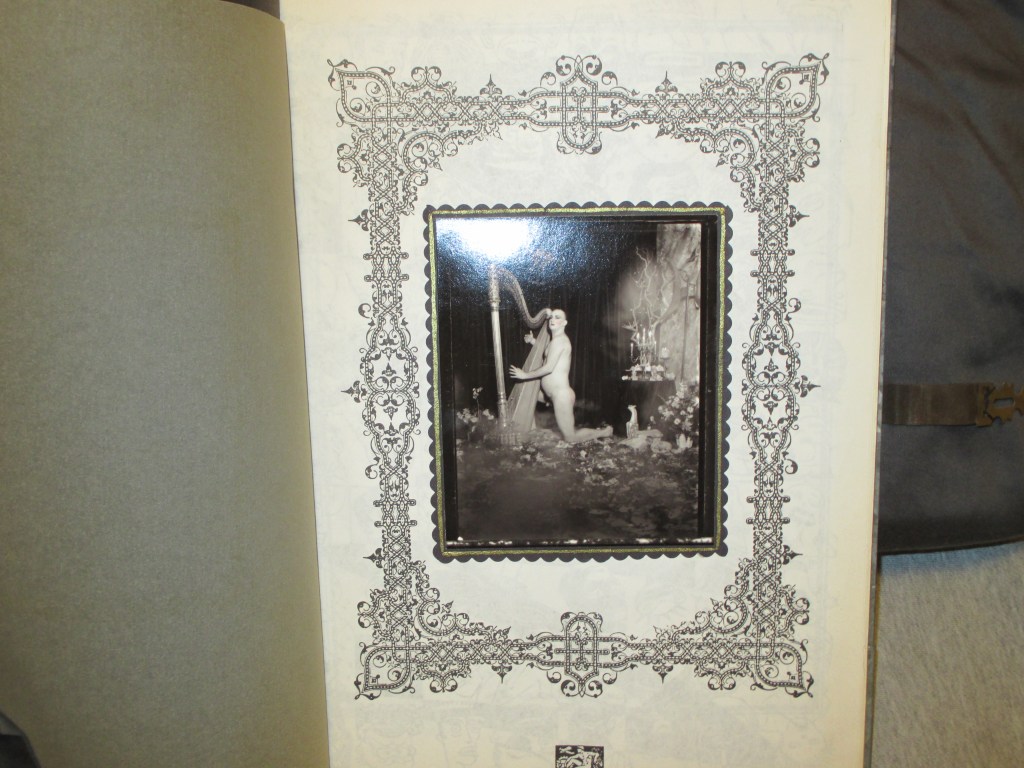
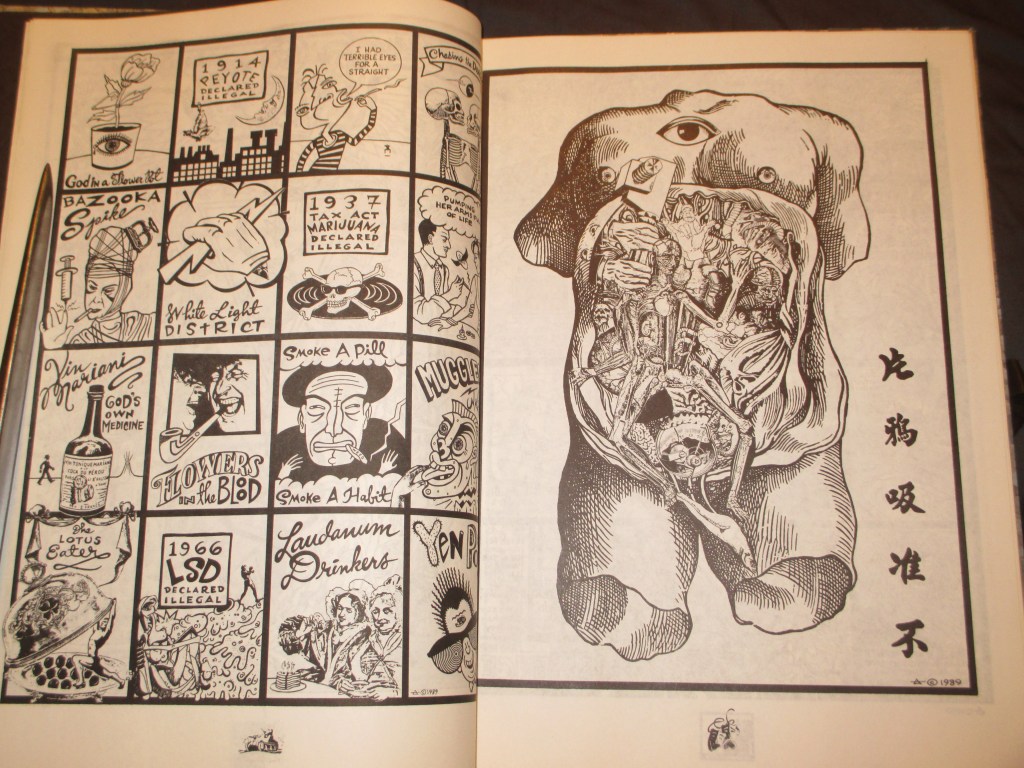
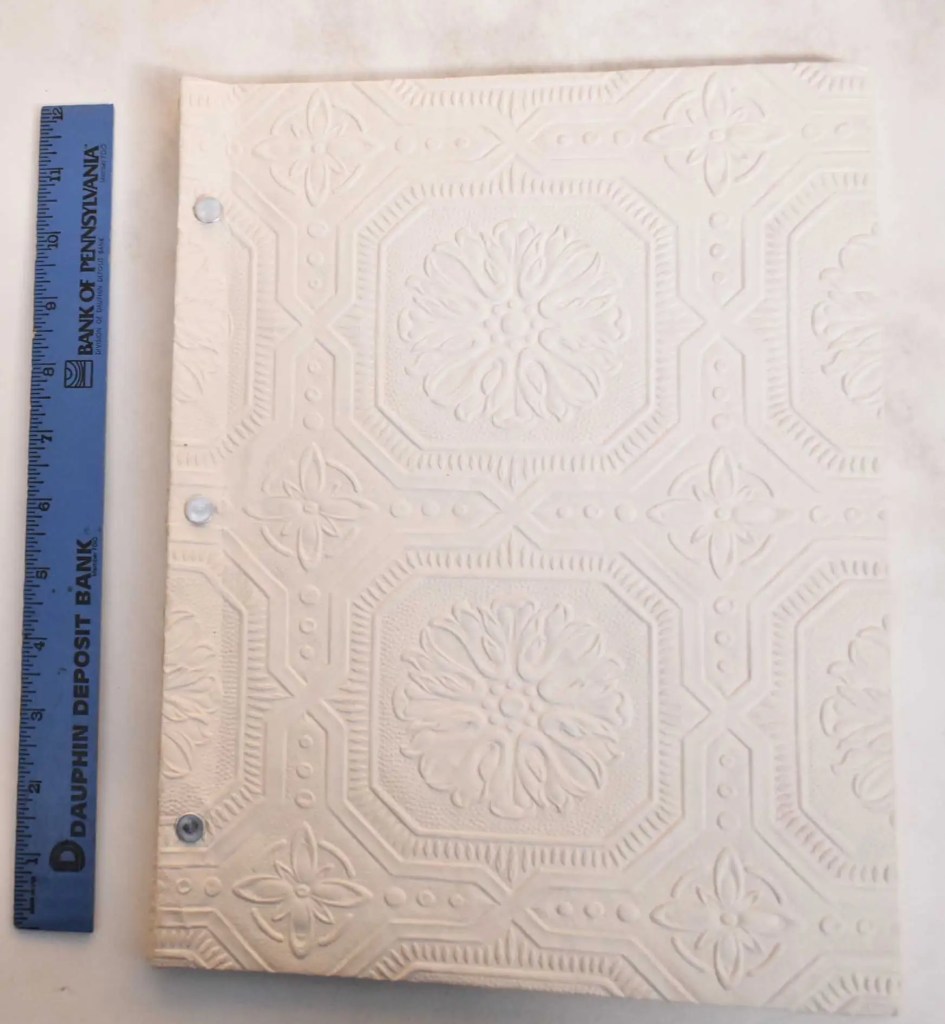
The book exists in different states. My copy of 136 unnumbered sheets is bound between sheet metal plates with a small brass padlock, while others are bound in textured wallpaper; with a fingerprint imprint in gold ink (some listings say blood, but it looks like gold ink to me) on the limitation page, and a tipped-in photo of Pugmire in the nude. The overall aesthetic is strongly reminiscent of underground comix, punk zines, and copybooks of the 1960s-1980s, with an emphasis on cut-and-paste techniques, surreal imagery, the presentation of familiar images in unfamiliar contexts or subtly distorted, and a Burroughs-esque eye for the unfiltered and sometimes teratophiliac reality presented by medical textbooks and cabinets of curiosity.

Example of the wallpaper cover from the Mullen Books listing.

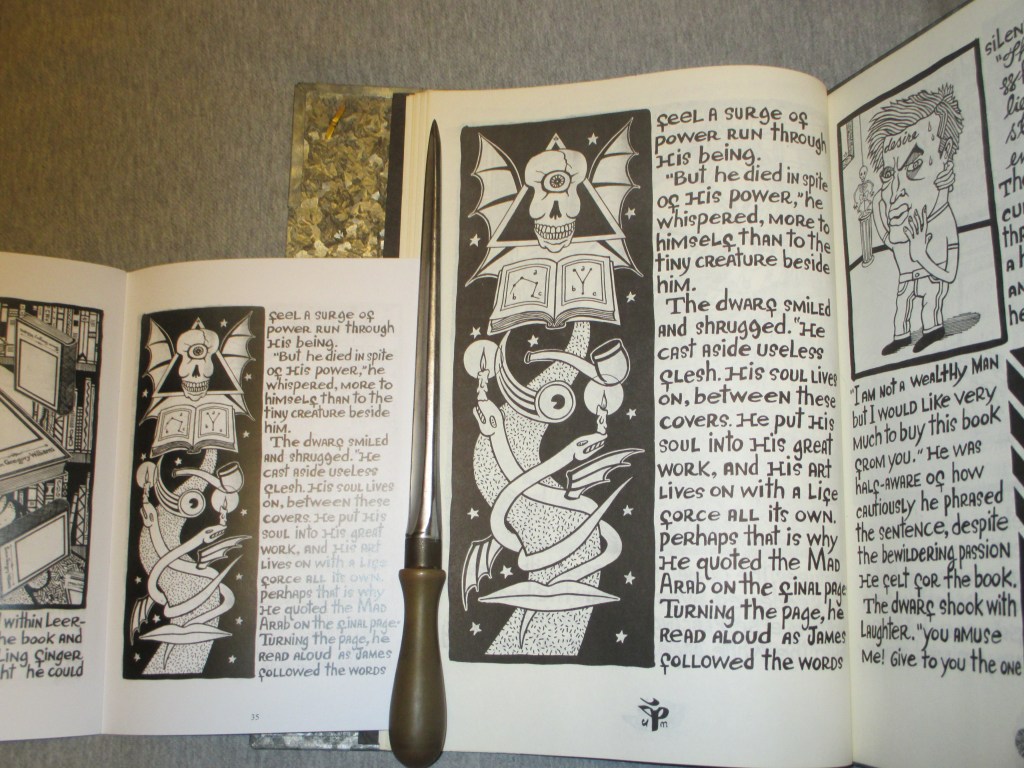
The illustrated version of Pugmire’s “Candlewax” is distinct from the rest of the project, but mostly because it has a coherent, linear narrative, with a darker, more Gothic tone than the more stylized kaleidoscope of images that preceeded this section, or the much more comic-strip style collaboration “Faces” with Bernstein. While Talbot continues to use the same distinctive style, the illustrations work to complement the text, at times a strict depiction, and at times more abstract and evocative.

The story itself is a sketch in miniature of bibliomania, murder, necromancy, hubris, and revenge. A fitting snapshot of the kind of obsession that has characterized aspects of the Mythos (and readers of the Mythos) from the beginning.

At least two versions of the “Candlewax” text have seen print. Pugmire had a tendency to rewrite his stories when they were reprinted, and this seems to be the case here as well. To give the flavor of the difference:

The man was a dwarf. His bent and twisted frame, disfigured by age and nameless ailments, seemed perpetually trembling. Drool moistened thin black lips, and yellow pus oozed from reddened eyes. A skeletal finger tapped the book that lay before him, and he addressed his visitor in a whispered voice.

“His name was Simon Gregory Williams. He wrote this book of spells in the late 1960s. That in itself makes it unique. Most of my books are ancient tomes, crumbling and worm-infected. But, as you see, this looks almost new.”
The tiny man bent his twisted frame toward the curious tome. Drool moistened his thin grey lips; yellow pus oozed from his reddened eyes. A skeletal finger tapped the yellow cover of the book. He addressed his visitor in a low whispered voice.

“His name was Simon Gregory Williams. He wrote this book of spells thirty years ago, while visiting the poet William Davis Manly, in your curious Sesqua Valley.” Here he opened the book and turned to various illustrated pages. He stopped at a vivid depiction of a tremendous mountain of white stone, the twin peaks of which resembled wings folded up on a daemon’s shoulders. “The infamous Mount Selta, of which I’ve heard so much. And below, in purple ink, the name ‘Khroyd’Hon’; such a strange name.”
“Candlewax” in Discrete Ephemera (1990)“Candlewax” in Mythos Tales & Others #1

The 1996 text deals much more with the Sesqua Valley cycle, probably to better incorporate it into the loose collection of stories and the Mythos that Pugmire would continue to build on in tales like “An Imp of Aether” (1997). Readers hunting this particular text may find themselves like the protagonist Oscar James, hunters of arcane lore about that mysterious vale and its even more mysterious occupants.

Left: Sesqua Rising, right: Discrete Ephemera

With an edition of only 500 copies, Discrete Ephemera and its illustrated version of “Candlewax” is very scarce and relatively expensive. Graeme Phillips reprinted the entire illustrated story in the chapbook Sesqua Rising (2016), but that was limited to only 50 copies, and is even scarcer, making this one of the rarest of Pugmire’s collaborations.

Madame Talbot also collaborated with Pugmire on some illustrated prose poems, and wrote:

I was thrill’d when one of my early Mythos stories, “Candlewax”, appear’d fully illustrated in one of Ashleigh’s hand-made books. There is nothing more thrilling than working on projects with outstanding artists 

W. H. Pugmire, “In Collaboration with Genius” (2016)

What is Discrete Ephemera and “Candlewax”? A collaboration of talents, a cross-pollination of ideas, attitudes, and styles. Discrete Ephemera is a kind of punkish grimoire, an art object to be experienced more than a text to be read and consumed, and in that sense “Candlewax” almost feels like a metatext…or, perhaps, a warning. For now, this copy is in my library. In time, it will be passed on to someone else. Hopefully, someone who gets it.


Bobby Derie is the author of Weird Talers: Essays on Robert E. Howard and Others and Sex and the Cthulhu Mythos.

Deep Cuts in a Lovecraftian Vein uses Amazon Associate links. As an Amazon Associate I earn from qualifying purchases.

“The Adventurer’s Wife” (2015) by Premee Mohamed

Whatever by the case, it is clear the African ethnology and history are a tangled and obscure affair; involving many a dramatic surprise for the future historian and archaeologist. It is not for nothing that Africa has been labelled a continent of mystery.

H. P. Lovecraft to Robert E. Howard, 30 Jan 1931, A Means to Freedom 1.141

We have better maps of Africa today than they did in 1931. Archaeologists have excavated the ancient cities, dug up the bones of primal ancestors. A few have even listened to the indigenous peoples, to take down their own history in their own words. With colonization and de-colonization, the myth of Africa has greatly retreated. Like the Old West, the period of the White Explorer Archetype and the Scramble for Africa is long over—and like the Old West, the tales spun out of that period have continued for far longer than the actual time when they might have held a grain of truth.

“The Adventurer’s Wife” by Premee Mohamed is a deliberate play on the established tropes. Details are deliberately a bit vague; if Mohamed drew any inspiration from any of the “African Mythos” stories like “Winged Death” (1934) by Hazel Heald & H. P. Lovecraft, she kept it largely off the page. There are old gods, and there are shoggoths, but no proper names to conjure by or places on the map a reader can point to and say “yes, this is where things happened.”

The vagueness is no doubt deliberate; in the great jigsaw puzzle of the Cthulhu Mythos, the story is a piece that can fit into many different puzzles, and become a part of many different pictures. The ambiguity plays to the strengths of the storytelling; the protagonist Mr. Greene, here to interview the adventurer’s wife, has preconceptions and prejudices that are set up and knocked down…and there is much that is hinted at but not spoken of openly, and some interestingly subtle subversion.

In many stories featuring the white explorer archetype, the focus is on the explorer: they are the protagonist, they are the adventurer. Allan Quartermain is one of the most famous, though Tarzan has likely eclipsed him. Even in stories where the explorer is dead, the focus is generally on their exploits, as revealed by journals or diaries, or as in the case of “Facts Concerning the Late Arthur Jermyn and His Family,” in wilder stories, gossip, and legend. Notably, we rarely get the viewpoint of the adventurer’s wife, someone who shared in the adventure and had their own viewpoint. It is hard to say more without giving the game away entirely, and the story is slight enough as it is that would be a disservice to those who haven’t read it.

Published in She Walks In Shadows (2015), it is a story that benefits from its place in the anthology as much as the anthology benefits from its inclusion. The theme of this being a woman’s story, a woman’s perspective, an often ignored and unspoken side of the narrative, serves it well in relation to other stories of that type. If it wasn’t in a Mythos anthology, it might feel out of place, or having made too many assumptions for the casual reader; but in that context, alongside stories like “Magna Mater” (2015) by Arinn Dembo, it feels like another facet on a jewel, another piece in a puzzle that may never be complete, but which is all the more intriguing because a few pieces have gone missing.

“The Adventurer’s Wife” was first published in She Walks In Shadows (2015), and has since been reprinted in the US paperback reprint Cthulhu’s Daughters (2016), online where it may be read for free at Nightmare Magazine (Apr 2017), adapted as an audiobook in Far-Fetched Fables No. 152 (2017), and in Premee Mohamed’s collection No One Will Come Back For Us and Other Stories (2023).

Premee Mohamed’s other Lovecraftian fiction includes “Fortunate” (2017, Ride The Star Wind), “The Evaluator” (2017, A Breath From The Sky), and “Us and Ours” (2019, A Secret Guide To Fighting Elder Gods).


Bobby Derie is the author of Weird Talers: Essays on Robert E. Howard and Others and Sex and the Cthulhu Mythos.

Deep Cuts in a Lovecraftian Vein uses Amazon Associate links. As an Amazon Associate I earn from qualifying purchases.

“The Picture” (1939) by Robert D. Harris

What was the first Canadian Cthulhu Mythos story?

Well-read weird fiction aficionados might point to Algernon Blackwood’s “The Wendigo” (1910), though that story was essentially grandfathered into the Mythos when August Derleth identified his creation Ithaqua with Blackwood’s wendigo in “The Thing That Walked on the Wind” (Strange Tales of Mystery and Terror Jan 1933). But as far as the first story written as a Mythos story, written and set in Canada…well, weren’t there Canadian fans? During the interwar period U. S. pulps were sold on both sides of the border, and even after wartime paper restrictions prevented such traffic, from 1942-1951 Canada produced its own localized edition of Weird Tales. Canadian fans like Nils Frome were well-known. So where is the Canadian Mythos fanfiction?

Sasha Dumontier discovered “The Picture” (1939) by Robert D. Harris in the online newspaper archive of The McGill Daily, which is the daily college newspaper of McGill University in Montreal. The short story ran in the 24 November 1939 issue; Dumontier also found Harris published at least two other stories (“Pen and Ink,” 8 Feb 1939 and “Winter Twilight,” 20 Dec 1939) and a few poems and letters to the editor in The McGill Daily. Both stories are short and straightforward weirds, though neither has any Mythos elements.

Robert Dresser Harris was born in 1920 in Island Pond, Vermont; the 1920 U.S. Federal census records both his parents as born in Canada. The family shortly moved to Asbestos, Quebec (now known as Val-des-Sources). Harris attended McGill University and graduated in 1940. After graduation, Harris worked as a cordite chemist supporting the wartime industries, but in 1942 he joined the Royal Canadian Air Force. A card at McGill University sketches out his service, but details on his later life and career are a bit sketchy without access to Canadian census records. A memorial notice shows Harris died in Toronto in 1991.

That Harris was a fan of weird fiction is obvious from his work published in The McGill Daily; whether he had any connection with other Canadian fans is unknown. Canadian fandom was not well-organized in the late 1930s, and the Canadian Amateur Fantasy Press was founded in 1942, after Harris had graduated and joined the war effort. Still, he may have some distinction at least in writing and publishing “The Picture,” which deals with an eldritch tome familiar to every Lovecraft fan…

The Picture

Garland hardly needed the picture on his bureau, for he could call up mentally with amazing clarity the image of Peggy’s face at any time. It was, however, a concrete symbol of what seemed to him the main reason for existence, and he appreciated it accordingly. it was Peggy at her very best with that singularly sweet expression which had first caused him to notice her. But strangely enough, there was no studio name on the picture anywhere and when he asked Peggy where it came from, she could not remember the exact place. From the best photographer in the city, it would have been a masterpiece; from an unknown, it was astonishing.

At times, something about the photo seemed to bother him. He would be working at something when he would feel irresistably that someone was staring at him intently; he would resist it as long as he could, and then swing round, to meet its gaze. On first sight, he always felt revulsion; it looked at him so devotedly—almost sickeningly so—and yet so possessively; certainly not like Peggy. The queer thing was, that other times it looked quite normal.

One night, Wilson dropped in, and as Garland scraped into the debris on his desk for an ashtray, Wilson said “That’s a nice picture there—queer expression, though, somehow quite malevolent. Not like Peggy at all, that way. You know I could swear the eyes followed you, as you walk around, just as though it’s watching you; trick of the light, I suppose.”

“You’ve noticed it too?” Garland asked, trying to keep his voice steady. “Weird thing, but it’s just coincidence, of course.”

†††

But after that, the picture came more out into the open with it. The night he came dejectedly home, after a good-sized row with Peggy, the picture first leered at him, but when he looked again, it was smiling sympathetically; there was no mistake about it, it was the truth. At Christmas, when we went home, it was especially bad. He took the picture with him, and all the holidays it wore that happy, possessive look, as though it were saying, “Now I’ve got you all to myself, she isn’t around any more. Just you and I, Brad.”

It was true, the thing was infernally jealous of its prototype. It knew what had happened, every time he came in from being with Peggy. The night of the Formal, when things really occurred, he didn’t get home till five; and the picture seemed to know that he and Peggy had left the dance at two. The thing fairly gibbered at him with rage; the whole face was distorted, the lips slightly drawn back, the brows contracted—it was horrible. He tossed it into the drawer with a shudder; he couldn’t possibly sleep with that looking at him.

He confided in Wilson, who, having seen the picture, was not inclined to laugh. “I don’t even know what the thing wants me to do.” he said. “I can’t very well make love to a picture—but even if I knew, I wouldn’t let it scare me into it.”

“I wonder how it works,” Wilson mused. “If we knew, we might be able to do something about it. Apparently, someone’s got hold of a way of photographing character. If you can get a distortion in physical appearance you can distort the character of the picture, too. If it’s deliberate, I’d say the man was a wizard, meaning just that.”

“Would you destroy the picture?” Garland asked.

“Not yet,” Wilson answered. “It’s very interesting, and you’ll never see anything like it again. Of course, if you feel you can’t stand it—”

“That’s all right,” Garland broke in. “I’ll see what happens.”

†††

The situation got no worse, but it was still bad enough to prey on Garland’s nerve. This continued for about a month, and then matters took on a worse appearance. At first, the picture had tried to get its way by a nauseating amative coaxing, but now its aspect was positively menacing. Strange, vague figures began to appear in the background, and those took on a sharper outline as the days passed.

Then Garland began having nightmares, of the most macabre sort, in which the face in the portrait played a large part. Several times, just as he awoke from a troubled sleep, he heard rustlings in the room, as if numerous little beings were making for the bureau, on which the picture stood.

One night, he woke up suddenly from a worse dream than usual. The full moon was shining in brightly, and in its light, he saw several black shapes moving and flowing about on the walls and ceiling.. With a courage I can only admire, he managed to persued himself that the shapes were only spots on the wall, and that the deceptive moonlight made them appear to move. However, in the morning, the wall was perfectly blank.

There was a little blood on the pillow. “Queer,” he thought. “I don’t remember cutting myself when I shaved last night. However—”

A sudden thought seized him, and he swung out of bed, and over to the bureau. There was blood on the cover, small blobs of blood scattered over the background of the picture, but the largest smear was right on the mouth of the portrait.

He wiped it off. The picture smiled sweetly back at him, but when he picked it angrily up, the features twisted to a look of dismay and rage. The eyes were horribly distended, but worst of all was the ghastly sound when he ripped it across. It certainly did not sound like tearing paper; to him, it sounded like a human scream, but that was probably due to his imagination.

In disgust and terror, he hurriedly held the fragments to a lighted match, and dropped them into the waste-basket. Then, without looking for coat or hat, he ran from the room.

†††

Garland had no more toruble from that source, but there is a sequel. The next day, he saw Peggy, and asked again about the source of the photo.

“Oh, yes,” she said. “I’d written the address down, and I found it a few days ago. It’s blotted, but it’s either 383 or 385 Ste. Clarisse.”

Garland made a point of investigating these two addresses. 383 was closed, and he could not get in, and the other was merely a rooming house; on inquiry he found that no photographer had ever had a studio there, at least for some years.

I told this story to give point to a little discovery of my own. A friend of mine last week showed me a book that was found on demolishing a row of buildings along Ste. Clarisse and Devraux streets. It is a huge tome, bound in leather, and completely illegible, except for a few words here and there. The name, which conveys nothing to me, is “Necronomicon.” There are several pages of cabalistic symbols, which make it probably a mediaeval book on Alchemy, Black Magic, or some such subject. It is hand-written, in a fluid which resembles very much deteriorated red ink; however, a reputable chemist tells me that it is almost completely of organic origin, which eliminates any theory that it might be ink. The pages, are quite dry and cracked, but I think, like everyone else who has seen it, that they are of human skin.

Found along with the book were several containers for Mazda No. 2 Photoflood Bulbs, and in another corner of the room was a blue silk screen.

— Robert D. Harris

As a story, “The Picture” is little more than a sketch, with underdeveloped characters and a bit of a rushed ending. Yet Harris manages to tell his story, even if the ending would be obscure to anyone that wasn’t fairly well-read in Weird Tales or managed to get a copy of some early Arkham House books from across the border. If it is a little ungainly in its telling, there are some elements that have the ring of real college life—like staying out ’til 5AM with a girlfriend, when they’d left the dance at 2AM—and readers could only imagine what happened in the intervening three hours unaccounted for.

The most notable element is the description of the Necronomicon; while Lovecraft had hinted at a “portfolio, bound in tanned human skin” in “The Hound,” in none of his writings had he suggested that the Necronomicon itself was bound in human leather, or that the pages were made of human vellum or inked with blood (or at least, a mostly-organic reddish substance). The popular association of the Necronomicon with anthropodermic bibliopegy and being written in blood came from the Necronomicon ex Mortis featured in Evil Dead II (1987) (and for more Necronomicon lore, see The Necronomicon Files by Dan Harms & John W. Gonce III). So Robert D. Harris was certainly ahead of the game in that respect.

“The Picture” by Robert D. Harris is ultimately just a bit of fanfiction, with the inclusion of the Necronomicon just a nod in Lovecraft’s direction—but who else in Canada was that in 1939?

The original text of “The Picture” was taken from The McGill Daily 24 Nov 1939.

Thanks to Sasha Dumontier, who found “The Picture,” did the initial research on Harris and his publications in The McGill Daily, and was kind enough to bring it to my attention. Thanks too to Dave Goudsward for his help on Harris’ vital statistics.


Bobby Derie is the author of Weird Talers: Essays on Robert E. Howard and Others and Sex and the Cthulhu Mythos.

Deep Cuts in a Lovecraftian Vein uses Amazon Associate links. As an Amazon Associate I earn from qualifying purchases.
“Ammutseba Rising” (2015) by Ann K. Schwader

This is the second story in this collection that takes place in Boulder; it is also the second appearance of Ann’s Great Old One Ammutseba. The first was in the poem “The Coming of Ammutseba”, which will be published in the forthcoming anthology From Kadath to Carcosa, by Mythos Books. Ann describes Ammutseba as “a very dark version/perversion of the Egyptian skygoddess Nut.” She also blames Joseph Pulber for encouraging her to create her own Mythos “book and beastie”. Her tome is included in this story as well: The Gate of All Lost Stars, the quotes from which are Ann’s own corruption of The Book of the Dead. Ann further informs me that the Obscura Gallery in the story is based on a real establishment, though it doesn’t have quite the same name, and it isn’t located in Boulder. She also did a great deal of research for this story, much of which came from Stanley C. Sargent, whose knowledge of Egyptology is simply phenomenal.

Ammutseba is one of only a handful of female Mythos deities. Most are simply mentioned; only five others have actually appeared in stories: Shub-Niggurath, Yidhra, Cthylla, Hydra, and Coatlicue. This may be due, at least in part, to the unspoken chauvinism that has pervaded the Mythos; it may also be due in part to the patriarchal nature of the existing pantheon. Whatever the reasons, however, Ammutseba is a most welcome addition (what am I saying?!) and I personally would like to see more of her.

Robert M. Price, introduction to “Lost Stars” by Ann K. Schwader in Strange Stars & Alien Shadows: The Dark Fiction of Ann K. Schwader (2003) 219

From Kadath to Carcosa never appeared; Mythos Books shut its doors. “The Coming of Ammutseba” was finally published in Twisted in Dream: The Collected Weird Poetry of Ann K. Schwader (2011). In 2015, “Ammutseba Rising” was published in She Walks in Shadows, as a kind of opening invocation:

At first, a spectral haze against the darkness,

some appairtion less of mist than hunger

made visible afflicts our evening. Stars

within it flicker, fettered by corruption

we sense but dimly. Terrible & ancient,

it murmurs in the dreams of chosen daughters.

Not it, but She […]

Opening lines of “Ammutseba Rising” by Ann K. Schwader, She Walks in Shadows 13

Taken together, we might call “Lost Stars,” “The Coming of Ammutseba,” and “Ammutseba Rising” as the Ammutseba Cycle, or possibly the Devourer of Stars Mythos. Relatively late additions to the wider body of Lovecraftian fiction, plagued by publishing delays, and currently not collected together—but such small details have hardly mattered.

Ammutseba exists…and in the days of the internet, has proliferated in odd ways. David Conyers refers to Ammutseba in the Call of Cthulhu roleplaying book Secrets of Kenya (2007); a Finnish metal guitarist has adopted her name, and so did a Maltese metal band (they later changed their name to Nokturnal Void), while there is an Amnutseba in France; J. Nathaniel Corres borrowed the name for an independently published space opera/Mythos novel, Elder Offensive: The Ammutseba Protocol (2018), Ed Russo borrows Ammutseba for his novel The Nameless Monster (2019). DeviantArt and other online galleries include plentiful fanart, some of it not even algorithmically generated.

In the spirit of the game that Mythos authors play, most of these later borrowings are at best impolite. Ammutseba is not in the public domain, as is the case of Lovecraft, whose Cthulhu and Necronomicon and whatnot are acknowledged as communal property. Back when most Mythos authors knew each other, it would be expected that at least some sort of permission would be asked and given first. This probably isn’t the case for most of the above. It is the nature of the internet that it makes it very easy to share information, but also very easy to steal ideas, intentionally or not.

It is easy to lose sight of Ammutseba as Schwader first depicted her—in part because there is no single consolidated source, no Bullfinch’s Mythology for these territories. In large part, this is because the Mythos is still living, growing, and evolving. Physical encyclopedias go out of date, online wikis and websites succumb to too many hands, or web rot as sites are abandoned, not backed up, and finally lost. Such things have happened before.

The eldritch entity Rhogog supposedly first appeared in the story “Sacristans of Rhogog” by Michael Saint-Paul. Call of Cthulhu roleplaying game writer Scott David Aniolowski liked the idea so much he worked it into a scenario, and from there Rhogog has proliferated. Unfortunately, that original story only appeared on a blog in the 1990s, never in print, and the blog long ago disappeared. As of this writing, no one has been able to find the original story or its author.

Her mystery eclipses tarnished stars

we kept for wishing on. Perhaps our daughters

will walk in shadow gladly, holding hunger

inside them for a weapon. […]

Lines from “Ammutseba Rising” by Ann K. Schwader, She Walks in Shadows 14

There is something terribly appropriate in having “Ammutseba Rising” open She Walks in Shadows. The idea of a goddess who bucks the patriarchy of cultists and eldritch entities, whose cosmic horrors can also connect, so very intimately, with the horror and experiences so unique to women, as Schwader demonstrated in “Lost Stars.” A Mythos entity that does not deserve to be forgotten, or misremembered.

“Ammutseba Rising” by Ann K. Schwader was first published in She Walks in Shadows (2015) and reprinted in Schwader’s collection Dark Energies (2015).


Bobby Derie is the author of Weird Talers: Essays on Robert E. Howard and Others and Sex and the Cthulhu Mythos.

Deep Cuts in a Lovecraftian Vein uses Amazon Associate links. As an Amazon Associate I earn from qualifying purchases.
“This Great Lover Won Women by Magic Powers” (1931) by Tally Mason

In November 1930, Fawcett Publications released a new pulp: Mystic Magazine. This lavishly illustrated, large-size pulp covered all manner of mystical phenomena, from seances to mediumship, palmistry to graphology, astrology to vampirism. In content, Mystic Magazine was a mix of nonfiction articles and the occasional story, written in the confessional style of Ghost Stories. In tone, the pulp seemed to cater more toward women—there was a kind of spiritualist lonely hearts column, regular features about what numerology or astrology said about your husband or love prospects, and the stories tended to have a romantic bent.

The pulp ran for four issues. With the fifth issue, Fawcett changed the title and approach; it became True Mystic Crimes (April 1931), adding in sensationalist material about Chinese tongs in San Francisco, murders caused by cults or solved by dreams or clairvoyance, zombies in Haiti, and all that sort of thing. Complete as the change was, the pulp still failed to find an audience among the crowded newsstands. The pulp ended there, to be no more than a rare collectible for pulp aficionados.

August Derleth earned his Bachelor of Arts from the University of Wisconsin in 1930. Derleth’s earliest letters from Clark Ashton Smith, addressed to him in Milwaukee in November 1930, occasionally touch on Mystic Magazine. Despite not being listed on the masthead, Derleth was an associate editor for the magazine, and published at least three stories and articles in Mystic under the byline “Tally Mason.” Still, the writing for the pulp was on the wall:

Dear Smith. In view of the fact the Fawcetts have discontinued Mystic together with its editor, my address after 17 February will be Sauk City, Wisconsin.

As Always,
August

August Derleth to Clark Ashton Smith, 6 Feb 1931, Eccentric, Impractical Devils 37

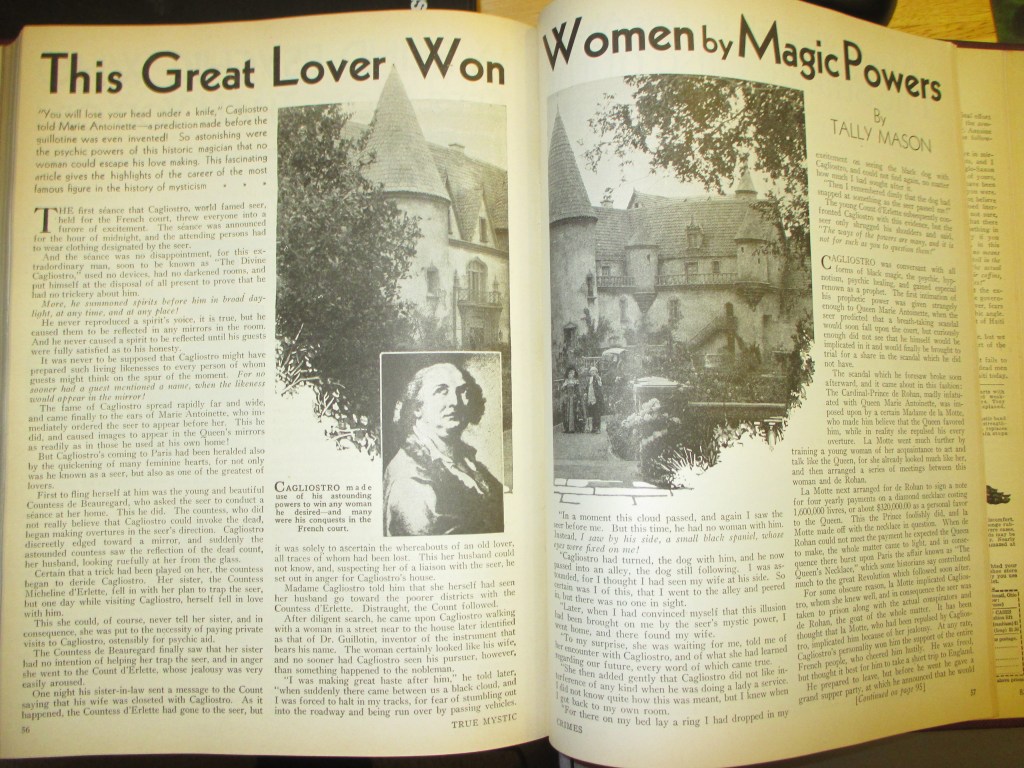
Back in his native Sauk City, August Derleth would begin writing for a pulp magazine titled Weird Tales. The date of his departure suggests the Fawcetts might have let him go before the transition to True Mystic Crimes—but that issue still contained two pieces from “Tally Mason,” whose manuscripts still survive among Derleth’s papers at the Wisconsin Historical Society. Both pieces were nominally nonfiction articles; “Your Picture Can Be Your Death Warrant” was about how images could contain a mystical link to their original subject, citing The Portrait of Dorian Gray as one example; the second, “This Great Lover Won Women by Magic Powers” was about the 18th-century occultist Alessandro Cagliostro, whose reputation and infamy has, over the centuries, become the stuff of legend and a great deal of fiction.

Yet “This Great Lover Won Women by Magic Powers” is interesting because of one particular thread that Derleth wove into the mix of facts and fiction:

But Cagliostro’s coming to Paris had been heralded also by the quickening of many feminine hearts, for not only was he known as a seer, but also as one of the greatest of lovers.

First to fling herself at him was the young and beautiful Countess de Beauregard, who asked the seer to conduct a séance at her home. This he did. The countess, who did not really believe that Cagliostro could invoke the dead, began making overtures in the seer’s direction. Cagliostro discreetly edged toward a mirror, and suddenly the astounded Countess saw the reflection of the dead count, her husband, looking ruefully at her from the glass.

Certain that a trick had been played on her, the countess began to deride Cagliostro. Her sister, the countess Micheline D’erlette, fell in with her plan to trap the seer, but one day while visiting Cagliostro, herself fell in love with him.

This she could, of course, never tell her sister, and in consequence, she was put to the necessity of paying private visits to Cagliostro, ostensibly for psychic aid.

The Countess de Beauregard finally saw that her sister had no intention of helping her trap the seer, and in anger she went to the Count d’Erlette, whose jealousy was very easily aroused.

One night his sister-in-law sent a message to the Count saying that his wife was closeted with Cagliostro. As it happened, the Countess d’Erlette had gone to the seer, but it was solely to ascertain the whereabouts of an old lover, all traces of whom had been lost. This her husband could not know, and, suspecting her of a liason with the seer, he set out in anger for Cagliostro’s house.

Madame Cagliostro told him that she herself had seen her husband go toward the poorer districts with the Countess d’Erlette. Distraught, the Count followed.

After diligent search, he came upon Cagliostro walking with a woman in a street near to the house later identified as that of Dr. Guillotin, inventor of the instrument that bears his name. The woman certainly looked like his wife, and no sooner had Cagliostro seen his pursuer, however, than something happened to the nobleman.

“I was making great haste after him,” he told later, “when suddenly there came between us a black cloud, and I was forced to halt in my tracks, for fear of stumbling out into the roadway and being run over by passing vehicles.

“In a moment this cloud passed, and again I saw the seer before me. but this time, he had no woman with him. Instead, I saw by his side, a small black spaniel, whose eyes were fixed on me!

“Cagliostro had turned, the dog with him, and he now passed into an alley, the dog still following. I was astounded, for I thought I had seen my wife at his side. So certain was I of this, that I went to the alley and peered in, but there was no one in sight.

“Later, when I had convinced myself that this illusion had been brought on me by the seer’s mystic power, I went home, and there found my wife.

“To my surprise, she was waiting for me, told me of her encounter with Cagliostro, and of what she had learned regarding our future, every word of which came true.

“She then added gently that Cagliostro did not like interference of any kind when he was doing a lady a service. I did not know quite how this was meant, but I knew when I got back to my own room.

“For there on my bed lay a ring I had dropped in my excitement on seeing the black dog with Cagliostro, and could not find again, no matter how much I had sought after it.

“Then I remembered dimly that the dog had snapped at something as the seer passed me!”

The young Count d’Erlette subsequently confronted Cagliostro with this evidence, but the seer only shrugged his shoulders and said, “The ways of the powers are many, and it is not for such as you to question them!

Tally Mason (August Derleth), True Mystic Crimes 56-57

A sequel to this episode quickly followed, on the occasion of Cagliostro giving a dinner-party after the Affair of the Diamond Necklace, just before leaving France for England. Once again, the Count d’Erlette featured prominently:

[Cagliostro] followed this prediction with that of the fall of the great French prison, the Bastille, and the creation of July 14 as National Day.

At this point, the Count d’Erlette asked rather scoffingly whether Cagliostro could see into his future and tell him what would become of the house of Erlette in the Revolution.

Cagliostro nodded and replied, “First, I see your father dead in this bed of heart failure at the same time that the mob is clamoring at the gates of your house in Paris.

“Then, I see the lovely Countess, your wife, killed by order of the provisionary government.”

“And me?” Asked the Count jovially. “What is to become of me?”

“You will flee with your son, Michel, but not before you have seen your younger brother, Auguste, killed by the mob. You will go to the German countries; I see you in Bavaria. Only for a short time will you be there. Your son will wed, and in turn have a son named Michel. Both you and your son will return to Paris during the time of Napoleon, but your grandson will remain in Bavaria.

“The House of Erlette will come to being once more during a decade many years from now, but the line that you represent will never again return to Paris. Your grandson, Michel, will go to America, and his sons will Iive there for all time. I see your grandson buried near the great American river called ‘Father of the Waters!'”

This Count d’Erlette ridiculed word for word, but every pronouncement came to pass, and even to this day the grave of Michel, the grandson, may be seen in a small town in southern Wisconsin.

Tally Mason (August Derleth), True Mystic Crimes 95

For readers familiar with Mythos fiction, the name “d’Erlette” might ring a bell.

Only a wizard would possess those mouldering, maggoty volumes of monstrous and fantastic lore; only a thaumaturgical adept would date the darker mysteries of the Necronomicon, Ludvig Prinn’s Mysteries of the Worm, the Black Rites of Luveh-Keraph, priest of Bast, or Comte d’Erlette’s ghastly Cultes des Goules.

Robert Bloch, “The Suicide in the Study,” Weird Tales June 1935

Lovecraft would shed some light on this little mystery in a letter:

Comte d’Erlette’s Cultes des Goules? An invention of Bloch’s. The name Comte d’Erlette, however, represents an actual (& harmless) ancestor of August W. Derleth’s, who was a royalist emigré from France in 1792 & became naturalized in Germany under the slightly Teutonised name of Derleth. His son, emigrating to Wisconsin in 1835, was the founder of the Derleth line in America.

H. P. Lovecraft to Willis Conover, Jr., 14 Aug 1936, Letters to Robert Bloch & Others 382

In other words, Derleth incorporated his own slightly-fictionalized family history to pad out his article on Cagliostro.

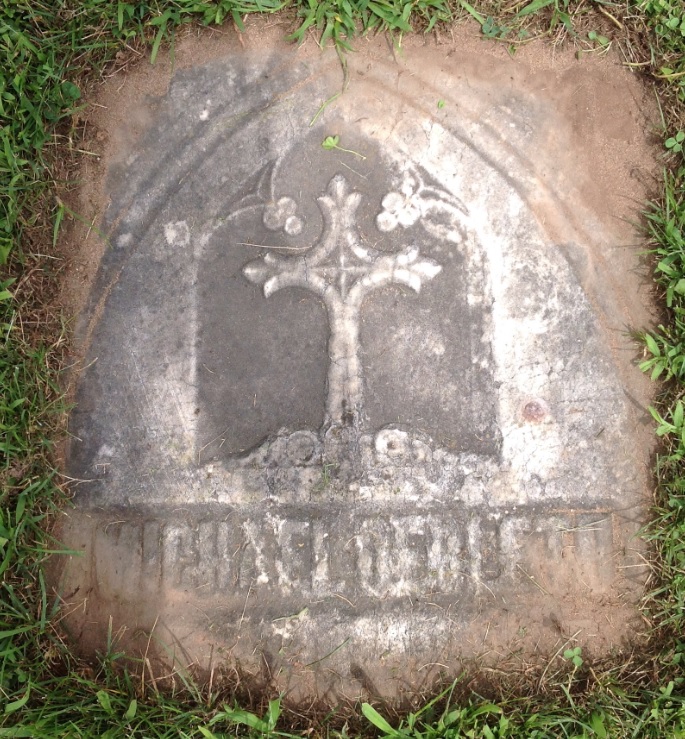
The gravestone of Michael Derleth, great-grandfather of August W. Derleth

The letter in which August Derleth revealed this heritage to Lovecraft does not appear to survive, but in their correspondence, Lovecraft begins to refer to him as “Auguste-Guillaume, Comte d’Erlette” (ES 2.455) in February 1932, so the subject probably came up in early 1932 or late 1931. Lovecraft would refer to Derleth as the “Comte d’Erlette” in his letters occasionally from then on, and the Cultes des Goules was added to the shelf of eldritch tomes that appear in his stories, and that of their contemporaries and literary heirs, though Bloch’s choice of attributing the volume to d’Erlette sometimes led to some confusion as to who actually invented it.

Derleth himself never chose to expand on his fictional ancestor in any of his Mythos fiction, though in his Solar Pons story “The Adventure of the Six Silver Spiders” (1950), the premise of the story is a Mythos red herring involving the sale of the private library of Paul Guillaume, the Comte d’Erlette, which reads in part:

I glanced at several of the other titles listed—d’Erlette, Paul Henri, Comte de: Cultes des Goules, Rouen, 1737; Prinn, Ludvig: De Vermis Mysteriis, Prague, 1807; Liber Ivonis (Author Unknown), Rome, 1662;—all manifestly occult literature.

August Derleth, “The Adventure of the Six Silver Spiders,” The Solar Pons Omnibus 2.848

Solar Pons is quick to point out to his companion Parker that the whole catalogue is a hoax.

“But the Count d’Erlette?”

“Erlette is a provincial name in France. The family existed in some numbers before the Revolution, but the last member to carry a title died in 1919.[“]

August Derleth, “The Adventure of the Six Silver Spiders,” The Solar Pons Omnibus 2.849

Derleth was not the only one to have a bit of fun with his fictitious ancestor, as many subsequent writers did write about the author of Cultes des Goules and his family.

It is not too much to say that “Tally Mason’s” article on Cagliostro is part of the secret history of the Mythos—not a direct part of the web of interconnecting stories that Lovecraft & Co. wrote, but a precursor and bit of background. One has to wonder if Derleth ever showed the piece to Lovecraft.


Bobby Derie is the author of Weird Talers: Essays on Robert E. Howard and Others and Sex and the Cthulhu Mythos.

Deep Cuts in a Lovecraftian Vein uses Amazon Associate links. As an Amazon Associate I earn from qualifying purchases.
Tentacles and Wedding Bells (2022) by Margaret L. Carter

“What’s tentacle porn?”

“You don’t want to know,” he muttered.

M. L. Carter, “In the Tentacles of Love” in Tentacles and Wedding Bells (2022)

In Sex & the Cthulhu Mythos, there is a section of about 11 pages tracing the thematic history of tentacles and erotica as it applies to the development of weird fiction. For those curious, go read it. There are citations for those who wish further reading and scholarly sources.
For the purposes of this review, it suffices to say that tentacles have been associated with weird fiction in general since around the turn of the century, and with the Mythos in particular since the days of H. P. Lovecraft, Robert E. Howard, Clark Ashton Smith, C. L. Moore, and August Derleth. Tentacles were depicted as alien and unnatural…especially when, as the popularity of Japanese anime and manga boomed in the 1980s and 1990s in the United States and other markets, tentacle erotica became increasingly more available and conspicuously a part of the erotic vernacular lexicon, even if it remained a niche interest.

Tentacle erotica is often mentioned with an expression of disgust, perversion, and transgression against the natural order, and the beings equipped with tentacles are typically inhuman, malign, and rapacious. Quite literally; “tentacle rape” has become a byword for the whole mode of tentacle erotica. It’s become almost a farcical joke: Tentacle Grape soda is a product that uses the nod-and-wink toward the trope of sexual violation by faceless phallic feelers as a selling point. Many later works have leaned into this and begun to play it for sexual titillation or laughs, as in Booty Call of Cthulhu (2012) by Dalia Daudelin or “Le Pornomicon” (2005) by Logan Kowalsky.

Yet what you don’t often see is a sex-positive take on tentacle sex.

Tentacles and Wedding Bells (2022) by Margaret L. Carter is a combination of two light-hearted and sexy novelettes that had previously been published at Ellora’s Cave, an early 2000s ebook publisher that focused on romance and erotica, and which shut down in 2016. While some might cheer Amazon’s dominant share of the market, this does come at the cost of less variety from smaller independent publishers like Ellora’s Cove. Yet now, they are available once again, this time collected together.

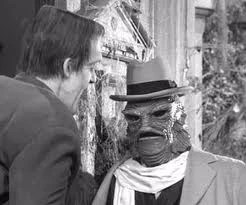
“Tentacles of Love” (2007) focuses on a wedding, where protagonist Lauren meets her future husband Blake’s family—a Mythos-inflected version of the Addams family or the Munsters, with Uncle Dexter from Innsmouth, Aunt Lavinia from Dunwich, Great-Aunt Asenath from Arkham, and of course, her fiancé’s twin brother Wilbur in the attic.

Uncle Gilbert, The Munsters (1965)

Only Wilbur takes more after their father:

A translucent mound of rainbow-colored bubbles filled the space, emitting blue and violet sparks whenever its surface rippled. A pseudopod oozed outward for a second, then withdrew into the mass, leaving a glittery trail on the floorboards.

M. L. Carter, “In the Tentacles of Love” in Tentacles and Wedding Bells (2022)

Wilbur, it turns out, is a shy, introverted soul who lives on the internet, listens to jazz, and enjoys Japanese anime (“Especially the giant robots and the creatures with tentacles.”) Pretty much like any NEET twenty-something. And Wilbur isn’t the only one with tentacles, as his brother soon reveals. For fans of “The Dunwich Horror” who have guessed at the purpose of Wilbur Whateley’s odd anatomy, M. L. Carter has the answers to your questions.

“Weird Wedding Guest” (2013) is the direct sequel; it’s Lauren and Blake’s wedding, and Wilbur meets bridesmaid Roxanne, who had been corresponding with Wilbur over email. In the dim and distant past of 2013 there was no internet dating service for the spawn of Yog-Sothoth, so the meet-cute is a little awkward…but it works.

Okay, so my email pal is half alien. He’s not really scary when you get past that fact.

M. L. Carter, “In the Tentacles of Love” in Tentacles and Wedding Bells (2022)

There are two reasons that these stories work. First, Margaret L. Carter knows her Lovecraft, and all the in-jokes and even the lore is spot-on. Fans of the Mythos will enjoy the Easter eggs and attention to detail, and the imagination at play. Second, the stories are played straight as spicy romance stories with women protagonists. These aren’t Derlethian pastiches, nor outright farces. These are women who take a great deal of weirdness in stride, and slowly come to explore some novel erotic circumstances…and their emotional attachment to their odd-looking but loveable paramours grows deeper. It’s a familiar story; like Beauty and the Beast, but more domestic.

Yet that’s why it works. Carter plays the tropes of the spicy romance off of the Lovecraftian callbacks beautifully. The sex scenes are creative and original, but more important than that they feel earned. This isn’t a story of sexual assault by eldritch entities, but a sex-positive exploration of new sensations between two willing and considerate partners.

Tentacle and Wedding Bells isn’t cosmic horror, but it is fun and intelligent. Carter is very deliberately subverting expectations in this story; the references to Wilbur’s interest in tentacle porn make a lot of sense for unstable congeries of iridescent bubbles that can exude pseudopods that double as genitalia.

It is nice, after all these years, to see both parts of Tentacles and Wedding Bells (2023) together at last and relatively available, either through Amazon or other retailers.


Bobby Derie is the author of Weird Talers: Essays on Robert E. Howard and Others and Sex and the Cthulhu Mythos.

Deep Cuts in a Lovecraftian Vein uses Amazon Associate links. As an Amazon Associate I earn from qualifying purchases.