In November 1930, Fawcett Publications released a new pulp: Mystic Magazine. This lavishly illustrated, large-size pulp covered all manner of mystical phenomena, from seances to mediumship, palmistry to graphology, astrology to vampirism. In content, Mystic Magazine was a mix of nonfiction articles and the occasional story, written in the confessional style of Ghost Stories. In tone, the pulp seemed to cater more toward women—there was a kind of spiritualist lonely hearts column, regular features about what numerology or astrology said about your husband or love prospects, and the stories tended to have a romantic bent.
The pulp ran for four issues. With the fifth issue, Fawcett changed the title and approach; it became True Mystic Crimes (April 1931), adding in sensationalist material about Chinese tongs in San Francisco, murders caused by cults or solved by dreams or clairvoyance, zombies in Haiti, and all that sort of thing. Complete as the change was, the pulp still failed to find an audience among the crowded newsstands. The pulp ended there, to be no more than a rare collectible for pulp aficionados.
August Derleth earned his Bachelor of Arts from the University of Wisconsin in 1930. Derleth’s earliest letters from Clark Ashton Smith, addressed to him in Milwaukee in November 1930, occasionally touch on Mystic Magazine. Despite not being listed on the masthead, Derleth was an associate editor for the magazine, and published at least three stories and articles in Mystic under the byline “Tally Mason.” Still, the writing for the pulp was on the wall:
Dear Smith. In view of the fact the Fawcetts have discontinued Mystic together with its editor, my address after 17 February will be Sauk City, Wisconsin.
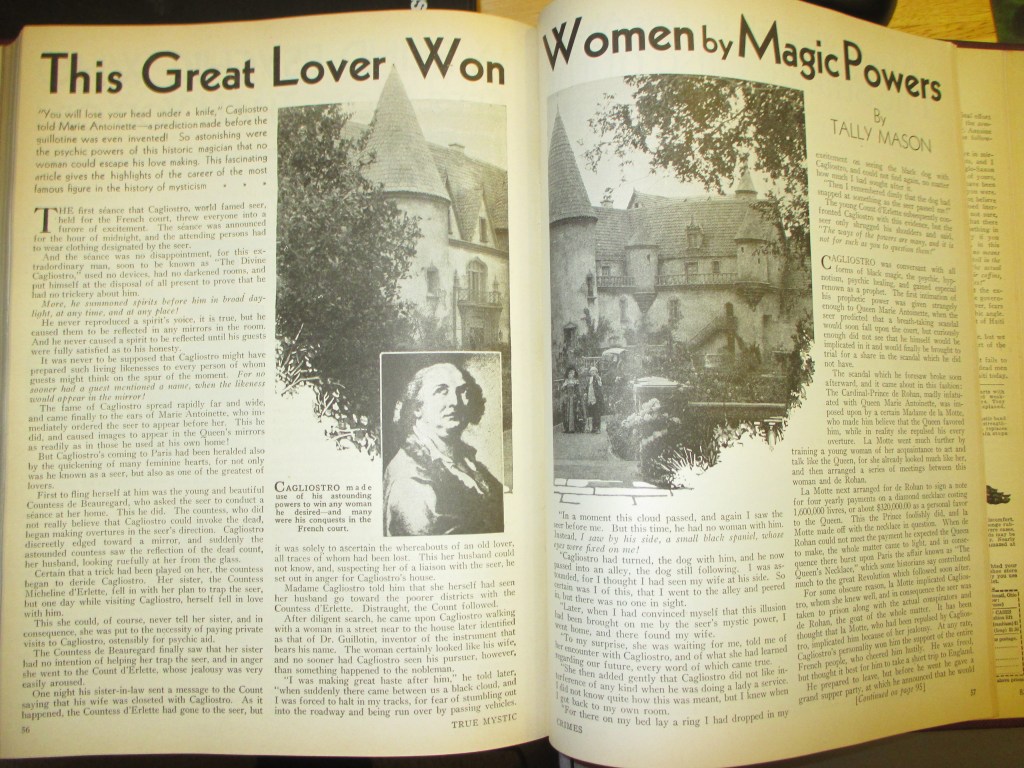
Back in his native Sauk City, August Derleth would begin writing for a pulp magazine titled Weird Tales. The date of his departure suggests the Fawcetts might have let him go before the transition to True Mystic Crimes—but that issue still contained two pieces from “Tally Mason,” whose manuscripts still survive among Derleth’s papers at the Wisconsin Historical Society. Both pieces were nominally nonfiction articles; “Your Picture Can Be Your Death Warrant” was about how images could contain a mystical link to their original subject, citing The Portrait of Dorian Gray as one example; the second, “This Great Lover Won Women by Magic Powers” was about the 18th-century occultist Alessandro Cagliostro, whose reputation and infamy has, over the centuries, become the stuff of legend and a great deal of fiction.
Yet “This Great Lover Won Women by Magic Powers” is interesting because of one particular thread that Derleth wove into the mix of facts and fiction:
But Cagliostro’s coming to Paris had been heralded also by the quickening of many feminine hearts, for not only was he known as a seer, but also as one of the greatest of lovers.
First to fling herself at him was the young and beautiful Countess de Beauregard, who asked the seer to conduct a séance at her home. This he did. The countess, who did not really believe that Cagliostro could invoke the dead, began making overtures in the seer’s direction. Cagliostro discreetly edged toward a mirror, and suddenly the astounded Countess saw the reflection of the dead count, her husband, looking ruefully at her from the glass.
Certain that a trick had been played on her, the countess began to deride Cagliostro. Her sister, the countess Micheline D’erlette, fell in with her plan to trap the seer, but one day while visiting Cagliostro, herself fell in love with him.
This she could, of course, never tell her sister, and in consequence, she was put to the necessity of paying private visits to Cagliostro, ostensibly for psychic aid.
The Countess de Beauregard finally saw that her sister had no intention of helping her trap the seer, and in anger she went to the Count d’Erlette, whose jealousy was very easily aroused.
One night his sister-in-law sent a message to the Count saying that his wife was closeted with Cagliostro. As it happened, the Countess d’Erlette had gone to the seer, but it was solely to ascertain the whereabouts of an old lover, all traces of whom had been lost. This her husband could not know, and, suspecting her of a liason with the seer, he set out in anger for Cagliostro’s house.
Madame Cagliostro told him that she herself had seen her husband go toward the poorer districts with the Countess d’Erlette. Distraught, the Count followed.
After diligent search, he came upon Cagliostro walking with a woman in a street near to the house later identified as that of Dr. Guillotin, inventor of the instrument that bears his name. The woman certainly looked like his wife, and no sooner had Cagliostro seen his pursuer, however, than something happened to the nobleman.
“I was making great haste after him,” he told later, “when suddenly there came between us a black cloud, and I was forced to halt in my tracks, for fear of stumbling out into the roadway and being run over by passing vehicles.
“In a moment this cloud passed, and again I saw the seer before me. but this time, he had no woman with him. Instead, I saw by his side, a small black spaniel, whose eyes were fixed on me!
“Cagliostro had turned, the dog with him, and he now passed into an alley, the dog still following. I was astounded, for I thought I had seen my wife at his side. So certain was I of this, that I went to the alley and peered in, but there was no one in sight.
“Later, when I had convinced myself that this illusion had been brought on me by the seer’s mystic power, I went home, and there found my wife.
“To my surprise, she was waiting for me, told me of her encounter with Cagliostro, and of what she had learned regarding our future, every word of which came true.
“She then added gently that Cagliostro did not like interference of any kind when he was doing a lady a service. I did not know quite how this was meant, but I knew when I got back to my own room.
“For there on my bed lay a ring I had dropped in my excitement on seeing the black dog with Cagliostro, and could not find again, no matter how much I had sought after it.
“Then I remembered dimly that the dog had snapped at something as the seer passed me!”
The young Count d’Erlette subsequently confronted Cagliostro with this evidence, but the seer only shrugged his shoulders and said, “The ways of the powers are many, and it is not for such as you to question them!“
A sequel to this episode quickly followed, on the occasion of Cagliostro giving a dinner-party after the Affair of the Diamond Necklace, just before leaving France for England. Once again, the Count d’Erlette featured prominently:
[Cagliostro] followed this prediction with that of the fall of the great French prison, the Bastille, and the creation of July 14 as National Day.
At this point, the Count d’Erlette asked rather scoffingly whether Cagliostro could see into his future and tell him what would become of the house of Erlette in the Revolution.
Cagliostro nodded and replied, “First, I see your father dead in this bed of heart failure at the same time that the mob is clamoring at the gates of your house in Paris.
“Then, I see the lovely Countess, your wife, killed by order of the provisionary government.”
“And me?” Asked the Count jovially. “What is to become of me?”
“You will flee with your son, Michel, but not before you have seen your younger brother, Auguste, killed by the mob. You will go to the German countries; I see you in Bavaria. Only for a short time will you be there. Your son will wed, and in turn have a son named Michel. Both you and your son will return to Paris during the time of Napoleon, but your grandson will remain in Bavaria.
“The House of Erlette will come to being once more during a decade many years from now, but the line that you represent will never again return to Paris. Your grandson, Michel, will go to America, and his sons will Iive there for all time. I see your grandson buried near the great American river called ‘Father of the Waters!'”
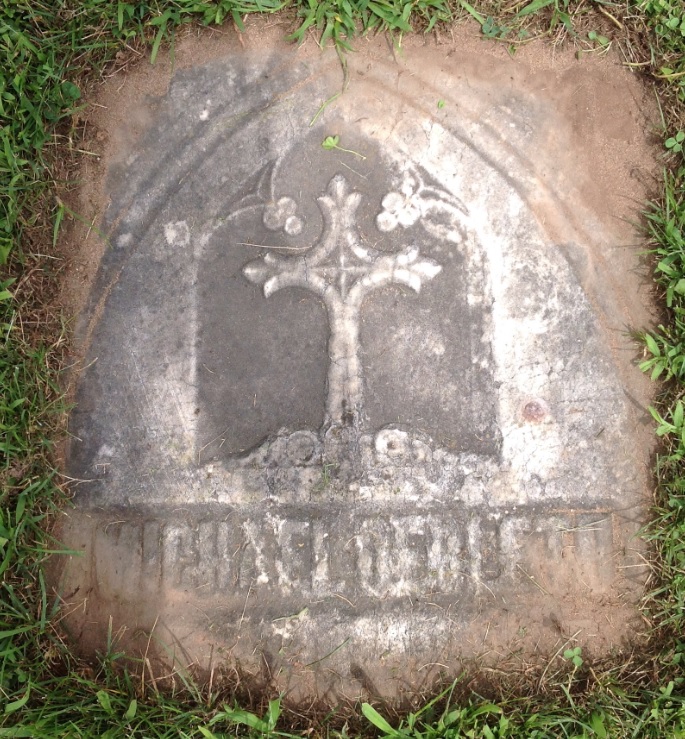
This Count d’Erlette ridiculed word for word, but every pronouncement came to pass, and even to this day the grave of Michel, the grandson, may be seen in a small town in southern Wisconsin.
For readers familiar with Mythos fiction, the name “d’Erlette” might ring a bell.
Only a wizard would possess those mouldering, maggoty volumes of monstrous and fantastic lore; only a thaumaturgical adept would date the darker mysteries of the Necronomicon, Ludvig Prinn’s Mysteries of the Worm, the Black Rites of Luveh-Keraph, priest of Bast, or Comte d’Erlette’s ghastly Cultes des Goules.
Lovecraft would shed some light on this little mystery in a letter:
Comte d’Erlette’s Cultes des Goules? An invention of Bloch’s. The name Comte d’Erlette, however, represents an actual (& harmless) ancestor of August W. Derleth’s, who was a royalist emigré from France in 1792 & became naturalized in Germany under the slightly Teutonised name of Derleth. His son, emigrating to Wisconsin in 1835, was the founder of the Derleth line in America.
The letter in which August Derleth revealed this heritage to Lovecraft does not appear to survive, but in their correspondence, Lovecraft begins to refer to him as “Auguste-Guillaume, Comte d’Erlette” (ES 2.455) in February 1932, so the subject probably came up in early 1932 or late 1931. Lovecraft would refer to Derleth as the “Comte d’Erlette” in his letters occasionally from then on, and the Cultes des Goules was added to the shelf of eldritch tomes that appear in his stories, and that of their contemporaries and literary heirs, though Bloch’s choice of attributing the volume to d’Erlette sometimes led to some confusion as to who actually invented it.
Derleth himself never chose to expand on his fictional ancestor in any of his Mythos fiction, though in his Solar Pons story “The Adventure of the Six Silver Spiders” (1950), the premise of the story is a Mythos red herring involving the sale of the private library of Paul Guillaume, the Comte d’Erlette, which reads in part:
I glanced at several of the other titles listed—d’Erlette, Paul Henri, Comte de: Cultes des Goules, Rouen, 1737; Prinn, Ludvig: De Vermis Mysteriis, Prague, 1807; Liber Ivonis (Author Unknown), Rome, 1662;—all manifestly occult literature.
August Derleth, “The Adventure of the Six Silver Spiders,” The Solar Pons Omnibus 2.848
Solar Pons is quick to point out to his companion Parker that the whole catalogue is a hoax.
“But the Count d’Erlette?”
“Erlette is a provincial name in France. The family existed in some numbers before the Revolution, but the last member to carry a title died in 1919.[“]
August Derleth, “The Adventure of the Six Silver Spiders,” The Solar Pons Omnibus 2.849
Derleth was not the only one to have a bit of fun with his fictitious ancestor, as many subsequent writers did write about the author of Cultes des Goules and his family.
It is not too much to say that “Tally Mason’s” article on Cagliostro is part of the secret history of the Mythos—not a direct part of the web of interconnecting stories that Lovecraft & Co. wrote, but a precursor and bit of background. One has to wonder if Derleth ever showed the piece to Lovecraft.
In Sex & the Cthulhu Mythos, there is a section of about 11 pages tracing the thematic history of tentacles and erotica as it applies to the development of weird fiction. For those curious, go read it. There are citations for those who wish further reading and scholarly sources.
For the purposes of this review, it suffices to say that tentacles have been associated with weird fiction in general since around the turn of the century, and with the Mythos in particular since the days of H. P. Lovecraft, Robert E. Howard, Clark Ashton Smith, C. L. Moore, and August Derleth. Tentacles were depicted as alien and unnatural…especially when, as the popularity of Japanese anime and manga boomed in the 1980s and 1990s in the United States and other markets, tentacle erotica became increasingly more available and conspicuously a part of the erotic vernacular lexicon, even if it remained a niche interest.
Tentacle erotica is often mentioned with an expression of disgust, perversion, and transgression against the natural order, and the beings equipped with tentacles are typically inhuman, malign, and rapacious. Quite literally; “tentacle rape” has become a byword for the whole mode of tentacle erotica. It’s become almost a farcical joke: Tentacle Grape soda is a product that uses the nod-and-wink toward the trope of sexual violation by faceless phallic feelers as a selling point. Many later works have leaned into this and begun to play it for sexual titillation or laughs, as in Booty Call of Cthulhu (2012) by Dalia Daudelin or “Le Pornomicon” (2005) by Logan Kowalsky.
Yet what you don’t often see is a sex-positive take on tentacle sex.
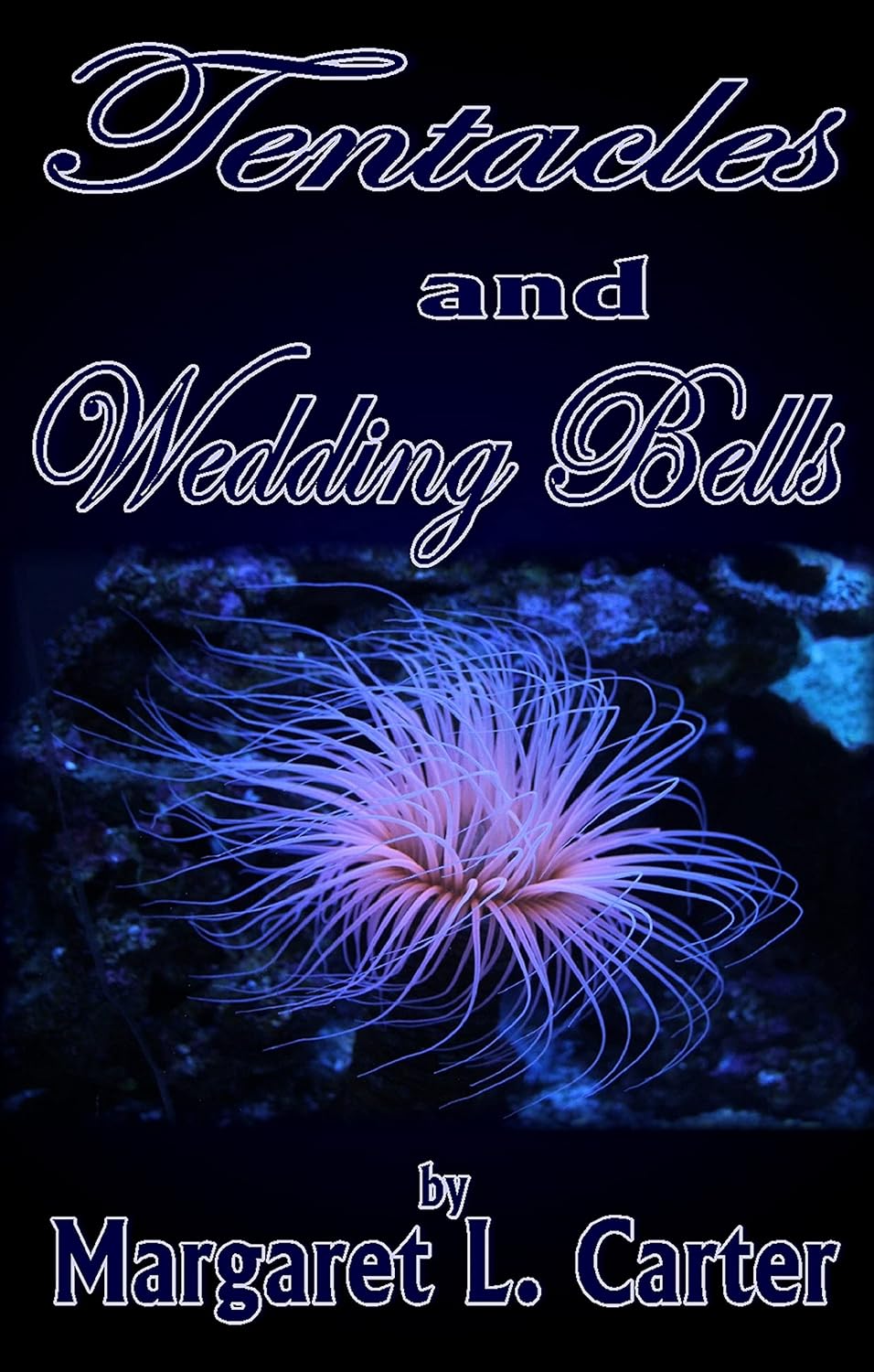
Tentacles and Wedding Bells(2022) by Margaret L. Carter is a combination of two light-hearted and sexy novelettes that had previously been published at Ellora’s Cave, an early 2000s ebook publisher that focused on romance and erotica, and which shut down in 2016. While some might cheer Amazon’s dominant share of the market, this does come at the cost of less variety from smaller independent publishers like Ellora’s Cove. Yet now, they are available once again, this time collected together.
“Tentacles of Love” (2007) focuses on a wedding, where protagonist Lauren meets her future husband Blake’s family—a Mythos-inflected version of the Addams family or the Munsters, with Uncle Dexter from Innsmouth, Aunt Lavinia from Dunwich, Great-Aunt Asenath from Arkham, and of course, her fiancé’s twin brother Wilbur in the attic.
A translucent mound of rainbow-colored bubbles filled the space, emitting blue and violet sparks whenever its surface rippled. A pseudopod oozed outward for a second, then withdrew into the mass, leaving a glittery trail on the floorboards.
Wilbur, it turns out, is a shy, introverted soul who lives on the internet, listens to jazz, and enjoys Japanese anime (“Especially the giant robots and the creatures with tentacles.”) Pretty much like any NEET twenty-something. And Wilbur isn’t the only one with tentacles, as his brother soon reveals. For fans of “The Dunwich Horror” who have guessed at the purpose of Wilbur Whateley’s odd anatomy, M. L. Carter has the answers to your questions.
“Weird Wedding Guest” (2013) is the direct sequel; it’s Lauren and Blake’s wedding, and Wilbur meets bridesmaid Roxanne, who had been corresponding with Wilbur over email. In the dim and distant past of 2013 there was no internet dating service for the spawn of Yog-Sothoth, so the meet-cute is a little awkward…but it works.
Okay, so my email pal is half alien. He’s not really scary when you get past that fact.
There are two reasons that these stories work. First, Margaret L. Carter knows her Lovecraft, and all the in-jokes and even the lore is spot-on. Fans of the Mythos will enjoy the Easter eggs and attention to detail, and the imagination at play. Second, the stories are played straight as spicy romance stories with women protagonists. These aren’t Derlethian pastiches, nor outright farces. These are women who take a great deal of weirdness in stride, and slowly come to explore some novel erotic circumstances…and their emotional attachment to their odd-looking but loveable paramours grows deeper. It’s a familiar story; like Beauty and the Beast, but more domestic.
Yet that’s why it works. Carter plays the tropes of the spicy romance off of the Lovecraftian callbacks beautifully. The sex scenes are creative and original, but more important than that they feel earned. This isn’t a story of sexual assault by eldritch entities, but a sex-positive exploration of new sensations between two willing and considerate partners.
Tentacle and Wedding Bells isn’t cosmic horror, but it is fun and intelligent. Carter is very deliberately subverting expectations in this story; the references to Wilbur’s interest in tentacle porn make a lot of sense for unstable congeries of iridescent bubbles that can exude pseudopods that double as genitalia.
It is nice, after all these years, to see both parts of Tentacles and Wedding Bells (2023) together at last and relatively available, either through Amazon or other retailers.
“An Epic Adventure in the world of H. P. Lovecraft,” is what is promised, and that is what writer/artist Sebastien Dietz sets out to deliver. Yuggoth Rising is a German-language black-and-white 9-issue independent comic series, originally produced by Undergroundcomix.de in 2012. While physical issues were limited in number and now quite scarce, the series is collected in both German and English through Comixology/Amazon Kindle in three acts, beginning with Yuggoth Rising: Erster Act(Deutsch) / Yuggoth Rising: First Act(English, translated by Craig Stanton).
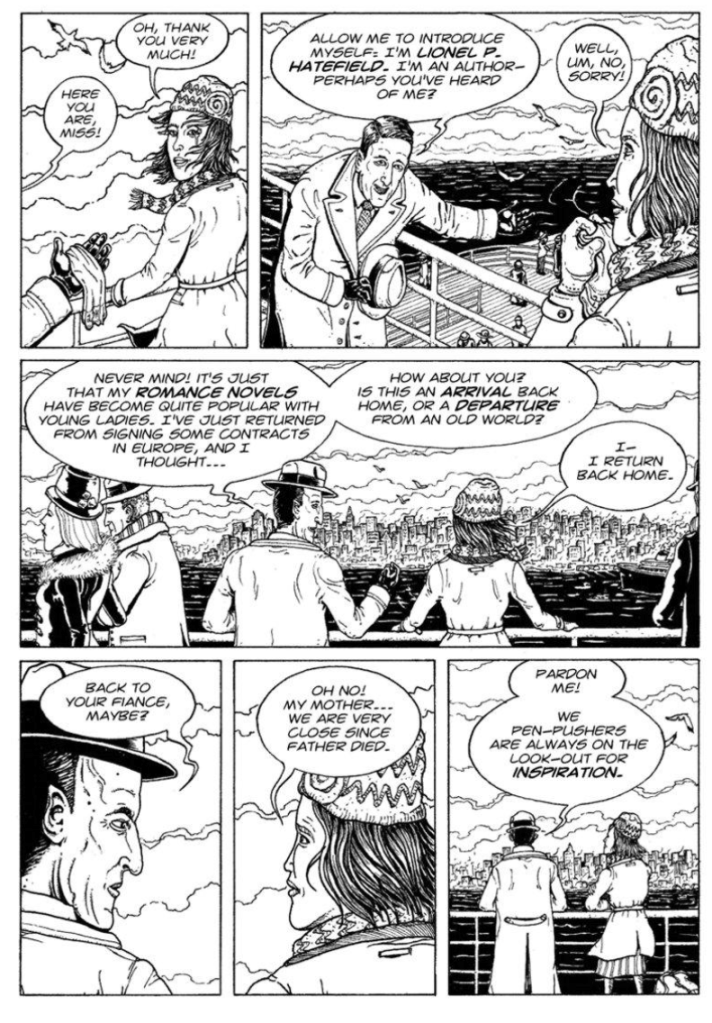
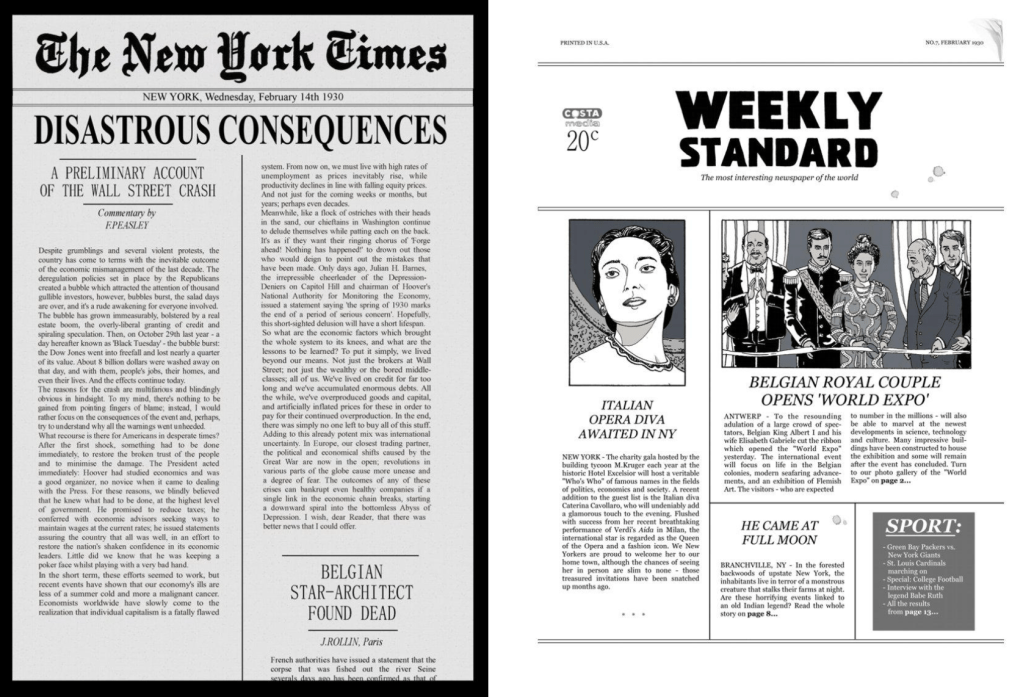
The epic adventure gets off on a bit of a left foot. February 1930, the Great Depression is settling in as our protagonist, an unemployed but educated young woman, returns to New York City—and on the ship runs into Lionel P. Hatecraft, author of popular romances.
At first glance, this is a set-up for a farce; in light of what comes later, it may be more appropriate to think of it as an unsubtle hint that while this takes place in the world of Lovecraft’s Mythos, this is not the world we know, the one that Lovecraft inhabited. Like the future envisaged by Robert W. Chambers in “The Repairer of Reputations,” or the 1920s and 30s envisaged in the Call of Cthulhu Roleplaying Game, this is a subtly different setting.
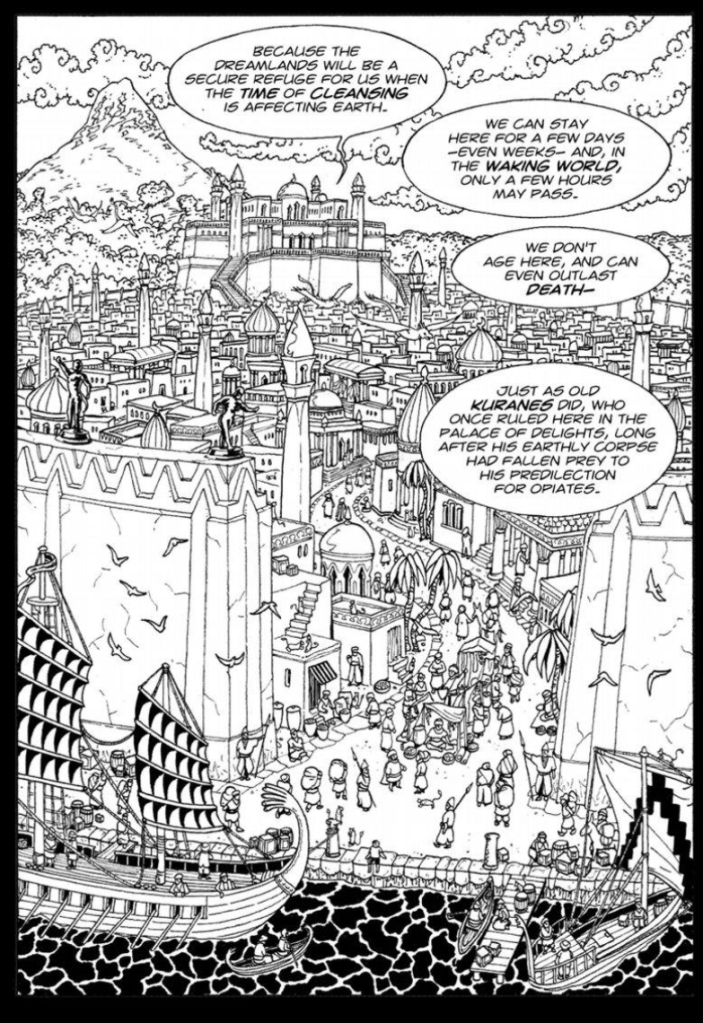
Dietz’ art is detailed, and cityscapes, streets, buildings, and ships are especially well-executed; he has an eye for splashes of darkness that stand out against the page. If there’s a criticism of his work, it is his human figures, whose heads are often slightly oversized in proportion to their bodies—but that’s more in the nature of a stylistic convention than a flaw. When he does break out for splash pages, the effect is worth it.
It’s not a tale told exclusively in comic panels. The end of each issue is punctuated by letters, articles, pages from magazines and newspapers, a convention used in other works to give the series a lived-in feel, to expand on things happening in many places during the same time period. Some of which are connected, and some of which are not.
Dietz’ story takes a broadly familiar shape: different threads, interweaving; widely separated characters working their way together until they meet. A young woman down on her luck, a brilliant expert in Mayan script, a millionaire embroiled in an international conspiracy, a slightly seedy newspaper porter on the werewolf-and-alien beat…ancient mysteries, the hunt for Planet X, and the Unaussprechlichen Kulten. The story moves at its own pace, neither too slowly or too quickly in this first act, these first three issues…
…but it just the opening act, the preliminaries. What revelations are here are just the beginning; our characters haven’t all met yet, the epic adventure has just begun. Taken by itself, it is promising…but readers shouldn’t be expecting “At the Mountains of Madness” or “The Shadow Out of Time,” although it takes a few cues from those works. Dietz’ inspirations more likely lie in Call of Cthulhu the Roleplaying Game, or the slightly pulpier adventures of August Derleth’s Trail of Cthulhu. The story of Yuggoth Rising—if the name isn’t clue enough—is things moving into place, the stars becoming right, cults and investigators getting into position, to destroy the world or redeem it.
If that sounds familiar, it’s because “when the stars are right” is the natural end-game of the Mythos; the Ragnorok or End Times, the eschatological frontier that looms in the unspecified future. Alan Moore and Jacen Burrows worked with that idea at the end of Providence, Jonas Anderson & Daniel Thollin did the same in 1000 Ögon: Cthulhu, and there are dozens of literary examples, in Cthulhu’s Reignand elsewhere. As with every Mythos story, it is less the tropes that are important than how it is told, how the characters develop and toward what end.
None of which a reader can tell in Yuggoth Rising: Erster Act, not on a first reading. On subsequent readings, readers can pick out more details, foreshadowings, hints that maybe they overlooked. Dietz has done a very credible job in setting the stage…and it is fortunate that this is a case where readers of both English and German have the opportunity to read it to the end, even if only digitally.
In naher zukunft existiert die menschliche zivilisation, wie wir sie kennen, nicht mehr.
Alte wesen sind aus ihrem schlaf erwacht und haben die herrschaft über die erde übernommen. Die wenigen überlebenden ergaben such der beuen religion und ihrer propheten.
Dies ist die geschichte eines mannes, der sich nicht unterwirft, sondern den kampf gegen die neuen mächte aufnimmt.
In the near future, human civilization as we know it will no longer exist.
Ancient beings have awakened from their sleep and have taken control of the earth. The few survivors surrendered to the new religion and its prophets.
This is the story of a man who does not submit, but takes up the fight against the new powers.
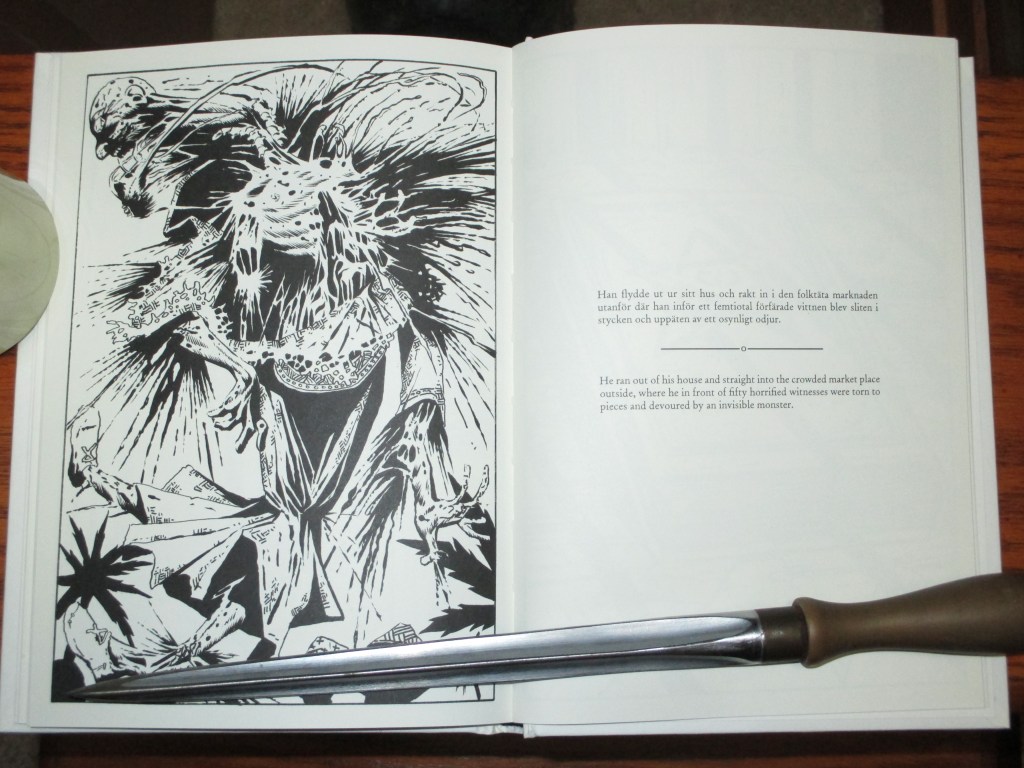
Back cover of Die Faust des Cthulhu 1.
English translation
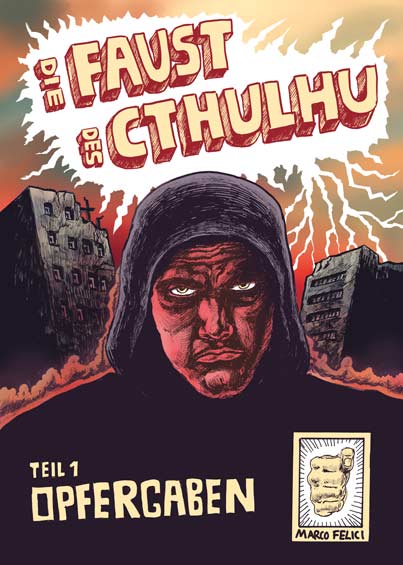
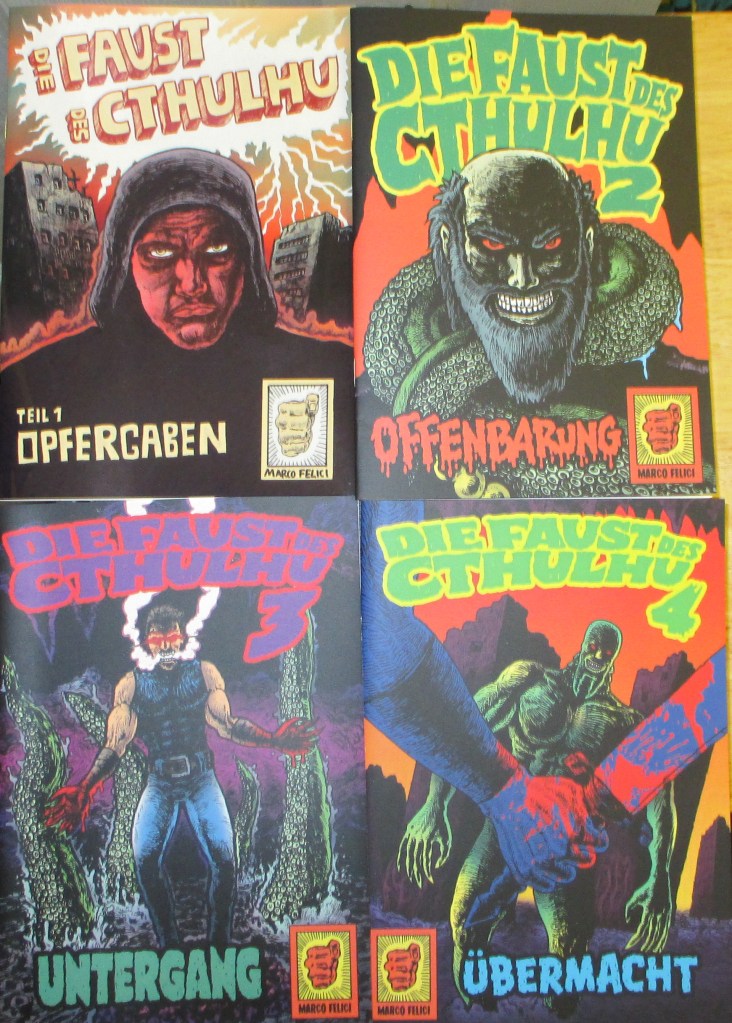
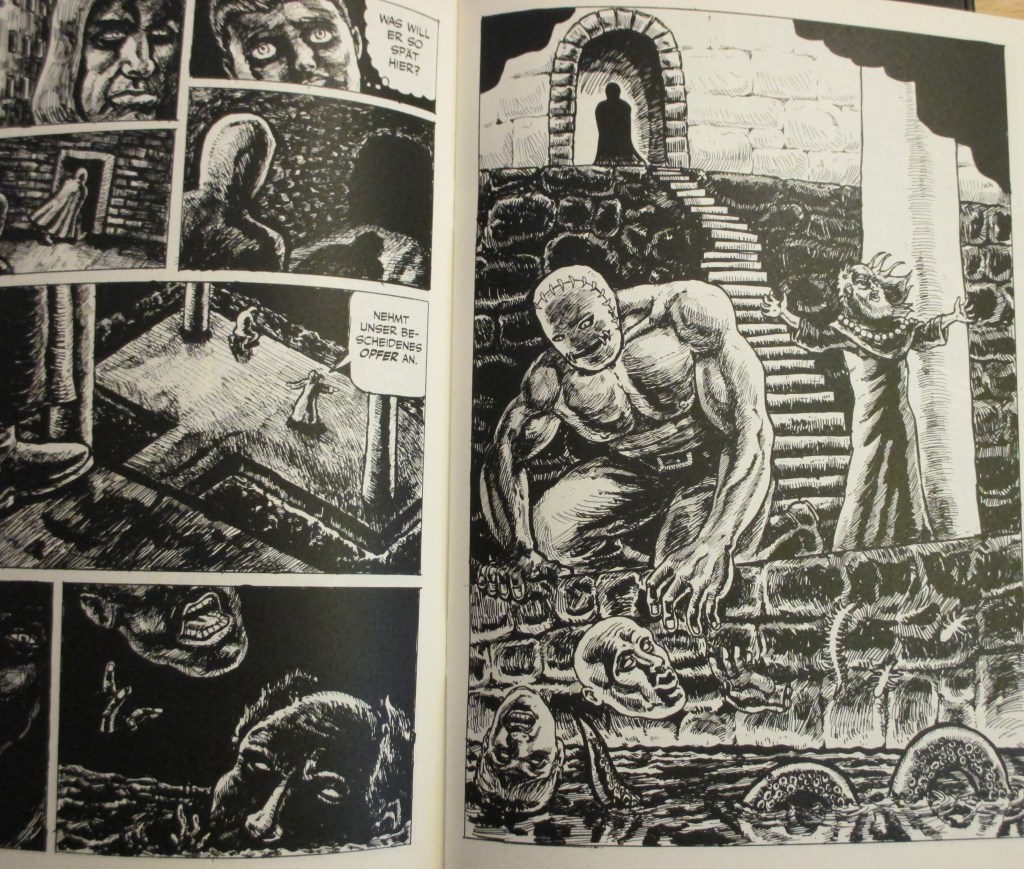
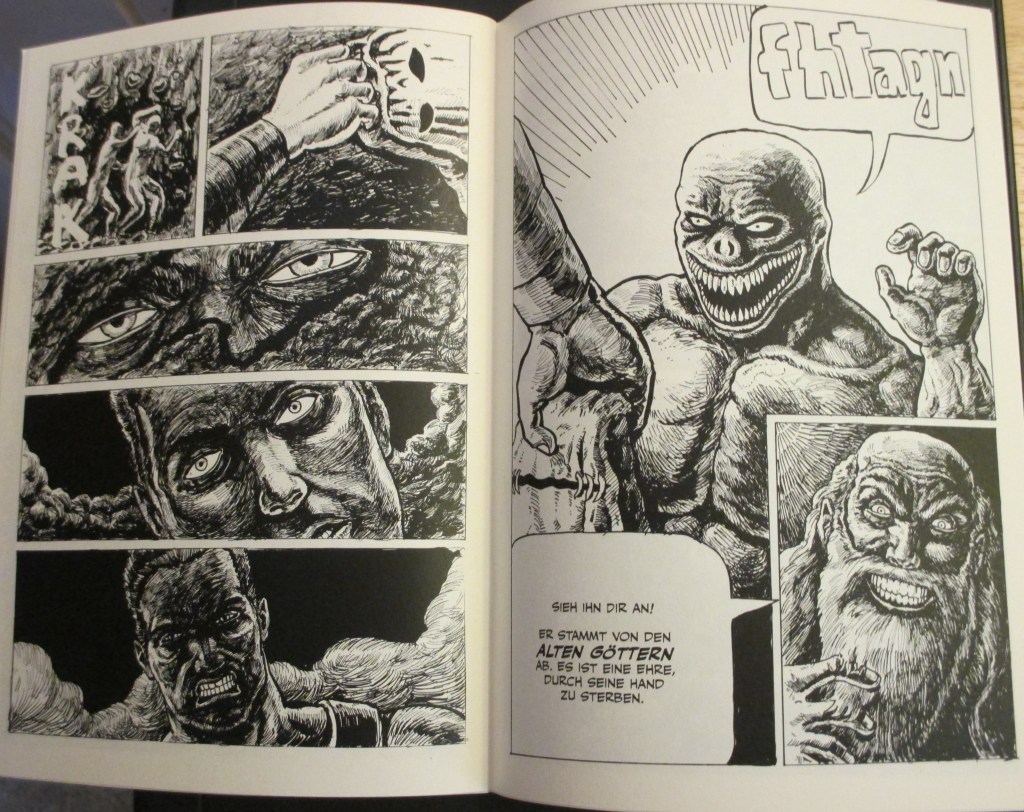
Die Faust des Cthulhu (The Fist of Cthulhu) is an independently published, black-and-white, German-language post-apocalyptic action-horror comic from writer/artist Marco Felici (lettering by Till Felix, cover colors & title design for issues 2-4 by Olaf Hänsel). Published irregularly, the series appears to consist of four separate issues and a collected edition:
Teil 1: Opfergaben (Part 1: Offerings) (2014)
Teil 2: Offenbarung (Part 2: Epiphany) (2015)
Teil 3: Untergang (Part 3: Downfall) (2018)
Teil 4: Übermacht (Part 4: Superiority) (2020)
Sammelband (Collected) (2022)
(Note: the listing I’ve seen for the collected edition says it collects the first five issues, so I may well be missing one.)
The art and story are strongly reminiscent of American underground comix of the 1970s-1980s, with the occasional shade of Richard Corben (especially in the color covers on issues 2-4), or Eastman and Laird’s early, relatively grungy-looking black-and-white issues of Teenage Mutant Ninja Turtles, long before the children’s cartoon softened their image and sensibilities. Story-wise, there may also be more than a touch of a manga influence, with shades of Fist of the North Star or other post-apocalyptic action-adventure series. Surprisingly, there’s also a touch of luchador influence, with the humanoid monsters sometimes going masked, at least initially.
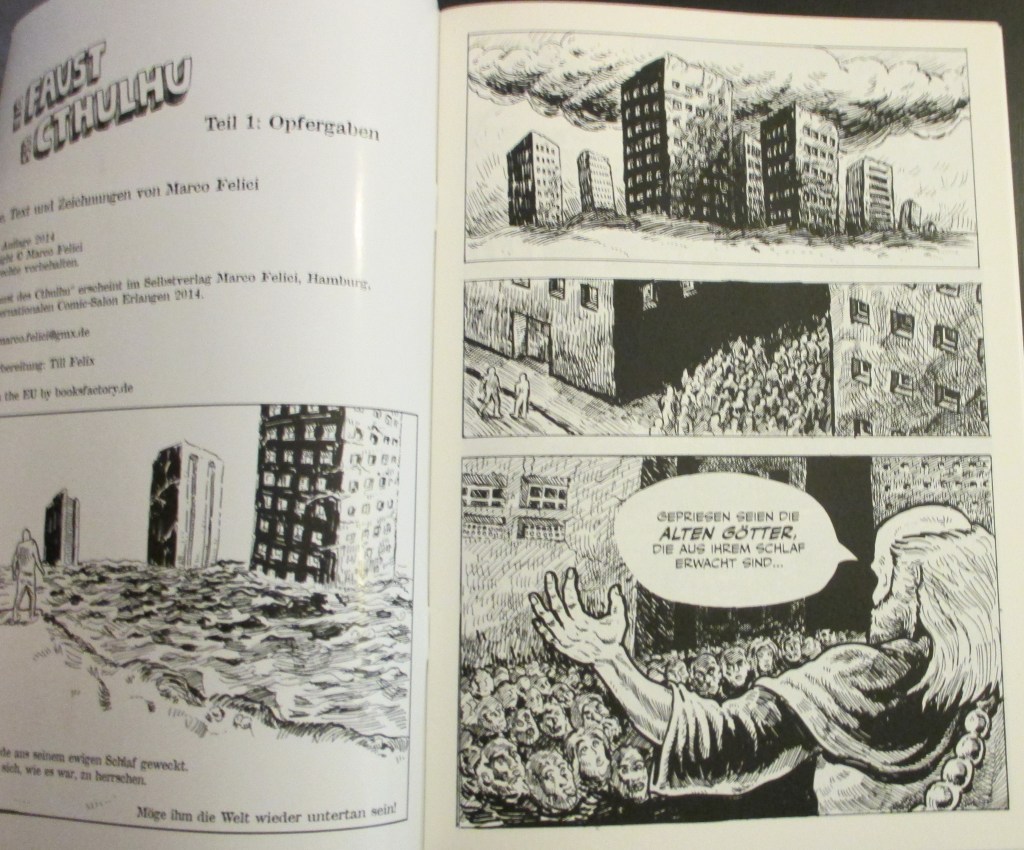
We open on the scene of a sacrifice to the Old Gods.
Fundamentally, the story is straightforward: a mysterious stranger takes exception to one of the regular innocent sacrifices to the Old Ones, and deals with a cultist and his minion—a half-human spawn of elder beings. Of course, our hero soon shows that he isn’t entirely human either…imagine if Wilbur Whateley decided he related more with his mother than Yog-Sothoth and chose to try and rid the world of eldritch horrors, and you’ve about got the scope of the series. Along the way, a kid sees him fight and becomes witness-cum-sidekick as they travel through the hellscape of the future.
Down below, the dismembered bodies of the sacrifices are fed to… something.
The art is a mix of that underground comix serviceable-enough grunginess and moments of interesting character and creature design. Backgrounds tend to give way to action lines or solid blocks of black or white, which makes sense in black-and-white comics where the focus is on the figures more than the surroundings.
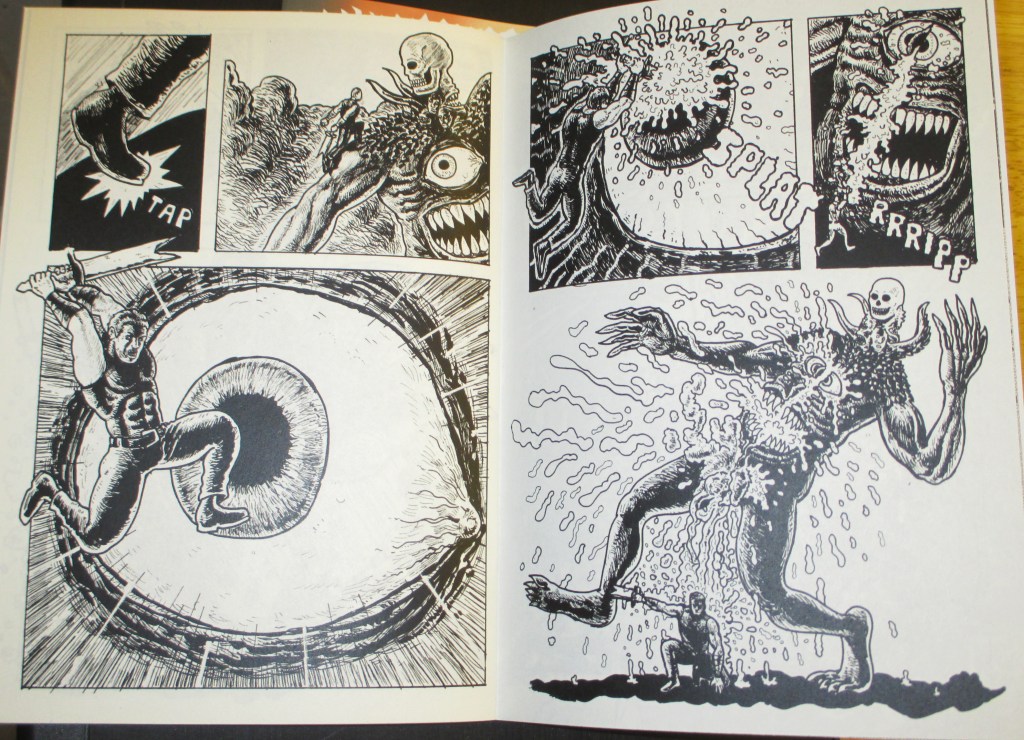
Mythos references are a bit scanty; Die Faust des Cthulhu isn’t a pastiche in the sense that it wants to expand on the lore in vast detail, and while there is a bit of exposition the actions tend to speak louder than words, and the explicit connections to the Mythos are usually relegated to a few exclamations in the heat of battle. There is more of an element of Robert E. Howard to the story than Lovecraft; the nameless hero is of the same mind as Conan that if something bleeds then it can die, even if the thought is not expressed in so many words. Readers hoping for deep pathos or character development may be disappointed, but primarily this is fun. A guy with a pair of knives wrestles tentacled monsters and cuts them apart. It’s closer to sword and sorcery than cosmic horror.
Sometimes that’s silly. Sometimes that’s awesome.
Climactic scene from Teil 4: Übermacht.
It is not clear how many copies of a given issue are printed, but given the scarcity probably not many; readers interested in tracking down a few should check out German comic shops or eBay.
Tänk om H.P. Lovecraft hade levt idag och bott i Uppsala! Hur hade hans berättelser sett ut då? Vår bok heter helt enkelt 1000 Ögon: Lovecraft och är vår hyllning till denna skräckens mästare. Vi tolkar några av hans berättelser och placerar dem i vårt 1000 Ögon-universum.
What if H.P. Lovecraft was alive today and lived in Uppsala! What would his stories look like then? Our book is simply called 1000 Eyes: Lovecraft and is our tribute to this master of horror. We interpret some of his stories and place them in our 1000 Eyes universe.
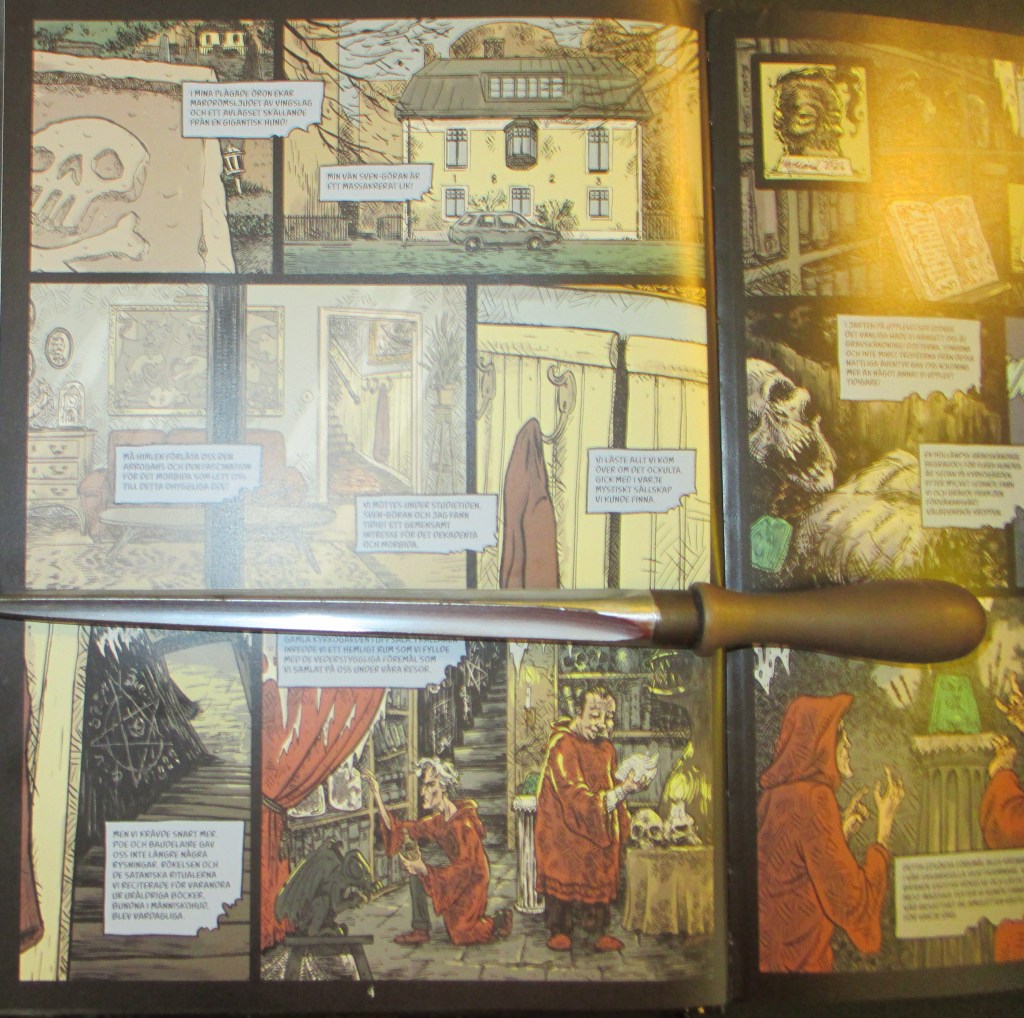
1000 Ögon(1000 Eyes) is the label for a contemporary Swedish-language series of horror graphic novels (really, thin bandes dessinée-style hardbacks) by the creative team of Jonas Anderson, Anders Björkelid, and Daniel Thollin, the last three published by Albumförlaget. Several of these have Lovecraftian influences, notably Filgia (2013), Lovecraft (2014), and Cthulhu (2015), but like a lot of non-English language publications that don’t make it into translation, they tend to get overlooked by English-reading audiences. The name “1000 ögon” is presumably a reference to the Swedish horror film Skräcken har 1000 ögon (“Fear has 1000 Eyes,” 1970).
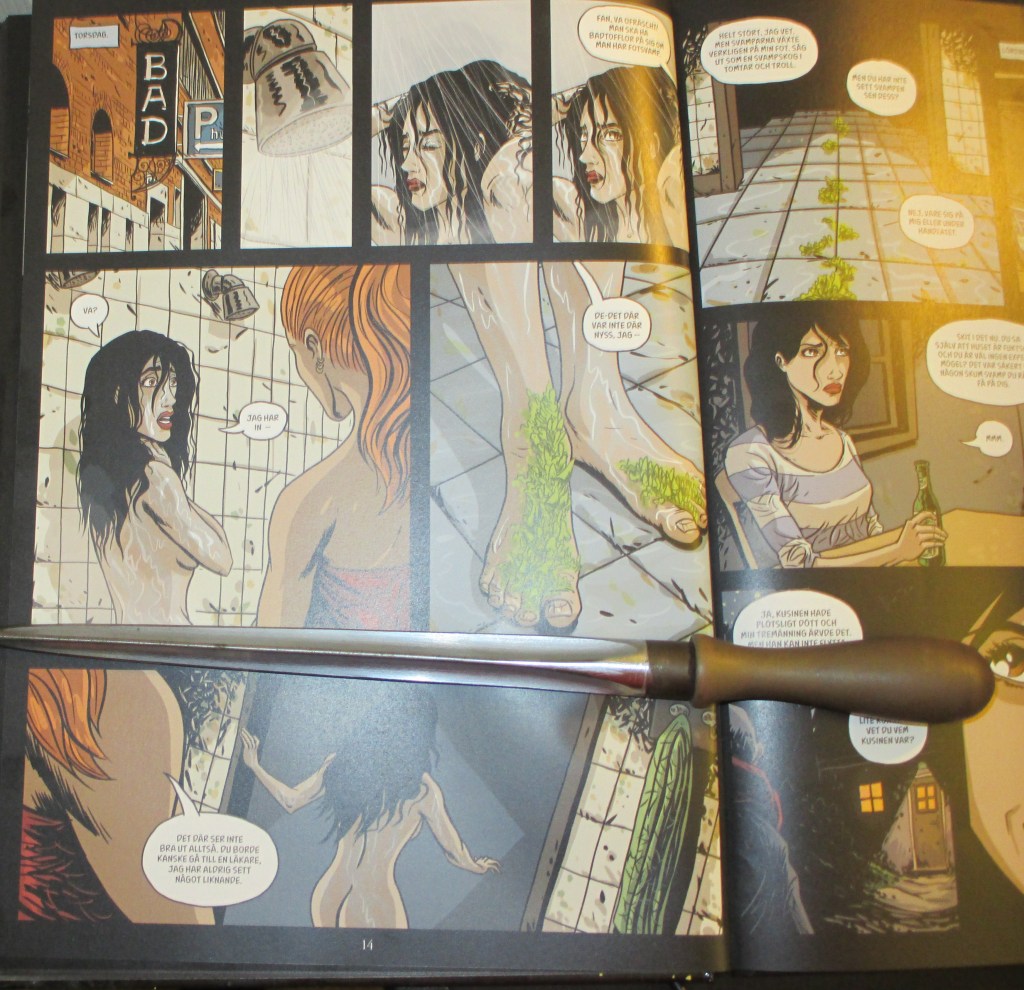
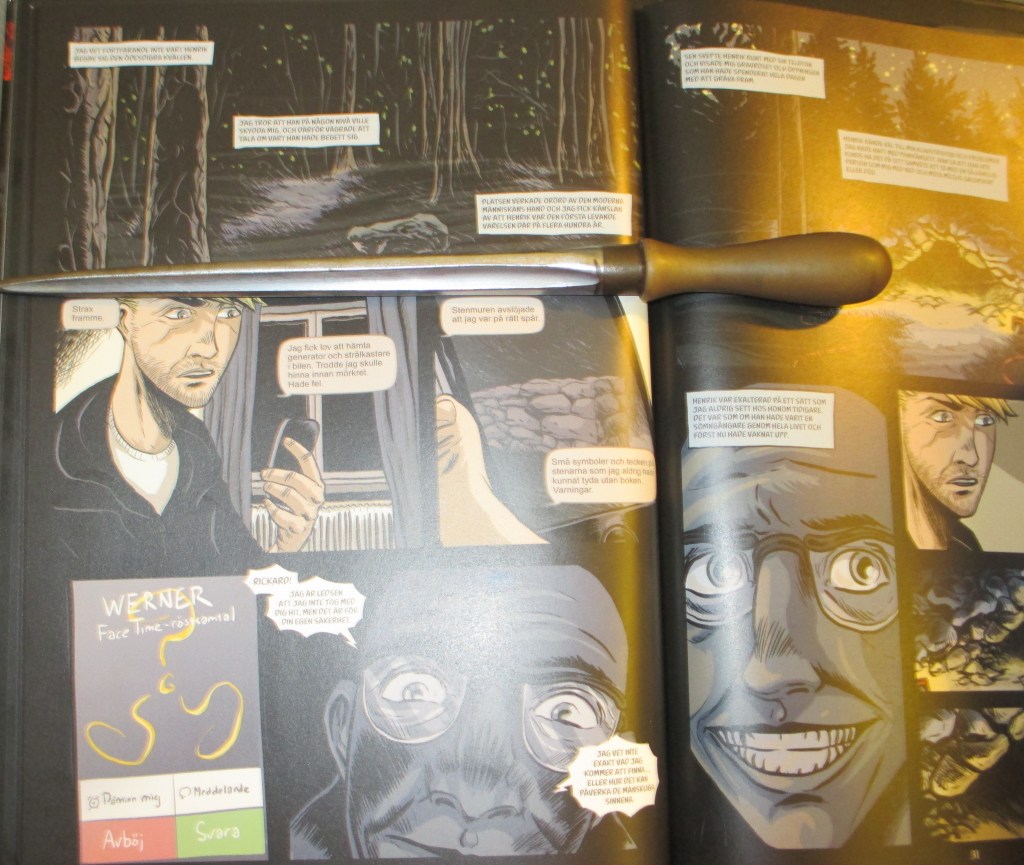
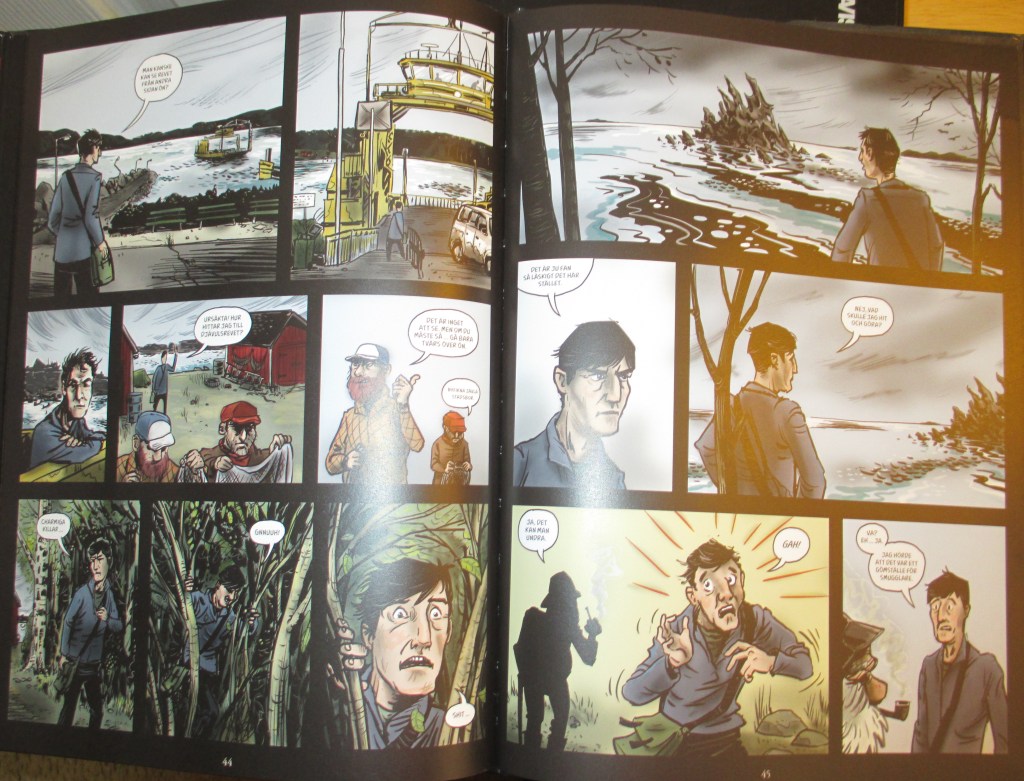
This is a bit of a shame because Lovecraft has an interesting basic premise: taking the core of four of Lovecraft’s stories (“The Hound,” “The Shunned House,” “The Statement of Randolph Carter,” and “The Shadow over Innsmouth”), and reworking them in a shared, contemporary setting, keeping what they feel is the essence of Lovecraft’s stories while freely altering the trappings and settings. In this way, the two graverobbing aesthetes of “The Hound” become more notably occult in their predilections (and apparently drive a Citroën GS); the protagonist of “The Shunned House” is a young woman named Cecilia dealing with something more than the standard mildew and black mold in the house, “The Statement of Randolph Carter” involves facetime over a smartphone rather than a field telephone, and “The Shadow over Innsmouth” takes some specific visual cues from the buildings of Uppsala and the Swedish fishing industry.
“The Hound”
Like many contemporary takes on the Mythos, Thollin and Anderson each work in references to the Cthulhu Mythos in these stories, even if there were none before. As each one writes and draws their respective episodes independently (“The Shunned House” and “The Statement of Randolph Carter” for Daniel Thollin and “The Hound” and “The Shadow over Innsmouth” for Jonas Anderson), this provides a degree of narrative continuity that might otherwise be lacking. Readers get the sense that these stories are connected, expressions of some common threat or body of myth, in a way that might not be obvious otherwise.
“The Shunned House”
For those at least passingly familiar with Swedish architecture or Uppsala in particular, the connectivity of the stories is also geographic and cultural. Which is rather the entire point of this exercise. While Lovecraft never weighed in on localization per se, he did famously note:
Searchers after horror haunt strange, far places. For them are the catacombs of Ptolemais, and the carven mausolea of the nightmare countries. They climb to the moonlit towers of ruined Rhine castles, and falter down black cobwebbed steps beneath the scattered stones of forgotten cities in Asia. The haunted wood and the desolate mountain are their shrines, and they linger around the sinister monoliths on uninhabited islands. But the true epicure in the terrible, to whom a new thrill of unutterable ghastliness is the chief end and justification of existence, esteems most of all the ancient, lonely farmhouses of backwoods New England; for there the dark elements of strength, solitude, grotesqueness, and ignorance combine to form the perfection of the hideous.
Which is to say: horror can be found closer to home than you think. Forget for a moment all those Hollywood horrors set in the United States, don’t think yourself safe just because Lovecraft restricted himself primarily to New England. Horror can be anywhere, closer than you would like…you may be in some corner of Lovecraft Country already and not even know it.
“The Statement of Randolph Carter”
Visually, Thollin’s style is “cleaner” and closer to American-style comic figuring, while Anderson’s is a little scratchier and closer to the Franco-Belgian school, and the digital coloring on Anderson’s work in particular can look a little muddy at times. While it wouldn’t be correct to say that none of the stories being adapted lend themselves to grand visuals, it seems both Thollin and Anderson lean into a more subdued approach, focusing on the human characters and generally keeping things at their scale. So there are few grand visuals, but several clever and well-designed elements, like the stark outcropping of Devil’s Reef, which really stands out when compared to how it is normally portrayed, as barely a bump above the waterline.
“The Shadow over Innsmouth”
Lovecraft was followed up by a sequel titled Cthulhu. Whereas Lovecraft consists of four adaptations, Cthulhu is made up of two original works, both set in Uppsala, before and after the stars are right. The stories maintain much of the same artistic style and themes of the Lovecraft adaptations, but the creators have a little more free play to indulge their imaginations. Readers who dig the style and want to see what happens what Thollin and Anderson move beyond adaptation to pastiche won’t be disappointed.
While you might find Filgia, Lovecraft, and Cthulhu available online in some second-hand bookstores, the best way to order them is probably direct from Albumförlaget.
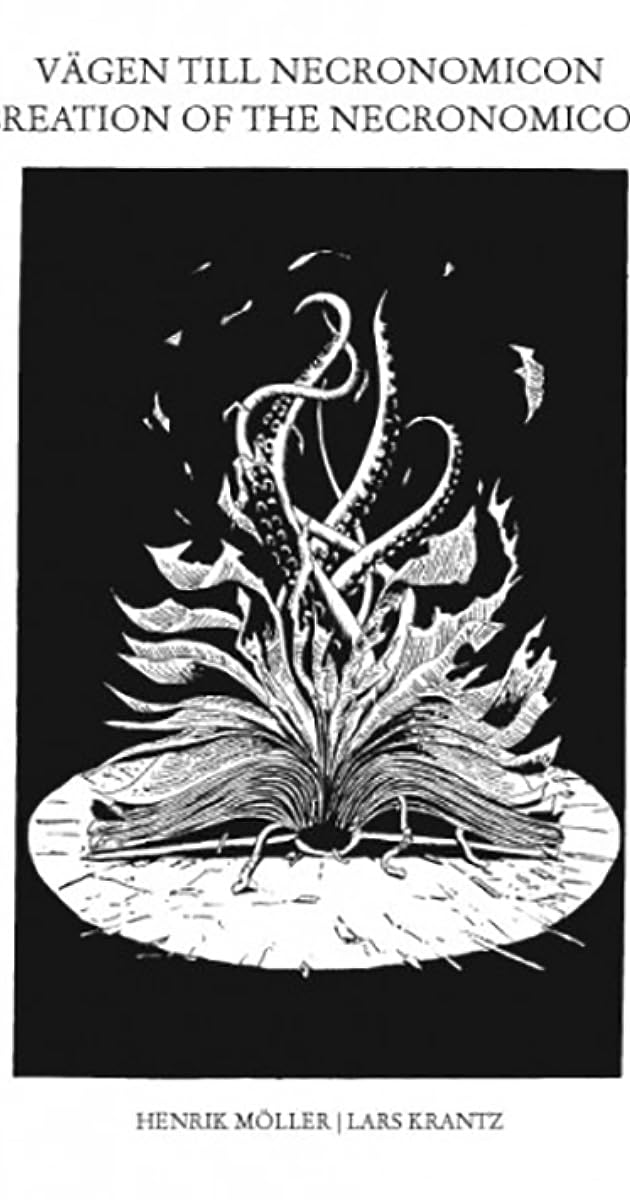
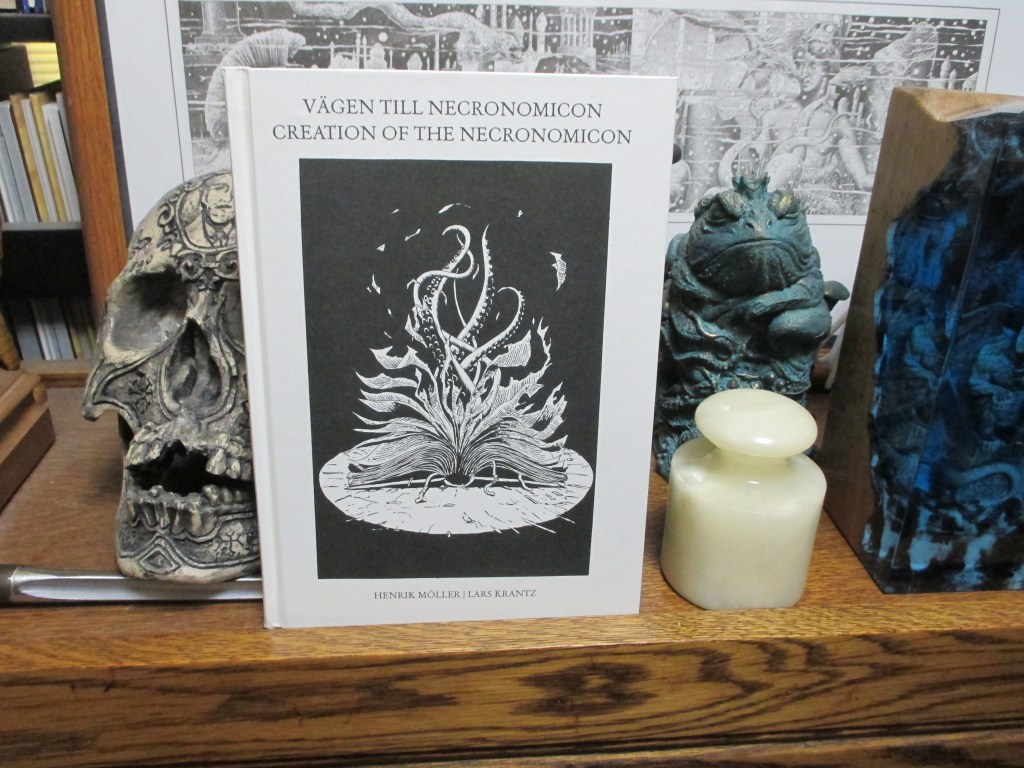
After Lars’ and my collaboration on the book CREATION OF A GOD [ATT BYGGA EN GUD, 2015], the plans of a trilogy began to take shape. While CREATION OF A GOD was a cross between the works of Lovecraft and Lord Dunsany, the second book, CREATION OF THE NECRONOMICON, was pure Lovecraftian fan fiction. The third will be a kind of Clark Ashton Smith-inspired postapocalyptic dark fantasy about three pregnant outlaws running from the law after a trainrobbery [SKAPANDET AV EN MYT —CREATION OF A MYTH, 2018].
Henrik Möller, introduction to Vägen till Necronomicon—Creation of the Necronomicon (2017)
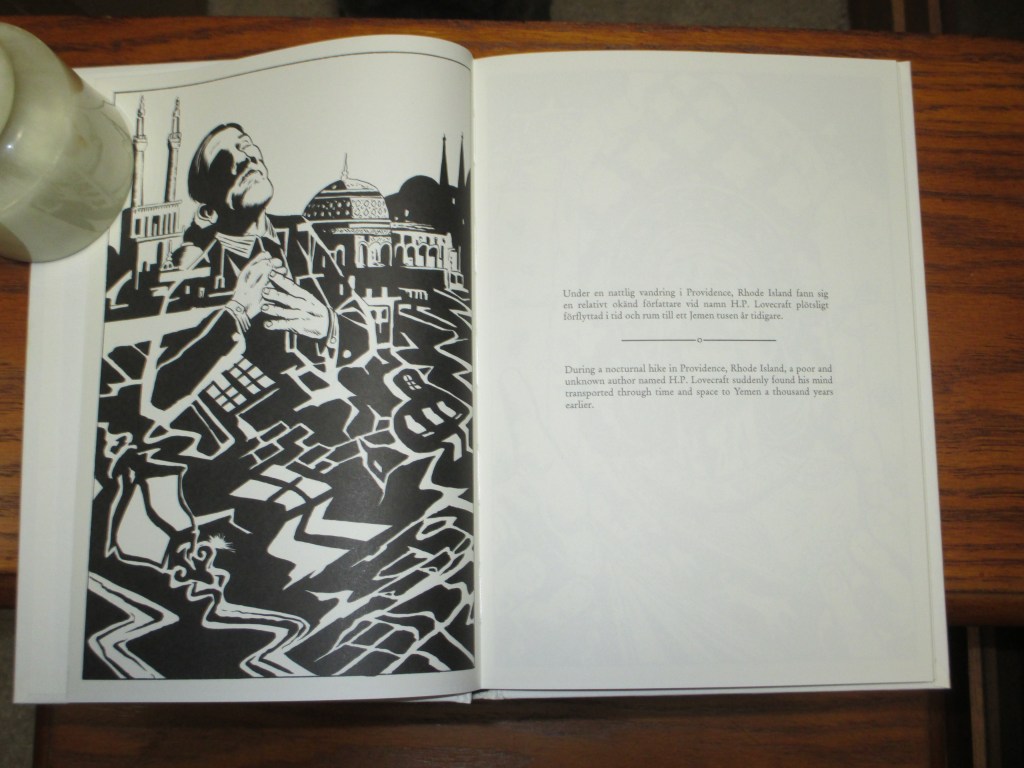
The middle of a trilogy of illustrated books, Vägen till Necronomicon—Creation of the Necronomicon (2017) consists of a text in Swedish and English by Henrik Möller, and black-and-white illustrations by Lars Krantz. While some sellers have categorized this book as a graphic novel, it would probably be more correct to label this an illustrated novel; text and image stand in contrast to one another, complementing one another: where one is sparse, the other is detailed; when one is subdued, the other is vivid. The result is as effective a work of graphic fiction as has yet been produced.
Möller’s description of the work as “fanfiction” is accurate, although that doesn’t quite do it justice. The story is an expansion of Lovecraft’s “The History of the Necronomicon,” retaining the essential elements of the story but expanding the narrative of Abdul Alhazred, adding a Vathek– or 1,001 Nights-style doomed romance. However, like many fans Möller and Krantz chose to weave fact with fiction, and the story has a framing narrative: one night in Providence, H. P. Lovecraft is out in a walk and finds his mind cast back a thousand years.
This is a not-uncommon device, the idea that Lovecraft and his fictional creation were both real, that the Mythos he created was real, at least to him—that the stories he told are occult truth, or even that he found or inherited a copy of the Necronomicon, from which he learned all this eldritch lore. The idea tends to rob Lovecraft of a certain genius, or at least agency; it makes him from a master storyteller to a kind of pulp journalist or cryptic occultist.
However, when carried out with sufficient style, the narrative convention of “the real Necronomicon!” still holds a bit of cachet. The tome, and its creators real and fiction, have achieved that legendary status where fact and fiction easily flow together. There are dozens of Necronomicons in the world today, from comic books to grimoires like Magic of Atlantis: Sauthenerom: The Real Source of the Necronomicon (1985) by Frank G. Ripel & Necronomicon: Il Libro Proibito di Abdul Alhazred (2022) by Mirando Gurzo, long novels to pillowbooks. All variations on the idea of the terrible book whose secrets are so terrible they make the skin crawl and the bright light of day a bit dimmer.
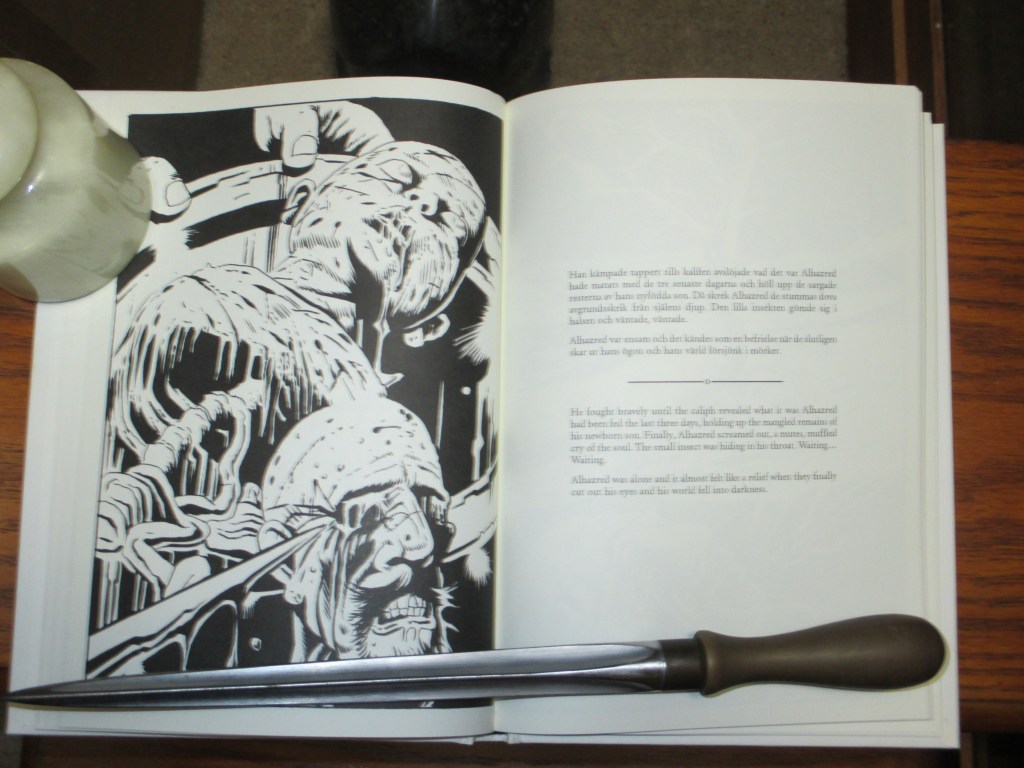
The Necronomicon is a sourcebook of horror. So it should come as no surprise that parts of Möller and Krantz’ book are appropriately horrible.
He fought bravely until the caliph revealed what it was Alhazred had been fed the last three days, holding up the mangled remains of his newborn son. FInally, Alhazred screamed out, a mutes [sic], muffled cry of the soul. The small insect was hiding in his throat. Waiting… Waiting.
Henrik Möller, Vägen till Necronomicon—Creation of the Necronomicon (2017)
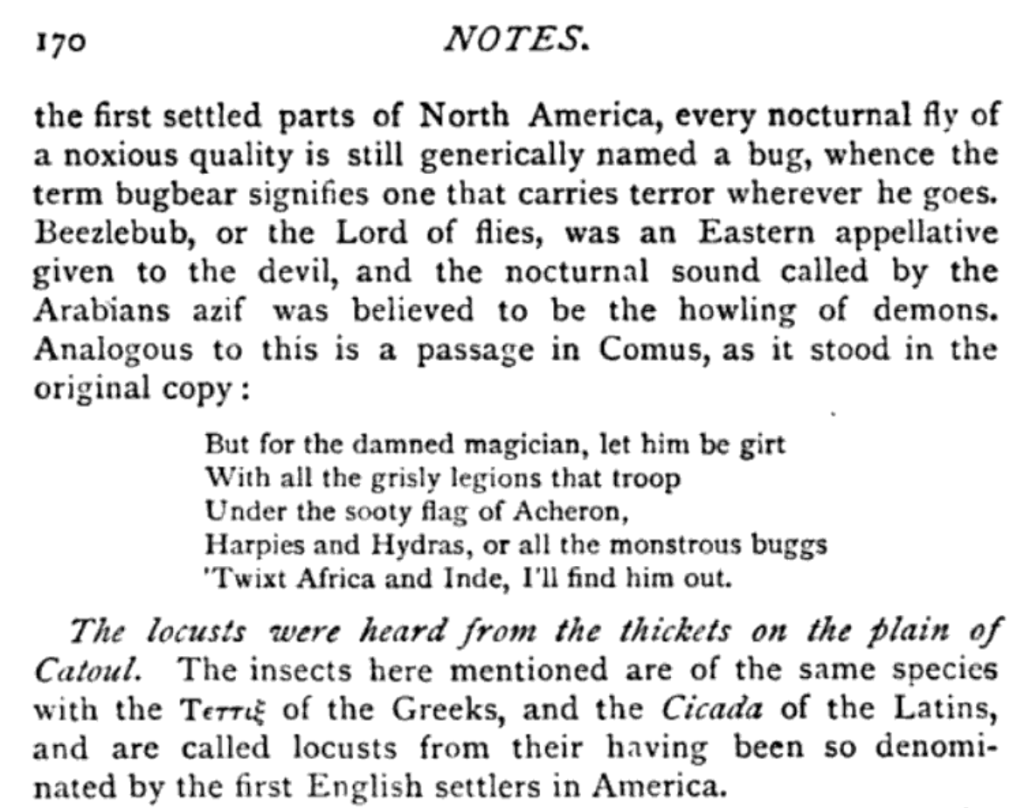
This motif of the insect comes from a very small, often overlooked detail about the Necronomicon, which Lovecraft had borrowed from another source:
Original title Al Azif—azif being the word used by Arabs to designate that nocturnal sound (made by insects) suppos’d to be the howling of daemons.
H. P. Lovecraft, “The History of the Necronomicon“
It is a small detail, often overlooked. Some authors credit Alhazred as an arch-cultist, heretic, and magician; others a hero whose dire warnings are often misinterpreted and abused; or a prophet, puppeted about by unseen powers. His life is a function with a single output: the Necronomicon. It is often the book that matters, the text itself, not necessarily where it came from or how it got into its current form.
Yet for Lovecraft, the whole point of “The History of the Necronomicon” is that the story of the text was what was important. The contents could never match the darkest depths of the readers’ imagination. Alhazred is integral to the story; it was the first such book to have a proper author and history, to be more than a strange and terrible name on the shelf in the secret library of some cultist. The story of the Necronomicon is important, because without that story, it is just another odd tome, no more special than the rest.
It is a book born in blood and mystery.
There is an epilogue. The narrative returns to the frame-story. Lovecraft at his typewriter. The temporal loop is closed. In the final pages, the story comes to a bit of an ugly and unsettling close, weaving fact and fiction again:
Finally, on his deathbed, he wrote down all of Alhazred’s writings from memory into what he called his death diary and bequeathed it to his friend Robert Barlow.
After Lovecraft’s death, Barlow took the book to Mexico where he eventually committed suicide. The book is, as of today, still missing.
Henrik Möller, Vägen till Necronomicon—Creation of the Necronomicon (2017)
The truth of Lovecraft’s “death diary” is more prosaic, and perhaps more terrible for that. It was a minute record of Lovecraft’s final, fatal illness and last days, beginning 1 January 1937. While the actual diary is missing, Barlow copied and condensed some entries, which are reproduced in Lovecraft’s Collected Essays volume 5. The entry for March 7th simply reads “hideous pain.”
The reality of the death diary puts the Necronomicon in context. We may fill it with whatever terrible cruelties and eldritch lore we may dream up. The Necronomicon Files by Daniel harms & John Wisdom Gonce III has a list; everything from the secret of telepathy to how to breed worms in the carcasses of camels. The real world is often more prosaic, but no less horrible. Lovecraft’s death diary is an account of adult fears, the yawning death in hospital beds as cancer gnaws at our bowels. A death by inches, punctuated by a thousand indignities, and then…nonexistence. Throwing the gates wide to let the Old Ones come again would at least be a choice.
Henrik Möller is also a filmmaker, and to accompany the publication of Vägen till Necronomicon—Creation of the Necronomicon (2017), he also released a short video adaptation of the work, which is still available on Youtube. The film in narrated by Möller in Swedish and English, to Krantz’ illustrations, with a soundtrack by Möller. If you cannot get the book, it is a good way to experience their story.
It is an open secret that H. P. Lovecraft created the Mythos as a kind of literary game. Alongside the artificial mythology and geography he developed, Lovecraft would work in references to friends like Clark Ashton Smith and his creations of Tsathoggua and the Book of Eibon. In turn, Smith & others at Weird Tales would start to play the same game, working references to the Lovecraft Mythos into their own stories. Frank Belknap Long, Jr. and Robert Bloch would even include fictional representations of Lovecraft himself into the Mythos, as an in-joke. Writers like August Derleth and Manly Wade Wellman would go a step further—putting Lovecraft himself into their stories, alongside his fictional creations.
He wished that Lovecraft were alive to see and hear—Lovecraft knew so much about the legend of Other-People, from before human times, and how their behaviors and speech had trickled a little into the ken of the civilization known to the wakeaday world. De Grandin, too—a Frenchman, a scientist, and with the double practicality of his race and education. De Grandin would be interested to hear of all this later. Thunstone had no doubt that he would survive to tell de Grandin about it, over a bottle of wine at Huntington, New Jersey.
The idea had a bit of cachet in the 1940s, but in the ensuing six decades the idea that Lovecraft was really writing the truth and existed in the same continuity as his own fictional creations has become cliché. Yet part of the reason the idea remains so popular after so many decades is that Lovecraft’s own mythic image has become intimately entwined with his Mythos. The Old Gent from Providence has engrossed decades of fans and scholars, and his image—typically a somber face with a prognathous jaw, in a plain and unassuming dark suit without ornament, a bit like an undertaker—has become as indelible to Mythos-art as Cthulhu or the Necronomicon. Lovecraft is still in many ways the face of the Mythos, and as a character in his own right has appeared in many media, from fiction and poetry to comic books and film.
It is important to emphasize that there’s nothing inherently wrong with having H. P. Lovecraft as a character in a Mythos story, or pursuing the idea that Lovecraft was writing the truth as fiction. Many writers have done it, from Robert Bloch in his novel Strange Eons (1978) to Alan Moore & Jacen Burrows in Providence (2015). A cliché is not bad by itself, but with so many other examples to compare it against, the execution becomes all-important—does the author do anything new? Do they do it well?
In the case of Jasmine Jarvis and The Rise of the Great Old One, there are a couple of good ideas buried in the narrative, but the execution doesn’t really give them time to develop. The style of the story is very reminiscent of a creepypasta: short, unadorned, straightforward, largely a first-person narrative, and set in the contemporary period. There isn’t a lot of character development or a lot of characters; the lore isn’t especially deep, there is a strong element of random weirdness, and the Lovecraftian element is most strongly represented by a kind of general aesthetic of crawling tentacles and fish-faced cultists. This isn’t a sequel to any specific Mythos story as much as a story inspired by the very existence of Lovecraft and the Mythos.
So what kind of ideas are buried in there?
One evening, whilst browsing the Internet and flicking through HP Lovecraft books I had obtained from the local library, I noticed that Lovecraft had stopped writing for a period of about twelve months. My interest was piqued—why? No one can account for his whereabouts during this time,and when he finally returned to writing, it seemed he struggled to put his stories together.
In real life, Lovecraft’s letters provide an incredible record of his life and it’s unlikely you could squeeze a gap year in there. Of course, this isn’t real life, so that offers some interesting possibilities: if Lovecraft was recording truth as fiction, and if there was a missing year in his life, what was he up to during that chunk of missing time?
Unfortunately, length and format don’t really give The Rise of the Great Old One a chance to explore this fully. While the conceit of the plot is that Lovecraft was onto something, the point of view character is an unreliable narrator named Angus who is spilling his guts to a psychiatrist. The result is a story that feels more like a sketch of what could have been, with more evolution, an interesting novella. What we get instead is a narrative that is very full of Lovecraftian clichés, but doesn’t do enough new and interesting with those clichés to really elicit interest. It is a little too generically Lovecraftian, more devoted to the pop culture idea of what Lovecraftian is rather than in the sense of how Lovecraft and his contemporaries wrote it.
This is something that you tend to see a lot of these days, especially in relatively low-budget Lovecraftian cinema like H. P. Lovecraft’s Witch House (2021) or H. P. Lovecraft’s The Deep Ones(2020). Stories that are trying to invoke a Lovecraft, but what they’re aiming for is less the careful development of mood and ideas of cosmic insignificance and biological determinism that Lovecraft wrote, and more a generic idea of robed cultists, old grimoires, and tentacle monsters—the elements that were so easy to pastiche and have thus become synonymous with the Mythos for a lot of people who have absorbed their idea of what the Mythos is through other media instead of reading his stories and letters.
When you look at what world can accommodate not just the individual narratives of each weird entity, but all of them together, you’re moving past the stage of passive consumption. Like the ancient citizens on the streets of Rome, facing a bewildering array of divinities from across the known world with all of their stories and attributes, some conflicting, some paralleling one another closely…the shared universe can become richer, tying together disparate elements of their backstories, hinting at a more complex relationship with more stories waiting to be told. Then you get films like The Monster Squad (1987) and comics like Screamland(2008), works powered by something more than nostalgia and replaying the same classics.
While all the individual elements might be familiar, when you play them off against each other, something new emerges.
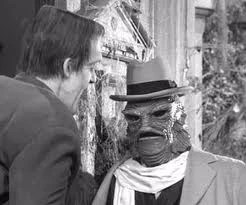
The Cthulhu Mythos already exists as a shared universe, and it has been remixed and crossed over with more traditional horror franchises and creations dozens, perhaps hundreds of times. Aquaman has fought Cthulhu. Sherlock Holmes has interacted the Mythos in dozens of stories and novels, including “A Study in Emerald” (1993) by Neil Gaiman. A Night in the Lonesome October (1993) by Roger Zelazny sees Holmes, the Cthulhu Mythos, and various Universal monsters play off against each other in the Game. In “From Cabinet 34, Drawer 6” (2005) by Caitlín R. Kiernan revisits “The Shadow over Innsmouth” by way of The Creature from the Black Lagoon(1954). Whether or not a horror/Mythos crossover succeeds is whether it transcends the formula of “X vs. Y”; whether it builds on its constituent elements to create something new and distinct.
“The One That Got Away” (2011) by Esther M. Friesner is that kind of story.
Damn it, it wasn’t fair! I went through just as much as that little blond chippie, and her big-shot showbiz pals knew it. Sure, they lost their star attraction, but what was stopping them from salvaging something from their losses by giving me a chance at the spitlight? I would’ve worn my native costume. I would’ve acted like I couldn’t speak a word of English so someone could pretend to translate while I recounted my terrible ordeal in his hairy clutches—even though I’d dodged those cltches pretty slickly, if I do say so myself. And if one of those puffed-up producers would’ve thought to scrape the pavement, salvage what was left of him, hire an army of taxidermists to pretty up the remains a bit, and stuck him back on stage, I would’ve screamed on cue like a champ at the results. Hell, I’ll bet I could’ve shrieked loud enough to make the audience believe—just for a moment—that he was still alive!
Friesner can’t come out and say things explicitly, because copyrights and trademarks are still owned by others, but the waltzing-around the subject is part of the charm of the narrative. The crossover is the premise; a nigh-forgotten character from a classic story dropped into an encounter with some Innsmouth sailors. What makes it work is the telling, and how Friesner develops the story. A young woman, late of Skull Island, left to her own devices in the United States of America during the Great Depression and Jim Crow has turned into a hardboiled woman of the world—and a surprisingly open-minded one.
Bat-winged and taloned, with what looked like an octopus boquet for a mouth, the creature reared out of the depths and strode toward me with eldritch lust in his fiery eyes.
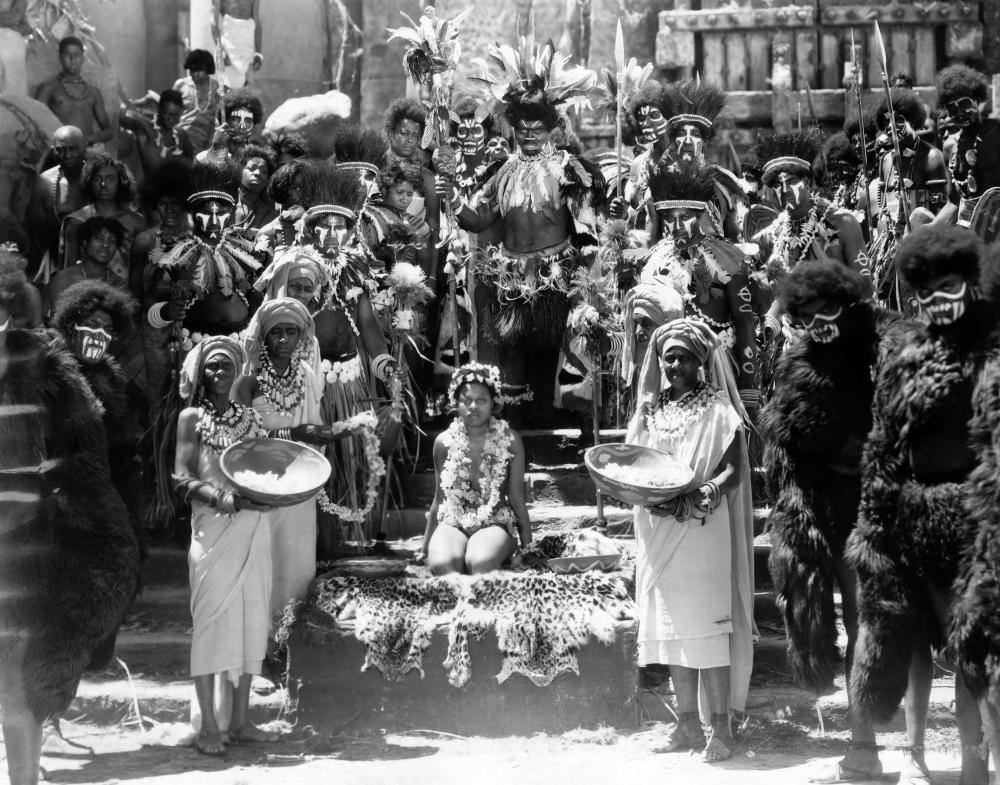
The tone is flippant, and the story is a play on wits worthy of the fast-talking repartee in a noir film. It is the unexpected (one might say sacrilegious if either Lovecraft or King Kong is one of your sacred cows) lightness that makes the story work. There is a darkly comic Pollyanna aspect of the narrator as she compares the cultural rituals of Innsmouth and Skull Island with gallows humor and no hard feelings.
Two mythologies meeting in unexpected ways…but also ways that are oddly fitting. For those who like to explore the culture of Innsmouth, in works like Innsmouth (2019) by Megan James, it’s nice to see what happens when the sailors get out into the wider world and encounter folks from other cultures. It is all good fun.
Eldritch Fappenings This review deals with works of pornography, and the history of erotic art and writing. As part of this review, selected passages involving sexually explicit activites will be included. As such, please be advised before reading further.
“Personally,” I said, “I shared Bloch’s opinion of the stories. There was too much emphasis placed on sex. Once I wrote a very critical letter to Editor Wright about the prevalence of sex in some Weird Tales stories, citing the Conan stories as an example.
About the Conan tales—I don’t know that they contain any more sex than is necessary in a delineation of the life of a lusty bygone age. Good old Two-Gun didn’t seem to me to overstress eroticism nearly as much as other cash-seeking pulpists—even if he did now & then feel in duty bound to play up to a Brundage cover-design.
In the 1930s editor of Weird Tales Farnsworth Wright recognized that sex sells—or at least, that a tasteful nude on the cover seemed to improve sales. Yet Weird Tales was not in any sense a pornographic magazine, and the “delineation of the life of a lusty bygone age” that Lovecraft spoke about was relatively prudish compared to an episode of Game of Thrones. Robert E. Howard would have an occasional female character disrobed, might hint at sex, but it would have been impossible to publish anything relating to male genitalia, penetration, or any oral sex beyond a passionate kiss in the 1930s, even if he had been so inclined to write such things. Even Howard’s stories for the Spicy magazines, which promised more sizzling sex than other pulps, were more likely to involve a particularly hard spanking than coitus, and paragraphs would peter out into ellipses before getting to any sort of explicit description.
Robert E. Howard’s hardboiled fantasy stories of Conan the Cimmerian would long survive him and grow in popularity, and as restrictions on sex in publishing eased (particularly after Grove Press, Inc. v. Christenberry, 1959), sword & sorcery fiction began to gradually grow more explicit. Fritz Leiber’s “The Sadness of the Executioner” (1973) for example, features “a deliciously slender girl of no more than sixteen, unclad save for four ornaments of silver filigree” as a violent and insane member of a mad king’s harem, and Leiber doesn’t mind describing her anatomy—but he stops short of pornography. Again, there were limitations to what most publications would accept.
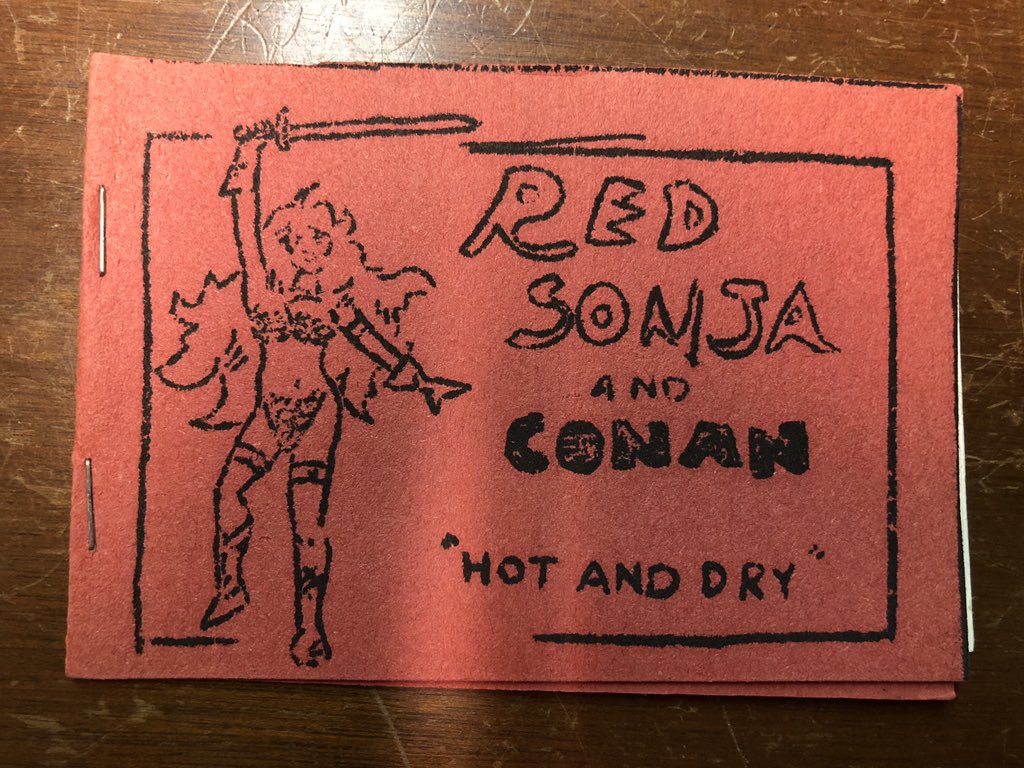
The earliest sexually explicit efforts in that vein were, oddly enough, probably inspired by Marvel’s Conan the Barbarian comic, which began publication in 1970. “Gonad the Horney” was published in the San Francisco Ball in 1972, and the Tijuana bible style Red Sonja and Conan – Hot and Dry was published in 1977. Both of these sexually explicit little comics were parodies of the Marvel material, much as how in later years Hustler would create This Ain’tConan the Barbarian (2011). Tongue was firmly in cheek, and the point was generally amusement rather than titillation or telling a good story.
Yet with the boom in paperback fantasy in the 1960s through the 1980s, the market for adult-oriented Sword & Sorcery grew…and a few pornographic novels were published to meet that market segment. Two in particular stand out as of particular interest to fans of Robert E. Howard and H. P. Lovecraft, The Coming of Cormac (1974) and The Seductress of Eden (1982) by Mark Farris—and these novels are worth consideration and comparison.
The Coming of Cormac (1974) by Caer Ged
During the fifth cycle of man, before the cataclysm that drove Atlantis from the depths of the sea and split the face of the earth, there was a oneness of the land called Augura by its inhabitants. Though darkness and its creatures and daemons still walked unchained, there rose five kings who rallied civilization and its boundaries. These kingdoms were called Telus,Nebula, Waldrop, Agila and Valana, and war was constant among them.
Beyond these boundaries of man was wilderness. To the south was Sartar with burning deserts and steaming jungles inhabited by savage men of black skin. To the east was the Land of Shadows with the Mountains of Krath barring entrance. To the west were the unknown waters of the Great Sea. And to the north was the frozen wasteland called Bifrost with its warring barbarians.
It was from this bitter land of cold that Cormac came to seek his fortune in the cities of civilization . . .
from The Book of Cormac, Aram Akkad.
Caer Ged, The Coming of Cormac 1
“KNOW, oh prince, that between the years when the oceans drank Atlantis and the gleaming cities, and the years of the rise of the Sons of Aryas, there was an Age undreamed of, when shining kingdoms lay spread across the world like blue mantles beneath the stars—Nemedia, Ophir, Brythunia, Hyperborea, Zamora with its dark-haired women and towers of spider-haunted mystery, Zingara with its chivalry, Koth that bordered on the pastoral lands of Shem, Stygia with its shadow-guarded tombs, Hyrkania whose riders wore steel and silk and gold. But the proudest kingdom of the world was Aquilonia, reigning supreme in the dreaming west. Hither came Conan, the Cimmerian, black-haired, sullen- eyed, sword in hand, a thief, a reaver, a slayer, with gigantic melancholies and gigantic mirth, to tread the jeweled thrones of the Earth under his sandalled feet.” —The Nemedian Chronicles
Robert E. Howard, “The Phoenix on the Sword”
The Coming of Cormac was billed as “the first ‘sword and sorcery’ book to ever hit the stands—with plenty of hot far-out, uncensored sex!”—and that statement may well stand the test of time, because while it is not the first erotic speculative fiction novel, it is the earliest one I’ve seen that was blatantly and obviously based on Robert E. Howard’s Conan stories (the title no doubt a reference to The Coming of Conan, an early collection). Cormac of Bifrost is essentially a clone of Conan the Cimmerian (and not far off from another Howard character, Cormac Mac Art). The basic premise of the tale, which involves rescuing a princess and some encounters with giant snakes, a witch, undead, and “demons” along the way is very much in the mold of the 1970s Sword & Sorcery pastiche, right down to casual references to “savage men of black skin,” the very sort of thing that Charles R. Saunders noted in his essay “Die, Black Dog! A Look At Racism In Fantasy Literature” (1975). Take out the naughty bits and the story could essentially have run in any fantasy magazine or as a script in Marvel’s Conan comics.
The story is very sexually explicit indeed. Like most erotic novels, that is both the promise and the problem: stopping the plot every few pages for a lengthy sex scene tends to disrupt the flow and pacing of the story, while trivial attempts at titillation are more likely to be eye-rolling than enticing:
A half-clad amazon hastened to the summons. The top-heavy girl panted as she trotted before the priestess of Krath. Her massive tits bounced and bobbed beneath thin veils of black gossamer cloth.
Caer Ged, The Coming of Cormac94
In terms of content, a great deal of focus is on rape of one sort or another; the princess Avalona gets used and abused in more way than one before Cormac can rescue her, fulfilling the dark promise of such villains. Cormac, once he is inevitably captured, is likewise abused. Not every encounter is nonconsensual, but this is very much the kind of story where the gaze is unflinching…and that is the point. This is all the kind of X-rated stuff that Robert E. Howard and most fantasy authors that came after him could at best hint at, but never put on the page.
The actual action sequences—such as when Cormac is fighting Yog-Sarez, the great serpent who is the son of the serpent-god Seth—are decently written. There is comedy in the book, although it is not quite what readers might expect. For example, at one point Cormac is in The Labyrinth, “a section of the city known for its thieves, robbers, and assassins” (plainly based on “The Maul from Howard’s “The Tower of the Elephant”) and encounters a pair of familiar characters:
To the barbarian’s left a large, blonde northerner, who looked no older than the Bifrostian, shared a table with a smaller youth dressed in grey garments. The two chattered endlessly of their adventures. Like magpies, they tried to out-brag the other, while guzzling bottles of cheap waterfront wine. Eventually, their ramblings turned to Avalona and a brazen plan to steal the princess from under Onard’s nose and to return her to Heres for the reward. The grey-clad youth’s fingers seemed to trace a path across a yellowed parchment spread before them. Slowly but surely, teh wine took its effect and the pair passed out, sprawled across the table.
Caer Ged, The Coming of Cormac 83-84
The pair are patently intended to be Fritz Leiber’s sword & sorcery heroes Fafhrd & the Gray Mouser. Their appearance here isn’t unprecedented; Roy Thomas and John Buscemea had joking inserted “Fafnir and Blackrat” into Conan the Barbarian #6 (1971), and there’s reason to believe that the author here was more than familiar with comic books. At one point Avalona is kidnapped by a rapacious madman with a singing sword looking for his wife Aleta—a reference to Prince Valiant—and later in the novel the witch-priestess summons four demons from the far future who turn out to be, basically, the Fantastic Four. That eventually turns out to be the witch’s X-rated undoing:
Abruptly, the thing stopped and roared. Its gigantic hands fell to tis waist and clawed at the flimsy cloth covering its sex. The blue material tore away, revealing a cylindrical organ of living stone, fully a foot long, hung like a pachydrem. As the creature’s boulder-shattering roars continued, the shaft jerked upward in a throbbing path.
Caer Ged, The Coming of Cormac 148
As Conan pastiche novels go, The Coming of Cormac is a bit below the level of Lin Carter’s Thongor series. The worldbuilding is sparse, the sorcery sparser, and the plot is a bit perfunctory, episodic, and often failing to build tension. The tongue-in-cheek pop culture inclusions are the sole real humor in what is otherwise a fairly cheerless novel of a feckless princess who is passed around and used by one person after another, but without any philosophical meditation a la the Marquis de Sade’s Justine. It accomplishes what it set out to do, but not much more.
“Caer Ged” is an obvious pseudonym, which has been attributed to George Wyatt Proctor, a fantasy fan and novelist. I’m not entirely sure what the basis for this identification is, although a contemporary fanzine Godless #8 (1974) claims “Caer Ged” is also “Lee Wyatt,” which is another pseudonym attributed to Proctor.
The Seductress of Eden (1982) by Mark Farris
My friends say that I am a man who was born out o fhis time, that I should have been one of the Trojan warriors or Hyperborean adventurers I have devoted my life to studying.
Mark Farris, The Seductress of Eden 5
Where The Coming of Cormac was set in a prehistoric past, akin to Robert E. Howard’s Hyborian Age, The Seductress of Eden is set very firmly in the contemporary 1980s. Enter Joseph Kade, a Canadian anthropologist with an interest in fantasy who decides to do some first-hand anthropological exploration of the dark underworld of sex—and ends up in a pulpy adventure that will take him all over the world, meeting (and bedding) all manner of beautiful women, almost getting killed multiple times, and finally stumbling into the ruins of a lost civilization in the Australian Outback while searching for the Phallus of the Old Ones.
If the principal focus of The Coming of Cormac is Robert E. Howard, the focus of The Seductress of Eden is Lovecraft, although the author slips in sly references to the works of Clark Ashton Smith and Howard as well. Kade is caught up in a quest for an eldritch artifact, and the story tends to careen from passionate sexual act to almost gratuitous violence and back again. The pulp aesthetic firmly establishes this as a Lovecraftian fantasy, but one that veers closer to Howardian action, despite references to the Necronomicon and the odd serpent-man:
It stood like a man, about six feet tall, but it resembled a lizard It had green, scaly skin and the head of a snake. It hissed at me and a long, forked tongue slithered out. Its unblinking eyes stared into mine and it raised clawed hands and moved toward sme, dragging an eight-foot tail behind it. […]
“Father was doing experiments with evolution,” said Gloria. “it was his theory that we all evolved from the basic forms of life, encompassing reptiles, and that it was not only possible forus to communicate with them but to evolve back to their forms. This was one of his experiments.”
“Jesus!”
“Father also believed that the continent of Eden was partially inhabited by a prehistoric race of snake-men. This experiment added credibility to that theory.”
Mark Farris, The Seductress of Eden 111-112
The Seductress of Eden is very fast and loose with the Cthulhu Mythos; this is not quite the setting readers familiar with Lovecraft and Howard will be familiar with. Instead of shoggoths, for example, there are shontothes; and instead of Cthulhu, there is quite literally Satan. The Howardian sword & sorcery elements don’t really come in until very late in the novel, though there they are rather explicit, once Kade picks up an ancient axe:
And I had wielded it before…in other lifetimes. I had fought with it on the steps of Atlantis, protecting my queen. I had wielded it on the wastelands of Cimmeria, a barbarian defending his homeland. I had struck with it in the depths of Nemordia, to free my mate from the lair of a wizard. And now I was using it to save a goddess…
Mark Farris, The Seductress of Eden 235
The main problem with The Seductress of Eden is that all of those past lives, reminiscent as they are of Howard’s James Allison stories, sound like more exciting and titillating adventures than the one chronicled in the book. While the action moves fast, it’s not a particularly deep plot, and the post-climax ending where Kade confesses his sins to a priest feels bowdlerized. A huge chunk of exposition at the end of the novel finally lays bare the writer’s version of what’s going on with the Phallus of the Old Ones, and it is so far from anything a Lovecraft fan might recognize it is almost parody.
Except that is the main difference between The Coming of Cormac and The Seductress of Eden: the story is played straight. This isn’t Howardian pastiche except for a couple of paragraphs near the end, nor is it a Lovecraftian pastiche despite the references to the Necronomicon. There are no tongue-in-cheek drop-ins of Prince Valiant and the Fantastic Four. It is an original story which plays out with as much seriousness as it can muster considering that Kade and his new girlfriend have to literally hump their way to their final goal.
Yet when the story assails the reader the Vatican assassins, the sex mutants, the mercenaries, the monsters, the repeated gangbangs, and a sex toy which is quite literally “What if H. R. Giger made a Sybian?,” the result is more like an X-rated serial than a coherent novel. The Seductress of Eden is very much a collision of fantastical pulp elements with hardcore sexuality, and the end result strains belief long before we get to the shontothes or the Golden Phallus of the Old Ones.
“So,” I went on, “now we try to get the scroll and map. And this Contessa has … the scroll?”
“Yes.”
“And I have to seduce her to get it?”
“That’s right.”
“This,” I said for about the millionth time, “is amazing!”
Mark Farris, The Seductress of Eden 73-74
As with Cormac in The Coming of Cormac, the protagonist Joe Kade isn’t a rapist—but there’s a lot of rape in the book. Weirdly enough, for all that the story is predicated on Kade encountering the darkest and most lurid parts of the sexual underground, the actual content is a bit vanilla: there are relatively few kinks on display, not many taboos presented or broken. Kade isn’t forced to expand his sexual horizons very far…and that is probably by design. The attraction of this book is the weirdness of its plot more than the weirdness of the sex itself.
The Seductress of Eden was published under the Tigress Books imprint, which also published Brian McNaughton’s Sheena Clayton novels such as Tide of Desire (1983). All of the Clayton novels had Mythos references in them, and it’s possible that “Mark Farris” was a house name that was used by McNaughton as well—however, the other Mark Farris novels for Tigress aren’t known to have Mythos references, and McNaughton himself never made any claim to the name. More to the point, The Seductress of Eden doesn’t read much like a McNaughton novel, who was prone to be much darker and less heavy-handed in his use of Mythos lore.
Women In The Novels
Both The Coming of Cormac and The Seductress of Eden are told primarily from the point-of-view of the male protagonists, although Cormac has a few chapters dedicated to Princess Avalona’s viewpoint—those chapters where she is raped. Which presents a substantial difference between the two novels worth discussing.
The recovery of Princess Avalona in The Coming of Cormac is the point of the novel, the central driving plot. She begins the novel as a blushing virgin, and through several chapters of degradation and forced sexual intercourse is used and abused, transported against her will, and finally, after many lives have been lost and the major villains are dead, is comfortable enough in her own sexuality to make advances on Cormac himself. It is not exactly a bildungsroman, but as a tale of Avalona growing up it parallels in some ways a much more X-rated and darker version of Queen Yasmela in Robert E. Howard’s “Black Colossus.” While Avalona never quite gets Yasmela’s agency, she at least comes to overcome her initial sexual trauma and take charge of her own sexual needs and desires.
By contrast, Gloria in The Seductress of Eden starts out the novel as a high-priced escort raised in a family of sex mutants with aspirations to gain the Phallus of the Old Ones to become a goddess, and her every action in the story is bent exclusively toward the goal. There is no innocence to be lost, no self-discovery, and ultimately no redemption of the character. She enters into the novel utterly confident in her own sexuality and repeatedly unfazed by any effort to degrade her through rape or any other form of sexual violence. In comparison with The Coming of Cormac, Gloria has more in common with the witch-priestess Sheheit than she does to Avalona—and that kind of represents part of the odd characterization of women in both stories.
In both The Coming of Cormac and The Seductress of Eden present sexuality as inherently positive, at least the relatively limited sexuality on display here. Cormac has no idea why the civilized people are so hung up about the whole virginity business, Kade is protective of Gloria because he loves her, but not overly jealous when she ends up having sex with someone else. While it isn’t quite the aftermath of the free love of the 1960s, sex is definitely not presented as a phenomenon that only happens within the confines of legal matrimony. Yet the women characters who have most embraced their sexuality or try to use sex for their own ends are presented as the ultimate villains.
It is not an uncommon characterization in pornographic works: sexual experience and lack of sexual mores is generally seen as a positive trait, but aggressive or self-serving sexuality is a hallmark of an evil character. This isn’t entirely unusual in fantasy either—in Howard’s “A Witch Shall Be Born” one of the key differences between Queen Taramis and her evil sister Salome is that the latter is sexually active and open about it—but in the context of a pornographic novel, it rather highlights the disparity between male and female characters. Cormac and Kade’s sexual exploits to sate their lusts don’t mark them out as sluts deserving of some dark fate, and they are rarely forced into sex against their will. By contrast, the women in these stories face most of the sexual violence, and most of the consequences of sex, including pregnancy and death.
Conclusions
Publishing has come a long way since Robert E. Howard first wrote the Conan stories. Softcore sword & sorcery novels like Lin Carter’s Tara of the Twilight(1979) have given way to explicit sexual scenes in George R. R. Martin’s A Song of Ice and Fire novels. There is more permissiveness in what can be openly published than ever before—yet the fundamental narrative problem of how (and if, and why) to weave hardcore eroticism into the story remains. For The Coming of Cormac and The Seductress of Eden, the sex is the point, it’s how they were marketed.
It is really odd to look back at erotica produced before the age of the Internet. While a writer’s imagination might be unlimited, and fanzines were free to publish the occasional nude drawing or naughty limerick without too much fear of the postal censor, as a commercial prospect any sort of really weird fiction or sword & sorcery-based pornographic novel had to be a bit of a daunting prospect—not because it couldn’t be done, but because you had to be able to both advertise that work to the correct audience and make something worth reading. In that respect, The Coming of Cormac and The Seductress of Eden are both game attempts to try and meet the needs of a very small and speculative market…and in doing so, they demonstrate how hard it is to produce commercial literature on demand.
Both novels suffer from trying to balance hardcore sex with their pulpy adventures. Howard’s original Conan stories sometimes include lingering gazes at the female form or hints of sexual activities that may happen or are about to happen, but these are largely small titillations that don’t affect the flow of the stories. Erotic fantasy adventure is a difficult prospect at the best of times, as the litany of B-movie sword-and-sorcery films that have struggled to pass muster with rampant female nudity and threadbare plots and acting can well attest.
What’s striking about both of these novels is that they’re coming from about the same place, and even if they don’t use quite the same means, they’re headed for the same goal: to try and capture some of the energy and tropes pulp fiction while injecting hardcore eroticism. On the surface, this shouldn’t be terribly difficult. Read Howard’s description:
Bêlit sprang before the blacks, beating down their spears. She turned toward Conan, her bosom heaving, her eyes flashing. Fierce fingers of wonder caught at his heart. She was slender, yet formed like a goddess: at once lithe and voluptuous. Her only garment was a broad silken girdle. Her white ivory limbs and the ivory globes of her breasts drove a beat of fierce passion through the Cimmerian’s pulse, even in the panting fury of battle. Her rich black hair, black as a Stygian night, fell in rippling burnished clusters down her supple back. Her dark eyes burned on the Cimmerian.
She was untamed as a desert wind, supple and dangerous as a she-panther. She came close to him, heedless of his great blade, dripping with blood of her warriors. Her supple thigh brushed against it, so close she came to the tall warrior. Her red lips parted as she stared up into his somber menacing eyes.
A lot of what makes pulp fiction work is that readers have to use their imagination. Nothing any writer comes up with will be able to match the sex that Bêlit and Conan have in the reader’s mind. Like the unnamable horrors so often attributed to Lovecraft, to render them in exquisite and clinical detail—to measure Conan’s sword to the nearest millimeter—is to rob them of some of their mystery and magic. If the mating dance of Bêlit in “Queen of the Black Coast” had turned to actual coitus, the entire tone of the story might not have shifted, but the infinite possibilities in the reader’s mind would have collapsed into a single certainty. The possibilities are often much more tantalizing than the execution.
But it ultimately depends on what you’re going for. The Coming of Cormac and The Seductress of Eden draw these comparisons specifically because, like erotic fanfiction they rely to a greater or lesser extent on existing properties. Without Conan, there is no Cormac or Kade. They invite comparison to Robert E. Howard because they are riffing off of Howard. Original works without trying to ape the themes of older fiction might have more leeway to forge their own balance with a more explicit tone, as Martin did in his Song of Ice and Fire series and as Karl Edward Wagner did in his Kane series.
Picture for a moment what it might look like if you could visualize the spiderweb connections of the Cthulhu Mythos, with each story a node, each line a connective thread. “The Shadow over Innsmouth,” “The Dunwich Horror,” and “The Call of Cthulhu” would be dense starbursts, referenced by dozens of successive stories…and further out from the “core” of Lovecraft’s Mythos tales would be the less popular tales, the revision and ghostwritten stories which contributed little to the collective mythology…or were simply less popular with fans and authors. Far out on the periphery, barely connected to anything else, is “Medusa’s Coil” (1939) by Zealia Bishop & H. P. Lovecraft.
In 2015, Gemma Files added a few lines, a new nodal point: “Hairwork” is one of the very, very few works which dared to do anything with Marceline Bedard and “Medusa’s Coil.”
“Redbone,” he says. “She a fine gal, that’s for sure. Thick, sweet. And look at that hair.”
“‘Redbone?’ I don’t know this term.”
“Pale, ma’am, like cream, lightish-complected—you know, high yaller? Same as me.”
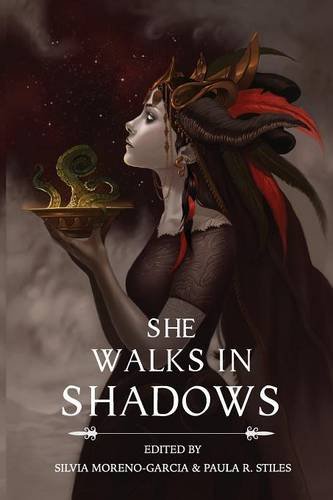
She Walks in Shadows is a collection of stories that revisits Lovecraft’s Mythos from the view of the often-ignored and neglected women characters. Marceline Bedard is arguably one of the most prominent and interesting of these, if only because so rarely did Lovecraft ever write a woman of color into his stories, much less give her a prominent role. There are many possible reasons for this: the story is only incidentally connected to the wider Mythos, for instance. Most important, though, is the failure of Lovecraft to develop anything of the internal life and motivations of Marceline. She is presented as a kind of femme fatale, an occultist, but why she does anything in the story is utterly absent. If she has any deeper plan beyond marrying Denis de Russy and posing nude for a portrait, it is never revealed. Likewise, her backstory and that of her great hair are left utterly mysterious.
From the perspective in which the story seed was first presented to Lovecraft, and the perspectives with which he told it—white man telling the tale to another white man—the absence of Marceline’s side of the story is perhaps understandable. Yet the absence is still present; the reader only gets one side of the tale.
So Gemma Files fills in the gap, providing something of Marceline’s side of the story, her motivations and background, and perhaps more importantly, what happens next.
In comparison with those works, it has to be said that Gemma Files’ “Hairwork” stands up well. She does not directly work to contradict Lovecraft’s story, but works around the facts by providing a motivation and tying it into the background she supplies, one that works very well. References to the wider Mythos are still fairly thin: Lovecraft didn’t leave much to work with, and unlike Victor LaValle in “The Ballad of Black Tom” (2016) who chose to re-center the story around the Cthulhu-cult, Files appears content to have left it on the periphery of the Mythos.
The most substantial change is the vague suggestion that painter Frank Marsh may have familiar connections with the Marshes of Innsmouth—and who knows but that someone may pick up that thread someday? And probably the most radical change in the story is the suggestion of what the hair itself might be:
And then there’s the tradition of Orthodox Jewish women, Observants, Lubavitchers in particular—they cover their hair with a wig, too, a sheitel, so no one but their husband gets to see it. Now, Marceline was in no way Observant, but I can see perhaps an added benefit to her courtesenerie from allowing no one who was not un amant, her intimate, to see her uncovered. The wig’s hair might look much the same as her own, only longer; it would save her having to … relax it? Ça ira?
“Yeah, back then, they’d’ve used lye, I guess. Nasty. Burn you, you leave it on too long.”
Black hair is tied up in so many aspects of history, culture, fashion, and racial discrimination that it is a difficult to know where to start. The focus on hair as a defining trait of Marceline Bedard, given her biracial or multiracial heritage, is something that is rarely examined by critics and scholars. Lovecraft was vaguely aware of some of the efforts that went into hair straightening from his time in Harlem, but like a lot of aspects of Marceline’s life, he doesn’t focus on it. A blank spot on the canvas for some worthy writer like Files to fill in.
In keeping with the overall plot of “Medusa’s Coil,” “Hairwork” gives Marceline Bedard means, motive, and depth—but she is still the villain of the story if not necessarily the antagonist. Lovecraft’s tale casts Marceline as a victim, essentially blameless except for the one-drop rule, but Files gives her animus, and the deliberation in what she does makes her something other than an unfortunate woman trapped between two men. In many ways, that makes her both more terrible and more interesting than Lovecraft’s original portrait of the Paris priestess.