Eldritch Fappenings
This review concerns graphic adult comic works.
Reader discretion is advised.
The cultural and economic factors that have led to at least two separate European pornographic comics involving the Frankenstein’s Monster and the Lovecraft Mythos intersecting, decades apart but identifiably through some of the same systems and processes, are difficult to articulate. A large part of the issue involves the odd currency that pornographic comics represent to publishers. It can be cheaper and faster to translate an existing work for publication in a new market than to commission and wait for an original work to be published in a given language. This has the odd effect that a number of the same works may be published in different languages, in different countries, years apart, and packaged at each stage as original works. And so readers, writers, and artists may be in communication with each other and sharing influences.
Before the internet, trying to track down the details of where this material was published was difficult. It requires recognizing the same material was published in different media, collating indices to erotic comics magazines (scarce enough data), and making connections with artists, writers, editors, translators, and publishers—data which is often missing or omitted. As a result, some of the data on these works is sketchy or nonexistent. Further digging might yield more details; the work always continues.
What is fascinating to me is that these two works represent independent expressions of the legacy of Mary Shelley’s Frankenstein and H. P. Lovecraft’s Mythos fiction, which came together by different people at different times in different ways, yet clearly represent iterations on the same ideas. Horror fans who grew up with both of these mythologies to play with synthesized them into new and original erotic works. Because they are pornographic, the works have largely escaped popular notice and critical scrutiny. Yet for fans of horror, they deserve at least a little recognition. They are, if nothing else, deliciously weird.
Nécroéroticon (1986)
“Franky Stone,” a bald, muscular version of Frankenstein’s Monster, premiered in the black-and-white French comic magazine Supersexy #1 in 1977. The subsequent issues of Supersexy chronicled the continuing adventures of Franky, in and out of bed, as he faced off against various monsters and threats by day and made love with the beautiful Arlette Delapierre, whose company he prefers to his creator, Dr. Stone. Erotic content was limited: bare breasts are on display, and sexual action is often depicted, but without showing the genitals or penetration, using various artistic devices (a gripping hand and carefully placed head, for instance, could completely conceal the penis while implying oral sex.)
Supersexy ended with issue #8, and Franky’s adventures continued in Hypersexy #3 (1978) with the ninth chapter: “Le Nécroéroticon.” This was the chronologically last adventure, although Franky would be republished in the French magazines Miss Eros (1980) and Sexorama (1985). In 1986, all nine chapters would be translated into Spanish by an anonymous translator and published as the 9-issue series La amante de Franksextein, with one chapter per issue, the remaining pages of each issue containing another, non-Franky Stone story. The Spanish issues don’t track in the same order as the original French publication, so “Necroeroticon” appears in issue 8 of La amante de Franksextein.
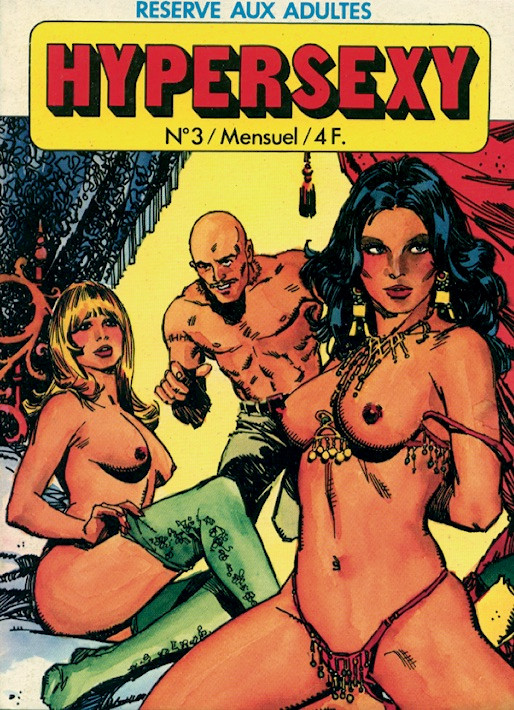
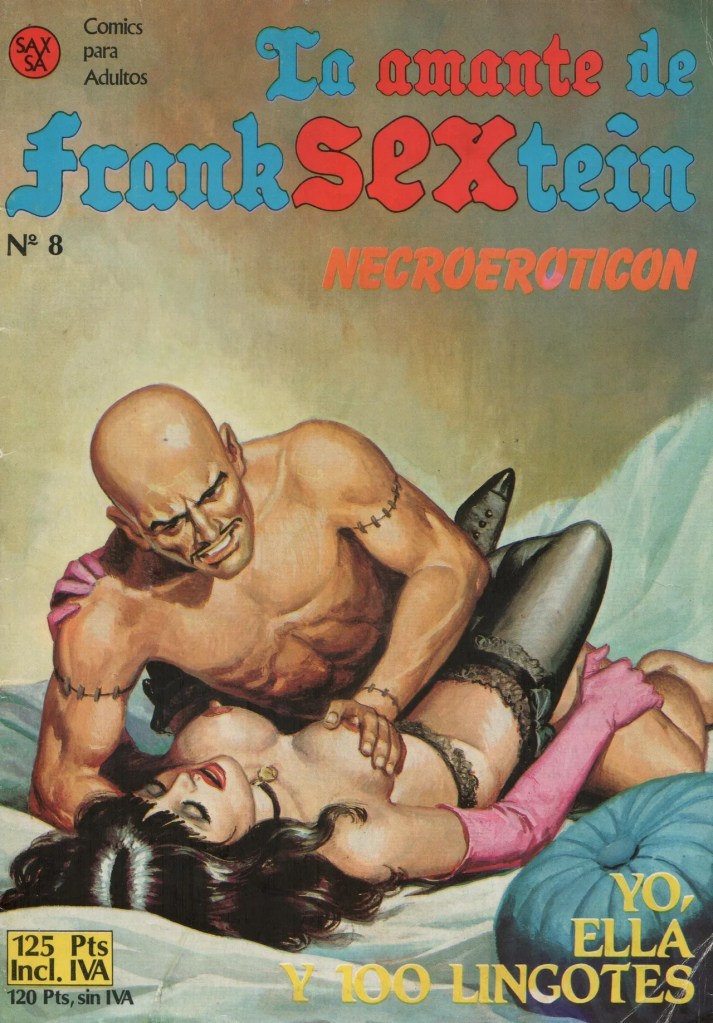
After a romantic interlude with Arlette, Franky goes to the bookstore to purchase an erotic work in two volumes: the Necroeroticon, which contains some new positions for Arlette and Franky to try. However, in Franky’s haste, he leaves behind the second volume, which is discovered by the villainous Dr. Stone and his assistant Pietr follow:
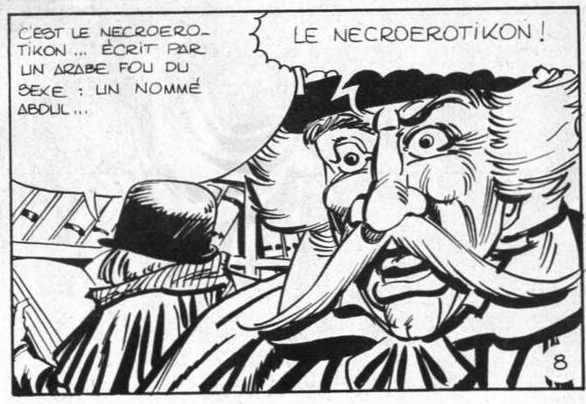
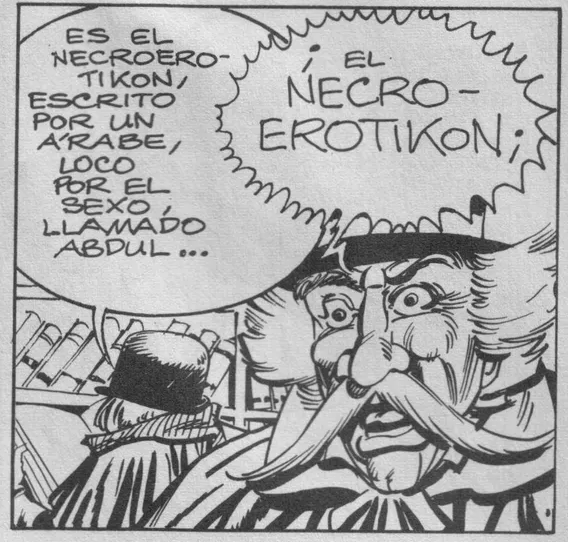
| C’est le Necroerotikon . . . écrit par un Arabe fou du sexe: un nommé Abdul. | Es el Necroerotikon, escrito por un árabe, loco por el sexo, llamado Abdul… | It is the Necroerotikon, written by an Arab, mad for sex, named Abdul. |
| French | Spanish | English |
While the translation is mostly word-for-word, the anonymous translator did have a few moments where they went for the gusto.
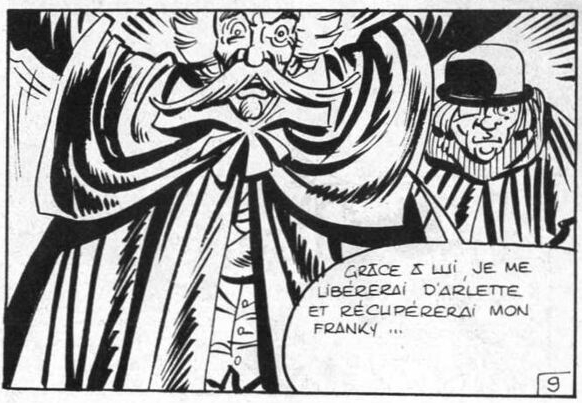
| Grâce à lui, je me libérerai d’Arlette et récupérerai mon Franky… | Thanks to him, I will free myself from Arlette and get my Franky back… |
| French | English |
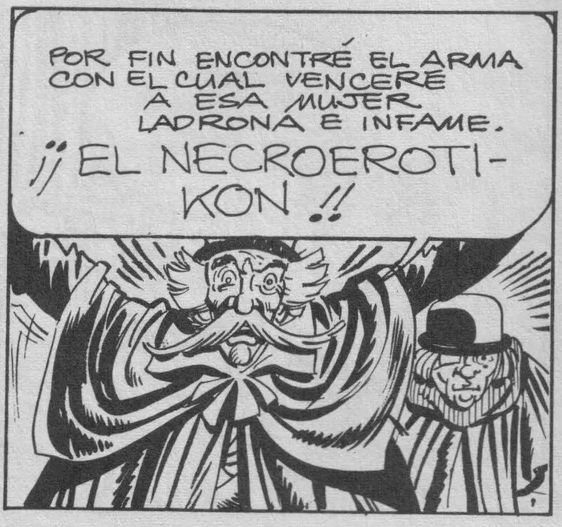
| Por fin encontré el arma con el cual venceré a esa mujer ladrona e infame. ¡¡El Necroeroticon!! | At last, I have found the weapon with which I will defeat that thieving, vile woman. The Necroeroticon! |
| Spanish | English |
Dr. Stone reads that when the planets are in alignment, and the sex ritual in the first part of the book is performed (which Franky and Arlette are in the middle of), there will be an earthquake that will awaken the sex god Phallocrath (Falocras in the Spanish version). Shortly thereafter, that happens, and Dr. Stone and Pietr (with three young women) go seek out Phallocrath in a cave, and find him. Since explicit sex and genitalia weren’t shown, the “sacrifice” of the three women occurs largely off the page, and Phallocrath is only seen in shadow.
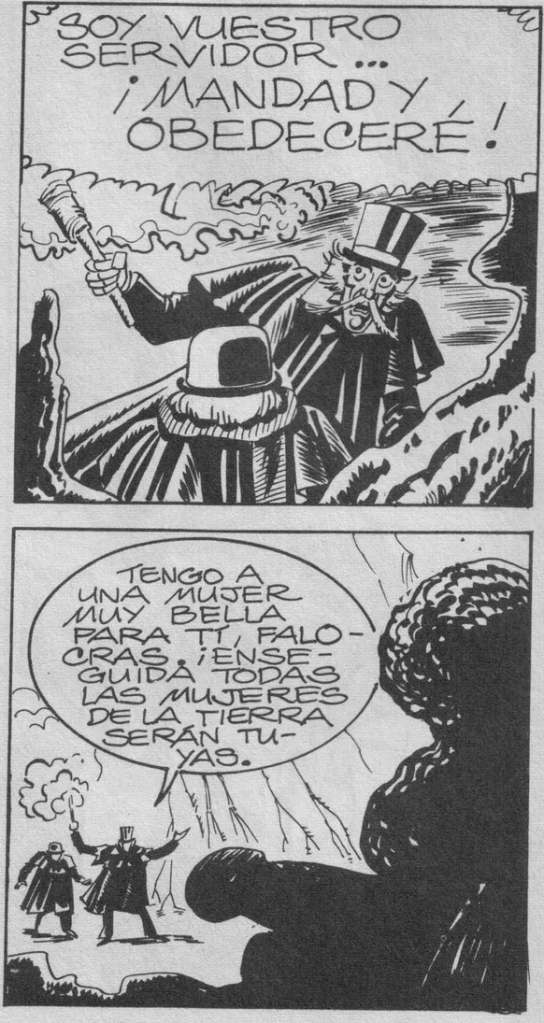
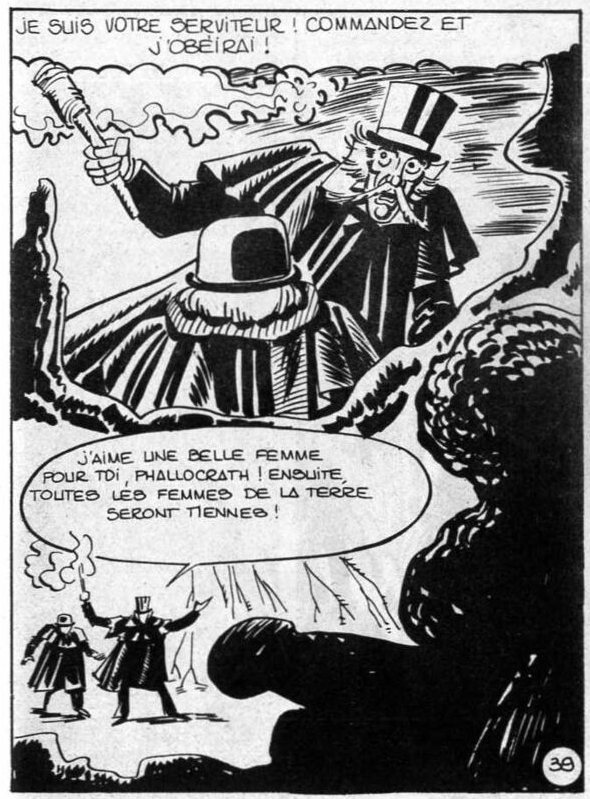
| Je suis votre serviteur! Commandez et j’obéirai! J’aime une belle femme pour toi, Phallocrath! Ensuite toutes les femmes de la terre seront tiennes! | Soy vuestro servidor… ¡Mandady, obedeceré! Tengo a una mujer muy bella para ti, Falocras. ¡Enseguida todas las mujeres de la tierra serán tuyas! | I am your servant! Give the command, and I shall obey! I shall find a beautiful woman for you, Phallocrath! And then, all the women of the earth shall be yours! |
| French | Spanish | English |
Unaware of this, Franky and Arlette want to try another ritual… unfortunately, Dr. Stone interrupts the ritual, and Phallocrath loses his powers. Arlette takes the opportunity to dispose of their half of the Necroeroticon.
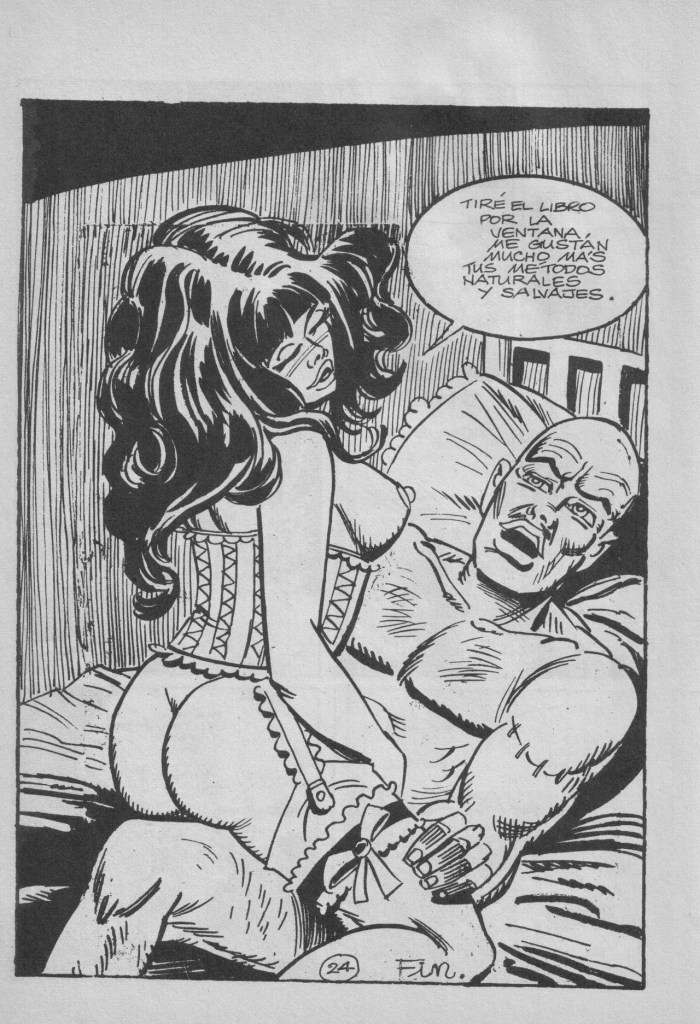
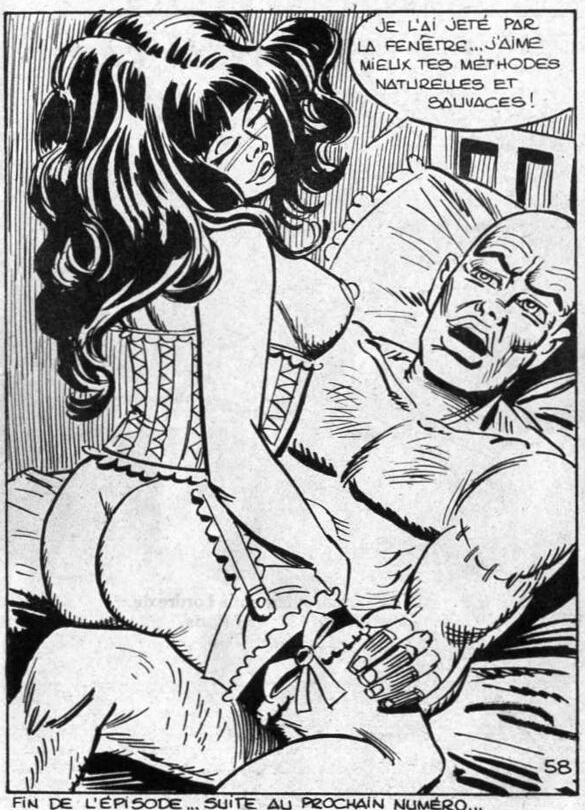
| Je l’ai jeté par la fenêtre… J’aime mieux tes méthodes naturelles et souvaces! | Tiré el libro por la ventana. Me gustan mucho más tus métodos naturales y salvajes. | I threw it out the window… I much prefer your natural, wild methods! |
| French | Spanish | English |
As with El Convento Infernal (1995) by Ignacio Noé & Ricardo Barreiro, we only get glimpses of the Necroeroticon as a kind of grimoire-cum-sex manual. The plot itself is a spicy comedy of errors, with the Lovecraftian elements largely a wink and a nod, with intimations of horrors that never appear on the page, a phallic eldritch entity we never see clearly, and consequences that basically don’t happen. Franky’s status as a Frankenstein’s monster-esque character plays no real role in the story, but Arlette’s assertion that she likes Franky’s natural and unsophisticated methods when it comes to lovemaking is a fitting denouement to the story.
Adult Frankenstein (2006)
Enrico Teodorani (15 May 1970– ) was born in Forlì, Italy; as a teenager in the mid-to-late 1980s began contributing to local fanzines and comics, and started singing in a couple of heavy metal bands. He has long had an affiliation with horror and erotica, and some of his most popular creations follow these trends, including the female western character Djustine, many of whose adventures have been translated and published in English as well.
In the early 2000s, Teodorani was publishing work with X Comics, an Italian-language monthly adult comics anthology magazine. This was a relatively popular format in Europe, and as with Metal Hurlant, there were often comparable volumes in different countries, such as Kiss Comix in Spain, which also had a French translation in France and an English edition in the United States. This meant that the work of a few creators could be available internationally in many languages in different publications, but it kind of makes it tricky to keep track of where everything was being published.
Around 2004, Teodorani began collaborating with various Djustine artists on a series of very short black-and-white works for X Comics that all feature Frankenstein’s Monster; the artists were Marco Guerrieri, Dario Santarelli, Gavino Piredda, Andrea Bulgarelli, Morrik, Luca Malisan, Danilo Loizedda, and Silvano, and the works vary from 1-6 pages. These appear to have been largely filler, but inspired by a 1976/1977 softcore Italian horror comic Frankenstein published by Edizioni Del Vascello/Edifumetto, which got a snapshot history in X Comics #37 (2002).
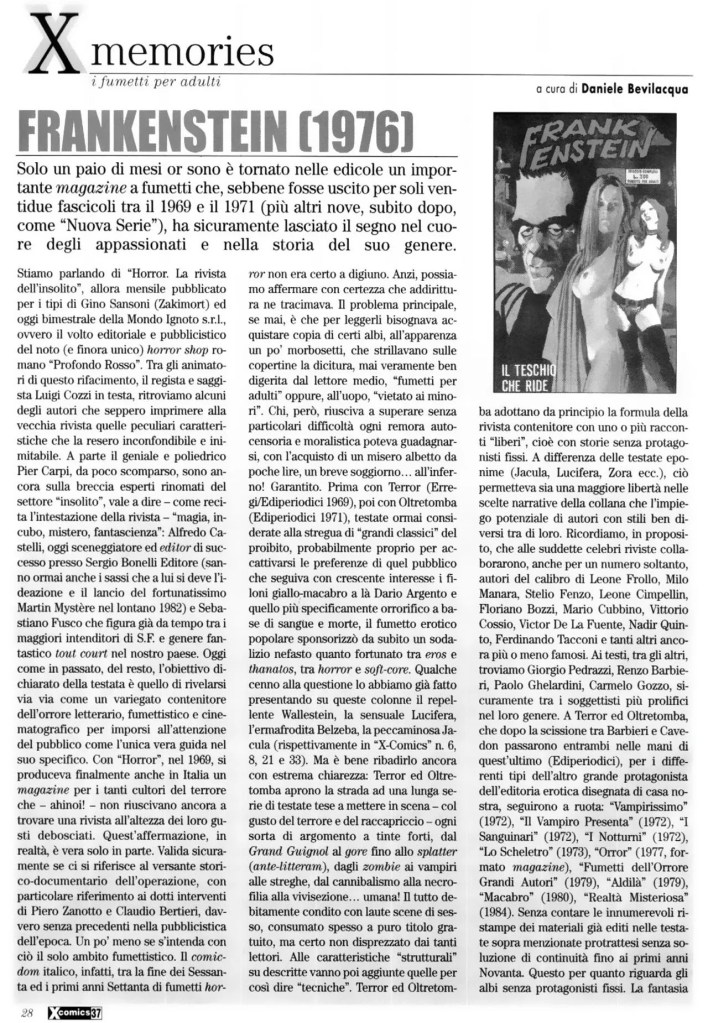
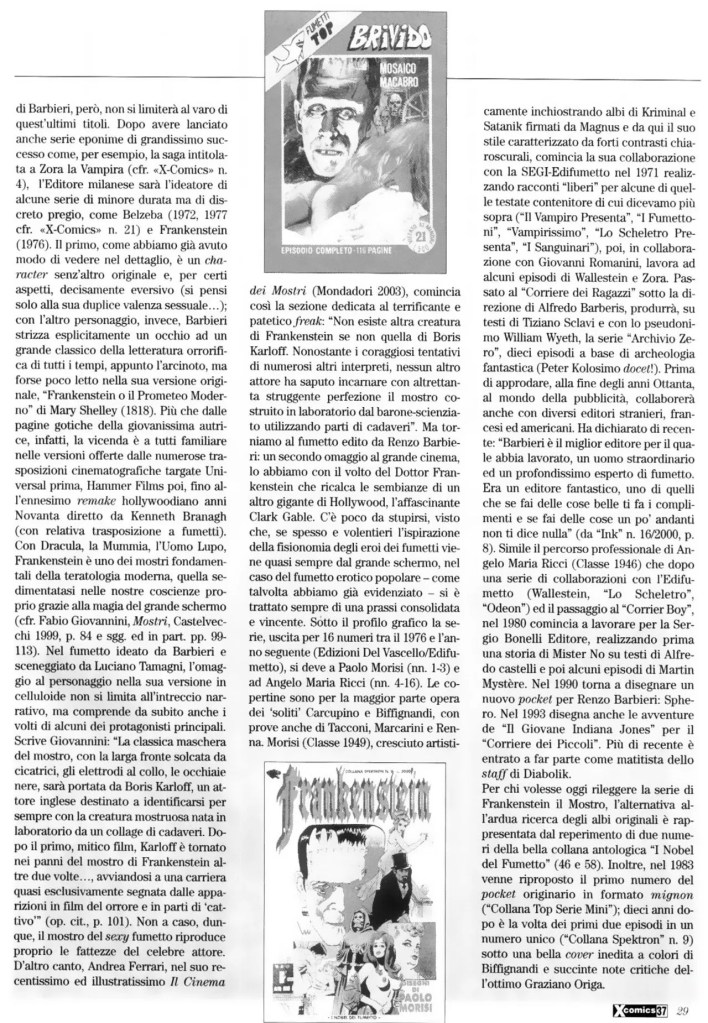
The Teodorani-written X Comics series appears as fairly disjointed, without a single plotline but more a series of brief erotic interludes in the saga of the Frankenstein’s Monster, the effect of the different artists and their unique takes on the monster, which vary from drawing inspiration from Boris Karloff’s makeup in the early Universal Frankenstein movies to the long-haired, sharp-featured Frankenstein’s Monster of Bernie Wrightson. It is a deliberately eclectic and pulpy mix, which often features Frankenstein’s Monster facing off against some other horror over a naked and nubile woman, and ending with a sex act. All in good fun.
There are two stories with Lovecraftian elements. In the 4-page “Island of Dr. Frankenstein” (artist: Andrea Bulgarelli), Dr. Frankenstein has taken his creation and a young woman to a remote island to use an ancient book to summon an amphibious humanoid from the deep for a sex rite—some clear overtones to “The Shadow over Innsmouth,” although nothing explicit. Frankenstein’s Monster objects, attacks the humanoid from the deep and drives it off, and is rewarded for his trouble.
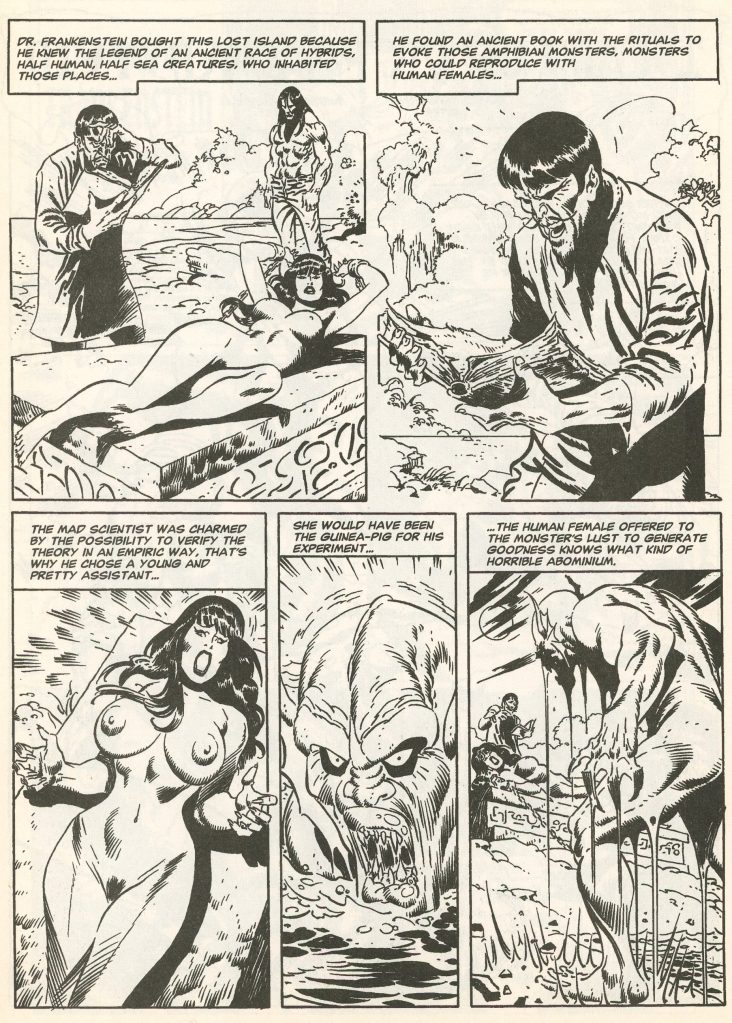
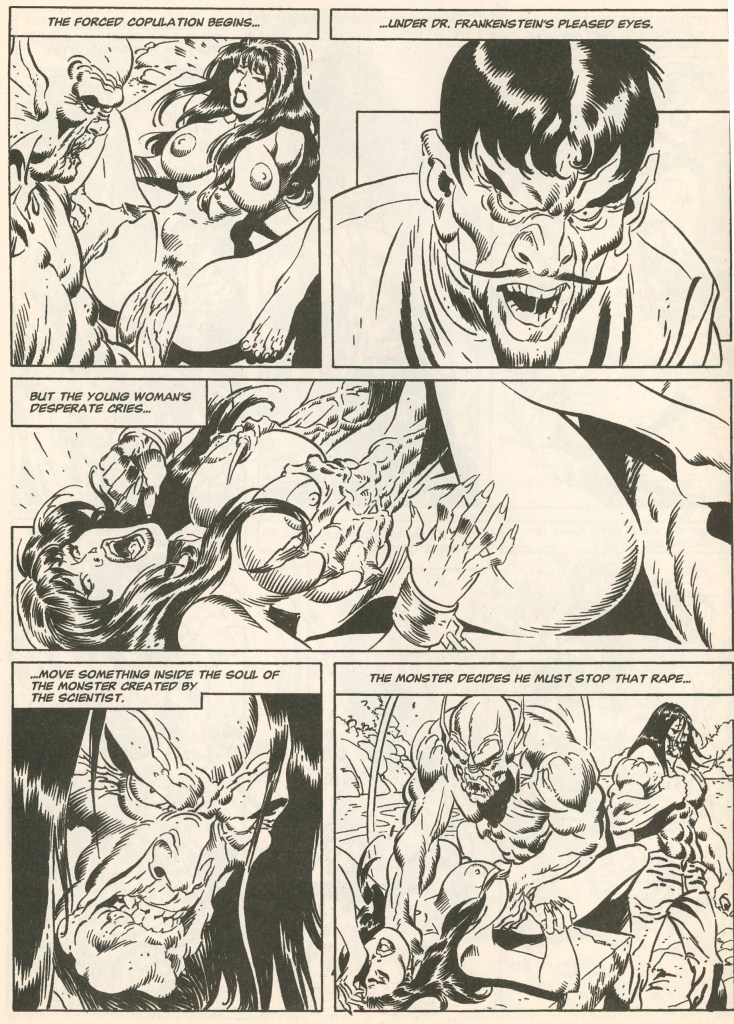
Some of Bulgarelli’s figurework has a distinct resemblance to John Buscema’s from Marvel’s Conan the Barbarian comics, though none of these are swipes, but all original works. Doctor Frankenstein is sporting a slightly outlandish English-style moustache, but in a comic where he’s dabbling in interspecies sexual relations, that’s hardly his worst character flaw.
The second, and more explicit Lovecraftian entry is the 4-page “Frankenstein, King of Demons” (artist: Silvano), which is the last story in the book. In the second-to-last entry, Frankenstein’s Monster had died and gone to Hell. In this story, in Hell, Frankenstein runs afoul of various Lovecraftian entities and is captured, before being inadvertently summoned by a magician, taking on an armored, costumed appearance very much in keeping with the Dark Age of Comics, and reminiscent of characters like Tim Vigil’s Faust.
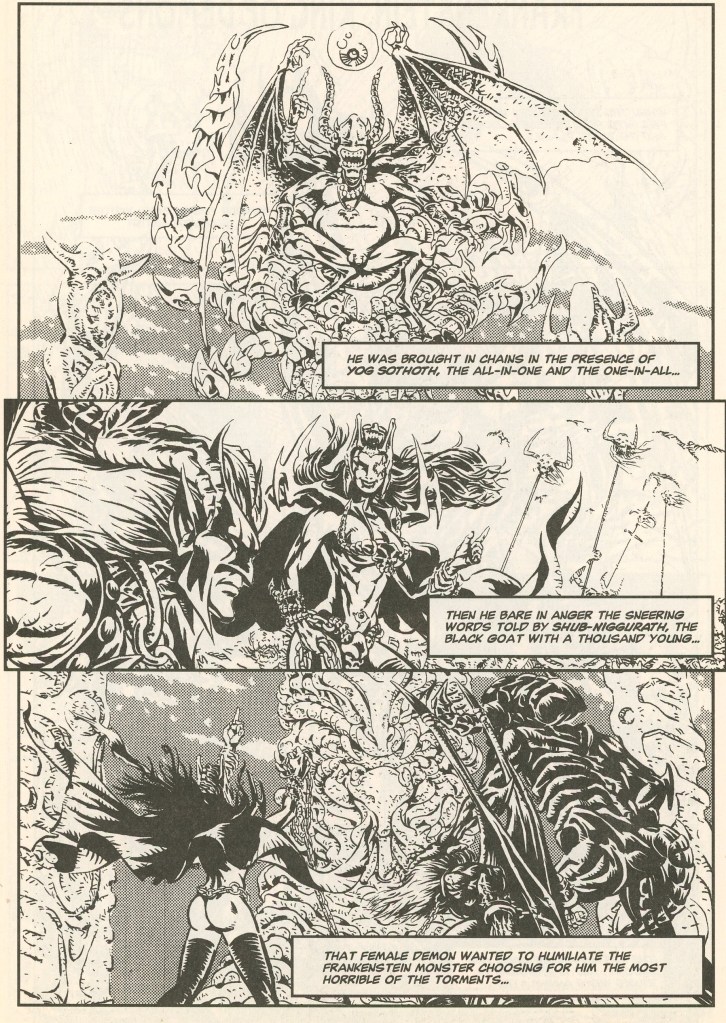
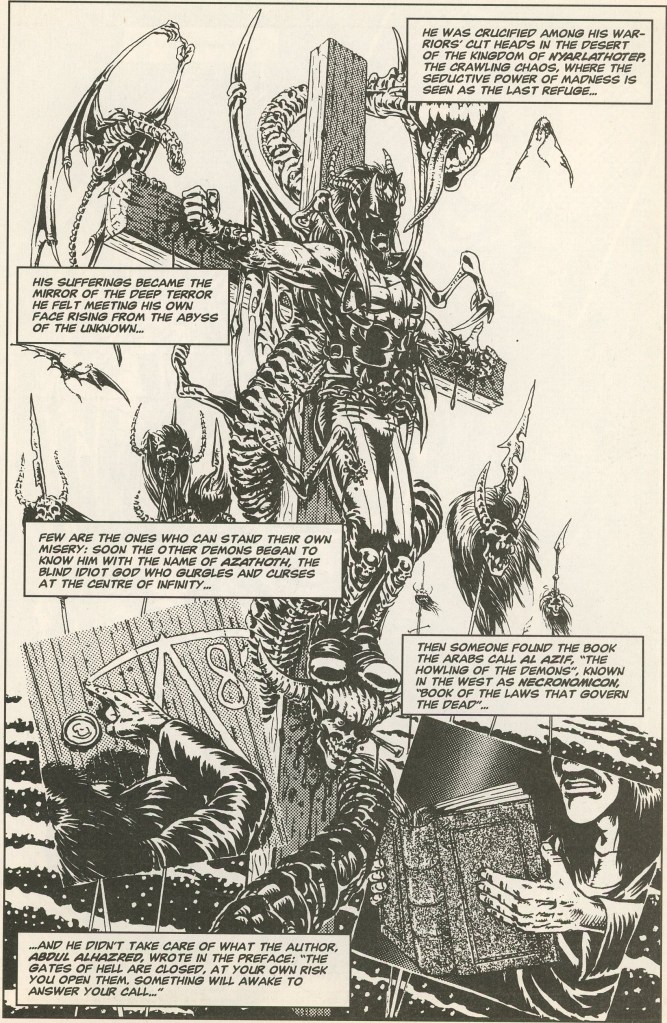
“Silvano” is credited for the art, and this is Silvano Calligari, who did some artwork for Djustine, and you can see him having fun here balancing light, nearly non-existent backgrounds with relatively dark, heavily detailed figurework. While other segments in Adult Frankenstein aim for comedy or eroticism, this one is clearly going for horror over titillation.
In 2005, the series was collected and translated into English by Enrico Teodorani, and published as a one-shot titled Adult Frankenstein by Eros Comix, which had handled other English translations of European erotic horror comics, such as Rosano Rossi’s Ramba (1992-1995); Raulo Caceres’ Elizabeth Bathory (2002-2004) and Morbid Tales (2004); and The Young Witches (1991-2005) by multiple writers and artists. An Italian edition with identical title but different cover was apparently published by EF Edizioni in 2008, though I haven’t been able to source a copy to confirm the contents.
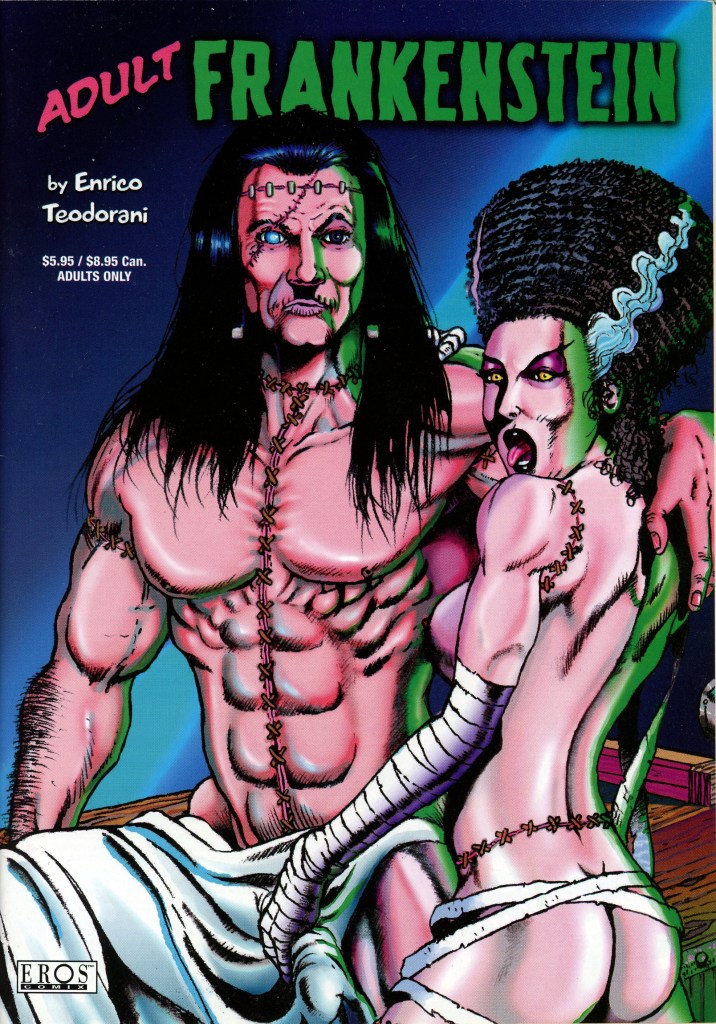
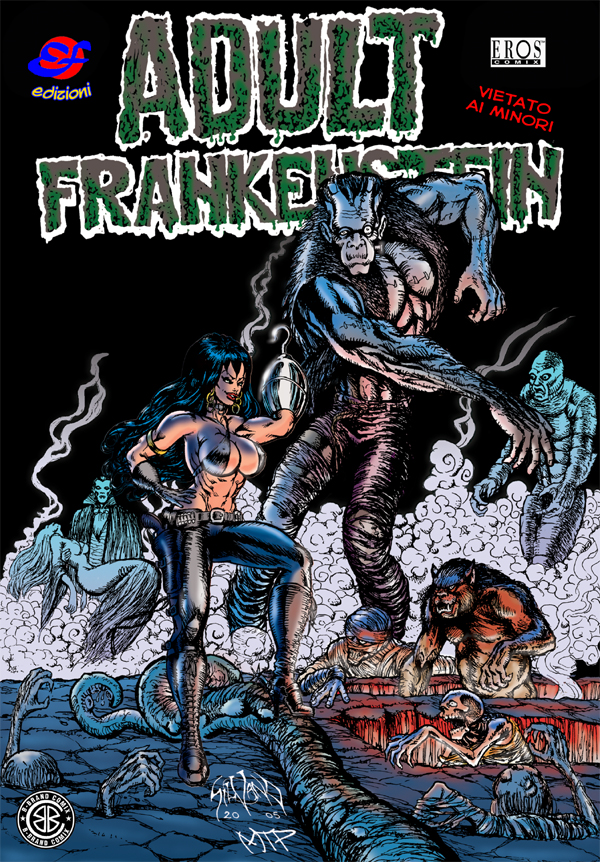
When you look at “Nécroéroticon” and Adult Frankenstein side-by-side, it is easy to see the parallels. The creators have taken Mary Shelley and Lovecraft’s creations in very different directions, and the Frankenstein’s Monster is barely recognizable in some of his appearances, marked out from the other characters only by a few tell-tale stitches, while Lovecraft’s Mythos is present more thematically than anything drawn directly from his stories.
Yet both of these works are genuine descendants of an international diaspora of English-language horror media; the shared result of stories, comics, and films that have made their way around the world for over a century and informed the pop culture of countries that Lovecraft, at least, never visited. They are part of an ongoing tradition of erotic horror, a tradition that involves translation across linguistic boundaries so that new audiences can read and maybe be inspired by these works.
Frankenstein’s Monster lurches on…and at least in some iterations, he may have a bit of help from Abdul Alhazred.
Bobby Derie is the author of Weird Talers: Essays on Robert E. Howard and Others and Sex and the Cthulhu Mythos.
Deep Cuts in a Lovecraftian Vein uses Amazon Associate links. As an Amazon Associate I earn from qualifying purchases.

