Her Letters To Lovecraft: Ida C. Haughton

The Woodbee for October is edited by Mrs. Ida C. Haughton, and though not of large size, does credit both to her and to the Columbus club.
—H. P. Lovecraft, “Department of Public Criticism,” United Amateur (Mar 1917), Collected Essays 1.145

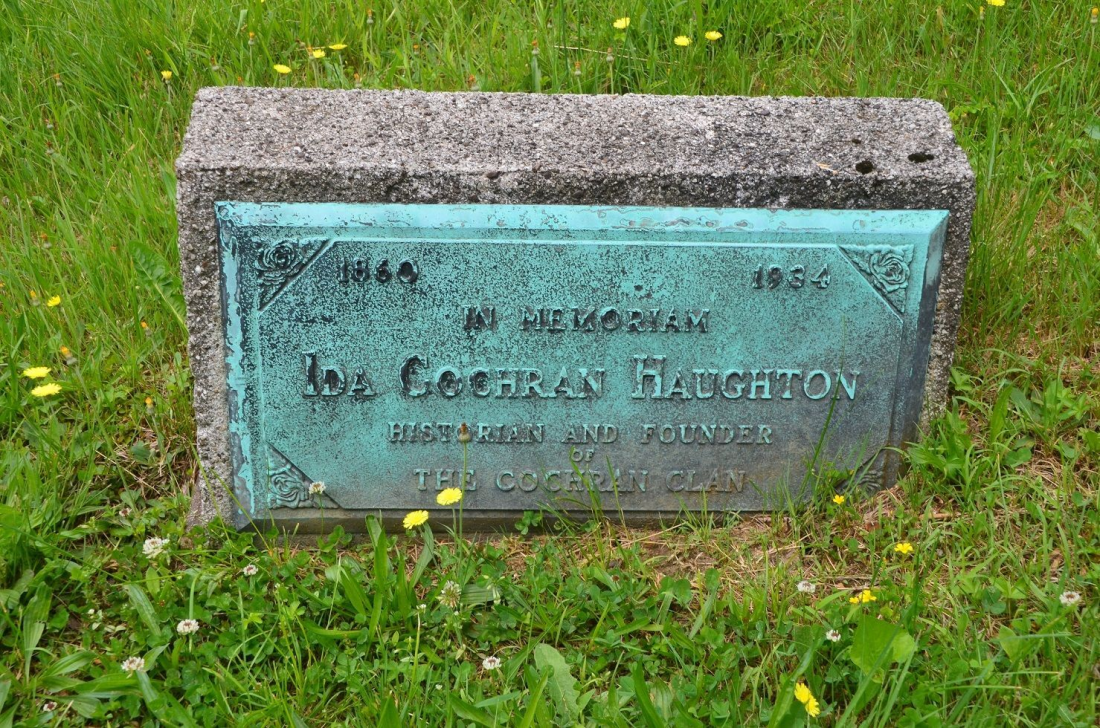
Ida Clara Cochran was born 22 July 1860 in Ohio, the first child of Samuel and Caroline Cochran. She had, apparently, little formal education. On 11 April 1883 she married Edwin S. Haughton. On 14 October 1887, their only child, Edna M. Haughton, was born. She was born, lived, and died in Ohio; and if she had any profession other than housewife it is not denoted on the federal census. Yet Ida C. Haughton had a considerable involvement in amateur journalism, one that brought her into contact—and conflict—with H. P. Lovecraft.

Organized amateur journalism in the United States began during the 19th century, when industrialization made amateur printing more feasible for individuals. There were several levels of organization, from small local groups like the Blue Pencil Club in New York City to larger regional groups like the Eastern Amateur Press Association, the New England Amateur Journalists Association, etc., and finally the national-level organizations: the National Amateur Press Association and the United Amateur Press Association—the latter of which was especially prone to faction, and by the time Lovecraft joined in 1914, had effectively split into two groups (the United Amateur Press Association with Lovecraft and Haughton, and the United Amateur Press Association of America with Elsie Gidlow). Various levels of organization were combined; so that for example the Blue Pencil Club was largely aligned with the NAPA and shared considerable overlap in membership, and the Woodbees Club in Ohio was wholly affiliated with the UAPA.

Ida C. Haughton was a member of the Woodbees and the UAPA. While it isn’t clear exactly when she joined, Lovecraft begins to mention her in his review column in the United Amateur (official organ of the UAPA) in 1915. There is, at this early date, no sign of animosity; while Lovecraft criticizes her poetry somewhat for perceived technical irregularities, his criticism is always balanced with praise, e.g.:

“Dead Men Tell No Tales”, a short story by Ida Cochran Haughton, is a ghastly and gruesome anecdote of the untenanted clay; related by a village dressmaker. The author reveals much comprehension of rural psychology in her handling of the theme; an incident which might easily shake the reason of a sensitive and imaginative person, merely “unnerves” the two quaint and prim maiden ladies. Poe would have made of this tale a thing to gasp and tremble at; Mrs. Haughton, with the same material, constructs genuine though grim comedy!
—H. P. Lovecraft, “Department of Public Criticism,” United Amateur (May 1917), Collected Essays 1.154

Little of Haughton’s work has been reprinted (notably, a convention report from 1920), so we have largely only Lovecraft’s reviews to judge, but she seems to have been fairly prolific in poetry, short fiction, sketches, short essays, and involved with editing of the Woodbee and sometimes her own amateur journals. Ida C. Haughton was noted for her devotion to her family and genealogy, having published a book Chronicles of the Cochrans (1915), which includes an autobiographical portion, and was involved with family reunions and an organization of Cochran descendants. Her daughter Edna M. Haughton, a schoolteacher, was also a member of the UAPA and the Woodbees, and there are indications that Ida recruited other relatives for amateur journalism as well:

The Woodbee for October is a magazine of wonderful merit, reflecting the sound scholarship of its gifted editor, Mrs. Ida Cochran Haughton. Mrs. Haughton feels constrained to apologise because of the prevalence of material from the pens of members of her family, but she has no reason to do so, since it would be difficult to find better literature than that which she used. […] The editorial comment, news notes, and other miscellaneous matter are of that high standard which one naturally expects from a writer of Mrs. Haughton’s culture and attainments; and it is not too much for the impartial critic to say that her management of the Woodbee has set a new standard in correct and graceful editorship. The October number is an issue to which amateurdom may well point with pride as one of the most substantial achievements of the year.
—H. P. LovecraftL, “The Department of Public Criticism,” United Amateur (Jan 1918), Collected Essays 1.183

Amateur journalism was a democratic institution, and the UAPA held annual elections for officers drawn from among the membership. This led to politics, and Sayre’s law applies. At the time he was recruited and ever afterward, Lovecraft was associated with a faction of the United which emphasized literary ability, high standards in printing and criticism. Haughton and the Woodbees were more focused on the social aspects of amateur journalism, with more emphasis on amateurism and less on high-minded literary ability. After Lovecraft’s presidency (1917-1918), he was succeeded by three presidents from his faction: Rheinhart Kleiner (1918-1919), Mary Faye Durr (1919-1920), and Alfred M. Galpin (1920-1921). During this period, the columns of the United Amateur were largely dominated by Lovecraft and his friends; and the official organ reflected their efforts to project a quasi-scholar, high-brow aesthetic.

Ida C. Haughton, and many others in the United, were critical of Lovecraft & friends’ management of the organization, which we get the occasional hint of in Lovecraft’s letters:

The very boorish and puerile attack on the critical department made last year by Mrs. Haughton, is yet echoing in the United.
—H. P. Lovecraft to Edward H. Cole, 13 May 1918, LAGO 35

Since Lovecraft was the critics department, more or less, he apparently took this personally. Haughton was at this point also the head of the Western Manuscript Bureau of the United, and later Secretary, receiving new membership applications and handling recruitment, and Lovecraft was apparently not happy with how she handled her duities:

Record each application received; send the applicants their certificates, properly filled out, with suitable words of welcome; and send all credentials to one or both of the MS. Bureaux—preferably the Eastern, unless she can endure dealing with that utterly impossible Haughton creature.
—H. P. Lovecraft to Alfred Galpin, 14 Nov 1918, LAGO 218

I was very pleased to receive your recent letter with interesting enclosures, & have duly forwarded the membership application to the new Secretary—Mrs. Ida C. Haughton, 1526 Summit St., Columbus, Ohio. I am glad to welcome you as a full-fledged member of the United, & hope that your affiliation may prove permanent.
—H. P. Lovecraft to Arthur Harris, 11 Sep 1919, LRKO 239

Your failure to hear from the association officially is due to the negligence of the new Secretary, a rather eccentric elderly woman who was given the post merely because she happens to live in the next convention city. […] Smith is not a member of the United, & I fear he does not know that Mrs. Haughton is our Secretary; but I will tell him, also writing Kilpatrick. I wish Mrs. H would get some blanks printed—I have typed them till I hate the sound of the machine!
—H. P. Lovecraft to James Larkin Pearson, 19 Sep 1919, LRKO 320

While never publicly insulting Haughton, it is clear that the criticism leveled against Lovecraft and his faction must have increased in fervor and volume, at least if Lovecraft’s reaction to it is anything to go by:

It is that filthy Cleveland sewer-rat [William Dowdell] and that disgusting Columbus hippopotamus-jellyfish [Ida C. Haughton] who have done all the malevolent work by their raucous howls, and I fervently wish them both a swift and rough passage to the abode of Beëlzebub.
—H. P. Lovecraft to the Gallomo, [Apr 1920], Miscellaneous Letters 83

At the 1921 convention, Ida C. Haughton won the vote for president.

Lovecraft was still Official Editor of the United Amateur, but had to deal with Haughton’s directives and her control of the United’s finances, as the UAPA collected dues from members to cover the printing of membership forms, lareaute certificates, and the United Amateur journal itself.

Since they were both officers of the organization and had to work together, Ida Haughton appears to have written to Lovecraft for the first time in 1921:

Ida has just written me that she and her Columbus henchman expect next year’s UNITED AMATEUR to be conducted in a more commonplace and democratic manner; with less of the purely artistic and more of the chatty and plebian. Only on such conditions, she implies, will the Columbus purse strings be liberally open. I have been dreadfully polite in replying, and have courteously ladled out wish to the effect that I’ll see her in hell first.
—H. P. Lovecraft to the Gallomo, 12 Apr 1921, Miscellaneous Letters 122

Part of the animosity came from Haughton’s accusation that Lovecraft had mismanaged the official organ fund. This frustration reached its peak with Lovecraft composing the satiric poem “Medusa: A Portrait”; to make sure there was no doubt who the gorgon in the poem was supposed to be, Lovecraft wrote a mocking dedication to Haughton when he sent the poem around to his close friends:

TO THE HON. IDA COCHRAN HAUGHTON, VISCOUNTESS WOODBY—
MY LADY:—

I shou’d be but a Cheater, and unworthy of the poetick Art, were I not to acknowledge to you by this Dedication the Indebtedness I ebar you. For ‘tis plain that I may my self claim but partial Credit for a Picture which, without so illustrious a Model, wou’d never have been drawn with any Sort of Fidelity. Truly, the Satirist desiring to shew certain Traits of Mind, wou’d be hard put to it, had he not before him some sort of living Example; and I am in Candour forc’d to concede, that of the QUalities I here seek to pourtray, no human Being cou’d display so great and flourishing an Abundance as your self. I shall ever count it a Piece of the greatest good Fortune, if my Satire succeed, that your Hatred of me mov’d you to slander and vilify me behind my Back; for lacking that Provocation I shou’d have neither had the Temerity to expos,e your Failings, not possessed so compleat a Fund of Lies and Calumnies from which to draw a Picture of such Venom as I never thought before to exist upon Earth.

Conscious, therefore, of my Debt, I will commend this unrpetentious Effort to your well-known Graciousness, and beg leave to subscribe my self,

MY LADY,
Your Ladyship’s most obedient,
Most devoted, humble servant,

THEOBALDUS SENECTISSIMUS, ARMIGER.
—H. P. Lovecraft to the Gallomo, 29 Nov 1921, Miscellaneous Letters 130-132

This language was only used in private to close friends; how Lovecraft phrased his reply to Ida C. Haughton is not known, since none of their correspondence is known to survive. In public, in the pages of the United Amateur, Lovecraft kept things civil, although occasional signs of frission slipped through:

It is not in a spirit of affront to him that we give preference to the plan of President Haughton, as outlined in her opening message, for the re-restablishment of a special magazine for credentials. We should be glad to curtail the official organ in the interest of such a magazine, as indeed we offered to do at the beginning of the term.
—H. P. Lovecraft, “Editorial,” United Amateur (Sep 1921), Collected Essays 1.298

A “credential” was a work which demonstrated literary ability, be it a poem, short story, or essay, and which formed part of a would-be amateur journalist’s application to national organizations like the UAPA and NAPA; it was often the first piece of theirs that would be published in an amateur journal. Having a separate magazine for publishing credentials was intended to encourage new recruits, and Lovecraft seems to have largely approved of this move:

Mrs. Haughton and other assemblers of the recent New Member deserve much credit for providing a sorely needed outlet for the work of the recruit. The United should have further numbers of this or an analogous publication, and it is to be hoped that such can be made feasible. The editorial note in the present issue would gain strength and pertinence is more closely connected with the subject-matter and less fertile in accidental misstatements.
—H. P. Lovecraft, “News Notes,” United Amateur (May 1922), Collected Essays 1.317

In 1922, the presidency of the UAPA went from Ida C. Haughton to Howard Conover, and Lovecraft and members of his faction were effectively outed from all positions of leadership. In 1923, Lovecraft’s faction returned as his wife Sonia H. Greene became president, but her presidency faced issues, both from her personal difficulties and because the treasurer of the former administration refused to turn over the funds. Despite efforts to carry on with recruitment and publication, the United Amateur Press Association was moribund, and would not survive many more years.

Ida C. Haughton’s later years in amateur journalism are opaque; references to her in Lovecraft’s editorials and letters drop off after her term as president, although there was still considerable animosity on his part into the mid-1920s:

I may be human, all right, but not quite human enough to be glad at the misfortune of Dowdell or of anybody else. I am rather sorry (not outwardly but genuinely so) when disaster befalls a person–sorry because it gives the filthy herd so much pleasure. To be a real hater, one must hate en masse. I hate animals like the Haughton rhinoceros mildly and temperately, but for mankind as mankind I have a most artistically fiery abhorrence and execration, I spit upon them!
—H. P. Lovecraft to James F. Morton, 8 Mar 1923, LJM 29

Shall be glad to see The Old Timer, & hope Old Medusa gets her unshielded by Adamic censorship. But don’t fancy the old rhino is really a human being—she simply ain’t! That cow-mountain is nothing but a festering tumour of ectopic tissue, produced by fatty degeneration & morbid cell-sprouting–a senile & purulent excrescence on the race, wholly acraniate or at best microcephalic, & with muscular reactions—which produce written articles–caused by neuro-ganglial maladjustments induced by a gall-bladder dislocated by malignant elephantiasis into a position corresponding to the seat of the rudimentary brain in that species of primitive organism of which she is a noisomely decadent variant. She—or it—is a mere octopus of ugliness, nightmare, stupidity, & snarling malevolence . . . . a pitiful object that ought to be buried.
—H. P. Lovecraft to James F. Morton, 23 Mar 1923, LJM 34-35

When it comes to real cause for serious offence, how the devil can you think this farce even half as grave as that other old Ohio slush-brain’s attack on me in 1921? Boy, there isn’t half the real poison in the whole damn carcass of Peg-Ass-Us, that there is in one ophidian strand of the false hair of that fat cow-hippopotamus in Columbus! Put that li’l ol’ memory to work, Kid! Whilst all Witless-Cut has done is to fume picturesquely under deserved criticism, that ‘Idra Hot-One monster ran the very gamut of abuse & positive insult—culminating even in an aspersion on my stewardship of the United funds!
—H. P. Lovecraft to Maurice W. Moe, 15 Jun 1925, LMM 140

With the dissipation and collapse of the UAPA, however, Lovecraft’s ire would cool. When, at last, a bit of sad news came to him, he regarded his old enemy a bit differently.

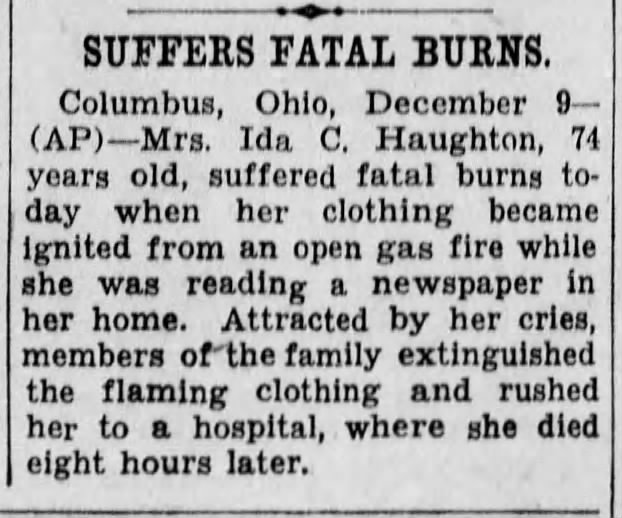
By the way—did you notice in one of the Oakland amateur papers the news that savage old Ida C. Haughton, my deadly foe in the early 1920s, was burned to death a year ago through the igniting of her clothing at a fireplace? Poor old gal! I’m surely sorry to hear it! I wished her a lot of things, but nothing quite as drastic as that!
—H. P. Lovecraft to James F. Morton, 12 May 1936, LJM 385

As for the continuance of the history to the finish in 1927—I really can’t tell when I’ll be able to get around to it, but I surely would like to do it some time—since no other old United member seems disposed to tackle the job. I doubt whether I’d try to revive the animosities of 20 & 15 years ago—for those issues are long dead, as indeed are some who participated in them. Poor old Mrs. Haughton, my arch-foe of 1921-22, was burned to death a year or two ago when her clothing ignited at a fireplace.
—H. P. Lovecraft to Hyman Bradofsky, 24 Nov 1936, LHB 383

It is hard to judge, from this distance, the issues which were so critical as to spark animosity between Ida C. Haughton and H. P. Lovecraft in the early 1920s. So too, we really only have Lovecraft’s side of the argument; and none of their brief correspondence survives for us to judge either Haughton’s tone or the content of her letters to him. Lovecraft’s animus, and his pity, both seem genuine; he certainly did not celebrate her death. Their quarrel had ultimately died with the United itself, and survives only in dusty editorials and old letters.


Bobby Derie is the author of Weird Talers: Essays on Robert E. Howard & Others (2019) and Sex and the Cthulhu Mythos (2014).

Deep Cuts in a Lovecraftian Vein uses Amazon Associate links. As an Amazon Associate I earn from qualifying purchases.
Her Letters To Lovecraft: Mary Faye Durr

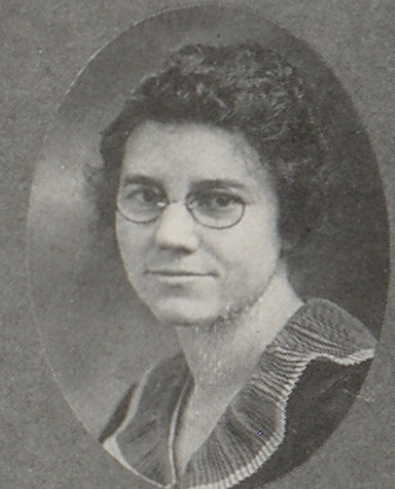
Mary Faye Durr was born on 17 May 1893, the youngest of three children born to Abraham and Mary Durr. Like many women of the period, details of her early life are sketchy. Is it known that she graduated high school and then college, graduating from the University of Ohio in 1915.

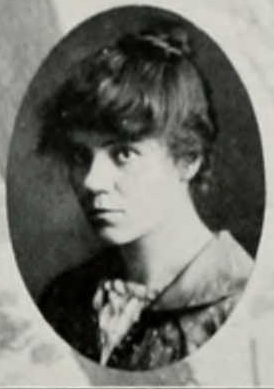
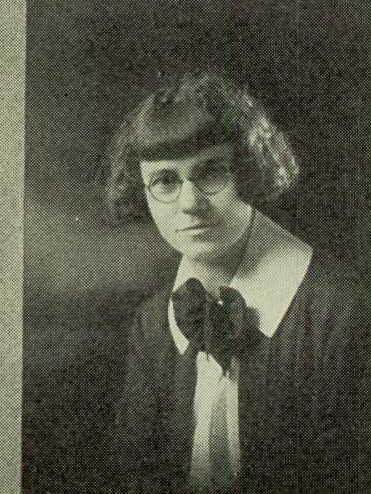
Durr’s entry from the 1915 University of Ohio yearbook.

In the same year, the young woman first pops up in the writings of H. P. Lovecraft, showing that she had at some point joined the ranks of amateur journalism, and in particular the United Amateur Press Association:

“A Best Book”, by Mary Faye Durr is a brief but delightful essay which reveals a just appreciation of the broader functions of literature.
—H. P. Lovecraft, “Department of Public Criticism,” United Amateur Dec 1915, Collected Essays 1.87

Durr continues to appear sporadically in Lovecraft’s reviews of amateur journals, and much of what he says is relatively positive, speaking to her technical skill and taste, if not exactly praising Durr’s creativity, and tracing her taking on positions within the UAPA:

“At the End of the Road”, by Mary Faye Durr, is graphic and touching description of a deserted schoolhouse. The atmosphere of pensive reminiscence is well sustained by the judiciously selected variety of images and allusions. […][120] “The Melody and Colour of ‘The Lady of Shalott'”, by Mary Faye Durr, is a striking Tennysonian critique, whose psychological features, involving a comparison of chromatic and poetic elements, are ingenious and unusual. Miss Durr i[s] obviously no careless student of poesy, for the minute analyses of various passages give evidence of thorough assimilation and intelligent comprehension.
—H. P. Lovecraft, “Department of Public Criticism,” United Amateur Jun 1916, Collected Essays 1.119, 120

“Beyond the Law”, by Mary Faye Durr, is a light short story of excellent idea and construction, whose only censurable point is the use of “simplified” spelling.
—H. P. Lovecraft, “Department of Public Criticism,” United Amateur May 1917, Collected Essays 1.153

Miss Mary Faye Durr of Mount Sterling, Ohio, has accepted appointment as Secretary, her occupancy of that important office ensuring an efficient and business-like handling of the records.
—H. P. Lovecraft, “Department of Public Criticism,” United Amateur Sep 1917, Collected Essays 1.172

“The Village”, a delightful study by our Secretary, Miss Durr, is replete with vividness of atmosphere and delicacy of touch; though it is closely rivalled by the masterly bit of psychology from the hand of the editor, entitled “An Interpretation”.
—H. P. Lovecraft, “Department of Public Criticism,” United Amateur Jan 1918, Collected Essays 1.183

Mary Faye Durr first appears in Lovecraft’s private letters in 1918, and it seems as if they were about to come into correspondence—through a typically Lovecraftian 22-page letter—if they had not already come into contact:

Ye Gods! For ‘Eaving’s sake abstain from sending my “mission in life” letter to Mistress Durr. I recall saying in it that I thought she was minding other people’s business! I have given her a 22-page broadside, calculated to demolish any pragmatical notions which may still becloud her mentality, but have not gone into personal excuses for idleness beyond saying that my constitution does not permit of systematic endeavour, else (of course) I should be doing something the same as any other rational human being. What does she think I am—a corner loafer? She might know better—for if I were, the “work or fight” law would have “got” me long ago, and I should be toiling in some munition factory or shovelling sewers at some content. I am not particularly anxious to discuss my affairs with relative strangers—my letter was for you, not her.
—H. P. Lovecraft to Alfred Galpin, 21 Aug 1918, Letters to Alfred Galpin & Others 202

Lovecraft says nothing of Durr’s personal life, and probably knew as little to nothing about her activities beyond amateurdom as she did about his. While Lovecraft was unemployed at this period, it appears that after graduating from university Mary Faye Durr became a schoolteacher; yearbooks and newspaper records track a long career in public education in Ohio that would last for decades. During the earliest part of her career (according to the Federal 1920 and 1930 census) she was apparently still living at home with her parents, a not-unusual situation for an unmarried young woman.

No letters survive from Lovecraft to Durr or Durr to Lovecraft, so the shape and extent of their correspondence is difficult to evaluate, but apparently Lovecraft lent one of her letters to James F. Morton:

I am glad Father Mo found Miss D’s epistle so interesting. She has a sort of pert, laconic humour or smartness, of which she is evidently fairly proud, & which she is not at all reluctant to employ.
—H. P. Lovecraft to Alfred Galpin, 29 Aug 1918, Letters to Alfred Galpin & Others 208

Speaking of clients—you & Miss Durr will be satisfied at last. I am a real labouring man! In other words, I have undertaken to make a thorough & exhaustive revision of Rev. D. V. Bush’s long prose book—now called “Pike’s Peak or Bust”, though part of my job is to find another name.
—H. P. Lovecraft to Alfred Galpin, 14 Nov 1918, Letters to Alfred Galpin & Others 222

Given Lovecraft’s correspondence with others, the start of their letter-exchange was probably fairly formal, slow to build a rapport.

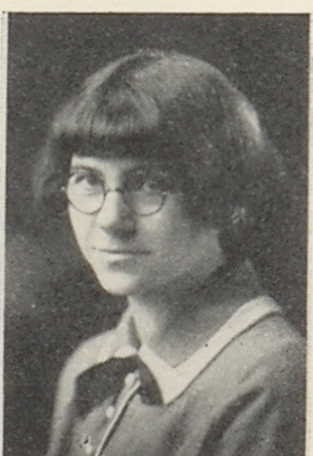
Mary Faye Durr, 1919 Marietta (Ohio) Yearbook

Mary Faye Durr was secretary of the UAPA 1917-1918, elected treasurer for 1918-1919, and at the 1919 convention, was elected President of the United Amateur Press Association for the 1919-1920 term, only the third woman in that office. The popular history of amateur journalism marks this period as sort of the beginning of the end of the UAPA:

The poet Rheinhart Kleiner, of Brooklyn, N. Y., was chosen President in 1918, and another woman President in 1919, Miss Mary Faye Durr, of Marietta, Ohio. But its members began to relax, recruiting was not carried on, interest waned, and this branch of the United, though seeming to have the best claim to lineal descent from the original body, gradually ceased to function, and in 1926 it passed out of existence.
—Truman J. Spencer, The History of Amateur Journalism 92 (online edition)

The truth is a little more complicated. Early in the year, Durr apparently realized that the UAPA desperately needed new members and set up an amateur journal specifically to do so, The Recruiter. Lovecraft reviewed it with high praise:

The Recruiter for January marks the advent to amateurdom of a new paper, which easily takes its place among the very best of recent editorial enterprises. Edited by Misses Mary Faye Durr and L. Evelyn Schump in the interest of the United recruits whom they are securing, its thoroughly meritorious quality speaks well for the new members thus added to our circle. […]

“Winter”, a brief poem by Hettie Murdock, celebrates in a pleasant way an unpleasant season. The lines are notable for correctness, spontaneity, and vitality, though not in the least ambitious in scope. […]

“Shades of Adam”, by Mary Faye Durr, is an interesting and humorously written account of the social side of our 1918 convention. Miss Durr is exceptionally gifted in the field of apt, quiet, and laconic wit, and in this informal chronicle neglects no opportunity for dryly amusing comment on persons and events. […]

The Recruiter’s is brief and business-like, introducing the magazine as a whole, and its contributors individually, Amateurdom is deeply indebted to the publishers of this delightful newcomer, and it is to be hoped that they may continue their efforts; both toward seeking recruits as high in quality as those here represented, and toward issuing their admirable journal as frequently as is feasible.

—H. P. Lovecraft, “Department of Public Criticism,” United Amateur Mar 1919, Collected Essays 1.224

Hettie Murdock was a fellow schoolteacher in Ohio; she and Durr would share a close friendship, to be detailed later, but Murdock’s involvement here may suggest that Durr recruited her for the UAPA around this time.

While no letters from Durr to Lovecraft (or vice versa) survive, one letter survives from Durr to Anne Tillery Renshaw among Lovecraft’s papers; Renshaw was at the time Official Editor for the UAPA under Durr. While the letter is only dated “Thursday, P.M.” it appears to have been during Durr’s period as president, and mentions that Halloween is the next day—and October 31st fell on a Friday in 1919. The letter deals in part with Durr’s correspondence with Lovecraft, and recruiting:

I supposed Recruiting committees were announced in Sept. no., but Lovecraft says not. If the two vice presidents have not notified their committees I will see what I can do about it.

I don’t remember if I told you about application blanks in my last, but this is the situation. Eddie told me in August that he was having Lovecraft look after them, and only last week I discovered that none had ever been ordered. Cook is getting them out now as fast as possible.
—Mary Faye Durr to Anne Tillery Renshaw, Thursday [30 Oct 1919], Brown Digital Repository

Renshaw presumably forwarded this letter to Lovecraft, who later used it to compose some Christmas greetings (let us all be thankful for parsimonious packrats!)

With this letter and The Recruiter, it is clear that Durr was conscious of difficulties in recruiting…but she was still a working woman, with limited time to devote to amateur affairs. It also shows she must have been in semi-regular contact with Lovecraft for various duties related to amateurdom, such as the hunt for a laureate judge which netted Lord Dunsany. Lovecraft for his point appeared to point potential recruits at Durr:

Your failure to hear from the association officially is due to the negligence of the new Secretary, a rather eccentric elderly woman who was given the post merely because she happens to live in the next convention city. You might speak about it to the President—Miss Mary F. Durr, 526 Third St., Marietta, Ohio.
—H. P. Lovecraft to James Larkin Pearson, 19 Sep 1919, Letters to Rheinhart Kleiner & Others 320

The secretary was Ida C. Houghton, who would herself be president of the UAPA during the 1921-1922 term, where she would butt heads with Lovecraft, who had taken on the position of Official Editor. At the 1920 convention where she handed off the office of president to Alfred Galpin, Durr gave a memorable speech riffing on Abraham Lincoln’s Gettysburg address (Fossil 341); her friend Hettie Murdock also attended the convention.

The last mention of Mary Faye Durr by Lovecraft is a brief review in 1921:

Miss Durr’s “As Ye Judge” is marked by distinguishable sanity and good sense—the ideal liberalism of a thoughtful mind—and lacks only originality of presentation to be remarkable. Not that it is in any sense unoriginal, but that it states in unornamented way truths which are universal among progressive students today.
—H. P. Lovecraft, “The Vivisector,” The Wolverine #10 (June 1921), Collected Essays 1.288

Without access to more amateur journals of the period, it is impossible to trace Mary Faye Durr’s career in that field much further; she never again seems to have sought or held office in the UAPA, and may have dropped out of amateurdom altogether after a time; at the very least, that would seem to be the end of any regular communication with Lovecraft, as there are no further mentions of her in his letters after this date.

A little bit more information is available about Mary Faye Durr’s personal life—and this is where Hettie Murdock comes back into the picture.

Mary Faye Durr’s parents both died in 1936; in the 1940 Federal census, she is listed as living with Hettie Barton Murdock as a boarder. In the 1950 Federal census, Durr and Murdock are both living together, and one transcriber has Murdock listed as “wife”—although a look at the actual record establishes this was probably an error that was scratched out.

1950 Federal Census

Newspaper accounts offer additional details. Both Durr and Murdock were single, never married, working as teachers at West High in Akron, Ohio, and may have both been members of the Unitarian Universalist Church. In 1943, they appear to have shared a vacation cottage in Cape Cod.

What happened to the Cape Cod cottage isn’t clear, but in 1956-1957, Mary and Hettie built a small home in Stuart, Florida in 1956 (St. Lucie News Tribune, 3 Oct 1956; The Palm Beach Post, 9 Feb 1957). The articles state that Murdock and Durr were “retired schoolteachers,” but Durr’s obituary claims she didn’t retire from teaching in Akron until 1965, so possibly only one of them was retired, or they were semi-retired but still teaching in some capacity. Murdock was still active in the Akron social scene as part of the Quota Club through the 1950s, with Durr sometimes involved as well, according to newspaper accounts, and it seems likely that the pair were snowbirds (cf. The Stuart News, 28 Nov 1957). Hettie B. Murdock would pass away in Florida on 28 Dece 1965 (The Stuart News, 30 Dec 1965).

Were they just housemates? Was this a Boston marriage? That they must have been great friends is undoubted; the women cohabited for at least 16 years, not just in Ohio but in Massachusetts and Florida as well, and were active in each other’s hobby-groups to some extent. But was there more? Were they actually lesbians?

The framing every same-sex relationship as necessarily heterosexual, chaste, and platonic is a form of queer erasure; a popular internet trope where archaeologists and historians look at any same-sex couple and declare they were roommates or were otherwise not evidence of homosexual relationships. Reality is a lot messier. We have only impersonal data to go by. We have no intimate documentation on Mary and Hettie’s relationship—no letters, diaries, poems, or stories that might give hints of lesbianism. We know Elsa Gidlow was a lesbian because she declared it, but such open announcements were rare.

What we do have is context. Mary and Hettie were public school teachers; one of the few occupations readily available to educated women. The job came with a degree of public scrutiny and high expectations for standards of behavior. Married women were often forced out of the workforce, so it wasn’t unusual for women teachers to remain single, and any sexual scandal or impropriety would also have seen their dismissal. Novalyne Price Ellis recalled the strictly regimented lifestyle expected of single women teachers when she was hired at Cross Plains, Texas in 1934 in One Who Walked Alone (1986), and while Akron isn’t small-town Texas, some of the same expectations were probably in place.

In the economic atmosphere of the early-to-mid 20th century, two women who shared the economic burden of a household together wouldn’t be too unusual. A pair of spinster teachers who lived together would be relatively inconspicuous, whether they were in a closeted romantic relationship or simply platonic life-partners. While a rare few LGBTQ+ folks were open about their sexuality, they were outliers; the majority of such people could not afford the social or legal discrimination that came from being “out.” Even if Mary and Hettie were in love, and shared their life together, they could not openly acknowledge such love without serious ramifications.

All of this speculation is far and away from Mary Faye Durr’s correspondence with H. P. Lovecraft—but that is in itself kind of the point. Neither Lovecraft or Durr revealed all of themselves to each other in their letters, based on what scanty evidence we have of their correspondence, and neither would be expected to. Amateur journalism was the crux and driving point of their relationship, but their lives outside that were closed books. We always have to remember that there is more to Mary Faye Durr than just the words on the page, more to the lives of Lovecraft and his correspondents than what is just in their letters to each other.

More than we will ever know.

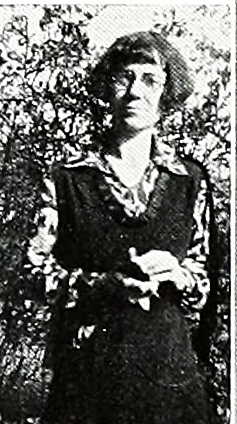
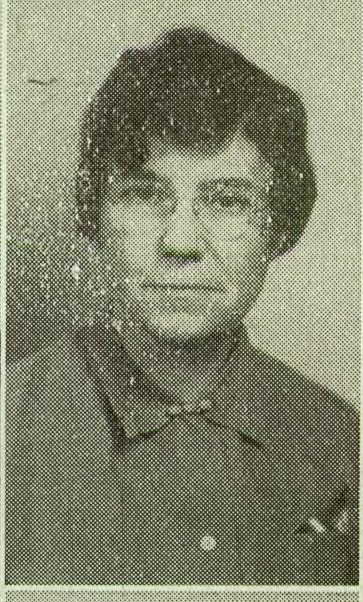
Unusually for one of Lovecraft’s correspondents, because Mary Faye Durr was in so many school yearbooks, as a student or a teacher, we have many more photos of her publicly available than others, so here’s a little gallery showing her over the years. There are probably many more in yearbooks yet unscanned.


Bobby Derie is the author of Weird Talers: Essays on Robert E. Howard and Others and Sex and the Cthulhu Mythos.

Deep Cuts in a Lovecraftian Vein uses Amazon Associate links. As an Amazon Associate I earn from qualifying purchases.

The Colour Out of Space (2016) by H. P. Lovecraft & Amy Borezo

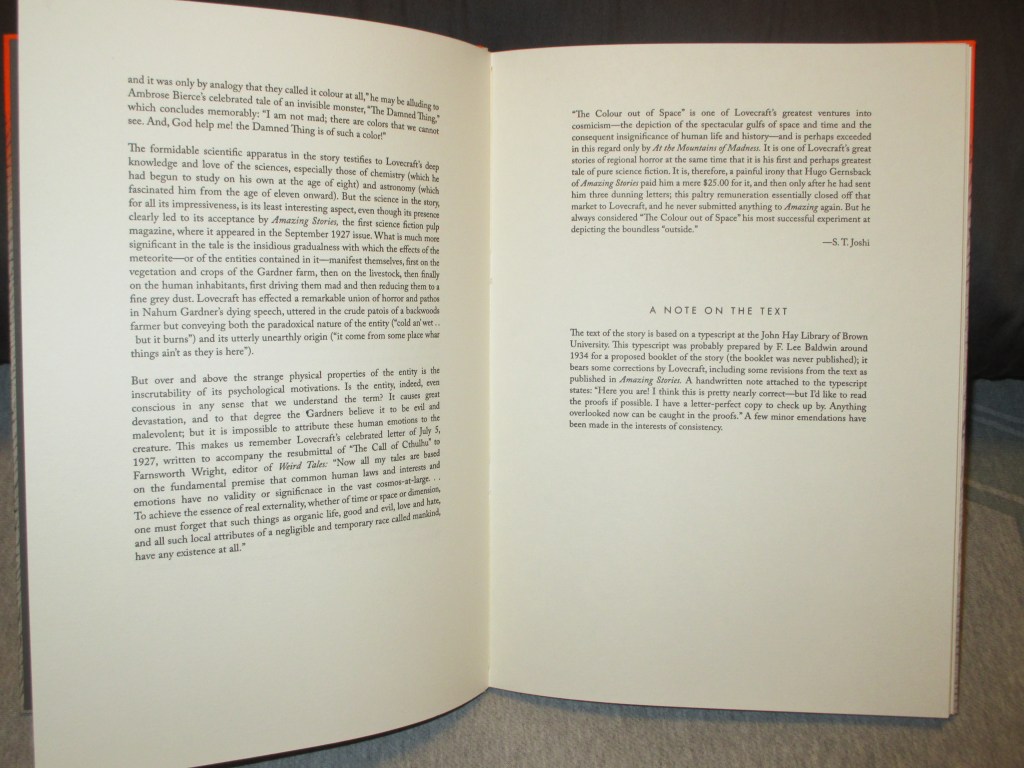
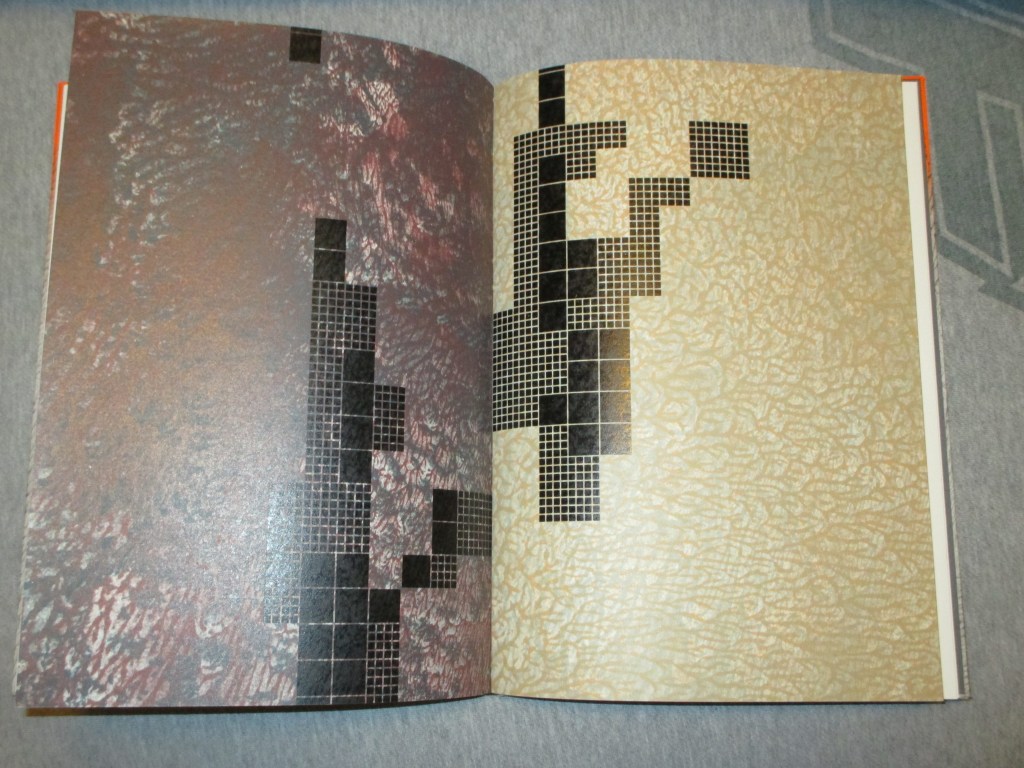
In 2016, artist Amy Borezo published a very limited illustrated edition of H. P. Lovecraft’s story “The Colour Out of Space.” To quote from Shelter Bookworks’ original page:

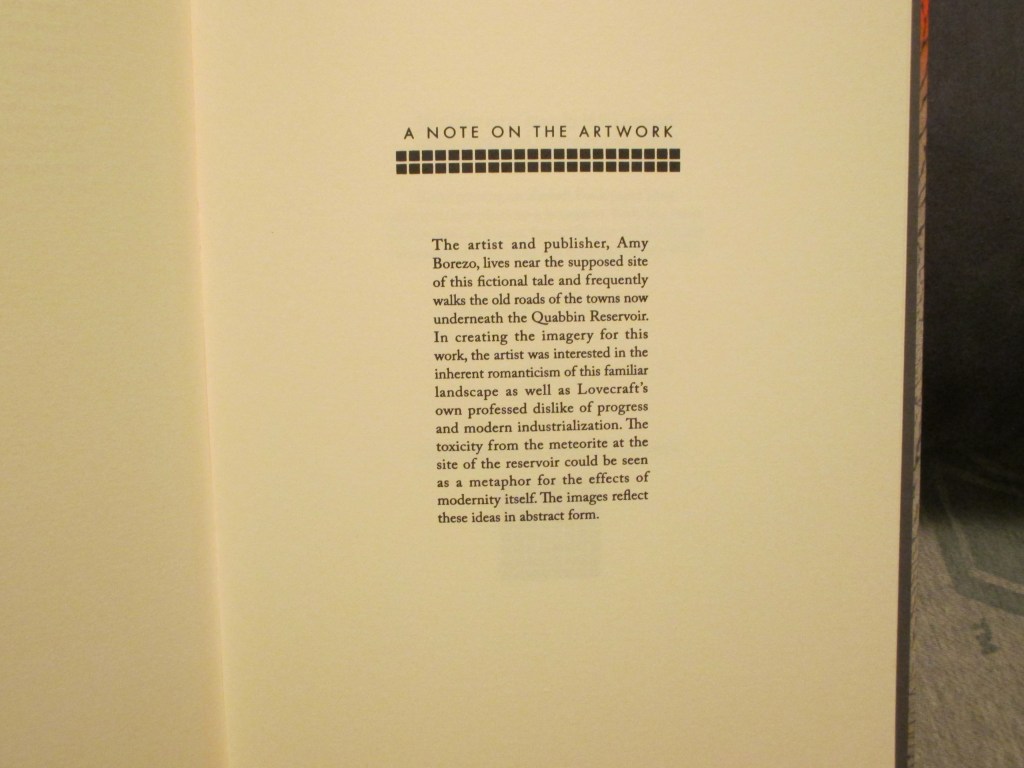
This hybrid artist’s book/contemporary fine press edition of the 1927 horror/sci-fi story by HP Lovecraft includes an introduction by Lovecraft scholar S.T. Joshi and 14 color images by Amy Borezo. The artist lives near the supposed site of this fictional tale and frequently walks the old roads of the towns written about in this story. In creating the imagery for this work, the artist is interested in evoking the complexity of the local landscape in abstract form with the construction of the reservoir overlaid visually through geometric blocks.

The text for this edition was provided by S.T. Joshi from his recent publication, H. P. LOVECRAFT: COLLECTED FICTION: A VARIORUM EDITION [Hippocampus Press, 2015] and is derived from a typescript at Brown University, evidently prepared by F. Lee Baldwin for a proposed reprint of the story (c. 1934) that never happened. It has some revisions in pen by Lovecraft, so presumably it represents his final wishes for the story.
_____________________

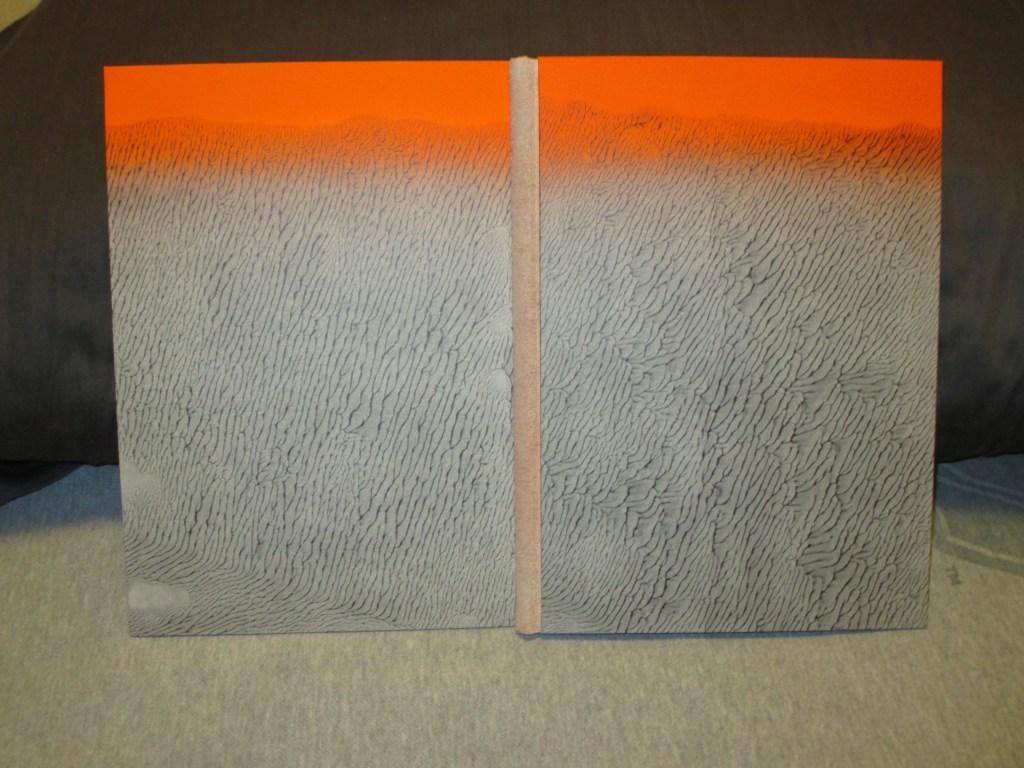
Relief printing on Zerkall Book paper from photopolymer plates on a letterpress. Body text set in Caslon, titles in Futura. Pages sewn onto a shaped concertina. Paste paper over boards with a buffalo suede spine. Housed in a presentation box. Special thanks to Lisa Hersey who assisted in printing and binding.

The edition, despite the relatively high cost (US$500 + shipping in 2016), sold out. It arrived in an attractive clamshell box, with a paper label. Inside, the colors on the paper are bright and vivid in a way that the light and the camera don’t really catch, the backstrip soft, the paper creamy and the text sharp. In your hands, the brilliant orange seems to leak through around the edges of the pages. A title page, a brief introduction by S. T. Joshi. The text and illustrations are on alternate pages, distinct, the images vivid but abstract. A word on the artist, a colophon and numbering page, and then the book is at an end.

Amy Borezo’s illustrated edition is, in a very real sense, a piece of art that you can read. The text itself is meticulous in its accuracy, but you can read the same text in Hippocampus Press’ variorum edition, you can read the same text for free online. If you must have a physical copy of a book in your hand, you are spoiled for choice: “The Colour Out of Space” is one of Lovecraft’s most reprinted works, and there are innumerable illustrations for the story from various artists, from J. M. de Aragon in the pages of Amazing Stories in 1927 and Virgil Finlay in Famous Fantastic Mysteries in 1941 to many others of the current day.

This massive plurality of choice, the sheer number of editions, touches on an issue that many readers and would-be readers of Lovecraft deal with: where do you start? What is the best edition? What if you want a really nice copy of a book? Which one of all the hundreds of titles should you go for, and why, and how much will it cost?

If that sounds like more of a collector’s issue than a reader’s issue, then congratulations, you’ve hit on one of the fundamental problems facing not only Lovecraft, but most popular authors in the contemporary period.

When Lovecraft was alive, he was primarily published in the amateur press, pulp magazines, some reprint anthologies like the British Not at Night series, and a couple of very small privately printed editions of The Shunned House (never bound or formally released during his lifetime) and The Shadow over Innsmouth (which was, but the binding was shoddy). There were no finely bound editions of Lovecraft with the embellishments of the bookmaker’s art available to the general public, no leather covers, no gilt lettering, no raised bands (caveat: one copy of The Shunned House was specially bound by R. H. Barlow as a gift for Lovecraft).

Early collectors of Lovecraft often focused on posthumous publications, like the first publications of Arkham House, and little obscurities like the edition of Lovecraft’s commonplace book put out by the Futile Press in 1938. Even ultra-small press editions were typically not “fine” in the sense of lavish materials, artwork, or presentation, but were often considered valuable simply because of the small size of their edition, the ease with which copies perished, and subsequent rarity in the face of growing demand. That demand came from Lovecraft’s own growing popularity; the mass market paperback reprints of Arkham House collections, the armed services editions, and foreign reprints in hardback and paperback vastly increased the audience for Lovecraft’s work.

Until quite recently, fancy fine press editions were not normal for living authors. Before mass literacy, books were often bought unbound and then the author could bind them however they liked; really rich people could commission books that were themselves works of art in every sense of the word, involving whatever costly materials or decorations they cared for. As the commercial basis of book reading and publishing became more egalitarian, fancy editions often became more about the skill of the bookmaker and/or any associated artist, for fine press editions, and the materials shifted.

So when you look at what constituted a really nice Lovecraft edition in, say 1980, you’re likely looking at the output of Roy A. Squires’ press. These were meticulously crafted letterpress editions, usually on high-quality handmaid paper, sometimes featuring tipped-in photographs or other illustrations. Where a normal chapbook from Necronomicon Press or a fan press might be published on an Apple II printer and stapled together, everything about Squires’ production was done by hand.

The slightly bourgeoisie desire for something fancier still nagged the science fiction and fantasy market. Arkham House paved the way in the late 1930s and 40s by showing that a small press publisher specializing in genre books was viable (the presses they inspired apparently didn’t know how often Arkham House founder August Derleth was running in the red, or how long it took for his small, relatively expensive books to sell). Most of these products weren’t fine press; they were solid books, aimed and priced at a select market. Very few of them produced anything that might be described as a luxury edition of Lovecraft; the choicest example might be the 1976 edition of Démons et Merveilles by French publisher Opta, which came bound in leather, with slipcase, and illustrations by Philippe Druillet. The translation has its issues (Lovecraft’s “ghouls” is rendered as “vampires,” to give one notable example), but compared to the rather plain but sturdy Arkham House editions, it’s gorgeous.

Easton Press (founded in 1975 as a division of MBI, Inc.) took up the gauntlet of producing, for lack of a better term, what not-rich people think of as rich people’s books: bound in letter, embossed in 22k gilt, very snazzy to look at. In practice, while Easton Press has consumed many acres of cowhide, the actual books they produce tend not to be very special: they’re reprints of existing books, often not anything particularly rare or obscure, with no additional editorial guidance or notes (and sometimes bad misprints). The books themselves are usually solid, but less than beautiful; their editions of Lovecraft show evidence of corner-cutting and mass production.

There is a niche market for really nice editions of books, at a price affordable to middle-class bibliophiles. Over the last twenty years or so, that niche market has exploded. Centipede Press, Subterranean Press, the Folio Society, etc. are names that are familiar now for deluxe editions of Lovecraft and/or other authors, typically reprinting older works instead of presenting anything original, and typically publishing in limited editions of a few hundred copies. Quality and presentation vary, although are generally pretty high—not quite the same production value as, for example, letterpress outfits like Pegana Press which continue the fine press tradition, but for high-end versions of books that you might otherwise buy at Barnes & Nobles…

…and that is kind of the rub. While there are some exceptions, most of these presses aren’t gambling on producing anything new. There might be new artwork, there might be a new introduction by Alan Moore or S. T. Joshi, but there is no experimentation, there is often nothing unique about these particular editions. There are some exceptions; Centipede Press has produced some original compilations like Conversations with the Weird Tales Circle that collects many rare, obscure, and out-of-print materials; and the art book A Lovecraft Retrospective is pretty much unparalleled. Helios House Press has published some original scholarship among the reprints (full disclosure: they’ve paid me for a few essays and other work).

For most of these companies, however, the text itself isn’t special. The production quality might not be much better than any other mass-produced hardcover. They might be pretty, but from a strictly objective standpoint they don’t offer much new or exciting. They’re just very expensive.

So what exactly are you, the reader, paying for?

Which is what you need to answer for yourself. If you’re a scholar or academic looking for a text that’s pure Lovecraft, you’re probably better off buying the Hippocampus Press variorum editions. If you’re a casual reader, the Penguin paperbacks are cheap and almost as good. If you’re a poor student, stick to the online editions at https://hplovecraft.com. If you want a fancy edition…well, you’ve got options. Lots of them, for every price point. Handmade Japanese paper, bound in leather, with silk bookmarks, signed in blood.

It’s all available for the right price.

So what sets Amy Borezo’s book apart? Normally, based on the materials, the quality of the printing and craftsmanship, I would qualify this as a fine press product. However, in the marketing, the presentation, this is a little different. It is a book, and can be read as a book, but it is also a work of art, and can be experienced and appreciated like buying a lithograph print from a series. If you’re a fan of Lovecraft, you know the words, you’ve read the story a hundred times. Many artists have tried to capture a colour that lies beyond human perception, to depict the events of the story in some fixed form. Only Borezo has gone to such effort to capture that feel in an entire book production, not just as isolated images.

The beauty of Borezo’s art is that it is abstract; it doesn’t try to impose meaning on the text, readers have to stare at it for themselves. Some might not like it, others might get it but not care for the idea, but for me there’s a certain tactile experience with that nearly radioactive orange that seems to seap through and around the pages at times. Yes, it could just be the collector in me, trying to justify the hundreds of dollars this book cost, but in a real way that is the experience we buy with every book, above and beyond the text itself. The feel of it in your hands, the smell of the paper, the crackle of the spine. It’s different, when you’re holding an old pulp whose brittle and yellowed pages are as fragile as a papyrus from a mummy’s tomb, or an old worn paperback whose tanned pages are as soft as toilet paper, or a crisply printed new edition with ink that almost looks still wet.

From a scholar’s perspective, from a historian’s perspective, the focus is usually on the text, not necessarily the visceral experience surrounding how the text is read and received. Yet it is important not to lose touch with that. In an age where Lovecraft is in the public domain, generative AI, and print-on-demand publishing, we are going to see a vast proliferation of books—many of which are going to be strictly hypothetical until someone orders them—and our eyeballs will see cover art generated by some pseudointellectual property theft engine and with text scraped off of somewhere online (errors and all), and pre-packaged to try and appeal to someone that wants to read Lovecraft—and whatever the end product is, the one thing I can guarantee is that it is not going to be anything like Amy Borezo’s edition of The Colour Out of Space.


Bobby Derie is the author of Weird Talers: Essays on Robert E. Howard and Others and Sex and the Cthulhu Mythos.

Deep Cuts in a Lovecraftian Vein uses Amazon Associate links. As an Amazon Associate I earn from qualifying purchases.
“Notes for Revision of an Unidentified Mystery Story” (1984) by H. P. Lovecraft

Thousands of pulp writers pounded out millions of words of pulp fiction during the 20s and 30s. Every week, hundreds of thousands of issues hit the newsstands of the United States of America, and found their way into Canada, the United Kingdom, and other countries. The vast majority of these writers and their work are utterly forgotten today—no more than a name and a list of titles in some dusty index or online database. A bare few have been remembered, as individuals and for their work. H. P. Lovecraft is an exception: the extensive investigation of his life and letters began shortly after his death in 1937, and continues to this day.

Early efforts by August Derleth and Arkham House were focused on identifying unpublished Lovecraft stories to get them into print. This included stories that were rejected during Lovecraft’s lifetime, such as The Case of Charles Dexter Ward (first published in Weird Tales May-July 1941), stories technically published but in obscure amateur journals or fanzines such as “The Alchemist” (Lovecraft’s first published story, from The United Amateur Nov 1916), to those works that Lovecraft revised or ghostwrote for others, such as “The Mound” (1940) by Zealia Bishop & H. P. Lovecraft, “The Horror in the Burying-Ground” (1937) by Hazel Heald & H. P. Lovecraft, and even those stories Lovecraft only had an oblique hand in, such as “Satan’s Servants” (1949) by Robert Bloch. Bits and pieces from Lovecraft’s letters were published as standalone works, such as “The Very Old Folk” (Scienti-Snaps Summer 1940) and “The Evil Clergyman” (Weird Tales Apr 1939). Even when Lovecraft’s files seemed exhausted, the demand remained—hence “posthumous collaborations” like “The Murky Glass” (1957) as by August Derleth & H. P. Lovecraft.

At this point, decades after Lovecraft’s death, there is little expectation of any new complete story to be discovered. While some interesting variant texts like “Surama of Atlantis” and “The Automatic Electric Executioner” (1953) by H. P. Lovecraft & Adolphe Danziger de Castro exist, a close study of Lovecraft’s letters and papers don’t suggest that many major “lost” stories remain to be found. Scholars might look for some juvenalia that Lovecraft claimed to have burned; meditate on the title of a novel that Lovecraft probably never started (or which turned into something else); read accounts of dreams which no one has yet excerpted as standalone works (e.g. the dream quoted in Frankenstein; or, The Modern Prometheus (1818) by Mary Wollstonecraft Shelley), etc. If there are any new works left to be discovered, they probably exist outside the corpus of Lovecraft papers—and consist of works associated with various revision clients.

There is no exhaustive list of Lovecraft’s revision clients, or what he worked on. Lovecraft typically only mentioned revision work in passing, and rarely named clients, unless they happened to overlap with other interests or appeared in Weird Tales, which was the case with Adolph de Castro, Zealia Brown Reed Bishop, and Hazel Heald. Others remain unidentified, and perhaps unidentifiable. For example:

Am utterly swamped with revision—from a rather quaint & interesting ex-westerner now living in Florida, whom Whitehead sic’d on to me. The fellow is fairly clever in a naive, semi-illiterate way, & I really think I can make something of one or two of his tales.

H. P. Lovecraft to Clark Ashton Smith, 23 Aug 1931, Dawnward Spire, Lonely Hill 321

Lovecraft never mentions this prospective client’s name, and all attempts to identify him are speculative. Even with Lovecraft’s known revision clients, we are aware that there are works Lovecraft revised or gave feedback on which were either not published or are lost, such as a revision of “In the Confessional” (1892) by Adolphe Danziger de Castro and “The Unchaining” by Zealia Bishop. There are other works by these clients that are lost that Lovecraft may have had a hand in, such as “In the Gulf of N’Logh” (193?) and “Lair of Fungous Death” (193?) by Hazel Heald, and others which he may not have, such as “An Heir to the Mesozoic” (1938) by Hazel Heald.

One of the more obscure scraps of Lovecraft’s revision works was offered for sale in A Catalog of Lovecraftiana: The Grill/Binkin Collection (1975), where entry 550 is listed as:

LETTER: HPL’s suggestions for revision of a detective story entitled “Robert Is Ill,” about which no more is known by this author. Two pages, written on the back of a letter to Lovecraft in Brooklyn from a European bookseller.

Nine years later, a second listing with more detail appears in The Book Sail 16th Anniversary Catalogue (1984), where entry 360 is listed as:

Two pages of suggestions for revision of an untitled mystery story, author unknown. 8 ½” x 11″, holograph, on the rectors of each page. Approximately 800 words. (No date, but the versos of each page comprise a letter to HPL from a Munich publisher dated November, 1926). Both pages twice folded. Fine.

Unfortunately, the manuscript appears to be in a private collection, so cannot be examined for further clues, but the catalogue did reproduce the complete text of these notes:

The Complete Text of Lovecraft’s Notes for Revision of an Unidentified Mystery Story, Author Unknown

Of course these are only vague suggestions—which you can use or not, just as you choose. I’m no expert in the field of the detective story.

Changes beginning with Chapter V
Robert is Ill

Robert screams in the night and is found ill as stated—but don’t give any imputation of his guilt so far. Don’t use the words “supernatural fear” or “insane fire”. Sympathise with him, and even hint that his illness may be due to the same enemy who murdered his step-father.

Omit the long description of the illness by the specialist—having him merely say it is Rocky Mountain spotted fever, without reference to the medium of contagion. Do not permit Curtiss’s excitement to become manifest—mention his intense interest (as if he suspected that poison might be involved) but give no clue to the coming revelation. Remember that Curtiss has himself looked up the disease after having had the insect identified…and is quite convinced from the date and nature of the illness that the insect is the cause.

Of course, this opinion must flash over him only when the illness is announced: for before this he does not know that anybody has been bitten, and has therefore read about the disease only casually in connection with the general properties of the insect. The seizure of Robert, then, is a shock of surprise which connects in a moment with the previous conception and leads to the dawn of an idea. Grasp this psychological situation and make the most of it without giving anything away. Let the doctor state the gravity of the disease and let the mother’s grief be visible to the reader’s sympathy.

Chapter VI
Knotting Up Loose Ends

Change the beginning to have the police strongly suspect Arnold. Introduce, if necessary, some bit of damaging appearance which leads the chief to insist on Arnold’s arrest. Have Curtiss protest that there are almost certain reasons to deem him innocent, but let the detective keep silent regarding those reasons, realizing that the chief would consider them flimsy.

Now have Robert Lester’s illness take a turn for the worse, so that the entire family—Arnold among them—is summoned to his bedside. The police have gone to Arnold’s office to arrest him; but upon hearing that he is at the Van Allen house, follow him there. Curtiss is with them and prevails upon them to give him time for an experiment before making the arrest. They arrive, and at Curtiss’s suggestion override the Doctor’s objections and enter the sick room where the family is all assembled. Robert sees the party, notes that one is in uniform and realizes what they are. Arnold displays uneasiness; but only such, of course, as the suspense and painfulness of the general situation call for.

Curtiss now advances to the bed and speaks to Robert with gentle firmness.

“Lester you can’t last long. That bug in the vial that broke in the laboratory on the night of the murder is pretty surely fatal nine days after it bites. We’ve pieced the whole thing out, and your sickness is the clincher. You might as well save us trouble before you pass out and tell us why you killed Professor Van Allen.”

Tableau

Lester turns pale despite his fever, nods helplessly and mumbles weakly—”There’s nothing to say—envelope in the safe deposit vault—”.

The police recognize the state of affairs and stand inactive. The doctor advances in alarm, feels the patient’s pulse and orders them out of the room. They retire to the library, and in a few moments a nurse emerges to say that Robert is dead. Curtiss says—”The case is closed”, and the police party leave, stopping at the safe deposit vault which Arnold tells them is the one used by the family. After getting Lester’s papers they return to the station where Curtiss explains the mystery to his colleagues. Make all this very brief, for the climax is over.

Now let Curtiss do his explaining as briefly as possible, telling of his inquiries in the West and of his researches anent the properties of the insect. After this, have Lester’s envelope opened and the confession read. Boil down this confession enormously, confining it wholly to skeletonic essentials. Have Lester say he wrote it for the sake of relieving his mind, etc. Cut out the conversation, etc. Let the key be in the envelope with the confession.

And have virtually nothing after the reading of the confession. That is logically

The End

Retain however the rumor about the insect being the detective.

P.S. If the existence of a written confession seems unconvincing to you, you can vary Robert’s response to a simple admission of guilt and have him write the confession then and there, just before he dies. Then—cutting out the stop at the safe deposit vault—you can end the tale just as in the synopsis with reading the confession at the very last. In that case, have the key found in the coat.

What can we make of all of this? Not much. The character names and bare plot outlined do not match with any known published tale, nor can they be conclusively tied to any published letters with known correspondents. The Munich publisher who wrote to Lovecraft is unidentified; however, November 1926 might be about the right date to have heard from such a publisher:

If I ever type “Sarnath” I’ll see that you have a copy. I did type it once, but that MS. is in the hands of the man (J. C. Henneberger of Chicago, connected with W.T.) who says he is trying to get my stuff placed with some book publisher.

H. P. Lovecraft to August Derleth, 19 Nov 1925, Essential Solitude 1.50

While that doesn’t lead us any closer to the identity of the mystery author, it establishes that the revision notes probably date from December 1926 or later—it not being unusual for Lovecraft to re-use paper in this fashion, especially when writing to friends. That suggests this might not have been intended for a formal revision client, but for one of his friends or fans; Lovecraft was well known to freely offer feedback and suggestions for would-be writers. On the other hand, while Lovecraft is best known for effectively ghostwriting stories for his clients, in practice much of his work appears to have been simply giving detailed feedback, and letting the clients rewrite the story repeatedly until it made the grade.

While it is clear that this is essentially a pure detective story, Lovecraft’s suggestions for the plot echo some of his other revision stories: the element of murder-by-insect bite is reminiscent of “Winged Death” (1934) by Hazel Heald & H. P. Lovecraft, while the deathbed confession recalls “The Last Test” (1928) by Adolphe de Castro & H. P. Lovecraft. It is interesting to note that the suggestions for tightening up the wordcount are very practical, and the essential format—a climactic death/reveal, followed by an abbreviated denouement—echoes several of Lovecraft’s own stories, such as “The Dunwich Horror” (1929).

Which is perhaps more interesting than the bare outline of the tail-end of a story that appears to have never been published: the insight into Lovecraft’s process, his characteristic approach to the narrative. While we can’t read the original work he is critiquing, the impression given is something overwritten, a narrative bogged down in exposition and over-explanation, a common feature of amateur writers, and probably a common aspect of the stories that Lovecraft read for his friends and fans, as well as clients. How Lovecraft approached those corrections is an insight into how Lovecraft constructed his own stories, the way he looked at how a story was structured as much as the details (the key apparently being a key plot point).

Readers hoping for “The Statement of Randolph Carter II: Loveman’s Revenge” to turn up are probably doomed to disappointment, but if expectations can be moderated…perhaps, in some private collection, there are still a few scraps of Lovecraft waiting to be discovered.


Bobby Derie is the author of Weird Talers: Essays on Robert E. Howard and Others and Sex and the Cthulhu Mythos.

Deep Cuts in a Lovecraftian Vein uses Amazon Associate links. As an Amazon Associate I earn from qualifying purchases.
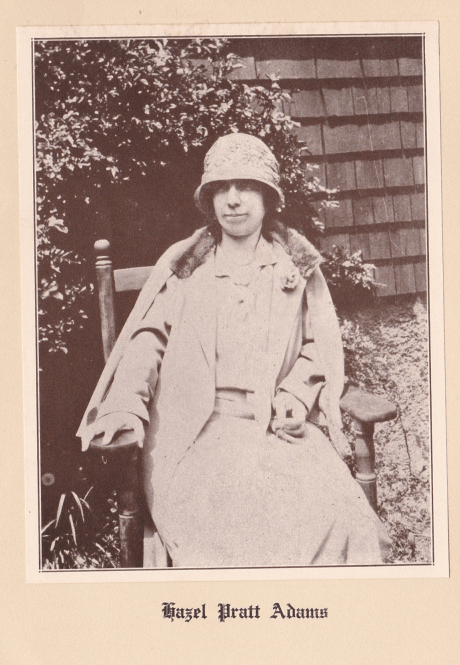
Her Letters To Lovecraft: Hazel Pratt Adams

A visit was also made to Eglin’s book store where Sam Loveman delighted all who had the privilege of becoming better acquainted with his magnetic personality. He was one of the most pleasing surprizes of the convention, and like Howard Lovecraft, despite his profound poetical effusions, is really quite human and intensely interesting.

Hazel Pratt Adams, “The National Convention” in The Brooklynite July 1923

She was born Hazel Bosler Pratt on 10 January 1888 in New York City; the middle child of Abram E. Pratt and Jeannette (also spelled Genette or Jannett in various census rolls) Bosler Pratt. Her early life is somewhat vague; census data indicates she was still living with her family through 1910, and her obituary claims:

Financial reverses made it necessary for her to enter business life at an early age, and she was first employed in different financial institutions of Brooklyn, later becoming secretary to George McLaughlin, who afterward became State Superintendent of Banks and Police Commissioner. She also did considerable newspaper and magazine work, including contributions to Brooklyn Life, over a pariod of many years […]

The 1910 Federal census lists her profession as stenographer, and that she was then working as a private secretary; a 1915 criminal trial of banker Edward M. Grout brought Hazel in as a witness, as she had worked as a stenographer for him in 1908, and a 1911 list of those who passed civil service exam for stenographers lists Hazel Pratt. From all this, we can gather that she was literate, competent, and professional.

What this obituary does not mention is her amateur journalism activity. While it isn’t entirely clear when Hazel joined amateur journalism, she was elected the inaugural Official Editor of the Brooklyn Amateur Journalists Club in 1908—which in 1912 would change its name to the Blue Pencil Club. Pratt would serve various roles in the Brooklyn club, including Secretary/Treasurer (1910), and the editor/publisher of the amateur journal The Brooklynite. In 1912, she was elected president of the newly-labeled Blue Pencil Club, and various newspaper articles indicate the club frequently met in her home. Her involvement also spread to other organizations; in 1911 she was listed as Eastern manuscript manager for the United Amateur Press Association, and in that same year attended a convention of the Interstate Press Association.

Hazel was presumably working as a stenographer during this time, and helping to care for his mother; her other interests are unknown, although a 1912 letter to the editor on the subject of women’s suffrage suggests she was forward-looking and politically conscious.

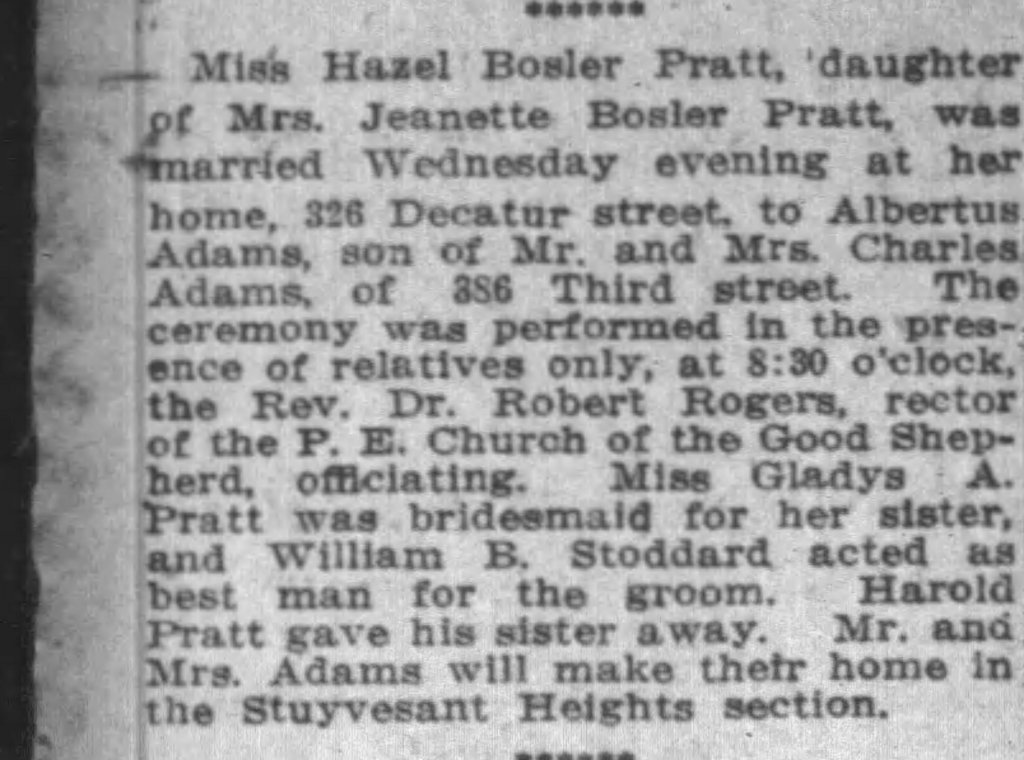
In 1914, Albertus Milton (A. M.) Adams (1879-1952) was elected President of the Blue Pencil Club, with Hazel Pratt Adams as the secretary and treasurer. A. M. Adams was the editor of the National Hotel Review, and with Hazel’s work in newspapers and magazines as well as amateur journalism, they seem to have shared interests in literature. By the end of the year, they were married.

So it was that when H. P. Lovecraft joined amateur journalism in 1914, he would likely have known her only as Hazel Pratt Adams. His first mention of her is from around this time:

Mrs. Adams’ essay on ghosts displays considerable literary knowledge, though the anecdote at the end is rather ancient for use today. We last heard it about ten years ago, with a Scotchman instead of a negro preacher as the narrator, and with the word “miracle” instead of “phenomena” as the subject.

H. P. Lovecraft, “Department of Public Criticism” (United Amateur Mar 1915), Collected Essays 1.23

Married life must have been interesting. In 1916, the Adamses bought the Tupper Lake Herald, a local newspaper for Tupper Lake, N.Y., and ran it for three years. Two sons were born to the marriage, Raymond Pratt Adams (5 Sep 1917-19 Dec 2010) and Charles LeRoy Adams (7 May 1920-9 Jan 1996), and Hazel continued her involvement in amateur journalism. In 1916, Hazel was named the Official Editor of the National Amateur Press Association.

In 1922, William B. Dowdell was elected as president of the National Amateur Press Association. Dowdell subsequently resigned, and H. P. Lovecraft filled out the remainder of his term. During his time in office, Hazel Pratt Adams impressed Lovecraft with her dedication to quality and leadership:

To stimulate more publishing, which we need so desperately, Mrs. Hazel Pratt Adams has unselfishly offered to assume complete charge of the issuance of any paper which any member may care to publish, attending in full to the arrangement, printing, addressing, and mailing, at a charge of only $20 for eight pages or $12.50 for four pages the size of the recent Brooklynite. This opportunity is so marvellously favourable, and so easy for even the newcomer, that we see no excuse for the lack of a striking revival of individual publishing.

H. P. Lovecraft, “President’s Message” (National Amateur Mar 1923), Collected Essays 1.325

When the next election loomed in 1923, Lovecraft wanted someone else—ideally someone ideologically in line with his vision for the organization, in terms of supporting high literary and print quality, even at the sacrifice of frequency—to lead the organization. The candidate settled on was Hazel Pratt Adams.

Concerning that other dark shadow, whose bat-wings flapped so menacingly above the bright lights of that elegant dining saloon where I was so mercilessly grilled, I am half convinced that the fates have saved me by giving to Mrs. A. an unalterable resolution to continue her candidacy. At least, I received from her an epistle wherein, besides a two-buck checque for the O.O. fund, was distinct mention of a campaign requiring money, & of a prospective Adams-and-Liberty journal to be intitul’d The Campaigner.

So, as Ya-know-me-Al would put it—that’s that! If Mme. Eve & Bro. Mortonius choose to alter their deep-laid designs, I suppose I can’t help myself; but just now it looks as though they were sailing ahead in fine shape, so that Fortuna will spare a victim whose (semi-)willingness to mount the scaffold hath been so conclusively demonstrated. But even so, I hardly look for utter chaos. Something’s been started, & if the ball is well rolling by the nones of Quintilis it will surely have enough momentum to keep on a while. It’ll take a full year to wipe Mike White off the map—& you can be sure Long & Galpin won’t still till that’s done! Still—me word is gave, & if the Adams-Morton move is changed, I stand ready for the axe.

H. P. Lovecraft to Edward H. Cole, 23 Feb [1923], Letters to Alfred Galpin & Others 42-43

I find that J. Ferd. [Morton] is completely & finally committed to the Adams candidacy, & that any other move would now be a positive act of hostility toward him. He is too far committed to withdraw without seeming traitorous to the Adams cause; a cause which he embraced because he knew how abhorrent office-holding is to me. […] [45] However, as I said before, I believe that the Adams arrangement will agreeably surprise you. Mrs. A. is certainly a capable routine administrator, & Morton assures me that he stands firmly in the background as an inspiration & intellectual influence . . . . . not that he uses those words, which from him would be less becoming than from another! He will continue whatever policy is started this term—& Mrs. Adams is heartily ready to act as a sympathetic standard-bearer.

H. P. Lovecraft to Edward H. Cole, 24 Feb [1923], Letters to Alfred Galpin & Others 44, 45

“Mme. Eve” was apparently Lovecraft’s nickname for Hazel—because she was the wife of Adam(s). As puns go, it isn’t very good, but a ticket with Hazel Pratt Adams and James F. Morton was a strong one. Cole, apparently, was not happy about this nomination, and had wanted Lovecraft to run.

About the Cole mess—I’d better curl up with a bottle of cyanide & get it over with before I do any more harm to myself and others. Bah. Probably I’ve incurred his undying coldness—he hasn’t answered that definitively declinatory epistle yet—and now Mrs. Adams writes that he’ll probably be peeved at her! Undertaker, put a good shot of embalming fluid in the old simp’s head—it’s been dead a long time. Tell Mrs. A.—though I’ll answer her myself in a day or two—that I’ll take all the Colic blame myself & exculpate her, & you, & everybody but poor me—in toto. He might as well be damn mad at one guy as half mat at several birds.

H. P. Lovecraft to James F. Morton, 1 Mar 1923, Letters to James F. Morton 26-27

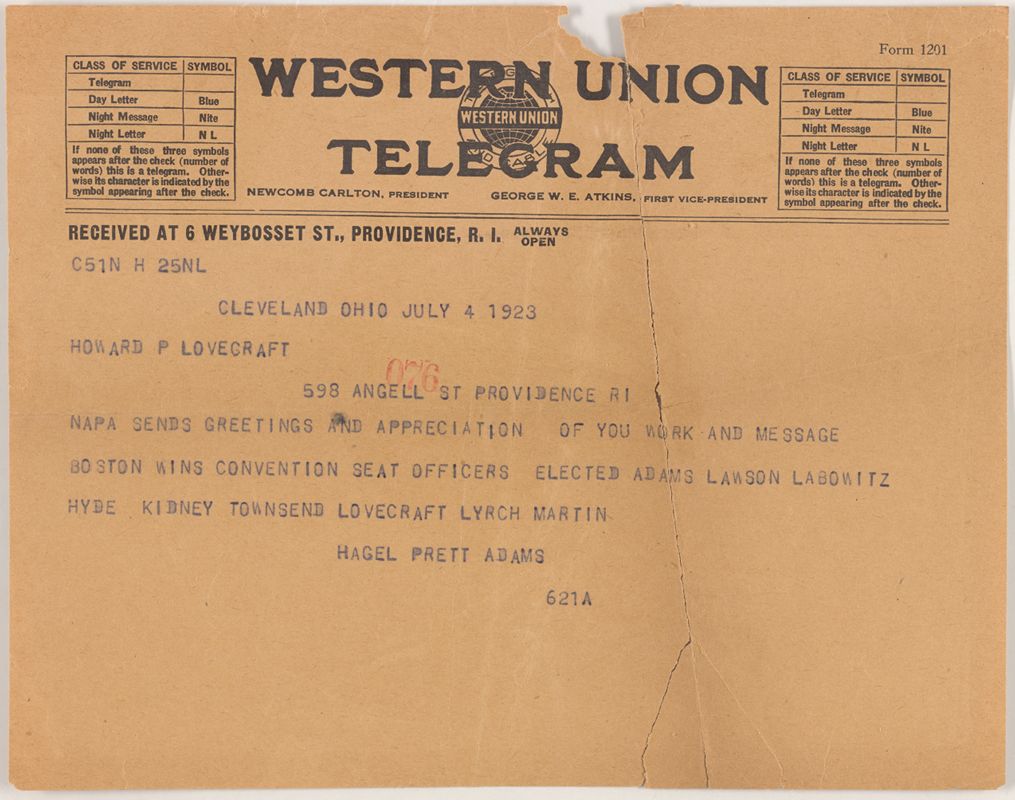
“Her epistle” suggests that Lovecraft and Hazel Pratt Adams were in correspondence by this time; when and how this started it is not clear, but presumably came about through his NAPA presidency, if not before. As it happened, with the support of Lovecraft and Morton, Hazel Pratt Adams was elected almost unanimously as the 4th woman president of the National Amateur Press Association. From the convention, she sent Lovecraft a telegram:

It was apparently not an easy time for her:

President Adams labored under serious difficulties, personal and otherwise. Throughout her entire term illness in her family added to her burdens. But she set an excellent example of activity by publishing 15 papers, and although the institution was entering upon one of its periodical times of depression, she maintained the high standard of work established by her predecessor.

The Fossils: History of the National Amateur Press Association

Lovecraft, for his part, was busy with his other things. On 3 March 1924, Lovecraft married Sonia H. Greene in New York; the couple set up their household in Brooklyn. Among their first visitors was Hazel Pratt Adams:

We had our first callers yesterday—Mrs. Adams of Plainfield, N.J., and Mrs. Myers of Cambridge, who is visiting Mrs. Adams before sailing for Paris for six months. They seemed very favourably impressed with the new household, and S.H. assures me that I did not appear altogether ridiculous as a host.

H. P. Lovecraft to Lillian D. Clark, 18 Mar 1924, Letters to Family and Family Friends 1.115

Sonia had been a member of the Blue Pencil Club, and almost assuredly was already friends with Mrs. Adams; it isn’t clear if this is the first time Lovecraft met Adams in person, or if they had met at an earlier convention, or Lovecraft’s prior trip to New York. In any event, it was the newlywed’s first time receiving callers as a couple.

Lovecraft apparently continued to correspond with Hazel Pratt Adams through at least 1925, because “The Horror at Red Hook” was composed on the backs of a letter dated 13 November 1925 (Midnight Rambles 225n78). The text of this letter has not yet been printed, and no other letters from the Hazel Pratt Adams/H. P. Lovecraft correspondence are known to survive.

Hazler Bosler Pratt Adams died on 6 August 1927. The cause of her death was not recorded in her obituary.

The Blue Pencil Club arranged the publication of In Memoriam: Hazel Pratt Adams. Sonia and Howard Lovecraft both penned tributes to their friend:

Source: The Papers of Sonia H. Davis, by Monica Wasserman

With such scanty evidence, it is difficult to say anything for certain about the friendship and correspondence of Hazel Pratt Adams and H. P. Lovecraft, except that they did correspond, and they were friends. They shared friends and interests in common, and wrote well (if sparingly) of one another. What else they might have talked about, we may never know, unless some new cache of letters turns up.

Thanks and appreciation to Monica Wasserman for her help with this piece.


Bobby Derie is the author of Weird Talers: Essays on Robert E. Howard and Others and Sex and the Cthulhu Mythos.

Deep Cuts in a Lovecraftian Vein uses Amazon Associate links. As an Amazon Associate I earn from qualifying purchases.

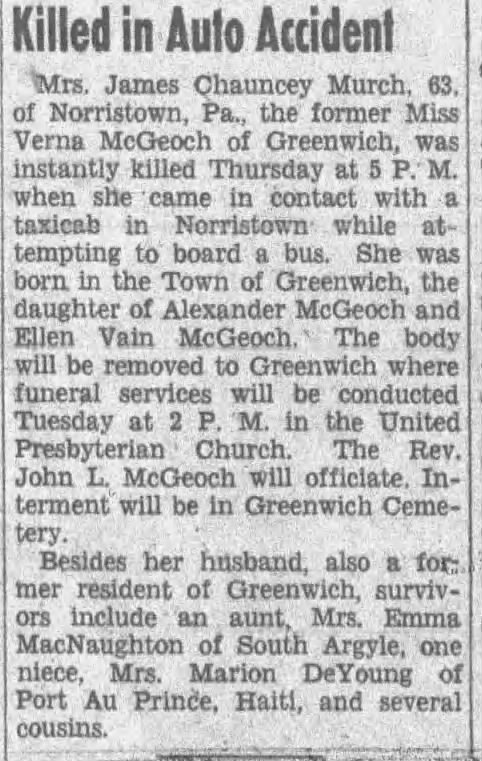
Her Letters To Lovecraft: Verna McGeoch

Verna McGeoch was born on 25 May 1885 to Alexander and Ella A. (Bain) McGeoch of New York; her older sister Jennie E. McGeoch had been born in 1878. Information on Verna’s early life is scanty. The 1900 federal census lists her sister Jennie as employed as a school teacher, and Verna as attending school. By the 1910 federal census, Jennie had married (to Alexander Horton Barbur, 1868-1928), given birth to a child (Marion Jennie Barbur), and died (Marion’s date of birth is listed as 15 October 1909, and Jennie’s death is listed as 19 December 1909). The subsequent censuses list Marion living with her aunt and grandparents.

If Verna McGeoch attended college or held any employment, it is not reflected in the census data. Nor do we have extensive written records from McGeoch on any part of her life. Yet we know that at least by 1915, Verna McGeoch had joined the United Amateur Press Association, and come to the attention of H. P. Lovecraft, who had joined amateur journalism in 1914:

Misses Kline and McGeoch both exhibit marked poetical tendancies in prose, the latter writer having something of Mr. Fritter’s facility in the use of metaphor.

H. P. Lovecraft, “Department of Public Criticism,” Jan 1915, Collected Essays 1.21

McGeoch features rarely in Lovecraft’s articles and editorials in the United Amateur, but outline a rising profile in amateur journalism:

Mr. Hoag’s introduction to the United Amateur Press Association came through his gifted friend and fellow-resident of Greenwich, Miss Verna McGeoch, and through our indefatigable Second Vice-President, Mrs. Renshaw.

H. P. Lovecraft, “Among the Newcomers,” May 1916, Collected Essays 1.110

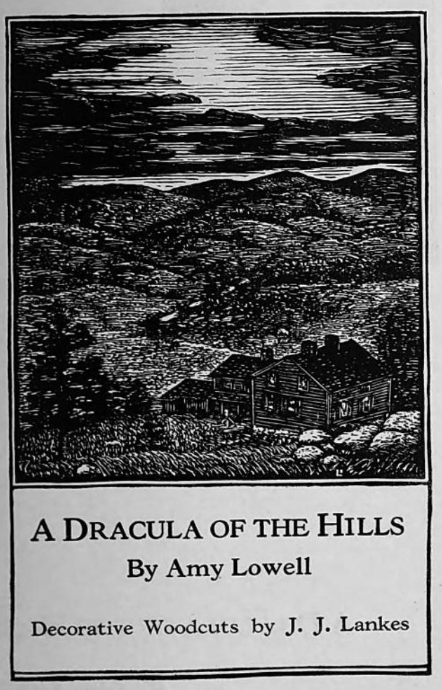
Jonathan Hoag was a prolific poet, and soon to be a good friend of H. P. Lovecraft, who would write an introduction to (and quietly edit) The Poetical Works of Jonathan E. Hoag (1923), which was Lovecraft’s first work published in hardcover.

Excelsior for March is in many respects the most notable of the season’s amateur magazines. Edited by our brilliant Laureate Recorder, Miss Verna McGeoch, it contains a surprisingly ample and impressive collection of prose and verse by our best writers; including the delectable lryicist Perrin Holmes Lowrey, whose work has hitherto been unrepresetened in the press of the United.

H. P. lovecraft, “Department of Public Criticism,” May 1917, Collected Essays 1.149

Lovecraft’s rising star in amateur journalism led him to be elected President of the United Amateur Press Association in 1917—and Verna McGeoch was elected the Official Editor of the United Amateur. The two would, for the next two have to work hand-in-hand with respect to the management of the UAPA in their respective duties.

The election of Miss Verna McGeoch to the Official Editorship, perhaps the most important of our offices, forecasts the publication of The United Amateur on a very high plane; qualitatively if not quantitatively.

H. P. Lovecraft, “President’s Message,” Sep 1917, Collected Essays 1.172

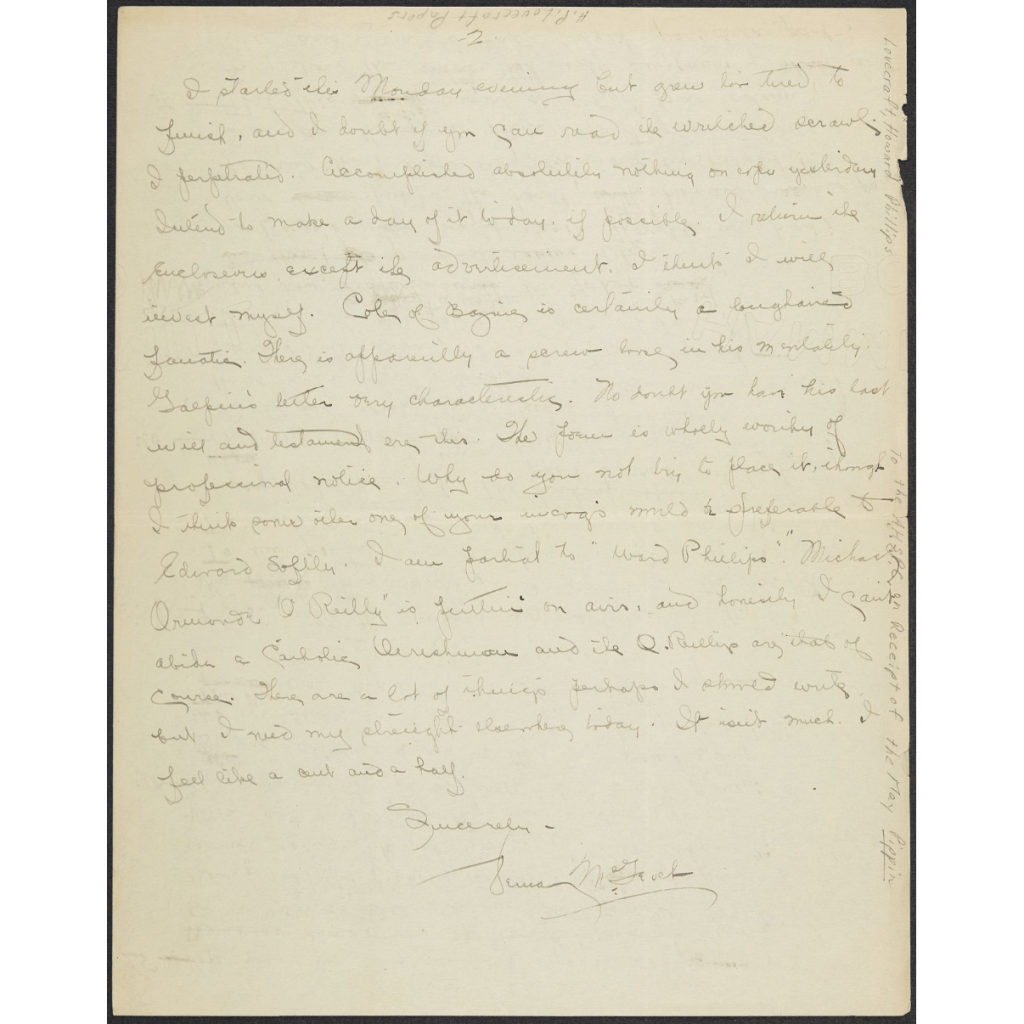
There must have been letters between them, at least on official business, but very little of it survives. We know that Lovecraft wrote Christmas Greetings to Verna, and we know that Verna wrote to Lovecraft because one page of a letter survives among Lovecraft’s papers:

I started this Mondey evening but grew too tired to finish, and I doubt if you can read the wretched scrawl I perpetrated. Accomplished absolutely nothing on cop[y] yesterday. Intend to make a day of it to-day, if possible. I received the enclosures, excerpt & advertisement. I think I will reward myself. Cole of Bazine is certainly a longhaired fanatic. There is apparently a screw loose in his mentality. Galpineus’ letter very characteristic. No doubt you have his last will and testament ere this. His power is wholly worthy of professional notice. Why do you not try to place it, though I think some other one of your incogs would be preferable to Edward Softly. I am partial to “Ward Philips.” “Michael Ormond O’Reilly” is puttin’ on airs, and honestly, I can’t abide a Catholic Irishman and the O.Reillys are that of course. There are a lot of things perhaps I should write, but I need my strength elsewhere today. It isn’t much. I feel like a cent and a half.

Sincerely,

Verna McGeoch

“Cole of Bazine” is fellow amateur Ira Cole, who a 1916 UAPA membership list gives as living in Bazine, KS. “Galpineus” is Alfred Galpin, Lovecraft’s good friend. Edward Softly, Ward Phillips, and Michael Ormond O’Reilly were all pseudonyms that Lovecraft adopted for publishing various pieces in amateur journals between 1918 and 1923. Verna McGeoch, as Official Editor, was in on the joke, and wrote a fictional biography of one of Lovecraft’s pseudonyms, Lewis Theobald, Jr., which was published in 1918. Which all suggests that this was probably written c. 1918.

Lovecraft’s presidential announcements and unsigned editorials over the course of his presidency have nothing but praise for McGeoch:

The November Official Organ deserves praise of the highest sort and will remain as a lasting monument to the editorial ability of Miss McGeoch and the mechanical good taste of Mr. Cook. It has set a standard beneath which it should not fall, but to maintain which a well-supplied Official Organ Fund is absolutely necessary. If each member of the Association would send a dollar, or even less, to Custodian McGeoch, this Fund might be certain of continuance at a level which would ensure a large and regularly published United Amateur. […] 

[175] A final word of commendation should be given to those more than generous teachers, professors, and scholars who are making “The Reading Table” so pleasing and successful a feature of the United’s literary life. The idea, originated by Miss McGeoch, has been ably developed by Messrs. Moe and Lowrey, and is likely to redeem many of the promises of real progress which have pervaded the Association during the past few years.

H. P. Lovecraft, “President’s Message,” Jan 1918, Collected Essays 1.174, 175

“The Reading Table,” an educational course introduced by Official Editor McGeoch, ia this month graced by a valuable contribution from Mauice Winter Moe. […]

[182] Miss McGeoch’s editorial is the most sensible summary yet made of the relations between the Untied and the National Associations. We believe, with her, that each has its own peculiar place, and that neither need attack or encorach upon the other. In the interests of harmony, belligents on either side should be promptly silenced.

H. P. Lovecraft, “Department of Public Criticism,” Jan 1918, Collected Essays 1.181-182

“An Appreciation”, by Verna McGeoch, is a prose-poetical tribute to Mr. Hoag, whose literary merit is of such a quality that we much needs lament the infrequency with this the author contributes to the amateur press. […]

[197] The editorial remarks in this issue of the United Amateur are worthy of close perusal on account of their graceful literary quality. Seldom has the critic seen the subject of the New Year so felicitously treated as in this brief study by Miss McGeoch. The author’s mastery of appropriate words, phrases, and images, and her intuitive perception of the most delicate elements of literary harmony, combine to make the reader wish she were more frequently before the Association as a writer, as well as in an editorial capacity.

H. P. Lovecraft, “Department of Public Criticism,” May 1918, Collected Essays 1.191, 197

The United Amateur has surpassed all standard hitherto known to amateur journalism, writing the names of Miss McGeoch and Mrs. Cook imperishably into the pages of our history. The lack of numerous publications has been more than atoned for by the quality of those which have appeared.

H. P. Lovecraft, “The United 1917-1918,” Jul 1918, Collected Essays 1.202

It is also during this period that Verna McGeoch begins to appear in Lovecraft’s private correspondence, usually with respect to her amateur duties, but with hints of familiarity that suggest of a correspondence:

The formation of next year’s ticket will be a matter of extreme difficulty. I would accept the presidency if absolutely no one else could be found—but I hope I discover someone at least half capable. Miss McGeoch suggests Mrs. Campbell, who is not only quite capable herself, but has Paul J. in the background as conselor & prime minister.

H. P. Lovecraft to Rheinhart Kleiner, 4 Apr 1918, Letters to Rheinhart Kleiner & Others 106-107

Kleiner would end up running and winning the presidency of the UAPA in 1918.

Miss McGeoch has sought to censor the reviews wherever she thought frankness got the better of amenity; and as a result of the discussion which ensured, Mr. [Maurice W.] Moe has decided that all amateur public criticism is vain, ineffective and superfluous.

H. P. Lovecraft to Alfred Galpin, 13 May 1918, Letters to Alfred Galpin & Others 35

Both Miss McG and Cook are confirmed infinitive-splitters, though I have lectured both on the subject. […] [204] I wonder who will finance the new application blanks? There is no constitutional provision for them, and it is usually left to the Secretary, though for the past two years private individuals—Campbell and Miss McGeoch—have philanthropically come to the rescue.

H. P. Lovecraft to Alfred Galpin, 21 Aug 1918, Letters to Alfred Galpin & Others 203, 204

This is the second reference to McGeoch’s generosity, which suggests she personally paid to have The United Amateur printed, above and beyond her annual membership fee to the UAPA. While we do not have letters from McGeoch to anyone else to say how she felt about Lovecraft, it was apparently a reciprocal appreciation, based on another passage in Lovecraft’s letters:

[Hoag’s] serious tribute sounded more comical than your semi-serious one—hence it is not remarkable that Miss McGeoch should fail to grasp the spirit at the bottom of your graceful lines. I agree that they are (considering the unworthy subject) scarce suitable for publication in the official organ. I am glad Miss McG speaks so well of me. It would be easy to say a great deal more in reciprocity, for I have seldom encountered her equal in kindly breadth of opinion, exalted ideals, high sense of duty, dependable efficiency, conscientious responsibility, & general nobility of character. This sounds like Theobaldian oleaginousness, but since nearly every other amateur can give a similar verdict, you may see that it has much foundation in fact. She is certainly one of the pillars of amateur journalism.

H. P. Lovecraft to Alfred Galpin, 29 Aug 1918, Letters to Alfred Galpin & Others 208

As a point of politics, it should be understood that Lovecraft and his “faction” of friends at the UAPA essentially controlled the organization from 1917-1922, and their particular approach—attempting to raise the aesthetic, scholarly, and literary standards of the organization, but also taking a very authoritarian tack—engendered backlash which led to the ousting of the faction and a certain amount of bitter deadlock. Sayre’s law applies very well to amateur journalism.

One example of this effort to raise literary standards was a series of surveys of historical literature that McGeoch began in September 1918. As Lovecraft put it:

“Greek Literature”, a brief essay by Verna McGeoch, gracefully and capably handles a theme of highest interest to all lovers of culture. Not only is the language well chosen and the development skillful; but the whole displays its author’s keen sympathy with the artistic spirit of classical antiquity.

H. P. Lovecraft, “Department of Public Criticism,” Nov 1918, Collected Essays 1.213

In the November 1918 issue of the United Amateur, Lovecraft published a corresponding piece, “The Literature of Rome.” He would continue to sing Verna McGeoch’s praises in print into 1919, as candidates were nominated and elections held. There are hints that she and Lovecraft were still in touch:

Future procedure is rather doubtful, because Miss McGeoch, in her anxiety lest a strain rest upon the present administration, favours the idea of a second election as demanded by Cleveland. Perhaps full reports from the convention will cause her to change her mind.

H. P. Lovecraft to Rheinhart Kleiner, 16 Jul 1919, Letters to Rheinhart Kleiner & Others 135

That this exchange involved more than just amateur business is clear:

My mother has just given me “The Gods of Pegana”, and as a token of gratitude for lending her the “Dreamers’ [sic] Tales”, Miss McGeoch has just ordered Little Brown & Co. to send me the Bierstadt biography—“Dunsany the Dramatist”! That wot I calls high int’rust for merely lendin’ a small book, believe muh!

 H. P. Lovecraft to the Gallomo, [Apr 1920], Miscellaneous Letters 96

References in Lovecraft’s letters and amateur editorials sharply drop off, however. They must have been in touch, or news must have come to him from mutual friends, because occasionally news did reach him and it was duly printed. Fellow amateurs would read, for example, of the visit of some of their associates to visit McGeoch when she was wintering with her parents in their winter home in St. Petersburg, Florida:

Messrs. Edward F. Daas and Eugene C. Dietzler, last mentioned as sojourning in New Orleans, are continuing their southward progress. In January they reached St. Cloud, Fla., the winter home of the Campbells; and thereafter all four enjoyed a pleasing succession of automobile trips, embellished with the various diversions peculiar to Florida’s genial climate. Among their excursions was one to Orlando, another to St. Augustine, where they beheld America’s oldest house and drank from the fountain of youth, and one to St. Petersburg, where on March 5 they called at the home of our former Official Editor, Miss Verna McGeoch.

H. P. Lovecraft, “News Notes,” Collected Essays 1.268

And, perhaps surprisingly:

An announcement of interest to amateurs is that of the engagement of Miss Verna McGeoch, former Official Editor, to James Chauncey Murch, Esq., of Chicago. Miss McGeoch has achieved amateur immortality as editor of the official organ for two years during the trying war period, and as the virtual regenerator of the paper from a qualitative point of view. Her double volume will in later years be eagerly sought as one of the finest achievements of amateur journalism. Mr. Murch is the son of Rev. F. B Murch, a prominent Presbyterian clergyman, and has won distinguished success in commercial endeavour. To the future Mr. and Mrs. Murch, the United extends its warmest and most widespread congratulations.

H. P. Lovecraft, “News Notes,” Mar 1921, Collected Essays 1.274

J. C. Murch was a veteran of the first world war and linotype operator originally from New York. The wedding was a small affair:

Lovecraft dutifully noted the nuptials:

On October 12 our former Official Editor, Miss Verna McGeoch, was united in marriage with Mr. James Chuancey Murch of Pennsylvania. Mrs. Murch may be addressed after November 9 at 144 S. 4th St., Easton, Penn.

H. P. Lovecraft, “News Notes,” Nov 1921, Collected Essays 1.303

That is the last word from Lovecraft regarding Verna McGeoch.

Without access to a full archive of amateur journals it is impossible to say if Verna had dropped amateur journalism completely with her marriage, but I have so far found no further record of her involvement in amateurdom or amateurs after 1921. Verna’s later life can be sketched only briefly: her father Alexander McGeoch died in 1923, her mother Elle McGeoch passed away in 1925, and her niece Marion came to live with Verna and James in Pennsylvania, at least for a while. Verna and James had no children of their own. In 1949 she was hit by a taxicab and died. Her husband James never remarried and died in 1955.

What was Lovecraft and amateurdom to Verna McGeoch? Until and unless more of her own essays or letters come to light, we may never know. They were at least associated, perhaps friends, certainly peers. Then, their lives took different paths. Perhaps it was the political infighting, perhaps it was the pressing needs of family, or some other work of which little public trace remains. From Lovecraft’s words and one-half of a letter, all we have is the image and memory of a woman who was capable, literate, and generous, and who was a friend and ally to Lovecraft during a critical stage of his life.


Bobby Derie is the author of Weird Talers: Essays on Robert E. Howard and Others and Sex and the Cthulhu Mythos.

Deep Cuts in a Lovecraftian Vein uses Amazon Associate links. As an Amazon Associate I earn from qualifying purchases.

“A Dracula of the Hills” (1923) by Amy Lowell

Roger Sherman Hoar, writing as Ralph Milne Farley, published “Another Dracula?” in the September and October issues of Weird Tales. Long forgotten, the story was eventually republished in the anthology Shades of Dracula (1982), alongside various rare works by Stoker. According to editor Peter Haining, the genesis for this story actually came from Stoker himself:

Among some enthusiasts of Bram Stoker’s works there has been a persistent rumour for years that it was in his mind to bring Dracula back to life in a new story, but in America this time, rather than Europe. The rumours originate from that last trip to America and a conversation Stoker had while the company was in Boston. In the first week of December 1903, Irving was appearing at the Tremont Theatre in Boston in The Bells and, as was customary, a number of the students from nearby Harvard University were employed for ‘walk-on’ parts. Among these was a 17-year-old Freshman named Roger Sherman Hoar.

Apart from his love of the theatre which had caused him to apply for a part in The Bells, Roger was a keen reader of horror fiction and had not long before been absolutely mesmerised by Dracula. As he knew the author always travelled with Irving, he hoped that during the couse of the engagement he might meet Stoker and have a chance to talk to him about the book. Stoker, for his part, liked mingling with the students as he tells us in his biography of Sir Henry Irving, and although he makes no specific reference to any such meeting, Roger Hoar later claimed that he talked with him on several occasions. Hoar says that he expressed his admiration for Dracula and ‘Stoker told me he planned to bring Dracula over to America in another story.’ In the years which followed, the young enthusiast waited unavailingly for the sequel he felt sure would follow. On hearing of Stoker’s death in 1913, he realised sadly that the story would now never be written.

Peter Haining, Shades of Dracula (1982), 134-135

This is, as near as I have been able to determine, a complete hoax on Haining’s part. Bram Stoker did accompany Sir Henry Irving and company to Boston in December 1903 for their U.S. tour, and they did perform “The Bells” with students from Harvard—newspaper accounts agree to the dates, and Stoker himself gives the details:

That night the Tremont Theatre in Boston, where we were playing, saw an occasion unique to the place, though not to the actor. The University had proclaimed a “Harvard Night,” and the house was packed with College men, from President to jib. At the end of the performance—Nance Oldfield and The Bells—the students presented to Irving a gold medal commemorative of the occasion.

I may perhaps, before leaving the subject of Harvard University, mention a somewhat startling circumstance. It had become a custom during our visit to Boston for a lot of Harvard students to act as “supers” in our plays.

Bram Stoker, Personal Reminiscences of Sir Henry Irving

Likewise, we can confirm from yearbooks that Roger Sherman Hoar (1887-1963) attended Harvard University in Boston. However, Hoar attended Harvard in 1905, graduating in 1909; in 1903, a 16-year-old Hoar was still a student at the Philip Exeter Academy in New Hampshire. Haining does not specify where he got the data for this anecdote—which appears nowhere else before this—and considering that Hoar died nearly twenty years before it saw print, readers might be suspicious as to how Haining got this information.

Unfortunately, there are several such issues with Shades of Dracula.

For example, Haining claimed that “Walpurgis Night” (a retitled version of “Dracula’s Guest”) in the book is reprinted from the May 1914 issue of The Story Teller, but that story did not appear in that issue under that or any other title. “Dracula’s Guest” did appear under the title “Walpurgisnacht” in Ghosts Four (1978), which may have given Haining the idea. Haining also claimed in Shades of Dracula that “In the Valley of the Shadow,” which he took from The Grand Magazine June 1907 is by Stoker, but that story was uncredited in its original publication and there is no evidence Stoker wrote it. Another story, “The Seer,” was definitely written by Stoker, but Haining did not find it in The London Magazine November 1901 as he claimed, but excerpted it from Stoker’s novel The Mystery of the Sea (1902). Stoker’s “At Last” was first published in Snowbound: The Record of a Theatrical Touring Party (1908), not in Collier’s Magazine 1904 as Haining claimed. “Lord Castleton Explains” is an excerpt from The Fate of Fenella (1892), not Cassell’s Magazine 1892 as Haining claimed.

Unfortunately, Haining had a bad habit of falsifying citations, histories, and anecdotes. See Another Haining Fraud for more examples; BramStoker.org has also cataloged several of his incorrect citations. While David J. Skal treats the anecdote somewhat credulously in his Stoker biography Something in the Blood 362-363, given the inconsistencies in Haining’s anecdote about Hoar meeting Stoker and what is known of Hoar’s academic career, and Haining’s own propensity for falsifying evidence, the anecdote should probably be taken as a deliberate hoax. A good pretext, perhaps, for including “Another Dracula?” into a collection of uncollected Stoker stories. It seems likely that Roger Sherman Hoar was inspired to bring Dracula-esque vampires to the United States on his own, without any more direct prompting from Bram Stoker than reading Dracula itself.

Of course, the Americas already had their own vampires—if you knew where to look.

The Black Vampyre: A Legend of St. Domingo (1819) beat Stoker’s novel to the New World by about eighty years. The New England Vampire Panic during the late 18th and 19th centuries was still making the news while Stoker was composing Dracula—among his notes for the novel is a newspaper article on the subject (“Vampires in New England,” The New York World, 2 Feb 1896, rpt. Bram Stoker’s Notes for Dracula: A Facsimile Edition 186-193.) The New England Vampire Panic laid the foundation for vampire tales inspired by local traditions, which include H. P. Lovecraft’s “The Shunned House” (1924) and Amy Lowell’s “A Dracula of the Hills” (1923).

You might be hard-pressed to find two writers as disparate in attitude as Lowell and Lovecraft who nevertheless tackle some of the same material, each inspired by local New England folklore, each expressing themselves in their own way. Lovecraft’s attitudes regarding Lowell are well-documented, and, perhaps weirdly enough, are intimately bound up with his attitudes regarding poetry in free verse (i.e. poetry that does not conform to a particular rhyme or meter).

In the July 1915 issue of his amateur journal The Conservative, H. P. Lovecraft launched attacks on two fronts: an antisemitic reproof of the journal of In A Minor Key by Charles W. Isaacson (“In A Major Key”) and a diatribe against vers libre (“Metrical Regularity”). The two were not entirely separate, as part of Lovecraft’s argument against Isaacson was the latter’s praise of Walt Whitman, who has been called the father of free verse. So when “Concerning the Conservative” (1915) by Charles D. Isaacson was published in response, it involved a response to both Lovecraft’s racism and his disparagement of Whitman. James F. Morton, who also responded to Lovecraft’s articles in The Conservative, wrote:

Even among the Imagists, erratic though an Ezra Pound or an Amy Lowell may be in spots, there is wholesome work of its own kind, which has a legitimate place in the literary field. […] Mr. Lovecraft’s conservatism, in this as in some other matters, smacks not so much of loyalty to present accepted truths or even still current habits of thought, as of reversion to the outgrown partial and restricted views of a past age. It is in large measure reaction, rather than conservatism.

 James F. Morton, “‘Conservatism’ Gone Mad,” Letters to James F. Morton 408

Imagism was a Modernist movement in Anglo-American poetry that rejected the romantic poetry of the Victorian and Georgian periods and preferred sharp language, clear images, experimentation with different forms, and free verse. Early and leading proponents included Ezra Pound (Des Imagistes: An Anthology, 1914) and Amy Lowell (Some Imagist Poets: An Anthology, 1915).

Lovecraft ultimately decided not to make further prejudiced statements against Isaacson; when it came to free verse and the Imagists, he was a bit more tenacious:

I have lately been amusing myself by a perusal of some of the “Imagist” nonsense of the day. As a species of pathological phenomena it is interesting. The authors are evidently of approximately harmless characteristics, since so far as I know, they are all at large; but their work indicates that most of them are dangerously near the asylum gates—uncomfortable close to the padded cell. There is absolutely no artistic principle in their effusions; ugliness replaces beauty, & chaos supplies the vacant chair of sense. Some of the stuff, though, would mean something if neatly arranged and read as prose. Of the major portion no criticism is necessary, or even possible. It is the product of hopelessly decayed taste, & arouses a feeling of sympathetic sadness, rather than of mere contempt. Since “Imagism” has no relation at all to poesy, I think no lover of the Muse need entertain apprehension for his art from this quarter.

H. P. Lovecraft to Rheinhart Kleiner, 23 Aug 1916, Letters to Rheinhart Kleiner & Others 58

At this rather early point in Lovecraft’s amateur journalism career, he was very much a “metrical mechanic,” much more fixed on the correctness of form and meter than content, and his preferred style was a pastiche of the older forms of Romantic poetry that the Modernists were trying to get away from. For an individual who was clinging rather stubbornly to a swiftly fading past, the Imagists’ complete break from such styles of poetry was akin to iconoclasm. As Morton perceptively pointed out, Lovecraft was being a reactionary.

Part of the problem was no doubt that the Modernists were not just breaking the molds of poetry, they also tended to be political progressives who advocated positions that Lovecraft was opposed to. So for instance, when Albert Mordell wrote an essay on Amy Lowell for the Poetry Review of America vol. 1, no. 4 (August 1916), Mordell analyzed her anti-war poem “Patterns,” inspired by the war in Europe. For Lovecraft, who was not a pacifist (see “The Peace Advocate” (1917) by Elizabeth Berkeley), this was heaping heretical philosophy onto antithetical aesthetics:

I am not inform’d just who was the first pseudo-poet to succumb to Whitman’s malign influence; certain it is, that I never heard “free verse” mentioned seriously till an exceedingly recent date. Now, however, it seems the recognised avenue of expression for persons who cannot think clearly, or who are afflicted with concomitant symptoms of radicalism and imbecility in other forms. That the vers librists are preeminently coarse in their ideas, is what one might expect as a result of their radical tendencies. A radical of any sort is by nature an iconoclast, and is never satisfied till he breaks some established canon of reason or propriety. Democracy of thought, with its accompanying rejection of the refined and the beautiful, insidiously leads on to a glorification of the gross and the physical; for the physical body is about all that the boor and the poet have in common. Mr. Mo bids these eccentrics keep off Parnassus and build a mount of their own, but methinks they have their Pierian grove already well established on some farmer’s dunghill in Boetia! From the dissipated “Bohemian” swine of Washington Square in New York, to the more scholarly Amy Lowell, they are all of the same clay. Albert Mordell, a critic in THE POETRY REVIEW, refers to the “poem” of Mrs. Lowell’s wherein grossness hath no small part, saying, ‘that if she had written nothing else, this poem would have been sufficient to immortalize her!”

H. P. Lovecraft to the Kleikomolo, October 1916, Miscellaneous Letters 22

By this point, Lowell had edited another anthology of Imagist verse (Some Imagist Poets: An Annual Anthology, 1916), and was something of the face of Imagism in the United States, at least as far as Lovecraft was concerned. When someone suggested that literary types should unionize, part of Lovecraft’s response was:

The place of literary radicals and imagist “poets” in this Utopian scheme demands grave consideration. Since the trade union movement requires at least an elementary amount of intelligence in its adherents, and is applied mainly to SKILLED labour, these deserving iconoclasts of the Amy Lowell school would seem to be left, Othello-like, without an occupation.

H. P. Lovecraft, “The Proposed Authors’ Union” in The Conservative Oct 1916, Collected Essays 2.17

Tongue firmly in cheek. However, Lovecraft was much more serious when he penned an essay on “The Vers Libre Epidemic”:

The second or wholly erratic school of free poets is that represented by Amy Lowell at her worst; a motley horde of hysterical and half-witted rhapsodists whose basic principle is the recording of their momentary moods and psychopathic phenomena in whatever amorphous and meaningless phrases may come to their tongues or pens at the moment of inspirational (or epileptic) seizure. These pitiful creatures are naturally subdivided into various types and schools, each professing certain “artistic” principles based on the analogy of poetic thought to other aesthetic sources such as form, sound, motion, and colour; but they are fundamentally similar in their utter want of a sense of proportion and of proportionate values. Their complete rejection of the intellectual (as element which they cannot possess to any great extent) is their undoing. Each writes down the sounds or symbols of sounds which drift through his head without the slightest care or knowledge that they may be understood by any other head. The type of impression they receive and record is abnormal, and cannot be transmitted to persons of normal psychology; wherefore there is no true art or even the rudiments of artistic impulse in their effusions. These radicals are animated by mental or emotional processes other than poetic. They are not in any sense poets, and their work, being wholly alien to poetry, cannot be cited as an indication of poetical decadence. It is rather a type of intellectual and aesthetic decadence of which vers libre is only one manifestation. It is the decadence which produces “futurist” music and “cubist” painting and sculpture.

H. P. Lovecraft, “The Vers Libre Epidemic” in The Conservative Jan 1917, Collected Essays 2.20

It isn’t entirely clear what free verse Lovecraft was reading; most of it seems to have come to him either through amateur journalism or what poetry journals he had seen. There is some evidence that Lovecraft may have at least skimmed through the Imagist anthologies, perhaps even Lowell’s own third and final Some Imagist Poets anthology when it was published in 1917.

As I think I have intimated before, I do not read the new “poetry”, save when I skim over a typical collection by Amy Lowell, Ezra Pound, or some equally notorious dunce, for the purpose of obtaining material for satire. There is nothing in this radicalism—it is all so arrantly nonsensical & foolishly futile! What do the poor fools want, anyway? I wish they’d might all be chloroform’d & put out of their misery. The other day Campbell sent me a copy of The Seven Arts, a magazine almost as radical in its way as the late but little lamented Bruno’s Weekly. It opens with a treasonable anti-war essay whose classic, fluent prose contains not a single sound idea or tenable theory; continues with a silly piece of Sinn Fein raving by the Irish author Padraic Colum; has a flagrantly disloyal editorial in vers libre by James Oppehnheim—an editorial whose outre verbiage at first gives nomeaning whatever, but which boils down to a plea for a pacifist revolution when deciphered into respectable English; & contains in addition as choice a mess of soft-headed literary garbage as one might wish to behold. And what is it all for? Probably not even the editor & contributors know—yet the sport of juggling with words, ideas, & phantasies probably pleases them just as such frivolous things as games, sports, & vaudeville sometimes please us. But they carry their nonsense too far, & take it so absurdly seriously! Poor creatures!

H. P. lovecraft to Rheinhart Kleiner, 24 Sep 1917, Letters to Rheinhart Kleiner & Others 89

Despite Lovecraft’s antipathy toward free verse, many poetry editors came to accept it as a valid creative expression, publishing such verse in newspapers, magazines, collections, and anthologies. One such editor was William Stanley Braithwaite, which became a particular bone of contention when Lovecraft found out that Braithwaite was Black:

So this—this—is the fellow who hath held the destinies of nascent Miltons in his sooty hand; this is the sage who hath set the seal of his approval on vers libre & amylowellism—a miserable mulatto!

H. P. Lovecraft to Rheinhart Kleiner, 5 May 1918, Letters to Rheinhart Kleiner & Others 112

Time and experience somewhat mellowed Lovecraft’s attitudes towards free verse and Amy Lowell. While the 1922 publication of T. S. Eliot’s “The Waste Land” prompted Lovecraft to write his own satire in free verse, “Waste Paper.” For all that Lovecraft remained a lifelong devotee of traditional meters and rhyme schemes, continued interaction with poets that used free verse such as Hart Crane and Edith Miniter seems to have led him to a begrudging acceptance of the practice. When Amy Lowell died 12 May 1925, Lovecraft wrote:

When I say that Miſs Lowell wrote poetry, I refer only to the essential contents—the isolated images which prove her to have seen the world transfigured with poetic glamour. I do not mean to say that the compleat results are to be judg’d as poems in any finish’d sense—but merely that there is poetical vision in the broken & rhythmical prose & disconnected pictorial presentations which she gave us. She is also, of course, the author of much genuine poetry in the most perfect metres—sonnets & the like—which most have forgotten because of the greater publicity attending her eccentric emanations.

H. P. Lovecraft to Lillian D. Clark, 8 Aug 1925, Letters to Family and Family Friends 1.340

Later, in what might be his final comment on Amy Lowell and her poetry, Lovecraft offered what might be a philosophical perspective on her and her work:

The individual quality is not a matter of theme, but is simply the manner in which one reponds to any theme that one does respond to. The history of poetry is full of cases of writers who have lived from one age into another & changed their styles accordingly. Byron, for instance, first wrote in the Georgian manner & then wholly recast himself in the mould of the romantic revival—as did many another poet who lived int he early XIX century. And in a later age, Amy Lowell discarded the late XIX century tradition for the imaginistic thought of the early XX century. In neither case was the poet’s essential personality changed. They merely continued to express in their own respective ways the impressions which impinged upon them. The change was not in them, but in the impinging impressions.

H. P. Lovecraft to Elizabeth Toldridge, Jan 1930, Letters to Elizabeth Toldridge & Anne Tillery Renshaw 123

We do not know if H. P. Lovecraft ever read “A Dracula of the Hills.” The poem in free verse was first published in The Century magazine vol. 106, no. 2, July 1923; and reprinted in Lowell’s posthumous collection East Wind (1926), neither of which is mentioned in Lovecraft’s letters or essays. Yet it is clear that Lowell and Lovecraft were drawing on a similar well of New England folklore. Compare:

She died that night.
I mind it well, ’cause th’ whippoorwills’d be’n so loud th’ night before;
When I’d heerd ‘mdash I’d thought Florella’s time was come.

Amy Lowell, “A Dracula of the Hills” (1923)

But speech gave place to gasps again, and Lavinia screamed at the way the whippoorwills followed the change. It was the same for more than an hour, when the final throaty rattle came. Dr. Houghton drew shrunken lids over the glazing grey eyes as the tumult of birds faded imperceptibly to silence. Lavinia sobbed, but Wilbur only chuckled whilst the hill noises rumbled faintly.

“They didn’t git him,” he muttered in his heavy bass voice.

H. P. Lovecraft, “The Dunwich Horror” (1928)

The vernacular dialect both authors try to capture is so similar, that if Lowell’s hills aren’t in Lovecraft country, they’re not far off. Both authors too were writing with a conscious eye toward other contemporary works; Lowell didn’t write “A Vampire of the Hills,” but used a reference to Bram Stoker’s Dracula to shape the readers’ preconceptions, much as Lovecraft in “The Dunwich Horror” would inject the line: “Great God, what simpletons! Shew them Arthur Machen’s Great God Pan and they’ll think it a common Dunwich scandal![“] In both cases, Lovecraft and Lowell were writing to an audience that would presumably get the reference they were making and would pick up on the clues.

They also both eschewed Stoker’s novel. There is no stake to be driven into a heart, no box on hallowed earth to sleep in, for Lovecraft and Lowell’s vampires. Lovecraft was inspired at least in part by an account in Charles M. Skinner’s Myths and Legends of Our Own Land (1896), and the case of Mercy Brown in 1892; Lowell’s inspiration is a little more obscure:

In a letter to Glenn Frank, editor of Century Magazine, Lowell wrote in 1921: “THe last case of digging up a woman to prevent her dead self from killing the other members of her family occurred in a small village in Vermont in the ’80s. Doesn’t it seem extraordinary?” She said her source was the American Folk-Lore Journal.

Michael E. Bell, Food for the Dead: On the Trail of New England’s Vampires 196

Bell couldn’t locate Lowell’s exact source (and she may have been mistaken), but he made a cogent observation:

Perhaps Lowell’s choice of the specific “Dracula” instead of the generic “vampire” for her poem’s title is telling. The term “vampire” did not appear in the Journal of American Folklore articles nor in her letter to Glenn Frank in which she comments on the “extraordinary” custom. Did she make the connection herself? Or had she used other sources of the New England superstition? Her choice of the literary Dracula suggests that Lowell assumed her readers would know the novel and be able to link Florella with the Count. By the early 1920s, when Lowell had completed the poem, Dracula was well on the road to total domination of the vampire genre; the terms “Dracula” and “vampire” had become synonymous. How did this occur?

The New England Vampire tradition, as incorporated into the works of Lovecraft and Lowell, has had no discernible effect on the popular imagination. Indeed, even the impact of the European folk vampire has been less formidable than we might believe. Although the vampire was a genuine figure in the folk traditions of Europe, and remained so in isolated areas of Eastern Europe well into the twentieth century, in the urban centers of Western and Northern Europe the vampire was known principally through written communication. And writing, unlike the malleable oral tradition, freezes texts and images.

Michael E. Bell, Food for the Dead: On the Trail of New England’s Vampires 199-200

Both Lovecraft and Lowell were writing ~23-24 years Anno Dracula; they were not setting down oral folklore traditions exactly as they heard them. Even focused as they were on the native New England revenant traditions, they scribbled in the shadow of Stoker’s novel, whose influence would only grow as the authorized plays in 1924 and 1927 gave way to the first authorized film adaptation in 1931. Dracula had already come to the Americas, and Lovecraft and Lowell’s recasting of local vampire tales can be read as a response to that.

Lovecraft wrote, “Some of the stuff, though, would mean something if neatly arranged and read as prose.” So too, there are vivid images in “A Dracula of the Hills” that even Lovecraft may have savored. When she wrote:

Florella’s body was all gone to dust,
Though ‘twarn’t much more ‘n a year she be’n buried,
But her heart was as fresh as a livin’ person’s.
Father said it glittered like a garent when they took the lid off the coffin.
It was so ‘ive, it seemed to beat almost.
Father said a light come form it so strong it made shadows
Much heavier than the lantern shadows an’ runnin’ in a diff’rent direction.

Amy Lowell, “A Dracula of the Hills” (1923)

In 1947, August Derleth edited and Arkham House published Dark of the Moon: Poems of Fantasy and the Macabre. Derleth claimed it was the first collection of verse in the genre since Margaret Widdemer’s The Haunted Hour (1920), and it would be the first of several poetry collections by Arkham House focusing on the weird and fantastic. Here at long last, Lovecraft and Lowell shared space between hard covers; “A Dracula of the Hills” reprinted alongside “The Fungi from Yuggoth.” Nor were they sorry company, for all that their technique and formulation differed.

“A Dracula of the Hills” can be read for free on the Internet Archive and Google Books.


Bobby Derie is the author of Weird Talers: Essays on Robert E. Howard and Others and Sex and the Cthulhu Mythos.

Deep Cuts in a Lovecraftian Vein uses Amazon Associate links. As an Amazon Associate I earn from qualifying purchases.

Her Letters To Lovecraft: Mrs. C. H. Calkins

One letter survives among the papers of the John Hay Library from a Mrs. C. H. Calkins to H. P. Lovecraft. From the content of that letter, we can infer that she was a local woman from in or around Wilbraham, Massachusetts, who attended to Evanore Beebe after the death of Edith Miniter on 5 June 1934, and apparently helped settle affairs. While only the one letter survives, there are passing references to her in Lovecraft’s letters to others that suggests other letters have been lost over time.

Exact identification is a little tricky; we can rule out Alice Haile Calkins (1865-3 April 1934), the wife of Cheney Hosmer Calkins (1860-1944), because Alice died before Miniter did (and in the ambiguous world of genealogy, it is nice to occasionally be able to rationally deduce such things with confidence). City directories for Springfield, Massachusetts list a Charles H. Calkins who worked at North Wilbraham and his wife is given as Lena M. Calkins—this would probably by Lena Maria Olds Calkins (1875-1955). Until a better candidate emerges, Lena seems to be the most likely to have written the letter to Lovecraft. As for the others mentioned in the letter, there are too many Farrs and McCarthys to identify them with any certainty from just this letter.

This letter is clearly in answer to one that Lovecraft sent, asking after something that had previously been sent to Mrs. Miniter before her passing—including, apparently, a story manuscript or typescript; it is vaguely possibly that Lovecraft might have sent her a copy of one of his recent stories, such as “The Thing on the Doorstep” (written August 1933), but no letters from Lovecraft include her among the circulation list, so it isn’t clear exactly what was in Mrs. Miniter’s possession at the time of her death.

Dear Sir:

I have looked over all that is left of Mrs. Miniter’s papers & found some of your letters & a story with your name at the top which is probably the one you refer to. We are very busy just now but I will mail them to you as soon as I can.

The last week Mrs. Miniter lived she got lots of letters & papers & looked them over & binned most of them. I could not let anyone go though the house as you spoke of it would not be right. We have to look after Miss Beebe she is not capable of telling what she wants & Mrs. Miniter & letters were all mixed in with Miss B’s. They have been looked over very carefully as we were trying to find a tax receipt. Mrs. Miniter told us & Miss B. did when she was better in her mind that the tax on a piece of property in Hampden was paid last year & Mrs. Farr said she heard them talk about it when we were not there but the bill came with a Demand this Fall. What they did with the money they said they sent to the tax collector no one knows. Mrs. M. was much worse off for a long time than you knew.

Mrs. Farr said she would sit in sort of a stupor all day but if some one came she would spruce up & seem real well. She went to the Memorial Exercises the Wed before she died at the Church[,] she went on grit & nerve.

I will mail the letters & papers as soon as I can get to it. Mr. McCarthy & wife called on their way back from Boston & Miss Beebe asked them if they saw Mrs. Miniter down there. [S]ome of the time she is fairly well in her head & again she thinks there are 3 or 4 small children there.

Yours resp.

Mrs. C. H. Calkins

The correspondence between Mrs. Calkins and Lovecraft went on longer than this; Lovecraft’s letters in the aftermath of Miniter’s death include several details about the confusion of her papers that suggest he was in contact with someone in Wilbraham for at least a few weeks. Mrs. Calkins was apparently Lovecraft’s point of contact; though it is notable that Lovecraft forwarded this letter to fellow amateur-journalist W. Paul Cook, who was a distant cousin of Miniter, so it is possible Cook became involved in that correspondence. Cook’s sister was Cora Charlina Cook Calkins (1883-1981), so it’s even possible that the Mrs. Calkins who wrote this letter was a relation of some sort.

In his correspondence to fellow-amatuer Edward H. Cole, who was also a friend of Edith Miniter, Lovecraft wrote to keep him abreast of developments:

But the purpose of this bulletin is to forward the enclosed epistle from the Wilbraham matron who is winding up the Miniter estate—which Culinarius [W. Paul Cook] has just sent me, & which he wishes me to relay to you. I will send, also, his own communication. The alleged wholesale mailing of Mrs. Miniter’s last days certainly sounds bizarre in the extreme—although a failing of faculties might account for it. Cook, as you see, professes scepticisml but it seems to me that the deliberate invention of such a tale would be even more unlikely than the actual occurrence of the thing. The only object of the survivors in misrepresenting the facts would be to conceal some loss or destruction of valuable papers. An active imagination might connect the matter with the local hostility to the Natupski novel—fancying some plot to destroy the unpublished sequel–but that sounds rather extravagant in the cold light of day. I am suggesting to Cook that he see whether the claim abotu Mrs. M’s failing mind tallies with the letters received from her. If he had lucid & capable-sounding letters during the period allegedly covered by the irresponsible mailing, then one may well suspect unreliability in the present report. Otherwise, the report itself sounds less extravagant than any alternative theory.

It will certainly be tragic & disastrous if nothing remains from the wealth of literary material in Mrs. Miniter’s possession. A complete loss at Wilbraham would be an even greater calamity than the Allston mishap—& would surely suggest the makings of a peculiarly malign fatality! I am suggesting to Cook that he get in touch with the dead-letter office regarding packages with a N. Wilbraham postmark.

H. P. Lovecraft to Edward H. Cole, 11 Oct 1934, Letters to Alfred Galpin & Others 91-92

De re Miniteria—I certainly agree that the account in Mrs. Calkin’s [for such is the name] letter contains no inherent improbabilities, & is (barring evidence whereof we know nothing) far less difficult to credit than any alternative theory could be. The matter is distasteful enough in any event, but it seems to me that an attempt to dispose of MSS. by mail to supposedly sitable persons would be a far from unnatural procedure for one with failing faculties & dark apprehensions, who had in palmier days been so dependent on the posts for contact with congenial colleagues.

H. P. Lovecraft to Edward H. Cole, 17 Oct 1934, Letters to Alfred Galpin & Others 93-94

Well—here’s some more Culinary light on the Miniter matter . . . & rather pessimistic light at that. It appears from Mrs. Calkins’ second letter that Mrs. M. did considerable paper-burning; while, as you see, Cook still thinks that the natives (in the person of the Tupper cousins) disposed of such documents as they thought injurious to them. I had not realised that any work of Mrs. M’s so ruthlessly reproduced the decadent ways of Wilbraham’s insidiously retrograding Yankees. It certainly makes one see red to think of two or three novels—& hads knows how many short stories—as deliberately destroyed . . . . but the situation speaks for itself, take it or leave it! I am again urging Cook to make enquiries at the dead letter office.

H. P. Lovecraft to Edward H. Cole, 24 Oct 1934, Letters to Alfred Galpin & Others 96

The “Natupskis” was a name for neighbors in Wilbraham that provided the raw material for Miniter’s novel Our Natupski Neighbors (1916). Lovecraft’s suspicions of foul play were probably unfounded, and at least some of Miniter’s papers were recovered (although not, as far as it known, the unfinished Natupski sequel), and half of those papers ended up in Lovecraft’s care.

This is the kind of incidental correspondence that crops up because of Lovecraft’s interaction with others; even after her death, Lovecraft’s connection with Edith Miniter was not severed, but became entangled in the threads of her past life and relationships.


Bobby Derie is the author of Weird Talers: Essays on Robert E. Howard and Others and Sex and the Cthulhu Mythos.

Deep Cuts in a Lovecraftian Vein uses Amazon Associate links. As an Amazon Associate I earn from qualifying purchases.

Deeper Cut: Lovecraft, Miniter, Stoker: the Dracula Revision

In The Essential Dracula (1979), Bram Stoker scholars Raymond T. McNally and Radu Florescu revealed a letter (H. P. Lovecraft to R. H. Barlow, 10 Dec 1932) that had been drawn to their attention by horror anthologist and scholar Les Daniels, where H. P. Lovecraft claimed that an old woman he knew had turned down the chance to revise Stoker’s Dracula. The letter had not been published before this. Although Lovecraft’s claim had been made in print as early as 1938, and a letter with the anecdote was published in the first volume of Lovecraft’s Selected Letters from Arkham House in 1965, this seems to be the first time the Stoker scholar community became generally aware of the claim. The authors were intrigued by the possibilities:

This is very intriguing! Lovecraft believed that someone else had written the final draft of Stoker’s book. Now that we have found Stoker’s notes, it is clear that Stoker at least did all the basic research for the book, as well as the outline of its contents. But was he capable of completing this massive re-write? If he was in the early stages of syphilis would he have been able to finish the work, or did he assign the final task to someone else?

We wrote to Professor Barton L. St. Armand of Brown University and [L.] Sprague de Camp, both the leading experts on Lovecraft, but neither could identify the “old lady.”

McNally & Florescu, The Essential Dracula 24

Without much supporting detail in Lovecraft’s letter, there was little that McNally and Florescu could do to authenticate the claim. St. Armand quotes the same letter from Lovecraft to Barlow in The Roots of Horror In the Fiction of H. P. Lovecraft (1977), two years before The Essential Dracula was published, but apparently had not found the letters identifying the potential reviser yet.

The connection between Lovecraft and Stoker, however ephemeral, and the influence this had on Lovecraft’s opinion of Stoker and his work excited some interest. While Lovecraft’s anecdote did not single-handedly invent the idea that Stoker did not write Dracula in totality, it did add fuel to the fire for those who wanted to speculate who else may have had a hand in writing the great vampire novel. Periodically Lovecraft’s claim about a Dracula revision has re-emerged in Stoker scholarship; the most extensive treatment of the story was by the late great David J. Skal in Something in the Blood (2016) 329-331.

Skal devotes several pages to the claim and cites two additional appearances of the anecdote in Lovecraft’s letters (HPL to Frank Belknap Long, Jr., 7 Oct 1923, which appeared in Selected Letters, and HPL to Donald Wandrei, 29 Jan 1927) that provide much more detail than most, as well as Lovecraft’s 1938 essay. Through these additional sources, Skal discovered that the “old lady” was noted amateur journalist Edith Miniter, and he dug into her life (his bibliography notably cites Dead Houses & Other Works by Edith Miniter), to see if there was any evidence to support the claim.

Something in the Blood zooms in on Miniter’s employment by the Boston Home Journal in January 1894 and the uncredited reviews of the Lyceum’s plays being performed in Boston at that time. Skal noted that Bram Stoker, as the business manager of the Lyceum, was also the company’s press contact and would have bought the advertising. However, Skal stops short of saying that Lovecraft’s anecdote actually happened or that any actual contact between Miniter and Stoker took place. While the idea that Stoker may have had help in drafting Dracula was intriguing—Skal addresses several theories that had been put forward about this—he obviously failed to find any convincing evidence to support Lovecraft’s claims.

Rickard Berghorn in Powers of Darkness: The Unique Edition of Dracula, traces over the same steps (and the same letters Skal quoted, as well as references in O Fortunate Floridian), and draws a hypothetical connection between the apocryphal Dracula draft and Lovecraft’s “The Rats in the Walls”:

The anecdote about Stoker’s draft apparently captured Lovecraft’s interest, and he must have asked questions of Mrs. Miniter; for example, if she could remember any differences between the draft and the finished novel. A scene like the one with the blood rite and the Count’s degenerate relatives in forgotten caves under the castle is so bizarre, original, and magnificent that Edith Miniter ought to have remembered at least that one among other scenes that might have been included in Stoker’s draft and later were deleted. (Berghorn 33)

A full response to this claim would be an essay in itself. On its face, the claim is speculative: Lovecraft never mentions Miniter or Dracula anywhere as an inspiration for the story, and no details are ever given of the draft as Miniter saw it. Even if Lovecraft wasn’t inspired by Miniter’s account, the potential influence of Dracula on “The Rats in the Walls” cannot be completely ruled out. Barton Levi St. Armand in The Roots of Horror In the Fiction of H. P. Lovecraft dedicates a long endnote on pages 94-95 to the possible influence of Dracula on the story, and also noted that Carfax, the Virginia home of the Delapores, is the same as Dracula’s English home in Stoker’s novel (St. Armand 21).

Berghorn’s further suggestion that Lovecraft may have read “The Judge’s House” in Dracula’s Guest and Other Weird Stories (1914) and that this inspired the story deserves greater attention (Berghorn 34). If Dracula or Miniter’s account of the Stoker’s unrevised draft seems an unlikely influence on “The Rats in the Walls,” then the idea that “The Judge’s House” served as inspiration seems impossible: “The Rats in the Walls” was written in 1923 and Lovecraft’s letters indicate that he did not read “The Judge’s House” until 1935, when the story was reprinted in Weird Tales (ES 2.683, DS 595). Of course, to know that, Berghorn would have had to delve through much more of Lovecraft’s published correspondence.

Which brings up the point: there are more instances in Lovecraft’s letters dealing with the speculative Dracula revision than McNally, Florescu, Skal, or Berghorn reported, or were probably aware of. Most of these instances have been noted in passing by Lovecraft scholars who, looking at what Dracula scholars have written, reported in turn that there was not enough information to confirm the anecdote. A typical annotation from Lovecraft’s published letters might help illustrate the issue; this is the one that accompanies the infamous 1932 letter to R. H. Barlow that McNally and Florescu quoted:

HPL refers to Edith Miniter (186[7]-1934), an amateur associate and the author of a professionally published novel, Our Natupski Neighbors (1916) and other works. HPL tells this story repeatedly in letters, and presumably heard it directly from Miniter, with whom he was in touch since at least 1921, but it has not been independently confirmed.

S. T. Joshi & David J. Schultz, O Fortunate Floridian 45n4

Between the two camps, there is thus a bit of a gap: the Stoker scholars largely haven’t been fully aware of or made full use of the Lovecraft material, and Lovecraft scholars have largely rested on the fact that Stoker scholars have not turned up anything new regarding the issue. Yet in the intervening years, a good deal more of Lovecraft’s letters have been published, and more data on Miniter and Stoker’s lives have emerged that provide considerable historical context to both Lovecraft’s claims and the development of Dracula.

What is needed is a joint approach. By compiling all of Lovecraft’s claims about the Dracula revision from his letters and examining them in the context of recent scholarship that shed light on Stoker’s life and the writing of Dracula, a better assessment of Lovecraft’s claims about Miniter and the Dracula revision—and whether they amount to anything—can be made.

What Lovecraft Claimed

The first reference to the Dracula revision in Lovecraft’s surviving letters dates to 1923:

Speaking of [W. Paul] Cook, he hath just lent me two books, one of which is Bram Stoker’s last production, The Lair of the White Worm. The plot idea is colossal, but the development is so childish that I cannot imagine how the thing ever got into printunless on the reputation of Dracula. The rambling and unmotivated narration, the puerile and stagey characterisation, the irrational propensity of everyone to do the most stupid possible thing at precisely the wrong moment and for no cause at all, and the involved development of a personality afterward relegated to utter insignificance—all this proves to me either that Dracula (Mrs. Miniter saw Dracula in manuscript about thirty years ago. It was incredibly slovenly. She considered the job of revision, but charged too much for Stoker.) and The Jewel of Seven Stars were touched up Bushwork-fashion by a superior hand who arranged all the details, or that by the end of his life (he died in 1912, the year after the Lair was issued) he trickled out in a pitiful and inept senility. But the book is a painful thing!

H. P. Lovecraft to Frank Belknap Long, 7 Oct 1923, Selected Letters 1.255

When H. P. Lovecraft encountered Edith Dowe Miniter (1867-1934) c. 1918, she was already a grand dame of amateur journalism, a writer who had been placing short stories, poetry, and articles in Boston newspapers and magazines since the early 1890s, and a novelist (Out Natupski Neighbors, 1916). In 1923, Lovecraft was an amateur journalist and writer of short stories who eked out a small income doing ghostwriting and revision work for popular author David Van Bush (hence “Bushwork”), which may have colored his perspective a bit.

It is worth noting that Lovecraft’s anecdote was written in 1923, before the first authorized play based on Dracula written by Hamilton Deane, which premiered in 1924 and toured for three years. American producer Horace Liveright bought the rights and John L. Balderston revised it for Broadway, which opened in New York in 1927 and went on to great success. Broadway actors like Bela Lugosi would be cast in the 1931 film from Universal Pictures. Lovecraft’s anecdote thus predates the broad popularity of Dracula as a character, when its reputation was far less than it is today, and so was likely not inspired by the later popularity of Dracula as a cultural phenomenon.

In his influential essay “Supernatural Horror in Literature” (written between 1925-1927, and later revised and expanded), his opinion of Stoker is the same as in 1923, although more politely phrased and (as it was intended for the public) without reference to Miniter or any hypothetical reviser:

Better known than Shiel is the ingenious Bram Stoker, who created many starkly horrific conceptions in a series of novels whose poor technique sadly impairs their net effect. The Lair of the White Worm, dealing with a gigantic primitive entity that lurks in a vault beneath an ancient castle, utterly ruins a magnificent idea by a development almost infantile. The Jewel of Seven Stars, touching on a strange Egyptian resurrection, is less crudely written. But best of all is the famous Dracula, which has become almost the standard modern exploitation of the frightful vampire myth. Count Dracula, a vampire, dwells in a horrible castle in the Carpathians; but finally migrates to England with the design of populating the country with fellow vampires. How an Englishman fares within Dracula’s stronghold of terrors, and how the dead fiend’s plot for domination is at last defeated, are elements which unite to form a tale now justly assigned a permanent place in English letters.

H. P. Lovecraft, “Supernatural Horror in Literature” Collected Essays 2.112

In private, however, Lovecraft leveled his charge with characteristic self-assurance:

Have you read anything of Stoker’s aside from “Dracula”? “The Jewel of Seven Stars” is pretty fair, but “The Lair of the Whie Worm” is absolutely the most amorphous & infantile mess I’ve ever seen between cloth covers; & that in spite of a magnificent idea which one would ordinarily deem well-nigh fool-proof. Stoker was absolutely devoid of a sense of form, & could not write a coherent tale to save his life. Everything of his went through the hands of a re-writer, (except, perhaps, the “White Worm”) & it is curious to note that one of our circle of amateur journalists—an old lady named Mrs. Miniter—had a chance to revise the “Dracula” MS. (which was a fiendish mess!) before its publication, but turned it down because Stoker refused to pay the price which the difficulty of the work impelled her to charge. Stoker had a brilliantly fantastic mind, but was unable to shape the images he created.

H. P. Lovecraft to Donald Wandrei, 29 Jan 1927, Letters with Donald and Howard Wandrei and to Emil Petaja 37-38

By this point, Lovecraft seems convinced that Stoker used revisers for his fiction, as when he wrote:

Stoker had creative genius but no sense of form. He couldn’t write any decent connected novel without extensive help & revision. Have you ever seen the pitiful mess “The Lair of the White Worm”? Poor Bram makes a fizzle of a truly magnificent horror idea which I’d ordinarily consider fool-proof. Do you know his “Jewel of Seven Stars”? That is much better.

H. P. Lovecraft to Donald Wandrei, 12 Apr 1927, Letters with Donald and Howard Wandrei and to Emil Petaja 89

It is worth pointing out that Lovecraft’s references to Stoker’s fiction in his letters show that he had only read Dracula and weirder stories such as The Lair of the White Worm and The Jewel of Seven Stars. When Weird Tales ran Stoker’s “The Judge’s House” in the March 1935 issue, Lovecraft wrote: “The Stoker reprint could have been worse—& it was absolutely new to me.” (ES 2.683).

Stoker’s stuff, aside from “Dracula” & “The Jewel of Seven Stars” is pretty poor. He depended almost wholly on revisers. One book of his—”The Lair of the White Worm”—is about the most puerile thing I’ve ever seen between cloth covers. Many insist that it is a dry conscious burlesque of his own work, but I feel certain that it represents his one solitary attempt to get before the public without revisers. It was, by the way, his last book. “Seven Stars” isn’t at all bad in its way.

H. P. Lovecraft to Richard Ely Morse, 28 Jul 1932, Letters to Hyman Bradofsky & Others 36

The subject of Miniter’s potential revision does not come up often in Lovecraft’s letters, but the argument, denuded of most detail, finally appeared in the original letter cited by McNally and Florescu, and so the most-cited by other Dracula scholars, in 1932:

I never heard of the Stoker book you mention—is it any good? Stoker was a very inept writer when not helped out by revisers, & his “Lair of the White Worm” is so bad that many have mistaken it for burlesque. I know an old lady who almost had the job of revising “Dracula” back in the early 1890s—she saw the original MS., & says it was a fearful mess. Finally someone else (Stoker thought her price for the work was too high) whipped it into such shape as it now possesses.

H. P. Lovecraft to R. H. Barlow, 10 Dec 1932, O Fortunate Floridian 44-45

It is worth pointing out how sparse this version of the anecdote isnot even mentioning Miniter by nameand while pithy, it may have spurred suspicions that someone other than Stoker had a hand in Dracula. R. H. Barlow was a consummate fan of weird fiction and a noted collector, even as a teenager, who wrote to pulp writers asking for autographs and manuscripts. No doubt such a query is behind Lovecraft’s response:

As for the old lady who almost revised Dracula—I know that she has not any reliquiae of the incident. She never was in direct touch with Stoker, a representative of his having brought the MS. & later taken it away when no terms could be reached.

H. P. Lovecraft to R. H. Barlow, Sep 1933, O Fortunate Floridian 81

This is the first added detail to the anecdote since Lovecraft first told it in 1923and it would make a lot of sense, if Stoker and Miniter were never in direct contact, for why there is no record of this supposed offer to revise Dracula. At times, Lovecraft would even walk back his assertion that Dracula was revised a little by noting it was a personal theory, not established fact:

About “The Lair of the White Worm”—I may have told you that my theory of its spectacular inferiority to the other Stoker products is that it represents the one thing which the author published unrevised. It is certain that all the rest were extensively gone over by others—I know someone who turned down the job of revising the original crude “Dracula” MS. Some have thought that the “White Worm” was written as a joke—a sort of satire on the terror-novel—but to me this theory is absurd & untenable.

H. P. Lovecraft to Richard Ely Morse, 29 Apr 1934, Letters to Hyman Bradofsky & Others 78

Edith Miniter died on 5 June 1934. Lovecraft wrote quite a bit about the doyenne of amateur journalism, and the reference to the Dracula revision was slipped in here and there, including for the first time a firm date:

Hope you can catch up with your correspondence—right now I owe 8 letters, have one revision job to do, & have one elegy to write . . . . the latter on Mrs. Miniter (the lady who almost revised “Dracula” in 1893), who died last June.

H. P. Lovecraft to R. H. Barlow, 1 Sep 1934, O Fortunate Floridian 173

Lovecraft also drew on his own experience as a ghost-writer or reviser when discussing Stoker, as he did in a longer discussion about those who rely on book doctors:

Systematic, long-term deception is always difficult—& before long 95% of all literary bubbles burst. The biggest surviving unburst bubble I know of is that of the late Bram Stoker. Usually, the literary parasite finds it impossible after a while to get aid from accustomed sources—so changes his reviser or tries to go on alone, & makes a spectacular flop.

H. P. Lovecraft to R. H. Barlow, 25 Sep 1934, O Fortunate Floridian 179

Which adequately describes Lovecraft’s interpretation of Stoker and The Lair of the White Worm. Lovecraft only discussed this matter with Barlow because they’d already gone over the Miniter anecdote. Mostly, however, the anecdote was repeated to those who hadn’t heard it before:

[W. Paul Cook] had with him some tremendously interesting antiquarian material—old papers of the ancestors of the late Mrs. Miniter (prominent amateur journalist who 40 years ago turned down a chance to revise “Dracula”), whose literary executor he is. The items included letters from a soldier at the front in the War of 1812, letters from 49ers in California, Civil War letters, & other documents of kindred historic value. I am now keeping this material pending the discovery of suitably appreciative blood-heirs of Mrs. Miniter.

H. P. Lovecraft to August Derleth, 4 Dec 1934, Essential Solitude 2.669

Notwithstanding her saturation with the spectral lore of the countryside, Mrs. Miniter did not care for stories of a macabre or supernatural cast; regarding them as hopelessly extravagant and unrepresentative of life. Perhaps that is one reason why, in the early Boston days, she had declined a chance to revise a manuscript of this sort which later met with much fame—the vampire-novel “Dracula”, whose author was then touring America as manager for Sir Henry Irving.

H. P. Lovecraft, “Mrs. MiniterEstimates and Recollections” (written 1934, published 1938) Collected Essays 1.381

“Mrs. Miniter—Estimates and Recollections” was the only time Lovecraft publicly asserted the claim that Miniter had been offered the chance to revise Dracula (after all, by that point both Miniter and Stoker were dead), and adds the intriguing detail that the offer was made when Sir Henry Irving was touring the United States in 4 Sep 1893-17 Mar 1894, which included a Boston leg at the Tremont Theater for four weeks starting 1 Jan 1894. Lovecraft’s continued references to 1893 suggest he wasn’t aware that the tour didn’t hit Boston until 1894, and was possibly simply counting back 30 years from 1923.

This led to a slight expansion of the original anecdote, embedded in general commentary that reveals Lovecraft’s overall opinion of Dracula as an author, apparently occasioned by some comments by young fan Lionel E. Dilbeck:

About “Dracula”—while I doubt the value of Dilbeck’s comments, I must say that I really think the novel is considerably overrated. It has some magnificent high spots—the Castle scene, & the coming of Dracula to Whitby—but as a whole it drags woefully toward the end, & is here & there pervaded by a certain mawkishness. Stoker was a queer bird—absolutely devoid of literary ability yet full of splendid ideas & images. ______ his work __________ the pitifully ludicrous “Lair of the White Worm” was revised by others. As coincidence would have it, I knew an old lady (Mrs. Miniter of Wilbraham, Mass. [the original of “Dunwich”], who died a year ago) who saw the original [MS]. version of “Dracula” in 1893, when a newspaper woman in Boston. Stoker was then in the U.S. as a manager of Sir Henry Irving’s company, & was submitting his MS. to various revisers. He offered the job to Mrs. Miniter, but she found it too difficult to accept at the offered price. She read the MS., & always said it was one of the poorest & most rambling pieces of writing she ever saw. Whatever merits of form the published book may have are due not to Stoker but to whatever unknown person did the revision. The same, of course, is true of his other better products—”The Jewel of Seven Stars”, &c.

H. P. Lovecraft to Emil Petaja, 6 Mar 1935, Letters with Donald and Howard Wandrei and to Emil Petaja 414-415

Subsequent mentions in Lovecraft’s letters are few, and add no other details:

Mrs. Miniter (who, incidentally, once turned down a chance to revise the unpublished manuscript of “Dracula” in 1893!) is buried in Wilbraham’s spectral “Dell”—not far from the grave of her robustious great-uncle George.

H. P. Lovecraft to Clark Ashton Smith, 26 Mar 1935, Dawnward Spire, Lonely Hill 596

Anent Stoker—I read “The Jewel of Seven Stars” years ago, & thought it not at all bad. On the other hand, “The Lair of the White Worm” is almost the worst novel I have ever seen in cloth covers! [Henry St. Clair] Whitehead used to insist that Stoker wrote this latter as a joke or parody—it is so much worse than anything else of his—but I convinced him that the case is probably somewhat different. The fact is that all his successful works were drastically revised—I knew an old lady, now dead, who in 1893 was offered the job of revising “Dracula” (a frightful mess in MS.) but turned it down because of the inadequate pay offered. Probably the “Lair” (his last book, published just before he died) forms his one single attempt to get across a book without revision—hence the abysmal difference from all his former tales. The idea is a splendid one, but he spoils it in the telling. I wish somebody else would write a novel on this theme!

H. P. Lovecraft to Duane W. Rimel, 12 Nov 1935, Letters to F. Lee Baldwin et al. 298

That is, barring any further discoveries among Lovecraft’s letters, all of the times Lovecraft made the claim that Miniter was offered the chance to revise Dracula. This is the body of work that needs to be evaluated.

Evaluating The Claims

The first and most critical point in evaluating these claims is that there is no direct reference to such a revision being offered in the surviving works of either Bram Stoker or Edith Miniter. H. P. Lovecraft is the sole source for this claim, which he repeated in his letters for at least 12 years (1923-1935). The lack of a direct reference from Stoker or Miniter is lamentable, as that would be first-hand, rock-solid evidence; however, the lack of such evidence is certainly plausible under the circumstances.

Lovecraft claims Stoker had no direct dealings with Miniter, and that she interacted with a representative, so Stoker might not even know who had been offered the job, if he did seek a reviser. Likewise, Miniter seldom if ever published anything about her proofreading or editing work, and what private papers remain don’t seem to concern that aspect of her life and work. Lovecraft’s statement that Miniter had “no residue” of the job offer is also plausible in context; after all, why would she keep any correspondence or notes about a job she had refused thirty years ago?

Why Lovecraft? Lovecraft and Miniter met, and probably began to correspond, c. 1920. The Dracula revision story might have been a natural anecdote to relay to a teller of weird tales, though Lovecraft never discusses the circumstances under which he heard it. Of all of Miniter’s friends and correspondents, Lovecraft is the one most remembered, most studied, and arguably most likely to spread gossip about a classic work of horror literature. So the fact that the anecdote has been preserved only through the auspices of Lovecraft’s incorrigible nature and correspondence isn’t unusual under the circumstances.

Since Lovecraft is our sole source of data for the anecdote, it has to be asked: how reliable was Lovecraft? Was he the type to make false claims, exaggerate, invent details, etc? Would the years have affected his memory?

Lovecraft did like the occasional literary hoax, such as The Battle That Ended The Century (1934) with R. H. Barlow, which was mailed anonymously to various of their friends and correspondents as a tongue-in-cheek joke. Yet he did not have a habit of inventing anecdotes in letters. Lovecraft had a penchant for prejudice in that he tended to seize on data that supported his suppositions and doggedly held to such views—it can be seen how the Miniter anecdote informed his belief that Stoker had someone revise his text, and in repeating the story and reading some of Stoker’s later work, Lovecraft became dead certain about it—and he could also be wrong. Yet he seldom knowingly spread false information in his letters (mostly related to private matters; he referred to his aunt’s case of breast cancer and mastectomy as a case of the “grippe” in letters to friends), and was generally very honest and had a good memory. While his anecdotes could wax poetic at points, he was a solid technical observer.

Concerning the Dracula revision anecdote in particular, for 12-odd years and to multiple correspondents, Lovecraft tells essentially the same story, sometimes adding a bit of detail but with no grand embellishments or ludicrous claims (beyond, possibly, the assertion that Stoker had to be revised). If Lovecraft was wrong, he was wrong from the start.

The most notable shift in the telling is the slight ambiguity of the date. In 1923, Lovecraft claims the revision offer was made “about thirty years ago”; in 1927 “before its publication” (i.e. before 1897); in 1932 “in the early 1890s”; in 1934 it was “40 years ago” and the very concrete “1893.” All of these coincide closely, but it appears Lovecraft was initially a bit ambiguous about the dating because he didn’t know, and then gelled on a more specific date (1893) later. It is perhaps notable that Lovecraft did not offer the detail that Stoker was “then touring America as manager for Sir Henry Irving” until 1934. In fact, both Miniter and Stoker were in Boston during late December 1893/January 1894, and their geographic proximity at the same time certainly makes the claim more plausible, but the lateness of the recollection might also suggest that Lovecraft shifted his date to accord with the dates of the tour.

Lovecraft’s motivation in repeating this anecdote, time and again, with slight variations and sparse additional details, was because it was interesting and because it supported his personal assessment of Stoker’s flaws as a writer. There seems little reason for Lovecraft to have invented the anecdote out of whole cloth, nor was he prone to such tall tales. Miniter, we can only presume, told the tale to Lovecraft because she thought it would interest him as an aficionado of horror fiction. There is no evidence she told it to anyone else. We have to accept the possibility that Edith Miniter told Lovecraft a fib, and he believed it wholesale. However, it seems odd that they could be friends for ~14 years and Miniter would never let Lovecraft in on the joke, if this was the case.

Accepting for the moment that Lovecraft heard the anecdote from Miniter, believed the anecdote, and reliably told the anecdote to others with little change or embellishment, how plausible is the scenario that he puts forth? What state was the Dracula manuscript in 1893/1894, would Stoker have been looking for someone to revise it, and would Edith Miniter be someone who might have been contacted to do the job?

What did the Dracula MS look like in 1893/1894?

Bram Stoker’s original notes for Dracula were sold at auction by his widow in 1913 (the year after his death) and surfaced again in 1970 when purchased by rare book dealer Abraham Rosenbach. The existence of these notes gained wider awareness when Raymond McNally and Radu Florescu reported on them in their book In Search of Dracula (1972). The entire collection of written notes, outlines, newspaper clippings, drawings, and assorted materials were reprinted in full as Bram Stoker’s Notes for Dracula: A Facsimile Edition (2013) and Drafts of Dracula (2019). A memo on an undated page notes possible titles as The Un-Dead or The Dead Un-Dead (Notes 91).

In 1984, bookseller John McLaughlin acquired the typescript draft for the novel, which was later sold at auction. The handwritten first page gives the title as The Un-Dead, and is dated 1897; this title also appears on the contract Stoker signed in 1897. The state of the draft manuscript shows a good deal of hand-correction, including by cutting and re-arranging sheets:

STOKER, Abraham (“Bram”) (1847-1912). Typescript of The Un-Dead, published as Dracula (London, 1897), WITH AUTOGRAPH ADDITIONS, CORRECTIONS AND DELETIONS IN INK BY THE AUTHOR, signed or initialed by Stoker in some 26 places, and with his name and address (“Bram Stoker, 17 St. Leonard’s Terrace, Chelsea, London”) on versos of some chapter endings, preceded by a hand-lettered title-page by Stoker (using the title The Un-Dead), dated 1897. Carbon and ribbon typescript (largely carbon, with some words, usually names of places or characters, typed directly into blank spaces), comprising Stoker’s revised typescript used as the printer’s setting copy, with the printer’s occasional blue pencil markings. Probably typed by Stoker in London and perhaps in Cruden Bay, Scotland, 1890-97.

530 sheets (comprising unnumbered title and pp. 1-541, with irregularities), lacking 8 pp. (175, 233, 297, 521, 525, 532, 534, 537), pp. 177 and 295 skipped in pagination but text continuous. Typed on the rectos of sheets of wove paper of varying size (ranging from 8.5 to 14.5 inches in height). Stoker (like his contemporary, Arthur Conan Doyle) cut and reassembled some pages of his manuscript as part of the editorial process, often adding necessary connecting text in ink (see below under “Pagination”). Several marginal notes in the text are perhaps in the hand of William Thornley Stoker, the author’s brother, some pencilled punctuation possibly added by an editor. A few marginal tears, not affecting text and without loss to paper, occasional minor soiling, otherwise IN AN EXCELLENT STATE OF PRESERVATION THROUGHOUT.

From Sotherby’s catalog entry, quoted in Simone Berni’s Dracula by Bram Stoker: The Mystery of the Early Editions 17-18

The manuscript text is followed closely by that of the published work (for comparison, a copy of the first edition, lacking ads, with a July, 1897 presentation inscription was used). Minor variations in the text occur such as “done” for “finished”, etc., all of which could have easily been altered in proofs. It seems apparent that this is a hybrid assemblage, prepared as setting copy (hence the editorial notations), but distilled from the pages of Stoker’s actual working document. The peculiar features leading to this conclusion are manifold, as follows:

Organization. Nearly all leaves bear three different page numbers; two written in Stoker’s hand, the third typewritten. Of the three, the typewritten and one handwritten numeral have been crossed off. The final hand-numbered sequence begins with page 3 (preceded by the preface note and the first page of the text) and continues through the final leaf, numbered 541. The ms. is complete save for five pages, the remaining discrepancy in the number of leaves to numbered pages accounted for in Stoker’s method of organization, some leaves bearing two consecutive numbers (more on this later). The hand-numbered page 3 also bears the partially obliterated typewritten page number 103, indicating that at one point in the evolution of the novel, the published opening was actually the 102nd page of the text. […]

Of particular interest is the method by which Stoker apparently reorganized the early form of the novel…by cutting the manuscript into pieces, then glueing it back together in the desired sequence. This practice is evident on many pages throughout the text, with gaps bridged by lengthy holograph inserts between the pasted-up portions. The second set of page numbers in Stoker’s hand might indicate that this shifting of the text was accomplished more than once. An attempt to re-assemble the work in the original order was stymied by the fact that some chapters were never numbered within the original context, but begin anew, the first page of each bearing the number 1. This occurs in chapters 19 and 23 through 27, the final chapter.

From The Book Sail 16th Anniversary Catalogue (1984)

The first thing that should be apparent is that if Edith Miniter ever saw a manuscript, it wasn’t even titled Dracula yet: both the final draft manuscript and the 1897 contract are for a book titled The Un-Dead. Dracula has been suggested to be a change insisted upon by Stoker’s publisher Archibald Constable & Co. (Berni 16), although no one really knows when it was changed between the final draft and the typesetting stage (Skal 363).

The second notable feature is that the few dates on the notes cover a broad range (1890-1896); there is reason to believe that the novel was set in the 1893 calendar year, as the dates and days of the week coincide with 1893, and Elizabeth Miller has made the cogent argument that by summer of that year “much of the novel had already taken shape” (Dracula: Sense and Nonsense). An 1896 news snippet suggests Stoker was working on the final chapters in c. June 1896 (Washington D.C. Times 21 Jun 1896), and in an 1897 interview with Jane “Lorna” Stoddard, Stoker claimed it took him three years to write the book (“Mr. Bram Stoker: A Chat with the Author of Dracula.”) That being said, even at a relatively late date (1897, the year Dracula went to press) it is evident that the manuscript was being whipped into final form with many insertions, corrections, deletions, and interpolations.

So what, hypothetically, could Miniter have seen in 1893/1894 if she had been presented with the job? The handwritten notes contain both a rough outline of the book (Notes 29-31), and synopses for several chapters (Notes 32-83), often in very fragmentary form, along with miscellaneous notes, timetables, vampire lore, etc. Much of this material cannot be effectively dated, though any pages or materials dated 1895 or later can be effectively ruled out. Theoretically, Stoker could have had the bones of the novel on paper, waiting to be written. Or he could have had a (very) rough draft, either handwritten or typed.

Robert Eighteen-Bisang and Elizabeth Miller in “Dracula: The Novel We Could Have Read” point out:

Had Bram Stoker adhered to his initial plans for his masterpiece and dashed it off with the same haste that marks many of his other works, Dracula would be a very different book. A German professor named Max Windshoeffel would confront Count Wampyr from Styria. Lucy Westerna would be engaged to Dr. Seward, and one of the vampire hunters (possibly Mina) would be slain by a werewolf.

Drafts of Dracula 287

So the plot and characters could well have been substantially different, though apparently similar enough for Miniter to recognize it in Stoker’s published novel. Even the format could have been markedly different.

Somewhere during the drafting process, the chapter or story that was later published as “Dracula’s Guest,” published after Stoker’s death, may have been cut from or spun out from the main text. In the preface to Dracula’s Guest and Other Weird Tales (1914), the widow Florence Stoker wrote:

To his original list of stories in this book, I have added an hitherto unpublished episode from Dracula. It was originally excised owing to the length of the book, and may prove of interest to the many readers of what is considered my husband’s most remarkable work.

Harry Ludlam, who mined Bram Stoker’s son Noel for family lore, added:

Florence Stoker lived to see “Dracula” become a sensation both as a play and a film—and enter the world’s language. It was she who decided to publish the forgotten chapter of “Dracula” which had been cut from the book before its publication in 1897. A former check taker at the Lyceum named Jarvis, who had been a loyal assistant to Bram, was appointed literary executor, and he discovered the manuscript while going through Bram’s papers. The episode, titled “Dracula’s Guest”, headed the short stories Bram had been selecting as he died, when the book was published in 1914.

A Biography of Dracula: The Life Story of Bram Stoker 151

Both accounts are a little lacking in detail; but it is clear that “Dracula’s Guest” is not in an epistolary format like the 1897 novel, but a rather straightforward narrative stylistically similar to Stoker’s stories written in the 1890-1892 period such as “The Squaw” (1893). Further, the characters and plot show many differences from both Stoker’s notes for Dracula and the 1897 text of the novel. Aside from Florence Stoker’s word on the matter, there is little in the story itself to suggest it was ever a part of The Un-Dead, and it is not clear when “Dracula’s Guest” was written or how it would fit into the drafting process.

Scholars like Clive Leatherdale and Elizabeth Miller have pointed out in books like Dracula Unearthed and Dracula: Sense and Nonsense the inconsistencies between short story and novel, and conjecture a more complicated relationship with “Dracula’s Guest” than as an excised chapter from the final novel. It is possible that “Dracula’s Guest” was an original story that Stoker set aside and expanded into The Un-Dead, for instance, or that it was part of a much earlier draft of the novel that lacked the epistolary format. Rickard Berghorn notes that references to the events of “Dracula’s Guest” appear to survive in the 1897 final draft, but not the 1897 novel (Berghorn 27). This suggests some version of “Dracula’s Guest” probably survived relatively late into the drafting process, but it likely wasn’t the 1914 narrative.

Whatever the case, it can be said with some certainty the working copy of The Un-Dead in 1893/1894 could not have looked much like the finished 1897 product, though several of the key characters and scenes might have been in there—enough to be recognizable to Miniter, apparently. Stoker’s notes for the novel certainly existed at the time, and that is enough to say that the idea of The Un-Dead existing in 1893/1894 as either a draft or an outline and set of chapter synopses has to be considered plausible. It is also apparent that Stoker would add to his notes and continue to write and revise the book almost right up to publication is proven by the existence and state of the 1897 draft.

Edith Miniter (through Lovecraft) is supposed to have said of Dracula as she saw it: “It was incredibly slovenly,” “a fearful mess,” and “one of the poorest & most rambling pieces of writing”—and this could possibly represent either a single sentiment refracted through the lens of Lovecraft three times or three separate statements she made. Certainly, if someone dumped a pile of handwritten notes a la the facsimile edition of the notes to Dracula in her lap, Miniter’s response might seem likely. If the manuscript was typed and in better order than that—effectively, a lost draft of The Un-Dead rather than a collection of outlines, synopses, and notes—it would be more of a reflection on Miniter’s appraisal of Stoker’s prose than anything else.

Did Bram Stoker need a reviser?

While it might not be obvious, this is actually three related questions wrapped up into one:

  • Did Bram Stoker actually write Dracula?
  • Did Stoker look for someone to proofread, edit, revise, or ghostwrite his material?
  • To what extent was Dracula written, revised, or edited by unseen hands?

Every book has to go through several hands, the text can change in any number of different ways without a record of who made the changes, and Dracula has always been lacking somewhat in the bibliographic details. We don’t know, for example, exactly how many drafts that Stoker went through from 1890 to 1897, or who all may have had a hand in it at various stages. On top of that, there has been considerable speculation on the authorship and editing of Dracula for many decades. A final determination is not possible here, but with respect to the question of where Stoker was at as a writer in 1893/1894, we can say a few things.

At the time The Un-Dead was conceived and written, Stoker’s primary occupation was as the manager of the actor Sir Henry Irving and the Lyceum Theater in London, a position which required him also to go with the company on tour, interact with press agents, etc. He found time to write both fiction and nonfiction, beginning with short stories like “The Crystal Cup” (1872) and the book The Duties of Clerks of Petty Sessions in Ireland (1879)—a rather dry and unimaginative handbook for civil servants—but encompassing everything from fairy stories for children to novels. In 1893-1894, while touring and managing Irvign’s company, collecting notes for and (possibly) drafting The Un-Dead, Stoker also wrote two rather modest novels, The Watter’s Mou’ (1895) and The Shoulder of Shasta (1895); and several short stories including “The Man from Shorrox” (1894), “A Dream of Red Hands” (1894), “The Red Stockade” (1894), “When the Sky Rains Gold” (1894), “Crooken Sands” (1894), and “Our New House” (1895).

“Modest” is a subjective assessment for Stoker’s early novels, but critics don’t offer shock and surprise that the author of The Duties of Clerks of Petty Sessions in Ireland wrote The Shoulder of Shasta. By almost universal agreement, Dracula was much more complex and polished work than any of his previous novels—and, as Lovecraft noted, better than later works such as The Lair of the White Worm (1912), which even Clive Leatherdale in Dracula Unearthed admits “bears signs of an ailing mind[.]” Was it just the fact that The Un-Dead percolated for at least six years, and went through an unknown number of drafts before it was polished into the horror gem that it is—or did somebody else have a hand in it?

To be clear, Stoker’s notes leave no doubt that the primary conception and details of Dracula were his. Even beyond the notes and annotations in his own hand on the final draft, there are themes and elements from his other work that carry through in Dracula and lend credence to his authorship of the novel. Given the long gestation of Dracula compared to his other novels and stories, which were written relatively quickly and with less careful planning, it is no surprise that the final product is much more polished than his other works, even if the final race to the finish seems to have been a rush job. Perhaps importantly, there is no evidence that Stoker ever employed a ghostwriter, or even a proofreader, to touch up any of his other works. While Bram Stoker’s other novels may be less than brilliant, he was a competent writer on his own with a distinct voice.

However, as pointed out above, the publishing process means that manuscripts go through several hands. The change of the title from The Un-Dead to Dracula is one clue that the editor at Archibald Constable & Co. might have had an influence on the final product. More than that, several small changes were apparently made to the galley proofs which make for textual differences between the 1897 final draft and the 1897 book text. The final draft would be re-typed, galleys read and corrected, then typeset for printing, at least some of which would have been outside of Stoker’s direct participation. What else might have been changed between the point where Stoker submitted the manuscript and it went to print?

It is important to recognize that the Dracula that went to print in 1897 shows all the scars of a somewhat arduous development, not the smooth and error-free prose of a work that has been gone over carefully by someone being paid to do the job. While Stoker might have benefited from a careful proofreader or detail-oriented editor or reviser making a pass at the draft, errors and contradictions in the text (none of which are very substantial to the plot) suggest that this did not happen—or if it did, that subsequent passes undid a lot of hard work.

The 1897 text contains numerous inconsistencies in spelling, geography, and detail, most of them minor, but some rather odd. For example, in the 1897 text Dracula says “I bid you welcome, Mr. Harker”—except Dracula was expecting Harker’s employer, Mr. Hawkins, and only learned Harker would replace him when Harker hands Dracula a letter. In the 1901 abridgment, this error is corrected by removing “Mr. Harker” from the line. In the 1897 final draft, a passage exists that shows Castle Dracula disappearing in a volcanic eruption; this was excised from the novel, but an earlier passage referring to volcanic energies designed to set up this climax was inadvertently retained.

Whether or not other hands than Stoker’s helped shape the text that would be Dracula, it is clear that the text of Dracula wasn’t completely sacrosanct, even after the first publication:

  • The 1901 paperback edition by Constable was abridged; Elizabeth Miller in “Shape-shifting Dracula: The Abridged Edition of 1901″ (The Green Book #5) says that it is not clear whether Stoker himself, an editor, or both were responsible for cutting ~25,000 words from the 1897 text. Part of the clean-up of the text involved correcting some of the inconsistencies and errors in the 1897 edition.
  • Various newspaper editors who serialized the text chopped it up basically as needed to fit, and sometimes added synopses (e.g. Buffalo Courier 21 Feb 1900) and variant titles (see The Forgotten Writings of Bram Stoker 8-9).
  • The 1899 American edition from Doubleday and McClure corrected some minor errors and introduced new ones.
  • An 1899 Swedish translation by the pseudonymous “A—e” was published as Mörkrets Makter (translated into English as Powers of Darkness); this adaptation, serialized in the newspaper Dagen, contains significant differences from Stoker’s novel, and a new preface claimed to be written by Stoker himself. Mörkrets Makter was later abridged in another serialization in the Swedish newspaper Aftonbladet Halfvecko-Upplaga.
  • The 1901 Icelandic edition Makt Myrkanna (also translated into English as Powers of Darkness) translated and abridged by Valdimar Ásmundsson from the abridged Swedish version of Mörkrets Makter published in Aftonbladet Halfvecko-Upplaga, was both serialized in the newspaper Fjallkonan and later published as a standalone book.
  • Other translations during Bram Stoker’s lifetime include the Hungarian (1898), Russian (1902), and German (1908) editions; these are not noted as diverging widely from the English text, though are obscure (Berni 69). Most of the early translations were likely unauthorized; only Germany was a signatory of the Berne Convention regarding international copyrights at the time, and no evidence in the form of contracts, etc. has come down to us suggesting they were authorized.
  • Stoker also wrote the first theatrical adaptation (really, a staged reading) in 1897, Dracula: or The Un-Dead to secure the performance copyright; a surviving manuscript shows excerpts from the novel’s galley proofs were amended with Stoker’s handwritten directions, very similar to the cut-and-paste method used in the 1897 final draft (Greg Buzwell, “Bram Stoker’s Stage Adaptation of Dracula).
  • Skal has suggested that Jarvis (or someone other than Florence Stoker) had a hand in editing “Dracula’s Guest” for the 1914 edition (Skal 503).

There has been some speculation that Mörkrets Makter (and thus Makt Myrkanna) was based on some earlier draft of The Un-Dead, given similarities between details present in Stoker’s notes (but not the final novel Dracula) and the Scandinavian version(s). Rickard Berghorn in “Is Mörkrets Makter Based On An Early Draft of Dracula?” in Powers of Darkness: The Unique Version of Dracula and Hans de Roos in Appendix B in Powers of Darkness: The Lost Version of Dracula highlight the character of a deaf-mute housekeeper, a police detective character, a secret red room, the odd Anglicisms in the translations, and the similarity of the blonde vampire woman in Mörkrets Makter with the golden-haired female vampire in “Dracula’s Guest” among other parallels that are including in Stoker’s notes but not in the 1897 final draft or published 1897 text. Berghorn also notes how Mörkrets Makter includes a scene strongly reminiscent of Stoker’s story “A Gipsy Prophecy” (1885).

However, nothing conclusive is drawn by Berghorn and de Roos; there is no individual element or scene which can indisputably be traced back to the notes for The Un-Dead but not to Dracula. Each individual element could be a coincidence or drawn from standard tropes of literature at the time, as Jason Colavito pointed out concerning the deaf-mute housekeeper (Why the Icelandic “Dracula” Adaptation Is Probably Not Evidence for a Lost Original Version of Bram Stoker’s Classic Vampire Novel). While the possibility remains that Mörkrets Makter was partially translated or expanded from an earlier version of the draft, it cannot be definitely proven; and Berghorn notes in particular that “Mörkrets Makter cannot be a straight translation of an early draft” (Berghorn 29); there are simply too many elements added by the anonymous Swedish translator.

An earlier draft would add another drop of ink to the already murky issue of what The Un-Dead looked like before the 1897 final draft. Taken with Stoker’s notes and the heavily annotated and cut-and-paste nature of the 1897 final draft, we get a picture of the text of The Un-Dead as fairly fluid up until its 1897 publication, and even after that, there was room for abridgment, adaptation, and translation—sometimes of a transformative nature. This both suggests that Stoker was flexible enough on the final product to accept editorial input on changes to be made and that any changes made by someone other than Stoker could well have gotten indiscernibly lost on the way to the final 1897 text.

Lovecraft’s repeated assertion that Dracula was “touched up” by someone else is based on his own private assessment of Stoker’s later fiction, inspired by Miniter’s anecdote, and informed by his own experience as a reviser and ghostwriter. That it found resonance with critics and scholars who believed someone else had a hand in Dracula must be considered a kind of atemporal synchronicity: different people coming to similar conclusions at different times. This chain of speculation that Stoker had help in writing the novel is found throughout Dracula scholarship, and various names have been offered as potentially having a hand in the final draft, such as Hall Caine (“Hommy-Beg,” to whom Dracula is dedicated). McNally and Florescu floated this possibility in The Essential Dracula 24, and Skal casts doubt on the claim in Something in the Blood 338, noting Caine’s own writing commitments at the time.

Other writers have disavowed any claim that anyone but Stoker could have written Dracula, e.g.:

Perhaps the most important effect of Stoker’s interpolations is to explode the myth, first put forth by horror writer H. P. Lovecraft, that Stoker got into such a muddle writing Dracula that he eventually found an American ghost-writer to finish it for him. Lovecraft, who spent his time ghosting other people’s material, should have known better. An admirer of Dracula, he unashamedly used its first four chapters for a whole section of his own book, The Case of Charles Dexter Ward. It is obvious that no British ghost-writer or editor, let alone an American, could have produced the text of Dracula with all of its little nudges in the ribs. The only person who could have written it is Stoker himself.

Bernard Davis, “Inspirations, Imitations and In-Jokes in Stoker’s Dracula” in Bram Stoker’s Dracula: A Documentary Journey into Vampire Country and the Dracula Phenomenon 225

Davis makes his point, though he probably takes the umbrage a bit too far. The “whole section of his own book” Davis is referring to amounts to a single paragraph in Lovecraft’s short novel:

The next card was from Klausenburg in Transylvania, and told of Ward’s progress toward his destination. He was going to visit a Baron Ferenczy, whose estate lay in the mountains east of Rakus; and was to be addressed at Rakus in the care of that nobleman. Another card from Rakus a week later, saying that his host’s carriage had met him and that he was leaving the village for the mountains, was his last message for a considerable time; indeed, he did not reply to his parents’ frequent letters until May, when he wrote to discourage the plan of his mother for a meeting in London, Paris, or Rome during the summer, when the elder Wards were planning to travel in Europe. His researches, he said, were such that he could not leave his present quarters; while the situation of Baron Ferenczy’s castle did not favour visits. It was on a crag in the dark wooded mountains, and the region was so shunned by the country folk that normal people could not help feeling ill at ease. Moreover, the Baron was not a person likely to appeal to correct and conservative New England gentlefolk. His aspect and manners had idiosyncrasies, and his age was so great as to be disquieting. It would be better, Charles said, if his parents would wait for his return to Providence; which could scarcely be far distant.

H. P. Lovecraft, The Case of Charles Dexter Ward

This probably is a nod to Dracula—Lovecraft enjoyed his in-jokes too—but to say he “unashamedly used” the first four chapters of Dracula (where Harker is at Castle Dracula) is a misrepresentation.

Details about Lovecraftian borrowings from Stoker aside, Davis’ main issue is illustrative: Lovecraft’s anecdote about a potential reviser was a claim Stoker scholars took seriously, if only so they could dismiss it. Lovecraft’s claim strengthened the belief that someone other than Bram Stoker might have had in writing Dracula. The documentary evidence, however, doesn’t seem to support this. Bram Stoker may have desperately needed a proofreader, editor, or reviser at various points while writing this novel, but he doesn’t seem to have actually had one except near the end when the final draft was prepared for publication.

Was Edith Miniter a candidate to revise Dracula?

This is really the crux of the matter. Even if Miniter and Stoker were both in Boston in 1893/1894, and Stoker had The Un-Dead in some form ready to be revised, edited, ghostwritten, or whatever, and had been on the look-out for someone to do the job for him, why would the job be offered to Edith Miniter of all people?

Edith Miniter owned and edited the Worcester County News with her husband from 1887-1890; the inexperienced couple mismanaged the business and, after being sued for libel, sold it off. Edith separated from her husband, an alcoholic, and worked several jobs as a newspaper proofreader and editor over the next several years before joining the Boston Home Journal in 1893 (see Kenneth W. Faig, Jr.’s “Edith Miniter: A Life” in Dead Houses and Other Works). At least some of her work must have involved theatre reviews, as she gave a lecture “on weekly journalism and its attitude to the theatre” to the Playgoers Club in 1898 (The Boston Globe, 14 Aug 1898); Skal in Something in the Blood notes reviews for Irving’s Boston 1894 performances in the Boston Home Journal, but as they are unattributed they cannot be tied directly to Miniter (and, oddly, weren’t even overly positive reviews). According to Lovecraft, Miniter had been employed at some point as a proofreader in Cambridge, Mass.:

[…] only last week I asked Mrs. Miniter for exact particulars of the occasional proofreading she used to do for Ginn & Co. at their plant in Cambridgeport.

H. P. Lovecraft to Lillian D. Clark, 29 Mar 1926, Letters to Family & Family Friends 2.583

Ginn & Company was an American textbook publisher; it is not clear when Miniter may have worked for them, or on what. So we can say at least that Miniter did do proofreading and editing, for newspapers, magazines, and books, possibly more or less freelance, and had at least a vague connection to the theatre as a journalist, but no proven connection to Stoker.

A notable element of Lovecraft’s claims is that “She never was in direct touch with Stoker” but with “a representative of his[.]” This makes eminent sense, considering that Stoker was on tour at the time and as Irving’s manager was probably incredibly busy with coralling actors, luggage, and setpieces between cities; managing receipts and hotels; etc. Lovecraft gives no hint to the identity of this hypothetical representative, but there was at least one common contact that both Stoker and Miniter knew or had dealings with.

William Henry Rideing was the editor of the Youth’s Companion magazine; he had bought poems from Stoker for the magazine in the 1880s, and had encouraged Stoker to write fiction (Paul Murray, From The Shadow of Dracula 147). Youth’s Companion also published some of the poetry of Edith Miniter, and she is known to have toured the magazine’s offices in 1894 (as part of an amateur journalism convention), meaning someone had the connections to arrange such a tour (The Boston Globe, 19 Jul 1894). Beyond the fact that both Stoker and Miniter were in contact with Rideing at some point in their lives, however, it isn’t clear if they both knew him at the same time. The existence of Rideing proves that there was a potential point of contact, but it doesn’t prove that Rideing was that point of contact.

While Miniter may have been in the job market for freelance proofreading, revision, and editing jobs in late 1893/early 1894, The Un-Dead would seem a poor fit for her particular talents and inclinations. Her prose fiction is marked by a concern with realistic subjects and a sardonic wit; she does not appear to have liked fantastic fiction and wrote little supernatural or Gothic fiction. At that point in her literary career she had never worked at novel length. If we conjecture that Rideing or someone else connected with Stoker made the offer directly to Miniter, they would have to be someone who knew Miniter and her professional skills, and confident of her ability to work at book length, but was ignorant of her tastes and style. It seems an ill-fit.

One particular point in Lovecraft’s claims is that Stoker’s representative “was submitting his MS. to various revisers”—the implication being that Miniter was not the only one approached for the job, but also that Miniter was not the only one to turn the job down. On the one hand, this seems perfectly reasonable and might make the claim more plausible: Miniter wasn’t singled out for her particular skills, she was one of many potential revisers approached to whip up a mass of notes or draft into publishable shape, but the pay was too low for the work. On the other hand, that also implies that multiple people were approached to revise The Un-Dead in 1893-1894 and not a single one of them mentioned it after Dracula was published in 1897 or exploded on the stage in 1927 or on the silver screen in 1931. Granted, given 30-40 years between events many of the approached revisers might have died, but it seems odd that no such claims emerged during the explosion in Dracula‘s popularity.

There is a possible resolution to this inconsistency: Stoker or his representative may have placed an advertisement in a newspaper for a proofreader or editor, which Miniter answered (or vice versa, Miniter could have placed such an ad looking for work and received an inquiry in response). Such ads were often anonymous, not using any identifiable names, but were publicly listed and could reach a wide audience. The problem with the theory is that neither Stoker nor Miniter were known to place and answer such ads, and no such advertisement has been clearly linked to either of them. So while it may fit the facts, it is, again, no more than just another conjecture without evidence, the most plausible of several unprovable scenarios.

Conclusions

The chronology of the writing of Dracula is poorly documented. We have Stoker’s notes and a final draft, but we have no idea how many drafts proceeded that, or what they look like. There is no evidence that Stoker had The Un-Dead in any shape for a reviser or editor to look at in 1893-1894, and he clearly continued to work on the book on his own right up until publication in 1897.

We know that some editing influence happened between that final draft and the text that went to print in 1897 (if only a change in title), but it is also clear that such editing, revision, or proofreading was not sufficient to address the numerous small inconsistencies that pepper the 1897 text. We don’t know if Stoker was ever even looking for a reviser, editor, or proofreader at any point prior to submitting the book for print. If he did, their influence in the text is not apparent because we don’t have any of those earlier drafts of the book. Stoker’s own hand is clearly marked in the 1897 final draft.

If you look hard enough for connections between two disparate persons, you’re likely to find some common thread or potential point of contact. To see Miniter as a possible reviser, we have to accept Lovecraft’s statements at face value, and then work from there to imagine how the pieces fit together. Yet we cannot lose sight of the fact that there is, except for Lovecraft’s letters, no evidence that Miniter and Stoker had any contact at all, even through a representative.

In the end, the addition of several more quotes from Lovecraft’s letters has not substantially improved what we know. Nothing can be confirmed or denied. There is nothing in Lovecraft’s account that directly contradicts the known facts of how Bram Stoker came to write Dracula, and there is also nothing in the known facts that directly supports Lovecraft’s second-hand anecdote. Yet by interrogating all of this evidence, we can at least show what we don’t know and why. It may even point to some potential avenues of future research: if more of Lovecraft’s letters or additional material from Edith Miniter’s papers come to light, or if Stoker’s correspondence in 1893/1894 contains some subtle hint that has been heretofore overlooked in its relevance, it might shed more light onto the drafting process of what became Dracula.

That is kind of the point of this whole exercise: it’s not just a question of what we know, but how we know it. Not just what evidence is available, but how we interpret that evidence critically and in its historical context. We may still not know much about what happened with Stoker’s unborn Dracula in 1893/1894, but now we know a lot more about Lovecraft’s anecdote.

As Stoker scholar Elizabeth Miller points out in Dracula: Sense and Nonsense, Lovecraft’s claims are hearsay. This is true. It is very interesting hearsay, if for no other reason than it scribbles in something on an otherwise blank spot in the history of the book that would be Dracula, but until some new evidence comes to light, fans and scholars alike will have to decide for themselves what they believe did or did not happen in Boston in that winter, and whether or not Edith Miniter sat down and carefully read page after page of the manuscript entrusted to her, evaluating the cost of her labor for this odd project, The Un-Dead, by Mr. Bram Stoker.

Addendum: Lovecraft on Stoker

While the majority of the references to Bram Stoker or his work in Lovecraft’s letters and essays have been quoted above, this probably gives a fairly skewed impression, and it is worth taking a moment to briefly go over what we know and don’t know regarding Lovecraft and Stoker aside from the Miniter anecdote.

Lovecraft does not appear to have read much of Stoker’s work, nor to know much of his life. This isn’t unusual given Lovecraft’s preference for weird fiction, the fact that he was only six years old when Dracula came out in 1897, and there was no biography of Stoker published until long after Lovecraft’s death. That Lovecraft heard of Stoker at all before the increased popular awareness that came with the plays and then the film is probably due entirely to the modest success of Dracula as a horror novel, cited as it was by reference works such as The Supernatural in Modern English Fiction (1917) by Dorothy Scarborough & The Tale of Terror (1921) by Edith Birkhead.

We don’t know exactly when Lovecraft first read Dracula (sometime before 1923, when he first makes mention of it in his letters) or in what edition, although it seems likely to have been an American edition and was probably a borrowed copy or read in a library, as he still didn’t have a personal copy by 1931. When it comes to Dracula, it is clear that Lovecraft enjoyed the first four chapters with Harker at Castle Dracula, but struggled to maintain interest as more characters were introduced and the melodrama heightened:

I agree very few good vampire tales exist. “Dracula” wouldn’t be so bad if it were all like the first or castle section, but unfortunately it doesn’t maintain this level. It is really very hard to work with a superstition as well-known & conventionalised as those of the vampire & werewolf. Some day I may idly try my hand, but so far I have found original synthetic horrors much more tractable.

H. P. Lovecraft to Clark Ashton Smith, 7 Nov 1930, Dawnward Spire, Lonely Hill 262

Your library acquisitions sound highly interesting. I must get “Dracula” some time; though it is really very uneven, with long slack passages & many bits of puerile sentimentality.

H. P. Lovecraft to Clark Ashton Smith, 27 Dec 1931, Dawnward Spire, Lonely Hill 338

“Dracula” isn’t bad—but it is very mediocre as compared with the real classics of supernatural literature.

H. P. Lovecraft to Natalie H. Wooley, 18 Jul 1933, Letters to Robert Bloch & Others 188

We know Lovecraft read The Jewel of Seven Stars in 1920 because he says so in a letter:

I have just finished Stoker’s “Jewel of Seven Stars”, lent me by Cook. It has defects, but is on the whole splendid—much better than Blackwood.

H. P. Lovecraft to Rheinhart Kleiner, 10 Feb 1920, Letters to Rheinhart Kleiner & Others 156

Lovecraft was also lent a copy of The Lair of the White Worm in Fall 1922 by W. Paul Cook (Selected Letters 1.255), and it was this story as much as anything that seems to have permanently spoiled Lovecraft’s conception of Stoker as a writer. It isn’t clear what else of Stoker’s that Lovecraft might have read, aside from “The Judge’s House” which was reprinted in Weird Tales in 1935 (ES 2.683, DS 595).

We know that Lovecraft had books in his library with reprints of “The Squaw” and “Dracula’s Guest,” but there is nothing in his letters about these stories. Nor is there any mention of The Mystery of the Sea or The Lady of the Shroud, though he was probably at least aware of them from his friends (Donald Wandrei mentions The Mystery of the Sea LWH 82). When Lovecraft updated his essay “Supernatural Horror in Literature” in the 1930s, he left the paragraph on Stoker as it was.

Unsurprisingly, Lovecraft seems to have generally missed the 1924 British theatre adaptation of Dracula, but when the American edition of the play was announced in 1927, a friend let him know, possibly sending him a program or newspaper announcement:

As for “Dracula”—bless my soul, but I never thought that anybody’d ever make a stage-play of it! I observe that there seem to be no castle scenes, & fear that Mr. Stoker would feel himself somewhat curtailed were he to mingle in the sophisticated throng of dramatic presentation. I shou’d bewail with much profundity my inability to witness this enactment; but as it is, I seem to have outlived all my response to the theatre—finding in it no imaginative nourishment, & never feeling really satisfied till I get the subject in visualisable form on the printed page. Therefore my periwig-rendings are less Sabazian than they might otherwise prove. If the play were in town and cost less than two bucks for a decent seat, I’d surely sop it up–but since it ain’t, I feel that I can deny myself a glimpse & still live unshadowed by any cloud likely to affec the major part of my after years. Incidentally—it will be interesting to watch the developments of the shew, & see how well your predictions regarding its vitality are verify’d.

H. P. Lovecraft to James F. Morton, 20 Oct 1927, Letters to James F. Morton 149

At this point, Lovecraft had separated from his wife and returned to Providence after his brief interlude in New York, so he no longer had access to Broadway theatres and would have had to wait for the production to travel to Rhode Island, even if he had any interest in it. The disparaging comment on Stoker and the “sophisticated throng” suggests Lovecraft might not have been aware of Stoker’s theatre connections at this point.

Lovecraft seems to have missed all the drama surrounding Nosferatu (1922) and never mentions that silent film. He did mention the the 1931 Universal Studios production of Dracula (1927):

Of the [Lon] Chaney cinemas which you list, I have seen “The Miracle Man”, “The Hunchback of Notre Dame”, & “The Unholy Three.” I believe he would have appeared in “Dracula” had he lived. I saw that film in Miami on Whitehead’s recommendation, but didn’t get much of a kick except for the castle scenes at the very beginning.

H. P. Lovecraft to J. Vernon Shea, 14 Aug 1931, Letters to J. Vernon Shea 35

Frankenstein” was the only cinema I attended during the autumn of 1931, & I was woefully disappointed. No attempt to follow the noble was made, & everything was cheap, artificial, & mechanical. I might have expected it, though—for “Dracula” (which I saw in Miami, Fla. last June) was just as bad.

H. P. Lovecraft to Clark Ashton Smith, 28 Jan 1932, Dawnward Spire, Lonely Hill 344

And the screen “Dracula” in 1931–I saw the beginning of that in Miami, Fla.—but couldn’t bear to watch it drag to its full term of dreariness, hence walked out into the fragrant tropic moonlight!

H. P. Lovecraft to Farnsworth Wright, 16 Feb 1933, Letters to Woodburn Harris & Others 78

Yes—& kindred apologies for overrating your esteem for Signor Lugosi. However—if I recall the film “Dracula” aright, this bird is far from bad. The trouble with that opus was (a) the sloppiness of Stoker himself, & (b) the infinitely greater sloppiness of the cinematic adapters. The acting was fully as good as the lousy text would permit!

H. P. Lovecraft to R. H. Barlow, 1 Sep 1934, O Fortunate Floridian 173

None of these views are a surprise (except possibly the reference to “Signor” Lugosi; Lovecraft was apparently under the misapprehension from his name that Lugosi was Italian rather than Hungarian, a not-uncommon misconception). Lovecraft was exactly the kind of literary-minded person who wanted accuracy in his adaptations, and the 1931 film, being adapted from the 1927 play which was a slimmed-down version of the 1924 play that abridged the 1897 novel in translation—well, it wasn’t aimed to please Lovecraft. One can quite imagine his displeasure as the film transitioned away from the castle scenes, and wonder how long he tolerated the drama before he slipped out of the theatre, bored and unhappy, to take in the moonlit Miamai night.

In this context—with Lovecraft so relatively ignorant of Stoker’s life and work, with Dracula not quite measuring up to what he had hoped the disappointment that was Lair of the White Worm, that Lovecraft seems to have been willing to so readily accept the Edith Miniter anecdote, and even to use it as a basis for his much more expansive declaration that everything Stoker did was revised. For Lovecraft, that was the theory that fit the facts. Of course, Lovecraft did not have all the facts—and so came to an erroneous conclusion.

Even so, Lovecraft lived and wrote in the shadow of Dracula. When he wrote about how difficult it was to write a vampire story, it was because Dracula (novel, play, and film) had increasingly defined what a vampire was and what their attributes and habits were for generations of weird fiction fans and writers. Stoker’s depiction of a vampire in Dracula set a standard in weird fiction which all other writers who came after had to deal with. When Lovecraft did eventually assay his own vampire story (“The Shunned House”), it is easy to see he was attempting something almost as far from Stoker as could be managed while still being a vampire yarn.


Bobby Derie is the author of Weird Talers: Essays on Robert E. Howard and Others and Sex and the Cthulhu Mythos.

Deep Cuts in a Lovecraftian Vein uses Amazon Associate links. As an Amazon Associate I earn from qualifying purchases.
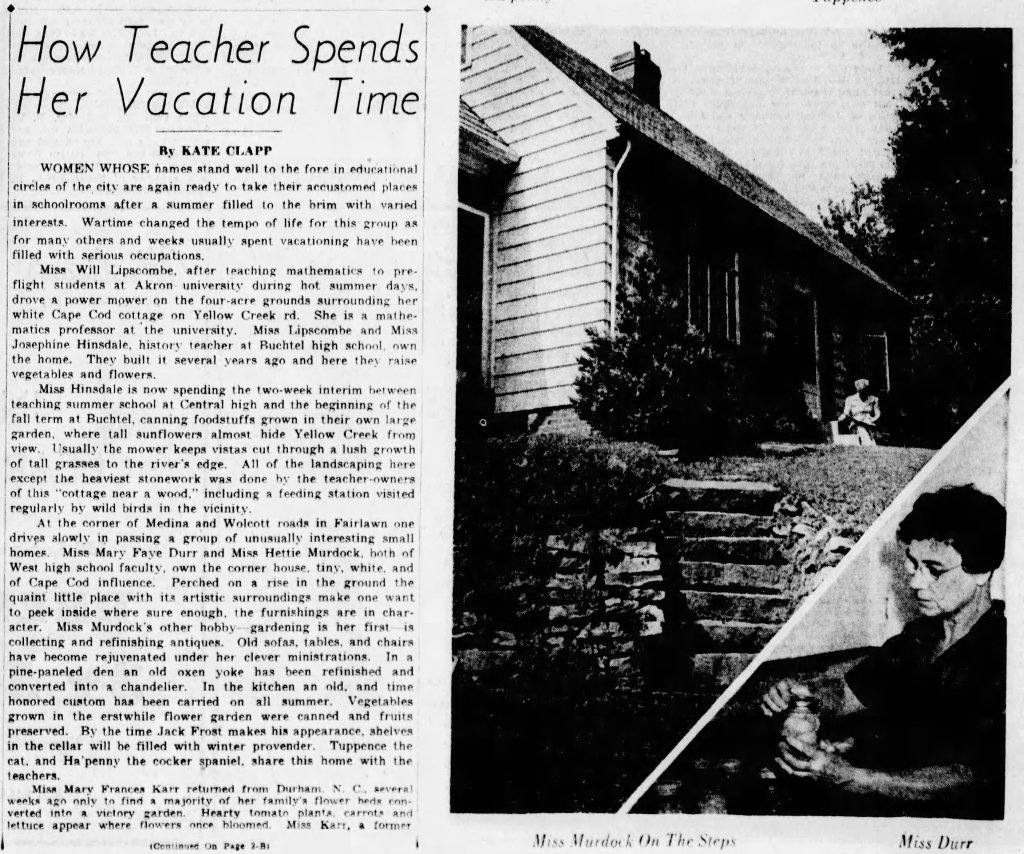
Her Letters To Lovecraft: Edith May Dowe Miniter

The details of Mrs. Miniter’s long career—a career inseparable from amateur journalism after her sixteenth year—will doubtless be covered by writers well qualified to treat of them. Reared in Worcester, taught by her poet-mother and at a private school, and given to solid reading and literary attempts from early childhood onward, the erstwhile Edith May Dowe entered amateurdom in 1883 and was almost immediately famous in our small world as a fictional realist. Controversies raged over her stories—so different from the saccharine froth of the period—but very few failed to recognize her importance. After 1890 she was engaged in newspaper and magazine work in the larger outside world, though her interest in amateur matters increased rather than diminished.

H. P. Lovecraft, “Mrs. Miniter—Estimates and Recollections” (written 1934) in Collected Essays 1.380

She was born Edith May Dowe on 19 May 1867 to William H. Dowe (~1838-1875) and Jane “Jennie” E. T. Dowe (~1841-1919). Jennie Dowe was a noted poet who encouraged her daughter’s literary efforts; Edith became involved in amateur journalism around age 13. In 1887, she married newspaperman and fellow amateur journalist John T. Miniter (1867-1900), and became Edith Miniter. For more on John and their marriage see “The Other Miniter: In Search of John T. Miniter” by Dave Goudsward.

The Miniters became involved in the newspaper business, operating a small local newspaper. The paper, and the marriage, failed within a few years, though Edith Miniter’s profession was still listed as “editor” or “newspaper editor” on federal censuses in 1900, 1910, 1920, and 1930. Edith Miniter relocated to Boston, where she gained some success both as a writer (numerous poems, short stories, and articles appear from her in newspapers and magazines, and her novel Out Natupski Neighbors appeared in 1916) and as an amateur journalist. She became a central member of Boston’s Hub Club, and attained several offices of the National Amateur Press Association—including becoming NAPA’s first woman president in 1909.

By the time H. P. Lovecraft was recruited for amateur journalism in 1914, Edith Miniter was already a doyenne. They were no doubt aware of one another through publications in amateur journals before they ever met or crossed pens—Lovecraft first mentioned Miniter in an unsigned editorial in the United Amateur in 1918 (CE 1.180), and he first mentions her in his letters in 1920:

The occasion for this recent excursion, wich took place last Saturday, was the Hub Club picnic; to which Mrs. Miniter invited me, & at which I hoped to meet James F. Morton. […]

[170] Mrs. Dennis is a famous old-timer often referred to by C. W. Smith. As Harriet C. Cox she won four story laureateships in the National, in the ‘eighties. She was was entirely out of touch with amateurdom, except for Mrs. Miniter, but seems rather interested again. […] However, later on it cleared, so that Cook, Mrs. Miniter, Mrs. Dennis, Morton, & I took a stroll in the woodland. The Fells district reminds me of Quinsnicket Park, but it is even more beautiful in places. During the walk, Mrs. Miniter plucked some bays, & as the party rested on a rocky bluff overlooking a beautiful lake & valley, she formed them into a genuine Parnassian wreath–which she insisted on my wearing all the evening, even at the “convention banquet”, in honour of my triple laureateship. […] I told Mrs. Miniter that I did not deserve the chaplet of bays–that no brow less noble than that of our poet-laureate, Samples, was worthy of such adornment& when the evening was over, I folded it carefully in a cageratte box which someone produced, & sent it to John Milton.
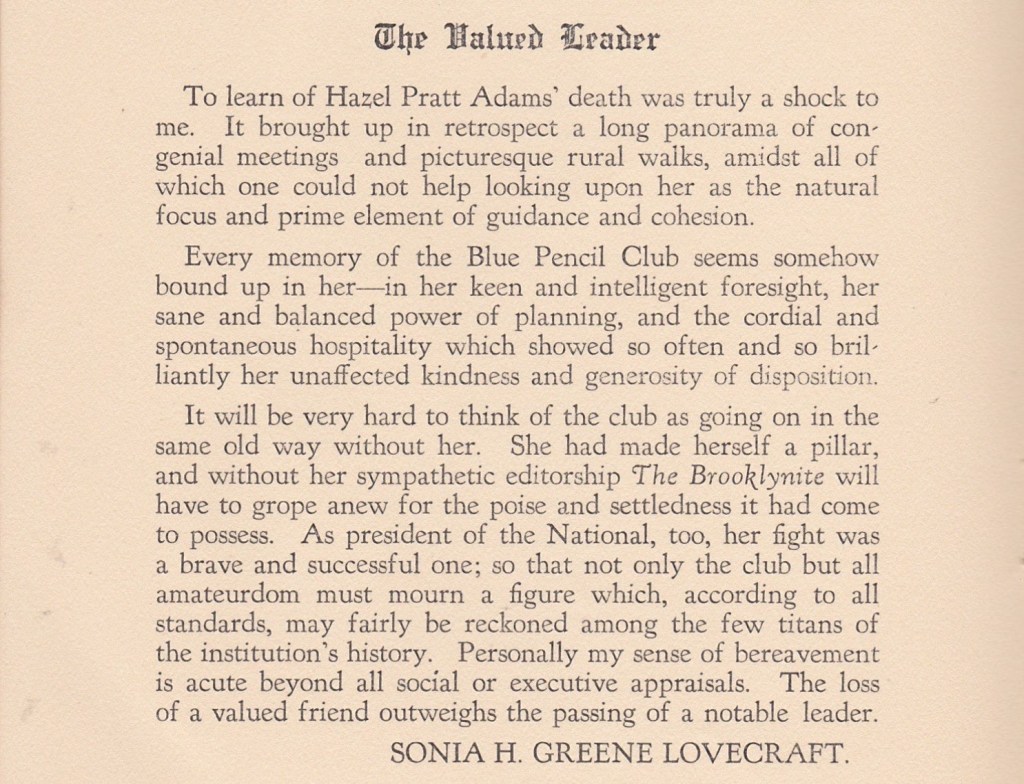
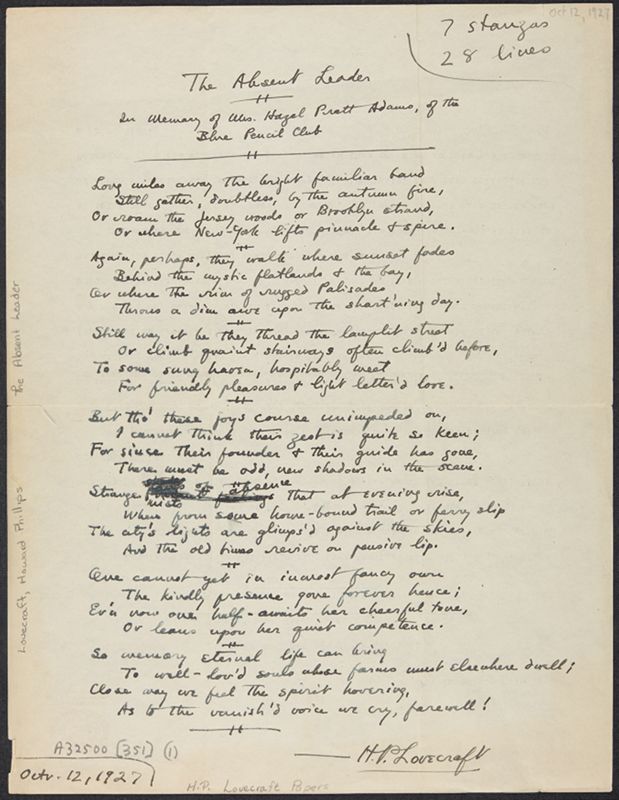
H. P. Lovecraft to Rheinhart Kleiner, 12 Aug 1920, Letters to Rheinhart Kleiner & Others 169, 170

One can just about imagine Miniter enjoying the sight of Lovecraft visibly uncomfortable wearing a laurel on his head all evening; she seems to have taken great delight in puncturing egos. In his letters, Lovecraft records several more meetings with Mrs. Miniter as he attended conventions or amateur gatherings in Boston. She was there when Lovecraft met Sonia H. Greene, who would become his wife; she was there when he read “The Moon-Bog,” which was written for a St. Patrick’s Day celebration; in a letter to his mother Lovecraft recalled:

The house was decorated with streamers of green paper in honour of the departed Celtic saint, and the presiding hostesses, Mesdames Miniter and Sawyer and W. V. Jackson, were attired in green habiliments with green paper ribbons incorporated in their coiffures.

H. P. Lovecraft to Sarah Susan Lovecraft, 17 Mar 1921, Letters to Family and Family Friends 1.31

Lovecraft even managed to bring himself to wear a green tie for the occasion.

Miniter’s reaction to “The Moon-Bog” is not recorded, but she and Lovecraft had philosophically different approaches to subject matter. Her fiction is all of a realist cast, sometimes taking inspiration from real-life—H. P. Lovecraft himself would appear as a character in The Village Green (192?) by Edith Miniter, lightly disguised. Lovecraft would write about her:

Notwithstanding her saturation with the spectral lore of the countryside, Mrs. Miniter did not care for stories of a macabre or supernatural cast; regarding them as hopelessly extravagant and unrepresentative of life. Perhaps that is one reason why, in the early Boston days, she had declined a chance to revise a manuscript of this sort which later met with much fame—the vampire-novel “Dracula”, whose author was then touring America as manager for Sir Henry Irving.

H. P. Lovecraft, “Mrs. Miniter—Estimates and Recollections” (written 1934) in Collected Essays 1.381

In his letters, Lovecraft would repeat the Dracula revision claim several times (discussed in further detail in Lovecraft, Miniter, Stoker: The Dracula Revision). The truth of his assertions that Miniter didn’t care for spectral stories might best be found in “Falco Ossifracus” (1921) by Edith Miniter—a parody of Lovecraft’s own style of macabre fiction, with Lovecraft himself nicknamed “Goodguile,” which would become her pet name for him.

It is not clear when precisely they began to correspond; it is likely no later than 1920, given their continued meetings no doubt involve communication of some sort. The difficulty of determining when things began is the paucity of evidence: no letters from Lovecraft to Miniter are known to survive, and only five letters from Miniter to Lovecraft are extant. One of the earliest of these, dated on “Friday the 13th” (prob. 13 May 1921) opens: “Dear ‘Goodguile.'” The letter deals in part with Miniter’s health; she notes that she took a fall and “had to learn to walk again.” A typed letter dated 4 July 1921 (possibly a draft, as it was torn in half), doesn’t mention the injury, but shows her characteristic wit:

By the war, Mr. McNamara had a good time the 18th, and wrote [W. Paul] Cook that were “real people” and not “Stuck up highbrow at all!” Now will you and James Morton stop quoting Hebrew.

Yours Truly, Edith Miniter

The last bit probably refers to some tendency of Lovecraft and Morton to go over the audience’s heads (i.e. quoting the scriptures in Hebrew sounds impressive, but doesn’t convey any information if the audience doesn’t understand Hebrew).

Lovecraft’s letter rarely mention correspondence with Miniter, but we know they had to still be in contact every once and a while, because some of Lovecraft’s Christmas Greetings to Miniter and her cats are recorded, e.g.:

From distant churchyards hear a Yuletide groan

As ghoulish Goodguile heaves his heaps of bone;

Each ancient slab the festive holly wears,

And all the women disclaim their earthly cares:

Mayst thou, ‘neath sprightlier skies, no less rejoice,

And hail the season with exulting voice!

H. P. Lovecraft, The Ancient Track 320

Lovecraft noted to his aunt Lillian: “To Mrs. Miniter, who finds humour in my predilection for Colonial graveyards, I despatched these lines” (LFF 1.515), and several of Lovecraft’s letters record how Mrs. Miniter would accompany him on his trips through Boston’s various graveyards.

Diminishing finances and possibly ill-health eventually forced Edith Miniter to leave Boston. She lived for a time with the family of the amateur journalist Charles A. A. Parker in Malden, Mass. (1924-1925), and then moved in with her cousin Evanore Olds Beebe (1858-1935) in Wilbraham, Mass., in the house where Edith was born. Beebe had named the property Maplehurst, and it was a former tavern. Around 1928, Miniter wrote to Lovecraft to invite him to come visit, and he did so:

At the station I was met by Mrs. Miniter in a neighbour’s Ford, & taken at once up the beautiful shady road that winds around Wilbraham Mountain. (For a description of this country, see the Dowe Memorial booklet.) The scenery is lovely in the extreme, with just the right balance of hill & plain. It is not so vivid as Vermont, but so much richer & statelier; with larger trees & more luxuriant vegetation [706] generally. The houses are old, but not notable. The population is quite sharply divided–the good families maintaining their old standards whilst the common folk are going downhill. A Polish invasion further detracts from the atmosphere in many localities—the house of the “Natupskis” being visible from the Beebe front porch. The home of Mrs. Miniter’s cousin is a large rambling late-colonial structure built as a taven, & is stuffed utterly full of magnificent antiques, none of which are for sale. They occupy every inch of floor, wall, shelf, & table space, & 7 cats & 2 dogs perambulate & gambol through the lanes between. Miss Beebe, a woefully fat but highly intelligent & cultivated gentlewoman of 70 is the ‘big man’ of all the surrounding countryside; & decides the fortunes of the school committee, town council, & everything else fromher seat beside the telephone. She is a mine of local history & tradition, & a fountain of weird anecdote—& of course a past master & connoisseur of antique collection. She means to leave to leave her possessions to the Museum in Springfield upon her death. She drives about in a horse & buggy, though not scorning to accept a motor life to town from neighbours in bad weather. The house is set high near a curve of a road lined with magnificent maples. Southward the graceful rise of Wilbraham Mountain can be seen—this mountain & all the land for miles around belonging to Miſs Beebe. A curious abandoned road connects the house with the mountain—it is picturesque to see the tall grass growing between stone walls where chaises & farmers’ wains once ran. The whole region is full of odd rural lore, & ought to prove a mine of inspiration for any writer. I have already learned many things about old New England life previously unknown to mesuch as the institution of cat-ladders inside the chimney of farmhouses, to enable the cats to climb from floor to floor when all the doors are shut. There is a fine system of cat ladders in the house—though only one ancient feline (Printer, aetat 17) knows how to use them. The place is very neat, though the only help is a boy named Chauncey, who sits at table with the family. He was taken from the poorhouse in Attleboro—but seems a delightfully gentlemanly person. My room is at the head of the stairs, & is furnished in the manner of about 1830. Lard-burning lamps are among the contents—these articles being formerly wholly unknown to me.

Mrs. Miniter does not appear to have aged at all in the 5 years since I last saw her, but is very active in literature & takes long rural walks. My diary so far is devoid of great events because of the showery weather. Friday I spent largely indoors inspecting antiques & watching cats—though in the vening I walked briefly down the road to imbibe a bit of the scenery. Saturday better weather enabled me to take a walk through some of the picturesque country to the north, Mrs. Miniter serving as guide whilst both dogs & one of the cats acted as a quadruped retinue. I never before saw a cat which followed persons over hill & dale like a dog. The country is very beautiful & traditional indeed, & undoubtedly represents the inland landscape of Western New England at its best. Upon returning I was shewn the extensive barn belonging to the place—Miſs [307] Beebe keeps 2 horses & several cows. The cats all have different & highly individualised personalities—2 are grey (including a patriarch 17 years old0 & five (including a very little kitten) are yellow. Of the dogs one is a mature & very well-bred collie, whilst the other, an Airedale puppy, is a trifle uncouth & over-demonstrative. Sunday—today—we attempted a walk up Wilbraham Mountain, but were overtaken by a thunderstorm & forced to accept a lift back from motorists—who stopped at the house & proved to be delightful persons quite prominent in Springfield educational circles. Tomorrow better outdoor luck is hoped for.

 H. P. Lovecraft to Lillian D. Clark, 1 Jul 1928, Letters to Family & Family Friends 2.705-707

Wilbraham, Mass. was the inspiration for H. P. Lovecraft’s Dunwich, and some of the folklore he picked up talking to the locals made its way into “The Dunwich Horror.” For more on Mrs. Miniter and Mrs. Beebe at Wilbraham, see “The Terribly Nice Old Ladies: Miniter and Beebe At Wilbraham” by David Haden in Lovecraft in Historical Context Fourth Collection.

The two friends must have kept in touch at least sporadically, based on references in correspondence to others:

The letter which Mrs. Miniter sent to me in your care had some choice portions intended for you, as well as directions to me which were not followed. Perhaps I should quote: “Remember me to Goodguile most strenuously and tell him whenever a cat misbehaves I wish he was here to look after it a while. Tell him Culinarius [W. Paul Cook] was here a few hours Saturday and we talked about him a vast deal. Also something about the lad from Indiana, of whom Cook first asked, ‘What relation is he to Ray Spink?’ If you knew what an insult this is you’d go to Athol instead of North Wilbraham and challenge [156] the traducer to single combat. But as he never knew Ray Spink and doesn’t know you perhaps he didn’t really go for to do it!”

Helm C. Spink to H. P. Lovecraft, 8 Aug 1930, Letters to Hyman Bradofsky & Others 155-156

Ray Spink was another amateur journalist; while Miniter could no longer hold court in the Hub Club or attend conventions, amateur journalism was apparently still a major part of her social life. Lovecraft explained this, and revealed he was still very much in touch with Miniter:

I think I told you on a postcard how much I appreciated the Dogmatic Catalogue. In acknowledging it to Mrs. Miniter I prepared a kindred journal entitled Catastrophic Doggerel, (not[e] correct order of precedence for felidae & canidae) some of it not all of whose contents I will herewith quote. The first gem concerned an eminent young Indiana cryptographer—the Champollion of his age—who smoked out a rat from a piece of verse where its presence had never before been whiffed.

H. P. Lovecraft to Helm C. Spink, 13 Aug 1930, Letters to Hyman Bradofsky & Others 158

This was followed by several poems on Miniter’s cats.

Two letters from Miniter to Lovecraft from this period survive. A 1930 letter to “Dear Friend Goodguile,” opens with her admitting to bronchitis, details all the doings of the cats, and apparently read “The Dunwich Horror” when it appeared in the April 1929 issue of Weird Tales:

We did enjoy that marvelous story in Weird Tales, tho’ never wrote you about it. When we meet again, E. O. B. is going to have it out with you about killing the birds. The tale has been lent about, some readers have enjoyed it, but most often it has been returned with shudders. Say, come up again, do, & get material for another yarn. There must be some yet attainable.

The other letter is probably from January 1931, and includes her thanks for Lovecraft’s poetic obituary of the ancient cat Printer, news of her cousin Evanore, and thanks for the postcards—Lovecraft having made it a point to send Miniter postcards from nearly every place he visited, to brighten her day with his travels, as he did for so many of his correspondents.

The fifth and final missive from Edith Miniter to Lovecraft is a very short note, undated, congratulating Lovecraft for something. “You certainly owe us another visit” suggests this is after the 1928 visit to Wilbraham, but other than that, we lack context. Possibly a congratulation for “The Dunwich Horror” appearing in print.

There must have been more letters because Lovecraft mentions her on occasion:

Mrs. Miniter is having a very hard time at Wilbraham, with her own asthma worse, & Miss Beebe’s health such as to demand constant care—plus a financial distress which grows more & more alarming.

H. P. Lovecraft to Helm C. Spink, 2 Feb 1933, Letters to Hyman Bradofsky & Others 202

Another friend and fellow amateur remembered in a memoir that might give the flavor for some of Edith Miniter’s correspondence to Lovecraft after she moved to Wilbraham:

When Edith lived in Boston we met often, and it was a definite personal loss when she went to Wilbraham. For a time, she wrote long letters at fairly frequent intervals, and she always expressed a determination to return to us some day.

The last few years her letters were shorter and less frequent, and, although, she said little about it, it was evident that her health was far from satisfactory.

After an accident, she wrote jokingly of her “broken bones,” and gave a ludicrous description of her appearence in a borrowed wrapper, much too big for her, that she was obliged to wear because all her own dresses “went on over her head” and she couldn’t “get into them.”

She touched humorously, at another time, upon her experience with the hives, but she never complained or seemed to deserve pity.

In her last letter, written less than three weeks before she left us, she said, “I am about the same as usual,” and it was a decided shock to learn that the end had come.

Minna B. Noyes, “Bygone Days” in The Californian (Spring 1938)

It is a familiar story; old age with its illnesses and decrepitude come on, heightened by financial woes. Edith May Dowe Miniter passed away on 5 June 1934, at Wilbraham. Lovecraft learned of the death in the amateur journal The Wolverine, which ran a brief notice:

It pained me to learn, through a paragraph in one of them, that Mrs. Miniter is no more. I sent her cards from all along my route, & the later ones—alas—can have had no recipient!

H. P. Lovecraft to Helm C. Spink, 17 Jul 1934, Letters to Hyman Bradofsky & Others 222

Lovecraft would apparently write to Wilbraham seeking more information, and possibly the return of materials he had lent to Miniter. A letter survives from a Mrs. C. H. Calkins to Lovecraft that gives a few more details on Miniter’s decline and the aftermath.

As one of her friends, Lovecraft worked to write memorials about Edith Miniter, and to encourage his friends to write memorials, although he would not live to see the publication of his lengthy “Mrs. Miniter—Estimates and Recollections.” There was some confusion in the estate, and the disposition of Edith Miniter’s papers, which seems to have been compounded by the death of Evanore Beebe in 1935. By an odd quirk, Lovecraft himself ended up with a collection of Miniter’s personal and family papers, holding them in trust until the proper heir could be located. In accordance with what Lovecraft thought would be Miniter’s wishes, he allowed certain works to be published posthumously in the amateur press—such as “Dead Houses,” which appeared in Leaves #1 (Summer 1937) from R. H. Barlow’s Dragon-Fly Press.

Lovecraft had one more duty to perform on Edith Miniter’s behalf, back in the old Dunwich country: the ashes of Mrs. Jennie Dowe had never been dispersed in accordance with her wishes, but remained at the funeral home. At first there was concern that some unpaid bill was the cause, but as soon as it was cleared up that all was paid for, the ashes were secured and Lovecraft returned to Wilbraham with fellow amateur Edward H. Cole:

The trip to ancient “Dunwich” was pleasant despite our melancholy errand, & we enjoyed the marvellous mountain vistas to the full. Nothing had changed–the hills, the roads, the village, the dead houses–all the same. Most of the ashes were sprinkled in the Dell cemetery—on the graves of Mrs. Dowe’s parents & daughter. The rest we kept till we had wound over the narrow serpentine hill highway & reached the old Maplehurst estate “back o’ the mountain”. There—in the deserted rose garden—we completed the ceremony of union with ancestral soil . . . . carrying out, after 16 years, what Mrs. D. had always wished.

H. P. Lovecraft to R. H. Barlow, 26 Sep 1935, O Fortunate Floridian 293-294

Even late in life, as Lovecraft dealt with the disposition of her papers and the memorial that took so many years to go to press, he reflected:

Without question, Mrs. M. was the greatest fiction-writer ever connected with amateurdom. Not so notable as to form, but with a searching insight into human nature, & a keen ability to capture the essentials of character with some swift graphic stroke or some laconic touch of veiled, subtle irony. She had the substance—writing at first-hand about types of people she had actually seen & studied instead of merely following literary conventions & imitating what other authors had written before her.

H. P. Lovecraft to Hyman Bradofsky, 18 Oct 1936, Letters to Hyman Bradofsky & Others 374

It is unfortunate that we have so little record of the correspondence of Edith Miniter and H. P. Lovecraft; not because it would necessarily have shed more light on Lovecraft, but because Miniter is a subject of historical and literary interest in her own right. We have thousands of letters from Lovecraft, we have only a handful from Miniter. Yet she was in her day as important, or more so, as Lovecraft in amateur journalism. Reading between the lines, we might also wonder what humanizing influence Edith Miniter had on her friend.

One has to wonder if Lovecraft thought of that great old lady of amateur journalism breathing her last, the whippoorwills outside the window chirping, and then fading suddenly to silence—not that Miniter would have appreciated such a flight of fancy, but perhaps she would have appreciated the sentiment.

Anyone interested in learning more about Edith Miniter or reading some of the fiction that Lovecraft so acclaimed should check out Dead Houses and Other Works and The Village Green and Other Pieces, edited by Kenneth W. Faig, Jr. and Sean Donnelly.


Bobby Derie is the author of Weird Talers: Essays on Robert E. Howard and Others and Sex and the Cthulhu Mythos.

Deep Cuts in a Lovecraftian Vein uses Amazon Associate links. As an Amazon Associate I earn from qualifying purchases.