“I Hate Queers” (1936) by R. H. Barlow

Meanwhile let me wish you all success with the realistic novel or character study—”No Right to Pity”. Material which ‘must be written out of one’s system’ has a very excellent chance of being genuine art—no less so when it comes hard than when it comes easy. And semeblance to a ‘chronicle of actuality’ is not to be deplored unless all dramatic modulation & implied interpretation be absent. Don’t hurry with the work—but let it unfold itself at whatever rate makes for maximum effectiveness. A subjective or quasi-autobiographical novel is often a stepping-stone to work of wider scope. Certainly, many books of the kind have received the highest honours in recent years.

H. P. Lovecraft to R. H. Barlow, 24 Jul 1936, O Fortunate Floridian 353

By early Summer 1936, Robert Hayward Barlow’s focus had turned to prose, poetry, and publication—the amateur journals The Dragon-Fly that Barlow managed to print using the press in the small shack (which Lovecraft had helped with during his last visit) were well-received by many. Barlow’s original fiction efforts ranged from fantasies like the “Annals of the Jinns” to post-apocalyptic vignettes like “The Root-Gatherers.” They showed promise, and Lovecraft was keen to encourage his young friend’s literary efforts.

Yet all was not quite well with R. H. Barlow’s home life.

Col. Everett D. Barlow suffered from what today is called post-traumatic stress disorder. From the hints and suggestions in R. H. Barlow and Lovecraft’s letters, it appears that the colonel was irascible, with periods of depression. Retired from the army and spending most of his time with his wife and youngest son at their homestead in DeLand, Florida, the old man was probably difficult to escape, for both R. H. Barlow and his mother, Bernice. The strain in the marriage would eventually lead to separation and divorce, but for Bobby Barlow, there were few opportunities to escape…

…which is what, essentially, R. H. Barlow’s sudden trip to Providence, Rhode Island to visit Lovecraft was.

It isn’t clear from R. H. Barlow’s autobiographical writing as to when exactly he came to realize he was gay, but there is evidence that around 1936 he was grappling with issues of sexuality and sexual identity. While it isn’t clear if he ever broached these matters with Lovecraft directly, there are hints elsewhere:

Don’t allow yourself to be influenced in any way by Cities of the Plain. This remarkable study in sexual perversion is sui generis.

August Derleth to R. H. Barlow, 8 Jul 1936, MSS. Wisconsin Historical Society

Cities of the Plain was the 1927 translation of Marcel Proust’s Sodome et Gomorrhe (1921/1922), a novel which deals with homosexuality and jealousy. By itself, this isn’t necessarily telling; Derleth was notably relatively open on reading about and discussion of sexuality (there are claims that he was bisexual, see Derleth: Hawk…and Dove (1997) by Dorothy M. Grobe Litersky), and perhaps Barlow felt more comfortable bringing up the book with Derleth than Lovecraft. Yet it could be a sign of Barlow’s growing interest and awareness of gay issues, especially as related to himself.

R. H. Barlow visited H. P. Lovecraft in Providence from 28 July to 1 September 1936, Since they were seeing each other every day, there was no need to write letters, so the surviving accounts of the trip come from Lovecraft’s letters to his other correspondents. One thread from such an exchange with Derleth stands out:

Speaking of impromptus—enclosed are a triad of modernistic character sketches which Barlow wrote the other day without any effort or premeditation whatsoever. He pretends to despise them, but I rather think he’d like to see them in one of the little magazines which you so kindly listed for Pabody. What do you think of them? Would you encourage R H B to revise & submit them, & to pursue further endeavours along the same line? He could grind out this stuff endlessly if there were any demand for it. It seems rather in the Story line.

H. P. Lovecraft to August Derleth, 22 Aug 1936, Essential Solitude 2.746

I read Barlow’s stuff with a good deal of interest, but must regretfully report that while it has the promise it is as yet pretty unformed, and not likely to see publication. Also, it is extremely difficult to read, owing to the fact that RHB is not up on paragraphing, etc. Structurally, the pieces are pretty bad. I Hate Queers has the most promise, but before the really chief characters are introduced, we get 4 pages of tripe about people who do not concern the leads at all. Nobody would take a story like that, though the best bet for Barlow’s emergence into little magazine print would be Manuscrupt, 17 West Washington, Athenos, Ohio. I have made a few marks here and there in one or two of the stories, though I did not contribute the usual amount of marginal notes owing to close typing. […] The use of long-winded, platitudinous expressions annoys, but despite all this I should think there is hope that RHB may make something out of such material as this. Let him drop at once any air of sophistication he may have. Affectations may serve a purpose to one’s self, but not in print. […]

No, RHB’s tales are far from the Story line: Story’s are crisp and clear, Barlow’s are jumbled. I Hate Queers might be revised to some good end, but much of it would have to be cut, and some staple point-of-view maintained throughout. He shifts point-of-view constantly, which is very confusing and not good creation. Frankly, the stuff shows sloppy writing: I can easily believe that he just dashed it off.

August Derleth to H. P. Lovecraft, 26 Aug 1936, Essential Solitude 2.747, 748

Barlow appreciated your criticisms immensely, & will doubtless be guided by them in future attempts. He is now, of course, in a purely experimental stage—scarcely knowing what he wants to write, or whether he wnts to write at all…as distinguished from painting, printing, bookbinding, &c. My own opinion is that writing best suits him—but I think he does better in fantasy than in realism. A recent atmospheric sketch of his—“The Night Ocean”—is quite Blackwoodian in its power of dark suggestion. However—it’s just as well to let the kid work the realism out of his system. At the moment he seems to think that the daily lives & amusements of cheap and twisted characters form the worthiest field for his genius. Plainness in style will develop with maturity.

H. P. Lovecraft to R. H. Barlow, 23 Sep 1935, Essential Solitude 2.748-749

This is the first and last mention of R. H. Barlow’s “I Hate Queers”—a piece that is not known to survive and has never been published. In another letter around this time, Lovecraft briefly mentions the plot of one of Barlow’s stories in comparison with The Last Puritan (1935) by George Santayana, though whether this is “I Hate Queers” or another piece is unclear:

As for your parallel betwixt Oliver’s admiration of the coarse Lord Jim & your artist’s anomalous devotion to a cheap prize-fighter—I can’t see that it holds. Lord Jim—a character vital & engaging personality despite his feet of clay—was a symbol to young Oliver. He was a symbol of the unrestraint for which one side of Oliver—because of his one-sided education & conventional antecedents—subconsciously longed. Meeting him in extreme youth at a time of suddenly enlarged horizons, Oliver always associated Jim with the abstract quality of liberation & expansion—the associative image persisting even after the basic commonness of the concrete Jim became manifest. Nothing of this sort is apparent in the case in your story. There is not the slightest reason in the world why any sane & mature artist would wish to see or talk with a cheap & undistinguished prize fighter. And I’d some tragic disease or malformation gave the artist an abnormal interest, he would naturally spend all his time in Fi ghting & eradicating the disease—not in displaying or encouraging it as a lower-grade character might.
—H. P. Lovecraft to R. H. Barlow, 30 Sep 1936, O Fortunate Floridian 365-366

Most likely, like much juvenalia it ended up in the ash bucket, never to see the light of day. Yet it is impossible to read that title, and the surrounding comments on the work, without delving into some speculation. The suggestion of autobiographical elements and the need to write something out of his system recalls Barlow’s later, very much explicit “Autobiography,” which was written as an extension of the psychoanalytic therapy he underwent in his twenties. One can easily imagine a literate young man attempting a quasi-autobiographical story; Robert E. Howard had done much the same thing with Post Oaks & Sand Roughs, and Arthur Machen with The Hill of Dreams, so Barlow was in good company.

The title itself is plainly homophobic, yet Barlow himself was homosexual, even if he hadn’t had his first experience with another man yet. Barlow’s “Autobiography” opens in 1938 at age 18 as he roomed with the Beck family in California, with his attraction to the male form already fully developed, at least if such passages as this are any to go by:

I could not decide which if the Beck boys to fall in love with and vacillated continually. Claire had a mania for bathing, and I saw him once or twice quite naked. he had a nice prick, uncircumcised. At other times he found excuses to go downstairs from the bath to the living room, dressed only in skin-tight drawers, which also showed him off to advantage.

R. H. Barlow, “Autobiography” (1944) in O Fortunate Floridian 410

Keep in mind that this was Barlow in 1944 looking back at himself in 1938, so he could have been impressing his then-current comfort level with his sexuality on his past self—but if it is accurate to his teenage feelings, this may suggest that Barlow had passed through any phase of doubt or confusion before this point—and perhaps he was still in that period of self-discovery in 1936 when he dashed off this short story.

This is important because the title “I Hate Queers” is very provocative, designed to establish and evoke an emotional response from the reader. After all, in the very homophobic 1930s, who would publicly disagree? Who would stand up and say they don’t hate queers? This suggests that the expressed prejudice of the title might be performative: the closeted gay character who emphasizes their homophobia to deflect suspicion about their own sexuality…or, perhaps, a heterosexual character who is preoccupied with being mistaken for gay because they know what discrimination that will bring.

It is fun to speculate; certainly Barlow would not have been able to be open about his burgeoning sexuality with his family, and perhaps not even with his few friends like Lovecraft and Derleth. Even discussing Proust or showing them “I Hate Queers” might have represented a risk, albeit a considered one, with any hint of personal interest disguised as literary interest or effort…and there was reason for Barlow to be concerned. Derleth was upfront about it:

Barlow is for sure a homo; from what I have heard, so was the late minister-weird taler Henry S. Whitehead. Any anybody with a mandarin moustache is vulnerable to the kind of flattery, larding I can do very well.

August Derleth to Donald Wandrei, 21 March [1937]

“I Hate Queers” stands out in Lovecraft’s correspondence as one of those fascinating possibilities which have been lost to time. We’ll never really know what the story was, unless an archive of Barlow’s teenage stories shows up at some point. It was a different world then, for LGBTQ+ folks, and it took decades of hard work and legislation to begin to win them recognition and equal rights with heterosexuals…rights and recognition which, sadly, have continually faced opponents dedicated to restrict, redefine, and rescind them. To turn back the clock to when gay men like R. H. Barlow struggled to express themselves even to their closest friends and relatives for fear of imprisonment and fines, censorship and blacklisting; and faced blackmail and violence simply for appearing to be different.

Barlow’s title is expressive of an age and attitude I had hoped was dead and buried, but there are still bigots today who would say it proudly…and that, perhaps, is a more subtle horror than the realism which Barlow had tried to express. For it is still as real today as it was in that earlier century.


Bobby Derie is the author of Weird Talers: Essays on Robert E. Howard & Others (2019) and Sex and the Cthulhu Mythos (2014).

Deep Cuts in a Lovecraftian Vein uses Amazon Associate links. As an Amazon Associate I earn from qualifying purchases.
Her Letters To Lovecraft: Lillian M. Galpin

Here’s some news that can’t wait for a letter. Alfredus—Grandpa’s little Galpinius-child—is married! The event occurred last June, but The Boy kept it a secret for a while—perhaps waiting to see whether or not it would turn out well.

H. P. Lovecraft to Lillian D. Clark, 27 Aug 1924, Letters to Family & Family Friends 1.154

According to census data, birth records, and her gravestone, Lillian Mary Roche was born on 16 Nov 1903 in Lowell, Massachusetts, one of six children of Irish immigrants Maurice and Elizabeth Roche. Her family was living in Chicago, IL in the 1920s, and Lillian was attending the University of Chicago and in the final year of her undergraduate degree when she married Alfred Galpin, then finishing his master’s degree at the same university. The marriage occurred on 23 June 1924, and initial prospects did not appear to be poor—Alfred was fluent in French and had a position as an instructor in that language at the Univeristy of Michigan secured. It would end with Lillian’s death in 1954…and as far as public records go, there is little to add to that. The Galpins had no children, and if Lillian left any record, it has not been published.

Yet things were not all right with the marriage…and that would lead to one of the oddest and briefest (one might say, tangential) correspondences in Lovecraft’s life. The story is not one that Lovecraft or anyone else has told directly, but has to be pieced together from different records, references in Lovecraft’s correspondence, and other odds and ends.

AUGUST 27, Wednesday. Did I mention that Alfred Galpin, Madisonian, friend of Lord and L (whatshisname) and myself, incidentally, went and got married some time ago? Hully gosh! He, Howard! Next I suppose CAS, SL, RK, and even JFM and perhaps even GK will join ranks.

George Kirk, Lovecraft’s New York Circle 28

H. P. Lovecraft came in contact with Alfred Galpin around 1918, when Galpin was still in high school, through their mutual associate Maurice W. Moe. They shared an interest and involvement in amateur journalism, and developed a robust correspondence. Lovecraft predicted great things for Galpin, but neither man shared everything with the other. When Lovecraft eloped in March 1924 to marry Sonia H. Greene, he didn’t inform Galpin (or anyone else) until after the fact; when Galpin married Lillian Roche a few months later, he didn’t inform Lovecraft right away either.

Ex-President Alfred Galpin, having been married in June, 1924, last autumn accepted a post as Instructor in French at the Rice Institute, Houston, Texas, perhaps the leading university of the Lone Star State. His interests are veering more and more away from literature toward music, and after suitable years of study he hopes to be recognised as a pianist and composer.

H. P. Lovecraft, “News Notes,” United Amateur 24, No. 1 (Jul 1925) in Collected Essays 1.356

For young, untenured university professors, going where the jobs are isn’t unusual, then or now. Yet the Galpins did not end up going to Paris. Instead, about a year after their marriage, Alfred and Lillian went to Paris:

The little rascal sailed from New Orleans (3d class) on the 14th of last month, & has since been imbibing true Parisian accent & colour whilst his wife studies at the Sorbonne. They inhabit a rather costly hotel in the Rue Madame, & Galpinius does not seem to be disappointed in the least—as yet—with the storied city of his dreams.

H. P. Lovecraft to Lillian D. Clark, 13 Jul 1925, Letters to Family & Family Friends 1.313

Most of Lovecraft’s surviving correspondence mentions Lillian indirectly; they were not apparently correspondents at this time, and if they exchanged letters after 1925 there is no evidence of it. She was, for the most part, mentioned only indirectly as Lovecraft related news about Alfred Galpin to his various correspondents. It is somewhat ironic, given how nebulous and tangential the bulk of these passing references are, that it is only through Lovecraft’s letters that we get a picture of Lillian Galpin.

The story unfolds in his letters:

Speaking of Galpin—he is now in Paris studying, having gone thither in June with his wife. The latter is returning ahead of him on the Majestic—arriving, as coincidence would have it, this very day—& Loveman & I expect to see her & ply her with questions anent her brilliant spouse & his Gallic sojourn.

H. P. Lovecraft to Clark Ashton Smith, 18 Aug 1925, Dawnward Spire, Lonely Hill 77

Arrival documents confirm that Lillian Galpin arrived, without her husband, in New York City on 18 Aug 1925. Why she left Paris is not clear, although in other letters Lovecraft notes that Alfred Galpin was experiencing financial difficulties (his father, who died in 1924, had left the bulk of his estate to a nephew also named Alfred Galpin). This is the first real hint of trouble in the marriage, although Lovecraft goes into no details—and Lovecraft himself was at the time semi-separated from his wife, living in Mrs. Burn’s boarding house at 169 Clinton Street in Brooklyn while Sonia was working in Cleveland to help support them both, visiting New York at intervals.

Alfred Galpin wrote to Lovecraft ahead of time to greet his wife at the pier and help her out; Sonia was in town at the time, although due to leave for Cleveland in a few days. Lovecraft, not sure how best to handle the situation, wrote Lillian a letter which was to be delivered to her when she came ashore, giving his phone number and enclosing photographs of himself and Samuel Loveman, so she could recognize them when they came to assist with her luggage.

Dear Mrs. Galpin:—

Your gifted husband having informed our local circle of easthetic dilettanti of your impending arrival on the S.S> Majestic, & having delegated to use the agreeable responsibility of showing you such sights & salient points of interest as you may care to inspect hre, I herewith take it upon myself to facilitate your location & identification of the circle in question. Mr. Galpin tells me that you will call me up by telephone, but it occurs to me that I may not have given him the number of this haven of remunerative guests; in which case you will look in vain through the book for a telephone in my name. Let me, therefore, here state that the correct number is MAIN 1401, at the Brooklynward end of which a proper sentry will be posted during the day of your arrival as estimated byt he White Star offices—Tuesday, Aug. 18.

H. P. Lovecraft to Lillian M. Galpin, 16 Aug 1925, Letters to Alfred Galpin & Others 261-262, MSS. John Hay Library

What followed was one of those comedies of errors that in another century could have been solved with a ten-minute call on a cellphone.

The next day—Tuesday the 18th—we were up early & on the watch for Mrs. Galpin’s telephone call. S H had to go out, but arranged to leave the numbers of the places she visited, so that I might reach her when Mrs. G. communicated. Meanwhile I busied myself with reading & correspondence—& framed an inquiry for the Post Office concerning an important envelope from Clark Ashton Smith, containing a letter, a story, & several poems, which was mailed to me last March & failed to reach its destination. Thus the day passed—when at three o’clock the Burns boy brought up the card of Mrs. Alfred Galpin! The steamship letter had failed to reach her; & after a five-hour search including inquiries at police stations, public libraries, & heaven knows what else, she had come upon the place through a vague remembrance that it was in Clinton Street, & that its number had three figures beginning with 1 & ending with 9. Beginning at 199, she had worked along the street northward, trying 189 & 179, & finally stumbling on the correct spot at 169.

H. P. Lovecraft to Lillian D. Clark, 19-20 Aug 1925, Letters to Family & Family Friends 1.353-354

Lovecraft’s 1925 diary entry for 18-20 Aug 1925 covers the essentials of Lillian Galpin’s visit (Collected Essays 5.165-166), while his letter to his aunt has a much more detailed, expanded account of events. One has to imagine Lillian Galpin, after a six-day crossing of the Atlantic, arriving in a strange city and randomly knocking on doors until she finds her husband’s friends. It was here that Lovecraft gave his description of her to his aunt:

Mrs. G. was undecided about the duration of her stay; though waning finance dictated a very brief sojourn,whilst her trunk had already been scheduled for through transportation to her parents in Chicago. Three days seemed a logical period, though she would like to obtain a local position & settle semi-permanently till the American return of The Boy. At length she decided to plan on leaving Thursday night, on a late train. Mrs. Galpin is a small person of no especial beauty, strongly resembling the portrait of Mrs. McMullen (Lillian Middleton) which you will find in the second (green-covered) issue of The Rainbow. She is descended from the most ancient Norman nobility domiciled in Ireland—the de Roches—& Alredus is strongly thinking of changing his name to hers, because of its greater aristocratic significance. Some of the kin of this family, the Burke-Roches, are of international social pormienncel whilst Mrs. G’s own father would be the 21st Earl of Fermoy if he would renounce his American citizenship. A proper family for the reception of Grandpa’s Boy—I can see him as Alfred de Roche, in a panlled coach with his new coat-of-arms on the door! Mrs. G. was, like Alfredus, an infant prodigy; & is a graduate of the University of Chicago. Her literary background is ample & profound, & appears to be united to an excellent taste & keen intelligence; in short, the match seems in very way a suitable one for The Child, whose genius deserves a kindred environment. Alfredus himself, I learn, is developing into a typical Parisian character. He wears his hair long—longer, in literal truth, than his wife’s—& even tried to grow a beard till he found it impossible. His scornful repudiation of literature is complete; & he not only laughs at his wife for reading, but refrained from telling her that he had ever followed letters himself—so that the Galpinian essays & critiques which I shewed her came as a complete surprise!

H. P. Lovecraft to Lillian D. Clark, 19-20 Aug 1925, Letters to Family & Family Friends 1.354-355

There is a Baron Fermoy in the peerage of Ireland, and the Burke Roche family do hold it, but someone got the other details wrong. More compelling is the idea that Alfred Galpin didn’t see fit to tell his wife anything of his amateur journalism career, despite the fact that he had once been president of the United Amateur Press Association in 1920-1921 term. That Lillian was resolved to be separated from Galpin until his return to the United States the following year, and looking for work to support herself, speaks somewhat to their marital difficulties—and one has to wonder if the Lovecrafts saw the parallels with their own situation.

After the play we took a taxicab to the Erie ferry near the White Star dock, & fetched Mrs. Galpin’s hand luggage to 169, where she took a room on the ground floor. En route we took refreshments at the Scotch Bakery. Finally, we dispersed for slumber; Ms. Galpin deciding to devote the morrow to job-hunting, & indicating her intention of rising early, perhaps before the rest of the household—returning some time in the afternoon, & attending the meeting of The Boys at Kirk’s ex-partner’s—where S H also planned to attend. […] I last spoke of Wednesday the 19th, on which date I rose early & wrote letters till mid-afternoon, when Mrs. Galpin returned from her fruitless industrial quest. Upon her arrival she spoke of the night before–which, thanks to the negligence of busy Mrs. BUrns–had not been one of rest. It seems that the downstairs room has not been kept as immaculate as some others herabouts, & that its couch has an undesirable population of invertebrate organisms which resent the intrusion of mere mortals to a highly vindictive extent! Accordingly Mrs. G. was far from harassed, & in the morning held an interesting conversation with Mrs. Burns—who apoligised profoundly & let her have the room at a reduced rate.

H. P. Lovecraft to Lillian D. Clark, 19-20 Aug 1925, Letters to Family & Family Friends 1.355-356

Fresh across the Atlantic, without her husband, in a strange city, and then faced with bedbugs. Lillian Galpin’s New York adventure was not shaping up to be a good one. Lovecraft himself had long been discouraged with job-seeking, and was not surprised by her lack of success. They went out to dinner, and then an evening with the Kalem Club. When they returned to 169 Clinton, the exhausted Lillian must have realized she was facing another night with bedbugs.

The residual trio proceeded to 169; where Mrs. Galpin, after inspecting her room, decided she could not rest. Accordingly—& with many apologies for having delivered a guest unwittingly into an arena of sanguinary monsters—S H & I decided that Mrs. G. had better stop at some haven of undisputed immaculeteness & desirability; hence I assisted in the transfer of her effects to the celebrated & dignified Hotel Bossert in Montague Street, where she obtained an excellent seventh-floor room for four dollars.

H. P. Lovecraft to Lillian D. Clark, 19-20 Aug 1925, Letters to Family & Family Friends 1.356

This was, however, not the last injury that Lillian suffered at Burn’s boarding house:

On this occasion I proceeded home, where I found Mrs. G. already arrived after a last & unavailing early morning interview ith a possible employer, & a last & earnest conversation with Mrs. Burns anent a fresh case of robbery in this delectable retreat! It seems that when packing in haste the previous evening she had left heind a somewhat valuable silk nightgown—which was now missing, & which has not been heard from since. Which of the sundry transient inhabitants to accuse one cannot say—but fortunately Mrs. G. is a philosopher, & able to dismiss life’s casual losses with a shrug & a sigh. We now endeavoured to set out upon that course of sightseeing which malign circumstance had thus far delayed—but again the Fates interposed, & the entire morning was wasted at the Erie & white Star piers in a fruitless attempt to locate Mrs. G’s trunk, for which she had failed to obtain a receipt, but which probably went through to Chicago. We did, however, recover the missing letter with its pictorial encloserues, which latter I wished to preserve.

H. P. Lovecraft to Lillian D. Clark, 19-20 Aug 1925, Letters to Family & Family Friends 1.357

They did retrieve the letter, which is why it is not preserved in Letters to Alfred Galpin & Others. Sonia was due back in Cleveland by an earlier train, to which city she invited Lillian to visit; they then helped Lillian see what she would of New York in her few remaining hours.

Since all museums close at five, it was now too late to see more than one; & this was chose without difficulty, snce Mrs. G’s chief wish in N.Y. was to inspect the American Wing of the Metropolitan Museum. Arriving in good season, & prviouslt surveying the French rooms (as you & I did) we proceeded to cover the colonial exhibits in detail; & Mrs. G. displayed a genuine interest & acute knowledge in remarking upon the objects displayed. She purchased the dollar handbook of the oclleciton, & means to become something of an authority on Georgian America whilst her effulgent lord & master absorbs the antique charm of mediaeval Paris.  […]

Mrs. Galpin, being exceedingly fatigued by continuous exertion, sent her regrets & went to her hotel to rest; but I went down & saw S H safely aboard the Cleveland train—incidentally carrying her a letter from A E P G which had just arrived. […] Now proceeding to the Bossert, I met Mrs. G. & transferred her values once more to 169, for later transportation to the train. She obtained some light refreshments—cheese crackers, orange marmalade, chocolate, & fruit, & served these whilst I began a letter to The Boy. In due time she added her section, & under separate cover we added the postcards obtained during the afternoon, as a supreme inducement for The Child to stop off in New York next June upon his return to the United States.

H. P. Lovecraft to Lillian D. Clark, 19-20 Aug 1925, Letters to Family & Family Friends 1.357-358

It was typical of Lovecraft to write joint letters with such friends were available; there would be nothing more suitable than for Lillian Galpin to include a brief note to the letter Lovecraft was writing to her husband. Regrettably, Alfred Galpin destroyed much of his early correspondence with Lovecraft c.1930, including their joint letter. This is why Lillian Galpin might be considered a “tangential” correspondent—the one letter Lovecraft wrote to her she didn’t receive, and the one letter they wrote together doesn’t survive.

After completing her section, Mrs. G. rested on the couch & slept soundly whilst I finished the epistle at length. At 11:00 I fared forth to secure a taxicab, which I found only with great difficult & alarming loss of time. Returning with it, I awakened Mrs. G. with as much gradualness & as little violence as possible, after which the expedition hastened in the cab across Brooklyn Bridge & through the town to the Erie ferry, just in time to miss the 11:50 boat which had been mentioned as the one connecting with the Cleveland-Chicago train! For a moment, dramatic despair supervened; but in another instant a clerk had cleared the skies by mentioning tht according to Daylight-Saving Time we were a full hour early, the real boat being the 12:50 by the local clocks. Saved! We now proceeded to a neighbouring cafeteria, had coffee & read books at a table which commanded a view of the clock, & in due time returned to the ferry & sailed thereon. Reaching the other side, I assisted the luggage to the 1:25 train, & bade Mrs. Galpin convey my regards to S H upon meeting her, & to Alfredus upon writing him.

H. P. Lovecraft to Lillian D. Clark, 19-20 Aug 1925, Letters to Family & Family Friends 1.358

That was the last time that H. P. Lovecraft and Lillian Galpin met, though he would continue to hear from her. In fact, rather shortly he would get an urgent letter from his wife regarding Lillian.

Had a letter from S H yesterday, saying that Mrs. Galpin didn’t shew up in Cleveland at all! She’s quite worried, imagining all sorts of kidnappings, wrecks, & such like; but I fancy Mrs. G. was merely too tired out to relish the Youngstown change of cars, so went straight home to Chicago.

H. P. Lovecraft to Lillian D. Clark, 19-20 Aug 1925, Letters to Family & Family Friends 1.367

Lovecraft was probably correct; after the trials and hectic travel of the last few days, Lillian was probably happy to be home…although again, this was back in Chicago, without her husband. How she spent the next year is not clear; Alfred Galpin was desperate for money to continue his music studies in Paris, even asking Lovecraft for a loan, and Lovecraft reported that his wife prevailed on Galpin’s mother to send a $250 cheque to cover his needs (Letters to Family & Family Friends 1.451-452). In 1926, she passed through New York again to take ship to bring him back to the States:

MAY 4 […] Met, the other day, Galpin’s wife: she went back to Paris on the Leviathan, and expects to bring him back ere long….

SEPTEMBER 9 […] Guess old Galpin isn’t coming from Paris either, as I hear his wife is going back and they’re to say another year. There’s bedlam for you.

George Kirk, Lovecraft’s New York Circle 87, 98

By this time, Lovecraft had left New York and so missed a reunion with Lillian; while Alfred Galpin may have wished to stay in France, they did apparently return to the United States in 1926, with Alfred taking a position at Northwestern University in Evanston ( a suburb of Chicago) teaching French and Italian. The 1930 Census shows Lillian employed as a clerk and living with Alfred in Chicago, but likely he would return home to Appleton, Wisconsin in between terms. Lillian did not apparently accompany him.

In 1930 Alfred finished his M.A. at Northwestern, and spent another year (1931-1932) in France; whether Lillian accompanied him is not clear, although a 1932 news article shows she was applying for jobs in Appleton. When Alfred returned to the United States, he took a position at Lawrence College (now Lawrence University) in Appleton. It is in these letters from Lovecraft to Alfred Galpin after the second trip to France that we get more hints of discontent in the Galpin household:

As for your present perturbations—I think a year or so will find you much less agitated, since all amorous attractions are essentially transient. And of course, if you’d get outside yourself, take an objective & panoramic survey, & give some really serious thought to the fortuitous meaninglessness of all emotion, you would be greatly helped in the cooling-off proces. That’s the only process worth cultivating unless the other victim gets ashamed of accepting luxury from a deceived partner & coöperates toward putting the whole matter on an open & straight-forward basis. Meanwhile one may only advise that you “coast” as inconspicuously & indecisively as you can—with eyes open as to possible exits & solutions. Let us hope that your wife will have time in Chicago to think on the value of the prize that is slipping away, & that a renewed affection on her part may assist in toning down the new & capricious hormone-storm. But time & common sense will doubtless bring their own adjustments.

H. P. Lovecraft to Alfred Galpin, 20 Jan 1933, Letters to Alfred Galpin & Others 283-284

Which sounds a great deal as if Lillian left Alfred, and that there was some issue that caused the separation—the hints “amorous attractions” and “deceived partner” sound an awful lot like an extramarital affair, or perhaps the preliminary stages of one. It’s speculative all around—someone that Alfred met in Paris? A female student at Lawrence College (notable as one of the first co-educational colleges)? The “possible exits & solutions” may have been a gentle hint at divorce, as Lovecraft’s own separation had led to. Suffice to say, Lovecraft was not himself a font of good advice on marital difficulties, although he tried to say positive and encouraging things:

I am glad your domestick affairs maintain a certain quiescence, if not ideal adjustment, & trust that time may do its own salutary & imperceptible modelling toward a stabler & sounder equilibrium.

H. P. Lovecraft to Alfred Galpin, 24 Jun 1933, Letters to Alfred Galpin & Others 292

It is gratifying to learn—even tho’ it implies no great change in your basick philosophy—that you have extinguish’d the altars of Astarte in favour of those of Urania & Hymenaeus. In your easy recovery from the aberration you might well read a confirmation fo what I previously told you regarding the wholly capricious, cosmically un-grounded, & therefore essentially trivial nature of such seizures. They are simply temporary biological-psychological surface twists—& when one thoroughly realises the trivialmechanical character of such emotional phaenomena, he ought to be able to analyse them out of existence whenever they interfere with the well-harmoised & appropriate course of his life, or with the practice of that fairness, honest, & open, aboveboard conduct which distinguishes artistic living from sloppy, messy living.

H. P. Lovecraft to Alfred Galpin, 5 Oct 1933, Letters to Alfred Galpin & Others 296

Astarte is the Hellenized version of the Near Eastern goddess Ishtar, associated with love; Aphrodite Urania was the aspect of spiritual love, and Hymenaeus the god of marriage. Which suggests that whatever affair was being pursued was broken off, and that Alfred Galpin was endeavoring to mend fences with Lillian. Part of this involved a trip to Chicago, implying they were still separated:

Glad you had a good Chicago trip, but sorry you picked up a cold. […] As for the philosophy & aestheticks of domestick organisation—I still don’t agree with your essentially cloudy & ill-defined system of standards. The common emotions connected with primary instincts, & not extensively linked with imaginative associations & a sense of pattern, are undeniably largely mechanical matters which, while powerful in the sense that a rap on the head or a siege of typhoid is mechanically powerful in its effect on the system, are certainly not important in the artistic experience of complex conscious living.  Assuredly, they are not important enough to justify their easy interference with the fulfilment of other emotions whose richness & coördination give them a really pivotal place in an harmonious life of widely-realised possibilities. I feel confident that the current fashionable endorsement of messy living will vastly diminish whenever a reacquired cultural stability gives our most active minds a renew’d chance for mature & leisurely reflection.

H. P. Lovecraft to Alfred Galpin, 25 Oct 1933, Letters to Alfred Galpin & Others 300

Some sort of peace was apparently brokered between husband and wife:

Glad that the household matters are recrystalising favourably, & hope the dual Appleton-Chicago arrangement may ensure you an ideal summer.

H. P. Lovecraft to Alfred Galpin, 6 Jun 1934, Letters to Alfred Galpin & Others 308

Again, speculation rears its head: if Lillian was living and working in Chicago, she probably was either living with family or had a lease on an apartment, and Alfred was probably in much the same situation in Appleton, although probably staying at the family home; perhaps Alfred would live with or visit Lillian in Chicago between terms until her lease was up, as they sought a more permanent solution.

Too bad that discord developed in Mme. Hasting’s work, but trust that her retirement to domesticity will not be any grave financial blow.

H. P. Lovecraft to Alfred Galpin, 24 Sep 1934, Letters to Alfred Galpin & Others 322

Where Lillian was when she lost her job (and what it was, and why she lost it) are entirely unknown. It was the Great Depression, and she was a married woman; sexism and economics are equally likely culprits. Lovecraft mentions her being disappointed in not getting a position in October 1934 (Letters to Alfred Galpin & Others 323), so she hadn’t given up looking just yet, and a little later he wrote:

Always glad to hear of old-time children turning out well—which reminds me that Little Alfie’s pa’s estate is getting settled at last, so that Master Consult Hasting may get 2000 bucks a year froma trust fund. Hot stuff! He’s fixing up the old home (726 E. College Ave.—formerly numbered 536 College Ave) in good style, & his ma is turning out the boarders as far as she can—& his wife is giving up her job in Chi.

H. P. Lovecraft to Maurice W. Moe, 29 Nov 1934, Letters to Maurice W. Moe 364

“Consul Hastings” was Alfred Galpin’s pseudonym in amateur journalism days. After this, presumably Lillian had moved to Appleton to be with her husband. The 1940 Census entry does not list any employment, and the 1950 lists only “Keeping house.” References to Lillian Galpin are few in Lovecraft’s remaining letters; his last mention of their marraige reads:

Descending to merely human matters—I trust that financial asperities will soon be smoothed out, & that domestic life in general will be clarified by a resigned realisation of the irreconcilability of romantic glamour with middle age.

H. P. Lovecraft to Alfred Galpin, 17 Jan 1936, Letters to Alfred Galpin & Others 325

We have to depend on Lovecraft’s description of Lillian Galpin because Alfred Galpin does not provide one. In his memoir about his friendship with Lovecraft,  “Memories of a Friendship” (1959), Alfred Galpin leaves out all mention of his wife or the time Lovecraft met and helped her those few days in New York in 1925. By 1959, of course, Lillian was dead (she passed away in 1954) and Alfred had remarried (to Isabella Panzini; when the marriage took place is unclear, but she entered the United States in 1957 as Mrs. Galpin). A letter from Galpin clarifies his reasons for cutting Lillian out of the narrative a little:

You will note that I remained as anonymous as feasible and in particular, since ISabella has brought me the only real happiness I have known, I don’t like any reference to “first wife” or such when they can be avoided.

In 1925, Lee got “fed up” with my high-brow and penny-pinching attitude toward Paris and announced her intention to go home; giving this the usual “the hell with you, go along then” treatment, I was surprised to find her show up one day with the return ticket, so off she went. That is why most of my 14-15 months in Paris in 1925-1926 were spent alone (not most as she ultimately came back to fetch me. . . .) and it was while I was alone there that I wrote such reams of correspondence to HPL and also to her—the file which I mention as having later destroyed, as I never had any fondness for lingering on what is dead in the past. Well, here is where HPL comes in—I wanted you, in strict confidence between us, to get the general picture.

When Lee actually left it was without any harshness between us, on the sound theory that I could profit best on our $$ by remaining alone. One of the things we were anxious for her to do on her return was to see HPL who had married just a few months earlier than me (March and June 1924) and who was then in Brooklyn. Still a “babe in the woods” as my music teacher called us both when we went abroad in June 1925, Lee stopped off in New York and then started looking for Howard on foot in Brooklyn after having lost the address!! Believe it or not, she actually found some one who gave her the address and spent a brief visit with them, but very brief for the reason to be indicated and which I have no reason to doubt, since the much less credible part of the story, just told, is confirmed by other sources.

Alfred Galpin to August Derleth, 25 Jun N.D. [1959?], MSS. John Hay LIbrary

Galpin then mentions the bedbugs, which no doubt stood out in any account Lillian must have given her husband of the trip.

Marriages are difficult, always have been; this was true for the Lovecrafts and it was true, apparently, for the Galpins. Sometimes they work out, sometimes they do not. It is unfortunate to us that Alfred Galpin destroyed all the letters from his wife…and Lovecraft…during that year in Paris. As it is, we have only a very limited view of Lillian Mary Roche Galpin…as Lovecraft saw and described her, through the lens of his own relationship with her husband.


Bobby Derie is the author of Weird Talers: Essays on Robert E. Howard & Others (2019) and Sex and the Cthulhu Mythos (2014).

Deep Cuts in a Lovecraftian Vein uses Amazon Associate links. As an Amazon Associate I earn from qualifying purchases.
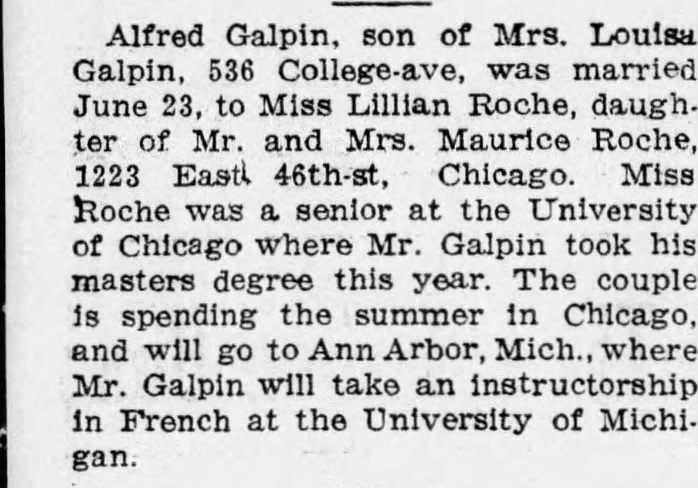
“The Ten-Cent Ivory Tower” (1946) by John Wilstach

[…] I happen to have published, as long ago as in the January, 1946, issue of Esquire, the first article about Lovecraft to appear in a general magazine. It was by John Wilstach, called “The Ten-Cent Ivory Tower,” and this is how it began:

“Enthusiasts for the work of Howard Phillips Lovecraft have become a literary cult. Highbrow critics pay tribute to him as a writer of horror tales. His devotees insist that his place is in a niche beside that of Edgar Allan Poe. Collectors scramble for his first editions. Yet, to one who has known literary booms and their nourishing, it is amazing that nothing has been done to acquaint the public with the personality of a man who was one of the most fantastic literary figures of modern times.”

Arnold Gingrich, “The greatest character H. P. Lovecraft ever created” in the Chicago Times, 2 Feb 1975

How do we know what we think we know about H. P. Lovecraft? Over the decades since Lovecraft’s death, many works have been published about Lovecraft—memoirs, recollections, biographies—and a great deal of his personal correspondence, autobiographical essays, and photographs. Diligent researchers have scoured archives for marriage certificates, wills, draft cards, city directories, and brief mentions in newspapers and amateur journals. The mass of data can be intimidating, difficult to sift through, and perhaps most especially interrogate.

When it comes to memoirs of Lovecraft, it can be especially difficult to sort out the veracity of various claims. Memories are tricky things, and can be skewed by age, distance, and emotion. Many of the recollections of Lovecraft contain matter which seems to be erroneous; not so much deliberately misleading as incomplete. Dates don’t line up, incidents don’t quite match with other accounts, and misunderstandings abound. These are typical problems in evaluating historical evidence…but there is an added wrinkle.

From the beginning, Lovecraft memoirs and biographies have been referential. So when W. Paul Cook wrote “In Memoriam: Howard Phillips Lovecraft—Recollections, Appreciations, Estimates” (1941), he included quotes from an amateur journalism piece on Lovecraft from 1919; when Winfield Townley Scott wrote the biographical essay “His Own Most Fantastic Creation” (1944), he drew material from Cook’s “In Memoriam”; when Sonia H. Davis wrote The Private Life of H. P. Lovecraft, she specifically spoke to several points in Cook’s memoir—and that’s one chain of references where the later author acknowledges drawing on the former. There are many works that borrow from other essays and memoirs on Lovecraft without acknowledgment so that you can have a number of works that have a superficial agreement—but might all be repeating the same legends and false information.

So how do you pick out fact from fiction in a Lovecraft memoir? Generally, the first task is to cross-reference the persons and events in the memoir with Lovecraft’s letters and, if possible, other sources to fix the dates and verify the contents as much as possible. There is a bit of a contradiction involved in this: if a memoir agreed 100% with all existing sources without any disagreement, it would be very easy to verify—but it wouldn’t be very useful, as there would be no information in there that wasn’t in other sources. What readers and scholars both like is new information, new data, some unique insight into Lovecraft’s life to add to our store of knowledge.

From this standpoint, “The Ten-Cent Ivory Tower” (1946) by John Wilstach seems at first promising: while Wilstach makes a number of errors about Lovecraft’s life and work (not uncommon in the memoirs), many details ring at least somewhat true (or at least familiar), and it contains some material not included anywhere else, including details of a meeting with Lovecraft and the gay poet Hart Crane in New York c.1925.

As background: John H. Wilstach (1890-1951) was a novelist and fairly prolific pulp-writer. He had some association with amateur journalism, publishing material in Driftwind and The Ghost, but he was mostly published in the Argosy, Top-Notch, and associated pulp magazines. His article “The Ten-Cent Ivory Tower” in Esquire was a very rare appearance in a “slick” magazine.

The first problem comes when trying to cross-reference dates and persons. Lovecraft and Crane did meet a couple of times, first in Cleveland in 1922 and later in New York City in 1924 and 1925. However, in no published letter does Lovecraft ever mention John Wilstach, nor is such a meeting with Crane and an unnamed third individual mentioned in Lovecraft’s diary for the period. For that matter, the published letters of Hart Crane, with their brief references to Lovecraft, don’t mention John Wilstach either. This individual, who claimed to be Lovecraft’s friend and to have met him several times in New York and Providence, RI, would appear to have fallen completely through the gaps in Lovecraft and Crane’s correspondence.

By itself, that might not be suspicious; Lovecraft’s correspondence for the New York period is not complete, and his meetings with Crane are not all well-recorded from either side. It is not inconceivable that there could be a meeting between Lovecraft, Crane, and a third man that both Lovecraft and Crane failed to record. In point of fact, there is another memoir that includes just such a meeting: Frank Belknap Long, Jr.’s “Some Random Memories of H. P. L.” published in Marginalia (1944), less than two years before Wilstach’s article. This brings us to the next problem.

Long’s memoir recounts a meeting between Lovecraft, Crane, Samuel Loveman, and himself on the street in New York in “the second year of [Lovecraft’s] New York phase”—Lovecraft had come to New York and married Sonia H. Greene at the beginning of March 1924, so the meeting would be post-March 1925. Long wrote:

Howard had never seemed more depressed—he was writing such lines as these: “My coming to New York had been a mistake; for whereas I had looked for poignant wonder and inspiration I found only a sense of horror and oppression. Instead of the poems I had hoped for there came only a shuddering blankness and ineffable loneliness.”

Frank Belknap Long, Jr., “Some Random Memories of H. P. L.” in Marginalia 335

The lines are part of the opening of Lovecraft’s story “He,” which was begun in August 1925, in general agreement with when Long says the meeting took place. In “The Ten-Cent Ivory Tower,” Wilstach wrote:

“Hart drew a battered manuscript from his pocket and I began reading:

“My coming to New York had been a mistake; for whereas I had looked for poignant wonder and inspiration in the teeming labyrinths of ancient streets…in the Cyclopean modern towers and pinnacles that rise blackly Babylonian under waning moons, I had found instead only a sense of horror and oppression which threatened to master, paralyze and annihilate me. . . .”

“Kinda turgid prose,” I waved my hand to stop him.

John Wilstach, “The Ten-Cent Ivory Tower” in Esquire Jan 1946, 83

What are the odds that Lovecraft and Hart Crane had not one but two otherwise unrecorded encounters, and that both of them would quote from the opening paragraphs to “He?” At this point, a scholar might be suspicious. Testing those suspicions would require comparing the content of “The Ten-Cent Ivory Tower” against the other sources available in 1946 when the piece was published. For the most part, this would mean Cook’s essay “In Memoriam” (1941), the first three Arkham House books regarding Lovecraft (The Outsider and Others (1939), Beyond the Wall of Sleep (1943), and Marginialia (1945)), the slim chapbook Rhode Island on Lovecraft (1945), August Derleth’s H. P. L.: A Memoir (1945), and some scattered essays, critical reviews, and articles, some of which were collected in Marginalia, such as the early version of Winfield Townley Scott’s biographical essay “His Own Most Fantastic Creation.” Crane’s letters mentioning Lovecraft would not be published until some years later.

As it turns out, most of the content in “The Ten-Cent Ivory Tower” could have been sourced directly from these existing sources; a copy of “In Memoriam” and Marginalia would have supplied nearly every “fact” (and much of the speculation) in Wilstach’s piece. Cook had not mentioned Hart Crane, but like Long he quoted from “He” to illustrate Lovecraft’s despair at the city he had come to detest. Wilstach acknowledged Cook in a way when he wrote:

W. Paul Cook tells me that Lovecraft made three poetry reputations with his rewrite method.

Unlike many Lovecraft enthusiasts, Cook insisted that, though his friend was a genius, one stout volume of stories, and another of letters, will provide his lasting work.

“Lovecraft has been compared to all the great masters of the macabre from Poet to James,” says Cook. “Only in spots can be found basis for comparison. A hint here and there of Poe—perhaps. A sign of Dunsany—possibly. Lovecraft identified his own influences as Dunsany, Poe, Arthur Machen, and Algernon Blackwood, rather than to Montague Rhode James. If we mention Machen and Blackwood we have about exhausted any color he may have unconsciously acquired from others. Since his advent, weird fiction has owed more to Lovecraft than Lovecraft owed to all the body of preceding writers.

“A friend once suggested the he stimulate dreams by means of drugs. Lovecraft exclaimed that if drugs would give him any worse dreams than he experienced without them, he would go mad. His dreams were his own It is unfair to call him equal to Poe, greater than Poe, or lacking in certain Poe qualities. Better, consider him as standing alone.”

That standing alone, for our friend, sounds very fair. And to judge him at all one must judge him as a writer, since he never was anything else. He never held any kind of a job, nor had the slightest inclination for any sport.

John Wilstach, “The Ten-Cent Ivory Tower” in Esquire Jan 1946, 160, 162

There is a bit of disingenuousness to this: while Wilstach is portraying this as something Cook told him personally, he is actually quoting directly from “In Memoriam” in the two middle paragraphs, and paraphrasing from there elsewhere. However, Cook and Wilstach were actually acquainted: Wilstach has an article in Cook’s amateur journals The Ghost #3 (May 1945) and #5 (Jul 1947). While neither article is about Lovecraft, their very presence confirms that the two men must have shared at least a correspondence. It’s not too much of a stretch to imagine that Cook himself was the source of the copy of “In Memoriam” that Wilstach must have had when writing “The Ten-Cent Ivory Tower.”

If a reader were to subtract from Wilstach’s memoir all the material that was directly attributable to Cook or a copy of Marginalia, the remaining details are few and rather weak. For example:

I learned that he had worked and roamed all night, slept since dawn, and had just breakfasted upon an orange.

John Wilstach, “The Ten-Cent Ivory Tower” in Esquire Jan 1946, 83

Lovecraft walking the streets of New York late at night, returning early in the morning, and sleeping late into the day are all believable; many letters support this behavior, and Cook and others commented on it. However, Lovecraft breaking his fast on an orange is unusual. While there are references to him consuming grapefruit when in Florida, citrus does not appear to have been a regular part of Lovecraft’s diet. One letter from his New York period shows how rare a treat fruit was to him:

[Sonia H. Lovecraft] left a lot of provisions here last week, including a lemon—so tonight I have been emulating W. V. Phillips in his vespertine glass of the citrick beverage.

H. P. Lovecraft to Lillian D. Clark, 22 Oct 1925, Letters to Family & Family Friends 1.457

Other little details face similar scrutiny. The errors become more glaring. The words Wilstach attributes to Lovecraft become less and less believable, even granting that twenty years had passed since they were set down. For example, during the apocryphal meeting with Crane, Wilstach wrote:

Crane muttered that I might tell something about the market.

“What have you been aiming at?” I asked him.

“I don’t know. Hart thinks my scripts should be typewritten.”

Well, it was unbelievable–he was actually, in person, the amateur who brought a manuscript rolled up, in handwriting, and tied with a string–and called back to find it still tied with the same string. Of course he had sought out the offices of Harper’s, Century, Scribner’s, while any tyro would know that his own chances were at the Munsey or Street & Smith’s fiction chains.

John Wilstach, “The Ten-Cent Ivory Tower” in Esquire Jan 1946, 83

It is unbelievable—because we know that while Lovecraft hated typing, he had learned after his first submissions of longhand manuscripts to editor Edwin Baird of Weird Tales that manuscripts had to be typed. Sonia H. Davis in her memoir of their marriage recalls how their honeymoon was spent in part with her reading out his manuscript for “Imprisoned with the Pharaohs” as Lovecraft laboriously typed it out on a rented machine. Wilstach’s repeated claim that Lovecraft never typed is patently not true—but is it the case of bad information, misremembering, or something worse?

Did John Wilstach just make it all up?

The Advocate-Messenger, 16 Dec 1945

Many magazines were published in the month before the cover date; newspaper journalists appeared to accept Wilstach’s piece at face value. Contemporary fans too appear to largely accept Wilstach’s article as accurate, with one writing:

In the few pages of the article he paints a very good word picture of Lovecraft as he knew him.

Jay Edwards, “Lovecraftiana” in Lethe #9 (Sep 1948)

Lovecraft’s surviving friends were less kind:

Winfield Townley Scott was fairly blunt:

Providence Sunday Journal, 17 Feb 1946

J. C. Henneberger wrote to Esquire saying the piece was flawed, and his letter was published in the March 1946 issue; Wilstach responded with a rebuttal in the June 1946 issue, which failed to correct any issues but cited W. Paul Cook’s piece on Lovecraft in The Ghost.

Time, no doubt, exposed more of the obvious flaws in Wilstach’s Esquire article to fans and would-be scholars alike. Lovecraft’s friend Robert Bloch would write:

My friend, the late John Wilstach, may or may not have met H.P.L. in the flesh; for the purposes of auctorial authority he laid claim to having done so in New York, during the Twenties, and penned an article for Esquire magazine, some years after H.P.L.’s death, entitled The Ten-Cent Ivory Tower.

I corresponded with Wilstach for some time before his own passing, and I can attest that his personal admiration for Lovecraft was unbounded. Nevertheless, he knowingly added his bit to the growing accumulation of Lovecraftiana which emphasizes only the legendary aspect, the “fantastic creation” rather than the whole man.

Robert Bloch, “Out of the Ivory Tower” in The Shuttered Room and Other Pieces (1959) 173

S. T. Joshi in H. P. Lovecraft: A Comprehensive Bibliography minces no words and simply calls Wilstach’s “The Ten-Cent Ivory Tower” fictitious. This makes a certain amount of sense: unlike “The Day He Met Lovecraft” (1972) by Lew Shaw, Wilstach was presumably paid for the article, and Esquire was a prominent enough market that publishing in it could raise a writer’s profile. There was a potential incentive for Wilstach to invent meetings and a friendship that maybe never took place.

When taken all together—the obvious errors, the borrowing from Cook, the absence of Wilstach from Lovecraft and Crane’s letters, the bits that just don’t line up—”The Ten-Cent Ivory Tower” is ultimately a poor source. Too much doesn’t fit with other facts from Lovecraft’s life, too much feels like a fictional narrative. Not useful to Lovecraft scholars or particularly interesting for fans today. The value of “The Ten-Cent Ivory Tower,” if any, is largely historiographical: this was a step toward a deeper understanding of and wider interest in Lovecraft and his work. While it might be a false step, how many thousands of readers encountered Lovecraft through this article in Esquire? Read about it in newspapers and fanzines? How many lives did Wilstach touch with this one piece?

Even though a memoir may sink out of sight and out of mind, in its passage it has left a mark on the world.

The January 1946 issue of Esquire containing “The Ten-Cent Ivory Tower” may be read for free online.


Thanks and appreciation to Dave Goudsward for his help and sanity check.

Bobby Derie is the author of Weird Talers: Essays on Robert E. Howard & Others (2019) and Sex and the Cthulhu Mythos (2014).

Deep Cuts in a Lovecraftian Vein uses Amazon Associate links. As an Amazon Associate I earn from qualifying purchases.
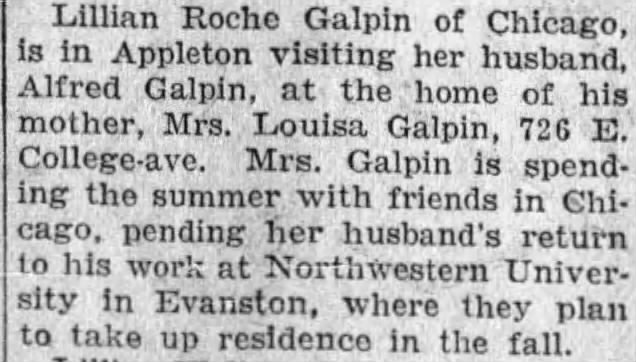
“The Day He Met Lovecraft” (1972) by Lew Shaw

Sir: As if it were yesterday, I remember meeting H. P. Lovecraft on the corner of Benefit Street and College Hill about noon on a very warm, sunny day.

College Hill is a rather steep climb, but on that day, a friend of mine and I, both attending Classical High at the time, were climbng up it oward the campus. At the base of College Hill on Canal Street, a new courthouse had been built. By taking the elevators to the fifth floor, we could have emerged on Benefit Street and eliminated the climb. However, despite the warm day, we walked.

As we got to Benefit Street, my friend greeted a passerby and introduced me to him. It was H. P. Lovecraft.

Lewis Shaw, “The Day He Met Lovecraft” in Brown Alumni Monthly 72, No. 7 (Apr 1972)

Memoirs and anecdotes of H. P. Lovecraft tend to come from familiar names: his correspondents, friends like Clifford & Muriel Eddy (The Gentleman from Angell Street), and his wife Sonia H. Greene (The Private Life of H. P. Lovecraft) most prominent among them. Even the few unfamiliar names like Dorothy Tilden Spoerl (“Cosmic Horror”) prove to have some connection to Lovecraft with a little digging. The very few memoirs that don’t have any provable connection to Lovecraft are thus a little suspect; they are extraordinary, and extraordinary claims demand extraordinary evidence to prove them.

The geography of Providence is real, and while Lovecraft often kept late hours, he was also more active during the warmer months and went out of doors to write in the sunlight. So at least some of the details given are plausible. Yet the most interesting part of Shaw’s account is the least believable:

On that sunny afternoon, H. P. Lovecraft told us the strange story he wrote about a hotel on Benefit Street, a building which stands there no longer.

Lovecraft had written a story about a true incident. At one time there was a young woman, a chambermaid in the hotel on Benefit Street, who left and married into wealth. Sometime afterward, she returned to visit the hotel as a guest. When she found herself discourteously treated and snubbed, she departed but put a “curse” on the hotel, on all those who had humiliated her, and on everything concerned with the hotel. In short order, ill luck apparently befell all and the hotel itself burned down. Furthermore, it had never been possible, somehow, for anyone to rebuild on the site. Even on the day H. P. Lovecraft told us the story, the place where the hotel had stood was still a vacant lot.

Lovecraft had finished the story and, without making his usual carbon copy, made only one draft, which he then mailed to the publisher. His story never appeared in print. It was lost in the mails.

Lewis Shaw, “The Day He Met Lovecraft” in Brown Alumni Monthly 72, No. 7 (Apr 1972)

Lovecraft is not known to have written any story about a cursed hotel, nor is there a mention of a Lew Shaw in his voluminous published letters. Scholars might be suspicious—an account of a lost Lovecraft story by an unfamiliar name, decades after Lovecraft’s death, during the early 70s when paperback publication was raising Lovecraft’s public profile? It sounds a bit too good to be true. S. T. Joshi certainly was not convinced:

There is much reason to suspect this entire account. In the first place, the story sounds like nothing Lovecraft would have written—the idea is hackneyed, and the protagonist would uncharacteristically have been a woman. Secondly, it is inconceivable that Lovecraft would have prepared a story without his usual two carbons. In the case of his essay on Roman architecture in late 1934, he wrote the piece by hand and sent it to Moe without typing it at all. Lew Shaw claims to have actually met Lovecraft on the street, in the company of a friend “who was interested in science-fiction” and knew Lovecraft; this might conceivably have been Kenneth Sterling, but Sterling never mentions this matter in either of his two memoirs. Shaw also claims to be of the Brown Class of 1941; but there is no one of that name in that class listed in the Brown University alumni directory. There is a Lewis A. Shaw in the Class of 1948, and a Lew Shaw who received a Ph.D. in 1975, but that is all. My feeling is that Lew Shaw (probably a pseudonym) is perpetrating a hoax.

S. T. Joshi, I Am Providence (2010) 2.1001

Joshi’s arguments are well-reasoned—but there are a few counter-arguments. While none of Lovecraft’s surviving letters mention a cursed hotel story, the account does not mention when the story was written or sent out; so it could conceivably fall into a gap in the correspondence, especially if the story was an early one or written for a revision client. A story set in Providence on Benefit St. isn’t out of the question either, “The Shunned House” was based on a real-life house (the Stephen Harris House, 135 Benefit Street). Likewise, while it would be uncharacteristic for Lovecraft to write a story with a woman protagonist, it was not unknown: “The Man of Stone” (1932) for Hazel Heald and “The Curse of Yig” (1929) for Zealia Bishop are primarily focused on female characters, or told in part from their perspectives, so it isn’t entirely out of the question. The postal service has lost many manuscripts and typescripts, so that by itself isn’t unbelievable either. The most obvious evidence of a hoax appears to be the absence of Lew Shaw himself…

Lewis Irwin Schwartz attended Classical High School in Providence, RI and graduated from Brown University in the class of 1941 (listed on page 72 of the Liber Brunensis for 1941). “Lew Shaw” was his stage name (“He Crashed The ‘Crewcuts’,” Brown Alumni Monthly Jan 1962). So, Joshi was correct that there was no “Lew Shaw” among the names in the Class of 1941, and that the name was a pseudonym—but didn’t have access to the bits of the puzzle that would show that Lew Shaw really did exist; those parts of the narrative at least match what we know of his background.

Joshi was also likely correct in identifying Shaw’s unnamed friend interested in science fiction as Kenneth Sterling. In Providence, Sterling attended Classical High School. They were both born in 1920, but Shaw was born in November, so he would probably have been a year behind Sterling. That gives us time as well: Sterling met Lovecraft in March 1935, and in the autumn of 1936 began attending Harvard, so the encounter with Lovecraft could only have happened in the summer of 1935 or 1936. Lovecraft doesn’t mention Shaw/Schwartz in the surviving letters to Kenneth Sterling, but on the other hand, those surviving passages are all excerpts, not complete letters, and there are gaps of months in the correspondence.

Kenneth Sterling wrote two memoirs about Lovecraft: “Lovecraft and Science” (1944) and “Caverns Measureless to Man” (1975). The first is slight, and doesn’t go into detail about how they met; the second is substantial, and more personal and biographical, going into considerable detail. Some of these jive with Shaw’s account:

During the academic year, excepting Christmas and spring recesses, the Science Club met weekly. That meant I had a schedule of one scientist a week—all, with two exceptions, from the Brown University faculty—and every time I walked up College Hill toward the Brown campus I visited Lovecraft for several hours. The total number of hours I conversed with him was huge.

Kenneth Sterling, “Caverns Measureless to Man” in Ave Atque Vale 406-407

This would have been the path Shaw describes. Sterling doesn’t mention the cursed hotel story; the one anecdote Sterling tells about bringing a friend to meet Lovecraft doesn’t jive either, since it was at a gathering in New York City. Again, this doesn’t immediately rule out Shaw’s story, but it doesn’t fully confirm it either. Shaw’s account is shifted from obvious hoax to doubtful…and there’s one final bit of evidence to consider: was there a hotel, cursed or not?

Newport Mercury, 21 Feb 1920

The Hotel Lorraine was on 18-28 Aborn Street, on the other side of the Providence River from Benefit Street, a geographic detail that Lovecraft would not have missed, but I’ve yet to find a notable hotel fire on Benefit St. during Lovecraft’s lifetime—and the 18 Aborn St. lot was still vacant according to the 1935 Providence City Directory, which does jive with Shaw’s story. No mention of a curse has turned up yet, but a lot of century-old folklore probably wasn’t written down, much yet made it onto the internet, where searches about cursed hotels in Providence point toward the Biltmore (now The Graduate).

The question then becomes: is this an error with Shaw’s memory, or did he fabricate the whole anecdote? The former might be understandable: a couple of decades can erode the details of many memories, or add details that weren’t there before. If the latter, why? As far as is known, Shaw never attempted to pass the anecdote off to a paying magazine or publisher or profit from the supposed association. It was of the nature of a brief letter to the editor to a college alumni journal about a local writer with ties to the college whose posthumous star had lately been on the rise and who had ties to Brown (Lovecraft’s papers are archived at the university library). In the Feb 1972 issue of Brown Alumni Monthly there had been an article on “Lovecraftmania at Brown” which probably suggested the letter.

Without any further evidence in Lovecraft’s letters to support the idea that the meeting actually took place, “The Day He Met Lovecraft” will have to remain classified as somewhere between doubtful and apocryphal. We have no absolute evidence that Shaw/Schwartz actually met Lovecraft, as there are no details in the incident that can be independently corroborated with sources that weren’t already published at the time. As Joshi noted, the plot sounds fairly hackneyed and un-Lovecraftian; not something he would write for himself, even with the local angle.

However, we also cannot entirely rule out that Shaw did not meet Lovecraft; we know Sterling had brought at least one friend to meet Lovecraft according to his later memoir. The plot of the apocryphal tale sounds un-Lovecraftian, but Lovecraft was willing to bend his artistic scruples a bit for revision clients. Is a lost revision story plausible? There’s evidence to suggest Lovecraft revised more stories than saw print, such as “In the Gulf of N’Logh” (193?) and “Lair of Fungous Death” (193?) by Hazel Heald, and his letters to Zealia Brown Reed Bishop. By 1935, Lovecraft had largely stopped revising fiction, but it is possible he was talking about an earlier story—Lovecraft didn’t discuss much of his revised fiction that didn’t get published.

While Lovecraft’s life is extraordinarily well documented by his letters, there are still little gaps in which things happened for which we have no record…and, perhaps, in which a clever fiction might be woven. Shaw’s account cannot be entirely ruled out, but neither can it be proved, unless more information comes to light.


Thanks and appreciation to Dave Goudsward for all of his help and assistance.

Bobby Derie is the author of Weird Talers: Essays on Robert E. Howard and Others and Sex and the Cthulhu Mythos.

Deep Cuts in a Lovecraftian Vein uses Amazon Associate links. As an Amazon Associate I earn from qualifying purchases.
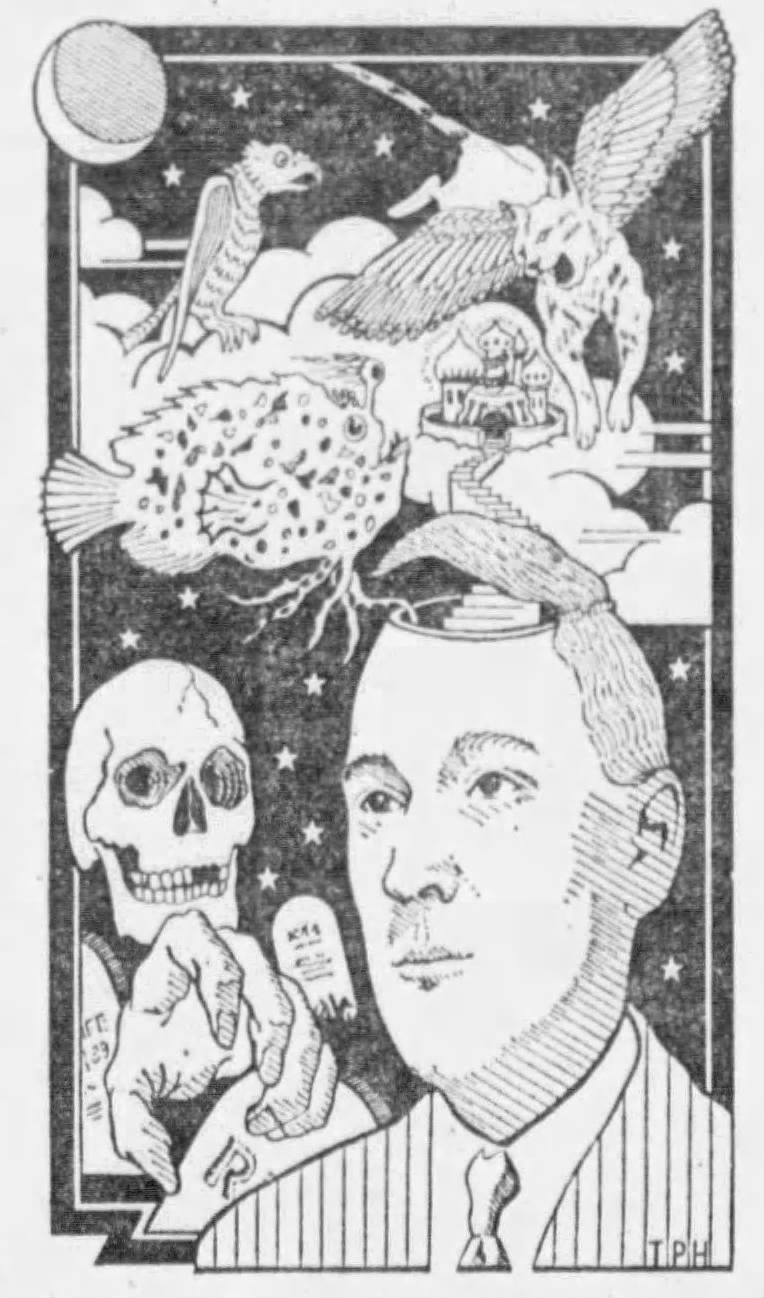
Her Letters To Lovecraft: Henriette Ziegfeld

“The Blind Prince,” by Henriette Ziegfeld, is an excellent juvenile tale involving a fairy story. The only serious objection is the undercurrent of adult comment which flows through the narrative. Particularly cynical is the closing sentence: “‘And here’s Mother,’ finished poor Auntie with a sigh of relief.” The ordinary fairy stories told to children are bits of actual Teutonic mythology, and should be related with a grave, absolute simplicity and naivete. However, as a psychological study of the typical childish auditor, the sketch as a whole is highly meritorious. We are inclined to wonder at the possible meaning of the strange word “alright,” which appears more than once in Miss Ziegfeld’s tale. It is certainly no part of our language, and if it be a corruption of “all right,” we must say that we fail to perceive why the correct expression could not have been used.

“Department of Public Criticism,” The United Amateur 15, no. 2 (Sep 1915), in Collected Essays 1.72

This was, as far as can be determined, Lovecraft’s first notice of the existence of Henriette Ziegfeld (1894-1976), an amateur journalist from Columbus, Ohio. According to census data, Henriette was the child of immigrant parents, her father Dutch and mother German, and one of 11 children that survived to be recorded. “The Blind Prince” was published in The Woodbee, the amateur journal of the Woodbee Press Club of Columbus, which was associated with the faction of the United Amateur Press Association that H. P. Lovecraft had joined the previous year.

Amateur journalism appears to have been something of a family affair for the Zeigfelds. Lovecraft’s editorials and a letter mention her brothers Arthur (1901-1971; CE 1.267, 302, 307-8) and Florenz (1888-1951; CE 1.88, 124; LRKO 87); a 1920 convention report also lists as voting members their siblings Emelie (Emily), Hilda, Alma, Oscar, and Mrs. Ziegfeld—presumably their mother, Pauline Ziegfeld (1859-1929). A 1921 accounting of officers of the Woodbees lists Arthur F. Ziegfeld as President and his sister Henriette as the Secretary and Treasurer (CE 1.267).

By coincidence, Florenz Ziegfeld shared his name with the impresario Florenz Ziegfeld, Jr. (1869-1932), who staged the famous revue Ziegfeld’s Follies (1906-1930s), which featured dozens of elaborately costumed showgirls (popularly called “Ziegfeld Girls”) in an elaborate musical and visual tableau. Inspired by the coincidence, in 1921 Arthur F. Ziegfeld began producing his own amateur journal titled Ziegfeld’s Follies.

The only surviving correspondence between the two is a single letter dated 6 Nov 1920 from Lovecraft to Ziegfeld, thanking the Woodbee Club for the generous donation of $25 toward the United Amateur Press Association’s fund for the publication of The United Amateur. Presumably, Henriette was acting as treasurer and had sent the money and an accompanying letter or note, so this was Lovecraft’s official thank-you. He also included an official notice in The United Amateur, which contains another relevant detail:

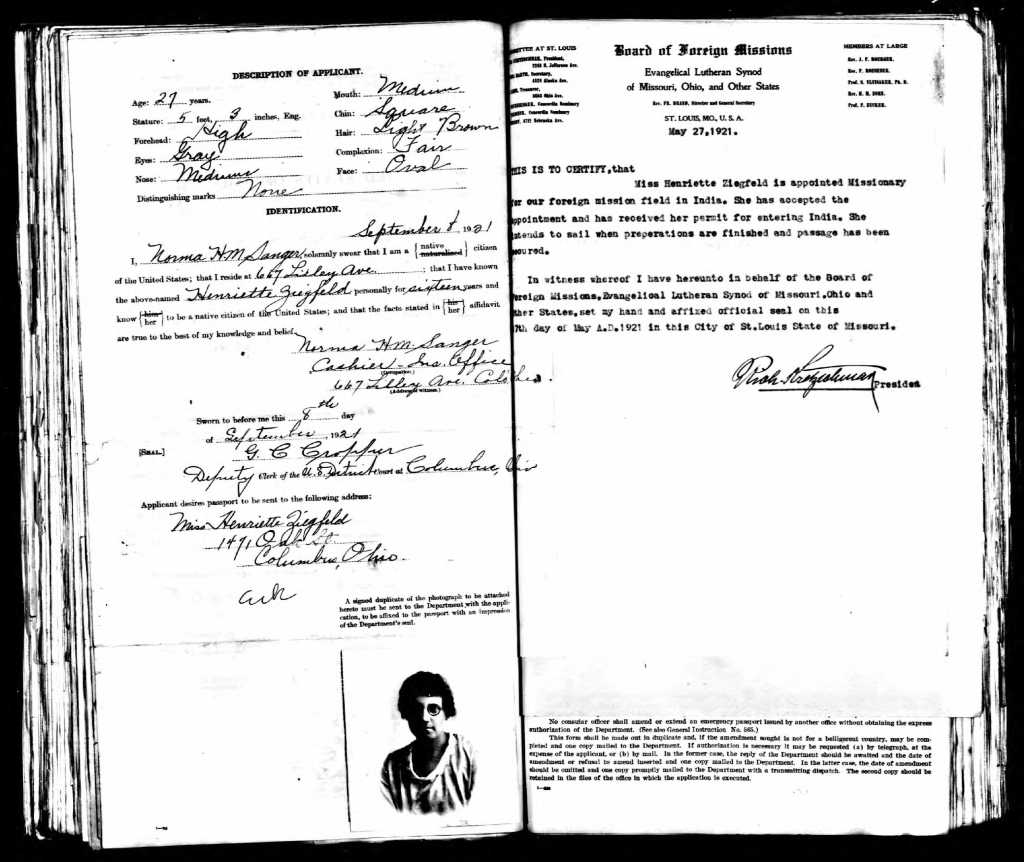
The Woodbee Club, now doubly prominent in amateurdom through its possession of both the Presidency and the Secretary-Treasurership, continues to be the most active of local bodies. On Labour Day, September 5, a successful corn roast was held on the Frazier Farm, whilst on September 24 the third annual rummage sale took place. Of the proceeds of the latter, $25.00 will be very generously donated to the Official Organ Fund in five-dollar instalments. The latest event is a farewell party to Miss Henriette Ziegfeld on the eve of her departure for India.

“News Notes,” The United Amateur 21, no. 1 (Sep 1921) in Collected Essays 1.300

Whether she replied is unknown; but possible—someone had to have informed Lovecraft that Henriette was leaving for a teaching mission in India, and in subsequent issues Lovecraft offered brief updates of her progress, so someone was keeping him appraised:

Miss Henriette Ziegfeld of the Woodbee Club on November 12 sailed for India, where she will be engaged in missionary work at Nagercoil, Travancore, in the southernmost part of the peninsula.

“News Notes,” The United Amateur 21, no. 2 (Nov 1921) in Collected Essays 1.303

On December 24th the Club received the pleasing news that Miss Henriette Ziegfeld had safely reached her destination in India, despite two threatened onslaughts of mal de mer during the voyage; onslaughts which were cleverly defeated by means of judicious pedestrianism.

“News Notes,” The United Amateur 21, no. 3 (Jan 1922) in Collected Essays 1.308
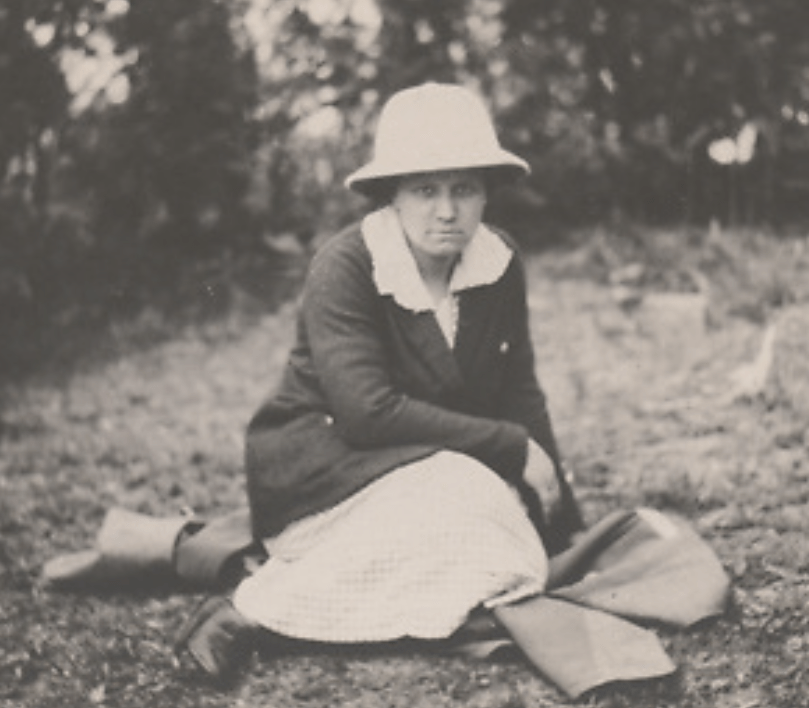
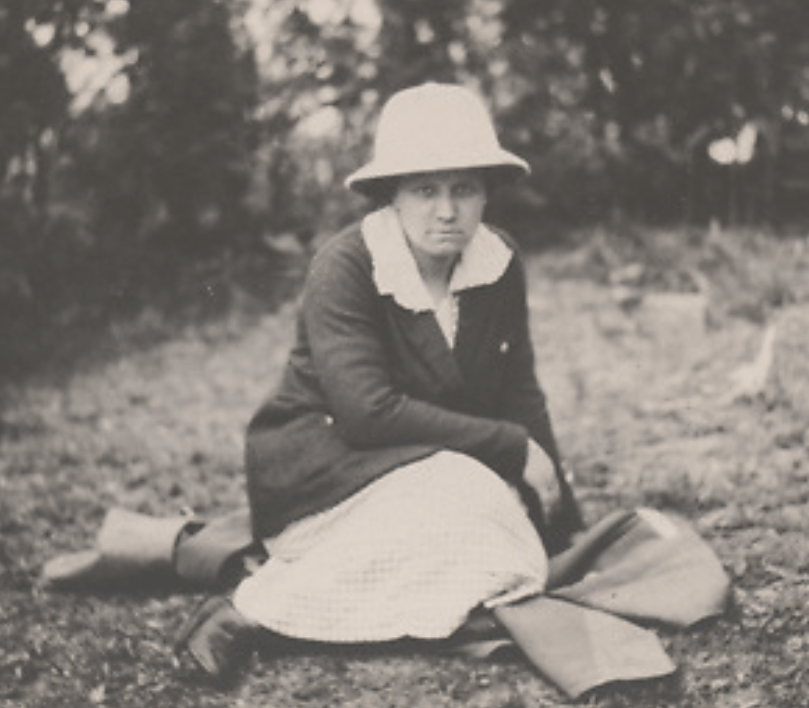
Henriette Ziegfeld’s 1921 passport photo
Henriette Ziegfeld in India, 1923, Concordia Historical Institute

That is the last word in Lovecraft’s amateur journalism essays or letters on Henriette Zeigfeld. No doubt a good example of many brief correspondences with women in various positions of amateur journalism, most of which do not survive.

The letter from Lovecraft to Henriette Ziegfeld has been published in Miscellaneous Letters (2022). While the date given on the letter is 1920, the notice of the $25 donation occurred in 1921—either the Woodbee Club made two such donations, or the letter is from 1921 and was misdated or mistranscribed.


Bobby Derie is the author of Weird Talers: Essays on Robert E. Howard and Others and Sex and the Cthulhu Mythos.

Deep Cuts in a Lovecraftian Vein uses Amazon Associate links. As an Amazon Associate I earn from qualifying purchases.
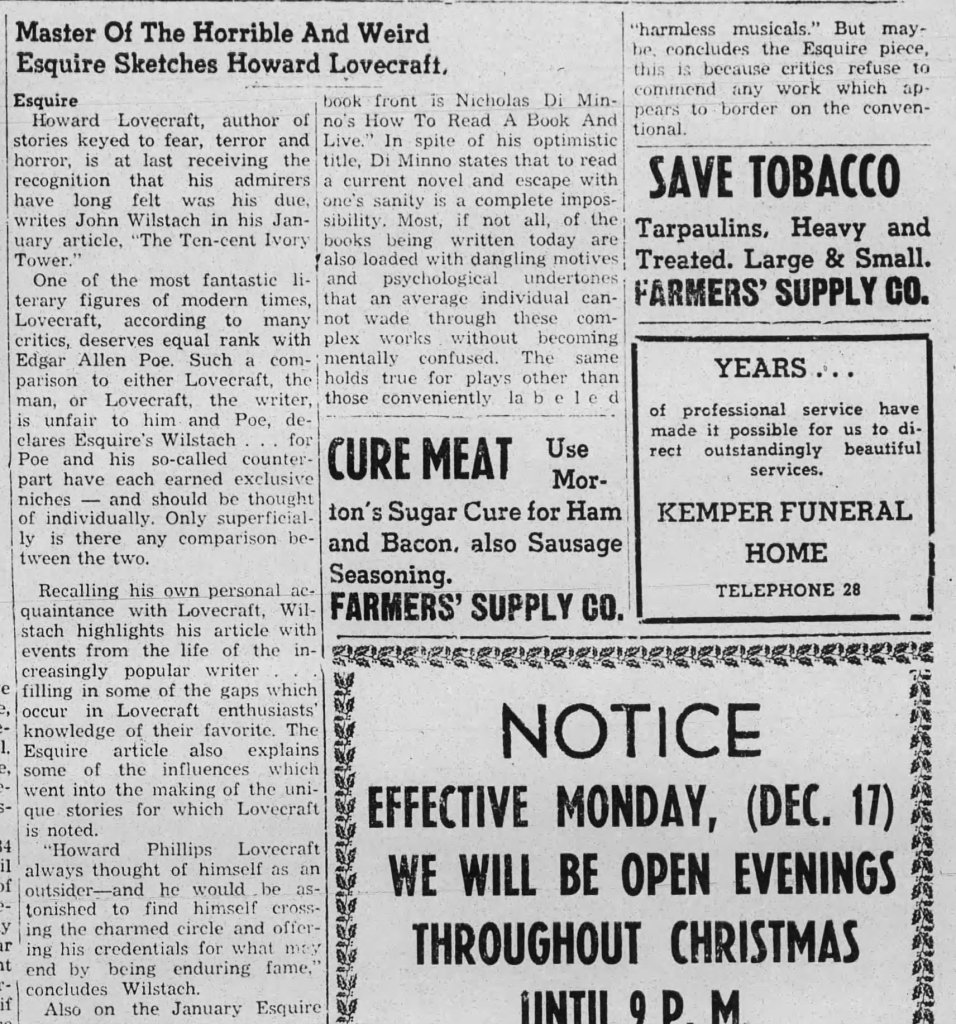
Her Letters To Lovecraft: Bernice Nette (Leach) Barlow

The present household consists of Barlow & his mother; & of a mother & son named Johnston, from Virginia, who keep house & attend to various duties.

H. P. Lovecraft to Duane W. Rimel, 13 May 1934, Letters to F. Lee Baldwin &c. 171

On the second of May 1934, a little after noon, H. P. Lovecraft stepped off the bus into the Florida afternoon sunshine. He was met there by Robert H. Barlow—a young correspondent whose letters had first reached him via Weird Tales three years earlier. Lovecraft was shocked to find his friend, with whom he would be staying for several weeks during his Florida vacation, to be only 16 years old.

No account is given, in letters or memoir, of Lovecraft meeting his teenage friend’s mother, Bernice Barlow. That is rather typical for everyone involved; she was there—cooking meals, driving the car, and no doubt a million other things—but during his two trips to DeLand in 1934 and 1935, Lovecraft’s letters focused on his adventures with Bobby Barlow, and R. H. Barlow’s memoirs of the time focus on Lovecraft. Little interest was given to the woman who quietly held everything together.

She was born Bernice Leach in Leavenworth, Kansas on 12 May 1884. Her father Adoniram (“Nide”) Bostwick Leach was a schoolteacher associated with the Leavenworth Business College; her mother Myrtilla Emlin (Parker) Leach appears to have been a homemaker. Bernice was the third of five children, with her older sisters Mabel (b. 1877) and Minnie (b. 1879), and younger brothers Parker (b. 1888) and Elwood (b. 1889). Absent any biographies, much of her life has to be pieced together with census data and newspaper accounts.

Bernice graduated high school and continued to live with her parents. At about age 20 or 21, she met Lt. Everett Darius Barlow (b. 1881), who was stationed at Fort Leavenworth. Newspaper accounts report on the visits of Everett and his brother Warren with the family. In 1905, it was announced that Everett and Bernice were engaged; on 21 December 1907, after he returned from his first stint in the Philippines, they were married. About ten months later, their son Everett Wayne Barlow was born, on 10 October 1908.

Life for a military wife is hard, and hardly documented. Census data shows that in the ensuing ten years the family moved from one posting to the next. When E. D. Barlow shipped out to France in April 1918, Bernice was heavily pregnant with their second child. She would be with relatives in Kansas when Robert Hayward Barlow was born on 18 May 1918. We can only guess at the unspoken decade between children—miscarriages, stillbirths, long absences from home might have all played their part.

When E. D. Barlow returned from the Great War, he was not the same. Without his medical records it can be difficult to get at the heart of the matter, but there are suggestions that he suffered from post-traumatic stress disorder, which made family life difficult. Lovecraft, whose own mother had suffered a breakdown before her death in 1921, was sympathetic:

Glad to hear your father is somewhat improved, & hope he can arrange to make his gains permanent. These nervous breakdowns are no joke; no matter how much they may inconvenience & depress the bystanders, they are a damned sight worse for the victim himself.

H. P. Lovecraft to R. H. Barlow, 19 Mar 1934, O Fortunate Floridian 114-115

In 1934 when Bernice Barlow and H. P. Lovecraft met they had been living pillar-to-post for about twenty-six years. With E. D. Barlow’s retirement at the rank of Lieutenant Colonel, the family ended up in rural Deland, Florida, far from family and friends. The house they built was named Dunrovin, and when Lovecraft arrived it was not quite finished. E. D. Barlow was up north, seeking medical treatment; Wayne Barlow had joined the army. So Bernice was on her own, with her precocious teenage son, and the Johnstons to help her out around the house. There is only one real anecdote about Lovecraft and Bernice from this period, but it bears repeating:

We had been in the habit of gathering blueberries beyond a shallow creek running between the swamp. Now HPL was no woodsman, as may be seen, and it was always perilous to trust his poor sight and lack of horse-sense. […] A series of recent rains had rendered the land very muddy, and the creek-channel had far overflowed, elaving a widespread thin puddle through which we had no choice but to wade. At the deeper creek had been placed a board to serve as bridge; and this was crossed without mishap. We spent some time gathering berries, but were through long before his dim eyes had attained even a half-basket. So we helped him filled it, and then all started home (Lovecraft, [Johnston], and myself). He lingered for possible other berried, and fearing just such a mishap, I stood uponthe makeshift bridge and called out its location to HPL.

[…] although I missed the scene myself (meeting him upstairs later) mother said he came in, soaking wet, and with most of his berries gone. In the God-awful rig he must have appeared very comical, thought it had also a tragic air about it. Promptly he said to mother, “I really must apologize!” She, amazed by this vision of a thoroughly wet HPL, said in surprise, “What for?”

He went on to explain he had been homeward bound when he came to the creek. Not seeing the board, he was abruptly pitched up to his neck into cold water. The berries were flung up and upset, most of them going on the slight current.

R. H. Barlow, “Memories of Lovecraft (1934)” in O Fortunate Floridian 406-407

The first visit lasted until 21 June 1934, about six weeks. Once in St. Augustine, Lovecraft posted a card to his gracious host:

It surely seems odd, after so many weeks of enjoyment of the Villa Barlovia’s hospitality, to be absent from the familiar table’s west end, & to forego the evening promenades on the moonlit Cassia road! I scarcely need reiterate how keen a delight my protracted visit gave me—& how profoundly I hope that I did not occasion any gortesque extremes of inconvenience with my wild hours & habitual absences from scnes of constructive endeavour.

H. P. Lovecraft to Bernice Barlow, postmarked 21 Jun 1934, O Fortunate Floridian 140

This is, as far as survives, the only piece of correspondence directly between Lovecraft and Bernice Barlow. No doubt any important news would have been shared through Lovecraft’s continuing correspondence with her son; there is a note on the envelope of one letter (“No news—Mother” O Fortunate Floridian 351) which may or may not be intended for HPL. Yet for the most part, Lovecraft seems to have quickly and firmly settled in as a family friend. On his 1935 visit, Lovecraft met Everett and Wayne Barlow and got along well with both of them.

Lovecraft did not write about the invisible stresses in the family—between husband and wife, father and son. R. H. Barlow would leave Florida for Kansas and the Kansas City Art Institute; Bernice and Everett would divorce in 1941. Yet Bernice was a survivor…she would continue to rebuild her life, and would eventually outlive her younger son. Perhaps in her waning years, back in Florida, she would remember the strange man who came to stay with them, how he would talk and the incident with the berries…and the card he sent, which she had kept for many years before it was donated with so many other documents of Lovecraft’s life to the John Hay Library.

The full text of Lovecraft’s postcard to Bernice Barlow is published in O Fortunate Floridian.


Bobby Derie is the author of Weird Talers: Essays on Robert E. Howard and Others and Sex and the Cthulhu Mythos.

Deep Cuts in a Lovecraftian Vein uses Amazon Associate links. As an Amazon Associate I earn from qualifying purchases.
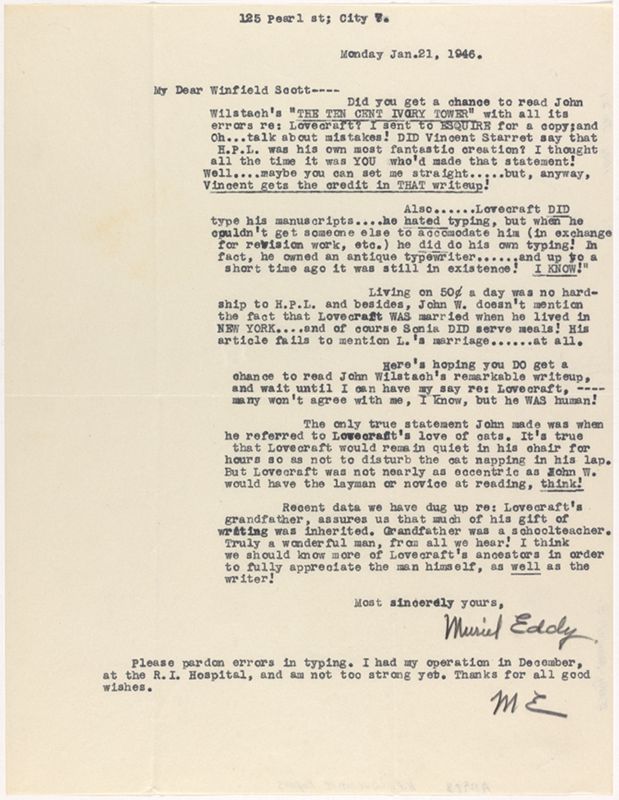
Deeper Cut: Spirits of Bigotry Past & Present: H. P. Lovecraft & J. K. Rowling

The main points of concern for the journalists seem to be the same as those of the bloggers; first and foremost they feel the need to express that Rowling is wrong and transphobic, but they also want to present their views on the debate of whether liking Harry Potter is still justifiable. The separating the art from the artist discussion is a crucial part of the majority of these articles. Several of the authors mention other controversial artists such as H.P. Lovecraft and analyse how these situations were handled.

Fleur Heiltjes, Alive but #Cancelled? The Public’s Response to the Controversial Author (2021) 31

In 1967, Roland Barthes published his essay “La Mort de l’Auteur” (“The Death of the Author”). This influential work of literary criticism examined the relationship between the author and their work; interest in a work often extends to interest in the author, and what we know about the author informs how we read a work. Many literary critics of H. P. Lovecraft have read elements from his own life in his fiction. Sometimes these readings are supported by primary evidence. Lovecraft himself noted in his letters that real-world personal experiences and places he had visited sometimes informed his fiction. For example:

[…] am now on the 22nd manuscript page of a long short story to be called “The Dunwich Horror”. The action takes place amongst the wild domed hills of the upper Miskatonic Valley, far northwest of Arkham, & is based on several old New England legends—one of which I heard only last month during my sojourn in Wilbraham.

H. P. Lovecraft to August Derleth, 4 Aug 1928, Essential Solitude 1.151

While evidence from Lovecraft’s letters has led to deeper insight into his life, his writing process, and his fiction, their wider publication beginning with the Selected Letters of H. P. Lovecraft from Arkham House also led to wider awareness of his personal prejudices. While many readers would have already picked up touches of early 20th-century prejudices in Lovecraft’s fiction and poetry, Lovecraft’s growing reputation as a writer, this reputation always cared with it the unpleasant reality that Lovecraft was racist, an antisemite, homophobic, etc. As his fame spread and his works entered the public domain, that same public—which has grown ever more diverse—has re-evaluated both Lovecraft and his work.

Lovecraft’s prejudices have become part of his legend. For many, they have become his defining feature: a popular image that is easy to turn to caricature and resistant to nuance and complexity. H. P. Lovecraft has become the ghost of a bigoted past who continues to haunt the readers of today. Unfortunately, the present is haunted by its own bigoted spirits.

Prejudice has become almost as indelible a part of the legend of British writer J. K. Rowling over the last few years as Lovecraft—and this has drawn comparison between the two. However, there are many important differences between the two writers, both in their specific circumstances and how they are read and interpreted by today’s audiences. Comparing two bigoted authors is fundamentally different from comparing apples to oranges…because to torture a metaphor, we have to take into account not just the fruit, but the trees they grow from, the orchard, the terroir: the historical context in which a living author and a dead one lived and worked.

H. P. Lovecraft, Spirit of a Bigoted Past

Howard Phillips Lovecraft (1890-1937) was a pulp writer and amateur journalist. Born into a moderately affluent white family in Providence, Rhode Island, a series of deaths in the family greatly reduced its fortunes. Lacking strong financial acumen or prospects, and with limited education, Lovecraft lived much of his life in genteel poverty, largely unknown outside of a small but ardent circle of admirers of pulp magazines such as Weird Tales, where many of his stories have published. After his death, his friends and fans continued to promote and publish his work, to expand and elaborate on the shared universe known as the Cthulhu Mythos he had devised, and to study his life and letters. Lovecraft’s fame is largely posthumous: he died a relatively obscure pulp author and reaped few financial rewards from his work. Awareness of his racism began to grow in the public consciousness after the publication of his Selected Letters (1965-1976) and especially Lovecraft: A Biography (1975) by L. Sprague de Camp, which not only emphasized his prejudices but contained the first widespread publication of the poem “On the Creation of Niggers,” which along with his childhood pet, the black cat Nigger-man, has become part of his legend, and usually the first things cited as examples of his racism.

It is not unusual that a white man in the early 20th century United States of America might be anti-immigrant, racist, homophobic, and misogynist: this was the era of the second Ku Klux Klan, Jim Crow, and the rise of the Nazi party. Women did not have the right to vote in the US until 18 August 1920, two days before Lovecraft’s thirtieth birthday. Lovecraft would never live to see the Holocaust, the Stonewall Riots, or the Civil Rights Movement. His prejudices reflect the period he lived in, and were widespread.

That is an explanation, not an excuse. Lovecraft may not have known better as a child or young adult, but as he entered his twenties he learned not everyone shared his bigotry. Relatively early in his writing career, Lovecraft received public pushback against his prejudices (“Not All Anglo-Saxons” (1911) by Herbert O’Hara Molineux, “Concerning the Conservative” (1915) by Charles D. Isaacson). After this censure, Lovecraft did not assay such public prejudice again, but kept his comments largely to himself and his close friends and family. While Lovecraft’s fiction shows the definite prejudices of his period, what we know of Lovecraft’s own prejudices comes almost exclusively from his thousands of letters and the memoirs of his friends and family, including his wife Sonia (The Private Life of H. P. Lovecraft (1985) by Sonia H. Davis, Her Letters To Lovecraft: Sonia H. Greene). Through his letters, we see Lovecraft at his best and worst, in his travels (Deeper Cut: Lovecraft in Chinatown, Deeper Cut: Lovecraft in Harlem) and in those he met and interacted with (Deeper Cut: Elsa Gidlow & Les Mouches Fantastiques, Deeper Cut: William Stanley Braithwaite).

While Lovecraft’s views on race were not static throughout his life, and were strongly influenced by his travels and meeting different people, he never overcame the prejudices of his earlier life.

Lovecraft’s influence on contemporary genre fiction cannot be overstated. He was a friend and encouragement to Robert E. Howard, Clark Ashton Smith, Robert Bloch, C. L. Moore, August Derleth, Donald A. Wollheim, James Blish, and many more; his fiction, down to the most obscure fragment, has been published and republished. The shared universe he created and encouraged has been enthusiastically embraced by fans, writers, artists, and game designers for decades, all the more so since his fiction has entered the public domain. Despite Lovecraft’s personal prejudices, his work has been embraced by and re-imagined by generations of women, BIPOC, and LGBTQ+ folk. Many works today specifically address the complex issues of Lovecraft’s personal prejudices (“The Ballad of Black Tom” (2016) by Victor LaValle, The City We Became (2020) by N. K. Jemisin)—Lovecraft has become a public domain character as much as Cthulhu, the spirit of a bigoted past who continues to haunt the present.

J. K. Rowling, Spirit of a Bigoted Present

Joanne Rowling (1965- ) was born in Yate, Gloucestershire, in the United Kingdom. From a fairly stolid middle-class background, she matriculated to university, graduated with a B.A. in French from the University of Exeter. Her first young adult novel Harry Potter and the Philosopher’s Stone (1997) reached widespread acclaim on publication, would be followed by more books, a series of critical and commercially successful films, merchandise, licensing deals, etc. Millions of copies of her books sold, and Rowling herself became a multimillionaire. With newfound wealth came both adulation and expectations: Rowling came under the public spotlight, her social media presence the subject of constant attention and criticism.

In the late 2010s, Rowling’s opposition to gender transition and transgender individuals have come increasingly to public attention and received commensurate criticism. (“JK Rowling criticised over ‘transphobic’ tweet about menstruation”). While Rowling attempted to justify her views with a self-serving essay (“J. K. Rowling Writes about Her Reasons for Speaking out on Sex and Gender Issues”), she has neither apologized nor corrected her views. Instead, Rowling doubled down on her prejudices and has used her wealth and public position to continue to discriminate against transgender individuals and support anti-trans activists (GLAAD Accountability Project: J. K. Rowling).

Rowling’s social media presence and the huge footprint of the Harry Potter media empire have led to swift and tremendous public awareness of her anti-trans prejudices. Individual friends and public figures, including those involved with the Harry Potter films, have variously distanced themselves from her views (Every Harry Potter actor who’s spoken out against J.K. Rowling) or supported her despite her prejudices (Ralph Fiennes defends JK Rowling). Her wealth and, perhaps, her ego have largely sheltered her from consequences: despite substantial efforts to publicly educate her on the realities of the discrimination that transgender people face, Rowling has doubled down on her beliefs in the face of criticism and opposition—and there isn’t much anyone can do about it.

There is a timing aspect to the rapid death spiral of Rowling’s reputation: her initial displays of transphobia have come at a time of increased awareness and vocal support from transgender people in the face of a rising of toxic political rhetoric against transgender people, especially in the United Kingdom (The Growth of the Anti-Transgender Movement in the United Kingdom, The Roots of Anti-Trans Feminism in the U.K.), but also internationally. The backlash against and support for Rowling and her transphobia have a strong partisan bias, even if that puts Rowling into proximity with individuals she herself wouldn’t want to be associated with (Putin cites J.K. Rowling as proof of West’s ‘cancel culture’) and her prejudices have had real-world consequences (How J. K. Rowling helped kill a proposed American LGBTQ civil rights law).

That’s the explanation, not an excuse. The terminal online nature of media in the 2010s and 2020s has made Rowling’s tweets a feeding frenzy of takes, trolls, and political posturing for those eager to stake out their space in the culture wars, but when you cut through the clickbait ledes, the facts are pretty straightforward. LGBTQ+ people in the United Kingdom had been fighting for and winning equal rights throughout Rowling’s life (Timeline of LGBT history in the United Kingdom). This isn’t a case where Rowling was raised a bigot in a terminally transphobic society and is repeating popular prejudices. Rowling’s transphobia is a marginal, reactionary pushback against legal recognition and protections that have taken LGBTQ folks decades of organized effort to secure. Instead of supporting the rights of women or working to protect the transgender fans of the Harry Potter series who have quite literally enriched her, Rowling has become one of the gilded bogeymen of Twitter, using her wealth and privilege to promote her agenda (If J. K. Rowling’s Women’s Shelter Turns Away Trans Women, Then It Isn’t Helping Women).

Comparison

When taken into comparison like that, the differences between Lovecraft and Rowling may seem a bit stark—but context is important. Lovecraft doesn’t get a pass just because his bigotry was commonplace while Rowling’s is marginal—but the fact that they had such different life experiences and reactions when confronted on their prejudice is in large part due to the 80-odd years between Lovecraft’s death and Rowling first hitting “like” on a transphobe’s tweet. We can only imagine what Lovecraft might have been like had he had Twitter, but we cannot know. As it is, lacking a broad public forum or the desire to push his prejudices in such a way, Lovecraft’s prejudices were kept mostly private until his death. The spotlight never shown on Lovecraft in that way during his life, except for the very briefest of moments; by the time fans could seriously react to his bigotry, Lovecraft was dead.

Rowling has the benefit of many things that never came to Lovecraft during his life—a university education, fame & fortune during her lifetime—but not a filter. Fame comes at its own cost, both in terms of loss of privacy and dealing with toxic fandom, but twenty-plus years since Harry Potter and the Philosopher’s Stone hit shelves, any sympathy for the online hate Rowling deals with has to be balanced against the fact that she’s had decades to manage and shape her media presence. When Rowling responded to allegations in 2020, she made a clear statement that she was not playing the victim:

I haven’t written this essay in the hope that anybody will get out a violin for me, not even a teeny-weeny one. I’m extraordinarily fortunate; I’m a survivor, certainly not a victim. I’ve only mentioned my past because, like every other human being on this planet, I have a complex backstory, which shapes my fears, my interests and my opinions. I never forget that inner complexity when I’m creating a fictional character and I certainly never forget it when it comes to trans people.

All I’m asking – all I want – is for similar empathy, similar understanding, to be extended to the many millions of women whose sole crime is wanting their concerns to be heard without receiving threats and abuse.

J.K. Rowling Writes about Her Reasons for Speaking out on Sex and Gender Issues

Rowling went on to oppose Scotland’s Gender Recognition Reform bill; apparently she supports every trans person’s right to live in any way that feels authentic and comfortable them as long as it doesn’t involve the right for trans women to call themselves women. Which is a step further than Lovecraft went. While it may be damning with faint praise to say Lovecraft never joined the KKK or participated in a lynching, the only physical act of discrimination Lovecraft’s ever performed was riding on a segregated bus. Then again, Lovecraft had no money. We have no idea what he would have done, if had the means to do it. Discrimination is a matter of means and opportunity as much as motivation.

Which is why comparison between H. P. Lovecraft and J. K. Rowling sort of falls apart. Both were and are prejudiced, respectively. Their exact prejudices are different (transgender identities was not understood in the same way during Lovecraft’s lifetime, see Deeper Cut: The Hormonal Lovecraft), as were the forms their discrimination took, and the arc of their reputation. It was shaped by the context of their lives and careers; if Lovecraft had been successful, perhaps he would have faced more backlash during his lifetime, if Rowling had died in poverty and Harry Potter kept alive by an ardent circle of fans, her tweets only published decades later, we wouldn’t be hearing about her transphobia until then. For want a nail, the main thing that Rowling and Lovecraft have in common, if you ignore all their circumstances, is that they were both bigoted.

So why compare Lovecraft & Rowling? Why not Rowling & Ernest Hemingway? In truth, Rowling has been compared to many other bigoted authors—and as with Lovecraft, the comparisons tend to be pretty superficial. When you get down to the level of what exactly people believed and how they expressed their discrimination, the divide between historical racism and contemporary racism, between letters in amateur journals which get seen by tens of people months later versus tweets that are seen by thousands of people in seconds—it gets difficult to make meaningful comparisons.

J. K. Rowling is no H. P. Lovecraft, and vice versa. Nor do we read them quite the same.

How We Read Bigoted Authors

Barthe’s “death of the author” is metaphorical as much as it is literal: while it might be polite to wait until the author is dead and can no longer comment on their work, in a broader perspective the point of “death of the author” is that the reader can engage with the text without knowing anything about the author, or without reference to the author’s comments and other writings outside of the text. For writers that might still have a pulse and some brain activity, it might be better to think of it in terms of “ignoring the author”—not with the intention of trying to enjoy an author with disagreeable views, but as a technique of literary criticism.

What readers generally can’t ignore is what they themselves bring to the text. Readers today don’t need to know anything about H. P. Lovecraft to figure out he was influenced by early 20th century views of race in stories like “Facts concerning the Late Arthur Jermyn and His Family.” However, readers today will also generally have very different interpretations of the concentration camps in “The Shadow over Innsmouth” than someone reading the story in the 1920s and 30s, and are more likely to draw comparisons with the Nazis and the Holocaust than with the enemy alien camps of World War I which Lovecraft was familiar with (“The Doom That Came to Innsmouth” (1999) by Brian McNaughton & “The Litany of Earth” (2014) by Ruthanna Emrys).

This is part of the reason Lovecraft’s reputation as a racist is so pronounced: if someone had a black cat named after a racial slur for Black people today, as Lovecraft did as a child, it would be so far beyond the pale of what is acceptable today that there would be accurately labeled as a terrible bigot. At the time when Lovecraft owned the cat, that wasn’t an uncommon name for a black pet. It is still an example of Lovecraft’s racism, but in context it is more accurately seen as part of a wider cultural trend in a society that is much more openly racist than today’s, not Lovecraft being uniquely racist. Which is generally why historical context is important when looking at dead authors and their fiction: looking at the past solely through the lens of contemporary experience often leads to misunderstanding and misrepresentation (presentism).

Given how prevalent racism, antisemitism, homophobia, sexism, etc. were in the past, it should come as no surprise that there were a lot of bigoted authors. With the combination of social progress and increases in scientific knowledge, it’s not surprising that there are a lot of authors who end up on the wrong side of history—and many of them, like Lovecraft, were fairly conservative or reactionary even with respect to the politics and social views of their own time. Even then, humans tend to be rather complex: for example, Lovecraft was a bigot in terms of race, but he was progressive in other areas such as opposition to censorship, support for women writers, and New Deal-style socialism.

Not that you would really know that from reading his stories. Those are aspects of Lovecraft’s personality and life that never found expression in his fiction. Readers who approach Lovecraft’s fiction with a “death of the author” perspective would be totally ignorant of anything except what is in the stories themselves. Which is why “death of the author” is a tool in the literary criticism toolbox, but not the only technique or approach that can or should be used to evaluate a work or body of work.

In practice, most readers bring something of their understanding of an author to the work when they read it. After the revelation of Marion Zimmer Bradley’s child sexual abuse, for instance, it can be very difficult not to look at her fiction through the lens of this knowledge (“Doom of the Thrice-Cursed” (1997) by Marion Zimmer Bradley). Readers aware of Lovecraft’s racism will tend to read his stories with an eye toward finding expressions of his racism in those stories—and they will find it, although their understanding may be imperfect without a broader understanding of the historical context of Lovecraft’s life and how and when and why he wrote the story.

Before the internet, it might have been said that posterity would probably not be kind to J. K. Rowling…but things are faster now, and Rowling is a bigger target. It took decades after he was dead for Lovecraft to become big enough to attract serious scholarship and opprobrium for his racism Fans, literary critics, and scholars were already combing over Rowling’s every word before she liked her first tweet. Unlike Lovecraft, Rowling is alive as the vultures pick her literary bones and the scholars root through her tweets like diviners making note of lesions on a bird’s liver. Rowling has a voice to push back against her critics in a way that Lovecraft can’t. She also has a possibility of redemption that Lovecraft will never have.

Cancel Culture

Minus some required reading for school or work, nobody has to read H. P. Lovecraft or J. K. Rowling. Their literary status is due to popularity, but there’s no compulsion behind it in the sense of the Nazis handing out copies of Mein Kampf. If you don’t want to read about Cthulhu or Harry Potter…why not change the channel, return the library book, block the tweets? Read or watch or listen to something else. Don’t give then your precious attention or your dollars.

For all the hyperbole that pundits, politicians, and celebrities have given to “cancel culture” and the terrible consequences that folks can suffer if held to account for being racist or sexist or anything else, the fundamental idea behind it is essentially laissez faire: you the consumer get to decide what to buy, what to read, etc. While social media can drum up semi-organized boycotts, share information about the intended subject of ostracism, or rally signatures for specific projects, for most people it’s a decision as simple, straightforward, and personal as putting an aluminum can in the recycling bin instead of the trash. The individual effort involved is generally minimal. It is only the net effect of thousands of potential customers en masse exercising their right to not buy what someone else is selling that has real impact on the bottom line.

In this way, cancel culture combines two effective techniques: social ostracism and economic impact. The massed body of the public cannot issue fines or enforce social mores, but they can refuse to buy Rowling’s books or ignore her until she either goes away or decides to act right. The latter is, perhaps, what a lot of people hope for: that an author who has said something stupid, bigoted, and offensive will realize the error of their ways, learn better, apologize, grow as a person, and make amends. Many fans want the moral values of the creator to match their content; there is a collective guilt that can be experienced in continuing to enjoy and support an author with bigoted views.

After all, the dollars, euros, and pounds spent on Harry Potter books, films, games, and merchandise are ultimately ending up in J. K. Rowling’s pocket…which she will then dip into to continue to support anti-LGBTQ+ legislation, or fund shelters that discriminate against trans women, or a shiny new smartphone to tweet with. Most readers don’t like to be complicit in supporting those authors who actively support their oppressors. When they are made aware of it, anyway.

The major problem of cancel culture is that the economic impact often has minimal visible effect, at least not for individuals as wealthy as J. K. Rowling is. She has already made her money, she’s already won. If nobody spent a penny on any Harry Potteriana for the rest of her life and she was stuck self-publishing verbose crime thrillers, she’s probably still set for life. Rowling’s wealth insulates her from pretty much any sort of collective economic action. If readers hope Rowling will one day shift her views and come to accept that trans women are women, it probably won’t be because there’s an economic impetus driving the decision.

H. P. Lovecraft cannot be canceled.

If nobody buys Lovecraft’s books, the text of them is still free on the internet. Lovecraft, for the most part, is in the public domain. Like it or not, he belongs to all of us now, and there is no way to stop people from using Lovecraft’s texts and his Mythos in pretty much any way they see fit. If the economic carrot-and-stick of cancel culture doesn’t work on Rowling because she’s too rich to care, it doesn’t work on Lovecraft because he’s broke and dead. No matter what nasty names Lovecraft is called on the internet, his moldering bones in Swan Point Cemetery, Providence, R.I. won’t rotate even a quarter-turn. No amount of urine on his grave can change his mind.

At least none of the money is going to benefit the prejudices Lovecraft had while he was alive.

The Two-Headed Ghost

Lovecraft cannot be canceled, but his legend continues—and his position in the literary firmament continues to be evaluated, debated, argued, as when his image was removed from the World Fantasy Award in 2015. Which is as it should be. While many readers identify strongly with works of fiction, the characters inside, and values they espouse—while many readers may idolize the creators of their favorite book, comic, game, or film—at the end of the day, H. P. Lovecraft and J. K. Rowling are just people. Very flawed, very complex human beings, not secular saints, and deserving of praise and sanction in response to their actions the same as anybody else.

Bigotry is a two-headed ghost. Janus-like, it stares into both the past and the future. Readers cannot escape the reality of historical racism, they can only choose how they themselves will approach the material and authors. If you as a reader cannot see past H. P. Lovecraft as anything but a bigot, cannot stand to read him, don’t want to hear about historical context or anything else that smacks of an excuse for racism, homophobia, antisemitism, etc.

Then don’t read him. Nobody can force you to. That’s your right. If you ever change your mind, Lovecraft will still be there. The dead cannot be hurt, only forgotten and misremembered.

Readers can also choose not to endorse and support bigots in the present. Unlike Lovecraft, J. K. Rowling can still change, can still look to the future—and she can already see, in the scholarly articles, the heartfelt fan letters, the opportunistic political punditry—what her legacy is shaping up to be. People may or may not read Harry Potter in a hundred years, but the question Rowling faces is how she herself will be remembered.

As long as an author breathes, they have a chance to change, to grow, to redeem themselves, at least a little. Lovecraft didn’t live long enough to do that; perhaps most don’t. The tide of history is relentless, and no one can see perfectly either where it came from or where it is going…nor force anyone else to change their minds. In the final analysis, all readers are faced with Barthes’ choice: how do they choose to approach the authors and their work? Because it is up to the readers to decide who they read, and how and why they read them. Whether to ignore their faults, or to accept them.


Bobby Derie is the author of Weird Talers: Essays on Robert E. Howard and Others and Sex and the Cthulhu Mythos.

Deep Cuts in a Lovecraftian Vein uses Amazon Associate links. As an Amazon Associate I earn from qualifying purchases.
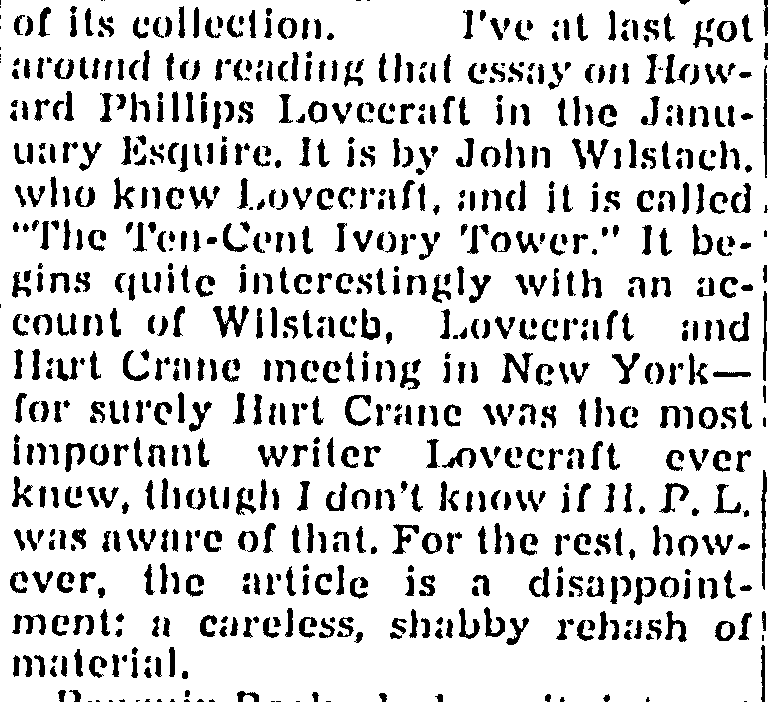
Her Telegram To Lovecraft: Wilhelmina Beatrice “Bess” Houdini

It seems that once Houdini was in Cairo with his wife on a non-professional pleasure trip, when his Arab guide became involved in a street fight with another Arab.

H. P. Lovecraft to Frank Belknap Long, 14 Feb 1924, Selected Letters 1.311-312

In January, 1910, I had finished a professional engagement in England and signed a contract for a tour of Australian theatres. A liberal time being allowed for the trip, I determined to make the most of it in the sort of travel which chiefly interests me; so accompanied by my wife I drifted pleasantly down the Continent and embarked at Marseilles on the P. & O. Steamer Malwa, bound for Port Said. From that point I proposed to visit the principal historical localities of lower Egypt before leaving finally for Australia.

H. P. Lovecraft, “Under the Pyramids”

Most readers overlook the fact that Bess Houdini was briefly a Lovecraftian character—even if mentioned only briefly and in passing. Yet she was there from the beginning of Lovecraft’s relationship with Harry Houdini, and she would be there at the end, her final word a brief telegram.

Wilhelmina Beatrice Rahner was born in Brooklyn in 1876, the daughter of Roman Catholic German immigrants. Her father died when she was young, and she worked at a brother-in-law’s tailor shop, then as a seamstress in a traveling circus, where she joined a song-and-dance act called the Floral Sisters with the name Bess Raymond. In 1894, stage magician Theodore “Dash” Hardeen of the Brothers Houdini act, arranged a blind date with two of the sisters for himself and his brother Erich…better known by his stage name, Harry Houdini. After a very brief courtship, Bess and Harry would be married. From then on, she would be his partner and assistant in his magical act as well as his wife (The Secret Life of Houdini 30-31).

Bess was no doubt Houdini’s assistant when H. P. Lovecraft first saw the Handcuff King on stage circa 1898, and she would have been on stage 27 years later when Howard and Sonia Lovecraft saw them at the Hippodrome in New York in 1925 (Letters to Family & Family Friends 1.238). For thirty-one years she had accompanied Harry Houdini around the world and been his wife and partner. By 1925, their act would have been as smoothly polished as it would ever be, and Lovecraft appears to have appreciated it. While there is no account of H. P. Lovecraft meeting Bess at this time, he did meet her husband at the show and visited the Houdini house in New York (Letters to Family & Family Friends 1.249). If Bess was present at this meeting, Lovecraft makes no mention of it.

In October 1926, the Houdinis performed at the Providence Opera House. Lovecraft attended the show, and afterward had a meal with both Harry Houdini and Bess. It may well have been their only meeting. Muriel Eddy provided an account of the trip:

When Harry Houdini came to Providence for the last time, we made up a theater party and attended the performance. It was a big production, and his wife Beatrice assisted him in his magic tricks and illusions. A niece, Julia, also was an assistant on the stage.

After the show, Houdini suggested that we go to lunch at a Waldorf restaurant. It was very late, and at the midnight hour we sat at a long table together, with Beatrice Houdini’s pet parrot perched demurely on her shoulder. Lovecraft got quite a kick out of watching the parrot…named Lori…sip tea from a spoon and nibble daintly at toast held by his polite mistress!

I remember that H.P. L. ordered half a cantalope filled with vanilla ice cream, and a cup of coffee. He was in great spirits and bubbled over with good humor, talking a blue streak about everything under the sun. Harry Houdini gazed at him admiringly. I am sure he liked H.P.L. as much as almost everybody did who had a chance to study and know him.

Muriel E. Eddy, The Gentleman from Angell Street 21-22

Whether Lovecraft and Bess exchanged more than two words to each other, we may never know—but there was another consequence of that night:

Shortly after meeting with Eddy and Lovecraft, Bess was stricken with a non-specific form of poisoning, probably from food. Houdini immediately summoned Sophie Rosenblatt, a nurse who had worked fro the family previously; but by Friday, October 7, Bess’s condition had deteriorated so badly that Houdini stayed up all night comforting her. She improved a little the next day, which was the last day of the run, so Houdini arranged for her and Sophie to leave straight for Albany, the next tour stop, while he took a lat night train to New York, where he had meetings scheduled for Sunday.

William Kalush & Harry Sloman, The Secret Life of Houdini 502

At some point in October after he had met with the Houdinis, Lovecraft must have written to Harry Houdini in Detroit about a proposed work C. M. Eddy, Jr. and himself had been working on, The Cancer of Superstition. The answer, however, did not come via letter, not did it come from Harry Houdini himself.

DETROIT MICH 409P
H P LOVECRAFT
10 BARNES ST PROVIDENCE RI

HOUDINI SERIOUSLY ILL STOP PLEASE HOLD MANUSCRIPT UNTIL FURTHER NOTICE
STOP ADVISE EDDY STOP

MRS HARRY HOUDINI

Telegram from Bess Houdini to H. P. Lovecraft, 28 Oct 1926, Miscellaneous Letters 168
A photograph of this telegram is reproduced in The Cancer of Superstition (2025) 18

During his final days, Harry Houdini was still traveling and performing, but he was suffering from a broken ankle and acute appendicitis, which would swiftly prove fatal. Harry Houdini would die on 31 October 1926. As his widow, Bess was now in charge of Harry Houdini’s remaining business, which included unfinished work by C. M. Eddy, Jr.:

I haven’t yet attempted the task of convincing the Houdini heirs that the world needs his posthumous collected works in the best Georgian manner, but honest Eddy has gone the length of trying to collect the jack on an article for which the departed did not give his final & conclusive authorization, & which I consequently advised him not to write at the time! Well–I hope he gets it, for otherwise I shan’t feel justified in collecting the price–in typing labour–of my aid on the text in question.

H. P. Lovecraft to James F. Morton, 17 Nov 1926, Letters to James F. Morton 122

There is no record of Bess’s response, but given that nothing further appears to have come of this, it is clear that with Harry Houdini gone she declined to pursue the project. Lovecraft does not mention any further communication with Bess Houdini; while it is possible he sent her a note of condolence on her husband’s death, or that they exchanged a final note on The Cancer of Superstition, if that is the case those letters do not survive. All we have is a single telegram, the text of which is reproduced in Lovecraft’s Miscellaneous Letters.

For more on Harry Houdini’s relationship with H. P. Lovecraft, see Deeper Cut: Houdini & Weird Tales.


Bobby Derie is the author of Weird Talers: Essays on Robert E. Howard and Others and Sex and the Cthulhu Mythos.

Deep Cuts in a Lovecraftian Vein uses Amazon Associate links. As an Amazon Associate I earn from qualifying purchases.
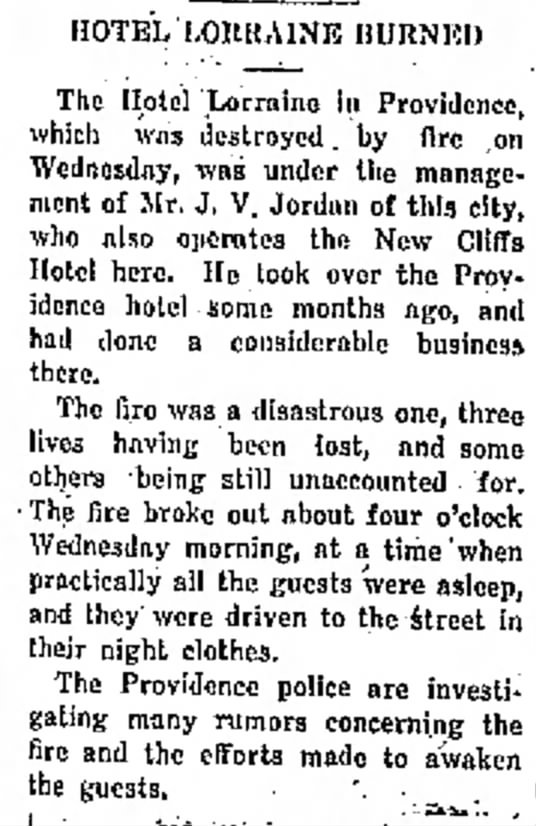
Howard, Mon Amour (2018) by Martine Chifflot

Sonia (Assise en train d’écrire, elle s’interrompt, levant la tête et s’exprimant a voix haute):
Howard est mort.
Quelle tristesse!

Et moi, qui ne suis plus tout à fait sa veuve…
Divorcée, remariée, je ne peux plus être sa veuve officielle.
Sonia (Sitting down to write, she interrupts herself, raises her head and speaks out loud):
Howard is dead.
What sadness!

And I, who am not quite his widow anymore…
Divorced, remarried, I can no longer be his widow, officially.
Howard, Mon Amour 19English translation
Scene 1

Ever since the publication of The Private Life of H. P. Lovecraft (1985) by Sonia H. Davis in various recensions, there has been great interest in the marriage of H. P. Lovecraft, and in his wife Sonia Haft Greene, who remarried in 1936 and became Sonia H. Davis. As the story of their marriage has unfolded in letters and memoirs, the narrative possibilities have struck several writers. Richard Lupoff included Sonia as a character in Lovecraft’s Book (1985), later expanded or restored as Marblehead (2015), to give one prominent example. Readers and scholars who have traced the story of their meeting, their work on the Rainbow, their collaborations “The Horror at Martin’s Beach” (1923), “Four O’Clock” (1949), Alcestis: A Play (1985), and “European Glimpses” (1988), and their final separation all speak to a dramatic narrative—some might say a tragedy, for all human lives tend toward tragedy at the end.

Howard, Mon Amour is a short drama in 23 scenes by Martine Chifflot. The scene is 1946; their mutual friend Wheeler Dryden has informed Sonia of the death of H. P. Lovecraft, nearly a decade prior. The two had fallen out of touch, and apparently contact had been broken prior to her third and final marriage to Nathaniel A. Davis. Alone while writing, the phantom of Lovecraft appears…whether his ghost, or a hallucination born of her grief, never quite clear. It doesn’t really matter.

Howard: Je suis ici, Sonia; je resterai aussi longtemps que tu vivras. Les choses là-bas ne sont pas tout à fait semblables à ce que l’on raconte, à ce que, moi-même, j’en ai dit et je ne suis pas autorisé à en parler mais il a été permis que je revienne… pour toi, comme pour t’accompagner, comme pour te remercier.Howard: I am here, Sonia; I will stay as long as you live. Things down there are not quite the same as we are told, as I myself have said, and I am not allowed to talk about them, but I have been allowed to come back… for you, as if to accompany you, as if to thank you.
Howard, Mon Amour 22English translation
Scene 2

The French found an early appreciation for Lovecraft, and not just his fiction but many of his letters and associated biographical materials have been translated into French, including Sonia’s memoir. “Un mari nommé H.P.L.” (“A Husband Named H.P.L.” in Lovecraft (Robert Laffront, 1991) appears to have been Chifflot’s main source of data on the marriage, and Chifflot’s drama is fairly accurate to the facts. She may put words into her character’s mouths, but the events play out largely in accordance with Sonia’s account of the marriage, warts and all; the drama of the scenes is a little heightened in the telling, the events more emotional and detailed, but also emotionally true to how Sonia told them herself.

Tante Lilian (ou Sonia L’imitant), apres un moment de silence):
Chère Sonia, nous vous remercions mais cela est tout bonnement impossible.

Voyez-vous, Howard et nous-mêmes sommes des Phillips et nous ne pouvons envisager que l’épouse de Howard doive traviller pour vivre à Providence. Cela constitue une sort de déshonneur que nouse ne pouvons tolérer pour Howard et pour nous-mêmes.

Non. L’épouse de Howard Phillips Lovecraft no peut entretenir son ménage, ni ses tantes. C’est le devoir du mari de subvenir aux besoins familiaux et Howard a joué de malchance à cet égard. Nous connaissons, tout comme vous, les grandes qualités de Howard et nouse aimerions vous voir réunis mais cela ne se peut dans de telles conditions. Vous nous entretiendriez et nous seriouns à votre charge. Ce serait une honte pour nous malgré votre générosité. Cela ne se peut, chère Madame… et nous devrons tous souffrir en silence.
Aunt Lilian (or Sonia imitating her), after a moment of silence):
Dear Sonia, we thank you but this is simply impossible.

You see, we and Howard are Phillips and we cannot contemplate Howard’s wife having to work to live in Providence. This is a dishonor that we cannot tolerate for Howard and ourselves.


No. The wife of Howard Phillips Lovecraft cannot support his household, nor his aunts. It is the husband’s duty to provide for his family, and Howard has been unfortunate in this regard. We know, as you do, the great qualities of Howard and we would like to see you reunited, but it is not possible under these conditions. You would be supporting us and we would be in your charge. It would be a shame for us despite your generosity. It cannot be, dear Madame… and we must all suffer in silence.
Howard, Mon Amour 64English translation
Scene 16

Most of the scenes are monologues, recalling some incident from their married lives; the more interesting scenes are dialogues, where Howard and Sonia actually have a bit of back-and-forth; other characters like Howard’s aunts Lillian and Annie have brief roles, and as suggested, could simply be retold by the actress playing Sonia doing their parts. It is a work meant to be not just read, but acted out; Chifflot herself has performed on stage in the role of Sonia:

Howard, Mon Amour. Scène 10. Sebastien Ciesielski et Martine Chifflot

For all the research that went in Howard, Mon Amour, there are a few idiosyncrasies that go beyond the facts. Little attention is given to Sonia’s Jewish identity or how Howard’s prejudices and antisemitism spiked during his stressful stay in New York, for example. There is an odd moment where Sonia believes that Howard’s correspondence with his revision client Zealia Bishop caused a “cooling” (refroidissement) of their relationship; and another where Sonia is said to dislike Crowley (in reality, Sonia and Aleister Crowley never met, it’s all an internet hoax). Which can all be explained as dramatic license rather than error or intentional misdirection. These are things that might stand out to a Lovecraft scholar with a penchant for pedantry more than a Lovecraft fan.

The emotional core of the work is true, however. In many ways, Sonia did find herself haunted by Lovecraft’s ghost for the rest of her life; his legacy clung to her as people asked her about the marriage, and many of her surviving letters survive because they are about Howard or addressed to his friends like August Derleth and Samuel Loveman. In Howard, Mon Amour, Sonia seems to accept that…and that she still loves him. Which, perhaps, is true. It was never love that got in the way of their relationship, but everything else around them: her health, his aunts, their finances, a difference in wants and needs, what they were and were not willing to do.

Howard, Mon Amour by Martine Chifflot was published in 2018 by L’Aigle Botté, and has been performed on stage as “Lovecraft, Mon Amour.” An English translation by Claude Antony has been announced:


Bobby Derie is the author of Weird Talers: Essays on Robert E. Howard & Others (2019) and Sex and the Cthulhu Mythos (2014).

Deeper Cut: Lovecraft in Chinatown

Chinatown [in San Francisco] must still be a fascinating & mysterious place, even though old-timers say it is merely a pallid echo of the original pre-1906 quarter. The only Chinatowns I’ve seen are those in Prov., Boston, & N.Y.—the latter the most picturesque of the three.

H. P. Lovecraft to E. Hoffmann Price, 14 Mar 1935, Letters to E. Hoffmann Price 170

For his first thirty years, H. P. Lovecraft seldom left his native Providence, Rhode Island. All of his travels, his visits with friends, and to ethnic enclaves in different cities—as well as his marriage and all of his professionally-published fiction—happened in the last seventeen years of his life. The vast majority of character growth, exposure to different cultures, and challenges to Lovecraft’s prejudices happened in the final third of his existence. Which is why it is interesting to see what Lovecraft writes about various ethnic neighborhoods and enclaves he visited, including the few Chinatowns he visited on his travels.

Despite the name, “Chinatown” is a bit of a misnomer. In the 19th century, especially after the end of slavery, employers in the United States began to import cheap labor from Asia—including the Empire of China, Japan, the British Raj and other central and south Asian countries, Southeast Asian nations like Formosa (Taiwan) and Siam (Thailand), and the Indonesian archipelago. All of these “Asians” came to the United States at different times and places—and because of their different appearance, cultures, religions, language, and perceived economic competition, faced tremendous discrimination and even violence from the American citizens. Like many other immigrants, they tended to be poor and poorly paid, and settled in the cheapest or least desired neighborhoods and ghettoes—which in time came to include Asian-owned shops, restaurants, and other businesses; as well as schools, cemeteries, temples, and cultural centers or benevolent societies—and became, in effect, small organic communities operating alongside and within larger and predominantly white American cities.

While commonly called “Chinatowns” because the bulk of the immigrant population and their Asian-American descendants were perceived to be Chinese, these communities were not usually homogenous, but included many different nationalities and ethnicities, and the “flavor” of a given Chinatown could vary considerably from city-to-city—even the preferred dialect of the Chinese language and the style of Americanized Chinese food would often reflect the province(s) where the majority of the immigrants had emigrated from.

Like other ethnic and linguistic minorities in the United States, Asian immigrants faced social, economic, and legal discrimination. The 1882 Chinese Exclusion Act and the Immigration Act of 1917 (the “Asiatic Barred Zone Act”) effectively halted immigration from Asia to the United States for decades; legal rules like Lum vRice, 275 U.S. 78 (1927) confirmed Asian-Americans as “colored” for the purposes of race laws, often prevented mixed-race marriages, segregating where Asian-Americans could work, live, and go to school. The Massie Case in 1932 highlights how prejudice against Asians could be deadly violent—and how socially accepted such violence was.

In the face of restricted immigration and ongoing discrimination, many Chinatowns shrank or ceased to exist altogether, the populations moving on—yet others thrived and grew, and still exist today, the largest existing both as vibrant communities still absorbing generations of immigrants and perhaps increasingly as tourist attractions. Yet in their endurance, they made their mark on American culture as well; the Asian architecture and festivals and the rags-to-riches stories of hardworking Asian immigrants struggling for their success became a part of the mythos of their cities. There was a dark side to this mythos too: Yellow Menace fears of enemy aliens, criminal gangs, opium dens, and tong wars filled the newspapers, dime novels, and eventually the pulps. It was not without reason that Robert E. Howard made his weird detective Steve Harrison’s beat Chinatown—the Texan was playing to the expectations of a pulp audience that had been raised to think of these ethnic enclaves in terms of stereotypes and prejudice.

Lovecraft, who visited Chinatowns in the 1920s and 30s, was aware of all of this—and his comments have to be understood as an outsider, a tourist who wants a glimpse of the exotic East he had long held in his imagination but never actually had the chance to visit.

Chinatown was as close to Asia as Lovecraft would ever get.

Providence

There were two small Chinatowns in Providence, Rhode Island: a small one centered around Burrill St. that burned down in 1906, and a newer one centered on Empire Street which was torn down in 1951 as the city extended the street and expanded it, not coincidentally razing the old buildings and displacing the small community there. While Lovecraft could have theoretically visited both during his lifetime, he was no doubt more familiar with the small community centered around Empire St.—as Empire intersects with Westminster St., where the Chin Lee Co. First Class Chop Sooey and American Restaurant stood, an establishment where Lovecraft and his aunt sometimes took their meals:

Christmas, thank Pegāna, was decently mild—& I succeeded in dragging my elder aunt down town for the first time in a year & a half—to partake of an old-time Christmas feast with plum pudding and all, at the hospitable refctory of that staunch upholder of ancient English tradition—Chin Lee, Esq., (a very distant eastern connexion—phonetically at least—of the main Virginia line of Stratford & Arlington!) who so liberally stocked you with chow mein at our little pre-Maxfield supper last June.

H. P. Lovecraft to James F. Morton, 27 Dec 1929, Letters to James F. Morton 212

“Chin Lee” (Chin Dong Goon) was the proprietor of the restaurant that was in or near the Providence Chinatown; an early menu survives showing largely American and French dishes, but this was probably for white customers. His daughter Grace Lee Boggs reports she was born in the family apartment above that restaurant.

Regrettably, Lovecraft doesn’t offer any more descriptive details of the Providence Chinatown, although he must have passed through or near it several times during his life. Being so relatively small both geographically and in terms of population, it probably lacked much in the way of distinctive architecture or tourist draw, although one can easily imagine Lovecraft taking out-of-towners for a stroll down Empire St. and making the turn at Westminster St., in case they wanted some chow mein or chop suey.

Boston

We threaded the colonial lanes of Beacon Hill, Chapel, Old Corner, Old South Church, old State House, Faneuil Hall, Paul Revere’s house, (built 1676) birthplace of Mortonius’ grandfather, old North Church, hellish colonial byways of the North End, (the scene of “Pickman’s Model”—I was heartbroken to find the actual alley & house of the tale utterly demolished; a whole crooked line of buildings having been torn down) & the relatively commonplace Chinatown along Beach St.

H. P. Lovecraft to Lillian D. Clark, 17 Jul 1927, Letters to Family & Family Friends 2.609

Boston was an international port for centuries, but the sprinkling of Chinese and other Asian nationals only appears to have formed an ethnic enclave in the 1870s, after a number of immigrants were brought over from California to Massachusetts as cheap labor. Despite discrimination, the Boston Chinatown grew and flourished, and was the largest New England Chinatown outside of New York during Lovecraft’s lifetime—and the only one in the region to survive to the present day.

It isn’t clear when Lovecraft first visited Boston’s Chinatown. Amateur journalism brought him more contacts and spurred his first adult travels outside of Providence, to Boston to meet up with fellow amateurs, and to listen to Lord Dunsany at Copley Plaza in 1919. Lovecraft might well have seen the Boston Chinatown on any visit in the 1920s; the 1927 letter to his aunt Lillian D. Clark discusses a tour of Boston where Lovecraft showed Donald Wandrei the sights, so he must have been familiar with it sometime before that.

As with Providence’s Chinatown, Lovecraft doesn’t give any real description. “Prosaic” probably implies that it was not markedly touristy at the time, and that the architecture mostly reflected Western styles. The paifang archway that now stands at the head of Beach St. as a symbolic entrance wasn’t erected until 1982, so in Lovecraft’s time the distinction would have been made in non-English signage, the greater number of Asian faces on the street, the sounds of people speaking Taishanese, and the smell of Chinese food wafting out from kitchens.

New York

Klei, now at the head of a triangular expedition with the same personnel as Saturday’s, proceeded to lead us into the slums; with “Chinatown” as an ulterior objective. […] And then Chinatown appeared. Here cleanliness reigned, for certain enterprising rubberneck-wagon owners use it as a sort of seat of local colour–they have fake opium joints which they point out as the real thing. Doyers St., the main thoroughfare, is narrow and crooked. It is fascinatingly Oriental, and Loveman rhapsodised on the evil faces of the natives. Probably it was only the usual low-caste physiognomy of the coolie type which so thrilled him–but bless me! Let the poets find thrills where they can.

H. P. Lovecraft to the Molo, 18 May 1922, Letters to Maurice W. Moe 97

The Manhattan Chinatown in New York City was, and remains, the largest Asian ethnic enclave on the East Coast of the United States. On his first trip to New York in 1922, Lovecraft’s friend Rheinhart Kleiner took him and fellow visitor Samuel Loveman on a tour of many points of interest in the city. Already, as Lovecraft noted, the area was becoming picaresque and beginning to cater to tourists, though it was still a thriving community and probably more Asian people in one place than Lovecraft had seen before.

It was a place that Lovecraft would revisit at least a few times during his stay in New York (1924-1926), and possibly he would pass by or close to it several times in later years depending on his route through the city. In his letters, he noted his second visit:

Another thing I visited that day was Chinatown—Mott and Dyer Sts., branching off from sordid Chatham Square. This I had seen after dark two years ago with Kleiner and Loveman; but I now beheld it for the first time by day. There are some interesting Oriental balconies, carved and gilded, but so few that one’s expectations are invariably disappointed.

H. P. Lovecraft to Lillian D. Clark, 1 Aug 1924, Letters to Family and Family Friends 1.141

At this point, Lovecraft would have probably already seen the Chinatowns in Providence and Boston, so he might have had his hopes up that New York—bigger and older than both—might have more of an exotic flavor. In this, like other Chinatowns, Lovecraft would be somewhat disappointed: these were working, living communities, not the romantic transplanted neighborhoods from Asian cities or dangerous ghettoes he might have imagined or hoped for:

Kirk, Leeds, & I once explored the N.Y. Chinatown during a tong war, when there were pairs of policemen stationed around at short intervals apart to prevent trouble—but we couldn’t scare up a single flying bullet.

H. P. Lovecraft to E. Hoffmann Price, 14 Mar 1935, Letters to E. Hoffmann Price 170

“Tongs” or benevolent societies were mutual assistance organizations that initially grew up in the West Coast Chinatowns such as San Francisco, and from there spread out or encouraged the formation of new groups. Despite the laudable stated purpose of helping its members—many Chinese immigrants in the 19th and early 20th century would have been relatively poor, spoken little or no English, and lacked many contacts to secure housing or handle immigration legalities—some of these groups became infamous for their association with criminal enterprises such as gambling, protection rackets, human trafficking, and sex work, and for the vicious fighting that could break out between rival organizations.

These “tong wars,” especially those in San Francisco, grabbed national headlines in the late 19th century, but diminished in scale and intensity in the 20th century. “Tong War” headlines appear in 1924 and 1925, and newspapers were prone to sensationalize the prospect of a bloody gang fight, so it isn’t clear when Lovecraft went on this particular expedition.

New York Daily News, 19 Oct 1924

There is some indication that Lovecraft got used to Chinatown, and passed through it or near it semi-regularly as needs dictated:

After leaving [Samuel Loveman] at his airy domicile & starting on a walk over Brooklyn Bridge & up through Chinatown to the north, Kirk & I decided to surprise Loveman with a birthday gift–as which, after much deliberation, we chose a bookcase, plus several cheap decorative accessories to brighten & domesticate his room.

H. P. Lovecraft to Lillian D. Clark, 22 Jan 1925, Letters to Family and Family Friends 1.237-8

During the period of his stay in New York, Lovecraft walked much of the city and became, in his own lights, a tour guide, particularly to its surviving Colonial buildings. When Donald Wandrei was to visit New York in 1927, Lovecraft made sure he didn’t miss out on the New York Chinatown either, giving him instructions much as he would for Harlem:

Chinatown (walk along Park Row from City Hall, turn into Mott St. at Chatham Sq.)

H. P. Lovecraft to Donald Wandrei, 1 Jul 1927, Letters with Donald & Howard Wandrei 128

Lovecraft had left New York in 1926 and moved back to Providence, which is probably the only reason why he didn’t show Wandrei the Manhattan Chinatown himself, as he did with the Boston Chinatown. Lovecraft still passed through New York periodically the rest of his life, and it was on one of these trips when Frank “Sonny” Belknap Long, Jr. wanted to visit some sites in New York, he turned to “Grandpa Theobald” to lead him:

We later followed a route of quaint sights–old chuchyards, waterfront areas, Chinatown, Five Points, &c.–which Sonny had compiled from a series of newspaper articles, & on which he needed his old Grandpas’ expert guidance. I could steer him without difficulty, & we coerced everything on the programme.

H. P. Lovecraft to Lillian D. Clark, 2-3 Jul 1931, Letters to Family and Family Friends 2.930

Other Chinatowns

There were other Chinatowns in cities Lovecraft visited including Cleveland, Miami, New Orleans, and Philadelphia, some of which still exist, others of which are no more. It does not appear that Lovecraft visited these ethnic enclaves, or if he did, chose not to make any reference to them in his surviving letters. Most of these, like Providence’s own quarter, would have been relatively small and easy to overlook, especially as Lovecraft was often traveling quickly and on the cheap.

Chinatown & Lovecraft’s Asiaphobia

Lovecraft was both a white supremacist and came to hate New York City and its large immigrant population. There are many comments in his letters regarding his particular animosity towards New York and its immigrant population, an animosity that informed several stories written or conceived while he wrote in the story such as “He,” “The Horror at Red Hook,” and “The Call of Cthulhu.” Readers of passages like the following might wonder if Lovecraft’s animosity toward the city were inspired in any way by Chinatown or its inhabitants:

You can’t imagine the horror of being engulfed in a maelstrom of repulsive Orientals whose aberrant physiogonomies & rat-like temperaments grate more & more on the sensibilities of an aesthetically impressionable person. New York represents such a stupidenous ruin & decay–such a hideous replacement of virile & sound-heritaged stock by whipped, cringing, furtive dregs & offscourings–that I don’t see how anyone can live long in it without sickening.

H. P. Lovecraft to Donald Wandrei, 1 Jul 1927, Letters with Donald & Howard Wandrei 84

The fact is, Lovecraft was not predominantly talking about the Chinese, Japanese, Korean, or any other Asian nationality or ethnicty whose immigrants came to New York: he was talking about Jews. While it seems weird to us today to talk about Jews as “Orientals,” the stereotypes of the early 20th century often considered Jewish peoples to have immigrated from, or be descended from people who immigrated from, the Near East, Middle East, or Central Asia (particularly with regards to the Khazar hypothesis, which Lovecraft seems to have picked up in New York). This identification is made much more explicit in other letters, where Lovecraft directly references the supposed Asian origins of Jews—and the best that can be said about those prejudices is that Lovecraft wasn’t being uniquely horrible, but was reflecting a very common way of “othering” Jewish immigrants and Jewish-Americans.

The odd thing about the Chinatowns and other ethnic enclaves that Lovecraft encountered on his travels is that he generally did not despise their existence. He accepted the existence of non-Anglo-American cultures, and even stated his admiration for what little he knew of Chinese and Japanese culture in many letters; he also vociferously didn’t want those cultures to spread or intrude on what he saw as white American culture. A self-contained enclave was preferable to the great American Melting Pot. While he never said it in such words, Lovecraft didn’t mind the Chinese in Chinatown anymore than he would have minded the Chinese in China.

That was part of Lovecraft’s rationale for his hatred of New York—the idea that it had once been an American city and that now all the (particularly Jewish) immigrants had come in and taken over; so that it had effectively ceased to be American by his standards (although a glance at the census might have enlightened Lovecraft to the fact that there weren’t quite as many Jews in New York as he thought). In a later letter, Lovecraft wrote:

I freely admitted that the nascent replacement-culture of New York might have as much potential intrinsic merit as any other culture, & that the centuries might conceivably refine & develop it into something of unique excellence–as interesting & non-repugnant to us as Chinese or Saracenic culture.

H. P. Lovecraft to Donald A. Wollheim, 9 Jul 1935, Letters to Robert Bloch & Others 308

Lovecraft’s experience of Chinese culture was limited to what he had read in books, the art he had seen in museums, and his brief trips to Chinatowns in Providence, Boston, and New York; he was as much a tourist as any diner in a Chinese restaurant in the United States, and the “exotic” atmosphere of carved and gilded balconies, delicate Japanese prints, and the music of bamboo flutes was his main expectation. In many ways, this expectation of the exotic remains in American culture, from the decor at American Chinese restaurants to the busloads of tourists who visit the various Chinatowns around the country—or, if that is insufficiently real, perhaps to the China Pavilion at Epcot Center in Orlando.

What needs to be understood about Lovecraft’s racism and his experience with Chinatowns is that this was by and large the limit of his experience with Asian immigrants and Asian-Americans. Social and legal discrimination in the United States had helped segregate Asian peoples in these few cities, and in these few parts of cities—his experience, and his prejudices, were not unique. Lovecraft’s asiaphobia and asiaphilia were informed by and reflected the culture he was a part of.

Those same stereotypes still inform aspects of our experiences today, even though the Asiatic Barred Zone Act has long been abolished. Many of us are still tourists with notions of an exotic Orient that reduces the real people and cultures, fascinating in their history and variety, down to a handful of set roles and expectations. Lovecraft’s Chinatown visits neither cured nor exacerbated his prejudices; he neither feared and hated the Asian-Americans he met nor fell in love with them. At best, these visits expanded his world, at least a little…and perhaps in our own lives, if we visit Chinatown, we might appreciate them for what they are and have been, instead of being disappointed that they don’t live up to the fantasies of opium dens and tong wars that were dated even when Lovecraft strolled those streets.


Bobby Derie is the author of Weird Talers: Essays on Robert E. Howard & Others (2019) and Sex and the Cthulhu Mythos (2014).