Whispers (2016) by Kristin Dearborn

The whole matter began, so far as I am concerned, with the historic and unprecedented Vermont floods of November 3, 1927.
—H. P. Lovecraft, “The Whisperer in Darkness”

The whole matter begins, as far as Dearborn is concerned, with the historic floods of August 2011. On August  29th, 2011, Tropical Storm Irene swept through Vermont, washing away roads and bridges and swamping rural communities in a manner which recalled the 1927 flood. Three people were killed.
—Daniel Mills, “Foreword,” Whispers (2016)

If you pick up a copy of Dearborn’s novella, skip the foreword by Mills. Go into it raw, without expectations. Let her surprise you a little.

“Lovecraft Country” is a space of the mind. Psychogeography. A map of myth that isn’t the territory. Walk through the streets of Newburyport, and it isn’t Innsmouth. Parts of Salem and Danvers might remind you of Arkham, but it isn’t that place, not really. There is no Dunwich. The weirdly verdant forests of Vermont were only as real, in their way, as Machen’s hills. Readers get the impression of the place, as it was in the 1920s and 30s, filtered through Lovecraft.

Not many writers re-tread the old literary sod, update it. Kristin Dearborn did.

Whispers is not a straight re-imagining of Lovecraft’s “The Whisperer in Darkness” in the strictest sense. The literary DNA is there, and just to erase any doubt is printed clearly on the cover of the book, but it is “inspired by,” not a pastiche or rehash of the old story. The tone and approach are different, more contemporary. New eyes on old territory.

The narrative shifts back and forth, Sarah and Neveah and Dean, chapter by chapter. One of those transitions which is easier to do in print than in film, for all the horror movie aesthetic. Something in the woods, dogs growling, protective barriers of distrust and paranoia raised and lowered. Then the voices start.

Score some crystal with us, Neveah.
—Kristin Dearborn, Whispers 17

Drug literature is an old standby of weird fiction, from Lovecraft’s “Celephaïs” and Clark Ashton Smith’s “The Hashish-Eater, or, The Apocalypse of Evil” to Robert E. Howard’s Reefer Madness. Most focus on the extraordinary visions, the excuse for phantasmagoric imagery, not the mental and physical cost. Not getting beaten up by your pimp-cum-dealer. It’s a matter-of-fact ugliness, earth-gazing. The kind of detail that keeps the story grounded.

We’ll show you the stars. (ibid, 18)

The stars are very far away from a small cabin in Vermont. Forces are in motion, narrative forces that the reader is aware of but those two women and five dogs in the cabin are not. Everyone brings their own history, their own baggage to bear, coloring their understanding of the situation. It’s a human element which Lovecraft largely distanced himself from. His eyes were for the stars, the wonder and horror of it all. Dearborn’s is for the people living the story.

It’s not the first time a writer has re-approached “The Whisperer in Darkness” from the perspective of human emotions, entanglements—even sex. Richard Lupoff wrote a sequel to Lovecraft’s story titled “Documents in the Case of Elizabeth Akeley” (1982) which brought the cosmic horror back down to Earth…but that is the key difference. Dearborn roots her story in the characters; she isn’t writing a sequel to anything. There are still things to discover for the first time in Whispers.

They aren’t all pretty. Not everybody gets to see the stars.

Whispers was published in 2016 by the Lovecraft eZine Press.


Bobby Derie is the author of Weird Talers: Essays on Robert E. Howard & Others (2019) and Sex and the Cthulhu Mythos (2014).
“The Madonna of the Abbatoir” (2014) by Anne M. Pillsworth

 New England has long been my spiritual home, and the region informs much of my fiction. One day I hope to find Lovecraft’s portals to his mythical towns of witch-haunted Arkham and Kingsport, shadowed Innsmouth and accursed Dunwich. Until then, I’ll just have to write about them.
—Anne M. Pillsworth, “About Me”

Most readers come to later Mythos fiction as initiated adepts rather than neophytes. They have learned the names of peoples, places, tomes, and entities; know what shadow came over Innsmouth and out of time, the twisting branches of the Pickman and Whateley family trees, and are more willing than most cultists to yell “Iä!” Writers fall into the same category, and to an extant face a more serious problem: how to approach the Mythos when the mystery is already gone?

Some writers turn to pastiche, and some embrace it. The latter is essentially what Anne M. Pillsworth does in “The Madonna of the Abattoir” (2014): her protagonists are undead and undying Mythos sorcerers and make no bones to hide that fact from the reader. Although there are Ornes and Pickmans and a Miskatonic University, they are not those exactly mentioned in Lovecraft’s Mythos; her setting is a couple generations earlier, in the late 1850s or 1860s. The Mythos is Pillsworth’s setting and workspace, but she makes no effort to try and capture the same moods as Lovecraft & co.—instead, she leads the knowing reader on. Because for all their knowledge and foreboding, they can’t be sure what is next…

But they can suspect. That’s half the fun.

Like a horror movie told through the eyes of the killer, the readers are in on the secret from the beginning, but there is still a plot to unfold, characters to expand on. Like the gaslamp fantasy of Widdershins (2013) by Jordan L. Hawk or “ALL THIS for the GREATER GLORY of the 7th and 329th CHILDREN of the BLACK GOAT of the WOODS” (2012) by Molly Tanzer, the period brings with it certain considerations for the treatment of female characters and sexuality; when Pickman wants Patience Orne to model for him, he does not approach her directly but a male relative as representative—and they go through the charade of propriety and appearances, acting out the pretense of women-as-property or women-as-delicate-flowers, etc. etc.

All the more pointless than in most Victoriana, because of who & what Patience Orne is.

Two easels in the center of the room held studies for Pickman’s Madonnas. Studies! The preliminary oils had finer detail than many finished paintings. Still more detailed were the pencil sketches tacked to the easels, which ranged in subject from the scrollwork on a marble mantelpiece to a heap of refuse in which each fishbone and tattered shoe, each apple core and moldy crust, was distinct. Only the Madonnas’ faces were left vague, their features barely suggested.
—Anne M. Pillsworth, “The Madonna of the Abattoir”

From a certain perspective, the Mythos abounds in Madonnas: women who approach some nonhuman ideal, perfect and almost unapproachable, often vaguely seen yet often felt. The unnamed Ape Princess in “Facts concerning the Late Arthur Jermyn and His Family”, the Deep One who married Obed Marsh in “The Shadow over Innsmouth”; Lavinia Whateley in “The Dunwich Horror”, Eliza Tillinghast Curwen in “Facts in the Case of Charles Dexter Ward”… and the female body has often been the subject of art, either to portray an idealized reality or to reveal a hidden truth. Pillsworth tackles these ideas directly, and it is the mood of the characters and situation which hold and sustain interest, rather than any further revelations of Mythos lore that may be coming.

Like many Mythos stories, there is a cyclic tone to “The Madonna of the Abattoir”—not a sequel to “Pickman’s Model” in the sense of “Pickman’s Other Model (1929)” (2008) by Caitlín R. Kiernan, but a distant and ancestral prequel which explores and reiterates, in the end, something of the same eternal idea in one of many variations:

She still wore the Madonna’s shroud, ensanguined as in the painting. Of course it was, for how else but from life could Pickman have captured the precise way blood would bloom through the linen weave? (ibid.)

There is an argument to be made that repetition dilutes the original idea, but the difference in style and tone between Pillsworth, Kiernan, and Lovecraft is such that while recognizable as distinct episodes with connective elements—as a Mythos of their own—each has something different to say, and the side-by-side comparison speaks more as a commentary on medium than anything else. Be it paint on canvas, or photography, or crude film reels: how best to capture that terrible reality, how else to capture it except from life?

“The Madonna of the Abbatoir” was published on Tor.com in 2014; it has been republished as a separate chapbook. Anne M. Pillsworth’s other Mythos fiction includes “The Patience Rose” (2009) and her young adult Redemption’s Heir series Summoned (2014) and Fathomless (2015). Along with Ruthanna Emrys, she writes the Lovecraft Reread series for Tor.com.


Bobby Derie is the author of Weird Talers: Essays on Robert E. Howard & Others (2019) and Sex and the Cthulhu Mythos (2014).
 

“Are You There, Cthulhu? It’s Me, Judy” (2018) by Beth W. Patterson

When the other two would leave the cabin together, I’d try doing my pectoral exercises in private, in hopes of expediting my development into womanhood. bending my arms, I’d swing my elbows in and out, chanting under my breath, “Get back, get back, I must increase my rack!” But of course I’d inevitably start to feel silly and switch to pushups, whispering, “Ph’nglui mglw’nafh Cthulhu R’lyeh wgah ‘nagl fhtagn.”
⁠—Beth W. Patterson, “Are You There Cthulhu? It’s Me, Judy” in Release the Virgins 50-51

Judy Blume’s 1970 classic Are You There God? It’s Me, Margaret is a story about a 6th-grade girl who, without much formal guidance or religious affiliation, finds a personal relationship with God while going through the normal pitfalls and travails of school and puberty. Beth W. Patterson’s twist on the subject shifts the setting to an equestrian summer camp in the contemporary period, and her title character Judy has more interest in the Virgins and Lovecraft than Judaism vs. Christianity. The mafia, cursed Indian burial mound, and zombie horse scare are just icing.

The story was made-to-order for the anthology Release the Virgins, which has as its raison d’être one brief anecdote (told in the foreword) and one simple commandment (followed by a caveat):

Every story must contain the phrase ‘Release the Virgins’ somewhere […] After a week, I amended the process with the admonition “No more unicorns!”
—Michael A. Ventrella, “Introduction” in Release the Virgins 9

The story is not Mythos in any real sense, and claims of Lovecraftian might be dubious: there is nothing of super-nature in the story, at least nothing that isn’t explained away before the end. But there is something interesting just in the idea of a young girl with a personal relationship to Cthulhu, which reminds me a great deal of Scott R. Jones’ When The Stars Are Right: Toward An Authentic R’lyehian Spirituality (2014) or even Phil Hine’s The Pseudonomicon, because as dogmatic as folks might be about the artificial nature of the Cthulhu Mythos and skeptical about the nature of spirituality, some folks just have a Cthulhu-shaped hole in their hearts and need something eldritch to fill it.

Which is really the most endearing part of the story. Judy doesn’t really seek intercession or favor, isn’t a young sociopath or fanatic looking to sacrifice her friends to awaken the dreamer of R’lyeh, but wants…someone she can honestly address her innermost thoughts and desires to.

Are you there, Cthulhu? It’s me, judy. I know you must be awfully busy in the mighty city of R’lyeh, and might not hear my thoughts with you being dead and all. But my friends don’t understand me, and I really think that I could ride Slipper if the counselors would only give me a chance. People say that you will be ready for resurrection when the stars are ready. Don’t you think the stars are ready for me too, Cthulhu?
⁠—Beth W. Patterson, “Are You There Cthulhu? It’s Me, Judy” in Release the Virgins 51

If there’s ever proof that Lovecraft can be applicable to more than just horror and weird fiction, I think it’s summed up in that final line. For those who are less interested in personal spirituality and want a story with horses, virgins, and Shub-Niggurath, I would recommend Charles Stross’ excellent novella Equoid (2014), which covers all of that very nicely…but would probably have not made the cut for the Release the Virgins anthology. Too many unicorns.

“Are You There Cthulhu? It’s Me, Judy” was published in Release the Virgins (2018); it has not yet been reprinted.


Bobby Derie is the author of Weird Talers: Essays on Robert E. Howard & Others (2019) and Sex and the Cthulhu Mythos (2014).
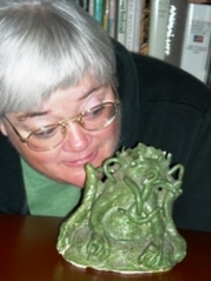
“The Discovery of the Ghooric Zone” (1977) by Richard Lupoff & “In The Yaddith Time” (2007) by Ann K. Schwader

He had seen Yaddith, yet retained his mind,
And come back safely from the Ghooric zone,
—H. P. Lovecraft, “Alienation,” Fungi from Yuggoth XXXII

This is the first appearance of the terms “Yaddith” and “the Ghooric zone” in Lovecraft’s work; though references to the former alien world would appear in his collaboration with E. Hoffmann Price “Through the Gates of the Silver Key,” and a few other places. Neither exactly captured the popular imagination in the same way as R’lyeh or Yuggoth, Carcosa or Innsmouth. Yet this one sonnet served as inspiration for several notable works.

“Discovery of the Ghooric Zone — March 15, 2337” (1977) by Richard Lupoff owes more to New Wave science fiction than Lovecraftian horror or sensibilities; it is the Mythos as space opera, as an epic of an unseen future, an exploration of the solar system as pure as any Golden Age sci fi epic, a looking-forward to cyberpunk, but it is also a literal and literary homage to H. P. Lovecraft—the man, the myth, the legend.

It opens up with what the first interracial LGBTQ+ threesome in Mythos fiction.

They were having sex when the warning gong sounded, Gomati and Njord and Shoten.  […]

Njord Freyr, born in the Laddino Imperium of Earth, had retained his masculinity even as he had undergone the customary implantations, excisions and modifications of pubescent cyborging. […]

Sri Gomati, of Khmeric Gondwanaland, had similarly retained her female primary characteristics in function and conformation even though she had opted for the substitution of metallic labia and clitoris, which replacement Njord Freyr found at times irritating.

But Shoten, Shoten Binayakya, fitted with multiply-configurable genitalia, remained enigmatic, ambiguous as to his or her own origin […]
—Richard Lupoff, “The Discovery of the Ghooric Zone”

Readers today might smile at Njord’s private crisis of masculinity, reminiscent of the same issues apparent in “Gilgamesh in the Outback” (1986) by Robert Silverberg, but the delineation of gender roles echoes in a very real way the alienation of Lovecraft’s poem. Njord clings to his masculine identity while at the same time feeling inadequate compared to the cybernetically enhanced Shoten:

Njord, the male crew member, cursed, distracted by the radar gong, angered by Gomati’s inattention, humiliated by her amusement and by her drawing away from himself and Shoten. Njord felt his organ grow flaccid at the distraction, and for the moment he regretted the decision he had made prior to the cyborging operations of his adolescence, to retain his organic phallus and gonads. A cyborged capability might have proven more potently enduring in the circumstances but Njord’s pubescent pride had denied the possibility of his ever facing inconvenient detumescence. (ibid.)

The attention on biological gender, gender transition surgery, and polyamory in general may seem unnecessary in a Mythos story, but in the case of “The Discovery of the Ghooric Zone” the trio are representatives of their respective future states as well as plot points along a gender spectrum; their interactions echo the places and peoples that they represent, all of future humanity striving together for this voyage of exploration. And, at the same time, the difference between 1977 and 2337 was never so vast as in the openness in sexuality…to which Lupoff wrote:

Cut to logo representing sex.

The major sexual attitude of the time was androgyny, rivaled but not equaled by the cult of pan-sexuality. Androgyny implies recognition of the full sexual potential of each individual. Former distinctions were abandoned. It was no longer regarded as improper to pursue a relationship of male to male or female to female; nor was it required to have two partners in a relationship. Practices ranging from onanism to mass interplay became acceptable.

The pan-sexualists held that androgyny was needlessly limiting in scope. If one could relate to any man or woman—why not to a giraffe? A condor? A cabbage? A bowl of sand? A machine?

The ocean?

The sky?

To the cosmos?

To God? (ibid.)

The format of the “cutscene” is cinematic; Lupoff draws out the action with excerpts on the history of the last four hundred years, anecdotes, personalities, commentaries on culture reminiscent of Dune (1965). It looks forwards and backwards at the same time; the Apollo 11 mission that landed humans on the moon occurred only seven years prior, in 1969, and yet:

Why has it taken until 2337 to reach — Yuggoth? When space flight began almost as long ago as the era Sri Gomati babbles about. The first extraterrestrial landings took place in 1969. Mars thirty years later. Remember the stirring political slogan that we all learned as children, as children studying the history of our era? Persons will set foot on another planet before the century ends! That was the twentieth century, remember?”

“Every schoolchild knows,” Shoten affirmed wearily.

Gomati, recovered from the shock of Njord’s blow, spoke; “We could have been here two hundred years ago, Njord Freyr. But fools on Earth lost heart. They began, and lost heart. They began again—and lost heart again. And again. Four times they set out, exploring the planets. Each time they lost heart, lost courage, lost interest. Were distracted by wars. Turned resources to nobler purposes. (ibid.)

There are more explicit Mythos references; and more explicit references to Lovecraft too. The story is set on the four hundredth anniversary of the death of H. P. Lovecraft, and if the future history is fantastical and impossible, it is also fascinating, an extended meditation that seeks to bridge past and future, weird fiction and New Wave, in a way no other author at the time did—and would be the spiritual precursor to works of Lovecraftian space opera such as Elizabeth Bear & Sarah Monett’s trilogy “Boojum” (2008)“Mongoose” (2009), and “The Wreck of the Charles Dexter Ward” (2012).

Yet those three do not come back safely from the Ghooric zone.

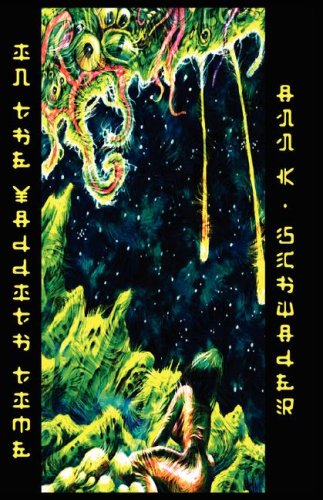
Three decades later, Ann K. Schwader published In the Yaddith Time (2007), a sonnet-cycle deliberately patterned after and echoing Lovecraft’s “Fungi from Yuggoth.” It begins with a quotation from “Alienation,” and continues on a similar theme to Lupoff’s—humanity’s faltering voyage into the unknown solar system, and into familiar territory:

[…] Our captain pointed
us toward the chaos framed beyond that stone
“Through there,” he cried, “awaits the Ghooric zone!”
—Ann K. Schwader, “Sacrifice Eyes,” In the Yaddith Time 14

The literary DNA has echoes of 2001: A Space Odyssey (1968), Alien (1979), Event Horizon (1997), and Ghosts of Mars (2001), the strange extraterrestrial relics left in space for humans to find, the madness overtaking captain and crew. Yet Schwader’s vision is an exploration of Lovecraft’s Mythos, told through her own imagery and captured in her own verse, and again there is that weird echo of Lupoff’s novella:

Writ strange, Earth’s chronicle was what we saw.

Past bled into the present, then ran on

down corridors torn deep in living stone,

revealing future horrors still unspawned

which showed mankind had never been alone.
—Ann K. Schwader, “The Walls of Prophecy,” In the Yaddith Time 26

The specific image here recalls Robert Bloch’s “Fane of the Black Pharaoh” (1937), but it echoes the secret history which underlies Lovecraft’s fiction, and Lupoff’s secret future unveiled piecemeal to his readers: humanity has never been alone, and never will be…

Schwader goes farther than Lupoff, at least in terms of distance; her astronauts go beyond Yuggoth, to the library of Celano, to Carcosa and the Lake of Hali, and finally to Yaddith. In conceptual terms, she travels less far: the bones of the story are old as sailing ships, captains gone mad, visiting places that test the imagination, loyalties tested beyond endurance by death and travails. No playing with gender, and indeed few references to how Earth had changed in whatever span of time separates the “now” of our contemporary period with the “then” of her sonnet-cycle. It is timeless in its futurity, and for her the focus is on the moment, the alien worlds to be explored, not the Earth left behind…except once, and that in a dream.

[…] Sudden night

spread shadowwings in one vast inky smear,

erasing daylight as a shriek of fear

arose from every throat: the stars turn right!
—Ann K. Schwader, “A Dream of Home,” In the Yaddith Time 28

Both “The Discovery of the Ghooric Zone” and In the Yaddith Time remains true to the Mythos as Lovecraft conceived it, the weird forces beyond human ken; what they are faced with when they travel out beyond the safe borders of the known into the outer dark. Yet both also go beyond Lovecraft: these are stories of exploration, in a sense which Lovecraft could only vaguely imagine. Space travel was never a reality for him, but Lupoff and Schwader lived through that—and could extrapolate that much further.

Richard Lupoff’s “Discovery of the Ghooric Zone — March 15, 2337” was first published in Chrysalis (1977), and republished in Tales of the Cthulhu Mythos (1990, Arkham House; 1998, Del Rey) and his collection Claremont Tales (2001, Golden Gryphon Press).

Ann K. Shwader’s In the Yaddith Time was published in 2007 by Mythos books. It has been reprinted in her collection Twisted in Dream: The Collected Weird Poetry of Ann K. Schwader (2011, Hippocampus Press).


Bobby Derie is the author of Weird Talers: Essays on Robert E. Howard & Others (2019) and Sex and the Cthulhu Mythos (2014).

“All Our Salt-Bottled Hearts” (2016) by Sonya Taaffe

So you’re not here to initiate me into the mysteries of the sea-mother whose faces rise and fall with the countless waves and her consort who makes the fish shoal as thick as cornfields in the fall?
—Sonya Taaffe, “All Our Salt-Bottled Hearts” in Forget the Sleepless Shores 247

There is an anthology or two yet to be compiled about Innsmouth. One might be called Women of Innsmouth, exploring the less-trodden narrative paths of the daughters, sisters, wives, and mothers which go largely nameless and implied in Lovecraft’s tale, and include “Shadow Over Innsmouth” (1942) by Virginia Anderson, “Mail Order Bride” (1999) and “Objects From the Gilman-Waite Collection” (2003) by Ann K. Schwader, “Pages Found Among the Effects of Miss Edith Teller” (2005) by Caitlín R. Kiernan, and “A Coven in Essex County” (2016) by J. M. Yales. Another, inspired more by the raid on Innsmouth and its aftermath, might be called The Innsmouth Diaspora, and include “The Doom That Came to Innsmouth” (1999) by Brian McNaughton & “The Litany of Earth” (2014) by Ruthanna Emrys, and “The Gathering” (2017) by Brian Lumley.

“All Our Salt-Bottled Hearts” by Sonya Taffe would fit neatly into both.

There is a promise in “The Shadow over Innsmouth” that is unique in all of Lovecraft’s work, that at the end:

We shall swim out to that brooding reef in the sea and dive down through black abysses to Cyclopean and many-columned Y’ha-nthlei, and in that lair of the Deep Ones we shall dwell amidst wonder and glory for ever.
—H. P. Lovecraft, “The Shadow over Innsmouth”

It is the one ending where the Lovecraftian protagonist embraces their change, and looks forward to what is to come. When all that once terrified them becomes, in a new light, what they have always wanted. And maybe that change in perspective is itself just another of Lovecraft’s rhetorical devices, showing that even the mind is not spared and all that they were was lost…but for some folks, there is a real path forward there. For those who have hated themselves or been hated by others for what they were (or were not), for those who have desired a personal transformation to accompany their private realizations, it is a promising ending. Not necessarily a happy ending, but one that promises a posthuman future.

Sonya Taafe wrote the story about what happens when that promise can’t be fulfilled.

Can’t is a mean word, full of inevitability. There are a lot of can’ts that exist in our world, a lot of nevers. People don’t like that there are things that they can’t change, about themselves and the world around them. Limits to medical science, to money, to talent, to the imagination. Speculative fiction exists in part to answer those can’ts, to provide a haven for what if, a place where it’s okay to dream about a world where you can have the biological gender to match your identity, or can have children, or can fly through the sky to the beating of great wings…

…or where you can breathe water and go down into the dark abysses.

This is a story about those who can’t. Blame it on genetics, the legacy of old Innsmouth families that survived the raid growing diffuse with the generations. Real-world genetics as applied to Lovecraftian biology. Hopes and dreams crushed by terrible realities. It is wonderful in its way: bleak and unsparing as the love between distant cousins, tied together in the loose-knit way of diaspora, like seeking like, and yet feeling distant and alienated from their own kin. Because not everyone belongs. Not everyone can…and it isn’t their fault. Isn’t anyone’s fault.

It is not a universe that cares about what is fair, even for the lost and wandering descendants of Innsmouth. And it can only end one way:

[…]  I was asked that question once and all I could think of was the Odyssey, how the road of the dead is a sea-road, the sun’s road, past the streams of Ocean and the gates of Helios, and maybe the pattern would be clearer to someone outside my head.
“An Interview with Sonya Taaffe, Author, Editor, Durian-Lover” (4 Aug 2004)

For some, the sea calls her children home; for others, they go willingly into a different abyss…and that is, perhaps, still better than the dry land.

“All Our Salt-Bottled Hearts” was first published in Dreams from the Witch-House: Female Voices of Lovecraftian Horror (2016) and republished in her collection Forget the Sleepless Shores (2018).


Bobby Derie is the author of Weird Talers: Essays on Robert E. Howard & Others (2019) and Sex and the Cthulhu Mythos (2014).
“Four O’Clock” (1949) by Sonia H. Greene

His touch was lightest in the stories by Sonia H. Greene, who was later to become his wife; he made some alterations in The Invisible Monster, he made only suggestions for the prose style of Four O’Clock.
—August Derleth, Something About Cats and Other Pieces(1949) vii

Four O’Clock” is the third work of fiction, after “The Horror at Martin’s Beach” (1923) (published in Weird Tales as “The Invisible Monster”) and Alcestis: A Play (1985) attributed to Sonia H. Greene with some input or assistance from H. P. Lovecraft, who she would marry in 1924. Relatively little is known about the genesis of this story, as Lovecraft mentions it only a few times in his letters, except that it was apparently one of three tales that were conceived during a visit by Sonia and Lovecraft to Magnolia, Massachusetts in 1922:

Mme. G. has taken to this sort of composition—has written one & planned two more—& I’m damned if they don’t look like good stuff! The first one, “Four O’Clock”, has some images noxiously Poe-esque—I shall polish it up for use in the U.A. or something else.
—H. P. Lovecraft to Alfred Galpin, 30 Jun 1922, Letters to Alfred Galpin 120

After the repast—a most marvelous meal prepared by Mrs. G. alone since the negress disappointed her & failed to appear—a programme of literary reading & discussion took place. I read my “Doom that Came to Sarnath” & “The Tree”, Belknap read his “Eye Above the Mantel”, Mrs. Green read her “Four O’Clock” & one of the other Magnolia horror-tales not yet revised […]
—H. P. Lovecraft to Anne E. P. Gamwell, 9 Sep 1922, Letters from New York 20-21

The story did not see publication during Lovecraft’s lifetime, but in 1946 Sonia (now Sonia H. Davis) came into contact with August Derleth of Arkham House, and after some personal disagreements and correspondence, both “The Invisible Monster” and “Four O’Clock” were published in Something About Cats and Other Pieces (1949), which contained several of Lovecraft’s revision tales; it would subsequently be reprinted in The Horror in the Museum (1970) and other collections of Lovecraft’s revision and ghostwritten tales, despite the relatively slight evidence, as Joshi notes:

In a letter to Winfield Townley Scott (11 December 1948; ms JHL), Sonia H. Davis wrote that this story was written only at HPL’s suggestion. On that basis, I excluded it from the revised Horror in the Museum (1989); but in fact, much of the prose appears to be similar to HPL’s own prose, with some characteristic linguistic and even punctuational usages; so HPL probably did touch up the story somewhat. HPL never mentions the story in any extant correspondence, it was apparently not published in his lifetime. The only basis for the text is its first appearance in 1949.
—S. T. Joshi, Collected Fiction Vol. 4 (Revisions and Collaborations): A Variorum Edition 4.613

The letter mentioned is available online, where Sonia writes:

I have sent to Arkham House snap photo of HPL’s aunts, some post cards, a story revised by HP and a fictitious story I wrote about HP a few months after I met him, but at his request I did not publish it in the Rainbow because, as he told it, it was obviously a description of himself.
—Sonia H. Davis to Winfield Townley Scott, 11 Dec 1948

If the “story revised by HP” is “The Horror at Martin’s Beach”/”The Invisible Monster,” then by process of elimination the “fictitious story I wrote about HP” must be “Four O’Clock.” Which perhaps places this story in the same category of “Falco Ossifracus” (1921) by Edith Miniter, closer to affectionate parody than an effort at a weird tale, a literary tweaking of Lovecraft’s nose.

There is something deliciously pulpy about “Four O’Clock.” The tale of supernatural revenge beyond the grave to be visited at the eponymous hour has all of the four-color garish earnestness of a Tale from the Crypt-Keeper. The demons, be they real or hallucinations, have a cartoonish quality. The Poe-esque images that Lovecraft mentioned are laid on with a heavy trowel, so the fine line between pastiche and parody is blurry and indiscernible, but for readers that cackled at old horror comics, it’s hard to suppress a smile.

The major question, as with every story that claims any part of being a Lovecraft “revision,” is how much of it he wrote—or re-wrote, as is often the case. “Four O’Clock” is not easy to categorize in that regard; it has no familiar landmarks of Lovecraft country, no explicit references to the as-yet-mostly-unborn conception of Lovecraft’s Mythos. There are thematic resonances with his work, but how much of these owe themselves to Lovecraft’s imagination or Sonia H. Greene’s is impossible to say. Take for example one of the opening sentences:

The great black silences of night’s depth told me, and a monstrous cricket, chirping with a persistence too hideous to be unmeaning, made it certain. (Variorum 613)

How comparable is this to azif?

[…] azif being the word used by Arabs to designate that nocturnal sound (made by insects) suppos’d to be the howling of daemons.
—H. P. Lovecraft, “History of the Necronomicon”

Similar common images abound, the most obvious of which is perhaps the appearance of what would become one of the more common visual cues in the Mythos:

The four talons, long, thin, and straight, were now seen to be tipped by disgusting, thread-like tentacles, each with a vile intelligence of its own, which groped about incessantly, slowly at first, but gradually increasing in velocity until I was nearly driven mad by the sheer dizziness of their motion. (Variorum 615)

H. P. Lovecraft, of course, neither invented the tentacle in weird fiction nor had any monopoly on the concept; M. R. James used them to good effect in “Count Magnus” (1904), Arthur Machen in “The Novel of the Black Seal” (1895), H. G. Wells in The War of the Worlds (1897), etc. The tentacles could be coincidental, or a deliberate reference to something that came up in their correspondence which Sonia incorporated into the story deliberately to invoke Lovecraft as the unnamed protagonist of the story.

We’ll never know.

Serious literary analysis of this story could point to it as a night terror, as a psychological suspense narrative driven by the phantasmagoric imagery, a variation on the theme of the incubus attack with all attendant sublimated psychosexual implications—and there is certainly a case to be made with that. Sonia H. Greene was 39 in 1922, biological clock ticking inevitably toward doom as surely as the fated hour approaches in the story. While such deep reading of the story is possible, maybe valuable to those who enjoy that kind of exercise, the simpler enjoyment of this story might be just in the slightly ridiculous seriousness with which it pursues its premise, like a solid exploitation film.

The plot actually has gross parallels to a tangential Mythos story: “Wentworth’s Day” (1957) by August Derleth features another posthumous appointment being kept. Stylistically the stories are worlds apart, but it’s interesting that Derleth for all his efforts to ground the plot in a suitably realistic milieu doesn’t achieve anything quite like the same effect as in “Four O’Clock”—where the over-the-top visuals of the pending hour, completely surreal in any realistic setting, actually work with the kind of dream-logic that might come from reading too much Poe.

Not that Derleth borrowed anything from Greene or Lovecraft, the idea of the appointment being kept or the curse fulfilled after death is a hoary one. Both stories might be considered a bit hokey, even when they were written, and there’s a campfire tale quality to “Four O’Clock.” It feels like a story to be read not to keep the darkness at bay, but to welcome it home.


Bobby Derie is the author of Weird Talers: Essays on Robert E. Howard & Others (2019) and Sex and the Cthulhu Mythos (2014).
 

“Pickman’s Other Model (1929)” (2008) by Caitlín R. Kiernan

You know, it takes profound art and profound insight into Nature to turn out stuff like Pickman’s. Any magazine-cover hack can splash paint around wildly and call it a nightmare or a Witches’ Sabbath or a portrait of the devil, but only a great painter can make such a thing really scare or ring true. That’s because only a real artist knows the actual anatomy of the terrible or the physiology of fear—the exact sort of lines and proportions that connect up with latent instincts or hereditary memories of fright, and the proper colour contrasts and lighting effects to stir the dormant sense of strangeness. I don’t have to tell you why a Fuseli really brings a shiver while a cheap ghost-story frontispiece merely makes us laugh. There’s something those fellows catch—beyond life—that they’re able to make us catch for a second. Doré had it. Sime has it. Angarola of Chicago has it. And Pickman had it as no man ever had it before or—I hope to heaven—ever will again.
—H. P. Lovecraft, “Pickman’s Model” (1927)

“Pickman’s Other Model (1929)” is a sequel in every sense of the word. Not only does Kiernan unfold the next chapter in the narrative, peeling away more onion-layers to reveal deeper mysteries, but it is a continuation of the themes of the original story in a new direction. Without so many words, Kiernan asks and answers the unobvious question: What’s better than a photograph from life?

The story could have been labeled “Eliot’s Tale”—Eliot being the person to whom Thurber, the protagonist in Lovecraft’s story, had been addressing his narrative to. Now three years later, Thurber was dead and it was Eliot picking up the pieces of the man’s life, sorting through the letters and drawings, uncovering something that Thurber, in Lovecraft’s story, failed to mention: Pickman’s nudes.

It isn’t some lingering prudery that kept nudity out of Lovecraft’s story, nor is it any particular prurience of Kiernan’s that places it at the center of hers. Lovecraft’s focus was on one of Pickman’s models, the necrophagous critters that haunt Boston’s old tunnels; Kiernan’s focus is on his other model—a young woman whom any artist might sketch in the nude to hone their skills at anatomy, and who catches Eliot’s attention.

The development of the investigation is leisurely, with specific details that are highly suggestive but never so explicit as to reveal the central mystery. Hints along the way, artfully arranged, touching on some of Kiernan’s favorite themes…echoes of “The Call of Cthulhu,” “The Hound,” old family shames and lesbian desires—and a particular anatomical feature—that echo Kiernan’s own stories like “Houndwife” (2010), “pas-en-arrière” (2007), and Daughter of Hounds (2007). Always keeping that toehold in reality, the story coded with all the care of a good hoax, as when Kiernan discusses what might well have been the inspiration for the story:

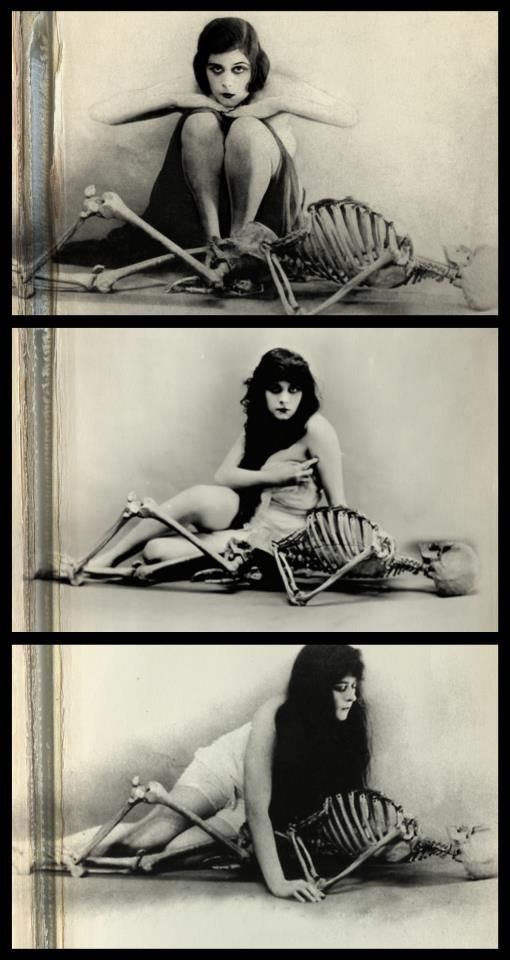
It might have only been a test reel, or perhaps 17,000 or so frames, some twelve minutes, give or take, excised from a far longer film. All in all, it was little but than a blatantly pornographic pastiche of the widely circulated 1918 publicity stills of Theda Bara lying in various risqué poses with a human skeleton (for J. Edward Gordon’s Salomé).
—Caitlín R. Kiernan, “Pickman’s Other Model” in Confessions of a Five-Chambered Heart 276

thedaskeleton

I overheard, when the lights came back up, that the can containing the reel bore two titles, The Necrophile and The Hound’s Daughter, and also bore two dates – 1923 and 1924. (ibid)

As much as Lovecraft and others liked to portray the artist as portraying some supernal truth, Kiernan knows that reality tends to be much baser. So much is the case when Eliot finally meets Pickman’s other model in the penultimate chapter: a tired young woman who has seen a little too much of the world, with bad habits and a filthy mouth. Living in the present but still haunted by the past.

A past which catches up to her in the final chapter, hinting as Lovecraft did of more in heaven and earth than was dreamt of, darker and uglier realities at play which even the best of art could only hint at as a shadow in the final flickering frames on a black-and-white reel.

The success of “Pickman’s Other Model (1930)” is less in revelation than in suggestion and presentation. This is a story not so much for readers who want another piece of the Mythos puzzle as much as those who enjoy the process of discovery…and how some stories and images stay with you, for a long while. That is the other question, and perhaps as close to a theme of Kiernan’s narrative and her utmost reflection on Lovecraft’s: How do you unsee such things? You can’t.

“Pickman’s Other Model (1930)” was first published in Kiernan’s Sirenia Digest (March 2008), it has been reprinted Black Wings: New Tales of Lovecraftian Horror (2010), New Cthulhu: The Recent Weird (2011), Confessions of a Five-Chambered Heart (2012), Beneath an Oil-Dark Sea: The Best of Caitlín R. Kiernan Volume Two (2015), and Houses Under The Sea (2018).


Bobby Derie is the author of Weird Talers: Essays on Robert E. Howard & Others (2019) and Sex and the Cthulhu Mythos (2014).


“Pickman’s Centerfold, Or: The Dunwich Ho” (2003) by Nancy Holder

Next thing I saw on the computer screen was a close-up of a drawing in a book of what looked to me like a big, enormous cock with tentacles and a beaked glans. I thought, Oh, Jesus, he’s the one for sure been cutting up the hookers. He’s got some kind of psychosexual thing going.

Gil slurred, “This’s Cthulhu.” Then he started crying.

—Nancy Holder, “Pickman’s Centerfold” in Hot Blood XI Fatal Attractions 245

Richard Upton Pickman holds a particular fascination with some writers in the Mythos. Artists have often struggled with censorship, obscenity, and unveiling true forms to the naked eye. It’s a very small conceptual leap to add an erotic element to Pickman’s work, like “Pickman’s Necrotica” in Alan Moore and Jacen Burrows’ Neonomicon (2010), the films in “Pickman’s Other Model (1929)” (2008) by Caitlín R. Kiernan…and the camshow websites designed by Pickman in “Pickman’s Centerfold, or: The Dunwich Ho.”

There is a certain reverent irreverence to Nancy Holder’s prose, right from the title to the very last line. It’s a free-wheeling, open approach to the Mythos fiction which borrows liberally from previous works, but isn’t beholden to any of them. So while Cthulhu and the Necronomicon and all make an appearance, it is in service to this story and its plotline, not to some larger fabric of Mythos fiction. “Pickman’s Centerfold” is not a sequel or prequel or really in any way connected with the narrative of “Pickman’s Model.”

This method of radical re-interpretation of the Mythos is very similar to that of “Showdown at Red Hook” (2011) by Lois H. Gresh or “Love’s Eldritch Ichor” (1990) by Esther M. Friesner and the result is…fun. Readers who have chewed through all of Lovecraft’s work and a hundred pastiches will find a story that can’t be fit into any timeline of the Mythos, and that’s okay. Holder has taken inspiration and elements from Lovecraft’s stories but has gone off to do her own thing.

The story itself is a bit light for the subject; despite appearing in (and probably written exclusively for) the erotic horror Hot Blood series, titillation and gore are not really the point, and Holder never crosses the line into either splatterpunk or erotica. Pornography and prostitution, with all its tawdry bits, are the waters in which FBI Special Agent Eliot Blake and his erstwhile comrade Gilman Innsmouth swim, like a particularly screwy episode of Law & Order: Special Victims Unit crossed with the film 8MM.

Hookers are people too, and we have a lot of those people in Boston, don’t let nobody lie to you that w have “clean up” our cit. It gets cold here. (ibid, 238)

That approach, of an FBI Special Agent hunting a serial killer running afoul of the Mythos is at once familiar to many readers but quirky enough to keep them reading.  Alan Moore did much the same thing in “The Courtyard” (1994) and its sequel. This approach helps in that it brings an “outsider” ignorant of the Mythos to come investigating, letting the readers re-live their own initiation into the weird mysteries. Holder draws on some established tropes in the process, some of more relevant than others. At one point, for example, Agent Gil pulls out a pile of books:

So wham! the books got put on the table front and center, and the first one had a picture of a really buffed-out Hannibal Lecter on the front and the title was Tales of the Cthulhu Mythos. I picked the next one up and title was At the Mountains of Madness, with a corpse in a hooded robe on the cover.

I waited for Gil to explain. (ibid, 242)

Gil couldn’t explain, and maybe Holder couldn’t either. Having works of Mythos fiction actually be present in the stories themselves is an old trick, going back to August Derleth placing Arkham House titles and copies of Weird Tales in the Mythos stories he wrote after the death of H. P. Lovecraft—Moore did the same thing in Neonomicon, Robert Bloch did it in his novel Strange Eons (1978). But whereas Bloch & Derleth were trying to establish the “truth” of Lovecraft’s Mythos in their narrative, and Moore was pursuing a grand metafictional narrative, Holder’s use here feels like a misstep. There are narrative ramifications which go unexplored: if Lovecraft lived, wrote, and died, then how has the FBI not run across the name “Richard Upton Pickman” before? The title-drops feel like an unwanted tie-in to a story that is deliberately trying to pursue its own separate narrative.

That possible misstep aside, the real focus on the latter part of the story is on the revelations: what Pickman is actually up to, what agents Blake and Innsmouth actually uncover. Despite the title, there is no centerfold—this is the digital era—and no “Dunwich Ho.” A grave disappointment for some readers, certainly, but also exemplary of one of the unconscious problems of this story: the women.

Pickman’s websites are implicitly heterosexual, places for camgirls to post their content and draw in clients; later in the story there is the suggestion he runs sites for men as well, but again exclusively for a heterosexual (if not always human) audience. The women themselves are only present in the story as nameless victims.

She was a truly awesome sight, with silicone tits of rounded perfection, big red nipples pointed directly toward the North Star. Her pussy had been shaved, and she looked fantastic. I figured, professional girl. Then I realized: one of Prickman’s girls. (ibid, 246)

There are a lot of possible invisible constraints here: maybe editorial policy at Hot Blood emphasizes heterosexual relations, maybe it would kill the pacing if Eliot Blake focused in on the identities of the female victims, maybe it’s just in keeping with Blake’s personality to treat all adult entertainers as prostitutes, characterized by their physical attributes rather than their names or personalities, and Holder was honestly reflecting that. Whatever the case, the women end up as ciphers, present only to be sex objects and then die gruesomely.

The human women aren’t the only ones that go nameless, but at least when Cthulhu’s wife/mate appears there’s a deliberate shift in tone: when the focus goes from “he” (Cthulhu) to “she,” it becomes retrospectively obvious that “she” has been the major driver for the story, not Pickman or Cthulhu. Holder doesn’t go into the details of “her”—doesn’t even her use common appellation—but it’s a rare story that puts Cthulhu and his mate on sexual parity, so to speak, and the revelation of what has really been going on works well.

“Pickman’s Centerfold, Or: The Dunwich Ho” was published in Hot Blood XI Fatal Attractions (2003); it has not been reprinted. Nancy Holder’s other Mythos work includes “In Arkham Town, Where I Was Bound” (2014), “Baubles” (2015), and “Nyarlathotep Came Down To Georgia” (2018), and she has taught Lovecraft at the University of California at San Diego and the Stonecoast Creative Writing Program at the University of Southern Maine.


Bobby Derie is the author of Weird Talers: Essays on Robert E. Howard & Others (2019) and Sex and the Cthulhu Mythos (2014).
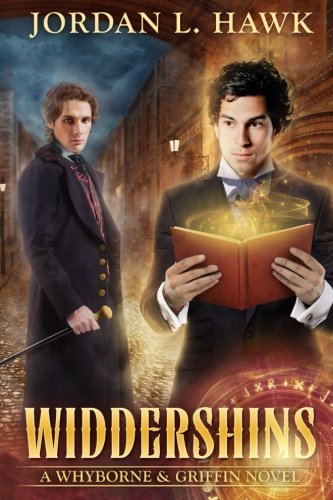
Widdershins (2013) by Jordan L. Hawk

Now I ride with the mocking and friendly ghouls on the night-wind, and play by day amongst the catacombs of Nephren-Ka in the sealed and unknown valley of Hadoth by the Nile.
—H. P. Lovecraft, “The Outsider”

Some of the trustees were still unhappy, but Christine’s stunning find of the tomb of the Black Pharoah Nephren-ka had commanded headlines across the globe.
—Jordan L. Hawk, Widdershins 14

1897. Somewhere between Boston and Providence lies the small city of Widdershins, a quiet place where a man can start over…at least until the Liber Arcanorum drops into the lap of a closeted translator of dead languages and the bodies start piling up. Nothing like an unexpected mystery to bring two people together.

Jordan L. Hawk’s Widdershins (2013) is an historical paranormal romance with two little twists: the world is set in the same country as Lovecraft’s Mythos (Dr. Whyborne even went to college at Arkham), and the protagonists are two homosexual men. It may, in fact, be the first homosexual Mythos romance novel—somewhat of a weird distinction to make, but previous Mythos romance novels like Margaret L. Carter’s The Windwalker’s Mate (2008) and Robin Wolfe’s Arkham Dreams (2011) were focused on heterosexual relationships, and homosexual characters and relationships remain rather rare in the Mythos by comparison. The closest comparable work in the field is probably “Moonshine” (2018) by G. D. Penman.

The depictions of the men and the challenges they face are sympathetic; the construction of the setting is very competent. Hawk does their research:

A: But the research into the period!! How much did you actually do to capture the period as well as the paranormal element?

JLH: As much as I can! I have a replica Sears & Roebuck catalog from 1897 so I could figure out what sorts of goods and furnishings an average person in the period would have in their home. And I managed to find plans for middle class homes and hotels of the era online, which was a major boon.

My biggest problems research-wise actually came from the American setting. Casually glancing over the history section, you’d think America in the 1800s was nothing but the Civil War, followed up by the western expansion. At times it wasn’t easy to find out about the day to day life of people living in the northeast, especially if I needed something really specific. Most of the “daily life” books of the period center on Victorian England rather than Gilded Age America, and although there is some overlap, there are a lot of differences beyond drinking coffee versus tea.
Author Interview: Jordan L. Hawk

The Mythos elements are also rather refreshingly grounded: Arkham and the Necronomicon and all exist, but to the majority of the world (and the two protagonists), they are but part of the setting. The protagonists only discover gradually that there are secret cults about and some brands of paranormal science actually work, if you know how to pronounce the Aklo. Once that is established, given an expert in dead languages and a genuine grimoire, progress is fairly rapid.

The tone established falls somewhere between Cthulhu by Gaslight and Lois H. Gresh’s Sherlock Holmes vs. Cthulhu: The Adventure of the Deadly Dimensions (2017); magic exists, there’s a mystery afoot, and by chapter 7 the two principals have met and teamed up to solve it. As they continue through the adventure, the two grow closer; the common goal, trials, and tribulations provide the crisis for both men to open up, commiserate, empathize, and grow fond of one another.

“Damn it, Griffin, fuck me,” I growled.
—Jordan L. Hawk, Widdershins 152

There is a sex scene. Not a weird one; no naughty tentacles or atypical anatomies. It is no more or less than the same kind of scene that would appear, without comment, in any number of other novels; only the genders of the particulars are different. That in itself is almost exemplary of the attitude of the novel as a whole: the book is not a homosexual pornographic novel. There is more hanging between Whyborne & Griffin that Victorian reticence, personal and social boundaries that have to be overcome and guards let down; readers who just want to see the two get together have to wait for it.

Then there’s the small matter of saving the world.

While not written in a pulp style, there’s a pulpish appeal to Widdershins. The stakes rise like something in an Indiana Jones film, the protagonists have to take into account all the possibilities that magic and the Mythos bring to their setting, and there’s an action scene at least every couple of chapters to keep the pace up. The characters, even beyond the two protagonists, have their own motivations and hangups. The best supporting character is Dr. Christine Putnam, an archaeologist that has fought an uphill battle her entire professional life because of her gender—and succeeded. Her desire to retain her hard-won reputation almost gets her killed, but that’s all the more endearing.

Searchers after horror will have to haunt stranger places than Widdershins to find what they’re looking for, but it is a well-written novel in its own mode of historical paranormal romance. It never descends into any attempt to ape Lovecraft’s style like a bad pastiche, nor does it hold slavishly to the tropes of a roleplaying game. Hawk refers to Lovecraft’s setting, but she makes few direct references to any particular story so the story is fairly accessible to the lay reader—which is also rather rare for a Mythos novel.

Jordan L. Hawk’s Widdershins is the first in the Whyborne & Griffin series, which as of 2018 includes a total of 13 novels and novellas.


Bobby Derie is the author of Weird Talers: Essays on Robert E. Howard & Others (2019) and Sex and the Cthulhu Mythos (2014).
 

“Cthulhu Sex (ahem!)—a poem—” (1998) by Katherine Morel

Katherine Morel is a painter, an aspiring mad scientist, and an honorary saint of Thud, bestower of the sacred word, obsquatulate. She is currently bruised and swollen due to extra grey matter being inserted into the space between her brain and skull and hopes to sleep it off in time to be in attenance at the marriage that changed over the millennium.
Cthulhu Sex Magazine, Vol. I, Issue 13

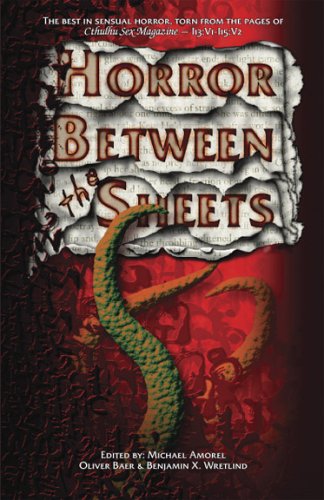
Cthulhu Sex magazine was the brainchild of Michael Morel, and graduated over the course of its run from a small black-and-white chapbook illustrated with crude, pixelated images of sperm to a slick, full-sized semi-prozine with color covers, photographs, and digital artwork. A collection of material from the magazine was issued in 2005 as Horror Between the SheetsIn the first issue and that final collection is printed (with slight changes) “Cthulhu Sex (ahem!)—a poem—” by Katherine Morel.

The poem is an almost perfect encapsulation of the magazine as a whole. While Cthulhu is in the title, it never appears in the body text. The tone is light, the verses violent, darkly humorous, and sexually explicit.

Twas through their connection she passed her infection
—Katherine Morel, “Cthulhu Sex (ahem!)—a poem—”, Horror Between the Sheets 36

Poetry has a long history among creators and admirers of the Mythos; H. P. Lovecraft, Robert E. Howard, Clark Ashton Smith, August Derleth, and Frank Belknap Long were all notable poets, and some of their poetry was directly related to the Mythos. So too, some of the first fan-additions to the Mythos were poems, such as “Shadow Over Innsmouth” (1942) by Virginia Anderson & “The Woods of Averoigne” (1934) by Grace Stillman.

In the 1990s, poetry would continue to play its part in fandom, being featured in prominent ‘zines & journals such as the Arkham Sampler and Crypt of Cthulhu—but there were editorial limits to what those ‘zines would publish. Hardcore horror, the splatterpunk style of violent and gory horror fiction that took its cues from slasher and exploitation films (and, reaching back into the dim mists of time, the weird terror pulps), had few outlets.

To see her reflection,
Caused him an erection,
Yet something seemed the slightest bit weird. (ibid.)

Cthulhu Sex became an outlet and medium for fiction and art that couldn’t be posted elsewhere. Not much of it dealt explicitly with Cthulhu, Lovecraft, or the Mythos; it didn’t have to. The title was a statement and a challenge, just as it is in Katherine Morel’s poem. The title gives context to the text.

In 1998, people could still remember when HIV was a death sentence and not one to be long-deferred. Japanese tentacle erotica had hit the shores of the United States with  Maeda Toshio’s Urotsukidōji and La Blue Girl, and were already the subject of jokes about “naughty tentacles” on the nascent internet. There was a zeitgeist there, mostly untapped as yet… until Katherine Morel’s “Cthulhu Sex.”

she scratched her complexion,
so that bloody tentacles appeared. (ibid.)

The tagline for Cthulhu Sex was “Blood, Sex & Tentacles.” Katherine Morel’s poem was an anthem for the magazine, an invocation for what was to be from 1998 to 2007. She captured, however briefly, the mood and attitude, right at the outset.


Bobby Derie is the author of Weird Talers: Essays on Robert E. Howard & Others (2019) and Sex and the Cthulhu Mythos (2014).