Posts

“Nymph of Darkness” (1935) & “Yvala” (1936) by C. L. Moore & Forrest J Ackerman

C. L. Moore (1911-1987) made her debut in Weird Tales with “Shambleau” (1933); and her stories were immediately lauded for their vivid language and distinctive imagination. With her marriage to Henry Kuttner in 1940, Moore would appear to vanish from the scene—she and her husband formed a prolific writing team, with most of their shared output published under his name or one of their joint pseudonyms. Yet during that period when Moore was on her own, she also collaborated on a round robin titled “The Challenge From Beyond” (1935) with A. Merritt, H. P. Lovecraft, Robert E. Howard, and Frank Belknap Long, Jr.; “Quest of the Starstone” (1937) with Henry Kuttner; and two stories with Forrest J Ackerman: “Nymph of Darkness” (1935) and “Yvala” (1936).

Forrest J Ackerman (1916-2008) was the early archfan of science fiction; he became heavily involved in organized science fiction fandom (notably engaging in a brief flame war with Clark Ashton Smith and H. P. Lovecraft in the pages of The Fantasy Fan), a cornerstone of the Los Angeles Science Fiction Society, and closely involved with science fiction and fantasy filmmaking and reporting in Hollywood—notably as editor of Famous Monsters of Filmland (1958-1983). He also co-created the character of Vampirella and was very briefly editor of a revamped Weird Tales in 1984.

Forry had the advantage over Moore in that he lived longer, and had more opportunities to weigh in on their collaborations in the 1930s. Yet from what has emerged, we can see that it was an interesting—if brief—partnership, which Ackerman continued to capitalize on for decades.

“Nymph of Darkness” (1935)

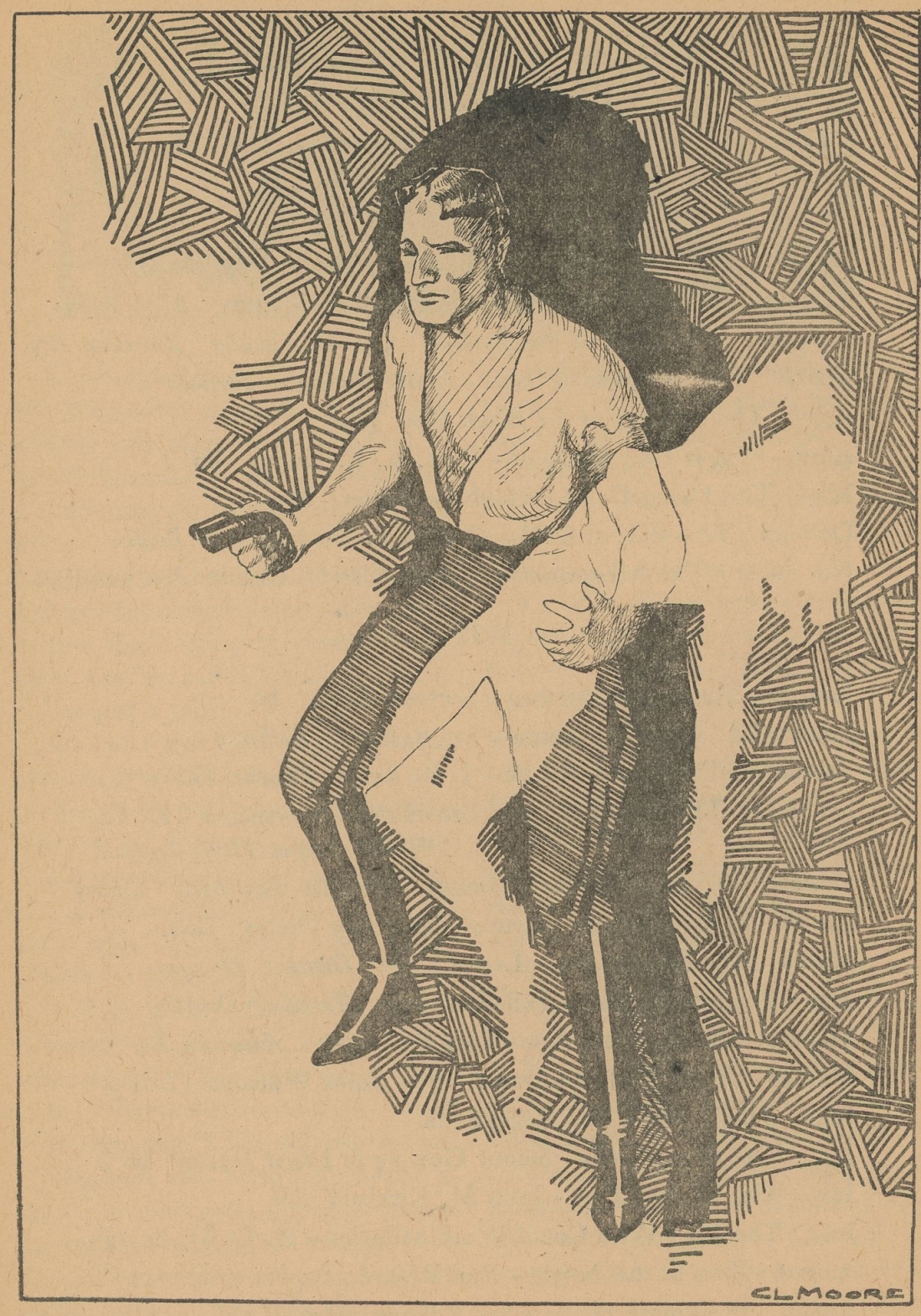
I’ll send you a drawing I’ve just made for FANTASY MAGAZINE. In collaboration with Forrest J. Ackerman, who’s been writing to me for some time, I’ve written a story for them, and Mrs. Schwartz, who edits the magazine, is going to fix things up so he can publish the illustration for it to. All this gratis, of course, for the WT issue of FANTASY. Mr. Ackerman’s idea was so good I just had to write the story. He seems to be bulging with good ideas, and wants to team up with me for WT, but I won’t be able to. Have so little time to write I have to cash in on every minute of it, and as long as I have ideas of my own can’t afford to use someone else’s and split the profits.

Let’s see now. That’s the JULHI drawing, BRIGHT ILLUSION and NYMPH OF DARKNESS I’ve promised. If I can find them. You can keep them all if you want. All three will be the original trial drawing, so I shan’t have any copy of my own, and I suppose you’ll return them if by any remote chance I need them again. I’m far too lazy to make copies of them, and anyhow will be glad to get rid of the things. They just clutter up my already unspeakably cluttered files (what I need is a nice, neat-minded secretary) and [. . .]

C. L. Moore to R. H. Barlow, 31 Dec 1934 – 11 Feb 1935, MSS. John Hay Library

“Nymph of Darkness” by C. L. Moore and Forrest J Ackerman first appeared in Fantasy Magazine April 1935, the Weird Tales special issue. Fantasy Magazine was a neatly-published semiprozine put together by Julius Schwartz (who would go on to become Lovecraft’s agent, and later an editor of DC comics), the same that would publish “The Challenge from Beyond.” It isn’t clear when exactly Moore and Ackerman came into correspondence, although it was probably 1934, possibly through The Fantasy Fan or another fanzines, possibly through Farnsworth Wright at Weird Tales, who sometimes forwarded fan mail to authors.

It was probably Ackerman that had the idea for a collaboration; while he was an avid fan of science fiction and wrote considerable prose, he wasn’t particularly noted as a fiction writer, and he had managed to collaborate with other writers by providing an initial idea and criticism on the work—while the writer did all the writing. Ackerman confirmed this as the general process in a letter:

Thank you for your complimentary remarks about NYMPH OF DARKNESS, which was from my plot. I contrived Nyusa, and her pursuer, and Dolf, et.c, and sent suggestions as Catherine while she was working on the story. After it was all finished and in New York and I had an autographed copy, I thot of the part at the conclusion about Nyusa giving NW a kiss, and C. was so enthusiastic about it and said it gave the story just the proper punch, etc., that she typed an extra page-insert about it and rusht off to FM.

Forrest J Ackerman to Mrs. Burnhill, 7 May 1935

In a 1948 issue of Ackerman’s fanzines Shangri-LA #4, he published “The ‘Nymph’ o’ Maniack,” which reprints some of Ackerman and Moore’s correspondence involved in the process. While labeled as being from 1936, these letters were probably from early 1935:

“Dear Forrie: Happy New Year. And by the way, if you heard a new year’s horn blowing extra loudly just at midnight, your time, and couldn’t locate it—that was me. I blew a special blast for you at about 2:00 a.m. or thereabouts, as nearly as I can remember now—of New Year’s morning just as the radio announced that it was at that moment midnight in Los Angeles. I never quite believe things like that—different times, I mean. Of course, know that you lose a day going round the world, and all that—but somehow can’t quite [268] believe it anyway. I read a story somewhere once in which someone in New York phoned someone in London, and over the wire ‘the late afternoon New York traffic vibrated weirdly in the stillness of the London night.’ It seems impossible, if you see what I mean.

[. . .]

Here is the outline I sent to Catherine when she was living in Indianapolis and working in a bank vault:

THE NYUSA NYMPH—One short and exciting experience in the adventure-filled life of Northwest Smith . . . Of a fleeing figure in the nite that bumped into NW at the Venusian waterfront—an unseen form—that of Nyusa, the girl who was born invisible! Further details: The business of the squat creature who came swiftly slinking thru the street, short on the heels of the figure in NW’s arms, with the strange lite-tube in its hands flashing from side to side (it would have caused Nyusa to become visible, you know—the lite from the tube) . . . and of Nyusa, whose abnormally high body-temperature kept her comfortable free from clothing; so that invisible she remained, as born—And from what she fled, and how NW was of service to her, etc.—I will leave to you.

MOORE to Ackerman: I think I know why the pursuer’s flash made Nyusa visible. Did you ever notice the peculiar colors one’s skin turns under different lights? A violet-ray machine turns lips and nails—as I remember—a sickly green, adn the blue lights they use in photographers shops, sometimes, make you purple. I once figured out why, but can’t remember and haven’t time now to go  into it. Something about complementary colors and mixing yellow and blue, and whatnot. Well, you remember in Bierce’s The Damned Thing his invisible monster was a color outside our range of perception. Coudln’t this flash-light be of some shade which, combined with Nyusa’s peculiar skin-tone, produce a visible color? * And Venus is the Hot Planet anyhow, so no need to increase her body temperate above normal tomake it possible fo there to run about in the altogether. * Smith had met her in the absolute black dark of the starless Venusian night. She came tearing down the street and bumped into him, and, tho considerably astonished to find his arms full of scared and quite unadorned girl, he of course didn’t realize her invisibility then. Afterward came this squat, dark pursuer, flashing his greenish glowing ray to and fro. When he’d gone by she heard another sound—origin yet unknown, to me or anyone else—which [269] so alarmed her that she pulled Smith into a run and guided him at top speed thru [the spellings “thru” & “tho” are Catherine’s] devious byways and into an unlighted room. “Lift me up,” said she, “so I can reach the light.” ANd when it goes on he realizes that he is holding in midair a beautifully muscular, firmly curved armful of nothingness. He had just dropped her onto the floor and staggered back, doubting his sanity. What happens next I don’t know. * If you have any more ideas, they’ll be welcome. This is the stage of a story when I usually sweat blood for several days, racking an absolutely sterile brain for ideas. Thens something takes fire and the whole story just gallops, with me flying along behind trying to keep up with it. Very strenuous. & Think hard and see if you can find any possible reasons, sane or insane, as to what the noise was she had heard, why it alarmed her so, whether she is invisible just by a freak of nature or whether by some mysterious mastermind’s intent. I suspect she is in the power of some insiduous villain, but I don’t know yet. * All thru the preface of the story I’ve made some veiled hint about the nameless horrors which stalk by night along the waterfront of Ednes, that said villain might be almost anything—some horror out of the ages before man, or some super-brain of the far advanced races we know nothing of, or an unhappy medium like the Alendar. (That reminds me—Vaudir is the infinitive of–as I remember my college days—the French verb wish. I presume Nyusa is purely original with you, so you deserve more credit than I, for it’s a grand name.) [“Thank you kindly, ma’am,” said the 18-year-old lad. “There is no truth to the rumor that I made it up from the initials of our major metropolis, N.Y. U.S.A.”]

[…]

MOORE to Ackerman: Thanks for the further suggestions. I had already gone on past my stopping point when I wrote you, so can’t use all your ideas, but have incorporated Dolf and the dancing-girl idea. It seems Nyusa is—sorry—really innately invisible, being the daughter of a Venusian woman and a Darkness which is worshipped by a queer race of slug-like, half-human beings which dwell under the Venusian city of Ednes. (Incidentally, Ednes, the city where in the Minga stood, is simply lifted bodily out of the middle of Wednesday.) Anyhow, Nyusa is forced by the preists to dance in their ritual worship under a peculiar light which renders her visible in a dim, translucent way. And because of her mixed breed she has access into other worlds from which her masters bar her out by their own strange mental powers because she’d never return to dance for them if she once got away. Dolf guards her for the same reason. I think now that Nyusa’s captors drive her too far sometime, and she realizes that after all she is half divine, and calls upon the strain of Darkness within her to burst [270] the bonds they have imposed. Smith, attacked by Dolf as he hides in their temple watching the ritual dance, fights with the worshippers and kills the high priest, whereupon their power over Nyusa is weakened and she exerts her demi-divinity to escape. Thus, tho Smith doesn’t get the fortune you suggested, he at least is spared the expense of buying her any clothes, which was a very practical idea on your part.

ACKERMAN to Moore: I have a suggestion about the ending. Shambleau stunned Smith; to this day he had probably not forgotten “it.” Sweet, was the girl of the Scarlet Dream. While in the Black Thirst, he gazed upon beauty incredible. But Shambleau was to be shunned; and the girl of the Dream . . . Vaudir dissolved. So, let the Nymph—Nyusa—just before she escapes . . . couldn’t she—kiss Smith? A kiss never to be forgotten: a kiss . . . so cool, with a depth drawn out of Darkness. And yet, a kiss of fire—from her Venusian strain—hot, alive, searing Northwest’s lips. A kiss, of delicious semi-divinity . . . a fond caress of frozen flame. Making it, under your care, Catherine, a kiss smothering with extra-mundane emotion, leaving the readers gasping. Smith’s reward, the kiss becomes famous and concludes the story.

MOORE to Ackerman: I do wish I had had your suggestion about the parting kiss before I finished. I wasn’t able to expand the idea as fully as I’d have liked to, both because of the space-saving necessity and because to give it the attention it deserved I’d have had to write the story toward it from the beginning. It was a grand idea and would have given the story just the punch it needed at the end. Oh well, no story of mine is complete unless I leave out some major point until too late. I meant to make Shambleau’s eyes shine in the dark, and to play up the idea of the Guardians in Black Thirst.

Ackerman republished this account in Gosh! Wow (Boy-oh-Boy)! Science Fiction (1982), Echoes of Valor II (1989), and the Ackermanthology! (1997), Expanded Science Fiction Worlds of Forrest J Ackerman and Friends (2002), and quite possibly other places, often accompanied by “The Genesis of an Invisible Venusienne: Afterward to ‘Nymph of Darkness'” (first published in Echoes of Valor II). A truncated comment was published as “A Forry-Word” when “Nymph” was republished in Fantasy Book vol. 3, no. 1 (Mar 1984), which includes the snippet:

Conceived and plotted in my den of scientifiction in San Francisco, the actual writing was done by Catherine Moore 3000 miles away at lunchtime in the vault of the bank where she worked as a clerk. (76)

It is not too much to say that Forry’s version of events has essentially been the only one put forward…but there is a bit more to the story. The initial reaction to “Nymph of Darkness” in Fantasy Magazine wasn’t entirely positive:

I read “Nymph of Darkness” in Leedle Shoolie’s mag, & wonder how much Price had to to with it. Full of hokum, & inclined to repeat parts of “Black Thirst”, yet not without a touch of the vividness & originality which one may regard as typically Mooresque.

H. P. Lovecraft to R. H. Barlow, 20 Apr 1935, O Fortunate Floridian 252

“Price” is E. Hoffmann Price, a fellow-pulpster, friend, and correspondent of H. P. Lovecraft, C. L. Moore, Clark Ashton Smith, Robert E. Howard, and others. Unlike Lovecraft, who was an auteur, Price in the 1930s dedicated himself to becoming ap professional pulp author who could make a living off of his fiction writing—reasoning that you cannot eat artistic sensibilities. While that commercial mindset served him for a while, it came at the detriment to his fiction; Lovecraft worried about Price’s influence on the young and impressionable Moore, who showed tremendous promise as a writer.

After Lovecraft’s death in 1937, Weird Tales editor Farnsworth Wright arranged with August Derleth to publish some of Lovecraft’s fiction that had appeared in fan magazines. Due to copyright law at the time, this work was technically in the public domain, but the modest sum would go toward Lovecraft’s surviving aunt. Seeing these stories published gave Ackerman the idea that maybe there was an opportunity to earn a few bucks on his own:

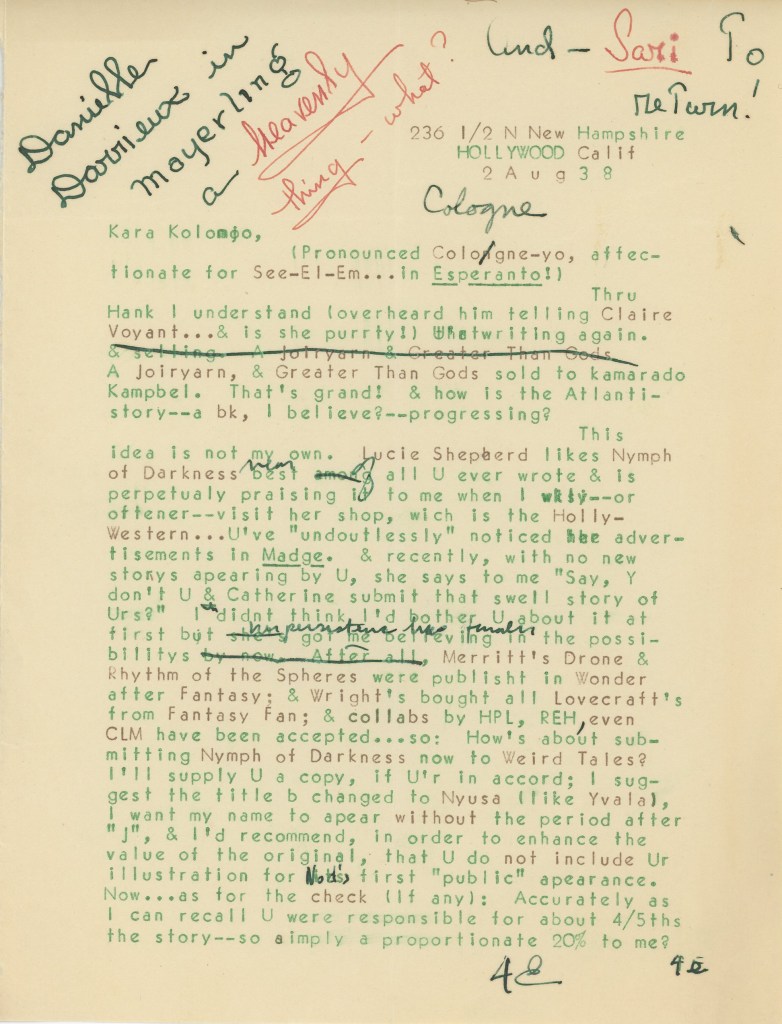
How’s about submitting Nymph of Darkness to Weird Tales? I’ll supply U a copy, if U’r in accord; I suggest the title b changed to Nyusa (like Yvala), I want my name to appear without the period after “j”, & I’d recommend, in order to enhance the value of the original, that U do not include Ur illustration for Nod’s first public appearance. Now . . . as for the check (if any): Accurately as I can recall U were responsible for about 4/5ths the story—so simply a proportionate 20% to me?

Forrest J Ackerman to C. L. Moore, 2 August 1938 (draft letter)
“4e” had a fondness for simplified spelling.

What kind of arrangement Moore and Ackerman came to is not clear, but Wright apparently accepted it by September 1938, and “Nymph of Darkness” was published in slightly expurgated form over a year later in Weird Tales December 1939—one of Wright’s final issues. While there are a few changes in formatting, punctuation, and spelling between the Fantasy Magazine and Weird Tales versions, the most notable difference between the two texts is a handful of changes to remove reference to Nyusa’s nudity:

Fantasy MagazineWeird Tales
His startled arms closed about a woman—a girl—a young girl, beautifully made, muscular and firmly curved under his startled hands—and quite naked.His startled arms closed about a woman—a girl—a young girl, beautifully made, muscular and firmly curved under his startled hands.
I did not know you, save that I think you are of Earth, and perhaps—trustworthy.I did not know you, save that I think you are of Earth, and perhaps trustworthy.
“No. But a Martian, or one of my own countrymen, would not so quickly have released a girl who dashed into his arms by night—as I am.”

In the dark Smith grinned. It had been purely reflexive, that release of her when his hand realized her nudity. But he might as well take credit for it.
“No. But a Martian, or one of my own countrymen, would not so quickly have released a girl who dashed into his arms by night.”

In the dark Smith grinned.

It was a blasphemy and an outrage against the eyes, against all that man hopes and believes and is. The darkness of the incredible, the utterly alien and opposed.It was a blasphemy and an outrage against the eyes, against all that man hopes and believes and is; the darkness of the incredible, the utterly alien.

The readers of Weird Tales received this new Northwest Smith story more positively, but possibly Moore sided more with Lovecraft—or simply didn’t care for the collaboration. It is notable that “Nymph of Darkness” was not included in any of the English-language collections of Moore’s Northwest Smith stories during her lifetime, and really only reprinted near the end, in the Denvention II program book, where Moore was scheduled as a guest of honor.

After Moore died in 1987, Ackerman and others published the story (which was in the public domain) more widely; and in most instances the text used was the unexpurgated version from Fantasy Magazine, with afterword and explanatory essay by Forry. In Sci-Fi Womanthology (2002) and Expanded Science Fiction Worlds of Forrest J Ackerman and Friends, Ackerman even managed to finally give it the title he wanted: “Nyusa, Nymph of Darkness.”

As far as the story itself…to say that the idea of a lithe, naked, invisible young woman that falls into the hero’s arms is a very Ackerman conceit would be an understatement. Forry would revisit the idea several times in other stories, most notably in “The Girl Who Wasn’t There” (1953) by Tigrina & Ackerman, and “The Naughty Venusienne” (1956) by Morgan Ives (Marion Zimmer Bradley) and “Spencer Strong” or “Otis Kaye” (Ackerman), depending on the publication. The idea is fairly fannish, forcing a slightly antiheroic sci fi series character into close quarters with a naked young woman.

The prose, however, is all Moore’s, and Moore takes the idea and runs with it. While not as original as many of her other stories from the 30s, “Nyusa” falls firmly into the science-fantasy field, where a rogue of the space ways might well encounter the cult of an obscure god and the hybrid child. While it isn’t quite “Northwest Smith goes to Dunwich,” there are broadly similar ideas that are being repurposed into a space opera concept, and Moore does her best with the bare bones of a plot that Forry provided.

“Yvala” (1936)

Unlike “Nymph of Darkness,” C. L. Moore’s Northwest Smith story “Yvala” was first published in Weird Tales February 1936 issue—and under her own byline, with no mention of Ackerman’s involvement. Unlike “Nymph of Darkness,” “Yvala” made the cut for the 1954 collection Northwest of Earth that collected most of Moore’s other non-collaboration Smith stories, and it was reprinted several times during her lifetime. We get a hint of Ackerman’s involvement in “Yvala” from his 1938 letter to Moore above (“suggest the title b changed to Nyusa (like Yvala)”). After Moore died in 1987, Ackerman wrote:

En passant, it is a virtually forgotten fact—except by Sharane Yvala Dewey, a woman I knew as a little girl, who was so named by her science fiction author father G. Gordon Dewey, who was captivated by the name of A. Merritt’s heroine in The Ship of Ishtar and the Yvala of Catherine Moore’s Northwest Smith adventure of the same name—it is a practically unknown fact that I created the character (pronounced Ee-vah-lah). I hope it’s not unchivalrous to suggest it, with dear Catherine so mentally decimated by Alzheimer’s disease that she has not known me or herself of what she wrote for two years or more (1987), but reflecting on the origin of the story it occurs to me I might retroactively be entitled to a byline on “Yvala” because in retrospect I feel I contributed about as much inspiration and plot gimmick to it as I did to “Nymph.” I will not belabor the point, however, since Catherine’s memory is a blank book and she is in no position to agree or disagree with my observation.

Forrest J Ackerman, “The Genesis of an Invisible Venusienne,” Ackermanthology 267, Echoes of Valor II 90-91

A decade and change later, Ackerman published the story as by “C. L. Moore and Amaryllis Ackerman,” and slightly expanded on this explanation:

Amaryllis? I confess: ’tis I, FJA. Had I been born a girl, that is the name my parents had selected for me. So what is my byline doing on this strange interplanetary story from the pages of Weird Tales in 1936? Because I have just walked up to the realization, 66 years later, that I was as much a collaborator on this story as on “Nyusa, Nymph of Darkness”! I contacted Catherine, under the spell of the Russian screen siren Anna Sten, and outlined the plot and named the character. Some years later when I met a Mr. & Mrs. G. Gordon Dewey, I recognized the name of one of their daughters, Julhi, as being a CLMoore name, but the middle name of Sharane (Merritt’s The Ship of Ishtar heroine) beffled me. “Eve-uh-lah? How do you spell that?” “Y-v-a-l-a.” “Ee-vah-la!” I exclaimed. “Why, I made up that name!” Today Sharane Yvala Dewey is nicknamed Syd and is a grandmother living in the Hawaiian islands. Yvala’s inspiratory, glamorous Anna Sterm (whose first husband was an Esperanto korespondanto of mine in Kiev)—ascended to anglehood several years ago—but not before being on all-fours in my living room playing with out cat Meetzi.

Forrest J Ackerman, Expanded Science Fiction Worlds of Forrest J Ackerman and Friends (2002), 59

No details on the inspiration or writing of “Yvala” have appeared in any of Moore’s surviving correspondence that I have seen, so we really have only Forry’s word on it. Reading the story, it is difficult to pick out Ackerman’s influence, except possibly by the seediness—Smith and Yarol are hired to go to an alien planet to kidnap women into sex slavery. That slavery exists in the Northwest Smith series was firmly established in “Black Thirst,” so that’s not necessarily unusual; but where that was something like an Oriental harem out of the Thousand and One Nights set, this one is closer to a sex trafficking tale of the more unpleasant pulp variety. There is something of “Black Thirst” too in the character of Yvala, a kind of embodiment of the inhuman beauty sought by the Alendar in that tale.

What saves “Yvala” is pure description and characterization; Moore throws herself into the description of Smith, the spaceport, and the strange alien world they land on. The climactic battle of wills echoes similar contests in “Shambleau,” “Werewoman,” and other stories. If it isn’t one of Moore’s better stories of the period, it is only because it is a little too derivative in the nature of the threat and the final conflict, which Northwest Smith once again barely survives.

We do not know why the “collaborations” did not continue, although the date “Yvala” was published might give a clue: February 1936 was when C. L. Moore’s fiance died from a self-inflicted gunshot wound to the head, and she was depressed and unable to write for some months afterward—and then she came into correspondence with Henry Kuttner.

A Word on Forrest J Ackerman & #MeToo

In 2018 during the #MeToo movement, allegations surfaced of Forrest J Ackerman sexually harassing female fans, at least some of whom were underage. Given some of Ackerman’s proclivities over the decades, including his preference for young and scantily-clad or unclad women, this doesn’t really come as a huge surprise in hindsight. At the time it came as a shock to many that “Uncle Forry,” who had long been a public face for fandom of science fiction and monsters in general, subjected women and girls to unwanted sexual touching and other forms of harassment.

Does this knowledge change how we read “Nymph of Darkness,” “Yvala,” and the whole relationship of collaboration between a young Forrest J Ackerman and C. L. Moore? Is there a certain additional skeeviness to the depiction of Nyusa, whose age is never given, as being naked all the time…or is that a more garden-variety bit of taboo-daring sensuality that Moore was happy to roll with? Given that Ackerman had several more decades to put forth his narrative on these stories, we may never know the full details of their collaboration, whether Ackerman’s account is accurate, or what other interactions they had when they met in person or through continued correspondence.

In The Forrest J Ackerman Oeuvre (2012) by Christopher M. O’Brien, one particular entry caught my eye:

[“C. L. Moore.” Perret, Patti. The Faces of Science Fiction: Intimate Portraits of the Men and Women Who Spahe the Way We Look at the Future. New York: Bluejay Books, 1984.] (Ackerman ghosted this piece for the then-ailing Moore.)

The page in question can be viewed online. I don’t know O’Brien’s source for this claim, though it is believable. Moore suffered terribly from Alzheimer’s in her last few years, with failing memory; Ackerman also has a piece in the book; and Moore’s piece itself seems to be stitched together from bits and pieces of what she had written elsewhere about herself over the years, not really adding anything new. Yet even if written with the best of intentions, it showcases the way in which Forry was still shaping the narrative, and it adds a layer of distrust.

We know so little of Moore’s later life, that we have no idea what her actual relationship with Forry was like after the 1930s. Whether they had a falling-out or drifting-apart, if they remained friends, if he did something inappropriate…we don’t have Moore’s side of the story. Lacking that, and with Ackerman’s own known proclivities to emphasize his part, and even to put words in Moore’s mouth—how much do we really know about these stories and their collaboration at all?


Bobby Derie is the author of Weird Talers: Essays on Robert E. Howard and Others and Sex and the Cthulhu Mythos.

Deep Cuts in a Lovecraftian Vein uses Amazon Associate links. As an Amazon Associate I earn from qualifying purchases.
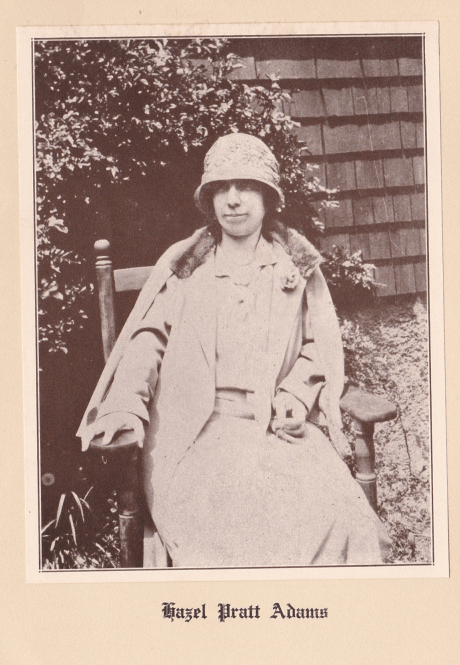
Her Letters To Lovecraft: Hazel Pratt Adams

A visit was also made to Eglin’s book store where Sam Loveman delighted all who had the privilege of becoming better acquainted with his magnetic personality. He was one of the most pleasing surprizes of the convention, and like Howard Lovecraft, despite his profound poetical effusions, is really quite human and intensely interesting.

Hazel Pratt Adams, “The National Convention” in The Brooklynite July 1923

She was born Hazel Bosler Pratt on 10 January 1888 in New York City; the middle child of Abram E. Pratt and Jeannette (also spelled Genette or Jannett in various census rolls) Bosler Pratt. Her early life is somewhat vague; census data indicates she was still living with her family through 1910, and her obituary claims:

Financial reverses made it necessary for her to enter business life at an early age, and she was first employed in different financial institutions of Brooklyn, later becoming secretary to George McLaughlin, who afterward became State Superintendent of Banks and Police Commissioner. She also did considerable newspaper and magazine work, including contributions to Brooklyn Life, over a pariod of many years […]

The 1910 Federal census lists her profession as stenographer, and that she was then working as a private secretary; a 1915 criminal trial of banker Edward M. Grout brought Hazel in as a witness, as she had worked as a stenographer for him in 1908, and a 1911 list of those who passed civil service exam for stenographers lists Hazel Pratt. From all this, we can gather that she was literate, competent, and professional.

What this obituary does not mention is her amateur journalism activity. While it isn’t entirely clear when Hazel joined amateur journalism, she was elected the inaugural Official Editor of the Brooklyn Amateur Journalists Club in 1908—which in 1912 would change its name to the Blue Pencil Club. Pratt would serve various roles in the Brooklyn club, including Secretary/Treasurer (1910), and the editor/publisher of the amateur journal The Brooklynite. In 1912, she was elected president of the newly-labeled Blue Pencil Club, and various newspaper articles indicate the club frequently met in her home. Her involvement also spread to other organizations; in 1911 she was listed as Eastern manuscript manager for the United Amateur Press Association, and in that same year attended a convention of the Interstate Press Association.

Hazel was presumably working as a stenographer during this time, and helping to care for his mother; her other interests are unknown, although a 1912 letter to the editor on the subject of women’s suffrage suggests she was forward-looking and politically conscious.

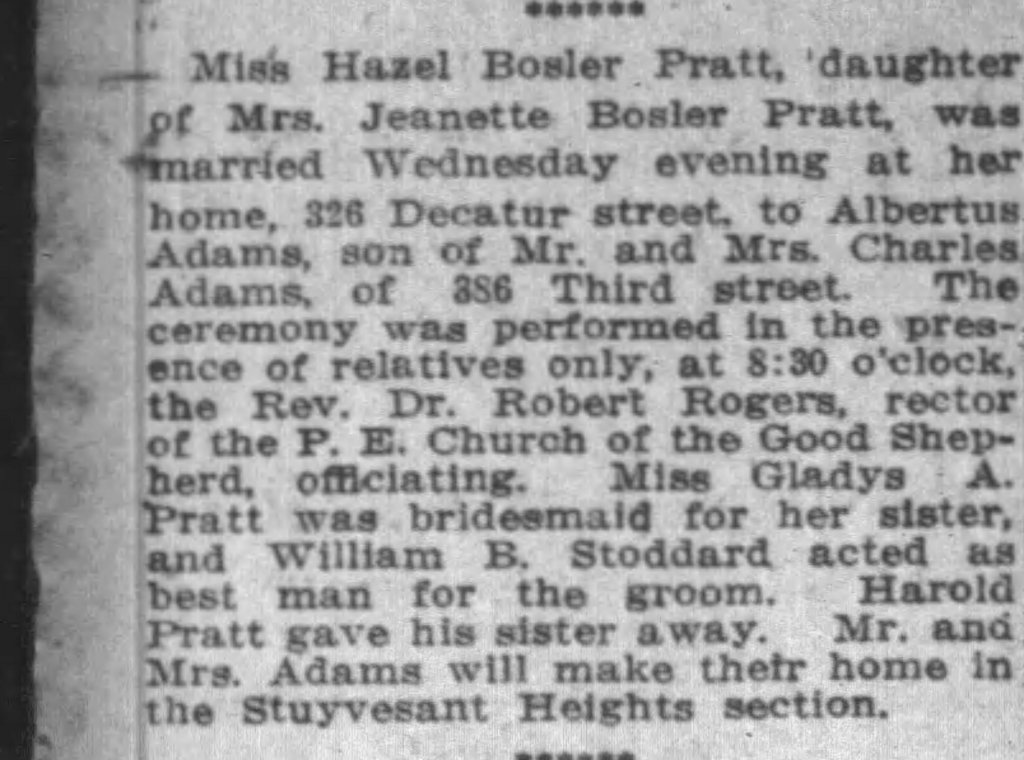
In 1914, Albertus Milton (A. M.) Adams (1879-1952) was elected President of the Blue Pencil Club, with Hazel Pratt Adams as the secretary and treasurer. A. M. Adams was the editor of the National Hotel Review, and with Hazel’s work in newspapers and magazines as well as amateur journalism, they seem to have shared interests in literature. By the end of the year, they were married.

So it was that when H. P. Lovecraft joined amateur journalism in 1914, he would likely have known her only as Hazel Pratt Adams. His first mention of her is from around this time:

Mrs. Adams’ essay on ghosts displays considerable literary knowledge, though the anecdote at the end is rather ancient for use today. We last heard it about ten years ago, with a Scotchman instead of a negro preacher as the narrator, and with the word “miracle” instead of “phenomena” as the subject.

H. P. Lovecraft, “Department of Public Criticism” (United Amateur Mar 1915), Collected Essays 1.23

Married life must have been interesting. In 1916, the Adamses bought the Tupper Lake Herald, a local newspaper for Tupper Lake, N.Y., and ran it for three years. Two sons were born to the marriage, Raymond Pratt Adams (5 Sep 1917-19 Dec 2010) and Charles LeRoy Adams (7 May 1920-9 Jan 1996), and Hazel continued her involvement in amateur journalism. In 1916, Hazel was named the Official Editor of the National Amateur Press Association.

In 1922, William B. Dowdell was elected as president of the National Amateur Press Association. Dowdell subsequently resigned, and H. P. Lovecraft filled out the remainder of his term. During his time in office, Hazel Pratt Adams impressed Lovecraft with her dedication to quality and leadership:

To stimulate more publishing, which we need so desperately, Mrs. Hazel Pratt Adams has unselfishly offered to assume complete charge of the issuance of any paper which any member may care to publish, attending in full to the arrangement, printing, addressing, and mailing, at a charge of only $20 for eight pages or $12.50 for four pages the size of the recent Brooklynite. This opportunity is so marvellously favourable, and so easy for even the newcomer, that we see no excuse for the lack of a striking revival of individual publishing.

H. P. Lovecraft, “President’s Message” (National Amateur Mar 1923), Collected Essays 1.325

When the next election loomed in 1923, Lovecraft wanted someone else—ideally someone ideologically in line with his vision for the organization, in terms of supporting high literary and print quality, even at the sacrifice of frequency—to lead the organization. The candidate settled on was Hazel Pratt Adams.

Concerning that other dark shadow, whose bat-wings flapped so menacingly above the bright lights of that elegant dining saloon where I was so mercilessly grilled, I am half convinced that the fates have saved me by giving to Mrs. A. an unalterable resolution to continue her candidacy. At least, I received from her an epistle wherein, besides a two-buck checque for the O.O. fund, was distinct mention of a campaign requiring money, & of a prospective Adams-and-Liberty journal to be intitul’d The Campaigner.

So, as Ya-know-me-Al would put it—that’s that! If Mme. Eve & Bro. Mortonius choose to alter their deep-laid designs, I suppose I can’t help myself; but just now it looks as though they were sailing ahead in fine shape, so that Fortuna will spare a victim whose (semi-)willingness to mount the scaffold hath been so conclusively demonstrated. But even so, I hardly look for utter chaos. Something’s been started, & if the ball is well rolling by the nones of Quintilis it will surely have enough momentum to keep on a while. It’ll take a full year to wipe Mike White off the map—& you can be sure Long & Galpin won’t still till that’s done! Still—me word is gave, & if the Adams-Morton move is changed, I stand ready for the axe.

H. P. Lovecraft to Edward H. Cole, 23 Feb [1923], Letters to Alfred Galpin & Others 42-43

I find that J. Ferd. [Morton] is completely & finally committed to the Adams candidacy, & that any other move would now be a positive act of hostility toward him. He is too far committed to withdraw without seeming traitorous to the Adams cause; a cause which he embraced because he knew how abhorrent office-holding is to me. […] [45] However, as I said before, I believe that the Adams arrangement will agreeably surprise you. Mrs. A. is certainly a capable routine administrator, & Morton assures me that he stands firmly in the background as an inspiration & intellectual influence . . . . . not that he uses those words, which from him would be less becoming than from another! He will continue whatever policy is started this term—& Mrs. Adams is heartily ready to act as a sympathetic standard-bearer.

H. P. Lovecraft to Edward H. Cole, 24 Feb [1923], Letters to Alfred Galpin & Others 44, 45

“Mme. Eve” was apparently Lovecraft’s nickname for Hazel—because she was the wife of Adam(s). As puns go, it isn’t very good, but a ticket with Hazel Pratt Adams and James F. Morton was a strong one. Cole, apparently, was not happy about this nomination, and had wanted Lovecraft to run.

About the Cole mess—I’d better curl up with a bottle of cyanide & get it over with before I do any more harm to myself and others. Bah. Probably I’ve incurred his undying coldness—he hasn’t answered that definitively declinatory epistle yet—and now Mrs. Adams writes that he’ll probably be peeved at her! Undertaker, put a good shot of embalming fluid in the old simp’s head—it’s been dead a long time. Tell Mrs. A.—though I’ll answer her myself in a day or two—that I’ll take all the Colic blame myself & exculpate her, & you, & everybody but poor me—in toto. He might as well be damn mad at one guy as half mat at several birds.

H. P. Lovecraft to James F. Morton, 1 Mar 1923, Letters to James F. Morton 26-27

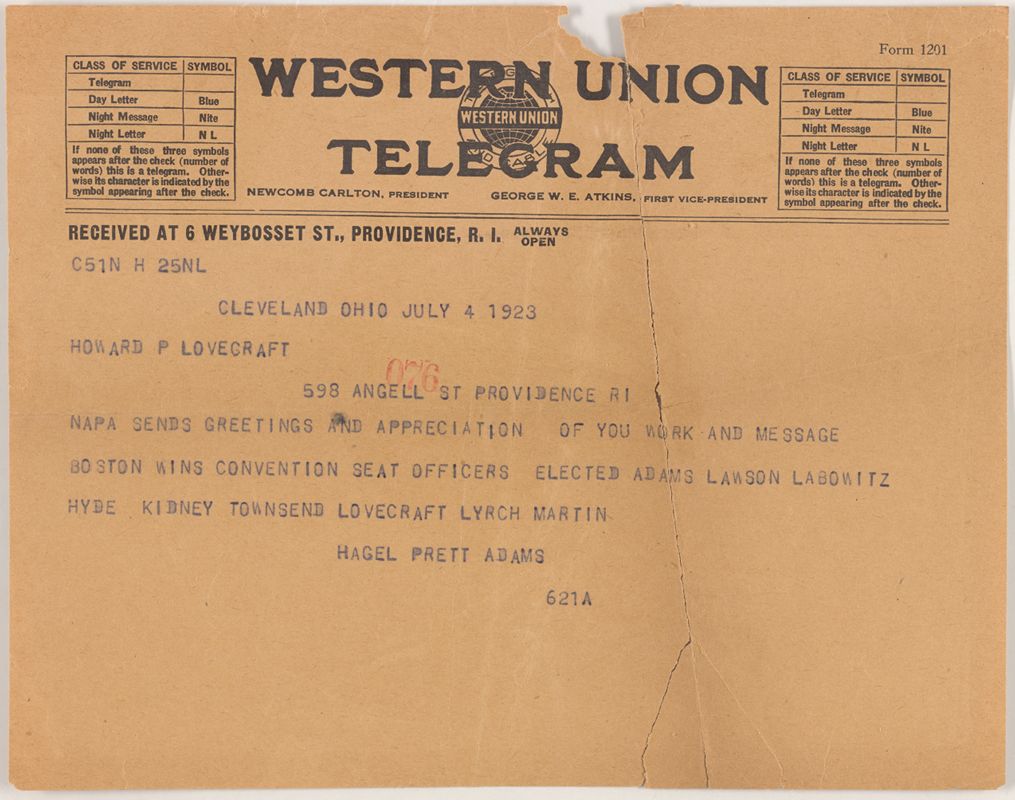
“Her epistle” suggests that Lovecraft and Hazel Pratt Adams were in correspondence by this time; when and how this started it is not clear, but presumably came about through his NAPA presidency, if not before. As it happened, with the support of Lovecraft and Morton, Hazel Pratt Adams was elected almost unanimously as the 4th woman president of the National Amateur Press Association. From the convention, she sent Lovecraft a telegram:

It was apparently not an easy time for her:

President Adams labored under serious difficulties, personal and otherwise. Throughout her entire term illness in her family added to her burdens. But she set an excellent example of activity by publishing 15 papers, and although the institution was entering upon one of its periodical times of depression, she maintained the high standard of work established by her predecessor.

The Fossils: History of the National Amateur Press Association

Lovecraft, for his part, was busy with his other things. On 3 March 1924, Lovecraft married Sonia H. Greene in New York; the couple set up their household in Brooklyn. Among their first visitors was Hazel Pratt Adams:

We had our first callers yesterday—Mrs. Adams of Plainfield, N.J., and Mrs. Myers of Cambridge, who is visiting Mrs. Adams before sailing for Paris for six months. They seemed very favourably impressed with the new household, and S.H. assures me that I did not appear altogether ridiculous as a host.

H. P. Lovecraft to Lillian D. Clark, 18 Mar 1924, Letters to Family and Family Friends 1.115

Sonia had been a member of the Blue Pencil Club, and almost assuredly was already friends with Mrs. Adams; it isn’t clear if this is the first time Lovecraft met Adams in person, or if they had met at an earlier convention, or Lovecraft’s prior trip to New York. In any event, it was the newlywed’s first time receiving callers as a couple.

Lovecraft apparently continued to correspond with Hazel Pratt Adams through at least 1925, because “The Horror at Red Hook” was composed on the backs of a letter dated 13 November 1925 (Midnight Rambles 225n78). The text of this letter has not yet been printed, and no other letters from the Hazel Pratt Adams/H. P. Lovecraft correspondence are known to survive.

Hazler Bosler Pratt Adams died on 6 August 1927. The cause of her death was not recorded in her obituary.

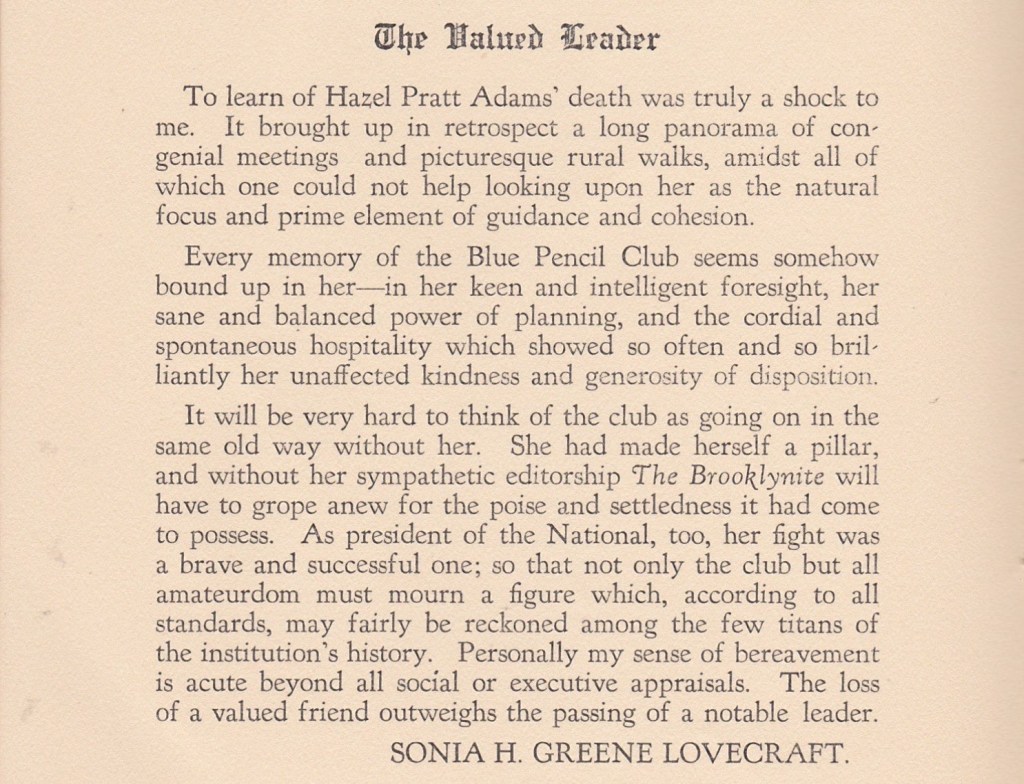
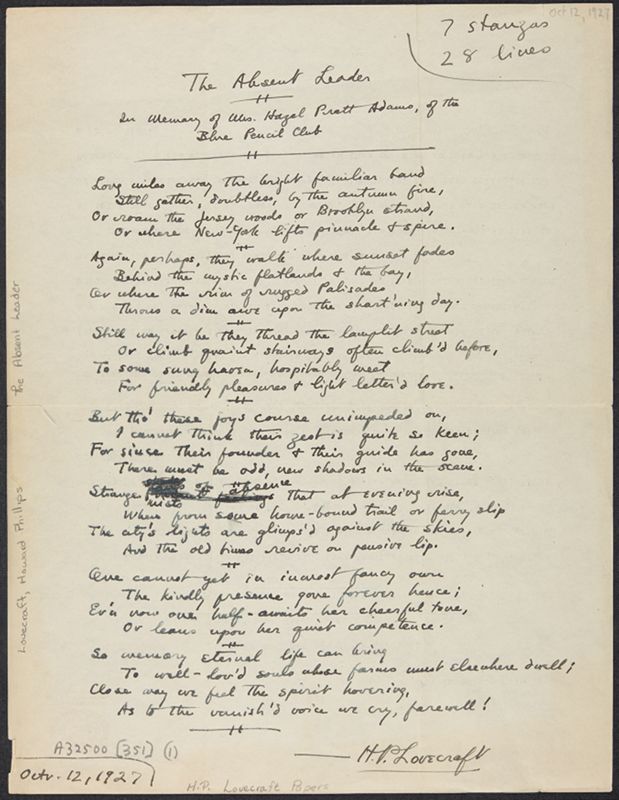
The Blue Pencil Club arranged the publication of In Memoriam: Hazel Pratt Adams. Sonia and Howard Lovecraft both penned tributes to their friend:

Source: The Papers of Sonia H. Davis, by Monica Wasserman

With such scanty evidence, it is difficult to say anything for certain about the friendship and correspondence of Hazel Pratt Adams and H. P. Lovecraft, except that they did correspond, and they were friends. They shared friends and interests in common, and wrote well (if sparingly) of one another. What else they might have talked about, we may never know, unless some new cache of letters turns up.

Thanks and appreciation to Monica Wasserman for her help with this piece.


Bobby Derie is the author of Weird Talers: Essays on Robert E. Howard and Others and Sex and the Cthulhu Mythos.

Deep Cuts in a Lovecraftian Vein uses Amazon Associate links. As an Amazon Associate I earn from qualifying purchases.
Unfinished Autobiography Fragment (1982) by C. L. Moore

There is no full biography of C. L. Moore.

This may seem a little weird, considering how immensely popular C. L. Moore and her fiction were during the heyday of Weird Tales. After her marriage to fellow writer Henry Kuttner in 1940, Moore’s profile dips—not because she was writing less, but because much of their shared output was published either under Kuttner’s name, or one of their shared pseudonyms such as Lewis Padgett. Her writing career shifted as she began to write for television in the 50s. After Henry Kuttner’s death in 1958, she remarried again to Thomas Reggie, and her writing career largely ceased, though publications of her previous work, and the occasional foreword or introduction, continued.

The last years of her life are a bit murky. Biographical focus has always been on her working years, and the fiction she wrote, the romance of her first marriage. Awareness of her work, and the degree of her collaboration with Kuttner, grew by leaps and bounds among fans, and in 1981 she won the World Fantasy Award for lifetime achievement, and was nominated for the Gandalf Grand Master award (the only woman to ever be so nominated). Yet Catherine withdrew from conventions and meetings; her interactions with friends and fandom dwindled, ceased giving interviews. Alzheimer’s disease was the diagnosis. She died in 1987.

This is not to say that no biographical materials exist for C. L. Moore. “An Autobiographical Sketch of C. L. Moore” was published in the May 1936 issue of Fantasy Magazine. Various reference works have given the raw data of at least a part of her life, including:

  • “Genius to Order” by Damon Knight in In Search of Wonder (1956)
  • “C. L. Moore: Catherine the Great” by Sam Moskowitz in Amazing (Aug 1962), which was reworked into a chapter of Seekers of Tomorrow (1966)
  • “Modern Masters of Science Fiction: 12: Henry Kuttner and C. L. Moore” by William Gillings in Science Fiction Monthly (Jun 1975)
  • “Henry Kuttner, C.L. Moore, Lewis Padgett et al.” by J. Gunn in Voices for the Future: Essays on major science fiction writers, vol. 1 (1976)
  • Moore’s entry in The Encyclopedia of Science Fiction and Fantasy, M-Z (1978)
  • “C. L. Moore and Henry Kuttner” by Frederick Shoyer in Science Fiction Writers (1982)
  • Moore’s entry in Contemporary Writers vol. 104 (1982), which includes a long interview by Jean W. Ross
  • “C. L. Moore” by Russell Letson in Supernatural Fiction Writers Fantasy and Horror vol. 2 (1985)
  • Moore’s entry in the Encyclopedia of Pulp Writers (2002) by Lee Server
  • Moore’s entry in Fifty Key Figures in Science Fiction (2009) by Brian Attebery

Among many other entries. Most of these are very outdated; some get facts wrong, most don’t cite their sources as well as they might be hoped to. A full picture of C. L. Moore’s life and work simply hasn’t been put together at this time. Other secondary sources tend to be scattered; works like C. L. Moore and Henry Kuttner: A Working Bibliography (1989) by Virgil Utter are convenient, but a good deal of bibliographical work has shifted to online sources like ISFDB.org and philsp.com…and while those sites may be useful, they are rarely complete or completely accurate. Critical literature about Moore’s fiction is more robust, especially that focused on her position as a woman science fiction writer, though her work is so mixed with Kuttner that no truly comprehensive assessment has ever been attempted.

Which isn’t to say there isn’t ample material for a fuller biography.

A handful of interviews conducted during Moore’s lifetime have seen print; there are some biographical snippets in her introductions and afterwords to various books; letters to and from H. P. Lovecraft and Robert E. Howard have been published, and among the unpublished letters known to survive a cache of correspondence from C. L. Moore at Brown University. Memoirs lurk in odd places; E. Hoffmann Price included reminiscences of C. L. Moore in his chapter on Henry Kuttner in his Book of the Dead. Fanzines [PDF], newspapers, and genealogical databases all contain useful and interesting information, including never-republished interviews [PDF] and letters to records of her marriages, details of her workplace, family data, etc. Letters to and from friends, editors, fans, and literary agents may yet linger in some archive, waiting to be re-discovered.

There is also the open question of what files or papers may yet survive, either in the possession of C. L. Moore’s heirs or collectors. When Frederick Shoyer wrote the entry on Moore and Kuttner for Science Fiction Writers, he quotes both from Henry Kuttner’s diary and from the “manuscript of [an] unfinished autobiography of Moore”:

Hank and I were hooked on the glorious feeling of having a story take the typewriter in its teeth and tearing off into the distance, we panting along trying to keep up—pages rolling up out of the typewriter and falling to the floor before we knew it was down to the bottom of the page. To be panting along behind a headstrong story like that is one of life’s major glories—a high better than drugs or drink. You summon it like a God to his altar, and He descends in his glory and inhabits the brain until the mind ceases to be a thing in itself and becomes part of a tremendous on-rushing stream. your only contribution being to hang in there and type fast enough to keep up.

Probably you have to train your mind to function this way, unconsciously of course, but it does trian itself because the reward is so glorious. When Hank finished a story, he felt at the time that it was not only the best he had ever written, but probably the best anyone had ever written. Re-reading usually brought second thoughts, but not always, sometimes it really was!

The glow of triumphant complacence can last for days. You have to let the story get cold before you re-read it critically, to catch the small errors which infest every rough first draft, the repetition, the unclear sentences, the spots that need cutting or expanding. As if the words which had come white hot from the crucivile were too hot from the creator to defile with one’s own crassly human alterations until the heavenly glow and heat had died out of them.

Science Fiction Writers 164

When was this written? Henry Kuttner is spoken of in the past tense, so sometime after his death in 1958, and probably before the decline of Alzheimer’s set in completely. Given the date, Shoyer may have gotten the materials from Moore herself; whether they still survive as part of her estate, or were lost with the passage of years, is unknown. All that was ever published was this fragment.

How nice it would be, to have more of C. L. Moore’s story in her own words.

For those involved with pulp studies, the fans and scholars of H. P. Lovecraft and Robert E. Howard are spoiled for choice when it comes to biographies and the raw materials. Many writers have assayed to capture their life, several publishers have worked hard to catalogue their writing, print and re-print their every word. Few other writers of the 1930s received anything like that attention; the full letters of Dashiell Hammet have never been published, for instance, and while you might find a biography of Walter B. Gibson (creator of The Shadow), there has never been a full biography of Seabury Quinn (creator of Jules de Grandin).

Most pulp authors linger in semi-obscurity; some are lost for good, remembered only by a few stories and bylines in crumbling pulp magazines. C. L. Moore has not suffered that fate—if anything, her star has been on the rise lately, with the Black God’s Kiss RPG and a new, authorized Jirel of Joiry story by Molly Tanzer for New Edge Sword & Sorcery magazine.

Perhaps someone will finally put all the pieces together and give a full biography of C. L. Moore. All the pieces are there.


Bobby Derie is the author of Weird Talers: Essays on Robert E. Howard and Others and Sex and the Cthulhu Mythos.

Deep Cuts in a Lovecraftian Vein uses Amazon Associate links. As an Amazon Associate I earn from qualifying purchases.
Quest for the Green Hills of Earth (1995) by Ned Brooks

Chacal: Rumor has it that you didn’t particularly care for the story in which Jirel met Northwest [Smith], “Quest for the Star Stone.” Could you give us a little background on the tale; the how and why of it?

Moore: I’d forgotten that I maybe like “Quest of the Star Stone” least—that doesn’t mean I dislike. If I said so, I expect it’s true. And if true, my guess would be that in this first Kuttner/Moore collaboration the machinery of working together had to be refined and worked over more before it functioned well. Hank and I had met, I think, a short time before this. Or had we met at all? Or only corresponded? Anyhow, he was urging me to do another Jirel and sent on a kind of opening situation to see if I would feel any interest. I did and we sent the Ms. back and forth to the best of my very dim recollection until we were ready to submit it. remember this was all 40 years ago and a lot has happened since.

“Interview: C. L. Moore Talks To Chacal” in Chacal #1 (1976), 28

They were not yet married. Catherine Lucille Moore had broken into Weird Tales with “Shambleau,” the first story of Northwest Smith, interstellar outlaw, in 1933; her fantasy heroine Jirel of Joiry followed in “Black God’s Kiss” in 1934. Henry Kuttner broke into Weird Tales with “The Graveyard Rats” in 1936. Both Moore and Kuttner were correspondents of H. P. Lovecraft. After C. L. Moore’s fiance died in February 1936, through Lovecraft she and Kuttner came into correspondence…and not immediately, but over time, that grew into something more. They married in 1940, and would go on to become one of the most famous writing teams in science fiction. Yet their first collaboration was one of their weirdest, and has arguably the oddest legacy.

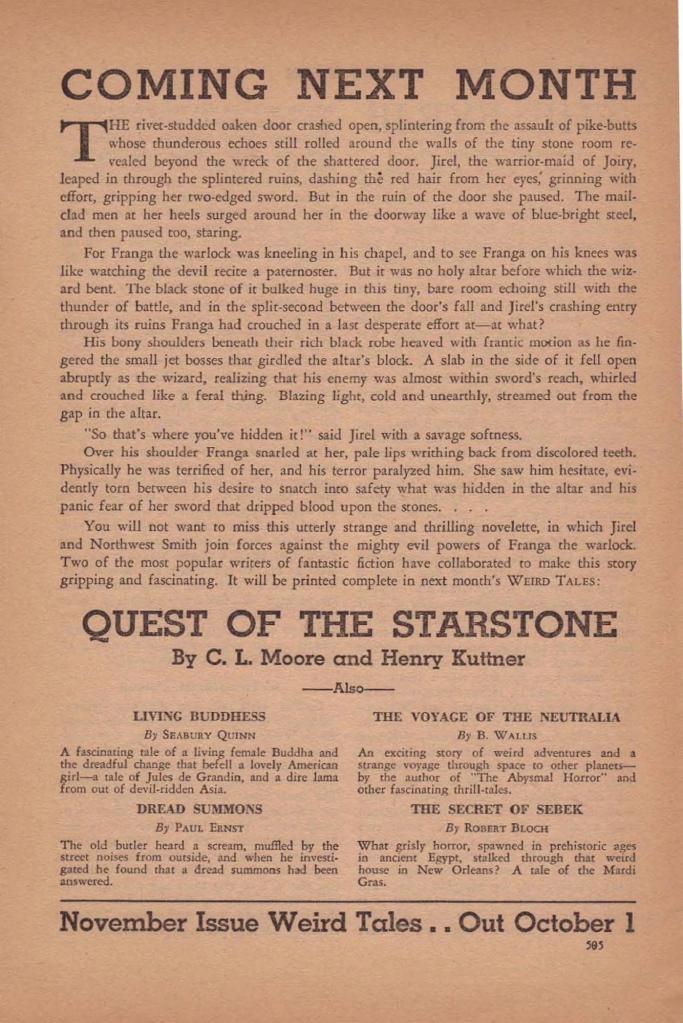
“Quest of the Starstone” was published in the November 1937 issue of Weird Tales; the two characters Northwest Smith and Jirel of Joiry had heretofore occupied completely separate settings with no connective elements, but there was a precedent for an author bringing two disparate characters together. Robert E. Howard had brought the Pictish king Bran Mak Morn and King Kull of Atlantis together in “Kings of the Night” (Weird Tales November 1930). Howard had a habit of developing common themes, backgrounds, and connective elements between many of his stories, so that such a chance meeting was less incongruous than it might have been.

Weird Tales Oct 1937 advert

Moore was nowhere near as devoted to building a consistent setting, but she had one advantage. Her stories of Northwest Smith and Jirel of Joiry never drew a hard line between science fiction and fantasy. It was not uncommon for Jirel to end up in some other dimensional, dealing with an alien entity; nor was it strange for Northwest Smith to turn his raygun against alien gods or sorcerers. In both stories, science and sorcery were part of the same spectrum, and either worked well as an explanation. Henry Kuttner, especially early in his career, was adept at pastiche and able to turn his hand to nearly anything. While that did mean he sometimes struggled to find his own voice, when it came to collaboration, his prose often flowed seamlessly with his partner’s.

As their first collaboration, “Quest of the Starstone” is a bit stiff. While the prose is competent, neither Kuttner or Moore is at their best, and the sensual, often dreamlike prose that characterized Moore’s solo efforts at both characters is often missing in a rather straightforward plot to get the two heroes to meet, team-up, and overcome a mutual for in a way that would become familiar to generations of superhero comics fans. Yet there is one passage in particular that had a longer and odder life.

Homesickness he would not have admitted to anyone alive, but as he sat there alone, morosely facing his dim reflection in the steel wall, he found himself humming that old sweet song of all Earth’s exiled people, The Green Hills of Earth:

Across the seas of darkness
The good green Earth is bright—
Oh, star that was my homeland
Shine down on me tonight. . . .

Words and tune were banal, but somehow about them had gathered such a halo of association that the voices which sang them were sweeter and softer as they lingered over the well-remembered phrases, the well-remembered scenes of home. Smith’s surprizingly good baritone took on undernotes of a homesick sweetness which he would have died rather than admit:

My heart turns home in longing
Across the voids between,
To know beyond the spaceways
The hills of Earth are green. . . .

What wouldn’t he give just now, to be free to go home again? Home without a price on his head, freedom to rove the blue seas of Earth, the warm garden continents of the Sun’s loveliest planet? He hummed very softly to himself,

—and count the losses worth
To see across the darkness
The green hills of Earth. . . .

C. L. Moore & Henry Kuttner, “Quest of the Starstone”

Who wrote this bit? Moore was the poet of the pair, but Kuttner was no slouch, and the title itself is a callback to two previous tales. In “Shambleau” Moore wrote: “[…] he hummed The Green Hills of Earth to himself in a surprisingly good baritone”; and in “The Cold Gray God” (1935):

No one sang Starless Night any more, and it was the Earth-born Rose Robertson’s voice which rang through the solar system in lilting praise of The Green Hills of Earth.

That could be the kind of detail that a good pasticheur like Kuttner would pick up and expand upon. Yet it wouldn’t be surprising if they both had a hand in the final version of this scene.

“Quest” was also almost the final appearance for both characters. Northwest Smith’s final appearance would be in “Song in a Minor Key” (1940), where Moore alludes to his exile and spoke of Earth as “a green star high in alien skies.” When Jirel of Joiry returned in “Hellsgarde” (1939), she does not mention Northwest Smith…but then, chronological continuity was seldom the strong point in either the Northwest Smith or Jirel of Joiry stories, except that “Black God’s Shadow” followed “Black God’s Kiss.” Like oil and water, the two characters drew apart.

For many years thereafter the story was quite scarce—Moore did not collect it in any her Northwest Smith or Jirel of Joiry collections in the 1950s or 60s. However, Sam Moskowitz claims:

When Robert Heinlein read the story, he never forgot the phrase which became the title of one of his most famous short stories and of a collection, The Green Hills of Earth.

Sam Moskowitz, Seekers of Tomorrow (1967), 312

“The Green Hills of Earth” ran in The Saturday Evening Post for 8 Feb 1947, and provided the title for Heinlein’s 1951 collection of science fiction. Heinlein himself claimed that he didn’t consciously realize he had lifted the phrase until after the story was published:

Two weeks after the sale was made, Vida Jameson was in bed with a cold, and Heinlein dug out some of his old Weird Tales pulps so she could read his favorite Northwest Smith stories by C. L. Moore. In the middle of reading, she sat up in bed, startled: she had discovered the title of Heinlein’s Post story in a passage in “Shambleau” where Northwest Smith is humming “The Green Hills of Earth” to himself.

Heinlein immediately apologized to Catherine Kuttner for unconsciously appropriating her intellectual property and asked for a formal release to use the song title.

The Kuttners, too, were delighted to learn about the sale to the Post and happy to make the release. They wrote him gloating congratulations.

William H. Paterson, Robert A. Heinlein: In Dialogue with His Century, Volume 1 (2010) 403

Subsequent publications would include the acknowledgment:

The phrase The Green Hills of Earth derives froma story by C. L. Moore (Mrs. Henry Kuttner), and is used here by her gracious permission

Heinlein did not reiterate Moore & Kuttner’s verses, but came up with his own—and attributed it to an author, the blind poet Rhysling. Both “The Green Hills of Earth” (song) and Rhysling would be mentioned in some of Heinlein’s other works, such as Farmer in the Sky (1950) and Time Enough for Love (1973). Heinlein’s work gained much more recognition than Moore and Kuttner’s, and his fictional poet Rhysling would in 1978 lend their name to the Rhysling Awards, an annual award for the best science fiction, fantasy, or horror poem—and in an unknown number of poems and filk music devoted to that enigmatic but evocative song, “The Green Hills of Earth.”

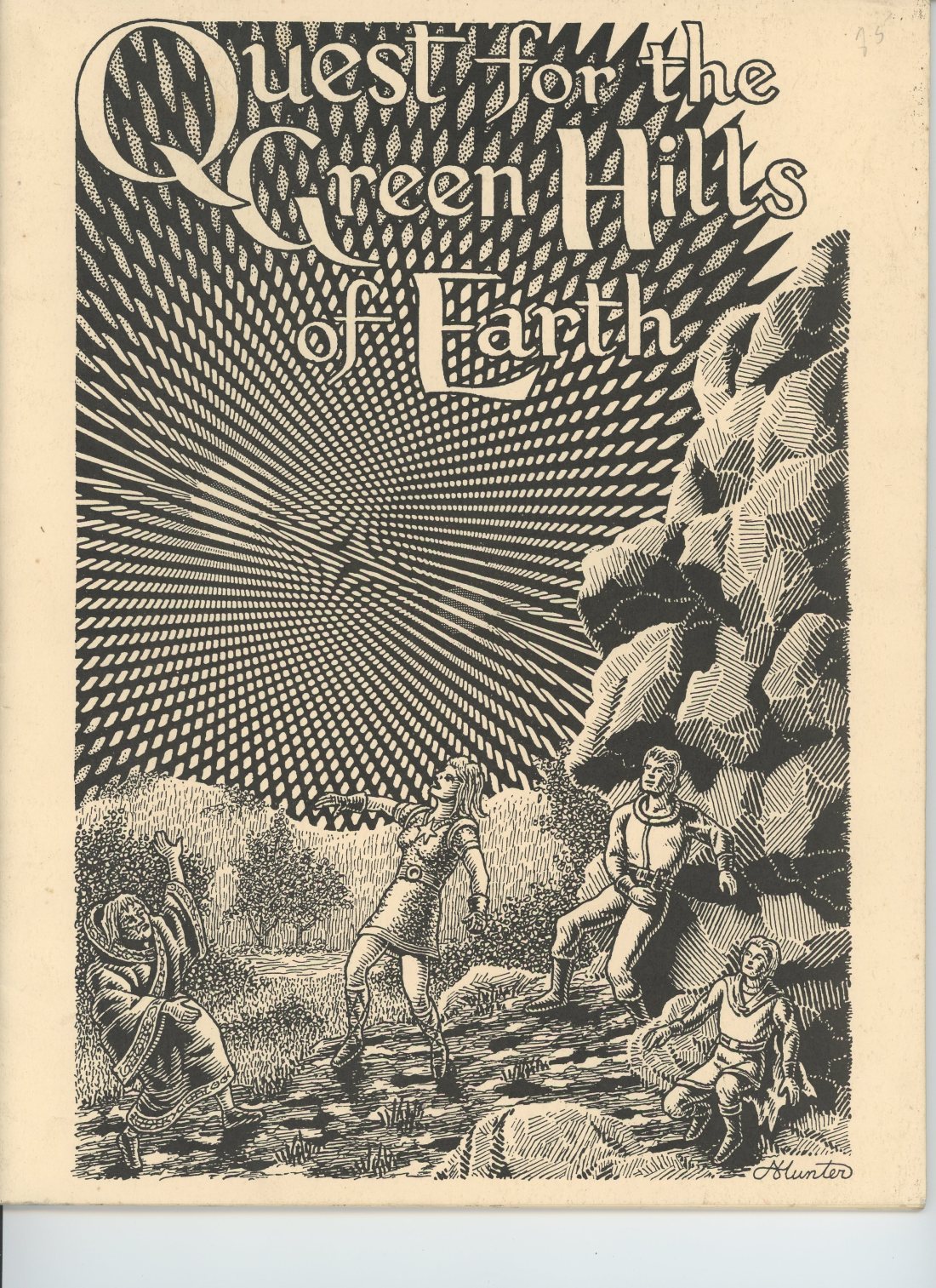
This is where Quest of the Green Hills of Earth (1995) comes in. Edited by Ned Brooks and illustrated by Alan Hunter, this is the kind of standalone chapbook that is a hallmark of science fiction and fantasy fandom. It reprints “Quest of the Starstone” in its entirety, Heinlein’s verses from “The Green Hills of Earth,” and three fan-made versions—one by Chuck Rein, George Heap, “and other fans of the 1960s”; one by Don Markstein (“late 60s”), and one by Steve Sneyd (Oct 1992). There is a brief article by Brooks tracing various recensions of the song to various tunes, both original and familiar—it has been sung to everything from “Greensleeves” to “Puff, the Magic Dragon,” and various dramatic presentations of “The Green Hills of Earth” or its song have been made and even marketed commercially. Brooks ends the booklet with sheet music for two versions, one composed by George Heap and the other by Joseph Kaye.

Curious listeners can listen to several versions of these songs, most based on Heinlein’s verses.

Why does it work? Why do just a few simple words strung together resonate with the hardboiled Northwest Smith, who could never go home again; and the blind poet Rhysling burned by radiation; and for all those generations of fans? I like to think it works because Moore, Kuttner, and Heinlein recognized a key aspect of science fiction: more than the hard science, the human emotion, the narrative of what it feels like to a person to go out to that distant frontier, matters.

I had thought that going into space would be the ultimate catharsis of that connection I had been looking for between all living things—that being up there would be the next beautiful step to understanding the harmony of the universe. In the film “Contact,” when Jodie Foster’s character goes to space and looks out into the heavens, she lets out an astonished whisper, “They should’ve sent a poet.” I had a different experience, because I discovered that the beauty isn’t out there, it’s down here, with all of us. Leaving that behind made my connection to our tiny planet even more profound.

William Shatner, “William Shatner: My Trip To Space Filled Me With Sadness,” Variety 6 Oct 2022

As it turns out, before we ever had an astronaut in orbit, a few poets did launch themselves into the great dark…for a little while, anyway…and captured something of that longing for home.


Bobby Derie is the author of Weird Talers: Essays on Robert E. Howard and Others and Sex and the Cthulhu Mythos.

Deep Cuts in a Lovecraftian Vein uses Amazon Associate links. As an Amazon Associate I earn from qualifying purchases.
“Shambleau” (1955) by C. L. Moore & Jean-Claude Forest

In 1933, C. L. Moore burst into the pages of Weird Tales with “Shambleau,” to immediate acclaim. The story was reprinted a couple of times over the ensuing decades, and formed the headline of Shambleau and Others (1953, Gnome Press), Moore’s first hardcover collection of her early Weird Tales fiction. The first foreign translation was in France in 1954, when it was translated for the anthology Escales dans l’infini (“Stopovers in Infinity”), translated by editor Georges H. Gallet.

The next year, Gallet’s translation was reprinted in V Sélections Été (Summer) 1955 issue.

V began publication as a weekly magazine in France in 1944 and went through several different names and editorial regimes, including V, V magazineVoir magazineVoirMLN illustrated magazine, and L’Hebdomadaire du reportage. V also spun-off several sister-titles, including V Cocktail, V Sélections, and V Spécial. All of the magazines in the V family seem to have shared the prominent feature of the female form, usually as a pin-up on the cover and as black-and-white photographs, illustrations, and cartoons throughout. G. H. Gallet was the editor-in-chief of the magazines.

The overall tone and audience is often hard to judge at this remove, like American men’s magazines of about a decade later, they appear to be a mix of general interest articles, fiction, slightly racy featurettes with nudes, and the kind of mildly risque cartoons that seem a bit innocent today. These were not, by any stretch of the imagination, pornography: each issue featured tasteful nudes, pin-ups, and bawdy jokes intermixed with a great deal of other articles, interviews, and features…and they had an eye for talent, sometimes featuring artists who would go on to a bit of fame and notoriety.

Jean-Claude Forest was born in 1930, and began working as an illustrator in the early 1950s. Like Gallet, Forest had a deep love of science fiction, and would become a renowned cover artist for the French sci-fi paperback series Le Rayon Fantastique, and achieve international fame for his sexy sci-fi epic Barbarella, created for V in 1962—his list of works, achievements, projects, and accolades is too long to go into here. Yet before Barbarella, he illustrated “Shambleau.”

Forest’s illustrations are a classic example of raygun gothic sensibility, and the same clear, sparse line work, framing, and figure-work will be familiar to fans of his comic strips. Yet he also took the opportunity to emphasize the sensuality and horror that is Shambleau, the scattered layout adds a certain dynamism to the blocks of justified text—and when Shambleau stands revealed, the text almost seems to give way before the tentacle-writhed woman who stands bold and stark on the page, eyes shadowed, rough as a crayon-sketch in places.

Forest seems to have taken relatively little inspiration from previous illustrations in Weird Tales—may not even have seen them—but appears to have at least been aware of the 1953 Gnome Press cover. Compare, for example, the characteristic shape of the “S” in the title at the opening of the story, and the “S” on the cover of the 1953 Gnome Press collection by Ric Binkley:

There is a certain irony to the fact that while non-English-reading audiences sometimes have to wait longer to get classic works of English-language weird fiction (and vice versa), sometimes when those works are finally made available, they are graced with the creative energies of more skilled artists and dedicated designers and editors. The original audience rarely gets a chance to appreciate this kind of art, since it is rarely translated back into English-language products.

Fortunately, in 2023, the original art by Forest was combined with Moore’s English-language text and an introduction by Jean-Marc Lofficier, and published by Hexagon Comics and Black Coat Press as The Illustrated Shambleau. While this lacks the dynamic swatches of grey and the distinct layout of the original, English-language readers who want to appreciate Forest’s art and Moore’s prose together can finally do so.

Better scans of the original pages can be seen at Cool French Comics, and those curious about the full magazine that “Shambleau” first appeared in can download it from here.


Bobby Derie is the author of Weird Talers: Essays on Robert E. Howard and Others and Sex and the Cthulhu Mythos.

Deep Cuts in a Lovecraftian Vein uses Amazon Associate links. As an Amazon Associate I earn from qualifying purchases.

“Jirel of Joiry: Into The Violet World” (1987) by C. L. Bevill and “Werewoman” (1994) by Roy Thomas, Robert Brown, Rey Garcia, and Susan Crespi

Why aren’t there more C. L. Moore comics?

Catherine Lucille Moore was a contemporary and correspondent of Robert E. Howard and H. P. Lovecraft; she was published in the same pulp magazine, Weird Tales, even collaborated with them on the round robin “The Challenge From Beyond” (1935). Her first story, “Shambleau” (1933), was an immediate hit with readers and weird fiction writers alike, and introduced the world to Northwest Smith, who would go on to star in a series of tales from Moore’s typewriter. Her next creation for Weird Tales, the flame-tressed swordswoman Jirel of Joiry in “Black God’s Kiss” (1934), was hailed as a female Conan.

In general outline, the Conan and Jirel publishing timeline largely lines up as well. Conan’s last original story in Weird Tales was in 1936; Jirel’s in 1939. Gnome Press published the first Conan hardcover in 1950, and the Jirel hardcover collection in 1954; paperback reprints for both appeared for both characters in the 60s as part of the general paperback Sword & Sorcery/fantasy boom. Sure, there were more Conan stories and they were more popular—is that the only reason why Robert E. Howard’s Conan the Cimmerian got the big break into comics when Jirel didn’t?

The boring, practical answer is probably “money.” Licensing a character, even an old pulp character, costs money, and anyone who did want to license Jirel for comics would have gone through C. L. Moore’s agent. Even relatively big publishers like Marvel had to balance cost versus popularity; according to Roy Thomas in Barbarian Life vol. 3, Marvel first approached Lin Carter’s agent about licensing Thongor of Lemuria because they thought Conan would be too expensive. Demographics might also have played a role; women warriors in fantasy have a long history, but in print and in comics, male characters dominated, as Nancy Collins noted when a very different red-haired swordswoman hit the page:

I was thirteen years old when I first saw Red Sonja. It was her debut appearance in the Conan the Barbarian comic book written by Roy Thomas and illustrated by Barry Windsor-Smith, back in 1973, and she was wearing a slightly more practical scale-mail tunic and leather hot-pants ensemble, but all the elements of her basic personality were there: bravery, skill with a sword, and the brashness necessary to go make a name for herself in the savage, male-dominated world of Robert E. Howard’s Hyborian Age.

She immediately grabbed my attention because there were so few strong female heroic characters back then, not just in comics but popular culture in general. (Moreover, the fact this outspoken and capable woman of action and I shared the same hair color did not hurt.) [I]t may be hard for today’s audience to understand, but in the 1960s and 1970s, with the notable exception of Wonder Woman and the Black Widow, most of the female characters in comics were either the girlfriends/wives whose role was to be menaced and/or kidnapped by the arch-nemesis of their heroic Significant Other (Lois Lane, Iris Allen, Gwen Stacy), young and far less seasoned distaff versions of well-established male heroes (Supergirl, Batgirl, Hawkgirl, Mary Marvel), superheroines with powers that precluded physical strength (Saturn Girl, Marvel Girl, Sue Storm, Dream Girl), or were symbolically devaluing (Shrinking Violet, The Wasp.)

Nancy Collins, foreword to Drawn Swords: An Unauthorized Exploration of Red Sonja and the Artists who Brought her to Life vii

Red Sonja as a property has enjoyed on-again/off-again success; the audience for a strong female character-led fantasy comic has been there since she first debuted, but the will and ability to keep her published in her own ongoing series hasn’t always been. Other swordswoman characters spun off from Conan like Age of Conan: Bêlit (2019, Marvel), Age of Conan: Valeria (2020, Marvel), and Bêlit & Valeria: Swords vs. Sorcery (2022, Ablaze) have enjoyed much less success in standalone miniseries—and maybe Jirel of Joiry would suffer the same fate, not quite clicking with audiences. It has to be remembered that of the thousands of characters created for pulp and magazine fiction, only a rare few like Doc Savage, Tarzan, The Shadow, Conan the Cimmerian, and Elric of Melniboné enjoy long-term popular and economic success.

So where does that leave Jirel? In the hands of the fans.

Jirel of Joiry: Into The Violet World (1987)

JIREL OF JOIRY: INTO THE VIOLET WORLD

Panel 1: Over Guiisard’s [sic] fallen drawbridge had thundered Joiry’s warrior lady, sword swinging, voice shouting hoarsely inside her helmet. For a while there was umult unspeakable. There under the archway, the yellow of fighting men and the clang of mail on mail and the screams of stricken men.

Jirel’s swinging sword and her stallion’s tramping feet had cleared a path for Joiry’s men to follow and at last into Guisard’s court poured the steel-clad hordes of Guisard’s conquerors.

Panel 2: She had waited impatiently in the courtyard until she had finally dismounted. Throwing her helmet away from her and her eager angry voice echoing hoarsely in the courtyard.

Jirel: Giraud! Make haste, you varlets! Bring me Giraud!

Panel 3: There was such bloodthirsty impatience in that hollowly booming voice that the men who were returning from searching the castle hung back as they crossed the court toward the lady in reluctant twos and threes, failure eloquent on their faces,

Below: Based on a story ‘Jirel Meets Magic’ by C. L. Moore

This piece came to me via eBay, the only comic art of Jirel I’d ever seen, and illustrating a bit of her third adventure “Jirel Meets Magic” (Weird Tales July 1935). For a couple years I’ve just enjoyed it, but eventually I decided to look up the artist—easy enough as it’s signed and dated—and was surprised to find out that it is author C. L. Bevill. Even better, she was willing to answer a few questions about this piece, how it came to be, and how I ended up with it:

When my sister and I were kids in the 70s we loved, loved, loved all things sword and sorcery. Conan, Robert Howard, Lord of the Rings, you name it. Both of us were artists and we did our own comics. So one of our favorite authors was C.L. Moore, who was a pulp writer in the 30s. Her most famous work is the Jirel of Joiry stories. I think she did those as a serial. (Forgive me if you’ve already looked up the information.)

I believe I did the piece for my sister as a birthday gift, but I don’t recall exactly. I don’t think she liked it but she was too nice to say anything. She died in March 2020 and I found the piece in her stuff, hidden away with a few other things she didn’t like from me. (I don’t hold it against her.) So I cleaned out her stuff after she died and was completely overwhelmed. (If you noticed the date, it was right at the beginning of Covid and she probably died from that.) Her landlord offered to take care of all the stuff and subsequently either sold it in a yard sale or gave it to charity. So if you got it from Washington state that’s likely how it ended up on ebay.

[…] if it’s still in a silver frame, there’s some comic artwork on the inside of the back there that I stuck in there for my sister. It was stuff we did as kids. I’m curious if it’s still there. […] Oh, we were incurable romantics as kids so the comic art in the back is something from a movie we liked as kids. Grayeagle. Terrible movie but we were very young.

C. L. Bevill, personal communication

That last note made me curious as well, so I popped open the frame:

Note: “Sure can tell where your artwork stopped & mine began. Love you, C”

On the back of the piece is a faint inscription:

To Cat,
with Love
your sister
Caren
Dec 25th 1987
—one year too late
Sorry
Dec 25th 1988
Still Love you
Cackie!

Close-up detail.

It is a lovely piece of fan-art, and I’m glad to finally have the story behind it—and the secret it has been hiding all these years.

“Werewoman” (1994)

By a quirk of publishing, “Werewoman” (1938) by C. L. Moore was first published in a fan-magazine, and fell into the public domain. This fact was not immediately recognized for some decades, but the ever-enterprising fan/scholar/anthologist Sam Moskowitz took advantage of this lapse to to republish it (without Moore’s permission or compensation) in his anthology Horrors Unknown (1971). While this has widely been considered as somewhat uncouth, it was technically legal—and if Moskowitz could do it, so could anyone else.

So it was in 1994 “Werewoman” was adapted to graphic format for Savage Sword of Conan #121 (May 1994). Roy Thomas provided the script, Robert Brown, pencils; Rey Garcia, inks; and Susan Crespi, lettering. Originally a story of Northwest Smith and set on Mars, the revamped story was adapted to feature Robert E. Howard’s Conan the Cimmerian in place of Smith, and the setting changed to a rather generic fantasy corner of the Hyborian Age.

Roy Thomas was at this point a veteran hand at such adaptations. When he had started out writing Conan the Barbarian for Marvel, it had been adapting Howard’s original stories and filling in the gaps on his own; later the series would adapt works by other authors, either non-Howard Conan stories like Lin Carter and L. Sprague de Camp’s novel Conan of the Isles (1968), which became a graphic novel of the same name, or non-Conan fantasy stories such as Gardner F. Fox’s Kothar and the Conjurer’s Curse (1970), which became Conan the Barbarian #46-51.

So why do C. L. Moore?

1994 was well into the Dark Age of Comics, and Robert Brown’s artwork is strongly reminiscent of Rob Liefeld’s work on X-Force and Youngblood, but aggressively 90s as it is, and lacking the more somber depth of shadow or evocative linework that characterized many of the better stories in Savage Sword, it kind of works, especially with Rey Garcia’s inks adding some real depth and definition to the lines.

While it may seem odd to adapt a Northwest Smith story as a Conan tale—imagine replacing Harrison Ford with Jason Mamoa in Star Wars—the hazy, dreamlike atmosphere of the story lends itself well to a kind of fever-dream episode in the adventures of everyone’s favorite Cimmerian, while the inherent wildness of running with the pack is almost more suitable to Conan than to Smith. As a Conan story, it’s middling; as a C. L. Moore adaptation, it’s better than nothing—which is, by an large, what readers have lived with.

Readers interested in the full story can find it reprinted in Savage Sword of Conan Omnibus Vol. 21.

Aside from these two works, there is little else to say about C. L. Moore in the comics. A few early horror comics may be unofficial adaptations of or inspired by her works, though this is based on similarity of plot more than anything else. There is another notable graphic adaptation of C. L. Moore’s “Shambleau” that was published in France in 1955, but that is worthy of a longer and more in-depth look on its own.


Bobby Derie is the author of Weird Talers: Essays on Robert E. Howard and Others and Sex and the Cthulhu Mythos.

Deep Cuts in a Lovecraftian Vein uses Amazon Associate links. As an Amazon Associate I earn from qualifying purchases.

“Lazarus” (1906) by Leonid Nikolaievich Andreyev

The question came up when talking with Monica Wasserman: What Russian authors had H. P. Lovecraft read, and when had he read them? The question arose in part from a comment that Sonia H. Davis, Lovecraft’s former wife, whose autobiography Two Hearts That Beat As One Monica had edited, had made in a letter to August Derleth:

Also, I forgot to state in my story that it was I would introduced H.P. to the Russian writers, and even sent him a short review of one of Gorky’s short stories “Chelcash” [sic] which was very much influenced by Nietzsche, as were some of Jack London’s stories.

Sonia Davis to August Derleth, 6 Jul 1967, MSS. Wisconsin Historical Society

Russian literature entered a golden age in the early 19th century, and several authors became internationally renowned, with their work translated into many European languages, including English. Sonia was a Jewish emigre from Ukraine (then part of the Russian Empire); she had left when she was seven years old, and was not fluent in Russian, but read Russian authors in English translation. That letter excerpt to Derleth suggests that perhaps she introduced Lovecraft to Russian authors, or at least encouraged him to read them. In fact, in the one surviving letter we have from Sonia to Howard, she discusses Nietzsche in regards to Maxim Gorky “Chelkash” (1895), as well as Leo Tolstoy, and reads in part:

Gorky, the Russian tramp author, risen through strife, amid poverty and ignorance, under the oppression and suppression of recent Czaristic Russia, created a character in his admirable short stories, one “Chelkash”. In this unique individual he incarnates the scums and the dregs, the flotsam and jetsam, of the lowest “basyak” translated, would be the equivalent of the most sordid tramp-hobo-bandit. A pirate whose composition embraces a quality of strength, a mental and psychological power and vigor, at once of a deity and satan combined. […]

One evening a few years ago, I went to Carnegie Hall to hear the son of the great Tolstoi. I was eager to hear of him from one who was at once his son, friend and exponent. You may imagine my disappointment when I found him to be a mediocre individual with nothing more striking and original to offer than the proper usage of words and phrases, with quotations interspersed; without casting one ray of light upon Tolstoi other than had already been gleaned from his books and biographies.

Sonia H. Greene to H. P. Lovecraft, 1 Aug 1921, Miscellaneous Letters 176-177

To come to any conclusions, however, would require a trawl through the length and breadth of Lovecraft’s published letters and essays to scour for any reference to Russian authors or works, to see what Lovecraft read and when. Naturally, I promised Monica I’d do it the next time I had occasion to sift through the letters. The earliest reference is in a letter to August Derleth:

Your recent book bargains all sound very fortunate, & I hope their digestion may prove altogether pleasant & culturally profitable. I read “Anna Kareinina” years ago, but can’t say I cared greatly for that or for anything of Tosltoi’s. To my mind, Tolstoi is sickeningly mawkish & sentimental, with an amusingly disproportionate interest in things social and ethical. Of course, that is typical in a way of all Slav literature; but other Russian authors show far less of this sloppiness in proportion to their genius & insight into character. If you want Russia at its best, try Dostoievsky, whose “Crime & Punishment” is a truly epic achievement.

H. P. Lovecraft to August Derleth, 11 Jan 1927, Essential Solitude 1.62

When and where Lovecraft did this reading-up of Anna Karenina (1878), Crime and Punishment (1868), or other works is unclear; if it was “years ago” in 1927, that might put it during or even before Lovecraft’s marriage and New York period (1924-1926), during the time when he and Sonia were essentially courting (1921-1923)—but that is supposition; I haven’t found any earlier references. It isn’t even clear if Lovecraft read Crime and Punishment in its entirety; his library contained The Lock and Key Library: Classic Mystery and Detective Stories (1909), which Lovecraft leaned heavily on when writing “Supernatural Horror in Literature” (1927), and which published excerpts from Crime and Punishment, so that might be all that Lovecraft had read.

The first bit of Russian literature that we know Lovecraft read, and which we can say definitively when he read it, was in the oddest of places: the March 1927 Weird Tales. Editor Farnsworth Wright had instituted a feature of weird fiction reprints, including foreign language works translated into English. Eric Williams, who edited Night Fears: Weird Tales… in Translation (2023) notes:

During Wright’s sixteen years as editor, at least forty-eight translations were published in Weird Tales, a surprising amount of material for which there is no real precedent in the pulps. And while that’s only a fraction overall of the stories in Weird Tales, an important point bears repeating: they were never isolated or categorized apart from the main body of work in the magazine. There was no Weird Translations section, for instance; rather, they were either presented as “classics” and “reprints” or, equally common, they were simply another weird story, fully integrated into the issue right alongside the most recent work for Greye la Spina or Seabury Quinn. (xix-xx)

Such was very much the case with “Lazarus” (original title: “Елеазар”) by Leonid Nikolaievich Andreyev (Леони́д Никола́евич Андре́ев), with the only indication it was something out of the ordinary story being the asterisk that it was “translated from the Russian.” The translator is not credited; the story had previously been translated and published in English in 1918, translated by Abraham Yarmolinsky, and reprinted in Famous Modern Ghost Stories (1921). A comparison between the 1921 anthology and 1927 Weird Tales texts shows a few differences in specific wording, but the two texts are so close that any such changes are probably due to Farnsworth Wright’s editorial hand. Lovecraft, for his part, was appreciative:

 […] I was glad to see “Lazarus” in this issue. It certainly gives the vague horror of beyond & outside in a way which few can achieve.

H. P. Lovecraft to Clark Ashton Smith, 18 Feb 1927, Dawnward Spire, Lonely Hill 122

“Lazarus” concerns the Biblical character of Lazarus of Bethany, who according to the Gospel of John had been resurrected from death by Jesus Christ. Andreyev does not depict Jesus or deal with the episode of resurrection itself, but rather the aftermath. Lazarus, who had died, is now among the living again, still bloated with the corruption of four days’ decomposition, and with the haunted stare of someone who has seen what awaits “yonder.” A newer translation might use the word “beyond,” but the meaning is the same as when Shakespeare wrote: “The undiscovered country from whose bourn no traveller returns.” (Hamlet Act Three, Scene One).

Except Lazarus did return.

While the Lazarus of the story does not echo the post-resurrection career of Lazarus of Bethany in Christian traditions, Andreyev may have been inspired by Orthodox Christianity’s later depictions, which said that after his resurrection Lazarus never smiled, which worked themselves into folk traditions. Lovecraft, who seemed largely ignorant of the specifics of Orthodox Christianity, probably knew nothing of this.

Yet it is easy to see how Lovecraft might have enjoyed this story on its own merits, shorn of any cultural context. Andreyev grounds the setting in the Roman Empire after the death of Christ, and depicts the Romans largely as Lovecraft would have enjoyed them, with their dignity, courage, pride, and power. The terrible effect of meeting Lazarus’ eyes engenders a feeling of alienation worthy of “The Outsider,” and for all the supernatural nature of the aftermath, it is not grounded in traditional Western European depictions of the afterlife. Indeed, there is an almost rationalist and scientific element to it, a genuine glimpse of ineffable truth.

But before long the sage felt that the knowledge of horror was far from being the horror itself, and that the vision of Death was not Death. And he felt that wisdom and folly are equal before the face of Infinity, for infinity knows them not. And it vanished, the dividing-line between knowledge and ignorance, truth and falsehood, top and bottom, and the shapeless thought hung suspended in the void

Lovecraft’s friend Frank Belknap Long, Jr. would list “Lazarus” at the top of his twenty-eight best tales of supernatural horror (Miscellaneous Letters 515). The same year, Lovecraft noted he was glad to see the story reprinted in the anthology Beware After Dark (1929), edited by T. Everett Harré (Miscellaneous Letters 516-517); Lovecraft was himself included in this anthology with “The Call of Cthulhu.”

There’s an argument to be made that Andreyev might have been Lovecraft’s favorite Russian author, or at least, pretty high on the list. In 1936, when compiling a reading list for Anne Renshaw‘s textbook, he mentioned of the Russian authors:

The Russian literature of the nineteenth century includes some of the most poignantly powerful fiction ever written, but sometimes seems remote and alien o use because of its close involvement with the subtleties of the Slavic temperament. Forget the occasional touches which sound mawkish, hysterical, and oversubtilised to western ears, and try to appreciate the psychological power and ruthless emotional portrayal. Turgeniev’s Virgin Soil and Fathers and Sons have great charm despite some overlcolouring and artificial contrasts. Chekhov’s short stories are vigorous, while Tolstoi’s novels War and Peace, Anna Karenina, The Kreutzer Sonata, and others go deep into human emotions. Greatest of all the Russians, however, is Dostoyevsky, with his grim and tense novels Crime and Punishment, The Idiot, The Possessed, and The Brothers Karamazov. No one except Shakespeare can excel him in driving force of fancy and emotion. […]

The Spanish Ibañez (The Cathedral), the Italian D’Annunzio (The Flame of Life), the Swedish Selma Lagerlof (Gosta Berling), and the Norwegian Sigrid Undset (Kristin Lavrandatter—an important study in mediaeval life) seem assured of a permanent place in literature, while in Russia Andreyev (The Red Laugh, The Seven Who Were Hanged), Artzibashef (Sanine), and Gorki (Foma Fordyeff, The Lower Depths, Chelkash) have vigorously carried the tradition of deep psychological insight and savage, ruthless realism down to the present time.

H. P. Lovecraft, [Suggestions for a Reading Guide], Collected Essays 2.189, 190

Of these works, the only ones in Lovecraft’s library were copies of Andreyev’s novels The Seven That Were Hanged and The Red Laugh, and Tolstoy’s War and Peace—the latter of which was inherited from his father:

“War & Peace”, in two ample volumes, is among the paternally inherited section of my library; & upon your enthusastick endorsement I am almost tempted to consider its perusal. The fact that its text leaves are cut, plus the evidence supply’d by fly-leaves that were originally uncut, leads me to the conclusion that my father must have surviv’d a voyage thro’ it; tho’ it is possible that he merely amus’d himself o an evening by running a paper knife thro’ it. What I have read of Count Lyof Nikolaievitch’s work has not filled me with enthusiasm. Both in him, & in M. Dustyoffsky’s efforts, I have seem’d to discern an exaggeration of neurotic traits which, however true they may be for the bracycephalick, moody, & mercurial Slav, have not much meaning or relevance in connexion with the Western part of mankind. I will not deny the greatness of these authors in reflecting the environment around them—but I understand too little of that environment to appreciate its close pourtrayal. But since “War & Peace” is actually in the house, it is not impossible that I may at least begin it some day. (N. B. Having just taken a look at the size of the volumes, I’m not so sure!)

H. P. Lovecraft to Alfred Galpin, 27 Oct 1932, Letters to Alfred Galpin & Others 271-272

There are a few other scattered references to Russian authors in Lovecraft’s letters; Anton Chekov and Ivan Turgenev are in good place next to Leo Tolstoy, Fyodor Dostoevsky, and Maxim Gorky. (Helena Blavatsky may be considered a separate case, as her fiction is more along occult lines.) However, the references are few enough that it is difficult to say when exactly he read any particular work, or if he read it in its entirety, or what inspired him to pick up those books, be it Sonia’s encouragement or something else.

Lovecraft had his prejudices and held to certain stereotypes about Russians, but he was at least open-minded enough to actually read them; even if not all the works were entirely to his taste. Even dismissive as he was of what he considered the “moody & mercurial Slav,” Lovecraft had sufficient respect for Russian literature to acknowledge its power and influence…and if not all of it was to his tastes, it can honestly be said that Lovecraft read “Lazarus” in Weird Tales in 1927—and found it good.


Bobby Derie is the author of Weird Talers: Essays on Robert E. Howard and Others and Sex and the Cthulhu Mythos.

Deep Cuts in a Lovecraftian Vein uses Amazon Associate links. As an Amazon Associate I earn from qualifying purchases.
Her Letters To Lovecraft: Verna McGeoch

Verna McGeoch was born on 25 May 1885 to Alexander and Ella A. (Bain) McGeoch of New York; her older sister Jennie E. McGeoch had been born in 1878. Information on Verna’s early life is scanty. The 1900 federal census lists her sister Jennie as employed as a school teacher, and Verna as attending school. By the 1910 federal census, Jennie had married (to Alexander Horton Barbur, 1868-1928), given birth to a child (Marion Jennie Barbur), and died (Marion’s date of birth is listed as 15 October 1909, and Jennie’s death is listed as 19 December 1909). The subsequent censuses list Marion living with her aunt and grandparents.

If Verna McGeoch attended college or held any employment, it is not reflected in the census data. Nor do we have extensive written records from McGeoch on any part of her life. Yet we know that at least by 1915, Verna McGeoch had joined the United Amateur Press Association, and come to the attention of H. P. Lovecraft, who had joined amateur journalism in 1914:

Misses Kline and McGeoch both exhibit marked poetical tendancies in prose, the latter writer having something of Mr. Fritter’s facility in the use of metaphor.

H. P. Lovecraft, “Department of Public Criticism,” Jan 1915, Collected Essays 1.21

McGeoch features rarely in Lovecraft’s articles and editorials in the United Amateur, but outline a rising profile in amateur journalism:

Mr. Hoag’s introduction to the United Amateur Press Association came through his gifted friend and fellow-resident of Greenwich, Miss Verna McGeoch, and through our indefatigable Second Vice-President, Mrs. Renshaw.

H. P. Lovecraft, “Among the Newcomers,” May 1916, Collected Essays 1.110

Jonathan Hoag was a prolific poet, and soon to be a good friend of H. P. Lovecraft, who would write an introduction to (and quietly edit) The Poetical Works of Jonathan E. Hoag (1923), which was Lovecraft’s first work published in hardcover.

Excelsior for March is in many respects the most notable of the season’s amateur magazines. Edited by our brilliant Laureate Recorder, Miss Verna McGeoch, it contains a surprisingly ample and impressive collection of prose and verse by our best writers; including the delectable lryicist Perrin Holmes Lowrey, whose work has hitherto been unrepresetened in the press of the United.

H. P. lovecraft, “Department of Public Criticism,” May 1917, Collected Essays 1.149

Lovecraft’s rising star in amateur journalism led him to be elected President of the United Amateur Press Association in 1917—and Verna McGeoch was elected the Official Editor of the United Amateur. The two would, for the next two have to work hand-in-hand with respect to the management of the UAPA in their respective duties.

The election of Miss Verna McGeoch to the Official Editorship, perhaps the most important of our offices, forecasts the publication of The United Amateur on a very high plane; qualitatively if not quantitatively.

H. P. Lovecraft, “President’s Message,” Sep 1917, Collected Essays 1.172

There must have been letters between them, at least on official business, but very little of it survives. We know that Lovecraft wrote Christmas Greetings to Verna, and we know that Verna wrote to Lovecraft because one page of a letter survives among Lovecraft’s papers:

I started this Mondey evening but grew too tired to finish, and I doubt if you can read the wretched scrawl I perpetrated. Accomplished absolutely nothing on cop[y] yesterday. Intend to make a day of it to-day, if possible. I received the enclosures, excerpt & advertisement. I think I will reward myself. Cole of Bazine is certainly a longhaired fanatic. There is apparently a screw loose in his mentality. Galpineus’ letter very characteristic. No doubt you have his last will and testament ere this. His power is wholly worthy of professional notice. Why do you not try to place it, though I think some other one of your incogs would be preferable to Edward Softly. I am partial to “Ward Philips.” “Michael Ormond O’Reilly” is puttin’ on airs, and honestly, I can’t abide a Catholic Irishman and the O.Reillys are that of course. There are a lot of things perhaps I should write, but I need my strength elsewhere today. It isn’t much. I feel like a cent and a half.

Sincerely,

Verna McGeoch

“Cole of Bazine” is fellow amateur Ira Cole, who a 1916 UAPA membership list gives as living in Bazine, KS. “Galpineus” is Alfred Galpin, Lovecraft’s good friend. Edward Softly, Ward Phillips, and Michael Ormond O’Reilly were all pseudonyms that Lovecraft adopted for publishing various pieces in amateur journals between 1918 and 1923. Verna McGeoch, as Official Editor, was in on the joke, and wrote a fictional biography of one of Lovecraft’s pseudonyms, Lewis Theobald, Jr., which was published in 1918. Which all suggests that this was probably written c. 1918.

Lovecraft’s presidential announcements and unsigned editorials over the course of his presidency have nothing but praise for McGeoch:

The November Official Organ deserves praise of the highest sort and will remain as a lasting monument to the editorial ability of Miss McGeoch and the mechanical good taste of Mr. Cook. It has set a standard beneath which it should not fall, but to maintain which a well-supplied Official Organ Fund is absolutely necessary. If each member of the Association would send a dollar, or even less, to Custodian McGeoch, this Fund might be certain of continuance at a level which would ensure a large and regularly published United Amateur. […] 

[175] A final word of commendation should be given to those more than generous teachers, professors, and scholars who are making “The Reading Table” so pleasing and successful a feature of the United’s literary life. The idea, originated by Miss McGeoch, has been ably developed by Messrs. Moe and Lowrey, and is likely to redeem many of the promises of real progress which have pervaded the Association during the past few years.

H. P. Lovecraft, “President’s Message,” Jan 1918, Collected Essays 1.174, 175

“The Reading Table,” an educational course introduced by Official Editor McGeoch, ia this month graced by a valuable contribution from Mauice Winter Moe. […]

[182] Miss McGeoch’s editorial is the most sensible summary yet made of the relations between the Untied and the National Associations. We believe, with her, that each has its own peculiar place, and that neither need attack or encorach upon the other. In the interests of harmony, belligents on either side should be promptly silenced.

H. P. Lovecraft, “Department of Public Criticism,” Jan 1918, Collected Essays 1.181-182

“An Appreciation”, by Verna McGeoch, is a prose-poetical tribute to Mr. Hoag, whose literary merit is of such a quality that we much needs lament the infrequency with this the author contributes to the amateur press. […]

[197] The editorial remarks in this issue of the United Amateur are worthy of close perusal on account of their graceful literary quality. Seldom has the critic seen the subject of the New Year so felicitously treated as in this brief study by Miss McGeoch. The author’s mastery of appropriate words, phrases, and images, and her intuitive perception of the most delicate elements of literary harmony, combine to make the reader wish she were more frequently before the Association as a writer, as well as in an editorial capacity.

H. P. Lovecraft, “Department of Public Criticism,” May 1918, Collected Essays 1.191, 197

The United Amateur has surpassed all standard hitherto known to amateur journalism, writing the names of Miss McGeoch and Mrs. Cook imperishably into the pages of our history. The lack of numerous publications has been more than atoned for by the quality of those which have appeared.

H. P. Lovecraft, “The United 1917-1918,” Jul 1918, Collected Essays 1.202

It is also during this period that Verna McGeoch begins to appear in Lovecraft’s private correspondence, usually with respect to her amateur duties, but with hints of familiarity that suggest of a correspondence:

The formation of next year’s ticket will be a matter of extreme difficulty. I would accept the presidency if absolutely no one else could be found—but I hope I discover someone at least half capable. Miss McGeoch suggests Mrs. Campbell, who is not only quite capable herself, but has Paul J. in the background as conselor & prime minister.

H. P. Lovecraft to Rheinhart Kleiner, 4 Apr 1918, Letters to Rheinhart Kleiner & Others 106-107

Kleiner would end up running and winning the presidency of the UAPA in 1918.

Miss McGeoch has sought to censor the reviews wherever she thought frankness got the better of amenity; and as a result of the discussion which ensured, Mr. [Maurice W.] Moe has decided that all amateur public criticism is vain, ineffective and superfluous.

H. P. Lovecraft to Alfred Galpin, 13 May 1918, Letters to Alfred Galpin & Others 35

Both Miss McG and Cook are confirmed infinitive-splitters, though I have lectured both on the subject. […] [204] I wonder who will finance the new application blanks? There is no constitutional provision for them, and it is usually left to the Secretary, though for the past two years private individuals—Campbell and Miss McGeoch—have philanthropically come to the rescue.

H. P. Lovecraft to Alfred Galpin, 21 Aug 1918, Letters to Alfred Galpin & Others 203, 204

This is the second reference to McGeoch’s generosity, which suggests she personally paid to have The United Amateur printed, above and beyond her annual membership fee to the UAPA. While we do not have letters from McGeoch to anyone else to say how she felt about Lovecraft, it was apparently a reciprocal appreciation, based on another passage in Lovecraft’s letters:

[Hoag’s] serious tribute sounded more comical than your semi-serious one—hence it is not remarkable that Miss McGeoch should fail to grasp the spirit at the bottom of your graceful lines. I agree that they are (considering the unworthy subject) scarce suitable for publication in the official organ. I am glad Miss McG speaks so well of me. It would be easy to say a great deal more in reciprocity, for I have seldom encountered her equal in kindly breadth of opinion, exalted ideals, high sense of duty, dependable efficiency, conscientious responsibility, & general nobility of character. This sounds like Theobaldian oleaginousness, but since nearly every other amateur can give a similar verdict, you may see that it has much foundation in fact. She is certainly one of the pillars of amateur journalism.

H. P. Lovecraft to Alfred Galpin, 29 Aug 1918, Letters to Alfred Galpin & Others 208

As a point of politics, it should be understood that Lovecraft and his “faction” of friends at the UAPA essentially controlled the organization from 1917-1922, and their particular approach—attempting to raise the aesthetic, scholarly, and literary standards of the organization, but also taking a very authoritarian tack—engendered backlash which led to the ousting of the faction and a certain amount of bitter deadlock. Sayre’s law applies very well to amateur journalism.

One example of this effort to raise literary standards was a series of surveys of historical literature that McGeoch began in September 1918. As Lovecraft put it:

“Greek Literature”, a brief essay by Verna McGeoch, gracefully and capably handles a theme of highest interest to all lovers of culture. Not only is the language well chosen and the development skillful; but the whole displays its author’s keen sympathy with the artistic spirit of classical antiquity.

H. P. Lovecraft, “Department of Public Criticism,” Nov 1918, Collected Essays 1.213

In the November 1918 issue of the United Amateur, Lovecraft published a corresponding piece, “The Literature of Rome.” He would continue to sing Verna McGeoch’s praises in print into 1919, as candidates were nominated and elections held. There are hints that she and Lovecraft were still in touch:

Future procedure is rather doubtful, because Miss McGeoch, in her anxiety lest a strain rest upon the present administration, favours the idea of a second election as demanded by Cleveland. Perhaps full reports from the convention will cause her to change her mind.

H. P. Lovecraft to Rheinhart Kleiner, 16 Jul 1919, Letters to Rheinhart Kleiner & Others 135

That this exchange involved more than just amateur business is clear:

My mother has just given me “The Gods of Pegana”, and as a token of gratitude for lending her the “Dreamers’ [sic] Tales”, Miss McGeoch has just ordered Little Brown & Co. to send me the Bierstadt biography—“Dunsany the Dramatist”! That wot I calls high int’rust for merely lendin’ a small book, believe muh!

 H. P. Lovecraft to the Gallomo, [Apr 1920], Miscellaneous Letters 96

References in Lovecraft’s letters and amateur editorials sharply drop off, however. They must have been in touch, or news must have come to him from mutual friends, because occasionally news did reach him and it was duly printed. Fellow amateurs would read, for example, of the visit of some of their associates to visit McGeoch when she was wintering with her parents in their winter home in St. Petersburg, Florida:

Messrs. Edward F. Daas and Eugene C. Dietzler, last mentioned as sojourning in New Orleans, are continuing their southward progress. In January they reached St. Cloud, Fla., the winter home of the Campbells; and thereafter all four enjoyed a pleasing succession of automobile trips, embellished with the various diversions peculiar to Florida’s genial climate. Among their excursions was one to Orlando, another to St. Augustine, where they beheld America’s oldest house and drank from the fountain of youth, and one to St. Petersburg, where on March 5 they called at the home of our former Official Editor, Miss Verna McGeoch.

H. P. Lovecraft, “News Notes,” Collected Essays 1.268

And, perhaps surprisingly:

An announcement of interest to amateurs is that of the engagement of Miss Verna McGeoch, former Official Editor, to James Chauncey Murch, Esq., of Chicago. Miss McGeoch has achieved amateur immortality as editor of the official organ for two years during the trying war period, and as the virtual regenerator of the paper from a qualitative point of view. Her double volume will in later years be eagerly sought as one of the finest achievements of amateur journalism. Mr. Murch is the son of Rev. F. B Murch, a prominent Presbyterian clergyman, and has won distinguished success in commercial endeavour. To the future Mr. and Mrs. Murch, the United extends its warmest and most widespread congratulations.

H. P. Lovecraft, “News Notes,” Mar 1921, Collected Essays 1.274

J. C. Murch was a veteran of the first world war and linotype operator originally from New York. The wedding was a small affair:

Lovecraft dutifully noted the nuptials:

On October 12 our former Official Editor, Miss Verna McGeoch, was united in marriage with Mr. James Chuancey Murch of Pennsylvania. Mrs. Murch may be addressed after November 9 at 144 S. 4th St., Easton, Penn.

H. P. Lovecraft, “News Notes,” Nov 1921, Collected Essays 1.303

That is the last word from Lovecraft regarding Verna McGeoch.

Without access to a full archive of amateur journals it is impossible to say if Verna had dropped amateur journalism completely with her marriage, but I have so far found no further record of her involvement in amateurdom or amateurs after 1921. Verna’s later life can be sketched only briefly: her father Alexander McGeoch died in 1923, her mother Elle McGeoch passed away in 1925, and her niece Marion came to live with Verna and James in Pennsylvania, at least for a while. Verna and James had no children of their own. In 1949 she was hit by a taxicab and died. Her husband James never remarried and died in 1955.

What was Lovecraft and amateurdom to Verna McGeoch? Until and unless more of her own essays or letters come to light, we may never know. They were at least associated, perhaps friends, certainly peers. Then, their lives took different paths. Perhaps it was the political infighting, perhaps it was the pressing needs of family, or some other work of which little public trace remains. From Lovecraft’s words and one-half of a letter, all we have is the image and memory of a woman who was capable, literate, and generous, and who was a friend and ally to Lovecraft during a critical stage of his life.


Bobby Derie is the author of Weird Talers: Essays on Robert E. Howard and Others and Sex and the Cthulhu Mythos.

Deep Cuts in a Lovecraftian Vein uses Amazon Associate links. As an Amazon Associate I earn from qualifying purchases.
Deeper Cut: Lovecraftian Movie Posters From Ghana

The first regular movie screenings in Gold Coast colony took place in Accra shortly after 1900 when traveling showmen from other parts of West Africa began screening their wares in various coastal cities on tours that took place over a period of months. The Gold Coast’s first purpose-built movie theatre, constructed by the British businessman John Bartholomew on Station Road in Accra, dates from 1914, just seven years after the first purpose-built theatre appeared in the United Kingdom, illustrating the very rapid spread of cinema technology and film entertainment across the empire although the logistical and financial challenges of operating in a colonial location limited further expansion at that time.

Gareth McFeely, “Gone Are The Days”: a social and business history of cinema-going in Gold Coast/Ghana, 1910-1982 (2015) 138

The British Empire claimed the Gold Coast in Western Africa as a colony from 1821-1957, and for many years it was white British businessmen who dominated the modest cinema industry and controlled what kinds of films were shown and when—and sometimes to whom, as Batholomew’s theater sometimes staged “Europeans Only” showings (McFeely 142). The modest little industry expanded slowly through the period of silent films and into the era of sound, marketing primarily English-language British and American films to an increasingly English-speaking and English-literate audience. Films were subject to the approval of the Cinematograph Exhibition Censorship Board of Control and other British laws and regulations.

Even as neighborhood theaters continued to expand to meet the needs of a growing urban population, beginning in the 1940s, the colonial government’s Gold Coast Film Unit also used buses to distribute documentary films, newsreels, and government information films to rural areas, including propaganda films produced by the Colonial Film Unit. In 1957, Ghana achieved independence and operated as a commonwealth realm; the new government took over the colonial-era government’s production and showing of films, and this continued when Ghana became a republic in 1960, with the government-owned Ghana Film Industry Corporation established in 1964 and the state-owned West African Pictures Co. Ltd., which ran a chain of movie theaters. Foreign entities like AMPECA (American Motion Picture Export Company) had to deal not just with government regulations and censorship, but sometimes direct competition with private theater owners in Ghana.

Political unrest and economic hardship rocked Ghana for much of the later 20th century, notably the military coups of 1966, 1972, 1979, and 1981; the government finally transitioned back to civilian democratic rule in 1993. During this period of turmoil, film censorship in the country slackened:

Films such as Blacula and The Exorcist underline the mild nature of censorship in the mid 1970s: a decade earlier the censor banned almost all horror films, never mind ones that contained dramatic scenes of bodies rising from the dead or adolescent girls possessed by evil spirits.

Gareth McFeely, “Gone Are The Days”: a social and business history of cinema-going in Gold Coast/Ghana, 1910-1982 (2015) 311

Economic hardship still continued, with inflation, widespread unemployment, and sometimes radical shifts in government policies all making it more costly to import films and keep up ticket receipts. Worse, after the 1981 coup the government enacted a nighttime curfew that lasted for two years, effectively destroying the old business model of nighttime cinema screenings.

In the early 1980s, the first independent films were produced in Ghana, many taking advantage of the Video Home System (VHS) technology to film direct-to-video. Videocassette recorders (VCRs) first became commercially available in the mid-1950s, but it wasn’t until the 1970s that home systems became commercially viable, with VHS emerging as the dominant format. The increasing availability and lowering costs of VHS VCRs spurred the home video market; films that were previously only available in traditional movie theaters could now be rented or purchased to view at home for relatively little cost, and the smaller, more portable, and cheaper VHS cameras lowered costs for independent filmmakers. Video rental stores proliferated in countries like the United States of America and the United Kingdom, and some filmmakers and distributors increasingly skipped traditional theater releases, releasing their films directly to video.

In many ways, the VCR changed how people all over the world watched and interacted with movies. Video cassettes were now marketed directly to the public, with the art on the paper sleeve taking the place of the traditional cinema poster. The lowering cost and increasing availability of video cassette technology allowed it to penetrate new global markets. You no longer needed to build a special building just to show films, and entrepreneurs were no longer restricted to government-made entertainment or officially licensed imports. In the 1980s, as the first independent Ghanaian filmmakers were shooting direct-to-video, small VCR-based theaters and video clubs began to pop up in urban areas of Ghana like the capital Accra, often with pirated video tapes:

With the widespread introduction of foreign videocassettes into Ghana in the mid-1980s, a group of entrepreneurs created small-scale mobile film distribution empires, sending their agents out on the road with videocassettes, television monitors, VCRs, portable gas-powered generators and rolled-up canvas movie posters. This mobile cinema phenomenon quickly became a part of the cultural domain of even the smallest villages and hamlets in the Ghanaian countryside. In the early years a big city distributor or his aide would roll into town—often by bus—possibly for three or four days, and begin the local version of a movie marathon. By day this would generally occur within the confines of a family home or possibly some small communal meeting center, such as a social club; by night, weather permitting, in the open air. By the early 1990s, these mobile cinema operations had peaked and local businessmen at the village level had largely replaced their traveling predecessors, purchasing their own TV sets, generators and VCRs. In order to assist with marketing, the big city distributors continued to provide a hand-painted-on-canvas movie poster with each cassette they rented or sold.

Ernie Wolfe III, “Adventures in African Cinema, 1975-1998” in Extreme Canvas (2000) 25-26

The timeline for when exactly hand-painted posters emerged in Ghana is unclear; through the 1970s Ghanaian theaters would use standard industry posters:

The main methods of advertising to this varied clientele were posters outside the theatres and the projection of trailers for coming attractions. Until the 1970s, American and British film distribution companies supplied posters and other advertising materials at the same time as the reels of film, while locally hand-painted canvas posters, similar to the vivid panels used to publicize concert party performance, were also used at times.

Gareth McFeely, “Gone Are The Days”: a social and business history of cinema-going in Gold Coast/Ghana, 1910-1982 (2015) 166

Using pirated VHS tapes would mean no official marketing materials, however; to advertise these films, local Ghanaian artists were commissioned to hand paint posters, often on cheaply available materials like flour sacks (and later, locally milled linen canvases, Wolfe 26). These were typically local commercial artists—sign painters and the like—who watched the film or used existing video cassette box art for inspiration. Many of these were foreign films, produced in Hong Kong, India, Nigeria, and the United States; as a consequence, the artistic sensibilities and commercial priorities for these handmade signs were very different from Hollywood or Bollywood counterparts. Few actor names appear, and the posters may feature nudity, graphic violence, gore, and spoilers that didn’t appear in the original advertising materials.

By the late 1990s cheap preprinted publicity materials had crowded local advertising traditions out, while the video club boom had also peaked, reducing the demand for eye-catching advertising materials in a market where profit margins were razor-thin.

Gareth McFeely, “Gone Are The Days”: a social and business history of cinema-going in Gold Coast/Ghana, 1910-1982 (2015) 166

Pure economics ultimately brought about the demise of this once-thriving and extremely localized contemporary African painting phenomenon. By 1996, with the Ghanaian economic boom of the late 1980s and early 1990s nearing its end, mobile cinemas were all but gone and video clubs had reached their peak. Business interests outside of Ghana, often from Europe, had begun providing many more video titles to the local marketplace, and with them for the first time came a large inventory of free offset-printed posters.

Ernie Wolfe III, “Adventures in African Cinema, 1975-1998” in Extreme Canvas (2000) 26, 28

By the 2000s, the hand-painted movie poster tradition was in serious decline; the spread of television in Ghana, the advent of digital video discs, and mobile video streaming increasingly made home viewing more accessible and affordable to local audiences. The Ghanaian movie posters began to receive international recognition with the publication of works like Extreme Canvas (2000) and art gallery exhibitions. As local demand declined, the market for such art shifted. Original posters became collectibles to be displayed in art galleries and sold on eBay; new posters might be commissioned and prints sold through marketers like the Deadly Prey Gallery for a Western audience who appreciated the aesthetic, or produced for exhibitions of contemporary African art—but the original theaters and context in which these artworks first emerged is essentially gone.

Of all the films to receive the Ghanaian treatment, very few are examples of Lovecraftian cinema. While potentially any video cassette could make its way to Ghana, there were a few practical limitations when considering such works that have come to light: the film had to be released on video cassette between c. 1985-1999, a relatively available mainstream or direct-to-video release, and would need to be sufficiently lurid or gory to appeal to Ghanaian audiences—or at least, to produce a poster sufficiently striking or memorable to be subsequently noticed and reproduced for Western audiences. By no means has every handpainted movie poster from Ghana been preserved; these posters are the quintessence of ephemeral commercial art, aging quickly and destined to be eventually discarded once their purpose was served.

In practice, this rules out the early Lovecraftian films of the 1960s like The Haunted Palace (1963), Die, Monster, Die! (1965), or The Curse of the Crimson Altar (1968), and more obscure or international independent efforts like Cthulhu Mansion (1990) or Cthulhu (2000), leaving a handful of adaptations and more loosely Lovecraftian films.

The Dunwich Horror (1970)

A loose update and adaptation of Lovecraft’s “The Dunwich Horror,” set in the contemporary late 1960s. While there are few gory scenes in the film, the psychedelic visuals, Rosemary’s Baby-esque plot, and a brief scene of Wilbur Whateley’s twin brother might all appeal to horror aficionados in Ghana.

Official poster for The Dunwich Horror for reference.
Source: private collection

These posters all follow the official marketing for The Dunwich Horror (1970) fairly closely, and given when the film was released—before the “Golden Age” of hand-painted posters, when official posters were in circulation—some of the earlier artists may well have seen versions of that poster and consciously modeled their images on that. It’s notable that the poster signed A. Michael Art, which is probably the most recent, differs much more markedly in the design (even depicting actress Sandra Dee as Black!), and with several uncharacteristic elements not in the film (the grasping hands, the rope around her neck). What’s really striking is how all of the artists chose to depict the tentacles as snake-like hair, turning Wilbur Whateley’s twin into a gorgon-like figure.

Re-Animator (1985), Bride of Re-Animator (1990), and Beyond Re-Animator (2003)

The first Lovecraftian film by director Stuart Gordon and producer Brian Yuzna was an update and adaptation of “Herbert West–Reanimator,” followed by sequels Bride of Re-Animator and Beyond Re-Animator. Unlike the rather sedate Lovecraft adaptations of the 60s, this was a horror comedy with outstanding practical gore effects, black humor, vivid action, and intense visuals. It is little surprise that it attracted the attention of Ghanaian audiences.

Official Spanish Re-Animator poster for reference.
Source: Tribalgh Ethnic Art Gallery
Source: X.com
Original Japanese Re-Animator poster for reference.
Source: X.com
Source: Extreme Canvas 2 228
Source: Deadly Prey Galley on Facebook

The gore and nudity in Re-Animator, Bride of Re-Animator (labeled as Re-Animator 2 above), and Beyond Re-Animator gave Ghanaian artists plenty of opportunity to use their own imaginations, with the decapitation of Dr. Carl Hill (David Gale) given the spotlight. Two of the posters closely follow international marketing materials, albeit with their own Ghanaian spin (the reanimating reagent is replaced with blood in the first poster featuring Jeffrey Combs as Dr. Herbert West, and Barbara Crampton appears to have gotten a breast augmentation and is no longer censored by the blood drop in the lovingly rendered head-giving-head scene). While not explicitly labeled as Beyond Re-Animator, the final poster is easy to identify as that film because of the distinct depiction of the scene where a rat fights a reanimated penis (although in the film, the testicles are not attached).

Very noticeable about these posters is the skill and attention given to the lettering; while some of the artists may have closely copied other posters or appear to have been told the plot of the movie instead of watching it, the lettering on the titles is terrific.

Source: Extreme Canvas 2 226

As a related piece of work, consider this poster for Dr. Giggles (1992). Jeffrey Combs doesn’t appear in this movie—the eponymous doctor was played by Larry Drake—but Dr. Herbert West obviously resonated with at least one Ghanaian artist.

From Beyond (1986)

The second Lovecraftian film by director Stuart Gordon and producer Brian Yuzna is an update and adaptation of Lovecraft’s “From Beyond.” This film doubles down on suggestions of sex and the visual effects, with inhuman monsters and grotesque transformations. Fewer posters of this work have been preserved.

Source: Extreme Canvas 191
Source: Deadly Prey Gallery

The first poster for From Beyond is a not-entirely-inaccurate rendition of Dr. Pretorius (Ted Sorel) in his makeup; although the enlarged, external pineal gland has been rendered as a snake (shades of The Dunwich Horror posters). By contrast, the second post is completely unrecognizable as any imagery from the film, and indicates that the artist probably painted it based on a description or straight from the imagination.

Evil Dead II (1987) & Army of Darkness (1992)

Director Sam Raimi’s Evil Dead II and its sequel Army of Darkness defined the look of the Necronomicon for moviegoing audiences for a generation, and the image of the book as roughly bound in human skin with an actual face visible on the cover continues to influence depictions of Lovecraft’s fictional tome today. Ghanaian artists seem less interested in depicting the Necronomicon ex Mortis, however, than they were with the character of Ash (played by Bruce Campbell) with his iconic chainsaw-prosthetic.

Source: Extreme Canvas 185
Source: Extreme Canvas 186-187
Source: Tribalgh Ethnic Art Gallery

Between the two Sam Raimi films, there are a lot of great images and scenes for Ghanaian artists. Which is why it is surprising that the artists sometimes recombine the Evil Dead imagery with that drawn from other films, such as Amando de Ossorio’s Blind Dead series, John Carpenter’s The Thing, and what might be Pumpkinhead. Which might be false advertising, but the important thing was to get butts in seats, and the more exotic imagery of some of the posters shows how syncrenistic these posters could be, borrowing horrific images from other films to fill in the space and spice up the post.

Hellboy (2004)

This adaptation of Mike Mignola’s comic book character to the silver screen by director Guillermo del Toro falls outside the “Golden Age” of Ghanaian movie posters, and posters for it may have been produced later for Western audiences. The final Lovecraftian villain for the film gets less attention than Hellboy (Ron Perlman) and Karl Ruprecht Kroenen (Ladislav Beran).

Source: Mollusc No.6
Source: Ghanavision

It’s interesting to note that the first two posters both mention Ron Perlman by name, which was rare during the Golden Age unless the lead was an international superstar like Arnold Schwarzenegger. Bizarrely, David Hyde Pierce is also mentioned; Pierce had provided the voice for Abe Sapien (played by Doug Jones), but went uncredited in the film.

Some readers might be disappointed that these hand-painted Ghanaian posters aren’t more “Lovecraftian” in the sense of emphasizing imagery familiar to Western audiences—there are scarcely any tentacles, nary a Necronomicon, no signs pointing to Dunwich or Arkham or Miskatonic University—but that is part of the point and the charm of these posters. They were being created outside the wider Western cultural milieu; they were at several removes from the original fiction H. P. Lovecraft wrote, and were working within their own cultural context, with images that stood out to them or made sense for their purpose.

This is Lovecraftian cinema as Ghanaians would have seen it in the 80s, 90s, and 00s. When school kids might wait for the sun to go down, praying it wouldn’t rain, and then crowding into an open-air theater, like a drive-in without cars, all eyes glued on the screen. There were people in Ghana that could chant “Klaatu barada nikto!” as loudly as anyone else anywhere else in the world, who would hold their breath as David Gale’s disembodied head was lowered between the nubile legs of Barbara Crampton, or cringe as Ken Forey was eaten alive by things just beyond the edge of perception. It was their part of a shared experience, and these posters are the remnants of that, as surely as any Mythos tome ever stood as a record and monument of a lost age.

Suggested Further Reading:


Bobby Derie is the author of Weird Talers: Essays on Robert E. Howard and Others and Sex and the Cthulhu Mythos.

Deep Cuts in a Lovecraftian Vein uses Amazon Associate links. As an Amazon Associate I earn from qualifying purchases.
Marvels and Prodigies (2024) by S. J. S. Hancox-Li

Marvels and Prodigies is a game of contemporary Lovecraftian horror. It is intended for players who want the classic experience of investigation and horror, but who also want the possibility of exploring deeper into the Mythos—the possibility of themselves becoming dread sorcerers, ecstatic cultists, blessed avatars.

Marvels and Prodigies Kickstarter

Marvels and Prodigies (2024) is an independent tabletop roleplaying game written and published by S.J.S. Hancox-Li, whose initial publication was the result of a successful crowdfunding campaign. The core books are the Seeker’s Handbook (which contains basic character creation and system rules; player characters are called Seekers) and Gardener’s Manual (advanced rules, rules for magic, Mythos lore, artifacts, adventure seeds, etc., people running the game are called Gardeners); there is also a separate character sheet and quick rules, and a starting adventure/scenario The Thing That Comes In Autumn. All are available through DriveThruRPG.

Ever since the Call of Cthulhu Roleplaying Game was first published by Chaosium in 1981, it has been the de facto tabletop roleplaying game experience for the Cthulhu Mythos. It has never been the sole roleplaying game to utilize the Mythos or attempt to capture the atmosphere of cosmic horror on the tabletop experience, but the widespread and long-lasting success of the game—seven editions over 40+ years, plus translations into many non-English languages—along with Chaosium’s efforts at publishing (and republishing) Mythos fiction have effectively made it the default for Mythos roleplaying in the same way Dungeons & Dragons is often considered a default for fantasy tabletop roleplaying in general.

Even if someone wants to make their own original Mythos game post-1981, it is often designed in the shadow of Call of Cthulhu, and the choices that the designers make are typically an express development from or response to something in the mother game. So, for example, the essential play space of Call of Cthulhu is that the player characters are investigators who investigate some phenomena. The details are vague because it’s a very broad and adaptable idea; the player characters might be a private detective agency in 1920s Harlem hired to look into something, or G-men trying to figure out why professors at Miskatonic University keep dying, or maybe one of the player character’s rich uncles died and left them a haunted house. Dungeons & Dragons features adventurers who go adventuring, Call of Cthulhu features investigators who go investigating.

In 2002, Ron Edwards coined the term fantasy heartbreakers in an article of the same name. While the term has come to be dismissive—a way to put down games that try to be “Dungeons & Dragons but better”—but, in a broader sense, the term effectively captures a certain segment of independent games that develop out of one game but which attempt to address some genuine issue (in terms of system, setting, or concept) that the original game lacks or does badly. Call of Cthulhu has generated any number of heartbreakers by this definition, from The Necronomicon Roleplaying Game to Yellow Dawn, Haunted West, and Space Madness!.

Marvels and Prodigies is a Mythos heartbreaker, in the best sense of the word. While obviously drawing thematic inspiration from Call of Cthulhu‘s play space, this aggressively independent roleplaying game takes a very different tack in terms of system (instead of the percentile roll-under skill system of Call of Cthulhu it uses a dice pool and hits system reminiscent of Shadowrun 4th edition or Vampire: the Masquerade) and ideology. Player characters are Seekers who want to investigate the occult, and are given access to abilities that reflect their interests, and clear ways to develop those abilities…and this is very different from the standard Call of Cthulhu scenario.

Call of Cthulhu has had magic in every edition. Characters (player characters and non-player characters alike) have the ability to learn and cast spells. However, the mechanics of the game make learning and casting spells relatively difficult, dangerous, and likely to fail, and almost always come with real drawbacks for the player character that makes the attempt. There are relatively few spells that provide some genuine benefit with minimal cost, and none of them are available at the start of play; they may never be available, since placement of tomes with spells is basically up to the gamemaster. Player characters generally can’t start out as wizards like in Dungeons and Dragons, and might never be able to be spellcasters unless the gamemaster specifically encourages that.

That is explicitly part of the design space of the game: Call of Cthulhu encourages a very different style of roleplaying to D&D. Every investigation may be an adventure, but that doesn’t mean the designers of Call of Cthulhu want you killing every non-player character and looting their corpse, like player characters adventurers might expect to do in a dungeon in D&D. Call of Cthulhu and Dungeons & Dragons both focus on excitement, but CoC leans more into horror, and one aspect of horror is helplessness. In D&D, if you run into a monster you can’t defeat because your characters aren’t at a high enough level, you might argue the encounter was poorly planned or unfair because there was no way to win; in CoC if you run in a monster you can’t kill, that’s just something you have to live with. The atmosphere of the game thrives on some situations never being winnable.

It’s not that casting a fireball at the shoggoth might take some players out of the 1920s setting, the designers of the game generally appear to not want players to have fun the wrong way.

As far as discouraging player characters wizards goes, this approach to magic could be called broadly successful; the fact that the magic “system” is essentially a grab-bag of random effects with little rhyme or reason and often very little thought to organization doesn’t help. While various products and heartbreaker RPGs would tweak the system mechanics to further encourage or discourage player characters using magic, it’s broadly accurate to point out that magic rules in Call of Cthulhu and its heartbreakers are generally pretty hodgepodge and discouraging compared to games where player characters might actually want to be occultists.

What’s different about Marvels and Prodigies is that it’s not just a roleplaying game about Lovecraftian horror, but also about Lovecraftian wonder:

In Marvels and Pridigies, there is not just horror in those alien vistas, but wonder and glory too. A major inspiration for the themes of Marvels and Prodigies is Ruthanna Emrys and Anne Pillsworth’s The Lovecraft Reread. On their reading, the power of Lovecraft’s best stories comes from a tension between xenophobia and xenophilia. Alien fungi remove human brains, but enable us to travel the stars and distant worlds. An ancient race of telepaths steals souls and exterminates entire species, but does so while maintaining the greatest library in history and a convocation of our timeline’s greatest geniuses. You are descended from inhuman monsters, but their blood enables you to live forever in wonder and glory.

S. J. S. Hancox-Li, Seeker’s Handbook 2

Emrys’ and Pillsworth’s Lovecraft Reread is particularly focused on re-reading weird fiction (not just Lovecraft’s) with a fresh perspective, and without fannish reverence that might get in the way of genuine criticism. As they put it in their Introduction: “Welcome to the H. P. Lovecraft reread, in which two modern Mythos writers get girl cooties all over old Howard’s original stories.” If a reader feels wound up by reference to “girl cooties” and Howard Phillips Lovecraft’s fiction, then they should probably go clutch their pearls somewhere else. Lovecraft is dead, his corpse isn’t going to spin in its grave, no matter what people say or feel about him.

Which is rather the point: Mysteries and Prodigies is not a game system to replace the d100s for Call of Cthulhu, it’s a game where the focus of the investigation is not just to be horrified, but perhaps to be enthralled. To find the beauty and meaning in the universe as much as the cosmic horror. A perspective that has been explored by many writers over the years, such as in the anthology Wonder and Glory Forever: Awe-Inspiring Lovecraftian Fiction (2020). The focus on occult-minded Seekers and the focus on improvement often adds a spiritual component to the game: it’s not about becoming the most powerful wizard per se, it’s about how your player character’s deepening knowledge of the Mythos and dedication to their path changes you. The journey, more than the destination.

But is it any good? As indie RPGs go, it’s fine. The system is fairly quick to learn and certainly a step up from Call of Cthulhu‘s normal resolution system; like a lot of heartbreakers, it’s got a lot of quirky little tables, lists, and the like. Some of the quirkiness is endearing, some it is just the rough edges of a product that hasn’t had several editions worth of proofreading, editing, and further development. Mythos games generally don’t have a robust system of metaphysics, and Marvels and Prodigies is no exception, so some of the abilities are still very much a grab bag of effects with gaps and potential for abuse—but powergaming is an emergent element of all roleplaying systems regardless of mechanics.

If there’s a criticism to be laid against the book’s writing, it’s that there’s not much actual sense of the setting. The game is implicitly in a contemporary real-world setting with smartphones and firearms, but the impact of things like the Internet or someone uploading the Necronomicon onto the Internet Archive isn’t really addressed, and any would-be Gardner is going to have to put in a bit of work fleshing out when and where the action takes place before introducing their Seekers.

Use of AI

Cover images and certain chapter headers were generated using Stable Diffusion XL. These images are openly licensed by CC BY-SA 4.0. […] The Stable Diffusion XL model constitutes transformative use of existing images.

Marvels and Prodigies Kickstarter Campaign

Marvels and Prodigies uses AI-generated images to illustrate the book. The use of generative AI has been very contentious, given that the dataset used to train the AI was derived from human artists without credit or permission, and that the use of AI-generated images threatens the job market of human artists. In this particular case, the use of AI-generated images merits some discussion.

Independent roleplaying game books with a single creator generally have zero art budget; no human jobs were lost because no humans were going to be paid to create images for these books. Either the creator does their best to create their own art, or grabs public domain images and uses those.

The standards for fair use of copyrighted materials vary by country, but in the United States one important aspect is whether the use is transformative: simply copying an existing work is a violation of copyright, but if the work is transformed in some way—such as being part of a collage, or the addition of speech balloons to make it a kind of cartoon, etc.—it may be considered fair use.

In this respect, Stable Diffusion is being used as a fairly sophisticated spirograph (or, less charitably, a plagiarism engine where the results are so chopped up the original source(s) cannot be identified), and the resulting output is released under a Creative Commons license. While folks may still dislike that the work of various artists was used to train the AI and would have preferred blank covers to AI-generated images, from a practical standpoint this is basically little different from any creator grabbing images off the internet and tweaking them in Photoshop just enough to avoid a copyright claim, only the fiddling has been automated.

While folks should continue to push against the use of generative AI in commercial products, the availability of the technology is already making substantial inroads in non-commercial and ultra-low-budget productions like independent roleplaying games where art budgets are effectively non-existent. Expect to see a lot more of this kind of thing in the future, unless legal and technical restrictions on generative AI make the availability of such applications inaccessible.


Bobby Derie is the author of Weird Talers: Essays on Robert E. Howard and Others and Sex and the Cthulhu Mythos.

Deep Cuts in a Lovecraftian Vein uses Amazon Associate links. As an Amazon Associate I earn from qualifying purchases.