The oldest and strongest emotion of mankind is fear, and the oldest and strongest kind of fear is fear of the unknown. —H. P. Lovecraft, “Supernatural Horror in Literature”
While many horror stories grapple with fear of the unknown, there are elements within and without the narrative of cozy horror stories that bring the work in question into a safer, more knowable realm, allowing for a sense of comfort to take hold. —Jose Cruz, “The H Word: Getting Cozy With Horror”
“Cozy horror” is the current term for a broad swathe of horror-flavored creative works. It is probably more properly a mode of weird fiction than a subgenre. A kind of attitude and approach that reaches across genre conventions. Not everything with horror trappings is necessarily horrific in the pure sense of the term. With experience comes familiarity. Bela Lugosi capes, Boris Karloff neck-bolts and flat top, plush Cthulhus all come from the same Hallowe’en-store aesthetic of cozy horror.
Parts of Lovecraftian horror have been cozy for a long time.
In part, this is because Mythos fiction, more than most, tends to be intensely self-referential. Writers want the readers to make connections with other stories, they want to be part of something bigger. Sometimes this bleeds over into full-blown nostalgia; “The Discovery of the Ghooric Zone” (1977) by Richard Lupoff and “Down into Silence” (2018) by Storm Constantine are both stories that bank on the reader not only being able to catch the hints, but to share in that sensation of quiet longing and awed recognition. Others just go for straight-up humor, even to the point of parody and satire: what is “At the Mountains of Murkiness, or From Lovecraft to Leacock” (1940) by Arthur C. Clarke if not taking the piss out of Lovecraftian horror, in a gentle and ribbing British manner?
The balancing point of “cozy Lovecraftian horror” is going to be subjective. It needs to at least work as a weird tale on its own; it needs to be a part of or allude to the Mythos in a way that the readers can recognize and respond to. Jose Cruz’ four elements of Familiarity, Sensuousness, Distance, and Fun are all important—but three of those, at least, are typical of most Mythos stories by default. Readers rarely identify with finding our great-great-great-grandma was a Deep One or Ape Princess, or experience the anxiety of living in the attic room of a witch house and dealing with an extradimensional rodent infestation when they really should be focusing on their finals. The Fun aspect of cozy horror is probably the trickiest and most argumentative aspect of the whole business.
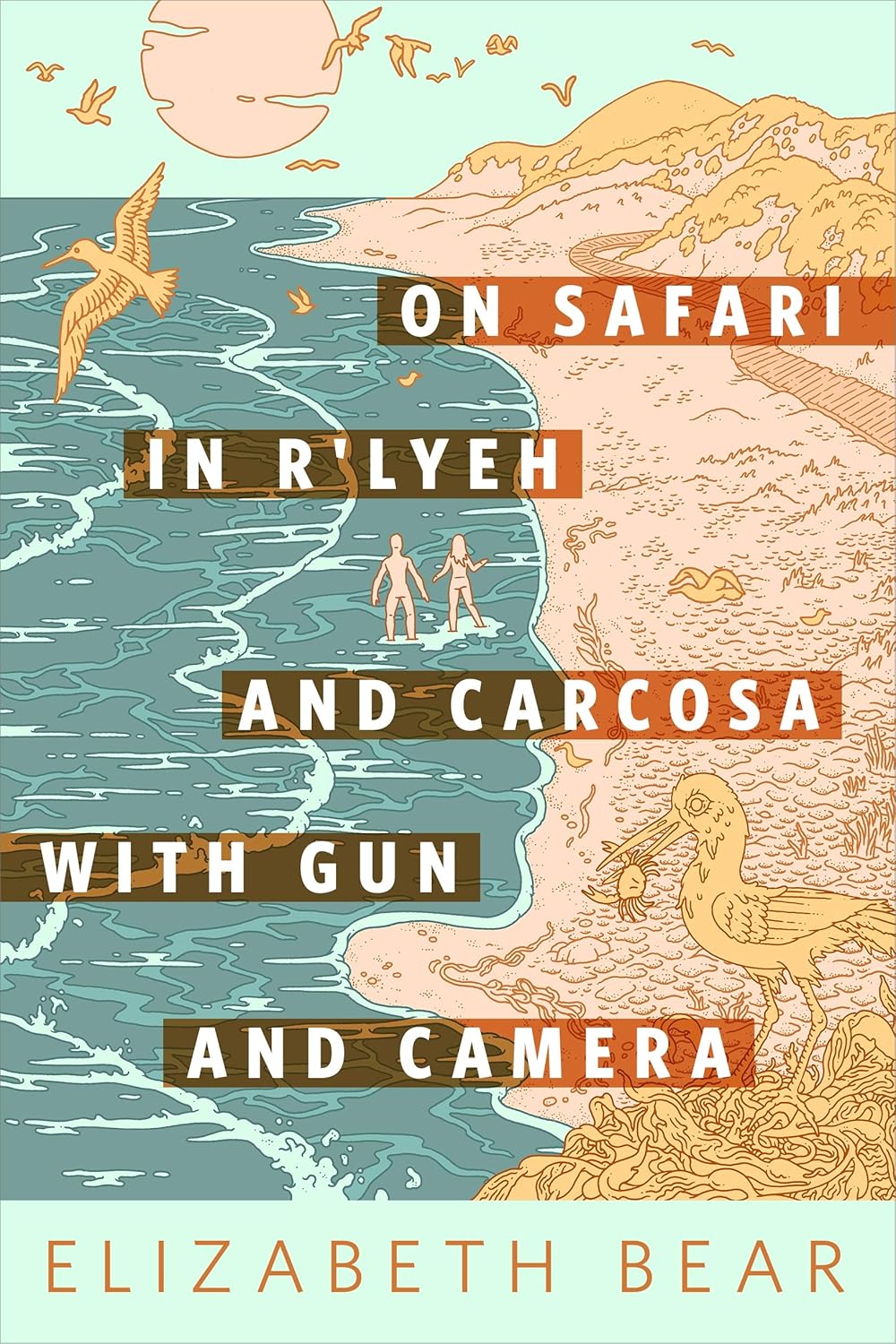
That being said, I believe “On Safari in R’lyeh and Carcosa with Gun and Camera” (2020) by Elizabeth Bear stands out as a very good representation of cozy Lovecraftian horror. The overall shape of the narrative is intensely familiar: how many scions of Innsmouth (never mentioned under that name) have come back home, in how many different variations? Yet the way the story is told is relatively light and novel: a fifty-something female physics professor with tenure and a penchant for sushi. A perfect setup for any number of funny-because-its-true comments about the lives of women in academia.
I note, entirely for the record and apropos of nothing, that I am the only female tenured faculty in the physics department. I note, entirely for the record and apropos of nothing, that I do an estimated thirty-six percent of the emotional labor in my sixteen-person department.
Female grad students and admins do the rest. And it’s not like we’re any less introverted and non-neurotypical than the dudes. We’re just forced to learn to endure more discomfort in order to have careers. —Elizabeth Bear, “On Safari in R’lyeh and Carcosa with Gun and Camera” (2020)
If the story was just a whine, no matter how well-deserved, it probably wouldn’t sustain interest. Yet Bear is very good at composing her narratives, and has structure the story with an in media res action sequence right at the start to let us know that yes, the safari with guns and cameras are real, we’re getting to that. Then she gets to that. It’s not exactly a novel story structure, but it’s a workhorse of fiction for a reason: putting a bit of action first as a hook to draw the reader in, and then it can build up again.
The actual horror in the story is slight. The monsters aren’t very monstrous, the characters aren’t really scared as much as driven by scientific curiosity; blasting away at byakhees like Hunter S. Thompson in bat country is a select aesthetic that doesn’t really encourage the same kind of comforting glow of, say, a mountain that walked or stumbled, or the remnants of an ancient cannibal feast that happens to have the unmistakable physical tell-tales of your own peculiar family. This is not quite on the level of a hypothetical Abbott and Costello Meet Cthulhu, but it’s not far from it.
It is the kind of good, clean fun that you can have when you learn to stop worrying and love the Lovecraft Mythos—and it managed to do it without naming Deep Ones, without running across a copy of the Necronomicon, and only mentioning Miskatonic Univeristy once and in regards to a failed graduate thesis in genetics. If the rules at play seem to owe a little more to the Call of Cthulhu Roleplaying Game than Lovecraft’s original, then at least Bear has the good sense not to recapitulate the entire Mythos, August Derleth style. She gives just enough lore to keep things moving, and no more.
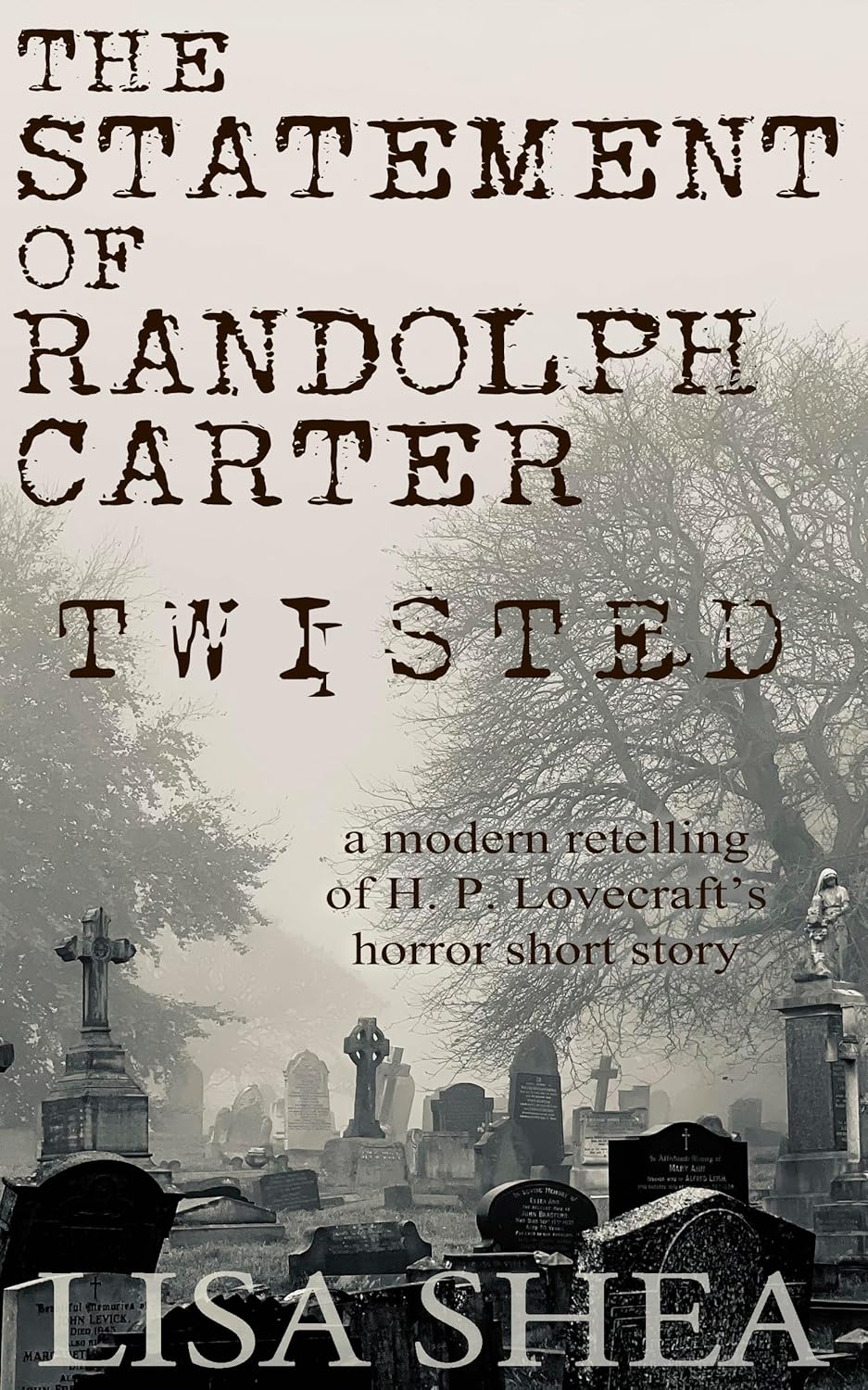
The dream originally took place in New England, in a cemetery there. For some reason, Lovecraft decided to relocate it to Florida, which makes NO sense to me. Florida doesn’t have a history of ancient cemeteries stretching back hundreds of years. Also, Florida is barely above ocean level! —Lisa Shea, “Author’s Note” in “The Statement of Randolph Carter Twisted” (2024)
The only topographical features of H. P. Lovecraft’s “The Statement of Randolph Carter” are the “Gainsville pike” and the “Big Cypress Swamp.” This has led many to believe the story takes place in Florida, near the city of Gainesville. It is possible that Lovecraft actually intended the location to be Georgia—his friend Samuel Loveman, who appeared in his dream and is depicted as Harley Warren, was stationed at Camp Gordon, only about 40 miles from Gainesville, GA.
I don’t point this out to nitpick, but to applaud. Lisa Shea’s author’s note gives evidence she really thought about Lovecraft’s story. Looked at how he framed it, what he did and did not achieve in a narrative sense. There have been many efforts to revise, revisit, revamp, and rewrite Lovecraft’s stories, from “His Mouth Will Taste Of Wormwood” (1990) by Poppy Z. Brite to “The Ballad of Black Tom” (2016) by Victor LaValle to “Kanye West—Reanimator” (2015) by Joshua Chaplinsky. Like old folktales, there is room for infinite variation. The first version of a story isn’t necessarily the best one, even if it’s the one repeated most often.
Shea’s “twist” to “The Statement of Randolph Carter” is an update to setting, characters, and attitude. No ambiguous Southern swamp in the 1910s and military telephones with long wires; this is set in Massachusetts in the 21st century with smartphones. The characters are younger, but their relationship is less ambiguous. The shift in setting and character requires a few tweaks in the plot; but the end result is tight. Nothing superfluous, no attempts to cram in a random “fhtagn!” where it isn’t needed. True to the spirit of Lovecraft’s original, but adapted to the current syntax.
There’s even a nice little flourish at the end. A little twist of the knife that Lovecraft didn’t do.
As a twisted tale, it works. What works best about it, however, might be the approach. Instead of approach Lovecraft’s tales as canon, they are approached as examples to study and learn from. Jumping-off points rather than fixed stars in the firmament.
If you read the original “The Statement of Randolph Carter” by Lovecraft, how would you change the scenes so they were more scary to you? —Lisa Shea, “Author’s Note” in “The Statement of Randolph Carter Twisted” (2024)
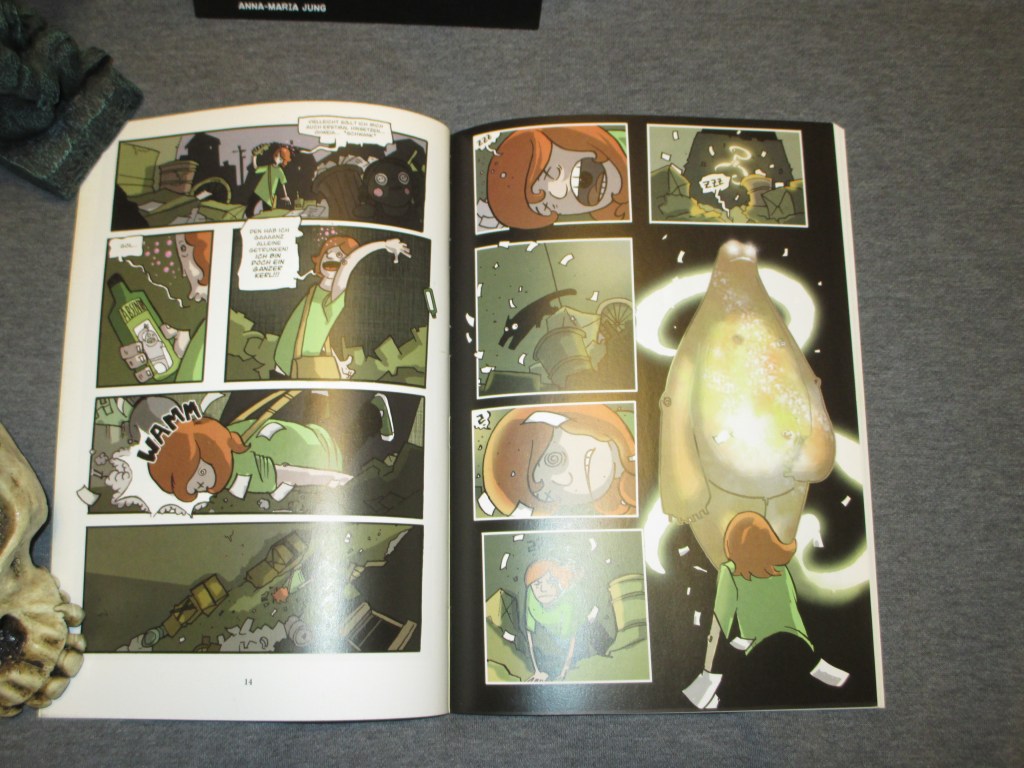
An einem seiner vielen ereignislosen, langweiligen Abenden beschließt der junge Jacop O’Damsel, freiberuflicher Nerd, sich besoffen in einem Hinterhof schlafen zu legen. Blöd, wenn ausgerechnet da plötzlich ein intergalaktischer Dimensionsschlürfer auftaucht. Bevor Jacop überhaupt die Chance bekommt, einen Kater zu haben, nimmt in das Ding auch schon einfach so mit.
Jacop wacht in Xoth auf, einer fremden Welt voller abartiger Kreaturen – oder solite man sagen: geradezu unsagbar grauenhaft? Auf jeden Fall sind da noch die »Humanisten«, eine Bande von stinkigen Fischköpfen, die Menschen kultarig verehren, und die Jacop angeblich für eine Mission brauchen. Und gäbe es niche genug an Wahnsinn zu verkraften, setzt der Bürgermeister der Stadt, der mächtige Cthulhu, seine besten Killer auf den Fall an. Den großen Alten sei Dank gibt es da noch Yen Niggurath, ein hübisches Ziegenmädchen, Des Gefallen an dem hilflosen Menschlein findet. Zusammen mit ihr get Jacop dem »Ordus Humanus« auf den Grund, Dennis – bei Cthulhus fettem Arsch! – er hat keine Lust, ständig um sein Leben zu rennen.
Vor dem Hintergrund von H. P. Lovecrafts Cthulhu Mythos entwirft Anna-Maria Jung eine Geschichte voller Monster, Nerds, Monsternerds und Nerd monster. Und der Mann aus der Angell Street kommt auch drin vor.
On one of his many uneventful, boring evenings, young Jacop O’Damsel, a freelance nerd, decides to get drunk and sleep in a backyard. Too bad when an intergalactic dimensional shambler suddenly turns up. Before Jacop even gets the chance to have a hangover, the thing takes him with it.
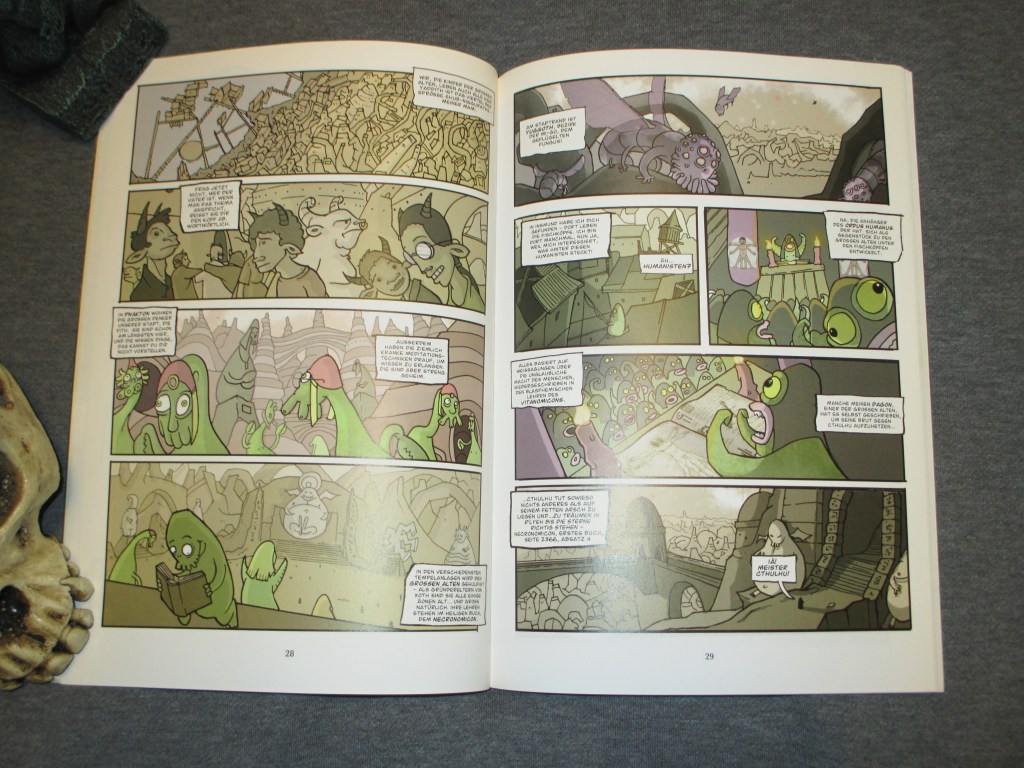
Jacop wakes up in Xoth, a strange world full of disgusting creatures – or should we say, downright unspeakably horrible? In any case, there are also the “Humanists”, a gang of smelly fishheads who worship humans in a cult-like manner and who supposedly need Jacop for a mission. And when there isn’t enough madness to deal with, the mayor of the city, the mighty Cthulhu, sets his best killers on the case. Thank the Great Old Ones, there is also Yen Niggurath, a pretty goat girl who takes a liking to the helpless little human. Together with her, Jacop gets to the bottom of the “Ordus Humanus”, Dennis – by Cthulhu’s fat ass! – he doesn’t want to constantly run for his life.
Against the backdrop of H. P. Lovecraft’s Cthulhu Mythos, Anna-Maria Jung creates a story full of monsters, nerds, monster nerds and nerd monsters. And the man from Angell Street appears in it too.
Back cover copy, 2010 edition
English translation
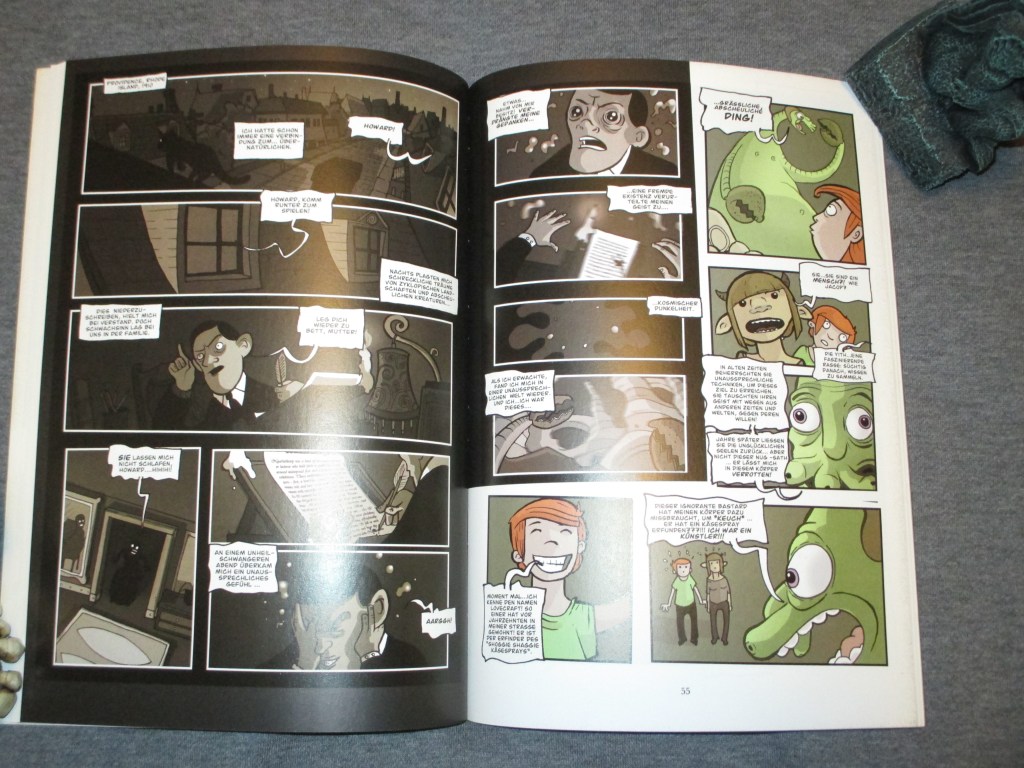
Xoth! Die unaussprechlichen Stadt (“Xoth! The unspeakable City!”) is a 2007 graphic written and drawn by Anna-Maria Jung ( https://www.annamariajung.com/ ), an Austrian illustrator with a penchant for monsters and nerds. The publication history is a little difficult to piece out, because part of the history has been eaten by the web, but the Internet Archive maintains a copy of (most) of the old website, which offers some background:
Xoth! ist ein 70 seitiges Farbcomic, das auf dem “Cthulhu-Mythos” von Howard Philips Lovecraft beruht.
Die Idee für Xoth! kam Anna-Maria Jung 2006 in New York, als sie ein Buch zu H.P. Lovecrafts Cthulhu Mythos entdeckte. Beruhend auf diesem Mythos entstand die Idee, eine einzige Heimatwelt für Lovecrafts Kreaturen zu kreieren.
Anna-Maria diplomierte 2007 mit einer Arbeit über »Lovecraft in den Medien«. Diese Diplomarbeit wurde eine konzeptuelle Vorarbeit für ihren Comic sie erforschte Lovecrafts Vergangenheit, den gesamten Mythos und seine Einflüsse auf die Medienwelt. Auf Wunsch kann man diese Diplomarbeit bei mir als PDF kostenlos bestellen.
Als praktischen Teil entwickelte sie die Charaktere, Hintergründe, Gegenstände, Zusammenhänge, Beziehungen und Verhältnisse einer Welt, die sie, inspiriert von Sci-Fi Autor Lin Carter, Xoth taufte.
Xoth! is a 70-page color comic based on the “Cthulhu Mythos” by Howard Philips Lovecraft.
Anna-Maria Jung came up with the idea for Xoth! in 2006 in New York when she discovered a book about HP Lovecraft’s Cthulhu Mythos. Based on this myth, the idea of creating a single home world for Lovecraft’s creatures was born.
Anna-Maria graduated in 2007 with a thesis on “Lovecraft in the Media.” This thesis was a conceptual preparatory work for her comic; she researched Lovecraft’s past, the entire myth and his influence on the media world. If you wish, you can order this thesis from me free of charge as a PDF.
As a practical part, she developed the characters, backgrounds, objects, contexts, relationships and conditions of a world that she named Xoth, inspired by sci-fi author Lin Carter.
Was ist Xoth? (Deutsche)
What is Xoth? (English)
Lin Carter’s Mythos fiction was published in The Xothic Legend Cycle by Chaosium; Xoth was the star from which Cthulhu originated, and Carter’s fiction dealt with Cthulhu’s progeny. Cthulhu himself appears in Jung’s Xoth! as the mayor of the city.
Unfortunately, with the death of early web, stuff like Jacop O’Damsel’s MySpace page and the English translation of some of the comic pages are likely sadly gone forever.
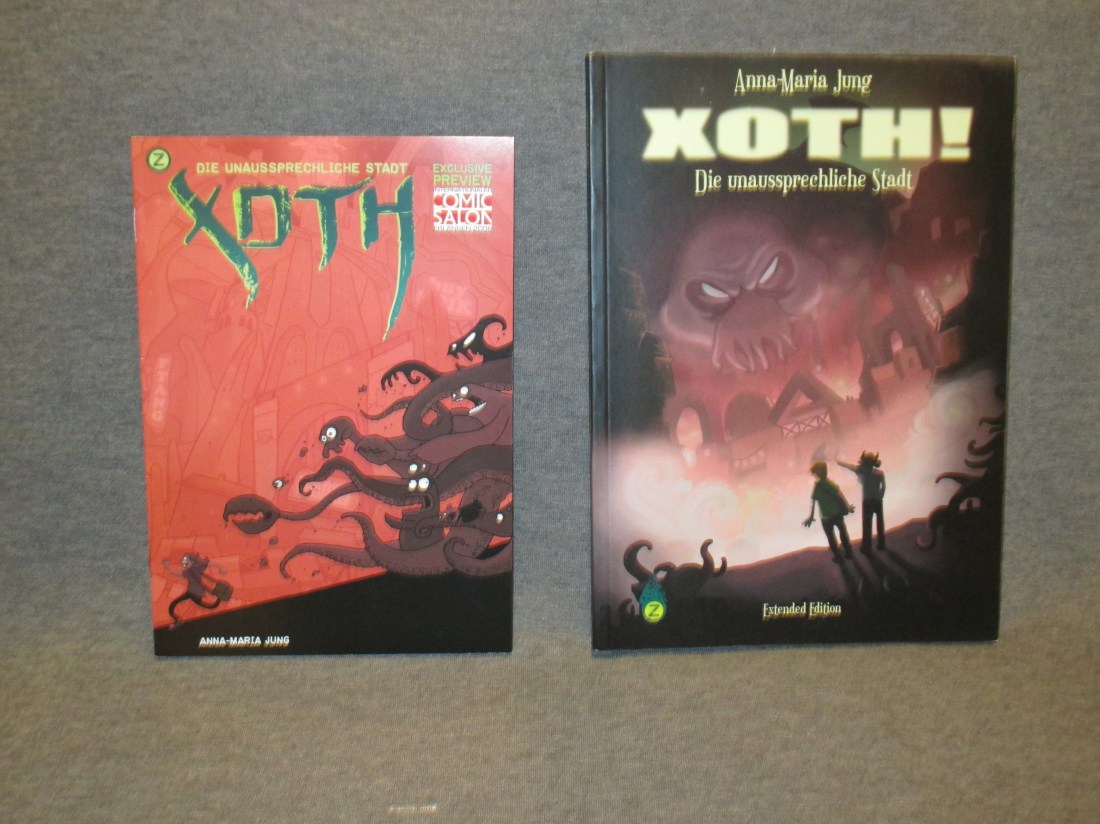
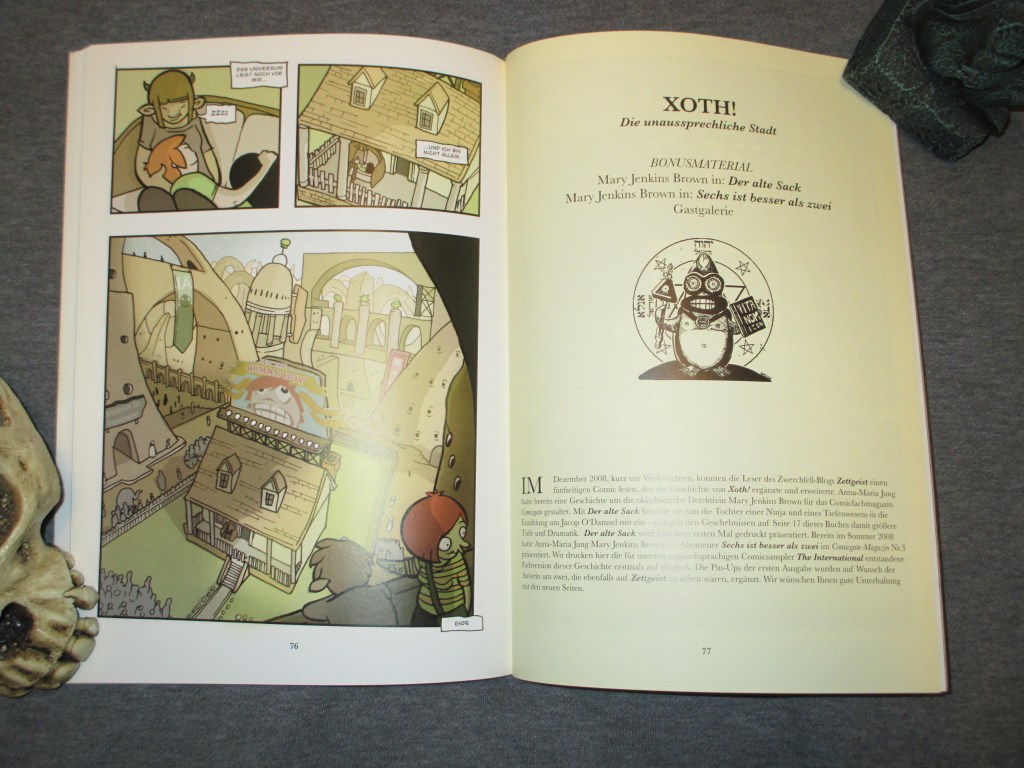
A 2008 “exclusive preview” of Xoth for the Internationaler Comic Salon Erlangen 2008, where the book presumably premiered; Jung also wrote and drew a spin-off comic titled “Marie Jenkins Brown: Sechs ist Besser als zwei” (“Mary Jenkins Brown: Six Is Better Than Two”) published in Comicgate Magazin #3 (2008). Both Xoth! and the Marie Jenkins Brown spin-off were collected and published in the Xoth! Die unaussprechliche Stadt Extended Edition (2010, Zwerchfell Verlag).
Absinthe and Dimensional Shamblers don’t mix.
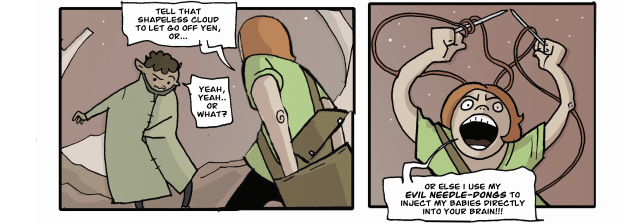
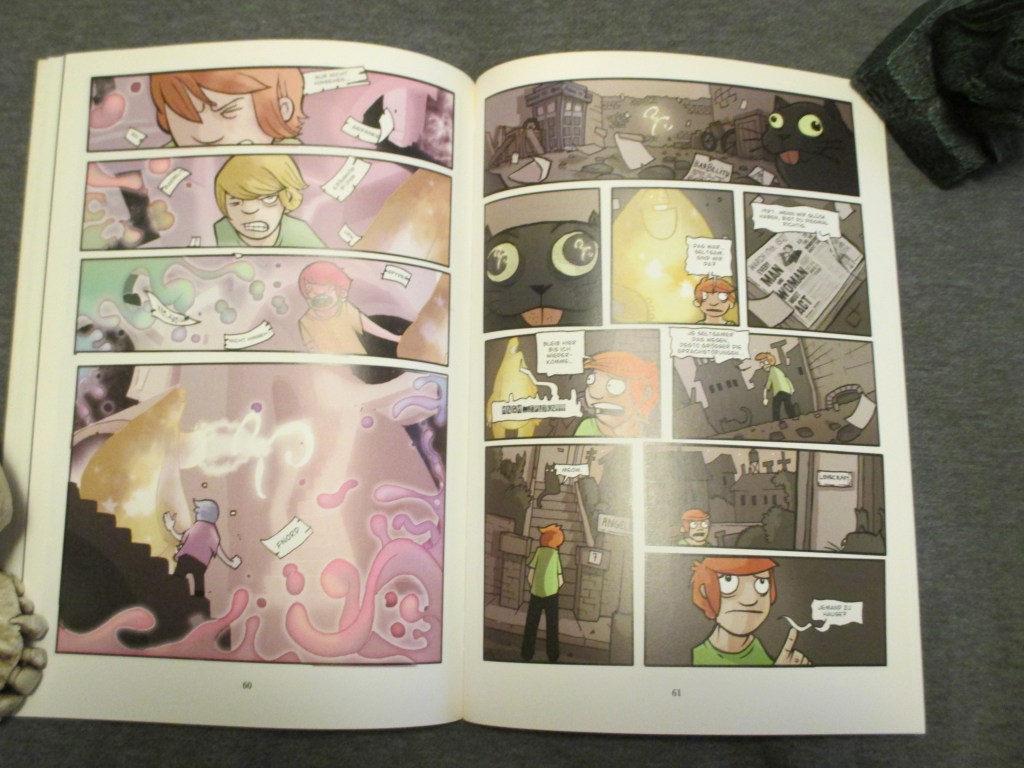
There is a slightly cartoonish, early-2000s webcomic vibe to Jung’s art style, which might make some folks to confuse Xoth! for a comic intended for kids at first glance, but really this is aimed at a more mature audiences, with references to alcohol and sex, and some brief cartoon nudity that is designed to amuse rather than titillate. It’s a fun takeoff of the Mythos for grown ups, especially grownups who were monster enthusiasts in their youth.
Fans will appreciate the many references to Lovecraft’s Mythos (and the Call of Cthulhu Roleplaying Game) sprinkled throughout the story. It’s definitely played for humor more than horror, reminiscent of works like The Unspeakable Vault (of Doom!), but with more narrative and focus on characters. This is really the story of Jacop O’Damsel, the sole human in the city.
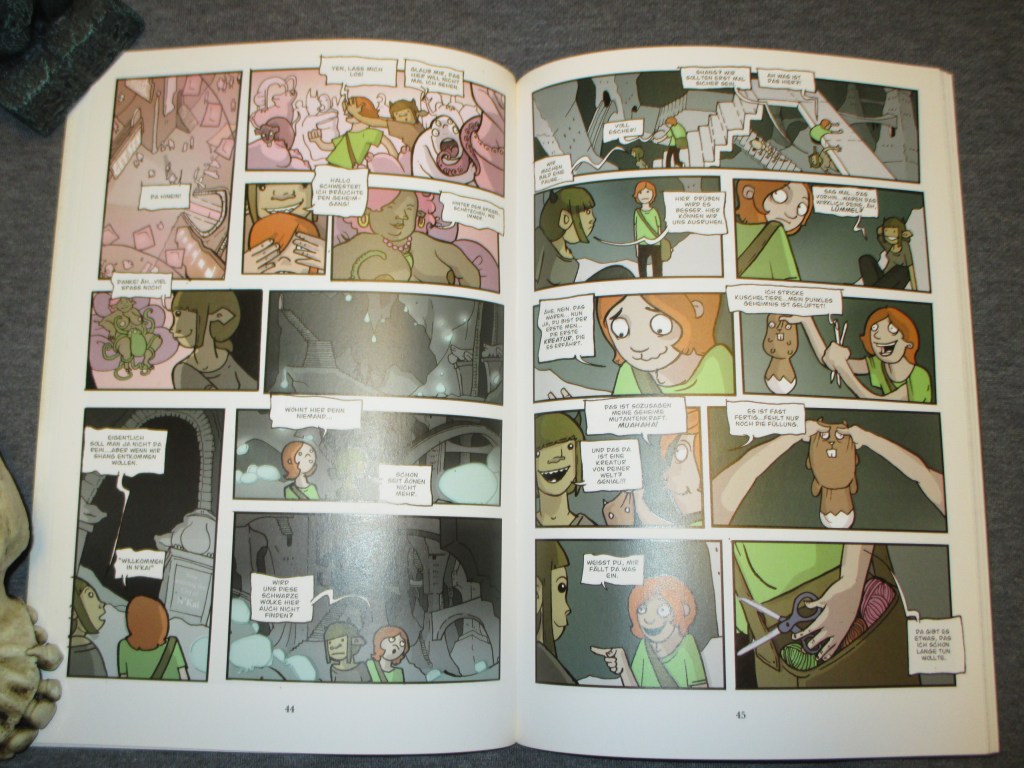
Fortunately, Jacop has help from Yen Niggurath, one of the Dark Young, who takes a shine to him. Their relationship has a meet-cute quality, and there’s a certain romantic frisson between the two almost from the start.
Lovecraft, “the Man from Angell Street.” does indeed make an appearance, although he spends most of the comic in the body of a Yithian he’s been mind-swapped with. Which is a fun way to include Lovecraft in what is otherwise a contemporary setting that includes cellphones.
A scene where Jacop meets a dying Lovecraft in 1937 is also included, although Jung makes a slip here in getting the date and address incorrect.
It is a fun graphic novel. The plot isn’t very profound, but not all stories have to be epic. Some people just learn to accept where they are and who they’re with. To monsters, humans are ultimately just another monster.
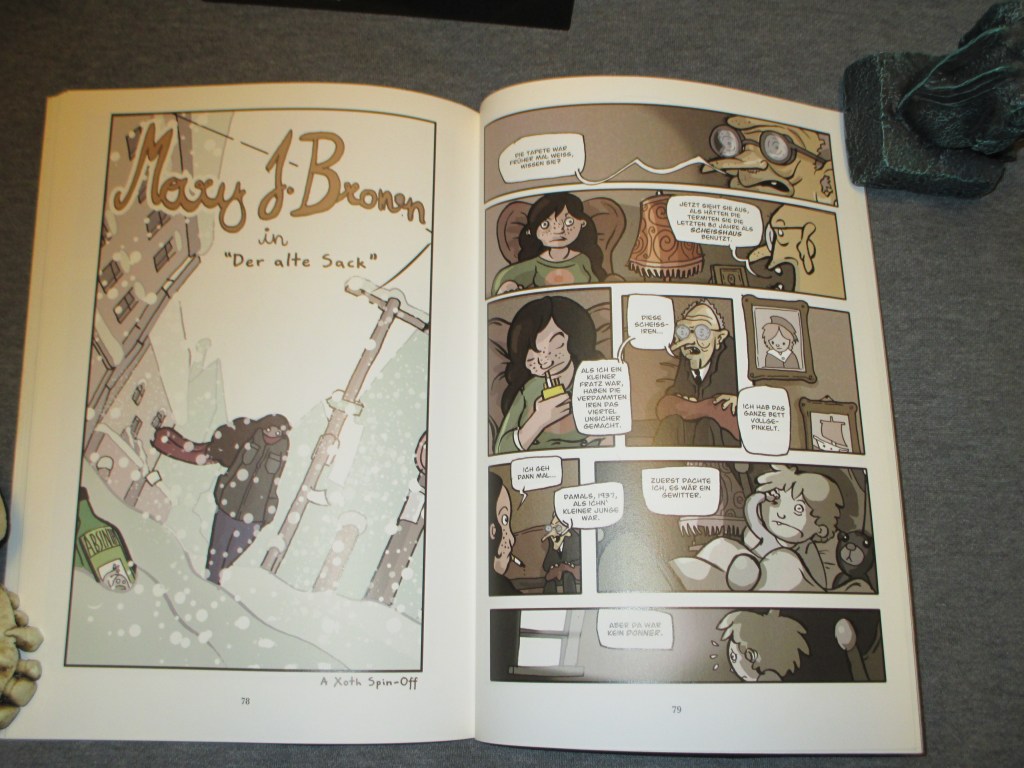
The Mary Jenkins Brown spin-off comics are a bit more deliberately mature, even racy in parts. Mary is an occult detective in these brief strips, but seems more interested in getting laid than solving mysteries. They’re short and cute, played for laughs more than eroticism. It’s nice to have them collected somewhere.
There is no published English translation of Xoth!, and sadly probably never will be, which I feel is a pity because there was a time and place when I think it would have definitely found an appreciative audience. The German-language Extended Edition is still available for sale, and Anna-Maria Jung’s webstore has a lot of cool shirts.
Lovecraft had a rare faculty for beginning with something commonplace and building up an overwhelming aura of horror that left his readers hanging onto the ropes. In that sense, I can’t think of anyone who could surpass him. He had a knack of delving into man’s subconscious, untranslated fears—putting them into an appreciable form, giving them appealing names and personifying one’s own, inmost, half-comprehended, even personal nightmares. —Bruce Bryan in “The Eyrie,” Weird Tales (Jul 1937)
H. P. Lovecraft created Yig for “The Curse of Yig” (WT Nov 1929), ghostwritten for Zealia Bishop. Yig is also mentioned as “Niguratl-Yig” in “The Electric Executioner” (WT Aug 1930), ghostwritten for Adolphe de Castro; and “The Father of Serpents” in “The Whisperer in Darkness” (WT Aug 1931); “Yig the Serpent-God” in “Out of the Æons” (WT Apr 1935), ghostwritten for Hazel Heald, and “Mother of Serpents” (1936) by Robert Bloch. Five appearances over the course of eight years, all in the pages of Weird Tales, and to the casual reader all by different authors.
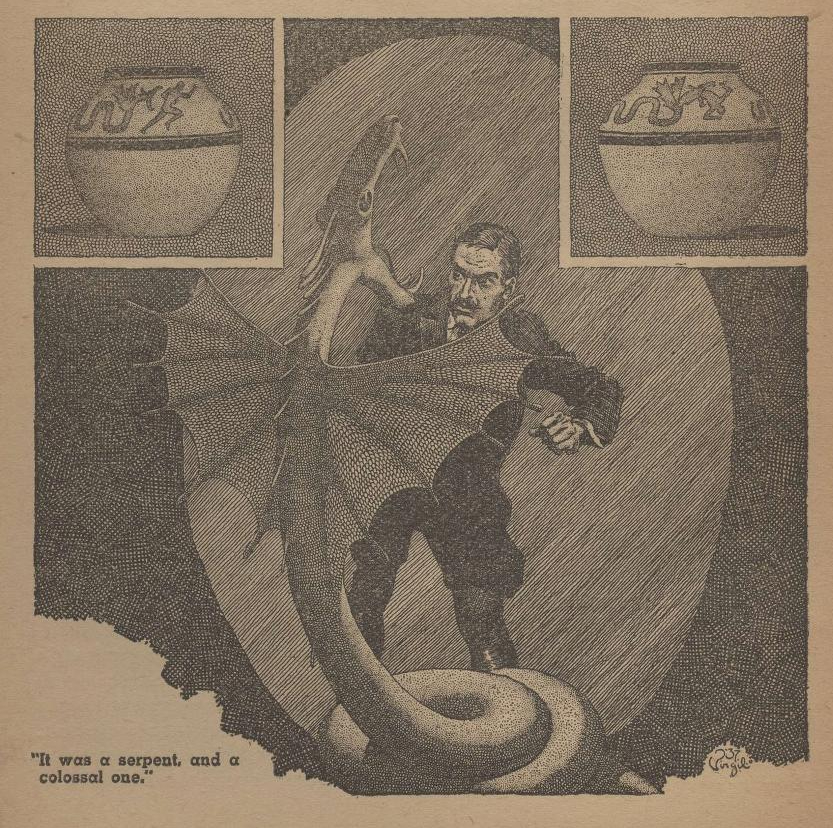
Perhaps that is why in 1937 professional archaeologist and pulp author Bruce Bryan borrowed Yig—here under the name “Yig-Satuti”—for his archaeological horror yarn, “The Ho-Ho-Kam Horror,” which ran in Weird Tales Sep 1937 issue.
“On the Mountain-That-Is-Heaven,” he hissed fiercely, “the white man is a trespasser. Yig-Satuti does not welcome visitors who come to dig up his secrets. It is bad medicine for those who seek to disturb the ancient dwelling-place of the god.” —Bruce Bryan, “The Ho-Ho Kam Horror” in Weird Tales (Sep 1937)
G. W. Thomas has described “The Ho-Ho-Kam Horror” as “an unnoticed Cthulhu Mythos sequel” (Snake Gods & Were-Serpents), and he’s largely correct. Dedicated fans recognized the reference to Yig at least as early as the 1950s, when George Wetzel included it in one of the listings in his TheLovecraft Collector’s Library (1955); the story is also listed in Chris Jarocha-Ernst’s mammoth A Cthulhu Mythos Bibliography & Concordance(1999). However, the story has never been reprinted outside of its original appearance, not in a random Mythos anthology or anywhere else, contributing to its overall obscurity and lack of recognition.
Even for dedicated Mythos-hounds, the story is easy to miss. Bruce Bryan was never a member of Lovecraft’s circle of correspondents, and outside of the reference to Yig, the story has no other connections to the Mythos—nor many to its probable inspiration, “The Curse of Yig.” For one, the story is not set in Oklahoma, but in Superstition Mountain in Arizona; the Native American groups involved thus shift in relation to that portion of the Southwest, and the mythology shifts with it, becoming associated with the Hohokam culture. Bizarrely, even though Yig-Satuti is depicted with wings, Bryan makes no effort to connect it with Queztacoatl as Lovecraft had done.
The story takes on a more familiar shape than Lovecraft’s “The Curse of Yig,” echoing “Sunfire” (1923) by Francis Stevens, “The Monster-God of Mamurth” (1926) by Edmond Hamilton, and “The Thing on the Roof” (1932) by Robert E. Howard among others—all stories where in an ancient and deserted city or temple, the monstrous god of the forgotten people remains to be discovered by archaeologists or treasure-hunters. While there’s a certain Lovecraftian touch in the framing of the story, since the last of it is told through a diary the protagonist discovered and the final sentence is an appropriately italicized culminating revelation, it is otherwise a bit crude. The pot that prognosticates the archaeologist’s doom, for example, is never explained in any detail.
By far the most substantial difference between Bryan and Lovecraft, however, might be in their treatment of Native American characters and culture.
Few would consider Lovecraft an exemplar when it comes to the accurate or sympathetic portrayal of Native Americans in his fiction. While there are sparingly few references to Native Americans in his corpus, the one Native American character who is named and speaks is Grey Eagle in “The Curse of Yig” and “The Mound,” and he is basically a walking stereotype of the Old Native American Chief, complete with the kind of English patois that Barbra A. Meek in “And the Injun Goes ‘How!’: Representations of American Indian English in white public space” (2006) called “Hollywood Injun English.” Yet for all that, Lovecraft obviously did research for his stories set in Oklahoma, accurately names the Native American peoples that would have been there, and references some of their genuine beliefs, like Tiráwa. The worst negative stereotype Lovecraft indulges in is depicting the Native Americans with a penchant for alcohol.
Bruce Bryan did his research too—albeit, a few folks wrote in to Weird Tales to correct a few points:
I read with much enjoyment Bruce Bryan’s story The Ho-Ho-Kam Horror. I lived near Superstition Mountain for about eight years, and learned to speak the Pima dialect fairly well. Naturally, I took quite an interest in the Indians, their legends and the ruins of the Hohokam. Little is known of the Hohokam, but there were a few errors in the story which I think the author should have corrected. ‘The Hopi and Smoki Indians do not live near Superstition Mountain, nor do they get their snakes for the rain dance there. I doubt if they know of the existence of the place. The story is based on legend, apparently, and legend has it that the Hohokam did not live on Superstition Mountain; the ancestors of the Apache Indians lived in that vicinity, and the Hohokam, who are apparently the ancestors of the Pimas (although this is not certain), lived and farmed the Gila River valley when the valley was not such a desert as it is now. The Casa Grande ruins (a four-story adobe structure) were built by the Hohokam who continually warred with the Apaches of Superstition Mountain. The Pimas and Apaches don’t get along any too well today, as far as that goes. In regard to the Hohokam-built ruins, the age of these ruins is probably more than two thousand years. At that time (when the Hohokam lived there) they irrigated the land with water from the Gila. Some of the ditches are filled with lava. It must have been quite a while ago that the volcanoes in Arizona erupted. […] Little can be said of Superstition Mountain. In the present century no white man has climbed it alone and come back, although a few have tried. Planes can’t fly very low over it, due to strong and gusty updrafts. An exploring party recently made a trip over part of the mountain to try to discover the cause of loud and thunderous noises, like the reports of guns, but found nothing. —Paul Smith in “The Eyrie,” Weird Tales (Nov 1937)
However, the issue has less to do with Bryan’s anthropology of the deceased Hohokam culture and geography than his depiction of the living Native Americans and their culture. Lovecraft kept the Native Americans almost always off the page, talked about rather than depicted directly interacting with the white viewpoint characters, and while Yig is depicted as part of their belief-system, but is not necessarily evil nor was his worship all-encompassing. Bryan has the Native American characters much more present, and the white viewpoint characters interact with them directly—which means there’s a lot more room for stereotyping, especially within the already hackneyed scenario of one lone white man with a group of Indigenous laborers.
The only one named is Jim Red-Cloud, who becomes the mouthpiece for the Native American viewpoint:
“Don’t be ridiculous, Jim!” I snapped angrily. “You’re not a superstitious child. You went to the white man’s schools. And you’ve been with me a long time. Tell me, just what or who is this Yig-Satuti?”
The Pima winced at my words, as if they expressed some damnable blasphemy. In the smoldering depths of his eyes modern teachings seemed to struggle with the antique lore of his savage forefathers.
“Some things the white man’s schools do not teach,” he whispered almost fearfully. “Some things they do not know. Yig-Satuti is the Indian’s god beyond all other gods. It is not well to speak his name, for he is jealous of his secrecy. Those who know, worship him in hidden places that the white man does not suspect. It is better so. Yig-Satuti is older than the earth itself, and all wisdom is his heritage. Here on his mountain we are trespassers. Much evil will come if we do not go.” —Bruce Bryan, “The Ho-Ho Kam Horror” in Weird Tales (Sep 1937)
Before long, the “rational” white archaeologist who ignores the warnings to the curious offered by Jim Red-Cloud. The nameless, faceless indigenous laborers are demeaned as superstitious and primitive children, whom the white man tries to coax with money and then threatens with implied violence. It is little surprise when the white man ends up alone and eaten by the ancient horror his excavation has unearthed.
A very old-fashioned story, one where none of the characters come out looking good.
In terms of Native American representation, the Yig Cycle stories—whether written by Lovecraft or anyone else—often suffer from difficulties in their portrayal and presentation of indigenous peoples and their culture. Part of this is due to ignorance, part of this is due to stereotypes, and part of this is just the lens of the storytelling. The default perspective is of voyeuristic outsiders to an indigenous culture poking around where they are not invited and don’t belong. It is a Colonialist narrative, told from the standpoint of the colonizer, and even when bad things happen to said colonizer, it does so by representing the indigenous culture as exotic, secretive, and dangerous. Reiterating and reinforcing stereotypes.
Not all Yig Cycle fiction is like that; “The Head of T’la-yub” (2015) by Nelly Geraldine García-Rosas for example provides a very different viewpoint, and the approach is much more respectful with regards to depicting Native American characters as possessing agency, and of how and why they integrate indigenous beliefs with the Cthulhu Mythos. If there’s a lesson to be learned from “The Ho-Ho-Kam Horror” by Bruce Bryan, it might be to listen more, keep an open mind, and try to see things from someone else’s perspective.
If nothing else, it would make a more interesting story if it had been written from Jim Red-Cloud’s point of view.
In the summer of 1976, a one-shot ‘zine of of weird poetry and art emerged from 5115 South Mead St., Seattle Washington. The publisher titled it Visions of Khroyd’hon, which probably meant nothing to anyone at the time, and it was published in the spirit of good fun:
There are many interesting poetry publications popping up every now & then, and I thought it wou’d be fun if I join’d—if only for a moment—ye crowd and publish’d this first and only issue of VOK. I’ve assembled lots of good poetry here, with a number of talented youngsters contributing clever rhymes, love sonnets, and exciting verse. There’s something for everyone’ I’m sure each reader will be able to find some moments of entertainment. —W. H. Pugmire, Visions of Khroyd’hon 1
Among the contributors were luminaries such as Brian Lumley, H. Warner Munn, J. Vernon Shea, Jessica Amanda Salmonson, and William Davis Manly, the latter of whom included several untitled verses, including this one:
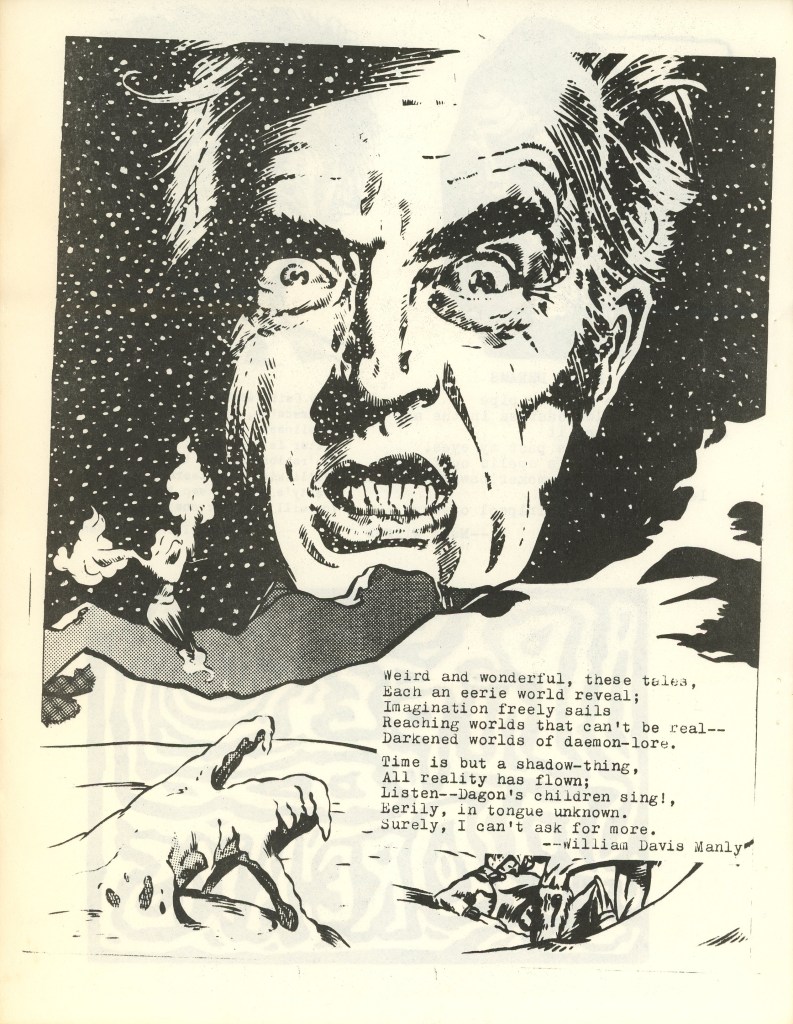
Weird and wonderful, these tales, Each an eerie world reveal; Imagination freely sails Reaching worlds that can’t be real— Darkened worlds of daemon-lore.
Time is but a shadow-thing, All reality has flown; Listen—Dagon’s children sing!, Eerily, in tongue unknown. Surely, I can’t ask for more. —william davis manly
It is a poem in praise of weird fiction, from someone who loves the strange, eerie, horrific, and awesome. A paean from one Mythos fan to every other. The artist is unknown, but the subject is writer Fritz Leiber, Jr., and appears to be traced from a scene from the 1970 film Equinox.
Equinox has several parallels with Evil Dead II, including a recording of a professor (Leiber) who unwisely reads aloud an incantation from a very evil book…although the book in Equinox is not specifically called the Necronomicon.
The hidden joke is that William Davis Manly is, like Robert E. Howard’s Justin Geoffrey or H. P. Lovecraft’s Abdul Alhazred, not a flesh-and-blood poet at all, but a character in Pugmire’s stories—a staple name in what would become the Sesqua Valley stories. Pugmire had begun producing poetry under the name William Davis Manly in the 1970s, probably first “The Cryptic Power” in the ‘zine Bleak December #8. The first bit of fiction referencing Manly was “From ye Journal of William Davis Manly” (Old Bones #1, Summer 1976), and in “The Thing in the Glen” (Space and Time Sep 1977) the story begins with a poetic epigraph:
“Beneath the old narcotic moon It preys upon mortality, Hungry to devour hope, And whispering to darkness.” —William Davis Manly, Visions of Khroyd’hon (quoted from Dreams of Lovecraftian Horror 57)
So Pugmire’s poetry ‘zine became, in the context of his Mythos fiction, a volume of poetry, much like Justin Geoffrey’s People of the Monolith in Robert E. Howard’s “The Black Stone.” William Davis Manly (or at least, his legend) would grow and develop in Pugmire’s tales, as would his slightly more diabolical counterpart, the sorcerer Simon Gregory Williams.
There is no definitive collection of W. H. Pugmire’s poetry, and maybe such a thing would be difficult to put together, given how much of it was published in ‘zines and scattered hither and yon. The quality and focus of it varies considerably, as Pugmire was equally disposed to either fulfilling some weird and fantastic corner of the Mythos or just praising his aunt in verse, but for readers who enjoy his fiction, Pugmire’s poetry is an indelible part of his larger body of work.
As far as I have yet been able to determine, the untitled poem from Visions of Khroyd’an has only ever been reprinted in the chapbook Sesqua Rising (2016) by Graeme Davis, which collects many other early Pugmire rarities.
Absence of much conversation is probably a permanent feature of my style, because the tales I write concern phenomena much more than they concern people. —H. P. Lovecraft to Natalie H. Wooley, 24 Oct 1933, LRBO 193
“The Colour Out of Space” is one of Lovecraft’s most evocative and best-loved stories. It has been interpreted by different folks as an environmental horror, as a rural Gothic, a precognitive flash of the dangers of nuclear radiation. It was not set in the far ago and the long away; H. P. Lovecraft set most of his horrors in his here and now. In the 1920s and 30s, close to home in Rhode Island, Massachusetts, and New York. They were horrors of the moment, and while he largely eschewed flappers and rumrunners, they took on the syntax of the time and place.
Which makes them interesting to update. How many horror stories would be different, if they took place after the invention of cell phones, or the advent of the internet, birth control pills, the Civil Rights Movement? How might that change the story? Not the phenomenon itself, but the people’s response to the phenomenon. Their perspective and understanding of it.
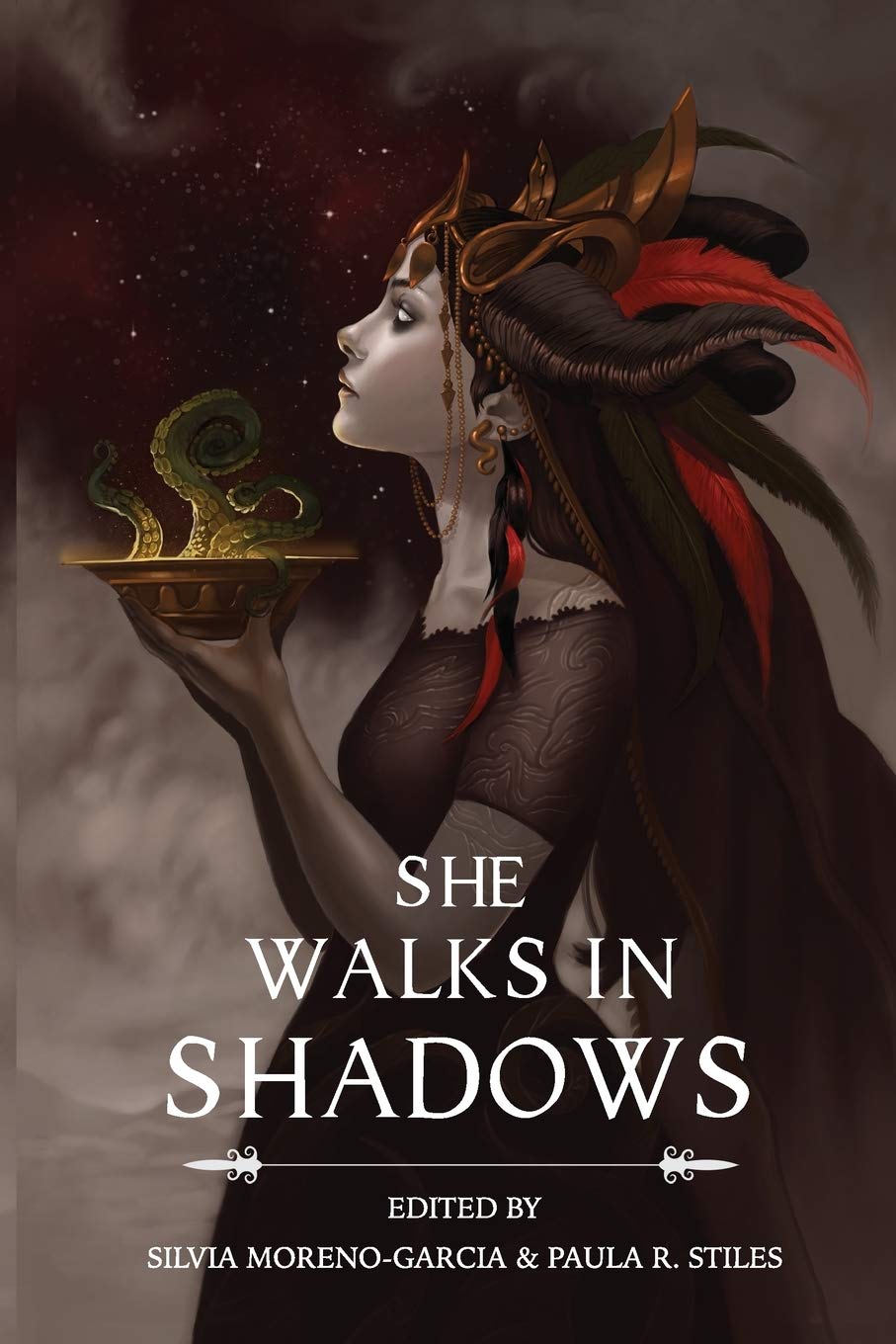
As is appropriate for a story that’s a reworking of H.P. Lovecraft’s “The Colour Out of Space,” “Violet is the Color of Your Energy” is named after two songs centered on color: 311’s laidback, beachy “Amber,” and Hole’s angry, feminist “Violet.” I doubt that MRA types would like this story. In my defense, though, “The Colour Out of Space” practically demanded a feminist revision. It’s fundamentally a story about a cranky farmer who keeps his family increasingly isolated, then imprisoned, resulting in the deaths of all. There’s a neighbor who seems to check in a lot. Oh yeah, and something’s off about the water and the crops. And the woman locked in the attic is the crazy one? —Nadia Bulkin, “Violet is the Color of Your Energy” [The Playlist]
Nadia Bulkin’s “Violet is the Color of Your Energy” is, in effect, a contemporary re-telling of “The Colour Out of Space.” One that leaves out Arkham, and shifts the point of view focus to Abigail Gardner (née Cuzak), who followed her college-educated husband to Cripple Creek to try and make a go of an old-fashioned family farm. The shift in time and space and perspective skews the story from the phenomenon (Lovecraft’s interest) to the individual. Zeroes in from the impersonal observation of everything going on to the very personal look at how this phenomenon affects Abby and her relationship with her husband and children.
“Are you sleeping with him?”
“What?” her voice broke. “Nate, the boys are right . . . .”
His shout punched down like a hammer of God. “Answer me, Abby! Was this some whore’s bargain? Said you’d jump into bed if he’d just cut your poor idiot husband a break?” —Nadia Bulkin, “Violet is the Color of Your Energy” in She Walks In Shadows39
The result is something like Christina’s World by Andrew Wyeth in prose. Things said and unsaid. A woman trapped by the decisions she’s made, the man she trusted, until she has no decisions left at all; yet this is not a morality play about a woman who made the wrong decision. Something is happening, something he won’t tell her about. This isn’t just a tale of spousal abuse, or stress turned to paranoia. Something happened, in the opening paragraph, reverberating throughout the short story. Something that works, unseen, on the corn, the animals, the water, her husband…and her.
If you haven’t read “The Colour Out of Space,” the ending might be confusing. A Shirley Jackson-esque non sequitur, like a needle skipping across a record, jumping straight to the last track. It is like a variant telling of an old and familiar myth, reminiscent of “His Mouth Will Taste Of Wormwood” (1990) by Poppy Z. Brite in that sense. Not a replacement for Lovecraft’s story, but a complement to it; an old campfire tale told to a new generation of campers, a riff on the old motif, recycled and made new again.
Boys and dogs alike asked for things—food, drink—and eventually, after the sun began to set, Teddy put down his American History book and asked for an explanation of Croatoan. —Nadia Bulkin, “Violet is the Color of Your Energy” in She Walks In Shadows39
There is a certain synchronicity between “Violet is the Color of Your Energy” and the 2019 film The Color Out of Space; both seek to update and adapt Lovecraft’s text, both keep the story small, centered on what a small family farm looks like in the 2010s, the breakdown that occurs as something happens beyond their control or capability to understand. The beats are not the same, but they’re working in a similar groove with a sense of isolation and desperation. Of things that have suddenly and inexplicably gone wrong, and the added stress has cracked the facade of normality, to show that maybe, things weren’t right this entire time.
Tabletop roleplaying has always had a performative aspect; the players and gamemasters were encouraged to embody their characters to some extant, and to be able to interact in character. The early community spaces around roleplaying games like Dragon Magazine (1976-2013) and Gen Con (1968-) were built on the shared experiences of gaming in small groups, and much of the early humor in gaming periodicals and associated media dealt with the peculiar quirks of players and rules interacting during a live session—as well as recounting the epic adventures characters underwent at those tables. This has been the basis of a good deal of media surrounding gaming, including comics like Knights of the Dinner Table (1990-) and Dork Tower(1997-), and the Japanese phenomenon of the replay, or transcripts of a gaming session packaged and sold for entertainment.
This performative aspect has been especially notable when gaming was done in public, before an audience, such as when participating in a tournament at a gaming convention or when doing live-action roleplay in any public space. There have been various efforts over the years to expand this practice in different media; for example some of the Knights of the Dinner Table strips were animated and voice actors brought in to provide short episodes like “Scream of Kachooloo,” based on the popular Call of Cthulhu Roleplaying Game. With the advent and popularity of YouTube (2005-), Twitch (2011-) and other streaming services, video and audio became increasingly popular media for gaming of all stripes, from video game let’s plays to various efforts to dramatize and/or capture the performance of a gaming session, which gelled into a format called actual play.
At its most basic, this can be as simple as group with a webcam and a cheap microphone recording a session at the kitchen table; at its most sophisticated, talented gamers/actors from around the world with their own high-end recording set-ups can collaborate on a gaming session together, and the whole professionally edited, produced, and with music or visuals into a viable product. The more high-end actual plays tend to have associated websites, social media, patreons, tipjars, and maybe even advertisements or sponsors to help defray the cost of production or run a modest profit for the gamers/actors involved. Shows like Critical Role(2015-) and its episodes CelebriD&D (2015-2020) have effectively migrated the concept from amateur or semi-professional to professional productions, but the community that generates and watches actual play primarily remains, first and foremost, dedicated hobbyist gamers who want to share the roleplaying experience.
While many actual plays focus on popular game systems like Dungeons & Dragons 5th Edition or particularly popular and notable published campaigns like Horror on the Orient Express, the format is democratic and allows for diverse gaming groups to run through any scenario or campaign, published or homebrew. This sometimes gives the rare opportunity to see, for example, a group of Black gamers play through roleplaying game designed for primarily Black player characters.
Queen’s Court Games (web, YouTube, Twitch, Bluesky, Patreon, etc.) is an award-winning actual play web series with a diverse cast; their byline is “Character-focused. Rules-light. Banter-free. Never D&D.” and they deliver. In 2023, the group (Noir Enigma, Jas Brown, Robert Madison II, Christian McKinzie, and Laura Tutu) played through the scenario Harlem Hellfighters Never Die by Chris Spivey, a scenario that came with Harlem Unbound (2017) by Darker Hue Studios (2nd edition). The actual play is spread out over six sessions/episodes, each of which is 2-3 hours long, with Noir Enigma playing the Keeper and the five gamers each as a single player character as they play through the scenario.
The performative aspect of actual play sometimes lends a scripted air to most proceedings, but the Queen’s Court Games group feels much more natural in their delivery. There is a conscientiousness to the performance, because the players all give each other space to talk, rarely trying to talk over one another, getting into little asides, etc. The Keeper, Noir Enigma, gets an oversized amount of attention because the Keeper is the driver for the scenario, the one which all the players have to interact with regularly and who has to set the pace and maintain the flow of the session for hours on end. Of the cast, Laura Tutu stands out as the most dramatic of the players. While they did practice some of their lines before play, there’s very much an improv group feel to the whole production, and the cast plays off each other well.
What sticks out the most is how much the players seem to enjoy the Harlem Unbound setting, and to inhabit those characters. It is not unusual to see Call of Cthulhu gaming groups that are all white people playing white characters and going through scenarios where anybody described as “dark” or “swarthy” is likely to wear a robe and wave a sacrificial dagger, so there is a different dynamic to having an all-Black group playing Black characters, the kind of humor they can bring (Christian McKinzie and Enigma Noir in particular get many of the funnier interactions, which have the other players in stitches with McKinzie’s self-deprecating humor and animated style). It is a playstyle that is conscious of and avoids the worst expressions of racism during the period, without playing down that racism and discrimination were prevalent at the time.
Spread out as Queen’s Court Games is over different channels, it is difficult to get a handle on viewership numbers and how well-received it was, but it is notable that the NZ Web Fest selected Harlem Hellfighters Never Die among its 2024 video actual plays.
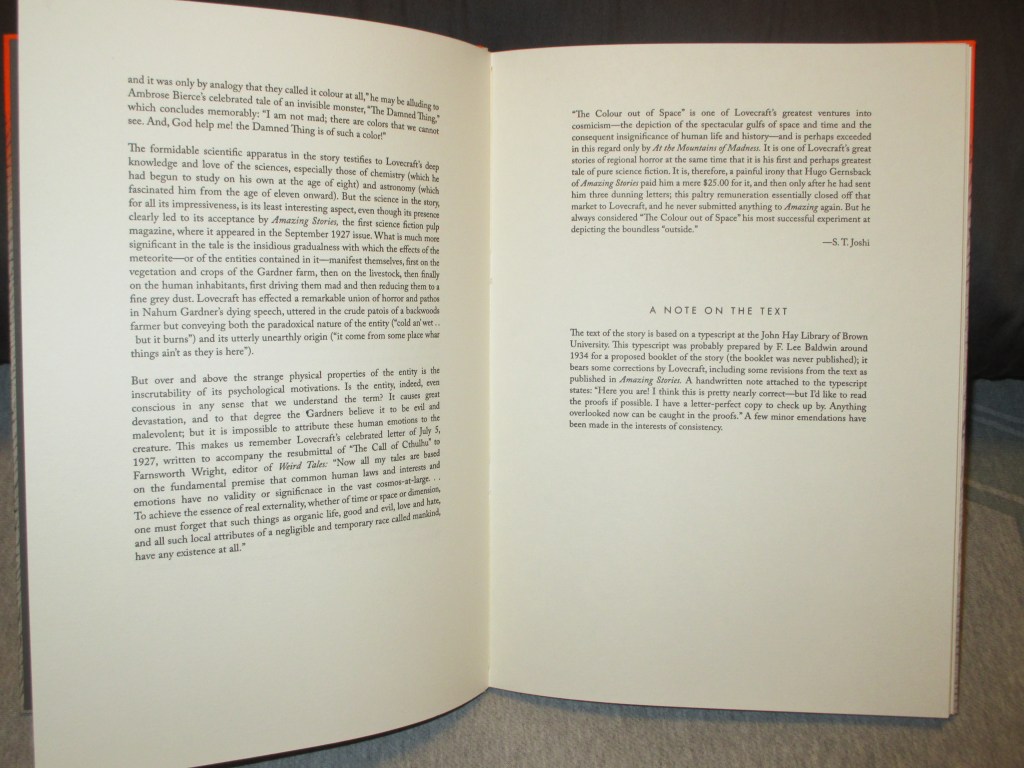
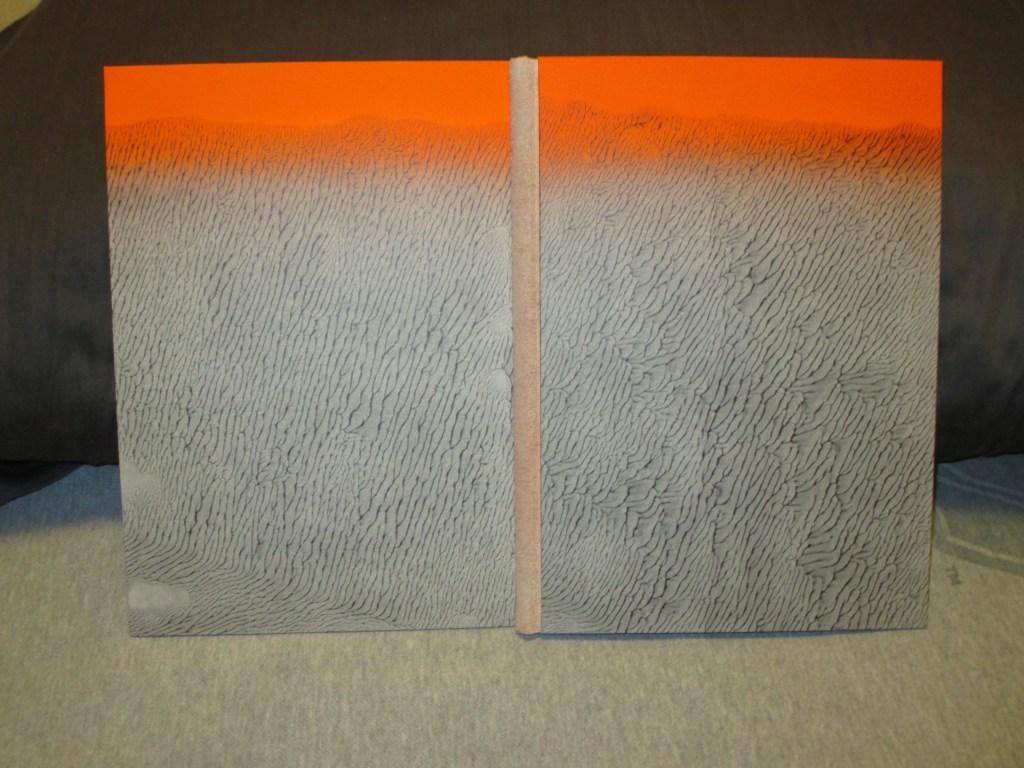
In 2016, artist Amy Borezo published a very limited illustrated edition of H. P. Lovecraft’s story “The Colour Out of Space.” To quote from Shelter Bookworks’ original page:
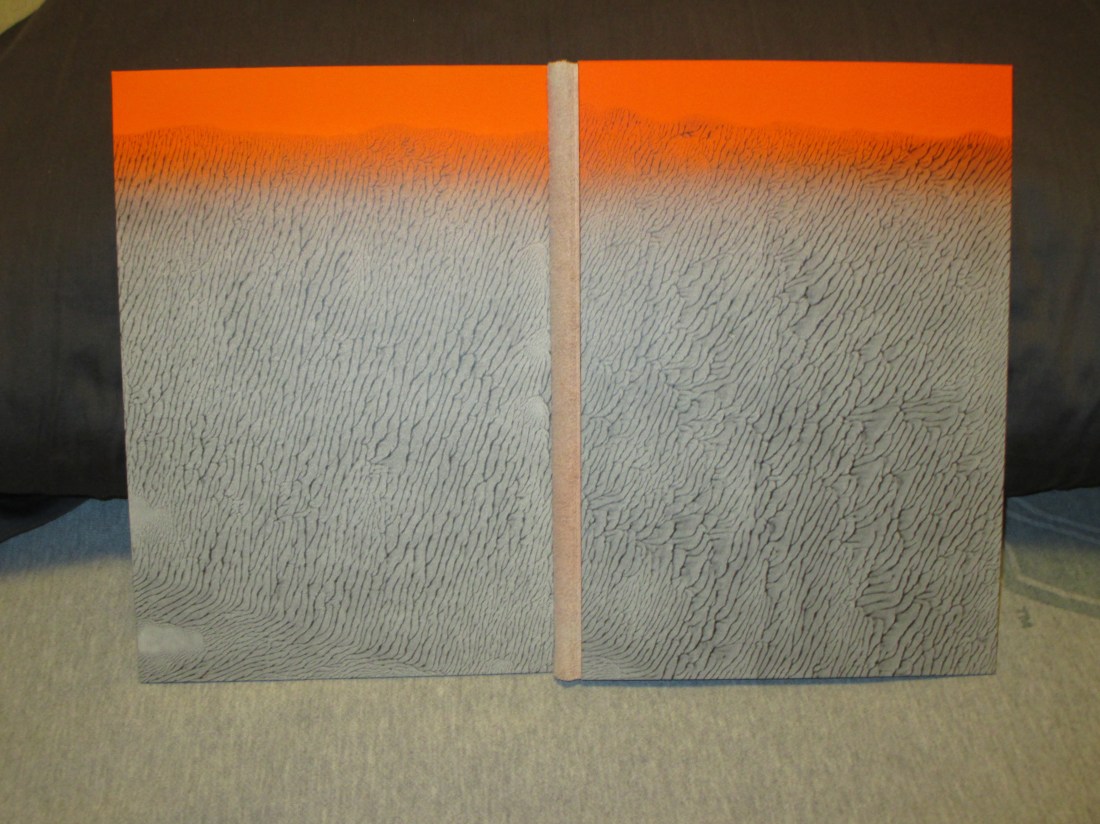
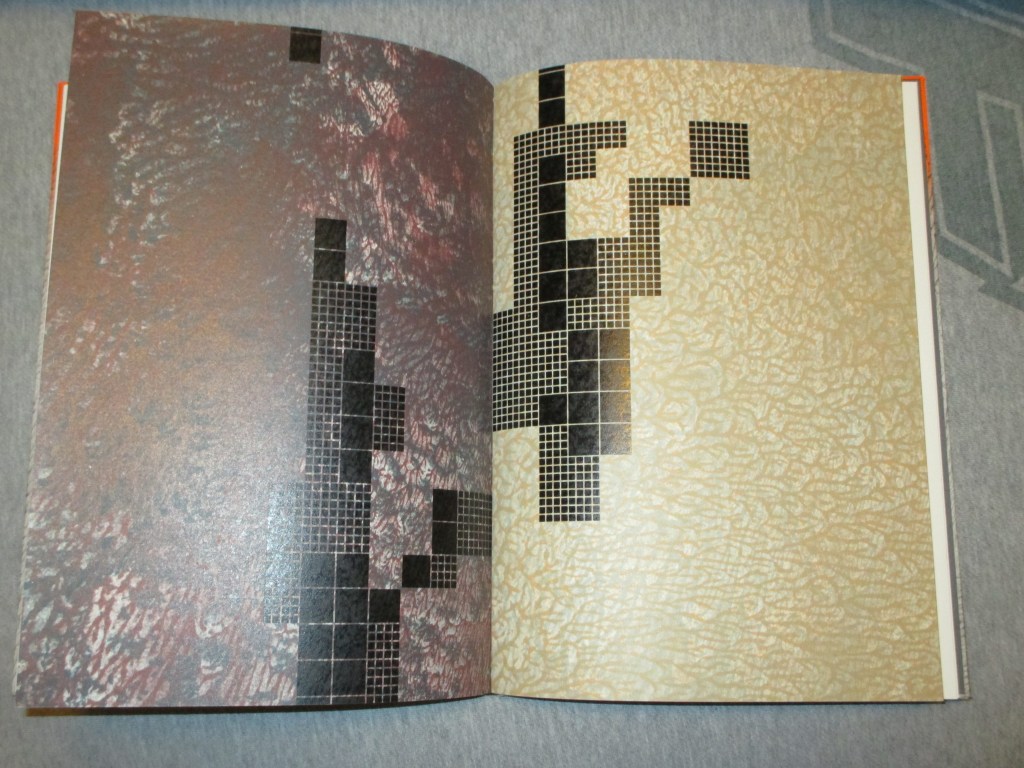
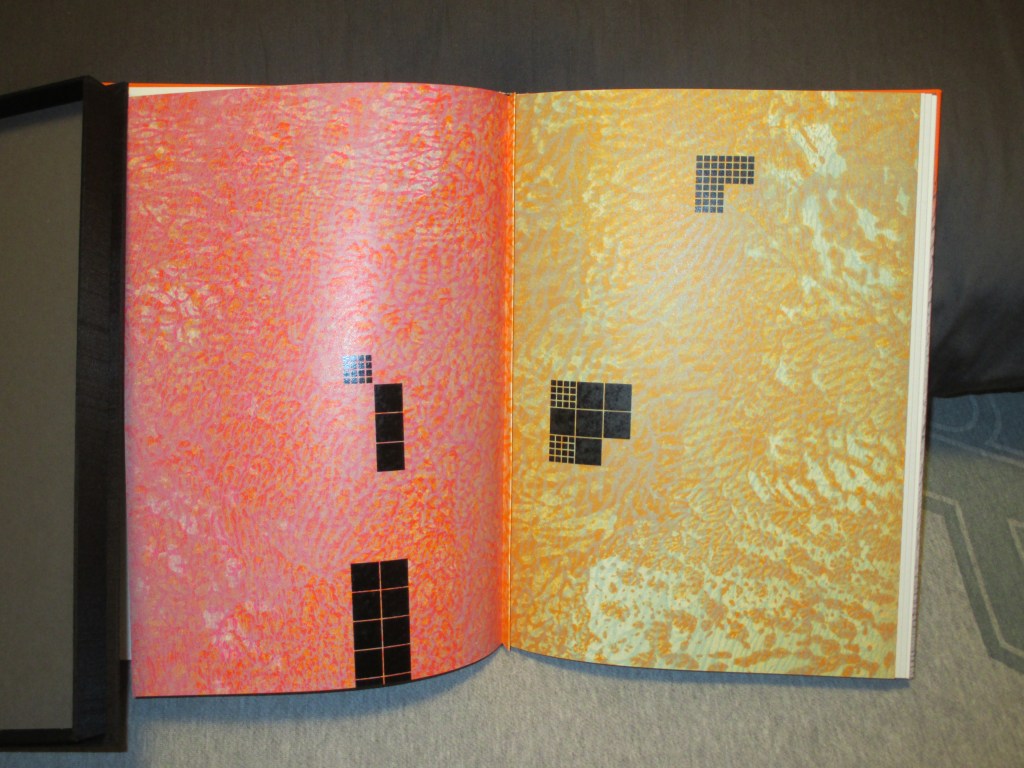
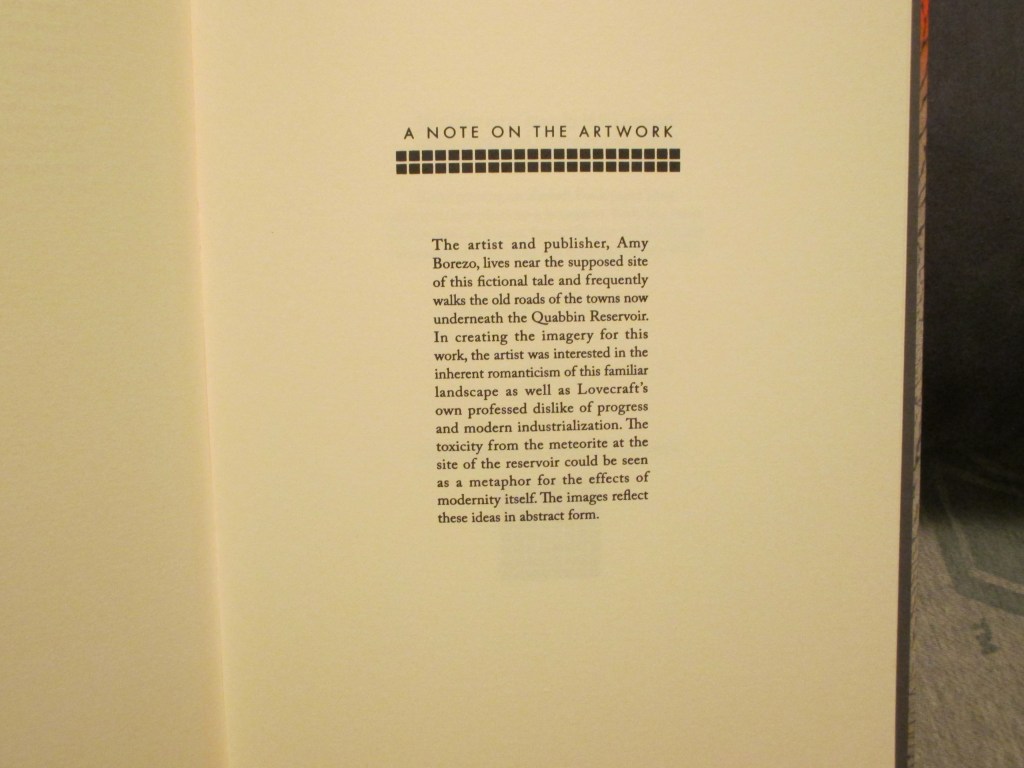
This hybrid artist’s book/contemporary fine press edition of the 1927 horror/sci-fi story by HP Lovecraft includes an introduction by Lovecraft scholar S.T. Joshi and 14 color images by Amy Borezo. The artist lives near the supposed site of this fictional tale and frequently walks the old roads of the towns written about in this story. In creating the imagery for this work, the artist is interested in evoking the complexity of the local landscape in abstract form with the construction of the reservoir overlaid visually through geometric blocks.
The text for this edition was provided by S.T. Joshi from his recent publication, H. P. LOVECRAFT: COLLECTED FICTION: A VARIORUM EDITION [Hippocampus Press, 2015] and is derived from a typescript at Brown University, evidently prepared by F. Lee Baldwin for a proposed reprint of the story (c. 1934) that never happened. It has some revisions in pen by Lovecraft, so presumably it represents his final wishes for the story. _____________________
Relief printing on Zerkall Book paper from photopolymer plates on a letterpress. Body text set in Caslon, titles in Futura. Pages sewn onto a shaped concertina. Paste paper over boards with a buffalo suede spine. Housed in a presentation box. Special thanks to Lisa Hersey who assisted in printing and binding.
The edition, despite the relatively high cost (US$500 + shipping in 2016), sold out. It arrived in an attractive clamshell box, with a paper label. Inside, the colors on the paper are bright and vivid in a way that the light and the camera don’t really catch, the backstrip soft, the paper creamy and the text sharp. In your hands, the brilliant orange seems to leak through around the edges of the pages. A title page, a brief introduction by S. T. Joshi. The text and illustrations are on alternate pages, distinct, the images vivid but abstract. A word on the artist, a colophon and numbering page, and then the book is at an end.
Amy Borezo’s illustrated edition is, in a very real sense, a piece of art that you can read. The text itself is meticulous in its accuracy, but you can read the same text in Hippocampus Press’ variorum edition, you can read the same text for free online. If you must have a physical copy of a book in your hand, you are spoiled for choice: “The Colour Out of Space” is one of Lovecraft’s most reprinted works, and there are innumerable illustrations for the story from various artists, from J. M. de Aragon in the pages of Amazing Stories in 1927 and Virgil Finlay in Famous Fantastic Mysteries in 1941 to many others of the current day.
This massive plurality of choice, the sheer number of editions, touches on an issue that many readers and would-be readers of Lovecraft deal with: where do you start? What is the best edition? What if you want a really nice copy of a book? Which one of all the hundreds of titles should you go for, and why, and how much will it cost?
If that sounds like more of a collector’s issue than a reader’s issue, then congratulations, you’ve hit on one of the fundamental problems facing not only Lovecraft, but most popular authors in the contemporary period.
When Lovecraft was alive, he was primarily published in the amateur press, pulp magazines, some reprint anthologies like the British Not at Night series, and a couple of very small privately printed editions of The Shunned House (never bound or formally released during his lifetime) and The Shadow over Innsmouth (which was, but the binding was shoddy). There were no finely bound editions of Lovecraft with the embellishments of the bookmaker’s art available to the general public, no leather covers, no gilt lettering, no raised bands (caveat: one copy of The Shunned House was specially bound by R. H. Barlow as a gift for Lovecraft).
Early collectors of Lovecraft often focused on posthumous publications, like the first publications of Arkham House, and little obscurities like the edition of Lovecraft’s commonplace book put out by the Futile Press in 1938. Even ultra-small press editions were typically not “fine” in the sense of lavish materials, artwork, or presentation, but were often considered valuable simply because of the small size of their edition, the ease with which copies perished, and subsequent rarity in the face of growing demand. That demand came from Lovecraft’s own growing popularity; the mass market paperback reprints of Arkham House collections, the armed services editions, and foreign reprints in hardback and paperback vastly increased the audience for Lovecraft’s work.
Until quite recently, fancy fine press editions were not normal for living authors. Before mass literacy, books were often bought unbound and then the author could bind them however they liked; really rich people could commission books that were themselves works of art in every sense of the word, involving whatever costly materials or decorations they cared for. As the commercial basis of book reading and publishing became more egalitarian, fancy editions often became more about the skill of the bookmaker and/or any associated artist, for fine press editions, and the materials shifted.
So when you look at what constituted a really nice Lovecraft edition in, say 1980, you’re likely looking at the output of Roy A. Squires’ press. These were meticulously crafted letterpress editions, usually on high-quality handmaid paper, sometimes featuring tipped-in photographs or other illustrations. Where a normal chapbook from Necronomicon Press or a fan press might be published on an Apple II printer and stapled together, everything about Squires’ production was done by hand.
The slightly bourgeoisie desire for something fancier still nagged the science fiction and fantasy market. Arkham House paved the way in the late 1930s and 40s by showing that a small press publisher specializing in genre books was viable (the presses they inspired apparently didn’t know how often Arkham House founder August Derleth was running in the red, or how long it took for his small, relatively expensive books to sell). Most of these products weren’t fine press; they were solid books, aimed and priced at a select market. Very few of them produced anything that might be described as a luxury edition of Lovecraft; the choicest example might be the 1976 edition of Démons et Merveilles by French publisher Opta, which came bound in leather, with slipcase, and illustrations by Philippe Druillet. The translation has its issues (Lovecraft’s “ghouls” is rendered as “vampires,” to give one notable example), but compared to the rather plain but sturdy Arkham House editions, it’s gorgeous.
Easton Press (founded in 1975 as a division of MBI, Inc.) took up the gauntlet of producing, for lack of a better term, what not-rich people think of as rich people’s books: bound in leather, embossed in 22k gilt, very snazzy to look at. In practice, while Easton Press has consumed many acres of cowhide, the actual books they produce tend not to be very special: they’re reprints of existing books, often not anything particularly rare or obscure, with no additional editorial guidance or notes (and sometimes bad misprints). The books themselves are usually solid, but less than beautiful; their editions of Lovecraft show evidence of corner-cutting and mass production.
There is a niche market for really nice editions of books, at a price affordable to middle-class bibliophiles. Over the last twenty years or so, that niche market has exploded. Centipede Press, Subterranean Press, the Folio Society, etc. are names that are familiar now for deluxe editions of Lovecraft and/or other authors, typically reprinting older works instead of presenting anything original, and typically publishing in limited editions of a few hundred copies. Quality and presentation vary, although are generally pretty high—not quite the same production value as, for example, letterpress outfits like Pegana Press which continue the fine press tradition, but for high-end versions of books that you might otherwise buy at Barnes & Nobles…
…and that is kind of the rub. While there are some exceptions, most of these presses aren’t gambling on producing anything new. There might be new artwork, there might be a new introduction by Alan Moore or S. T. Joshi, but there is no experimentation, there is often nothing unique about these particular editions. There are some exceptions; Centipede Press has produced some original compilations like Conversations with the Weird Tales Circle that collects many rare, obscure, and out-of-print materials; and the art book A Lovecraft Retrospective is pretty much unparalleled. Helios House Press has published some original scholarship among the reprints (full disclosure: they’ve paid me for a few essays and other work).
For most of these companies, however, the text itself isn’t special. The production quality might not be much better than any other mass-produced hardcover. They might be pretty, but from a strictly objective standpoint they don’t offer much new or exciting. They’re just very expensive.
So what exactly are you, the reader, paying for?
Which is what you need to answer for yourself. If you’re a scholar or academic looking for a text that’s pure Lovecraft, you’re probably better off buying the Hippocampus Press variorum editions. If you’re a casual reader, the Penguin paperbacks are cheap and almost as good. If you’re a poor student, stick to the online editions at https://hplovecraft.com. If you want a fancy edition…well, you’ve got options. Lots of them, for every price point. Handmade Japanese paper, bound in leather, with silk bookmarks, signed in blood.
It’s all available for the right price.
So what sets Amy Borezo’s book apart? Normally, based on the materials, the quality of the printing and craftsmanship, I would qualify this as a fine press product. However, in the marketing, the presentation, this is a little different. It is a book, and can be read as a book, but it is also a work of art, and can be experienced and appreciated like buying a lithograph print from a series. If you’re a fan of Lovecraft, you know the words, you’ve read the story a hundred times. Many artists have tried to capture a colour that lies beyond human perception, to depict the events of the story in some fixed form. Only Borezo has gone to such effort to capture that feel in an entire book production, not just as isolated images.
The beauty of Borezo’s art is that it is abstract; it doesn’t try to impose meaning on the text, readers have to stare at it for themselves. Some might not like it, others might get it but not care for the idea, but for me there’s a certain tactile experience with that nearly radioactive orange that seems to seap through and around the pages at times. Yes, it could just be the collector in me, trying to justify the hundreds of dollars this book cost, but in a real way that is the experience we buy with every book, above and beyond the text itself. The feel of it in your hands, the smell of the paper, the crackle of the spine. It’s different, when you’re holding an old pulp whose brittle and yellowed pages are as fragile as a papyrus from a mummy’s tomb, or an old worn paperback whose tanned pages are as soft as toilet paper, or a crisply printed new edition with ink that almost looks still wet.
From a scholar’s perspective, from a historian’s perspective, the focus is usually on the text, not necessarily the visceral experience surrounding how the text is read and received. Yet it is important not to lose touch with that. In an age where Lovecraft is in the public domain, generative AI, and print-on-demand publishing, we are going to see a vast proliferation of books—many of which are going to be strictly hypothetical until someone orders them—and our eyeballs will see cover art generated by some pseudointellectual property theft engine and with text scraped off of somewhere online (errors and all), and pre-packaged to try and appeal to someone that wants to read Lovecraft—and whatever the end product is, the one thing I can guarantee is that it is not going to be anything like Amy Borezo’s edition of The Colour Out of Space.
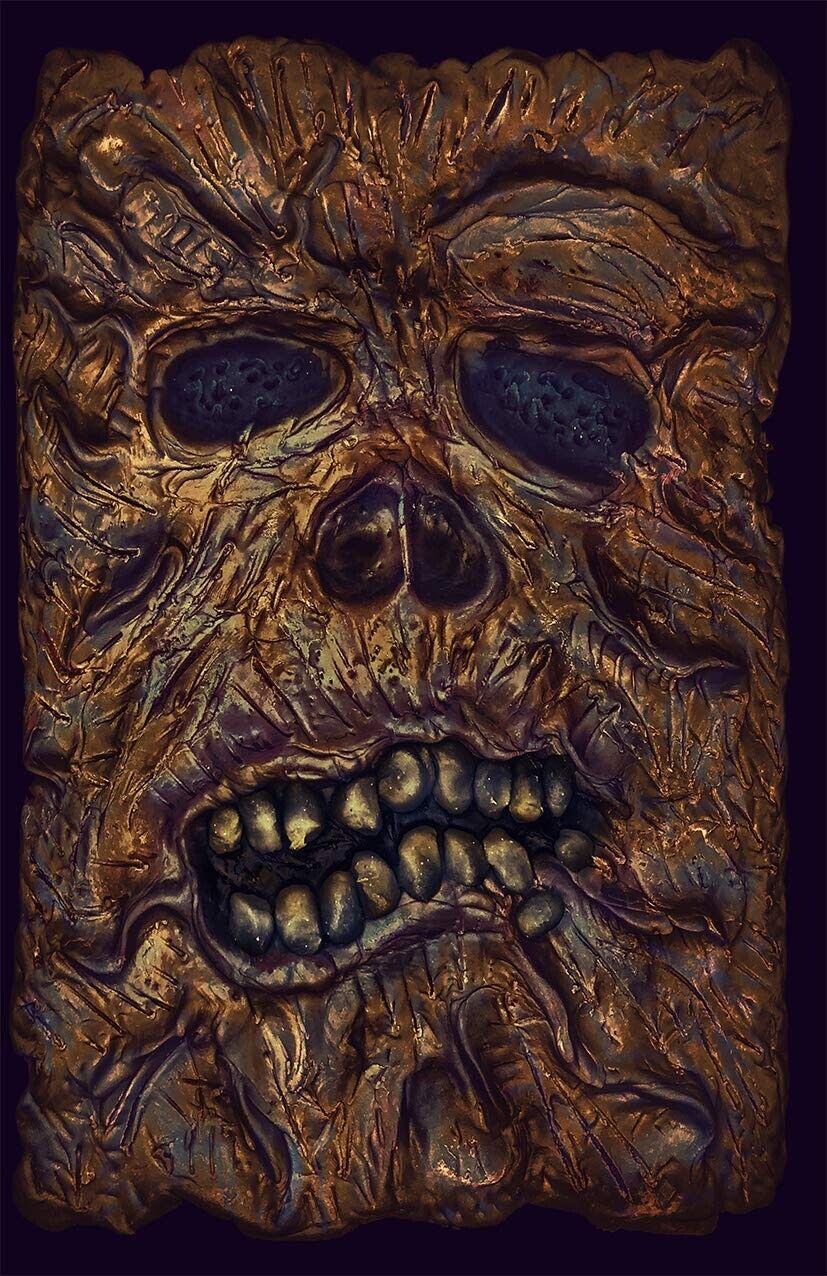
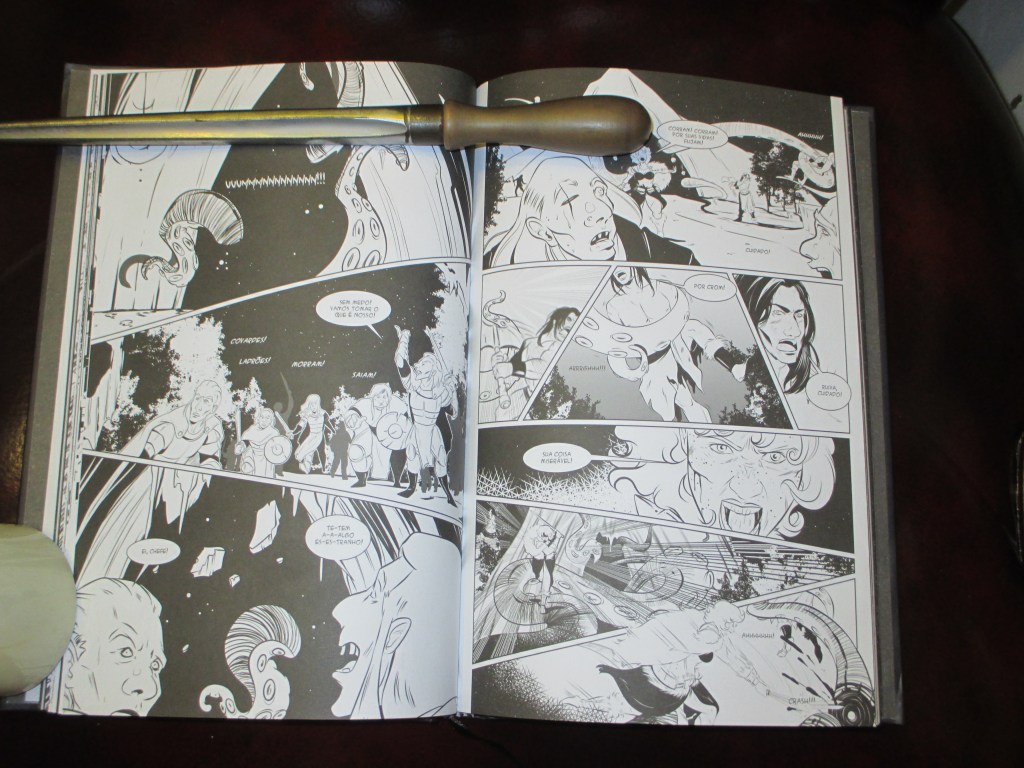
Os Mitos de Lovecraft (2020) is a crowdfunded Brazilian black-and-white graphic anthology edited by Douglas P. Freitas and published by Skript, probably best known for the deluxe hardcover edition which has a cover modeled on the bound-in-human-skin Necronomicon ex Mortis from Evil Dead 2 and Army of Darkness. Like its fellow Brazilian Lovecraftian anthology O despertar de Cthulhu em Quadrinhos (2016), while there is a common theme in terms of subject, the style and tone of the individual works inside varies considerably. Every style of comic art and horror can be represented under the broad remit of Lovecraftian comics, from straight adaptations of Lovecraft in exquisite realistic depiction to splatterpunk-esque gore fests with plenty of airbrush-style gore streaks to lighter works with more cartoonish tentacled Cthulhu-esque characters.
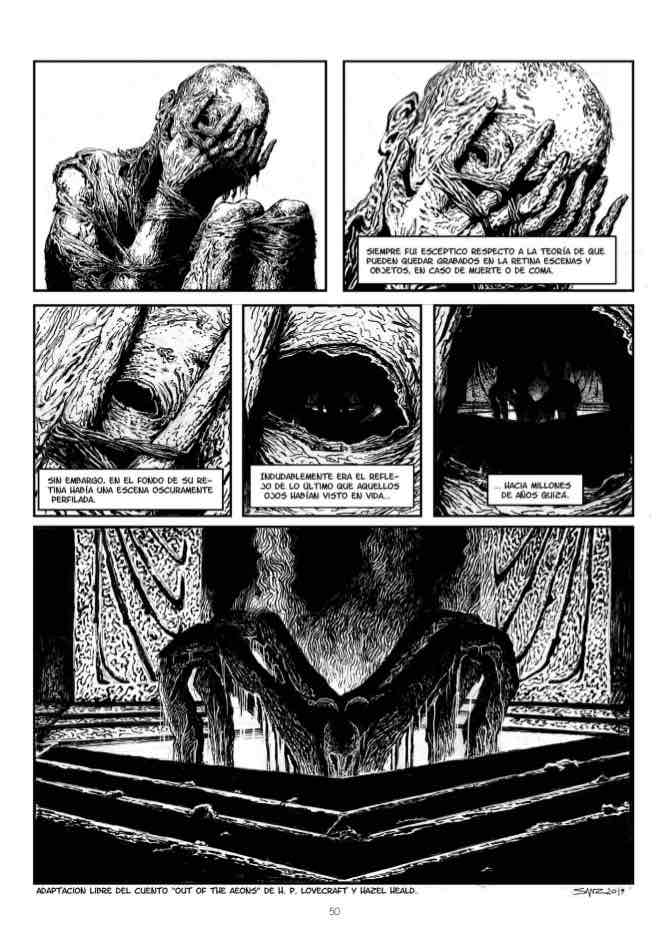
The anthology begins with an absolute masterpiece in two pages, by Argintenean artist Salvador Sanz, which originally appeared in the Spanish-language graphic horror anthology Cthulhu 23; for this anthology, it was translated into Brazilian Portuguese by Aline Cardoso and re-lettered by Johnny C. Vargas. This is a distillation of “Out of the Æons” (1935) by Hazel Heald & H. P. Lovecraft, subtracting all the human characters, the drama, and the fantastic history deciphered from the scroll in exchange for focusing on a masterful rendering of the mummy who caught a glimpse of Ghatanothoa—and paid the price.
In a cinematic journey, the reader is taken closer and closer to the ancient petrified horror. The panels zoom in on the one eye that peeks out between gnarled fingers. To the dark image that is still captured there, on the retina. The detail on the art, the pacing, and the execution of the concept, which boils down the essence of the Lovecraft/Heald horror story into two pages, is exquisite.
※
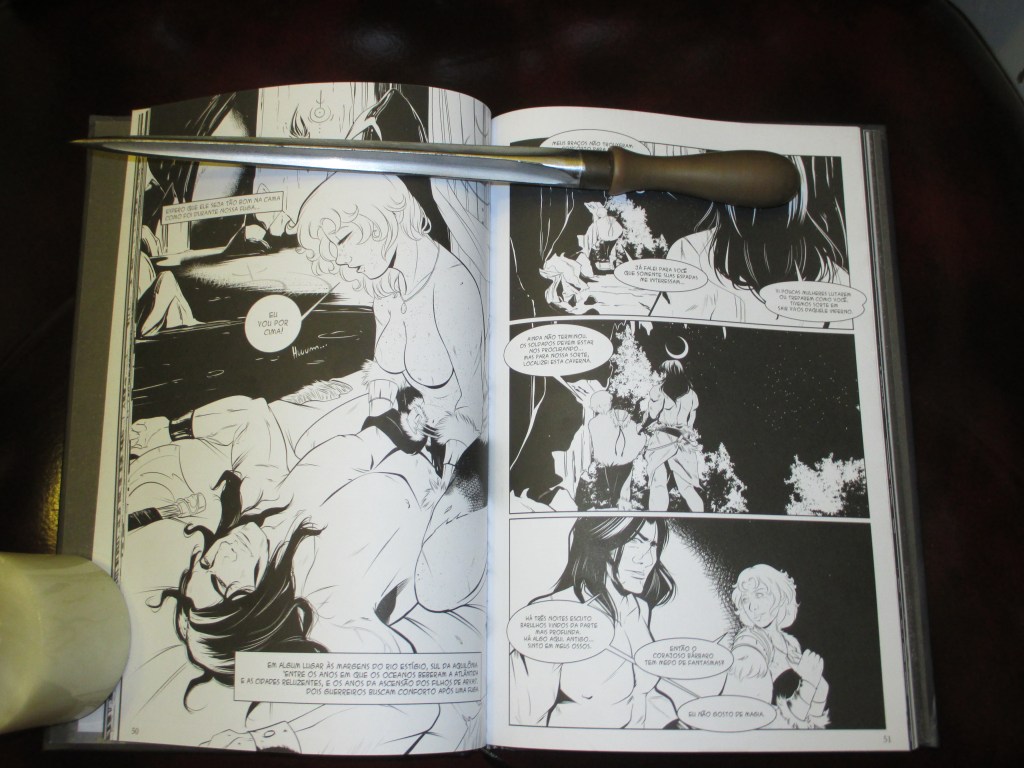
Freitas’ own contribution to Os Mitos de Lovecraft is “Sob As Trevas” (“Beneath the Darkness”), in collaboration with illustrator and comic creator Chairim Arrais. This is a tongue-in-cheek 8-page sword & sorcery story involving a nameless Cimmerian warrior and their female partner Ruivas (“Red”/”Red-hair”). Freitas & Arrais are clearly referencing Robert E. Howard’s most famous creation, Conan the Cimmerian, and aren’t coy about it:
Em algum lugar às margens do rio Estígio, sul da Aquilônia, ‘entre os anos em que os oceanos beberam a Atlântida e as cidades reluzentes, e os anos da ascensão dos filhos de Aryas’. Dois guerreiros buscam conforto após uma fuga.
Somewhere on the banks of the River Styx, south of Aquilonia, ‘between the years when the oceans drank Atlantis and the gleaming cities, and the years of the rise of the sons of Aryas’. Two warriors seek comfort after an escape.
“KNOW, oh prince, that between the years when the oceans drank Atlantis and the gleaming cities, and the years of the rise of the Sons of Aryas […]” —Robert E. Howard, “The Phoenix on the Sword”
The character Ruivas is depicted similarly to the eponymous character in Arrais’ standalone comic “Red+18”; whether this is intended as an unofficial crossover, an Easter egg for fans of Arrais’ work, or just a coincidence—the character could as easily be a play on Red Sonja for the Marvel Comics, albeit sans the trademark mail bikini—is unclear, and maybe unimportant.
The story itself is fairly slight and straightforward: after successfully stealing a jewel, the pair of thieves hide out in a convenient cavern…which ends up being occupied by some nameless eldritch horror.
The story really wanted more pages; there’s little opportunity to really develop any atmosphere before the tentacles emerge from the darkness, and the action sequences are correspondingly cramped and staccato-like, crammed into increasingly more panels per page. With the in media res debut, the titillation, and the swift conclusion, this is strongly reminiscent of the kind of back-up feature that sometimes ran in Savage Sword of Conan, more of a sketch of an interlude than a full-fledged story.
Yet what there is there is fun. The writing is light-hearted, the chemistry between legally-not-Conan and Ruivas is alternately playful and rocky, and Arrais’ artwork does everything the script calls for. The brief sword & sorcery interlude sets a different tone than the other stories in the anthology, featuring more sex and action than horror or outright comedy. While I would have liked for it to delve more into the Howardian vibe of horror that permeated tales like “Xuthal of the Dusk” or “Red Nails,” limitations of space have to be acknowledged. Still, it would be nice if Freitas & Arrais had the opportunity to revisit the idea at a longer length more suitable to develop the characters and story at some point.
Eldritch Fappenings This review deals in part with artwork that includes nudity and/or sexuality explicit content. As such, please be advised before reading further.
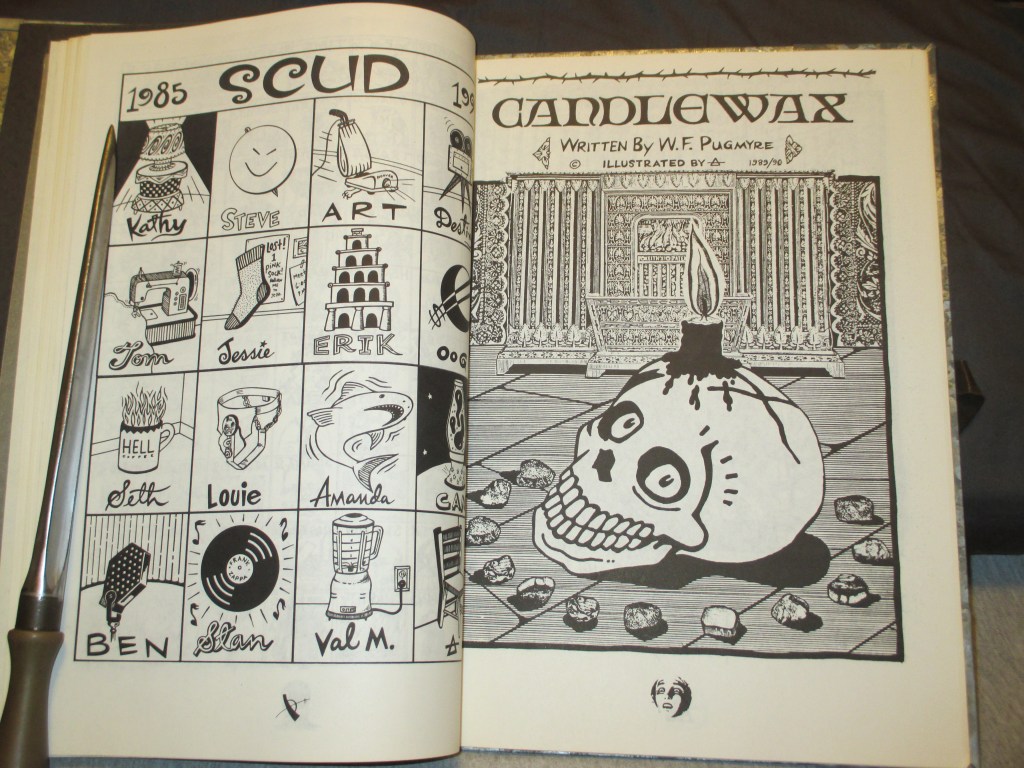
In the 1985 Christmas supplement to the fanzine Fungi, W. H. Pugmire‘s story “Candlewax” first saw publication. This was one of Pugmire’s earliest efforts at Mythos fiction, and is a part of his Sesqua Valley cycle—his own corner of Lovecraft country set in the Pacific Northwest, populated by characters like Simon Gregory Williams. While Pugmire would go on to write many more tales of Sesqua Valley, which have been collected and published in various volumes, “Candlewax” is one of the comparatively rarer tales, having been reprinted only a handful of times—and, most interestingly, in an illustrated edition.
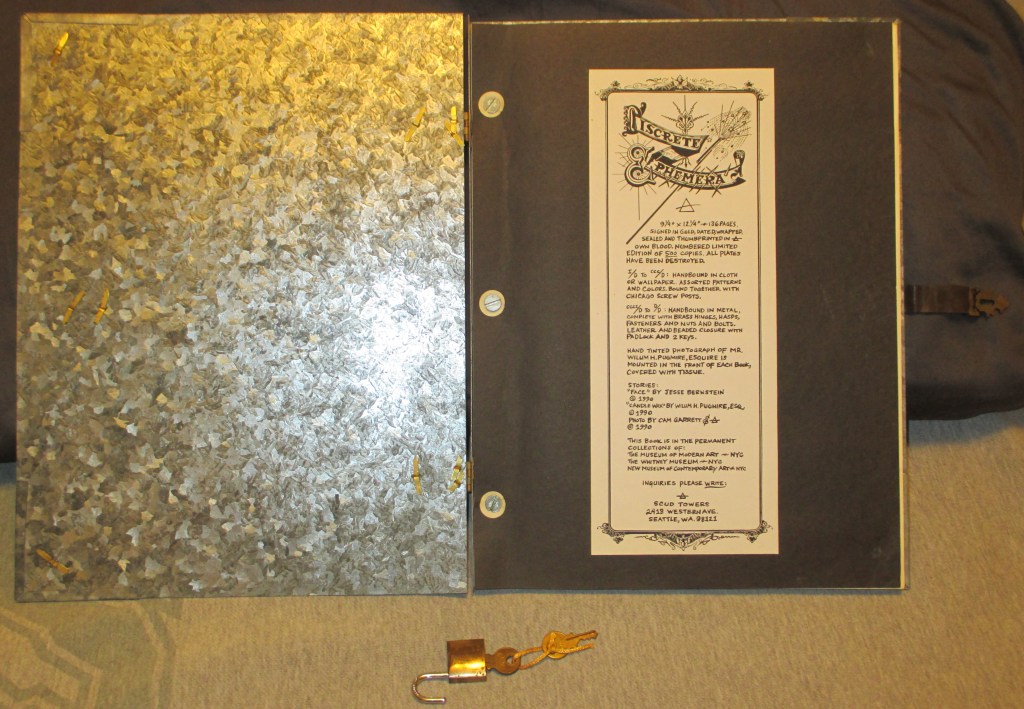
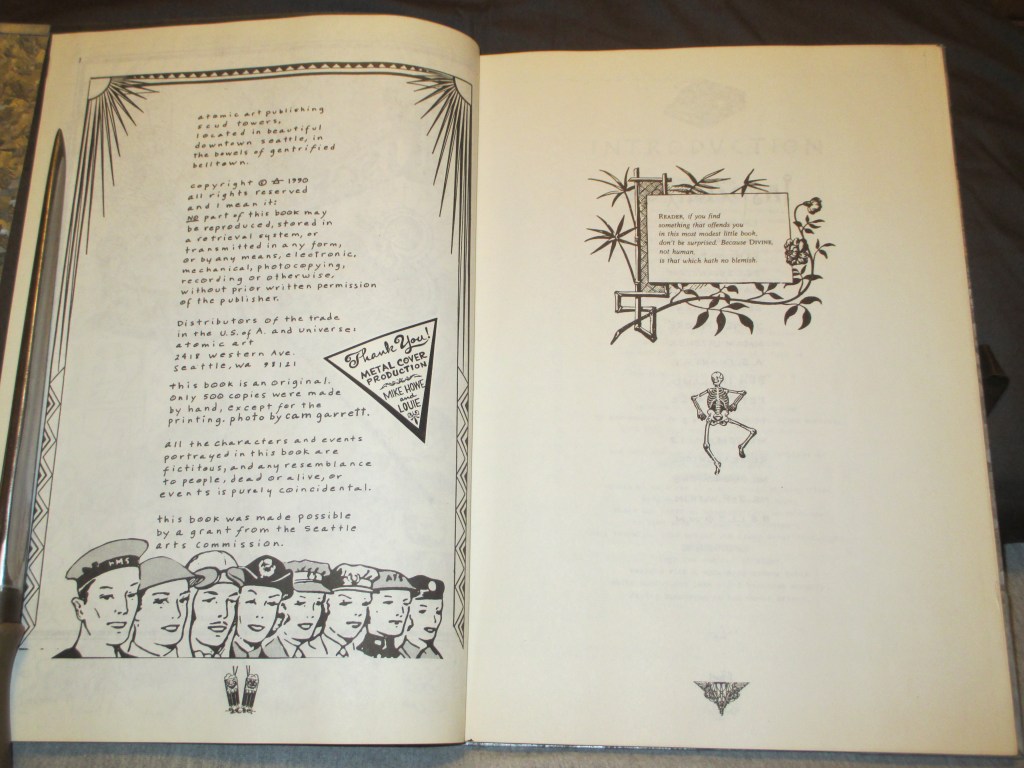
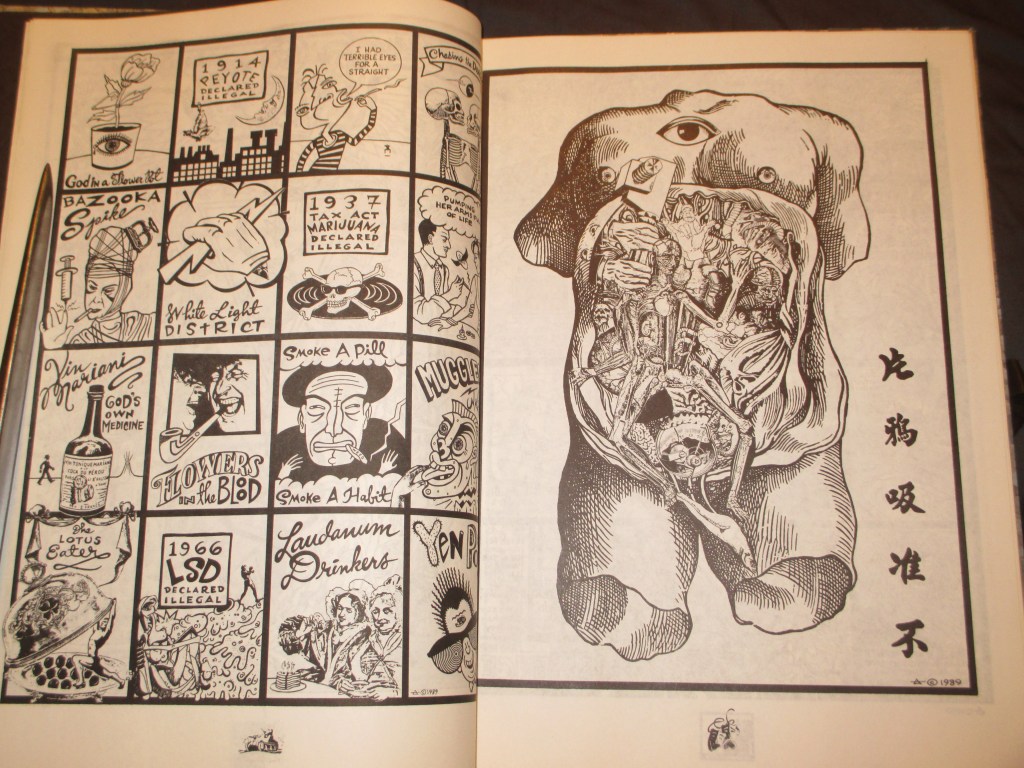
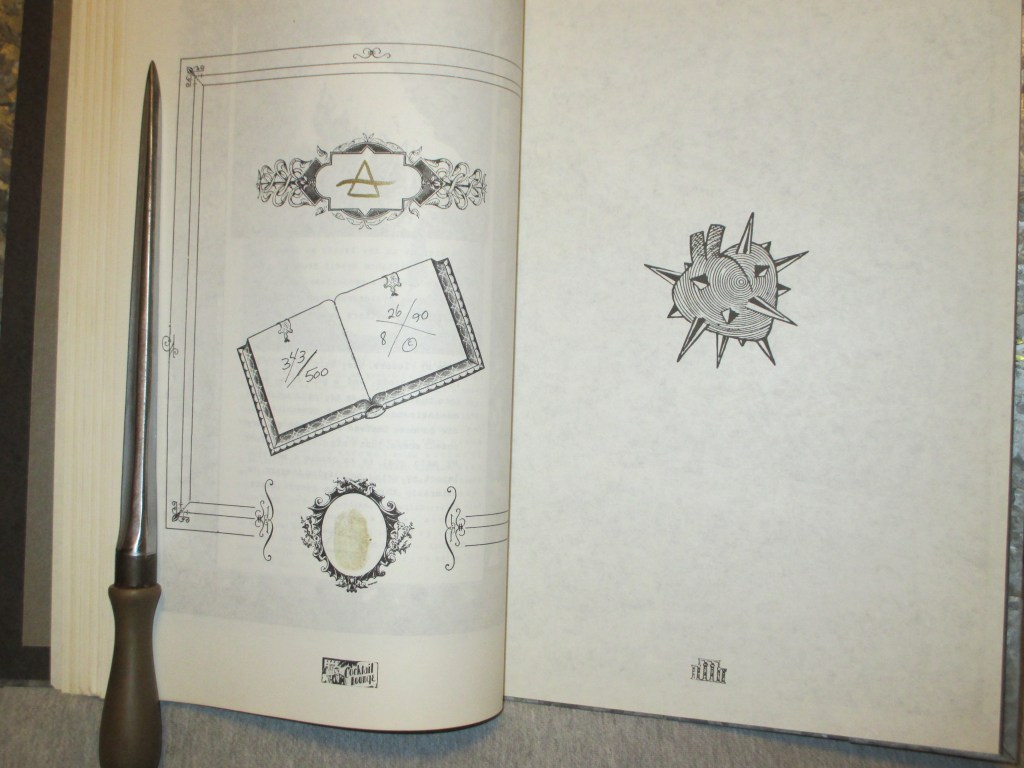
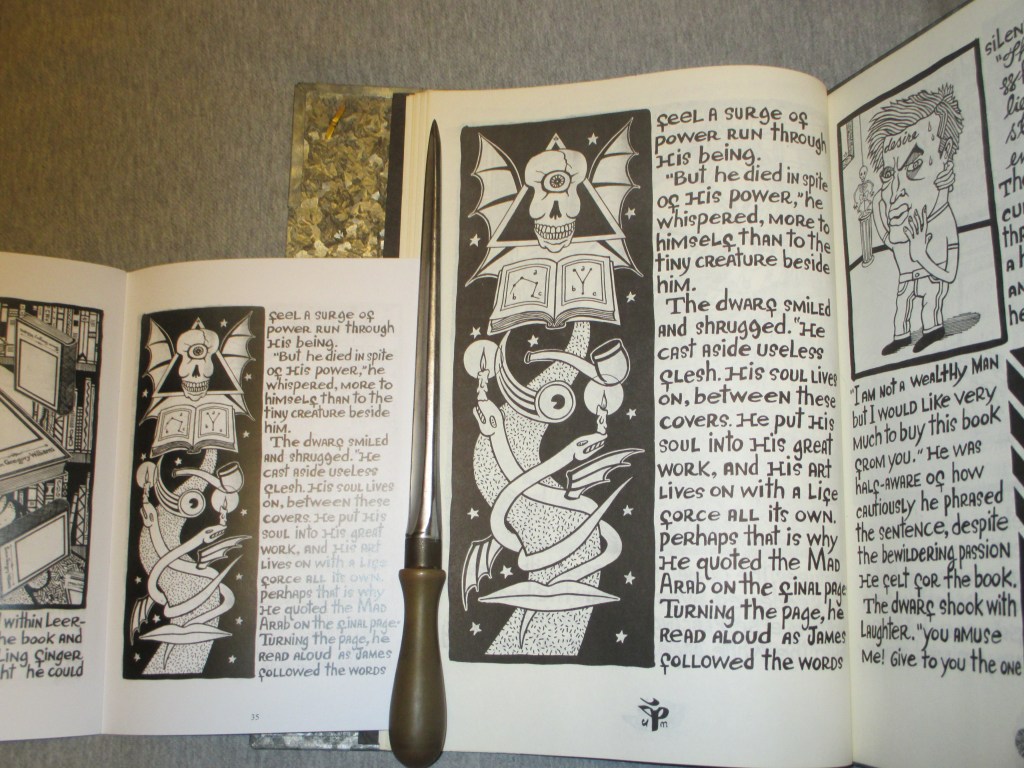
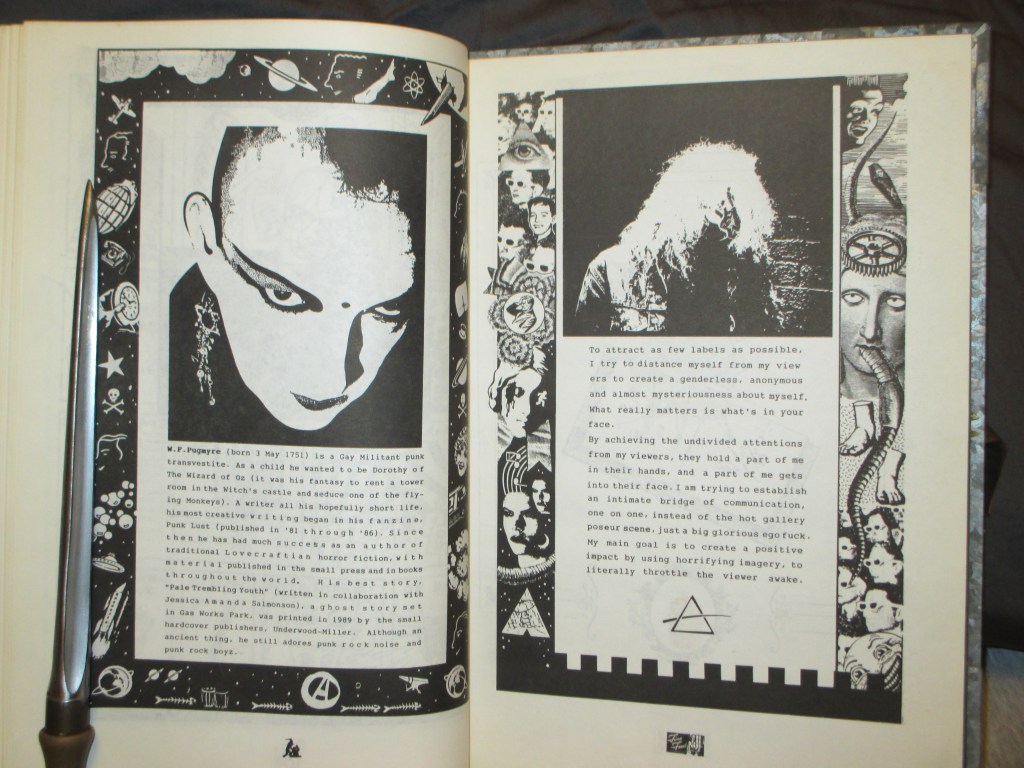
Discrete Ephemera (1990) is a limited edition (500 copies) book art project by Ashleigh Talbot, and illustrated texts by Steven J. Bernstein (“Face”) and W. H. Pugmire (“Candlewax,” as “W. F. Pugmire”), made possible by an art grant. Madame Talbot is presented throughout via a symbol:
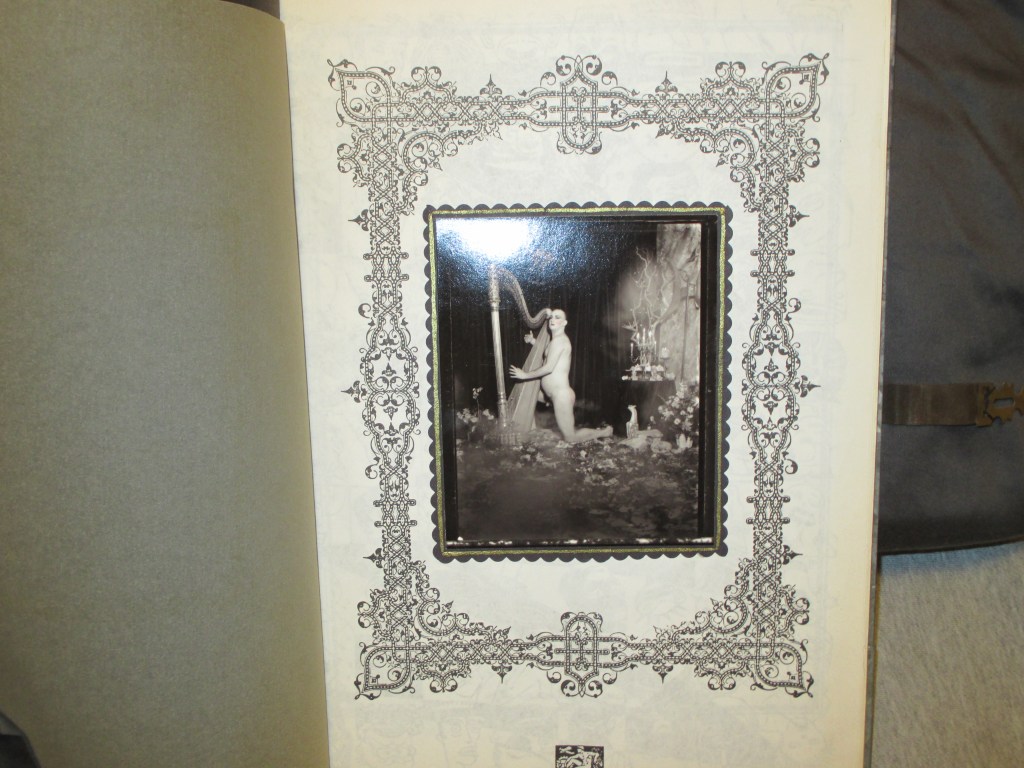
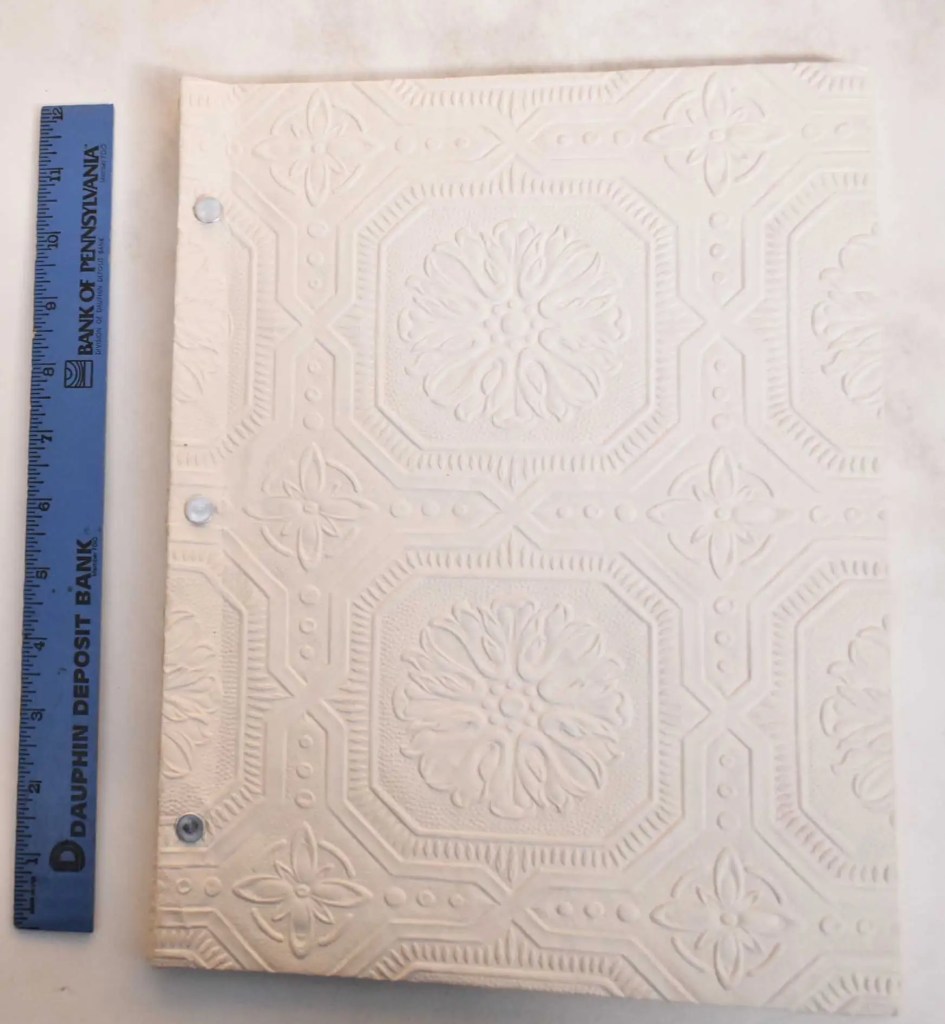
The book exists in different states. My copy of 136 unnumbered sheets is bound between sheet metal plates with a small brass padlock, while others are bound in textured wallpaper; with a fingerprint imprint in gold ink (some listings say blood, but it looks like gold ink to me) on the limitation page, and a tipped-in photo of Pugmire in the nude. The overall aesthetic is strongly reminiscent of underground comix, punk zines, and copybooks of the 1960s-1980s, with an emphasis on cut-and-paste techniques, surreal imagery, the presentation of familiar images in unfamiliar contexts or subtly distorted, and a Burroughs-esque eye for the unfiltered and sometimes teratophiliac reality presented by medical textbooks and cabinets of curiosity.
The illustrated version of Pugmire’s “Candlewax” is distinct from the rest of the project, but mostly because it has a coherent, linear narrative, with a darker, more Gothic tone than the more stylized kaleidoscope of images that preceeded this section, or the much more comic-strip style collaboration “Faces” with Bernstein. While Talbot continues to use the same distinctive style, the illustrations work to complement the text, at times a strict depiction, and at times more abstract and evocative.
The story itself is a sketch in miniature of bibliomania, murder, necromancy, hubris, and revenge. A fitting snapshot of the kind of obsession that has characterized aspects of the Mythos (and readers of the Mythos) from the beginning.
At least two versions of the “Candlewax” text have seen print. Pugmire had a tendency to rewrite his stories when they were reprinted, and this seems to be the case here as well. To give the flavor of the difference:
The man was a dwarf. His bent and twisted frame, disfigured by age and nameless ailments, seemed perpetually trembling. Drool moistened thin black lips, and yellow pus oozed from reddened eyes. A skeletal finger tapped the book that lay before him, and he addressed his visitor in a whispered voice.
“His name was Simon Gregory Williams. He wrote this book of spells in the late 1960s. That in itself makes it unique. Most of my books are ancient tomes, crumbling and worm-infected. But, as you see, this looks almost new.”
The tiny man bent his twisted frame toward the curious tome. Drool moistened his thin grey lips; yellow pus oozed from his reddened eyes. A skeletal finger tapped the yellow cover of the book. He addressed his visitor in a low whispered voice.
“His name was Simon Gregory Williams. He wrote this book of spells thirty years ago, while visiting the poet William Davis Manly, in your curious Sesqua Valley.” Here he opened the book and turned to various illustrated pages. He stopped at a vivid depiction of a tremendous mountain of white stone, the twin peaks of which resembled wings folded up on a daemon’s shoulders. “The infamous Mount Selta, of which I’ve heard so much. And below, in purple ink, the name ‘Khroyd’Hon’; such a strange name.”
“Candlewax” in Discrete Ephemera (1990)
“Candlewax” in Mythos Tales & Others #1
The 1996 text deals much more with the Sesqua Valley cycle, probably to better incorporate it into the loose collection of stories and the Mythos that Pugmire would continue to build on in tales like “An Imp of Aether” (1997). Readers hunting this particular text may find themselves like the protagonist Oscar James, hunters of arcane lore about that mysterious vale and its even more mysterious occupants.
Left: Sesqua Rising, right: Discrete Ephemera
With an edition of only 500 copies, Discrete Ephemera and its illustrated version of “Candlewax” is very scarce and relatively expensive. Graeme Phillips reprinted the entire illustrated story in the chapbook Sesqua Rising (2016), but that was limited to only 50 copies, and is even scarcer, making this one of the rarest of Pugmire’s collaborations.
I was thrill’d when one of my early Mythos stories, “Candlewax”, appear’d fully illustrated in one of Ashleigh’s hand-made books. There is nothing more thrilling than working on projects with outstanding artists
W. H. Pugmire, “In Collaboration with Genius” (2016)
What is Discrete Ephemera and “Candlewax”? A collaboration of talents, a cross-pollination of ideas, attitudes, and styles. Discrete Ephemera is a kind of punkish grimoire, an art object to be experienced more than a text to be read and consumed, and in that sense “Candlewax” almost feels like a metatext…or, perhaps, a warning. For now, this copy is in my library. In time, it will be passed on to someone else. Hopefully, someone who gets it.