Pre-Code Lovecraftian Horror Comics

In the years before Seduction of the Innocent and the rise of the Comics Code Authority (1954), there was an age undreamed of… Garish four-color comics of crime, horror, science fiction, the occult, and the weird filled the newsstands. The comic book had emerged as a definitive form in 1934, at first reprinting newspaper comic strips, but soon comic magazines emerged featuring original material. While the Golden Age of Comic Books is usually said to have begun with the advent of Superman in Action Comics #1 (18 April 1938), the lucrative field swiftly diversified into many different genres, not just superheroes. In the 1940s and 50s, one of the most notable and notorious genres was the horror comic.

Early comic books shared a great deal of crossover with the pulp magazines, including artists, writers, editors, and even publishers. Harry Donenfeld was the entrepreneur behind the Spicy pulp magazines that published Robert E. Howard and E. Hoffman Price—and the same magazines also published comic strips such as Olga Mesmer, The Girl with the X-Ray Eyes; Sally the Sleuth; and Polly of the Plains. Donenfeld would later expand his enterprises into the burgeoning field of comics in the mid-30s with Detective Comics, Inc.—known better today as DC Comics.

Around the same time, future Marvel Comics publisher Martin Goodman edited horror pulps. Julius Schwartz, the science fiction fan who acted as Lovecraft’s agent for At the Mountains of Madness and The Shadow Out of Time, became an editor for DC; Weird Tales writers Frank Belknap Long, Jr., Otto Binder, and Manly Wade Wellman, among others, all wrote comic book scripts. Weird Tales artists Virgil Finlay, Matt Fox, and Frank Kelly Freas worked in comics too. So when it came time to bring their skills to comics, many of the people involved with horror comics turned to horror pulps for inspiration.

Sometimes more than inspiration:

The one instance I remember was a very awkward one. It’s curious that I remember the name of the author who complained. It was August Derleth, a well-known horror writer. It was a story in one of our magazines, called “The Ornalean Clock,” and it involved the other staff writer. Mr. Derleth wrote in (it surprised me that he was reading these comic books) and sent us the story that he wrote which was about an Ornalean clock It was clear that it had been plagiarized.

It was very awkward. Richard [Hughes] confronted the writer, who did what plagiarists always do—that is, claimed he must have dipped into his unconscious, he wasn’t aware of it, and so forth. And perhaps the only defense he had was that it was so blatant!

Norman Fruman, assistant editor of the American Comics Group, quoted in Michael Vance’s Forbidden Adventures: The History of the American Comics Group 73

Derleth’s story was “The Ormolu Clock” in Weird Tales January 1950. Derleth’s friend Frank Belknap Long, Jr. had written the first issue of Adventures into the Unknown, the first ongoing horror comic, published by the American Comics Group. Derleth was well-known for his love of comic strips, and no doubt spotted the plagiarism because he followed the horror comics after Long had brought them to his attention. Ironically, it was Derleth who would write a letter to editor Richard Hughes encouraging them to continue to publish horror comics instead of canceling the series (Forbidden Adventures 110-111).

If ongoing horror comics began in 1948 with Adventures into the Unknown, the horror comics craze was kicked off by Crypt of Terror #17 (April/May 1950) from EC Comics—better known today under its later title, Tales from the Crypt. EC’s comic stories were, for the time, often well-written and well-illustrated; they often had a moral, but they could also feature darker twist endings, and a bit of grue. The many imitators of EC were not often as conscientious in their writing or art; much like the pulp magazines, the newcomers often leaned into gore, mutilations, eye gouging, drug abuse, and nasty ends where criminals get away with their crimes.

While individual comic book publishers had their own internal codes of censorship, there was no industry-wide limitation on content except for general statutes on obscenity. So while explicit sex and nudity were largely the province of Tijuana bibles, comic books on the stand could easily present gore, mutilations, dark and mature storylines, mouldering skeletons, vampires, voodoo, cannibalism, and all the rest. Plagiarism, either of published stories or swipes from other artists, was rife. Yet the period ended swiftly.

In 1954, a moral panic swept the United States (and was echoed in the United Kingdom and other countries around the world), spurred on by Frederic Wertham’s Seduction of the Innocent, his many articles in newspapers and magazines, and his testimony before the Senate Subcommittee on Juvenile Delinquency. Other pearl-clutchers and parents groups added their voices, and federal oversight seemed a real possibility—so the major comic publishers came together and formed the Comics Code Authority, whose Seal of Approval would mark approved comics. Not approved? Horror.

The formation of the CCA effectively ended most horror comics publishing in the United States for a generation, and had a chilling effect on comics intended for mature audiences. They would come back—the underground comix of the 1960s and 70s especially paid tribute to EC’s horror comics, and raised a general middle finger to the censorship of the CCA, while major publishers like Marvel and DC would push back little by little with their own horror comics in the 1960s, sometimes sidestepping the CCA by publishing full-sized comic magazines. This would lead to a great flowering of horror comics magazines from publishers like Warren and Skywald in the 1970s and 80s, and lay the groundwork for comics like Heavy Metal Magazine (originally a translation of the French magazine Metal Hurlant).

Ironically, in 1954 Weird Tales also ceased publication, one of the last of the old-time pulp magazines to give up the ghost, unable to compete either against science-fiction digests or the coming men’s adventure pulps that flourished in the postwar era. An entire sub-industry was gutted almost overnight. Former pulp writers and artists who had known, talked, and corresponded to H. P. Lovecraft, who might have adapted his work to a new medium, never got that chance…well, except during the period before 1954.

While there are thousands of pre-Code comic books, there are only a handful of comics that can be positively said to be “Lovecraftian horror,” either because they directly adapt a Lovecraft story or explicitly make reference to Lovecraft’s Mythos. If one were to include other early Mythos writers like Robert E. Howard, the list would be a little longer—“Skull of Doom” in Voodoo Comics #12 (1953), for example, seems to be an adaptation of Howard’s “Old Garfield’s Heart.” But for the sake of keeping this list manageable, here are some positively identified pre-Code Lovecraftian horror comics, many of which are in the public domain and can be read for free.

A Note: Many of these early comics were completed in small studios by teams of writers and artists, working for low rates, and often without credit. As such it is not always clear who exactly worked on many of these comics, but as far as it can be determined, the names of the writers, artists, letterers, etc. will be included below.


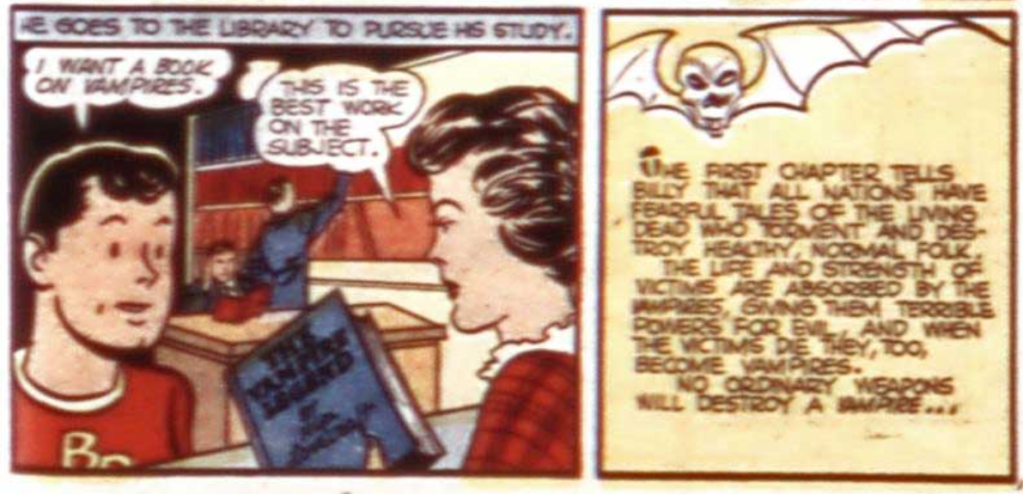
“Captain Marvel Battles the Vampire” (March 1941)

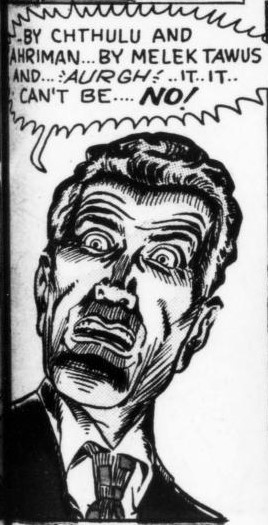
Published in Captain Marvel Adventures #1 (Fawcett Publications), this 16-page story of Captain Marvel (now often known as Shazam) was penciled by Jack Kirby and inked by Dick Briefer. The mystic hero finds himself up against one of the undead, and to better understand his foe and their weaknesses, a librarian hands him The Vampire Legend by H. P. Lovecraft. An unlikely title, but a neat homage to Lovecraft!
“Dr. Styx” (August 1945)

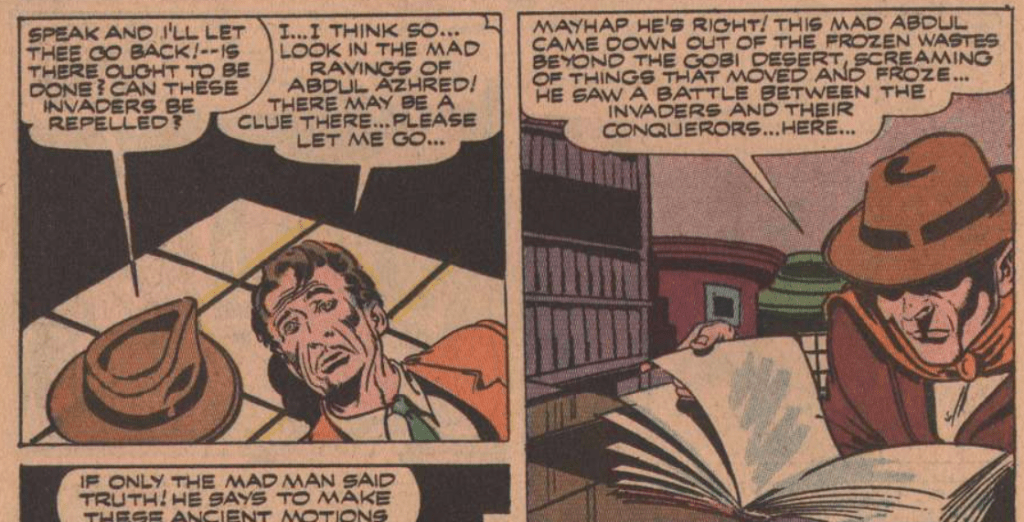
Published in Treasure Comics #2 (American Boys Comics Inc.), this uncredited 8-page comic presents an occult thriller whose eponymous hero is an unsung prototype to Doctor Fate, Doctor Strange, The Phantom Stranger, and John Constantine. Whoever the writer was, they must have read more than a little of the Mythos to cite Ludvig Prinn (created by Robert Bloch), Cthulhu, Abdul Alhazred, and the Necronomicon (however misspelled).
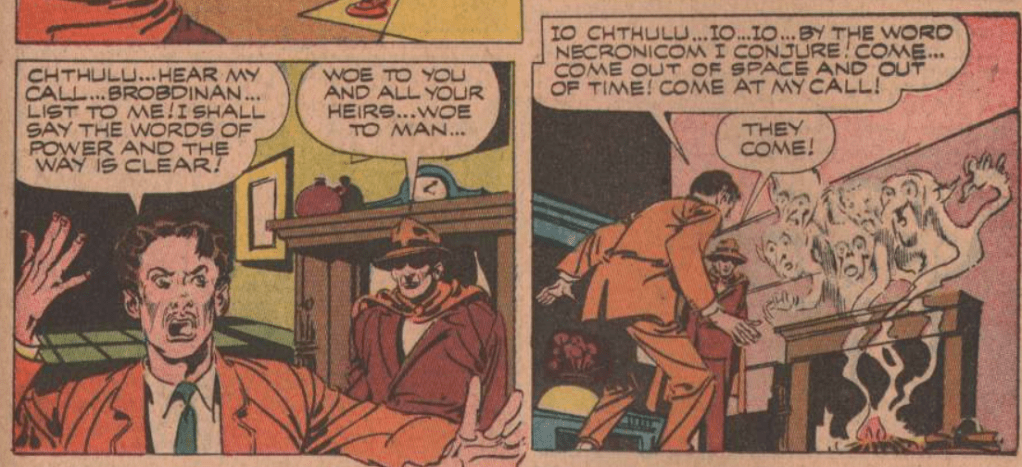
Red Dragon (Feb-Mar-Apr 1946)

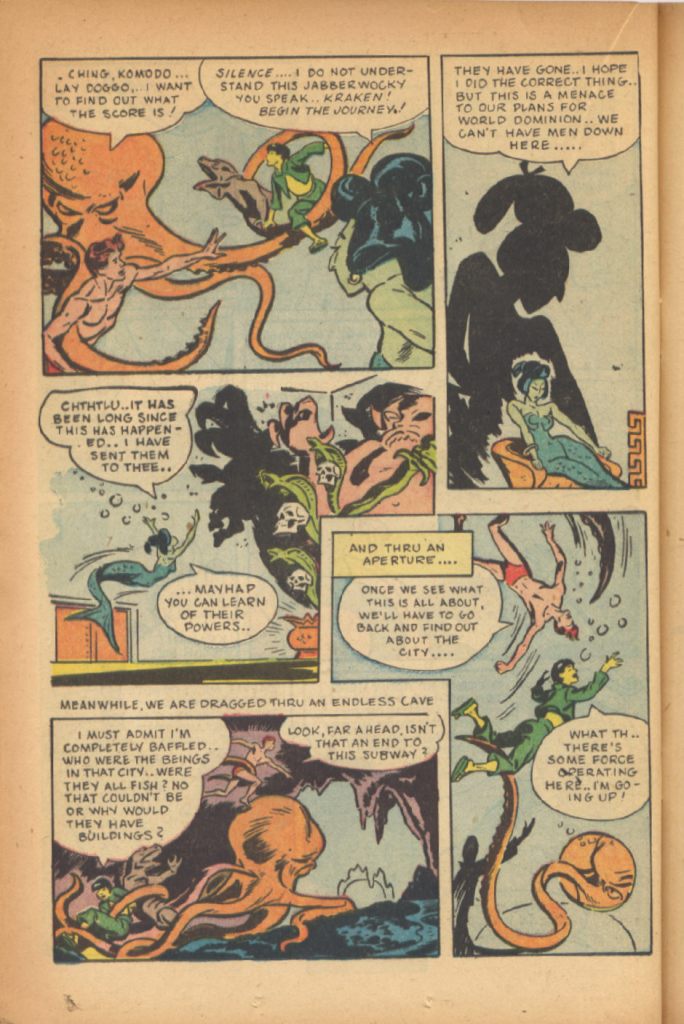
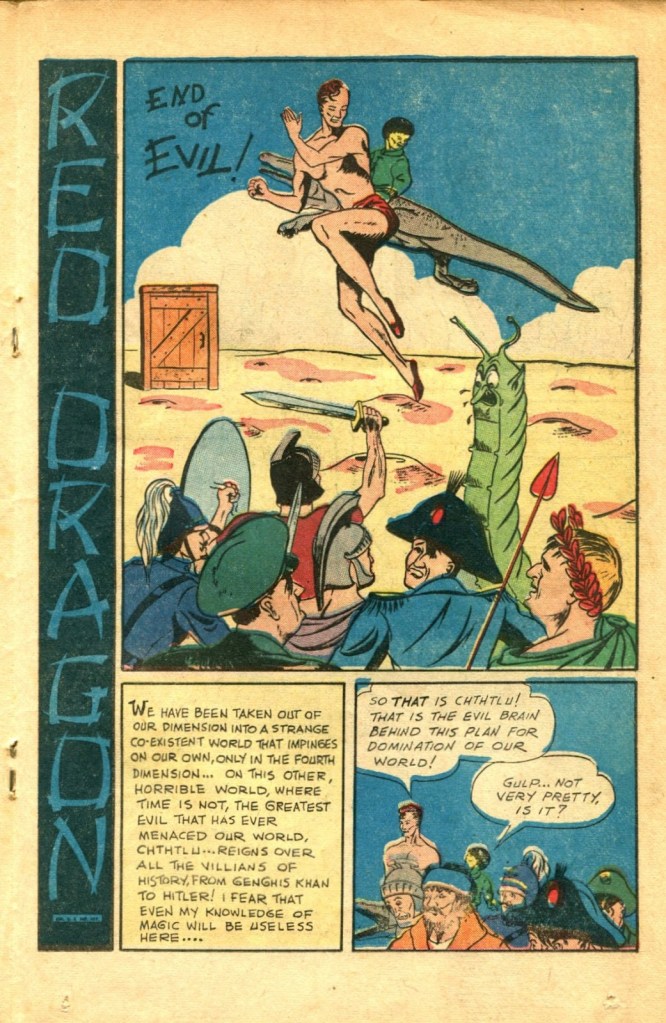
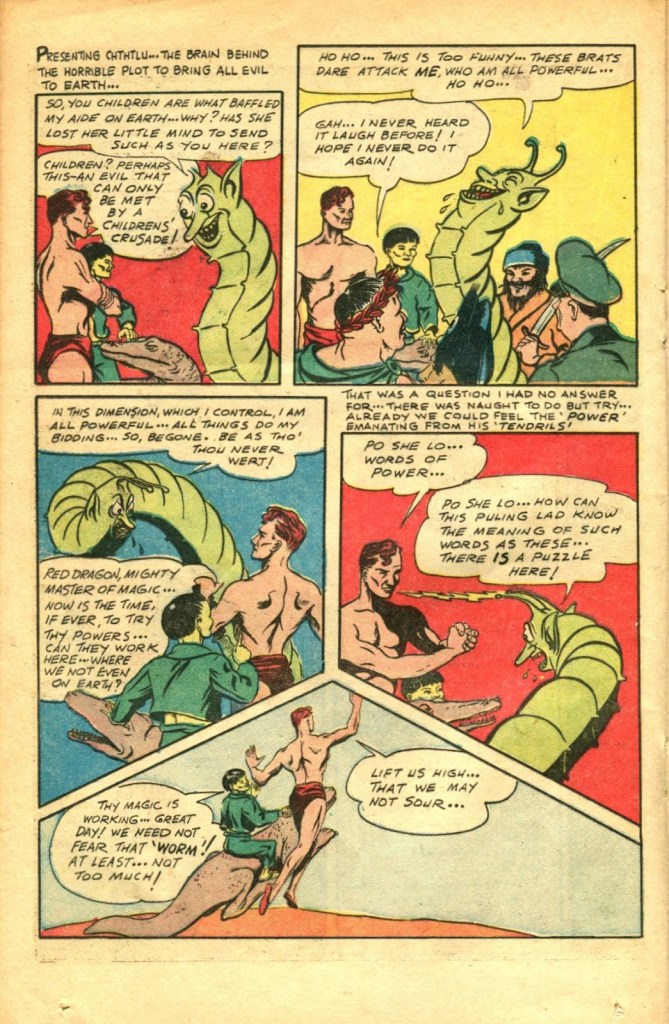
Red Dragon was a mystic superhero character whose adventures ran as a back-up feature in Super-Magician Comics published by Street & Smith, better known for their pulp magazines. Whereas most of Super-Magician Comics featured stories with the fantastic adventures of real magicians like Houdini, Red Dragon could perform acts of genuine magic by reciting the mystic words of power “Po She Lo” and a bit of doggerel rhyme. Red Dragon was accompanied on his adventures by a Chinese companion, Ching Foo, and a komodo dragon.

In a three-act adventure (“The Kingdom of Evil!” v.4 #10 Feb 1946, 8 pages; “Where Time Is Not” v.4 #11 Mar 1946, 8 pages; and “End of Evil!” v.4 #12 Apr 1946, 8 pages), Red Dragon and his companions run afoul of a cult of fish-men who worship Dagon and “Chthtlu”—an entity who dwells outside of normal space and time and is a giant green malevolent interdimensional worm with a humanoid face, a bit reminiscent of Mister Mind, and possibly inspired by him. The Lovecraftian influence is scant but noticeable. Sadly, no writer or artist is credited.

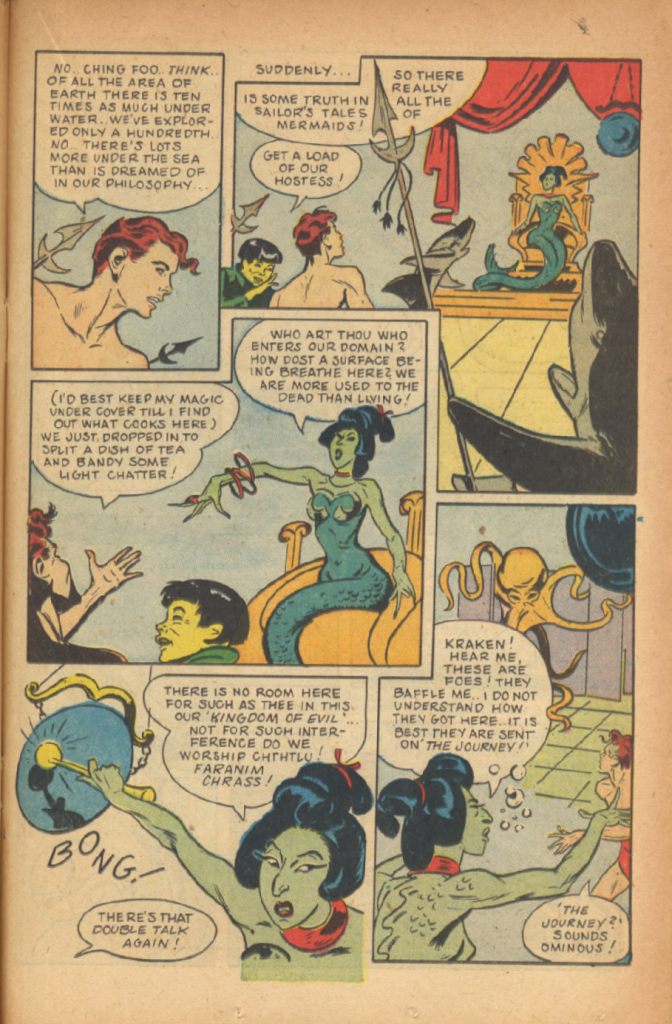
“The Book of Doom” (Oct-Nov 1948)

Red Dragon lent his name to two short series by Street & Smith in the 1940s. Like Super-Magician Comics, these were a mix of illusionism, mystery, and supernatural adventure. In Red Dragon #5 (Oct-Nov 1948), psychic investigator Dr. Savant tells the tale of a man who inherited an occult library—including a copy of the Necronmicon—and sought to raise the devil. Dr. Savant was suspicious (and he was right). The Lovecraftian elements are little more than trappings. This story ran for 8 pages; no artist or writer is credited.
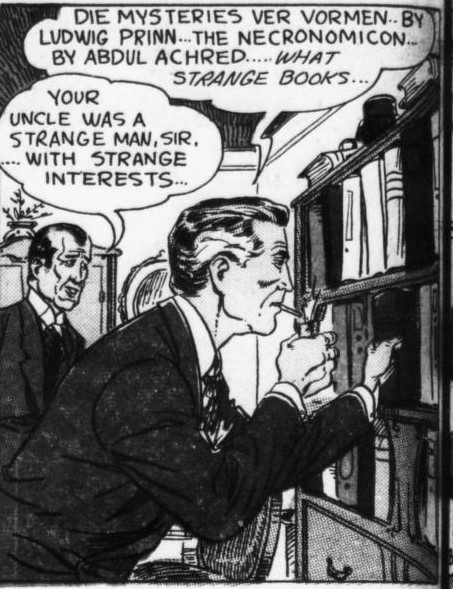
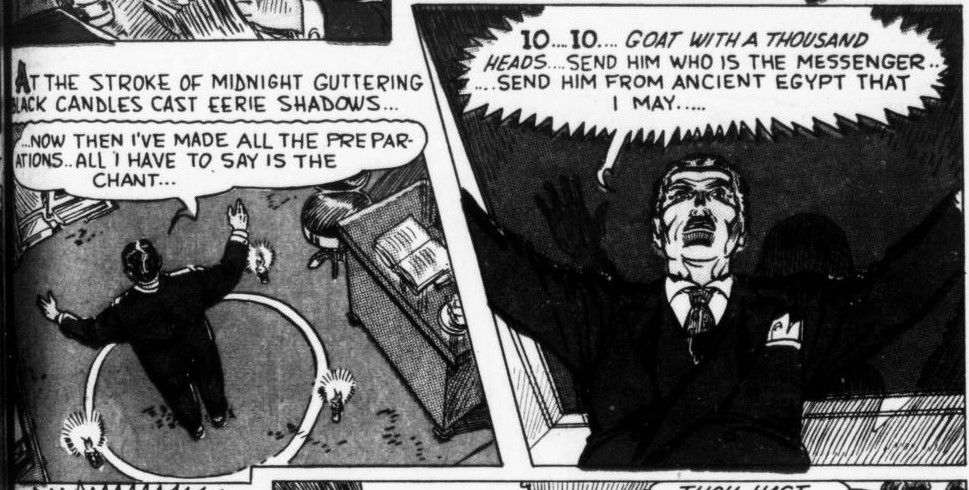
“The Thing At Chugamung Cove!” (May 1949)

Marvel Comics’ first foray into horror was Amazing Mysteries #32 (May 1949), which continued on the numbering from Sub-Mariner Comics #31, and the first story in that issue was “The Thing at Chugamung Cove!” (11 pages)—which is, in effect, a highly abridged and transformed version of Lovecraft’s “The Shadow over Innsmouth,” where a writer goes to the legendary deserted town and uncovers some frightful family history. No artist or writer is credited for this adaptation.

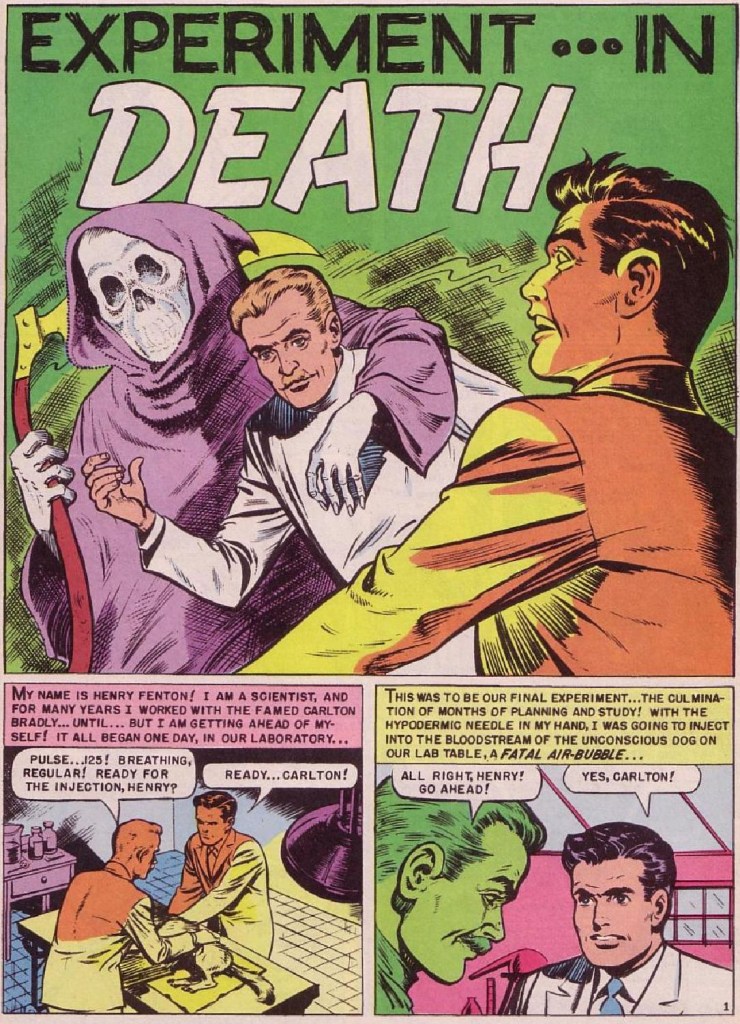
“Experiment … In Death” (May-June 1950)

Published in Weird Science #12 (EC Comics), this 6-page story co-scripted by Bill Gaines and Al Feldstein, and illustrated by Jack Kamen with letters by Jim Wroten, is clearly strongly inspired by H. P. Lovecraft’s “Herbert West—Reanimator”; but the lengthy six-part narrative has been largely scrapped to get at the core idea of a reagent that reanimates the dead, two doctors performing experiments to do just that, and how the degradation of the brain renders them violent. In ditching the plot, so too is ditched most of the gore, making this more of an intellectual horror.
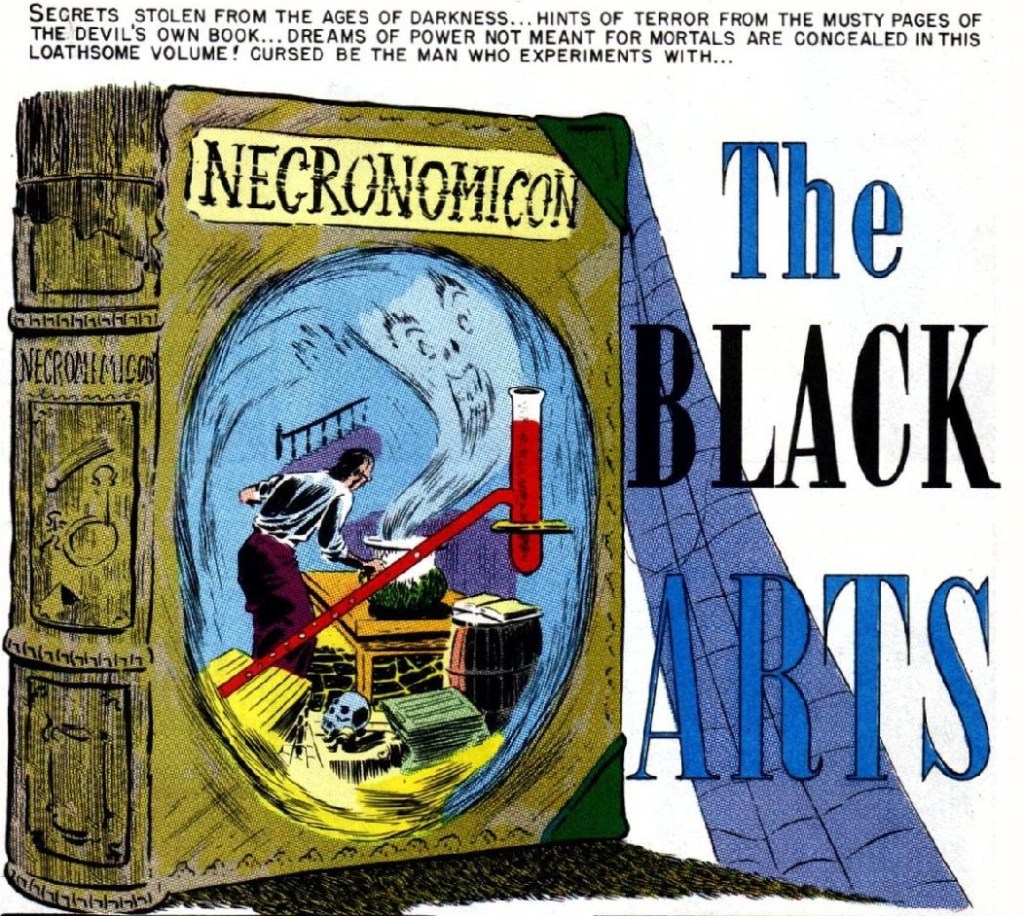
“The Black Arts” (July-August 1950)

Published in Weird Fantasy #14 (EC Comics), this 7-page story by written and inked Harry Harrison, penciled by Wally Wood, and lettered by Jim Wroten is a fairly generic tale of a young man that uses a recipe for a love potion from the Necronomicon to get a young woman to fall in love with him. Nice guys don’t use the black arts to date-rape young women, so the hint of a grisly comeuppance looks like karmic justice. The standout character here is the Necronomicon itself; which features prominently in the story.
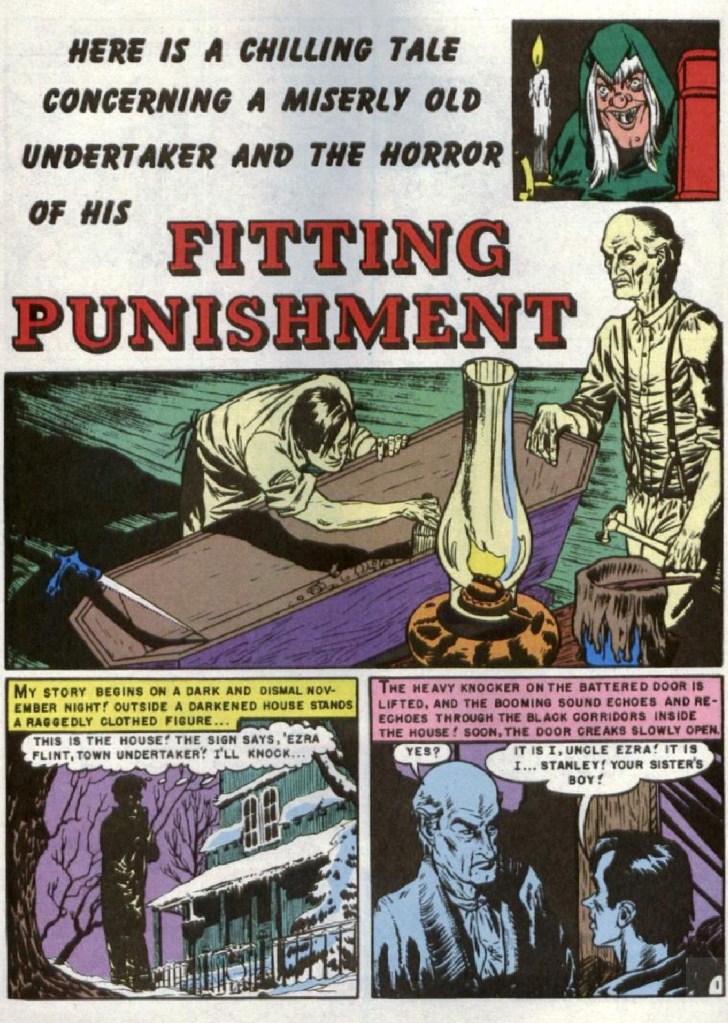
“Fitting Punishment” (December-January 1951)

Published in The Vault of Horror #16 (EC Comics), this 7-page uncredited adaptation of H. P. Lovecraft’s “In the Vault” was written by Al Feldstein, penciled and inked by Graham Ingels, and lettered by Jim Wroten. While stripped of much of Lovecraft’s prose and compressed to its bare essentials, Feldstein and Ingels manage to capture the essence of this very Poe-esque tale, whose climactic ending offers a vivid visual little less gruesome than Lovecraft’s original.
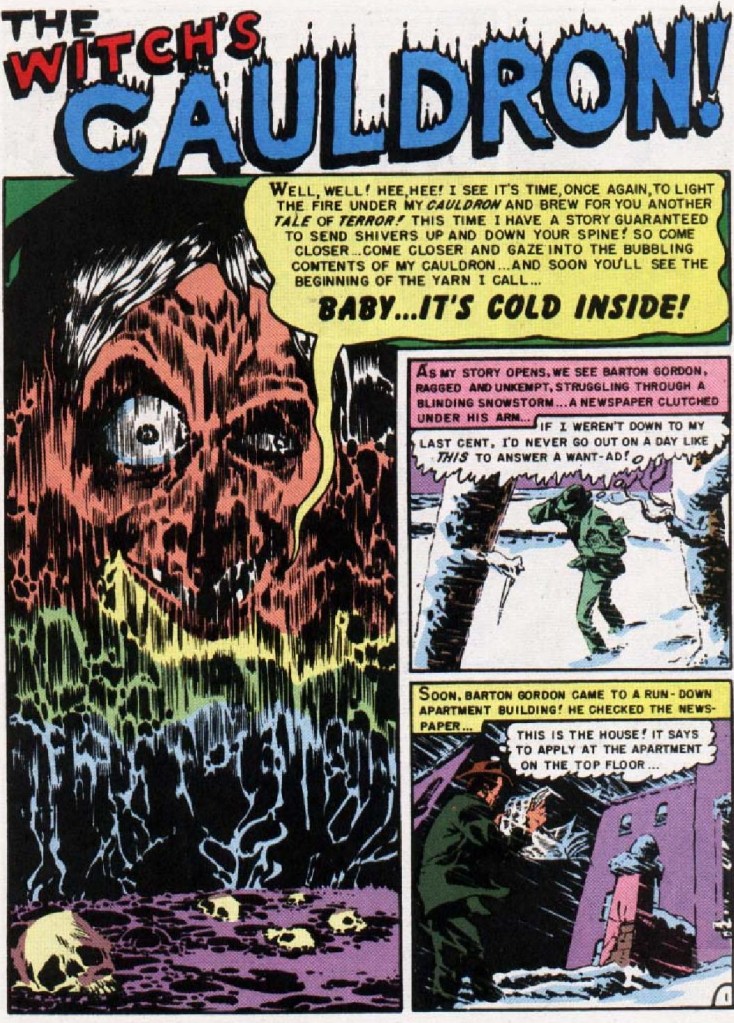
“Baby…It’s Cold Inside” (February-March 1951)

Published in The Vault of Horror #17 (EC Comics), this 7-page uncredited adaptation of Lovecraft’s “Cool Air” was co-written by Al Feldstein and Bill Gaines, penciled and inked by Graham Ingels, and lettered by Jim Wroten. As with “Fitting Punishment,” this isn’t a Mythos story and is very much in the Edgar Allan Poe vein, but even stripped bare to the essentials it gets the message across. “Cool Air” has been one of the more popular of Lovecraft’s stories to adapt to comics, having been adapted at least five times over the decades, perhaps because of its rather straightforward plot—and the gruesome climax.
“Prisoner on Charon’s Ferry” (March 1952)

Published in Whiz Comics #143 (Fawcett Comics), this 6-page comic of Ibis the Invicible briefly features a grimoire called the Necromicon as a prop during a lecture, which an unscrupulous attendee uses to summon Charon (and later, a vulture). No artist or writer is credited, though the Grand Comic Book Database credits Bill Woolfolk with the script.
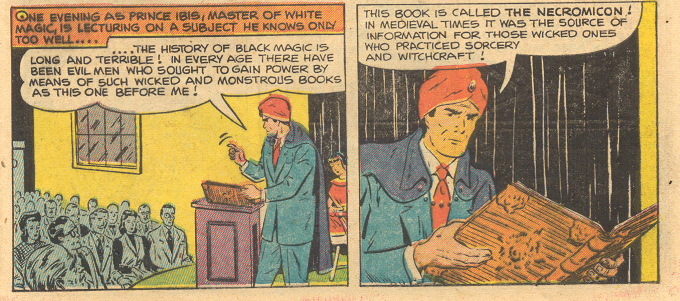
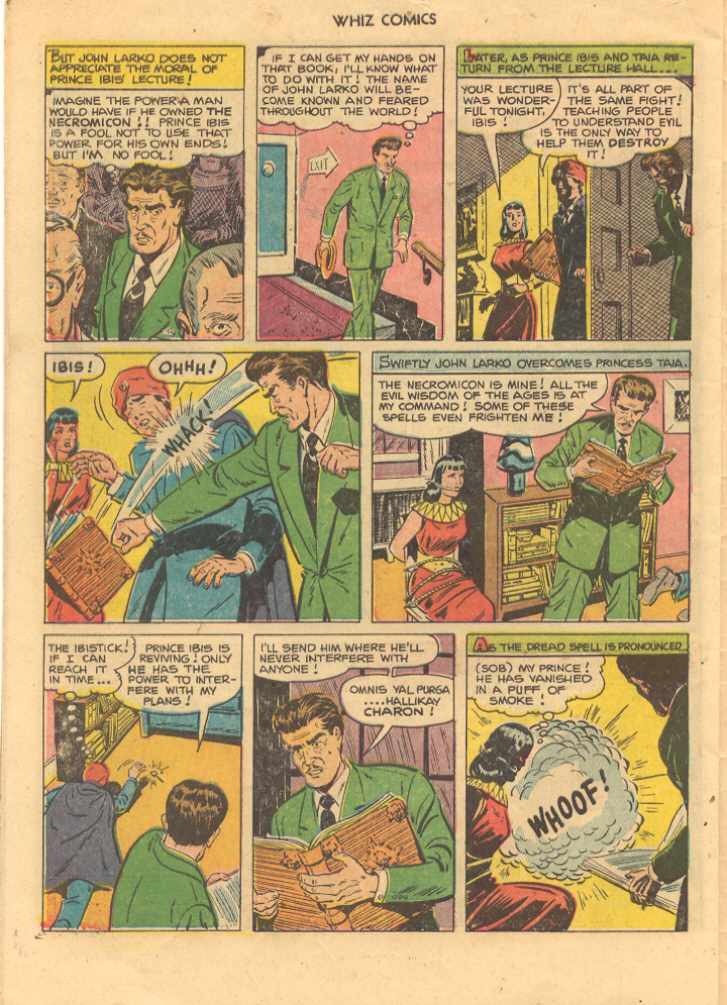
“Portrait of Death” (September 1952)

Published in Weird Terror #1 (Comic Media), this 7-page uncredited adaptation of Lovecraft’s “Pickman’s Model” was illustrated by Rudy Palais. As an adaptation, it’s interesting to compare “Portrait of Death” to “Fitting Punishment” and “Baby…It’s Cold Inside!” The line work and anatomy is a little cruder, the coloring a bit sloppier, and the writing takes many more liberties with the source material. Yet it is very much in the same spirit as the EC Comics adaptations.

The Corpse That Wouldn’t Die!” (January 1953)

Published in Web of Evil #2 (Quality) this 6-page story is largely adapted from Clark Ashton Smith’s “The Return of the Sorcerer,” though the eponymous sorcerer is not dismembered and the unnamed grimoire is in Sanskrit rather than the Arabic of the Necronomicon. The story was re-worked for Eerie Publications in the 1970s.
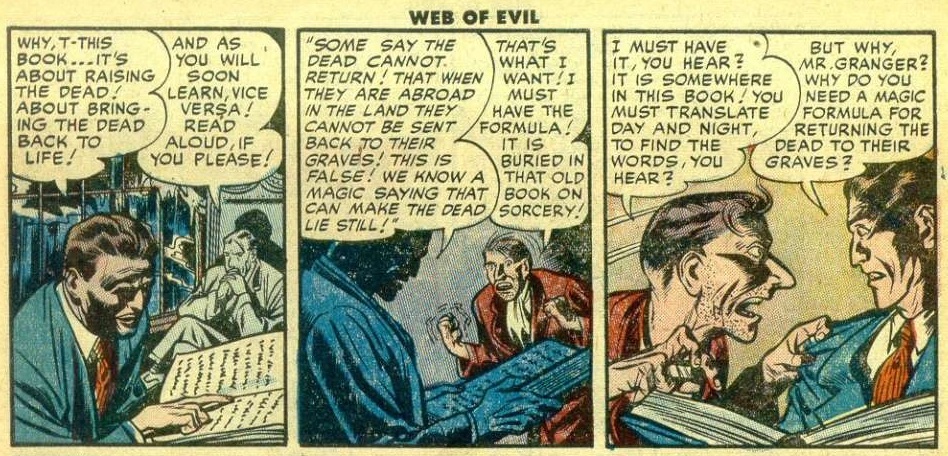
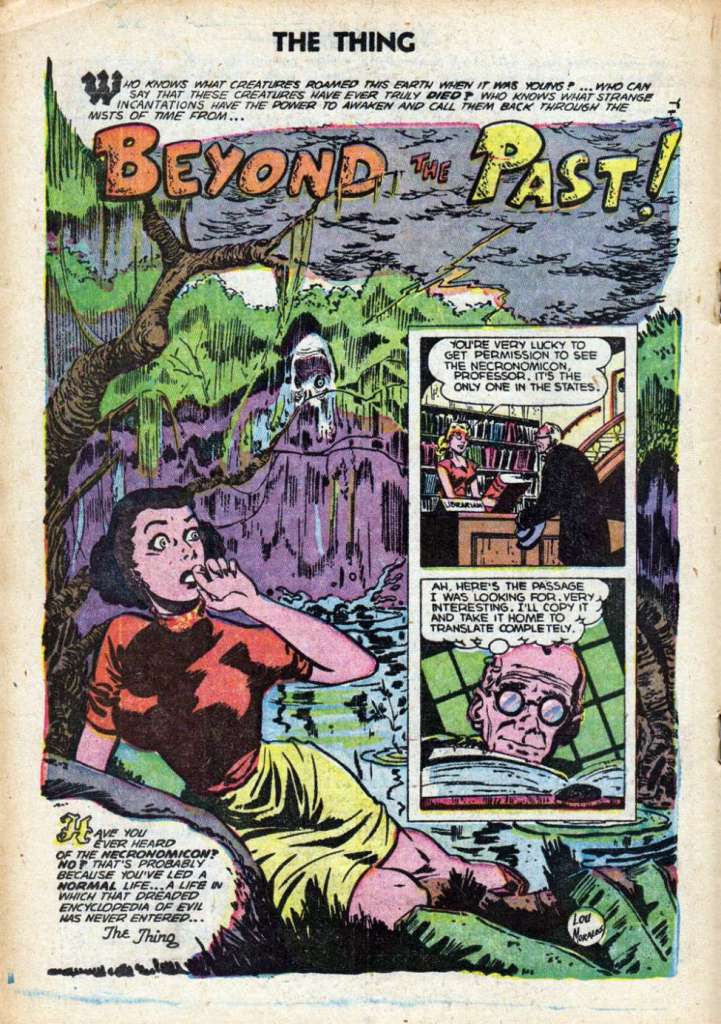
Beyond the Past” (November-December 1953)

Published in The Thing #11 (Charlton Comics) this brief 4-page original story illustrated by Lou Morales is a definite homage to Lovecraft and the Necronomicon, albeit slightly garbled. The story had an odd afterlife, as newspapers—and then Frederic Wertham himself—mixed up the plot and thought that the Necronomicon a blood-drinking monster, not a tome of eldritch lore!
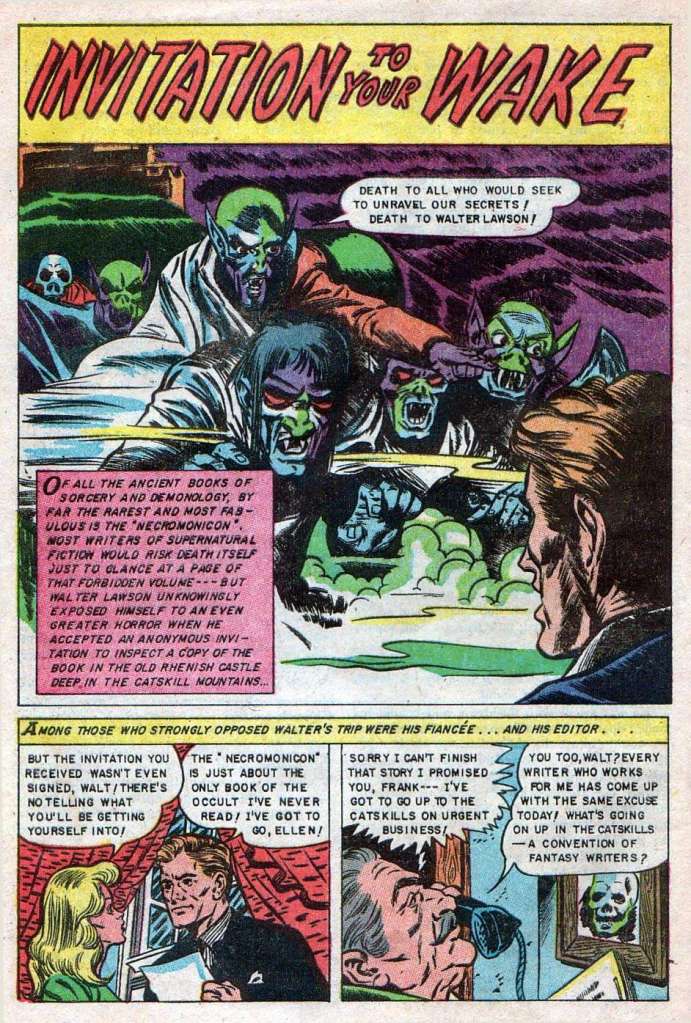
“Invitation to Your Wake” (December 1953)

Published in The Hand of Fate #21 (Ace Magazines), this 7-page original story has no credits, although the Grand Comics Database suggests it was penciled and inked by Sy Grudko, probably because of similarities of style. Like EC’s Tales from the Crypt and Vault of Horror, the stories in The Hand of Fate are narrated by a mysterious cloaked figure—by the stories tend to be more serious and less darkly humorous. Once again, the major Lovecraftian element is the appearance of the “Necromonicon,” as the rest of the monsters in this story are typical vampires, werewolves, etc.

There are no doubt many more pre-Code Lovecraftian horror comics out there—for a certain value of Lovecraftian. For example in “The Fish-Men of Nyarl-Amen” in More Fun Comics #65 (DC, March 1941) by Gardner Fox (writer) and Hal Sherman (art), mystic hero Doctor Fate defeats an army of prehistoric fish-men from beneath the sea. Chris Murray in Kevin Corstorphine in “Co(s)mic Horror” in New Critical Essays on Lovecraft argue this is a definite Lovecraftian influence:

The similarity to stories such as “The Call of Cthulhu,” with the sunken city of R’lyeth [sic], and also the Deep Ones who appear in “Dagon” and “The Shadow over Innsmouth” (1931) is obvious. Indeed, the name Nyarl-Amen seems reminiscent of Y’Ha-nthlei, the name of the undersea cyclopean city referred to in “The Shadow over Innsmouth,” and is certainly related to Nyarlathotep. However, the potential for horror in the tale is undercut, as is so often the case in comics of the time, by some rather clunky dialogue.

Murray & Corstophine, New Critical Essays on Lovecraft 166

Is it really? Hard to say. Gardner Fox in particular was well-known for riffing off of material from Weird Tales, both in prose and comics. Robert E. Howard’s Conan the Cimmerian was a definite influence on Fox’s character Crom the Barbarian who debuted in Out of this World #1 (Avon, June 1950), and Fox’s Kothar the Barbarian Swordsman novels (some of which were later adapted into Conan comics by Marvel!) So it wouldn’t be surprising if Fox was riffing off of Lovecraft in the 1940s. Yet, at the same time, Lovecraft didn’t hold a monopoly on fish-people either.

Another edge case is “The Last of Mr. Mordeaux,” penciled and inked by Joe Sinnott, which ran in Astonishing #11 (Atlas, Spring 1952). The 5-page story definitely seems to have taken inspiration from Lovecraft’s “The Lurking Fear” and “The Shadow over Innsmouth”: to prove his aristocratic lineage, the American Mr. Mordeaux travels to his ancestral castle in Hungary, and finds the remains of his family—driven underground centuries ago and degenerated into reptilian creatures, yet still bearing the hallmark bulging eyes and lack of eyebrows that Mr. Mordeaux still bears. Is this any looser of an adaptation than the other pre-Code horrors listed above? Where does the line fall between inspired-by and loose adaptation? In part, “Mordeaux” seems inspired-by because the premise is so broadly evocative of Lovecraft’s stories, but not directly evocative of any particular story. “The Lurking Fear” comes closest, but even that is a loose fit.

We get into the perennial question of: “What does Lovecraftian even mean, anyway?” Defined broadly enough, any terrible entity with tentacles or dark cult might look like stepped-on Lovecraft. In some cases, that’s probably true. With the publication of Lovecraft’s stories in hardback starting in 1939 by Arkham House, and the paperback editions that followed—including an Armed Services edition during World War II—Lovecraft’s fiction was more available than many of his contemporary pulp writers. Still, the Necronomicon didn’t appear in hundreds or even dozens of comics during these decades. It was an in-joke for dedicated fans—and perhaps that is how pre-Code Lovecraftian horror should best be understood. Something for the weird connoisseurs of the horror comic book and weird fiction.

The influence of Weird Tales and its circle of writers and artists on the early comic book industry could be a book in itself, ranging from Manly Wade Wellman’s work on Will Eisner’s The Spirit to the absolute sensation that was (and is) Robert E. Howard’s Conan the Cimmerian. Yet there was a certain magic to that Wild West period before the Code came down like a heavy lid, shutting down entire comic lines. While the Lovecraftian comics above aren’t particularly gruesome even by today’s standards, certainly not among the most notorious offenders of the 1940s and 50s, they were lost to time…and while the EC Comics have been collected and reprinted, many of the others remain virtually unknown.

With the arrival of the Comics Code Authority, comic books in the United States shifted ever more toward a younger audience, and toward superheroes. Unable to publish explicit horror comics, it may be unsurprising that the next Lovecraftian comics published were superhero comics like Justice League of America #10 (DC, March 1962), where the Necronomicon makes an appearance—but that would change. Underground comix creators, Marvel’s 1960s horror comics adaptations, the success of Conan the Barbarian (1970), Warren’s horror comics magazines, and Metal Hurlant’s Lovecraft special issue in 1979—the world of Lovecraftian horror comics was only groing to grow bigger and weirder.

Yet it started here, with a handful of pre-Code horror comics, many of which have never been reprinted. While these might not be the roots from which later Lovecraftian comics would grow, they were definitely precursors, part of that flood of sometimes dark, gory, and trashy four-color horror that scared parents and publishers into censorship. The first faltering steps to bring Lovecraft and Lovecraftian horror into a new medium.

Thanks to Will Murray for help and assistance.


Bobby Derie is the author of Weird Talers: Essays on Robert E. Howard and Others and Sex and the Cthulhu Mythos.

Deep Cuts in a Lovecraftian Vein uses Amazon Associate links. As an Amazon Associate I earn from qualifying purchases.

The Cthulhu Helix (2023) by Umehara Katsufumi (梅原克文)

The novel The Cthulhu Helix (2023) by Umehara Katsufumi (梅原克文) was originally published in Japanese in 1993 as 二重螺旋の悪魔 (“Double Helix Devil”); it has been translated into English by Jim Hubbert and published by Kurodahan Press, whose other publications include the Lairs of the Hidden Gods series of Japanese Cthulhu Mythos short fiction translated into English and West of Innsmouth: A Cthulhu Western (2021) by Kikuchi Hideyuki (菊地 秀行).

When H. P. Lovecraft wrote weird fiction in the 1920s and 1930s, the walls between science fiction and fantasy were practically non-existent. While a few arch-fans like Forrest J. Ackermann argued the point, in practice the supernatural and super-science were, from a narrative perspective, utterly interchangeable and compatible. C. L. Moore’s Northwest Smith fought alien gods on Mars; Robert E. Howard’s Conan wandered through ancient cities lit by radium-lamps; and H. P. Lovecraft’s Fungi from Yuggoth raised their buzzing voices in worship to Shub-Niggurath and the Black Goat of the Woods. There is no hard delineation between Lovecraft’s fantasy and science fiction stories.

If viewed through the lens of pulp fiction of his day, the science fiction elements in Lovecraft’s stories are exactly in tune with the kinds of pulp sci fi that showed up in Weird Tales. “From Beyond” is ultimately a gadget story and a gland story, brain-stealing crustacean aliens featured in Edmond Hamilton’s “The Shot from Saturn” (WT October 1931) not long after Lovecraft’s own “The Whisperer in Darkness” (WT August 1931) introduced the Mi-Go and their brain canisters. What differed with Lovecraft was his approach—Hamilton leaned into the adventurous interpretation of an alien invasion from another planet, but Lovecraft’s extraterrestrials were profoundly weirder, less explicable, not exactly less hostile but less prone to the even-then hackneyed tropes which H. G. Wells had covered so well with The War of the Worlds (1898).

Post-Lovecraft, science fiction and fantasy continued to grow and diversify, sometimes locking themselves into genre cages and sometimes breaking out. The early ideas of science fiction as gadget stories and space opera—The Gernsback Continuum as William Gibson put it—gave way over time to different ideas. Science-fantasies like the Star Wars and Star Trek novels and the Man-Kzin Wars anthologies played with psychic powers in far futures and galaxies far away where space travel was the norm and multiple intelligent species and cultures interacted in an intergalactic community; others focused on sociological changes, dystopic futures, future wars. The science may have been hard or soft, but the emphasis generally shifted from bright shiny new tech and worn old plots to more human stories on the effects of technology on people, the social impact and implications of new ways to communicate and interact, the question of what it was to be human.

Which, in the late 80s, gelled into Cyberpunk—the ultimate forebear of all the dizzying array of “-punk” suffixes which would be affixed to many speculative fictions to come. Broadly, cyberpunk was high tech and low life, continuing many of the same fundamental speculative technologies and advancements that came out of previous science fiction, but seen through the lens of contemporary societal issues—megacorporations, pollution, the alienation that came with technology and greater bureaucratic control of life, global computer networks, personal augmentation with cyberware raising the question of what it meant to be human, etc.

H. P. Lovecraft had written about what might, in hindsight, be called a megacorp in “In the Walls of Eryx” with Kenneth Sterling, but there was no down-and-out protagonist, no career criminals, no street to find its own uses for things. The Mi-Go perfected putting a brain in a canister, but there was no global Matrix to plug those brains into, to play out the games of the Matrix films. The ingredients for cyberpunk fiction using elements of the Mythos were there from the start—but it took a while for Cthulhupunk to manifest itself.

The Cthulhu Helix is one of the first Cthulhu Mythos biopunk novels (The Queen of K’n-yan (2008) by Asamatsu Ken (朝松健) was published around the same time in Japan, but made it into English translation first). It is very much a 90s product: fast-paced, set in a near future where corporate greed overcomes moral considerations, with a strong militaristic sci-fi undercurrent, and media-savvy some otaku-grade Easter eggs in reference to popular culture:

Things got weird. The monkey started ripping the cage apart. There was s ound of metal tearing. The Star of the show uttered a strange cry. His hairy body was channeling the spirit of Hercules.

“What the hell did you do to him?”

“That lead in the back of his skull is an on/off switch. The main players are micro-robots implanted in his hypothalamus. NCS-131 microbots.” She pointed to the macaque. “His name is Son Goku.”

Umehara Katsufumi (梅原克文), trans. Jim Hubbard, The Cthulhu Helix (2023) 125

The media-savviness is at the heart of the novel. While the aesthetic is something like Resident Evil (1996) or anime like Lily C.A.T. (1987), the Lovecraftian flavor is consciously a metaphor for the horror that’s been uncovered lurking in human DNA. There are no Necronomicons for these territories, just an awareness of the tropes as they are being applied:

Until now we’d been using C—for Cthulhu—as a basket term for all of these monsters. But we’d been getting flak about the single letter, so they’d decided to switch to what everyone else was using: Great Old Ones. GO1 for short. Bureau C was still Bureau C. C for clean, as we told people who didn’t have clearance.

There was another new term for the Cthulhu mythos, for a new entity: the Elder God. Lovecraft’s Elder Gods have been the lords of the Great Old Ones. They had imprisoned the Great Old Ones in this and other dimensions after they rebelled against their masters.

Lovecraft’s characters were not what we were facing. The Cthulhu Mythos was fiction, and any resemblance between it and the creatures we were battling was coincidence. No one knew anything about DNA or the intron regions in Lovecraft’s day. Still, he would’ve been astonished if he had known how close to reality his stories had come.

Umehara Katsufumi (梅原克文), trans. Jim Hubbard, The Cthulhu Helix (2023) 112-113

Using Lovecraft’s terminology and ideas without making his stories canon opened up a world of possibilities to reimagine and rework Lovecraft’s ideas into a contemporary syntax. In his day, Lovecraft had government agents raid Innsmouth, but 70+ years later the government response needed to shift to meet the needs and expectations of a new generation. Bureau C parallels the development of Delta Green for the Call of Cthulhu Roleplaying Game, the Laundry from Charles Stross’ The Laundry Files, and the Agency in Agents of Dreamland (2017) by Caitlín R. Kiernan and the rest of her Tinfoil Dossier series.

Which is why The Cthulhu Helix works as a Lovecraftian novel. The characters are all conscious of Lovecraft’s legacy, but for them it’s all shorthand and metaphor, a way to frame and discuss these complex ideas and relationships without getting bogged down in Elder Signs and other minutiae. The particular approach Umehara took is fairly Derlethian, but that’s not surprising considering when and where it was published.

A word on the translation: Jim Hubbert has done great service here in rendering very smoothly-flowing prose. It’s not always easy to keep a narrative comprehensible and moving in translation, but this reads very well, especially considering the occasional breaks in format and the potential for alphabet soup. Kudos on a job well done.

The Cthulhu Helix (2023) by Umehara Katsufumi (梅原克文) can be purchased through Kurodahan Press.


Bobby Derie is the author of Weird Talers: Essays on Robert E. Howard and Others and Sex and the Cthulhu Mythos.

Deep Cuts in a Lovecraftian Vein uses Amazon Associate links. As an Amazon Associate I earn from qualifying purchases.
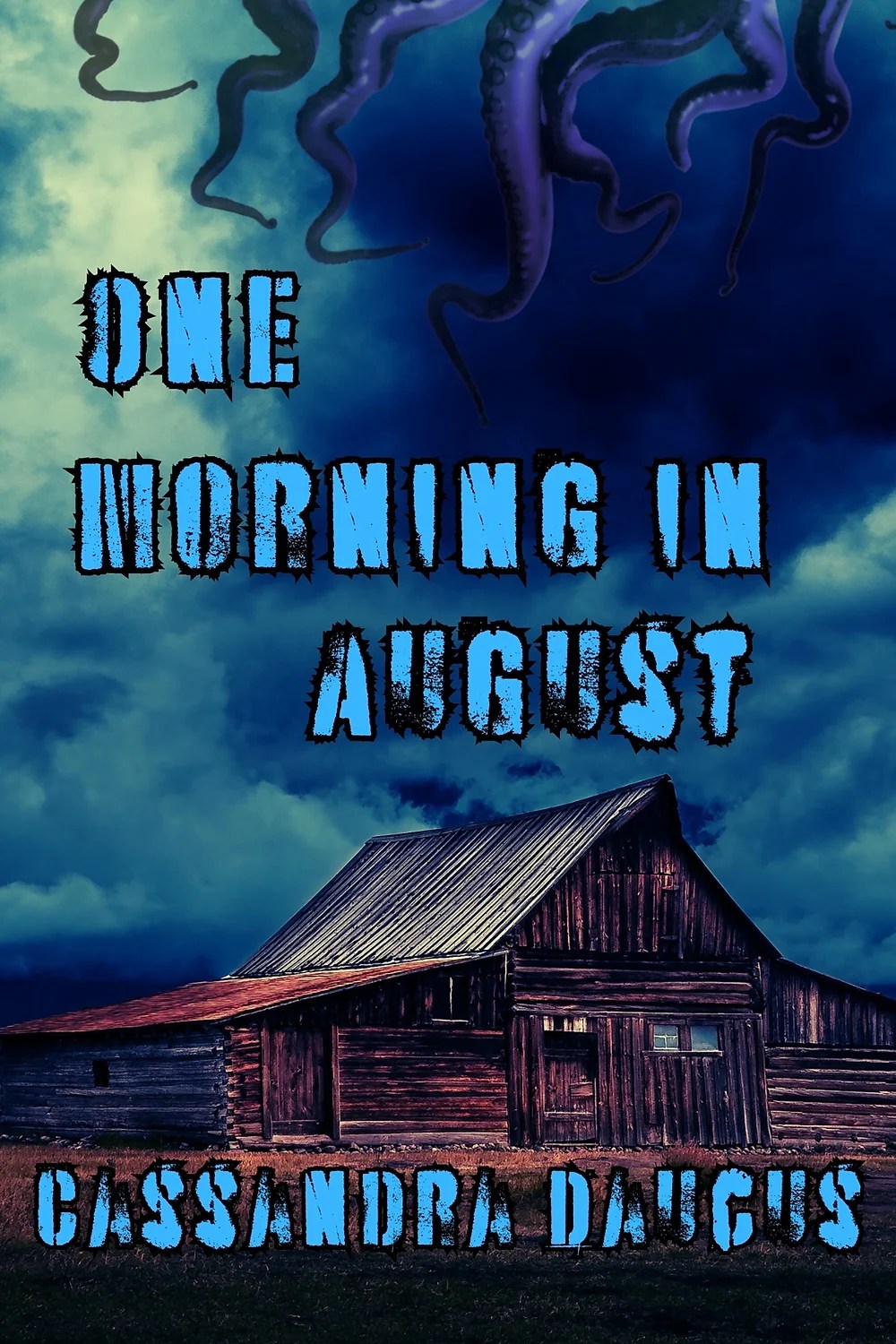
“One Morning in August” (2023) by Cassandra Daucus

The heritage of American weirdness was his to a most intense degree, and he saw a dismal throng of vague spectres behind the common phenomena of life; but he was not disinterested enough to value impressions, sensations, and beauties of narration for their own sake.

H. P. Lovecraft, “Supernatural Horror in Literature”

Lovecraftian literature is often transgressive by literary standards. Many works are not stories or plot-driven narratives in any conventional sense, and individual works have sometimes been called prose poems or mood pieces. This is fitting when you think of Lovecraft’s assertion that the weird phenomenon was the center of the story, rather than any central character—something that can be seen in “The Dunwich Horror” or “The Call of Cthulhu.”

“One Morning in August” (2023) by Cassandra Daucus is little more than a single scene, like the prelude to a post-apocalyptic film. Like many Lovecraftian tales, there isn’t much to the plot, characterization is limited, and the focus is on the weird phenomenon more than anything else. Yet there is also something Lynchian in its construction, the establishment of that “American weirdness” that Lovecraft noted in Poe, the buried emotions and resignations that underlay everyday life.

August was always hot as sin, and Bea had been disappointed to discover that the heat would redden her skin on the Nebraskan prairie even more than it did back in Boston

Cassandra Daucus, “One Morning in August”

There is that sense of loss and regret in Bea, who if not our main character is at least our prime witness for what is about to happen. The establishing shot of Bea is reminiscent of Christina’s World (1948) by Andrew Wyeth, with its vast open sky and unspoken longings. The setting, a sod house on the Nebraskan prairie, is as much part of the story as Dunwich is for “The Dunwich Horror.”

“Get in the cellar! It’s a tornado!”

James dragged her towards the house. Bea kept her eyes on the sky and allowed her gaze to drift, just in time to see the cloud over town extend a long, dark finger towards the ground. When it touched, a puff of dust exploded into the air.

Cassandra Daucus, “One Morning in August”

While the characters in the story grope toward rational explanations, like the characters in Algernon Blackwood’s “The Willows,” it doesn’t really work when what’s going on is inherently irrational. The reactions of characters in a horror movie only occur because they do not know they are in a horror movie; it is the audience who knows going in that the situation is not normal, who has seen films and read books like this before and is familiar with the tropes.

In other hands, “One Night in August” could have been extended in any number of ways. Like a low-budget film that quickly corrals all of its characters into a single room, an entire long drama could have been played out in the cellar as Bea and her family wait for things to pass and the sun to shine again. Tensions could rise, long-buried emotions could come to the surface, the seedy underbelly of the family could have been exposed and brought to light like a vivisected frog, its limbs pinned, guts on display for curious children to poke at. Instead, Daucus opts for a swifter ending, a more overt horror, a swifter destruction. Nothing wrong with that, it’s an artistic choice.

If there’s a criticism to be made about the story, it’s that some of the tropes are a little too familiar. For much of the story, Bea is framing things through her own perspective, but near the end of the tale things shift into a kind of gear normally only seen in Italian horror movies in the 1970s and 80s. While it is weird to think of it this way, we as a culture have developed a thematic language for cosmic sin. The idea that something from outside wants or needs a sacrifice, that it requires a priest or cult to serve those wants and needs…it would have been been more horrific in many ways if it had the raging, uncaring, impersonal destruction of a tornado. Something that couldn’t be bargained with, or fought, too alien to be cruel.

But all she could do was feel it happen.

Cassandra Daucus, “One Morning in August”

What works about this story is that it is a cut gem. While it may tie in thematically to a whole corpus of Lovecraftian literature, it stands on its own quite well as an effort to define a single mood in a single scene. Complete unto itself.

“One Morning in August” (2023) by Cassandra Daucus was published by Psychotoxin Press, and can be purchased here.


Bobby Derie is the author of Weird Talers: Essays on Robert E. Howard and Others and Sex and the Cthulhu Mythos.

“A Brief and Hideous Scrawl” (2022) by Erin Brown

Possibilities hinted from under the jaded metropolitan certainties in his mind; old and eldritch ancestral memories, back when beautiful virgins were wrapped in glorious robes and set out on a rock in the sunlight to be cheered by the people—and to await the dragon. The beastling was no dragon, he knew. He was a brief scrawl of hideous calligraphy write on the world, a blunt and blasphemous word.

Erin Brown, “A Brief and Hideous Scrawl” in FIYAH #22 (2022), 27

Today, Cthulhu can be quaint. Even snuggly. The majesty and fantasy of the vast, alien horror has been worn away by decades of merchandising, diluted by endless pastiches, a multitude of jokes. Hundreds of artists have tried their hands at depicting the supposedly undepictable, and the general consensus is “giant squid guy.” Often with a crotch as smooth and featureless as a Ken doll. After all, a vast, ancient entity may be one thing, but a penis? Utterly unacceptable. There may be children present. You can’t put that on a plushy.

(You absolutely can. Some people have. I digress.)

Cthulhu doesn’t have to be neutered. Like every mode and genre of horror, there are folks who say Lovecraftian horror isn’t scary anymore, if it ever was. It is ridiculous, it isn’t real, doesn’t raise a bead of cold sweat, no feces exits the rectum without permission, etc. etc. Most of these reactions are to the sanitized, Ken doll version of Cthulhu; the safe version they’ve seen a thousand times in comics and on stickers and t-shirts. Scratch that surface, and in truth, the shudders were largely always metaphorical. Few folks had nightmares about Cthulhu when the ink was still fresh on the pulp paper of Weird Tales, just as few folks died of fright when they read Dracula in the 1890s, or saw it i movie theaters in the 1930s. The idea that horror is supposed to scare the reader is essentially misguided.

At its best, weird fiction gives the reader’s imagination the tools so they can scare themselves. The realization of something, either from a dry but technically accurate description or an elaborate and expensive computer-generated image, can never approach the power of suggestion. In the case of Lovecraftian literature in particular, the suggestion is that there is something unknown and perhaps unknowable, that is so much weirder and worse than whatever familiar horrors we’re used to dealing with.

In one age, the epitome of horror may have been the vampire or werewolf; a few movies and dozens of shorts stories and novels later, and folks can confidently talk about silver bullets and crucifixes, blessed swords and fire, lasers and giant mirrors. The fun may still be there, but familiarity robs these creatures of the element of surprise. Of course, there are always exotic horrors—from other cultures, other subgenres. Crossing mythologies, crossing genres, is an old trick. How does a European exorcist deal with a penanggalan or yōkai? Oooh, what happens if a Sumerian vampire invades medieval Japan?

This is the philosophical underpinning of Erin Brown’s “A Brief and Hideous Scrawl” in FIYAH #22 (2022). On the surface, an urban fantasy predator stumbles into a different genre, and it takes them a while to figure that out. The beastling’s ignorance is almost self-destructive, but for the audience, it’s instructive. Readers equate “eldritch” with “scary thing with tentacles” all too often; they snicker and make jokes about Japanese anime, hentai, and naughty schoolgirls. Silver bullets are to werewolves what naughty schoolgirls are to Cthulhu; albatrosses around their necks. Ideas that serve to lessen and diminish the original horror by making their limits and habits more defined, more rational…more knowable.

Brown gets it. What’s better, Brown can write it. While Lovecraftian horror started out in a rather prudish period, and Lovecraft himself asserted that “The true weird tale has something more than secret murder, bloody bones,” etc., more recent generations tend to remember that bloody bones can serve a purpose. There is nothing wrong with gore, or a little body horror, especially if they serve the needs of the story and are carried off with sufficient skill. There is a certain grounding that comes with the very frank reminder that people may piss themselves when they’re scared, that murders are very rarely clean events that leave a neat and bloodless corpse.

Ultimately, the beastling’s idea of himself as “a brief and hideous scrawl” is more accurate than he knew. Like most creatures, the beastling sees itself as the center of its own narrative; a singular horror in a big world. It cannot conceive of a greater horror than itself…and that lack of imagination is, at heart, what the story is about. To look out into the darkness, see the shadows play, and not wonder at what strange shapes may cast them isn’t just dull…in some cases, it’s damn near fatal.

“A Brief and Hideous Scrawl” by Erin Brown was published in FIYAH #22 (2022).


Bobby Derie is the author of Weird Talers: Essays on Robert E. Howard and Others and Sex and the Cthulhu Mythos.

Deep Cuts in a Lovecraftian Vein uses Amazon Associate links. As an Amazon Associate I earn from qualifying purchases.
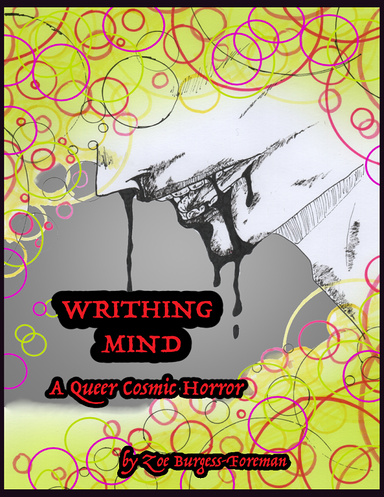
“Writhing Mind” (2022) by Zoe Burgess-Foreman

What he truly wanted to do was to find a way to express the feelings and images that had begun to creep into his head when he dreamt – a vast cosmos, something swirling and dancing in the void beyond, a body dancing to a distant beat and tendrils reaching out to take his hand.

Zoe Burgess-Foreman, “Writhing MInd” (2022)

Madness is a key theme of cosmic horror, an aspect of both attraction and repulsion. Weird fiction rarely accurately depicts mental health issues, but it has often sought to capture something of the mystique of the distorted sensorium, the disordered mind, the transition from “normal” and prosaic consciousness to one that has moved beyond rationality and into an increasingly different world view and mode of thinking. In traditional horror fiction, that state of altered consciousness is unreal—in weird fiction, that state is the true reality, a glimpse behind the veil, a realization of previously hidden truths.

Artists are a common lightning rod for such eldritch revelations, as exemplified by Lovecraft’s horror in clay:

Wilcox was a precocious youth of known genius but great eccentricity, and had from childhood excited attention through the strange stories and odd dreams he was in the habit of relating. He called himself “psychically hypersensitive”, but the staid folk of the ancient commercial city dismissed him as merely “queer”. Never mingling much with his kind, he had dropped gradually from social visibility, and was now known only to a small group of aesthetes from other towns. Even the Providence Art Club, anxious to preserve its conservatism, had found him quite hopeless.

H. P. Lovecraft, “The Call of Cthulhu”

Other writers picked up on the idea; “Something in Wood” (1948), “The Tulu Jar” (2000) by Ann K. Schwader, “The Summoned” (2015) by Clint Collins, a macabre gallery could be filled with Mythos-inflected objets d’art. Yet few stories focus on the headspace of the artist, the experience of creation, the relationship or insight or period of possession which shapes ordinary materials into an effort to capture in some form the extraordinary.

Which is ultimately what Zoe Burgess-Forman’s “Writhing Mind” is. As a story, it is almost a snapshot; there is little build-up and the denouement is cursory. These are the boring parts of the story anyway, the background and exposition. By the time the story starts, the events have already begun; the reader is only carried along for the ride, like a voyeur, watching the artist struggle to create, their descent and transcendence. The bloody climax rolls out like the first few minutes of a horror film, normal people too stuck in rational thinking to recognize the signs or heed the warnings, leaving behind only blood, bodies, and a particularly tenacious and circular idea.

They had slightly moist quality to them, not unpleasant but just enough to make them glide over his skn and make his body tingle with anticipation. They reminded him, now he collected his thoughts, of the tentacles of an octopus as rounded mouths sucked on his flesh like hungry kisses.

Zoe Burgess-Foreman, “Writhing MInd” (2022)

“Writhing Mind” is described as “a queer cosmic horror,” and that’s worth a moment of consideration. Lovecraftian fiction, as much as it deals with cosmic horrors from beyond human experience, is almost always heteronormative by default. Works like “(UN)Bury Your Gays: A Queering of Herbert West – Reanimator by H.P. Lovecraft” by Clinton W. Waters are the exception, not the rule. Queer Lovecraftian works like Le Pornomicon (2005) by Logan Kowalsky, Dagger of Blood (1997) by John Blackburn, and Strange Bedfellows (2023) by Caroline Manley (Raph) are comparatively rare compared to works like Booty Call of Cthulhu (2012) by Dalia Daudelin. By comparison, the sensuality and sexuality in Zoe Brugess-Foreman’s story is explicit, but not overly concerned with labels. The artist is cisgender male and a self-described himbo; but their sexual preference, if any, is oblique. Ultimately, it doesn’t matter.

The artist is queer for tentacled things from beyond. This is entirely appropriate: the same open mind that fuels their eldritch artwork goes pseudopod-in-hand with their sexuality. In the context of the story, there is no introspection that goes into this. The artist is already too far along in the process to question their sexual shift, or to comment on it rationally. No passing reference to Hokusai’s erotic print Tako no Ama, no anatomical studies of octopus or squid, or anything that could serve as a foreshadowing of a growing paraphilia that comes to consume them.

In hindsight, that feels like a mistake, because the artist is the only queer character in the story. Their queerness becomes inextricable from their madness, and lacking the boring build-up of a background, a deeper understanding of the character’s mindset and sexuality, the combination of sensuality, violence, and mental illness can be mistaken as causal rather than correlation. It feels like the story would have benefited from giving the artist a queer friend, someone that understood them and could relate to them but was unaffected. This was a device that Lovecraft used in stories like “The Thing on the Doorstep,” where a more straitlaced friend tells the story of a weirder associate.

Ultimately, “Writhing Mind” feels like a literary exercise with many familiar building blocks. It is not explicitly a part of the Cthulhu Mythos, there are no references to the Necronomicon, and the eldritch entity that fills the artist’s dreams and body is called by no familiar barbarous name. Yet it is clearly working in the same mode as works like Prnomicon and Strange Bedfellows, even if it mixes the ingredients a little differently…and not without a degree of skill.

“Writhing Mind” (2022) by Zoe Burgess-Foreman is available on Lulu as an ebook.


Bobby Derie is the author of Weird Talers: Essays on Robert E. Howard & Others (2019) and Sex and the Cthulhu Mythos (2014).

Deep Cuts in a Lovecraftian Vein uses Amazon Associate links. As an Amazon Associate I earn from qualifying purchases.
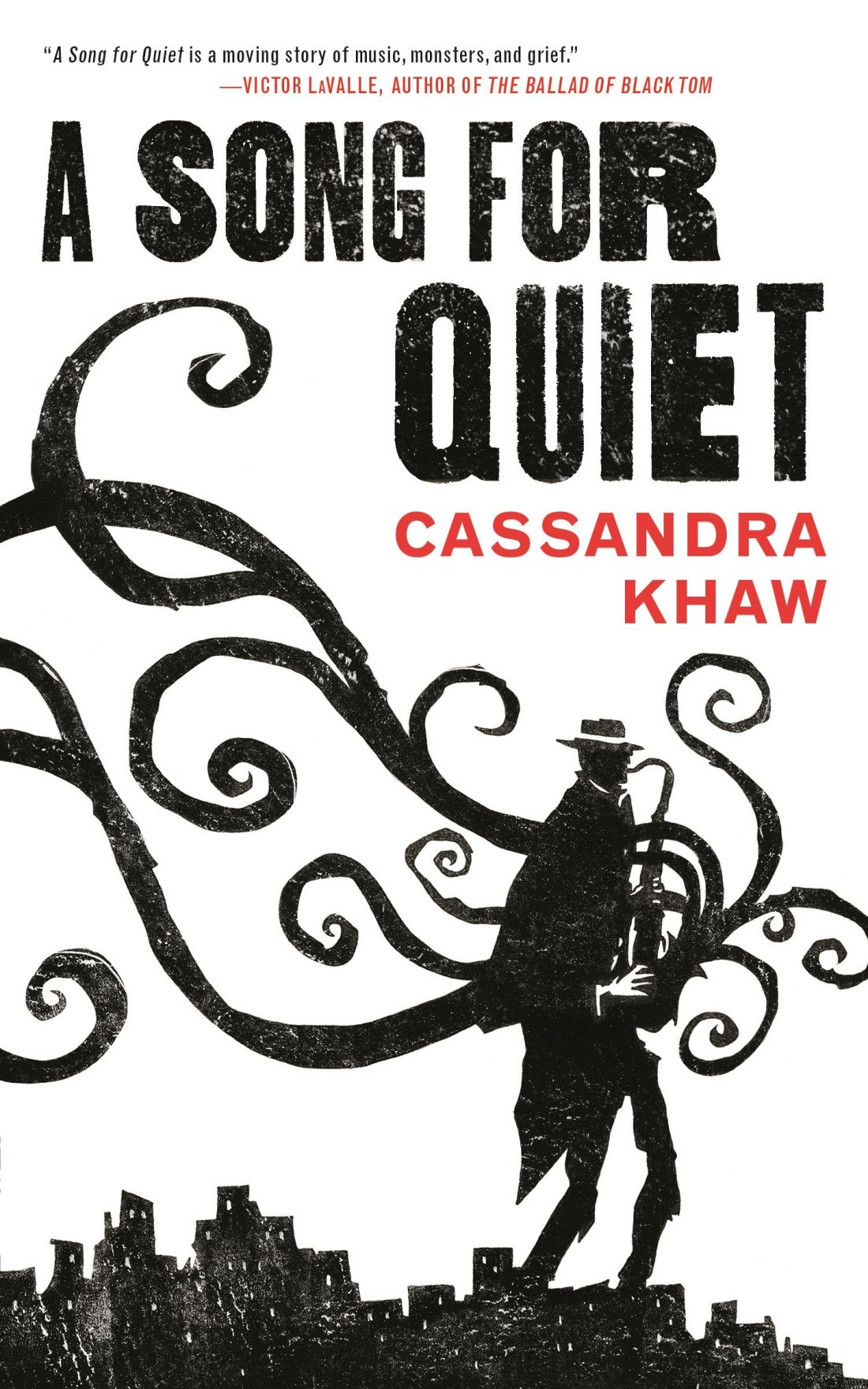
A Song for Quiet (2017) by Cassandra Khaw

Blues is about wanting and not having, about putting that need into someone else’s hands for a little while so you can pause and breathe.

Cassandra Khaw, A Song for Quiet 35

In Hammers on Bone (2016) by Cassandra Khaw, an eldritch abomination walks around in a human suit, playing hardboiled private detective John Persons, a monster who works against other monsters, working for its own inscrutable reasons against Lovecraftian incursions. A Song for Quiet is a standalone novella in the same setting, though a continent away and decades prior, with Persons relegated to an ambiguous supporting role as the narrative shifts to focus on rambling bluesman Deacon James.

Any more detail would give away the plot of the story, and it has little to spare.

In terms of theme and content, A Song for Quiet is a distant literary descendent of “The Music of Erich Zann,” the essential theme reworked and woven with considerable skill and imagination into a new context, a cousin to stories like “The Opera Singer” (2015) by Priya J. Sridhar and “While The Black Stars Burn” (2015) by Lucy A. Snyder—in part because music is the language and the medium by which the weirdness from Outside penetrates this reality, but because music doesn’t just happen. You need a figure on the threshold, like Erich Zann, who has the skills to play and faces the choice to do so. That places a very human conflict in the midst of what might otherwise be a very impersonal cosmic struggle. Ultimately, the musician on the threshold has to decide if to play.

Khaw’s choice to center the narrative on one such threshold-character, Deacon James, comes with advantages and drawbacks. The advantage is that Khaw is a skillful writer who really gets into James’ head, and the world seen through his eyes is a part of the world in stories like The Ballad of Black Tom (2016) by Victor LaValle, Lovecraft Country (2016) by Matt Ruff, and Ring Shout (2020) by P. Djèlí Clark—where Black people, even in a relatively unsegregated northern city like Arkham, have to step carefully, watch their words and actions, because any wrong step could mean violence and death. Jim Crow America was an ugly place with its very mundane horrors, without adding any Lovecraftian horrors to the mix.

The downside is, James knows nothing about the Lovecraftian aspect of the setting and doesn’t learn much of anything by the book’s end. Hammers on Bone worked so well in part because John Persons was an insider on the occult world of the Mythos, readers got their point of view and many things could be explained or accepted because of that. A Song for Quiet, seen mostly through the bluesman’s eyes, is like much in life a puzzle for which many pieces are missing and which will never be complete. John Persons in this book is one piece that doesn’t seem to fit (unless the reader has read Hammers on Bone at some point); he appears from nowhere, does things, explains almost nothing, and this is all perfectly in keeping with how the character might appear to James, but it’s as damnably frustrating as a poorly-played non-player character in a session of the Call of Cthulhu roleplaying game, enigmatic to a fault.

Another piece that doesn’t quite fit is Arkham itself. As a setting, Khaw does a tremendous job of expressing the unease a Black man might feel traveling to and being in a relatively unknown northern city; used to the more openly segregated South, Deacon James is only really at ease in Black spaces. Why it features in the story is another question entirely: Arkham is the backdrop, but it could almost as easily have been Boston, New York, or even London. While an American city makes sense, since blues music is an African-American creation, by the 1940s the geographic remit of blues music and players had gone global. There’s nothing special about Arkham in this regard—it is the place name to cement a Lovecraftian connection, but Deacon James isn’t playing to an audience of hip Miskatonic University students or anything like that. So the setting feels a bit superfluous; like a film that drops a few Lovecraftian place names but doesn’t really connect to Lovecraft’s stories about those places.

This isn’t a damning criticism: many stories have only peripheral connections to the wider Mythos, and that’s fine. The first and most important thing is whether or not the story is good, the amount of Mythos lore dropped is not a primary measure of story quality. The lament here is that it could have been better. Khaw’s take on Arkham through James’ POV is intriguing, it’s something that the novella could have used more of, and if that setting had tied more strongly into the plot it would have been smashing…or perhaps it would have turned a tightly written and fast-paced novella into a bloated short novel.

There is a lot to like about this story; Khaw’s prose is alternately poetic and grounded, using music metaphors to give shape and texture to things seen and unseen, and the characters are well-defined. As another episode of the Persona Non Grata series, it expands the world of Hammers on Bone without stepping on any toes, far enough away in time and space so that the two stories can work independently, but taken together suggesting a wider, more complex world. Thematically, the ending is a strong focus on the human conflict of the musician on the threshold, but the missing pieces of the puzzle leave a bit of tension, like a chord that refuses to resolve.

Cassandra Khaw’s A Song for Quite (2017) was published as part of Tor.com’s Lovecraftian novella series including Hammers on Bone (2016) by Cassandra Khaw, The Dream-Quest of Vellitt Boe (2016) by Kij Johnson, The Ballad of Black Tom (2016) by Victor LaValle, and Agents of Dreamland (2017) by Caitlín R. Kiernan.


Bobby Derie is the author of Weird Talers: Essays on Robert E. Howard and Others and Sex and the Cthulhu Mythos.

Deep Cuts in a Lovecraftian Vein uses Amazon Associate links. As an Amazon Associate I earn from qualifying purchases.

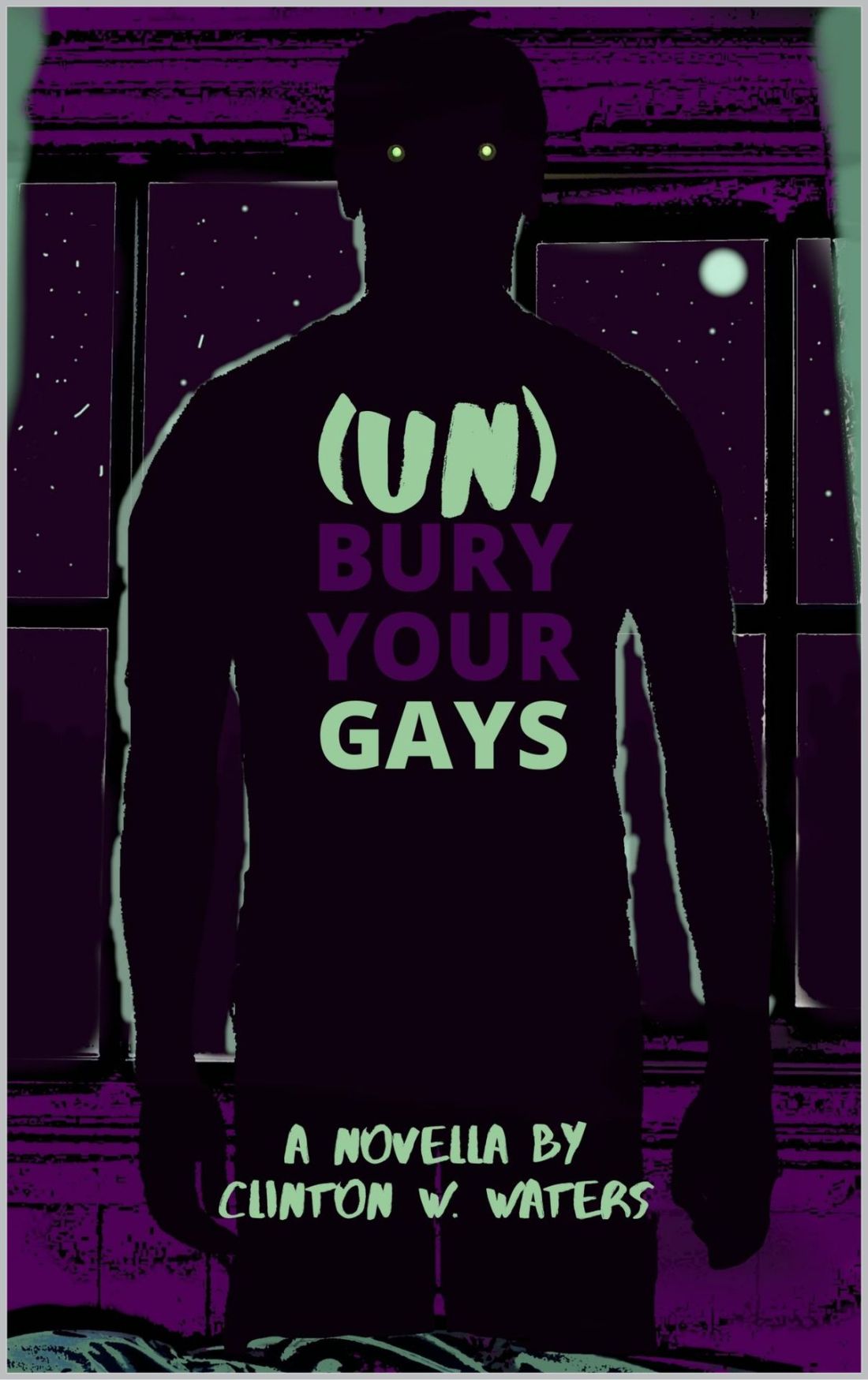
“(UN)Bury Your Gays: A Queering of Herbert West – Reanimator by H.P. Lovecraft” (2022) by Clinton W. Waters

While he was with me, the wonder and diabolism of his experiments fascinated me utterly, and I was his closest companion. Now that he is gone and the spell is broken, the actual fear is greater. Memories and possibilities are ever more hideous than realities.

H. P. Lovecraft, “Herbert West—Reanimator”

How do you go about queering Herbert West?

In 1922, before Weird Tales had ever hit the stands, H. P. Lovecraft’s first commercial work went into print: six brief tales of gruesome mad science, for which he was to be paid five dollars an episode. Commercial hack work, and Lovecraft knew it; it would not be published again until Lovecraft was safely dead and beyond objecting. From there it entered the domain of reprints, and it became the basis for the 1985 film Reanimator. The film, with the iconic performance by Jeffrey Combs as Herbert West and the glowing green reanimation agent, was a smash success. It inspired a franchise of movies, a novelization, comic books, merchandise, and stories chronicling the further adventure of the reanimator, his foes and rivals.

Herbert West has become one of Lovecraft’s breakout characters.

It is harder to pin down when the queer interpretations began. The basic building blocks were always there, from the beginning: West and his unnamed partner’s close homosocial bond, like Holmes and his Watson; Lovecraft’s typical asexuality and lack of romance in the story; the allegorical implications of men trying to create life without women, especially via the Freudian technique of injecting some of their special serum into the body. One might also add the loneliness of the outsiders, forced to hide their actions from the world, forced out onto the fringes just to be themselves without discrimination.

For queer folk, reading into the text or the adaptations something of their own experience, maybe Herbert West was always queer too. He just wasn’t out about it yet.

Brian McNaughton may have been the first to really play with the idea in “Herbert West—Reincarnated: Part II, The Horror from the Holy Land” (2000), published in Crypt of Cthulhu #106 and his collection Nasty Stories. Molly Tanzer certainly brought in the open with “Herbert West in Love” (2012). The erotic appeal was made manifest in “Herburt East: Refuckinator” (2012) by Lula Lisbon. Alan Moore & Jacen Burrows expressly coded West and his companion as queer in Providence (2017), which played off against their own queer protagonist…and there are more. The constellation of Reanimator-derived works continues to grow; some are more explicitly queer than others. Each of these interpretations is different, both in their understanding and in their depiction of what being queer means, and in what they drew from Lovecraft or what they borrowed from other media; the glowing green reagent being a common element in most stories written after 1985.

The fluid was fluorescent and green as I gently tipped the vial. A single bead of he concoction caught on the lip of the tube and then fell, splashing into the beed’s mouth.

Clinton W. Waters, “(UN)Bury Your Gays: A Queering of Herbert West – Reanimator by H.P. Lovecraft”

“(UN)Bury Your Gays” is a spiritual sequel to “Herbert West—Reanimator”; one that retreads a little familiar ground (it is a reanimator story, it would be more shocking if there wasn’t a reanimation), but is overall smaller, more focused: the protagonists are not simply repeating the Herbert West/unnamed assistant dynamic, but are exploring a much more complicated, nuanced, realistic friendship as the only two queer kids in high school. There is a sensibility in the story reminiscent of “Pale, Trembling Youth” (1986) by W. H. Pugmire & Jessica Amanda Salmonson; a weird sort of universality to the outsider experience which makes the characters much more sympathetic than West and his nameless assistant ever were.

Waters sets the action in the current day, and a certain pop-culture sensibility flows through the scenario: like the genre-savvy characters in the Scream films, they can picture themselves in a horror story and sometimes try to interpret what’s happening through that lens, riffing on vampirism and flesh-eating zombies in a way that Herbert West & his assistant in 1922 couldn’t. Less directly and less obviously, the two teens also approach their sexuality and relationship through the same lens. This is far and away from a Lovecraftian interpretation of Brokeback Mountain, but there are shades of the same relationship dynamics at play. What the leads have isn’t sexual, but they are tied together by their sexuality. A shared intimacy, but not exclusivity.

In a lot of ways, Waters flips Lovecraft’s script. Instead of a nameless protagonist talking about his relationship with Herbert West, we have the great-grand nephew Humphrey West telling the tale of his best friend. Where Herbert West is focused on reanimation practically to the exclusion of all else and seems to take his relationship with the unnamed narrator for granted, in “(UN)Bury Your Gays” the focus is all about the relationship between Humphrey and his friend, with reanimation a catalyst for a shift in their dynamic, and that is what the story is ultimately about.

Of Daniel “Danny” Moreland, I can only speak fondly. He was my closest companion. My champion. My single greatest achievement.

Clinton W. Waters, “(UN)Bury Your Gays: A Queering of Herbert West – Reanimator by H.P. Lovecraft”

A key point in Waters’ approach is that it is a queering, not the queering of “Herbert West—Reanimator.” This is one interpretation, one take, one possible iteration of the infinite possibilities of exploring Lovecraft’s original narrative, characters, or concepts through a queer lens. Rather than repeating what Molly Tanzer or Alan Moore wrote, Waters is presenting a different permutation on the same idea—one that is more inspired by Lovecraft’s original than a strict revisitation of the same familiar story and characters.

Because there is more than one way to be queer, and more than one way to reanimate the Lovecraftian corpus.

“(UN)Bury Your Gays: A Queering of Herbert West – Reanimator by H.P. Lovecraft” (2022) by Clinton W. Waters is available on Amazon Kindle.


Bobby Derie is the author of Weird Talers: Essays on Robert E. Howard & Others (2019) and Sex and the Cthulhu Mythos (2014).

Howard, Mon Amour (2018) by Martine Chifflot

Sonia (Assise en train d’écrire, elle s’interrompt, levant la tête et s’exprimant a voix haute):
Howard est mort.
Quelle tristesse!

Et moi, qui ne suis plus tout à fait sa veuve…
Divorcée, remariée, je ne peux plus être sa veuve officielle.
Sonia (Sitting down to write, she interrupts herself, raises her head and speaks out loud):
Howard is dead.
What sadness!

And I, who am not quite his widow anymore…
Divorced, remarried, I can no longer be his widow, officially.
Howard, Mon Amour 19English translation
Scene 1

Ever since the publication of The Private Life of H. P. Lovecraft (1985) by Sonia H. Davis in various recensions, there has been great interest in the marriage of H. P. Lovecraft, and in his wife Sonia Haft Greene, who remarried in 1936 and became Sonia H. Davis. As the story of their marriage has unfolded in letters and memoirs, the narrative possibilities have struck several writers. Richard Lupoff included Sonia as a character in Lovecraft’s Book (1985), later expanded or restored as Marblehead (2015), to give one prominent example. Readers and scholars who have traced the story of their meeting, their work on the Rainbow, their collaborations “The Horror at Martin’s Beach” (1923), “Four O’Clock” (1949), Alcestis: A Play (1985), and “European Glimpses” (1988), and their final separation all speak to a dramatic narrative—some might say a tragedy, for all human lives tend toward tragedy at the end.

Howard, Mon Amour is a short drama in 23 scenes by Martine Chifflot. The scene is 1946; their mutual friend Wheeler Dryden has informed Sonia of the death of H. P. Lovecraft, nearly a decade prior. The two had fallen out of touch, and apparently contact had been broken prior to her third and final marriage to Nathaniel A. Davis. Alone while writing, the phantom of Lovecraft appears…whether his ghost, or a hallucination born of her grief, never quite clear. It doesn’t really matter.

Howard: Je suis ici, Sonia; je resterai aussi longtemps que tu vivras. Les choses là-bas ne sont pas tout à fait semblables à ce que l’on raconte, à ce que, moi-même, j’en ai dit et je ne suis pas autorisé à en parler mais il a été permis que je revienne… pour toi, comme pour t’accompagner, comme pour te remercier.Howard: I am here, Sonia; I will stay as long as you live. Things down there are not quite the same as we are told, as I myself have said, and I am not allowed to talk about them, but I have been allowed to come back… for you, as if to accompany you, as if to thank you.
Howard, Mon Amour 22English translation
Scene 2

The French found an early appreciation for Lovecraft, and not just his fiction but many of his letters and associated biographical materials have been translated into French, including Sonia’s memoir. “Un mari nommé H.P.L.” (“A Husband Named H.P.L.” in Lovecraft (Robert Laffront, 1991) appears to have been Chifflot’s main source of data on the marriage, and Chifflot’s drama is fairly accurate to the facts. She may put words into her character’s mouths, but the events play out largely in accordance with Sonia’s account of the marriage, warts and all; the drama of the scenes is a little heightened in the telling, the events more emotional and detailed, but also emotionally true to how Sonia told them herself.

Tante Lilian (ou Sonia L’imitant), apres un moment de silence):
Chère Sonia, nous vous remercions mais cela est tout bonnement impossible.

Voyez-vous, Howard et nous-mêmes sommes des Phillips et nous ne pouvons envisager que l’épouse de Howard doive traviller pour vivre à Providence. Cela constitue une sort de déshonneur que nouse ne pouvons tolérer pour Howard et pour nous-mêmes.

Non. L’épouse de Howard Phillips Lovecraft no peut entretenir son ménage, ni ses tantes. C’est le devoir du mari de subvenir aux besoins familiaux et Howard a joué de malchance à cet égard. Nous connaissons, tout comme vous, les grandes qualités de Howard et nouse aimerions vous voir réunis mais cela ne se peut dans de telles conditions. Vous nous entretiendriez et nous seriouns à votre charge. Ce serait une honte pour nous malgré votre générosité. Cela ne se peut, chère Madame… et nous devrons tous souffrir en silence.
Aunt Lilian (or Sonia imitating her), after a moment of silence):
Dear Sonia, we thank you but this is simply impossible.

You see, we and Howard are Phillips and we cannot contemplate Howard’s wife having to work to live in Providence. This is a dishonor that we cannot tolerate for Howard and ourselves.


No. The wife of Howard Phillips Lovecraft cannot support his household, nor his aunts. It is the husband’s duty to provide for his family, and Howard has been unfortunate in this regard. We know, as you do, the great qualities of Howard and we would like to see you reunited, but it is not possible under these conditions. You would be supporting us and we would be in your charge. It would be a shame for us despite your generosity. It cannot be, dear Madame… and we must all suffer in silence.
Howard, Mon Amour 64English translation
Scene 16

Most of the scenes are monologues, recalling some incident from their married lives; the more interesting scenes are dialogues, where Howard and Sonia actually have a bit of back-and-forth; other characters like Howard’s aunts Lillian and Annie have brief roles, and as suggested, could simply be retold by the actress playing Sonia doing their parts. It is a work meant to be not just read, but acted out; Chifflot herself has performed on stage in the role of Sonia:

Howard, Mon Amour. Scène 10. Sebastien Ciesielski et Martine Chifflot

For all the research that went in Howard, Mon Amour, there are a few idiosyncrasies that go beyond the facts. Little attention is given to Sonia’s Jewish identity or how Howard’s prejudices and antisemitism spiked during his stressful stay in New York, for example. There is an odd moment where Sonia believes that Howard’s correspondence with his revision client Zealia Bishop caused a “cooling” (refroidissement) of their relationship; and another where Sonia is said to dislike Crowley (in reality, Sonia and Aleister Crowley never met, it’s all an internet hoax). Which can all be explained as dramatic license rather than error or intentional misdirection. These are things that might stand out to a Lovecraft scholar with a penchant for pedantry more than a Lovecraft fan.

The emotional core of the work is true, however. In many ways, Sonia did find herself haunted by Lovecraft’s ghost for the rest of her life; his legacy clung to her as people asked her about the marriage, and many of her surviving letters survive because they are about Howard or addressed to his friends like August Derleth and Samuel Loveman. In Howard, Mon Amour, Sonia seems to accept that…and that she still loves him. Which, perhaps, is true. It was never love that got in the way of their relationship, but everything else around them: her health, his aunts, their finances, a difference in wants and needs, what they were and were not willing to do.

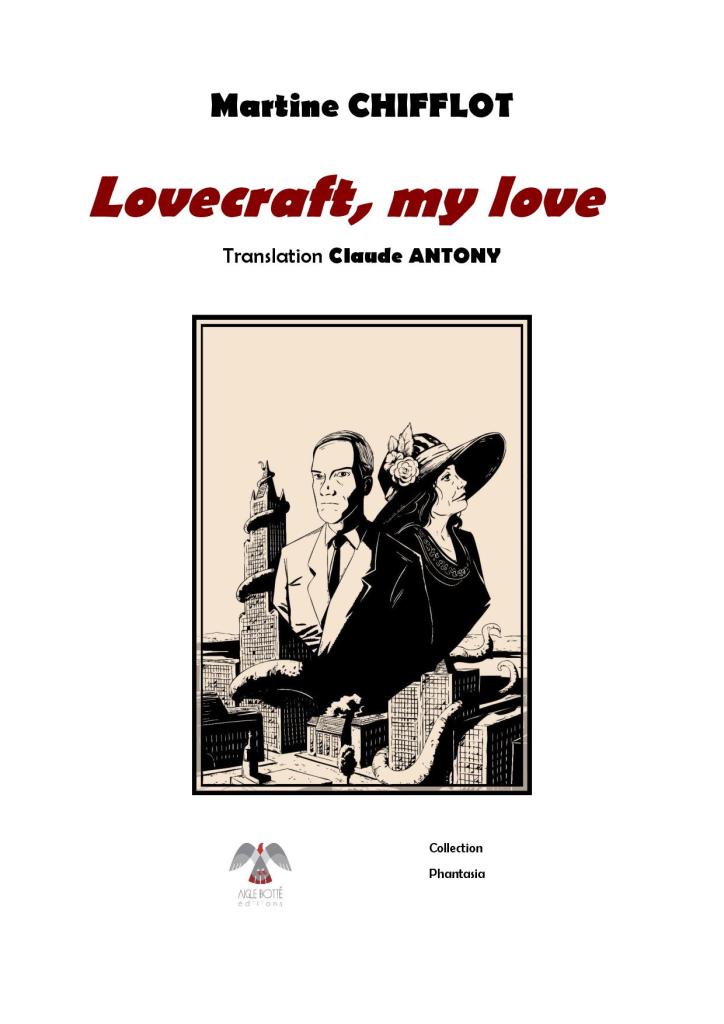
Howard, Mon Amour by Martine Chifflot was published in 2018 by L’Aigle Botté, and has been performed on stage as “Lovecraft, Mon Amour.” An English translation by Claude Antony has been announced:


Bobby Derie is the author of Weird Talers: Essays on Robert E. Howard & Others (2019) and Sex and the Cthulhu Mythos (2014).

Cthulhu Scat Hangover & The Innsmouth Porno VHS (2014) by Adolf Lovecraft

In all of his stories, not one of H. P. Lovecraft’s characters ever pissed themselves in fright. No character soiled their britches as Great Cthulhu stumbled through the waves, or noisily vomited up a half-digested lunch on seeing the swiftly-decomposing remains of Wilbur Whateley. You might run across a reference to a man whose face has been bitten away, but never a dirty diaper; a suggestive smear of blood, but never a drop of menses. A character might be described as moving through filth, but you never get the actual description of the turds, or the rotting carcasses buzzing with flies, or the sudden desperate need for a restroom.

Weird fiction may be horrifying, but it is rarely disgusting. Fear and disgust are basic emotions that can both arise from transgressions, and can be quite intimately linked: a dead body may engender fear and disgust, a prude might find a Satanic orgy both horrifying and revolting. During the heyday of Weird Tales, there was a limit one could go in explicit description, and while later decades grew more lax in terms of actual censorship, many practical limitations remain. Nudity is still more acceptable in horror films than actual feces; a character might be shot a hundred times or bisected by a saw blade, but they probably won’t be drowned in a toilet full of urine.

Even in weird and horror fiction, there are many norms and mores…and transgressing these can result in quite powerful works of art and literature. Terrible, in their own way, but powerful.

This is the psychology of the exploitation films, underground comix, heavy metal and all of its many musical sub-genres and modes with their cover art, and of Splatterpunk fiction and its literary descendants Extreme Horror and Bizarro fiction. For writers and artists who embrace the transgression beyond mere fright, there are strange, vast opportunities to go beyond what any normal writer—even the normal Lovecraftian writer—has gone before.

Of course, it isn’t necessarily pleasant to read or write, but that’s the point. The visceral response, the new emotional sensation that you can’t get anymore. After reading “Innsmouth” or “Cthulhu” for the fiftieth or a hundredth time, do you really still feel the same dread? Or have you gotten used to it? Cthulhu, for many, has become a familiar horror. There are plushies. You can go buy dice and pillows, Cthulhu panties and sex toys. While a Lovecraft reader might be horrified at the mere existence of such merch, Cthulhu itself is far less a figure of terror to most. Cthulhu has become…cuddly.

That isn’t always the case, of course. Some Lovecraftian fiction is more transgressive than others, even in these jaded later days. “Necrophallus” by Makino Osamu (牧野修) is explicitly more visceral than the average Mythos tale; Insania Tenebris (2020) by Raúlo Cáceres pushes Mythos art to an explicit extreme; “The Vulviflora of Vuutsavek” (2008) by Charlotte Alchemilla Smythe is sexually explicit without letting go of the essential element of horror—yet none of these works really embrace disgust as equal to horror. None of them push that element of transgression.

For Lovecraftian works like that, you generally need to look for such works as Edward Lee’s “Hardcore Lovecraft” line including The Innswich Horror, The Haunter of the Threshold, Going Monstering, Trolley No. 1842, and The Dunwich RomanceThese are all stories that put the horror and disgust under a microscope, that don’t pan away or keep the nastier bits of the action off the page or buried under a metaphor, as Lovecraft did. In a more avant-garde vein, you might look at Jordan Krall’s bizarro classic Squid Pulp Blues, pedal-to-the-metal Tentacle Death Trip, and the surreal collection Nightmares from a Lovecraftian Mindor Kevin Strange’s McHumans.

Many of these works are now out of print and rare. Extreme fiction tends to have a limited audience, and self-publishing and small presses have been the norm; once it was Arkham House that published what the big publishers wouldn’t, but now the bleeding, gore-stained edge of extreme Lovecraftian fiction is mostly occupied in self-publishing…and there are some delightfully disgusting treats out on the fringes of known literature.

“Adolf Lovecraft” was the pseudonym for a bizarro writer who self-published three ebooks: Cthulhu Scat Hangover (2014), The Innsmouth Porno VHS (2014), and Cthulhu Bomb (In A Whore’s Guts (2016). While never destined for any best-of anthologies and largely ignored by critics, these are works that are exactly what they set out to be: nasty deep dredges where the balance is less on Lovecraftian horror than Lovecraftian disgust.

Cthulhu Scat Hangover contains two stories: “The Brown Eye From Beyond” and “Cthulhu Scat Hangover.” Both of these stories deal with very similar themes and visuals, and barely amount to more than a scene each; they may or may not have been inspired by a similar scene in chapter four of “The Apocalypse Donkey” in Squid Pulp Blues…

The wet sounds of shit-hitting-cement got louder. The tentacles got closer and before they wrapped around his leg, JImbo thought he saw the hypnotic and crystalline eyes of a squid. He blinked, thinking it was his imagination but when he looked again, they were still there.
—Jordan Krall, Squid Pulp Blues 146

…or perhaps not; independent invention has happened before and will again.

While some of the images are striking, the prose is rather straightforward, with an almost business-like low-budget horror movie earnestness than any effort to wax loquacious. Adolf Lovecraft does not try to ape Lovecraft’s loquaciousness and occasional ultraviolet prose.

The pain was indescribable as Angela from accounts slowly forced her entire fist into his sphincter. He was screaming gibberish, completely helpless, and she too was shouting something equally nonsensical—”Cthulhu R’lyeh wgah’nagl fhtagn!” or some such bollocks—as her wrist, then her forearm, strekaed with gore and faeces, disappeared past Donny’s torn, haemorrhaging anus.
—Adolf Lovecraft, “Cthulhu Scat Hangover”

The stories also have no wider Mythos to tie into; aside from the name and familiar incantation, we aren’t left with any idea of why Angela from accounts is doing this, exactly. We don’t see the cult, if there is one, we get one perspective of a life with all of its petty bullshit hopes, ambitions, fears, and insecurities, and then he dies on a toilet after shitting out a tentacled horror.

It isn’t even played for laughs.

The Innsmouth Porno VHS also consists of two short works: the eponymous “Innsmouth Porno VHS” and “Brown Shower Apocalypse.” The latter has more in common with the contents of “Cthulhu Scat Hangover” than the others, and again there’s that sense of familiarity of theme, if nothing else, with Krall’s Squid Pulp Blues: the looming apocalypse, the terrible mundane sordidness of human relationships, sexual paraphilia, and the use of drugs and alcohol to cope. While it isn’t wholesome to any degree, “Brown Shower Apocalypse” isn’t written as a story to cater to or condemn those who have a sexual desire for a woman to shit on their chest like that infamous scene in Ilsa, She-Wolf of the S.SAs kinks go, it’s disgusting but not horrorific…except, perhaps in this story where it blends from one into the other at the end.

“The Innsmouth Porno VHS” is a different approach: no scat, for one thing. For another, it engages in a bit of intriguing worldbuilding:

Mike and I, in our early 20s, had been born into a world in which the Innsmouth Condition already existed. The Innsmouth kids had been born about a decade earlier. It wasn’t exactly commonplace to us—I’d only ever seen a couple of people with it in my life, and that had been in large cities—but it definitely was part of the world.
—Adolf Lovecraft, “The Innsmouth Porno VHS”

Imagine a world where developing fishy attributes was like Thalidomide babies. Pornography is already intensely driven by genre and tags; the desire for new and different sees users browse by both specific sexual acts and kinks and types of performers. Race, sex and gender, hair color, body types, body modifications like tattoos and piercings are all fair game. It wouldn’t be that strange to imagine what adults with Innsmouth Condition might end up doing in front of the camera…

It is about as far from cosmic horror as you can get. If Joe Koch is correct that body horror is the opposite end of the spectrum from cosmic horror (A Transmusculine Horror Writers Looks At Lovecraft), then “The Innsmouth Porno VHS” might suggest that the spectrum has another axis, and that body disgust is the opposite end of the spectrum from cosmic disgust. The idea recalls Arthur Machen’s dialogue on sorcery and sanctity, the idea that there are transgressions of the mundane world that are more repellent than mere theft or murder, the kind of revulsion against reality hinted at in some weird tales:

And for three hundred years I have done his bidding, from this marble couch, blackening my soul with cosmic sins, and staining my wisdom with crimes, because I had no other choice.
—Robert E. Howard, “The Tower of the Elephant”

A tentacled entity sliding out of a broken rectum covered in shit into a toilet might evoke mingled disgust and horror, but there is nothing of the cosmic in a videotaped orgy featuring two women with birth defects. Weird, certainly; outside the mundane categories on your pornographic website of choice, but the physicality of a hardcore sex tape, with spitting, rough sex, and dirty talk spoken from mouths ill-adapted to human speech trends more toward disgust than horror…although there is still that strange fascination that accompanies anything unusual, bizarre, and taboo.

As the name implies, “The Innsmouth Porno VHS” is sexually explicit, but the real focus is on the mental or spiritual corruption of the protagonist. The eponymous VHS awakens something in him, and Adolf Lovecraft deftly captures that sense of utter fascination, of something beguiling in its wrongness, the shivering sensation of watching something you weren’t meant to see…trying to capture, in a sense, that liminal state of watching pornography for the first time, except with less explicit fear of being caught and more explicit visceral attraction mixed with disgust.

The orgy, gangbang, fish fry, whatever it was, began to wind down.
—Adolf Lovecraft, “The Innsmouth Porno VHS”

The difference between this story and the others in Adolf Lovecraft’s small corpus is that the dirtiness and disgust are on the inside. The other stories are gross-outs, violent, nasty, and viscerally disgusting in the acts they describe, and the point-of-view characters don’t survive to develop new kinks or learn any moral lesson. In “The Innsmouth Porno VHS” however, there’s something more…not in the sense of a greater extreme of physical disgust, but maybe in the sense of cosmic disgust. It isn’t just about jerking off to a new fetish for Innsmouth girls, it’s what that new and unnatural libido leads him to do…and that is, in many ways, more disgusting than all the scat-filled references in the other stories combined.

Cthulhu Bomb (In A Whore’s Guts) is an omnibus anthology of Adolf Lovecraft’s work, including all four stories from the previous two collections along with several new ones. The same themes are at play, but the stories don’t build on one another, there is no larger picture to grasp. Many of the same ideas, spinning out in variations, fucked-up situations that are brutal but never beautiful, that degrade but don’t enlighten.

Disgusting stories aren’t for everyone; it is a different kind of transgression, meant to invoke a different response, and while disgust and fear are closely related, the effects they have on mind and body can be very different. For those who think they have delved into the depths of cosmic horror…there may be some things out there that you aren’t ready for yet, and may never be. There are stranger and more terrible things than Adolf Lovecraft out there.


Bobby Derie is the author of Weird Talers: Essays on Robert E. Howard and Others and Sex and the Cthulhu Mythos.

Deep Cuts in a Lovecraftian Vein uses Amazon Associate links. As an Amazon Associate I earn from qualifying purchases.
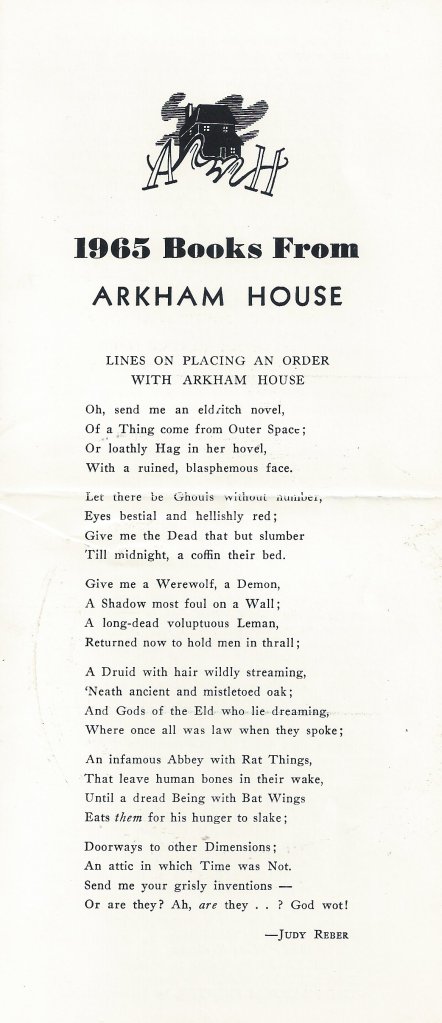
“Lines On Placing An Order With Arkham House” (1965) by Judy Reber

There was never any question about the name of our publishing house—the imprint to be used on what we then thought perhaps the first of three volumes. Arkham House suggested itself at once, since it was Lovecraft’s own well-known, widely-used place-name for legend-haunted Salem, Massachusetts, in his remarkable fiction; it seemed to use that this was fitting and that Lovecraft himself would have approved it enthusiastically. […]

Nevertheless, the buyers of our first book were sufficiently enthusiastic to persuade me to believe there might be a market for small editions of books in the general domain of fantasy, with emphasis on the macabre or science-fiction.

August Derleth, Thirty Years of Arkham House (1970) 3, 4

Before he was a professional writer of weird fiction, Lovecraft was an amateur. He came out of his shell in the 1910s with the amateur press movement, and his first weird fiction was published not in pulp magazines or anthologies, but in small amateur journals—and he carried that amateur attitude with him for the rest of his life. While Lovecraft did not disdain being paid for his work, he disliked writing for money rather than for art. He loved weird fiction, and that appreciation and passion became a part of his legend.

So too, it became a part of the legend of Arkham House.

It is easy today to consider Arkham House as a mere business venture. It was not the first small press in the United States, nor the first to publish anthologies and novels of weird fiction. The Popular Fiction Publishing Co., the publishers of Weird Tales, had tried their hand at a slim anthology titled The Moon Terror and Others (1927), culled from the magazine; it was a commercial failure that took decades to sell out. More success was found in the United Kingdom with the Not At Night series edited by Christine Campbell Thomson, which had its pick of the most gruesome Weird Tales, and brought writers like H. P. Lovecraft and Robert E. Howard into hardback publication.

Yet mainstream publishers, while they might tolerate H. P. Lovecraft in the occasional anthology like Creeps By Night: Chills and Thrills (1931), would never bring out a collection of Lovecraft’s fiction during his lifetime, or in the years immediately after. Nor was Robert E. Howard collected during his lifetime, except for the Western stitch-up novel A Gent from Bear Creek (1937). Popular as they might have been in the pages of Weird Tales, many of the most prominent Weird Talers lacked recognition outside of the pulps and the growing body of organized science-fiction/fantasy fandom.

Imagine for a moment that you were at a newsstand in July 1954, and you put down your thirty-five cents for the penultimate issue of Weird Tales. It was the 278th issue of the Unique Magazine, which during its initial run had been published since 1923. The first story in that issue you might have read was “The Survivor,” one of August Derleth’s “posthumous collaborations” with H. P. Lovecraft, worked up from a note in Lovecraft’s commonplace book.

If that story resonated with you—if you wanted to read more from this “Lovecraft” person—how would you do it? Try to buy back issues of Weird Tales? Hope for a reprint in another pulp? Or, perhaps, you would note the advertisement for Arkham House in the back of the issue, and write to them for a catalog, or mail off your check or money order for one of the advertised titles.

That is what Arkham House was, for much of its existence: for decades, it was practically the sole source for Lovecraft’s works and those related to him. As it expanded, it also published works by Robert E. Howard, Clark Ashton Smith, Lord Dunsany, Arthur Machen, Robert Bloch, Ray Bradbury, Henry S. Whitehead, Frank Belknap Long, and many more. These were relatively expensive books at the time, in limited print runs, but it was not the limited book market of today. These books took years and sometimes decades to sell through 2,000-4,000 copies.

August Derleth did not get rich off Arkham House. It was a business, to be sure, and he was by necessity a businessman as well as a writer, an editor, and a fan. Yet if it had just been about the money, or just about Lovecraft, Derleth could have stopped long decades before his death and focused more on his own writing. Instead…he inspired competition.

By the close of the first decade of publishing, the seeming success of Arkham House had brought into being a dozen other small houses in direct competition, following the lead of Arkham House.

August Derleth, Thirty Years of Arkham House (1970), 9

Derleth doesn’t name names, but Arkham House outlived erstwhile publishers like Fantasy Press (1947-1961), Gnome Press (1948-1962), and Macabre House (1954-1979). With longevity came the legend: Arkham House had not only been the first to publish many works by Lovecraft & co., but those books, once sold out, began to demand higher prices on the used & rare book market. A cycle which still feeds collectors paying fabulous prices even today, with no end in sight.

Like Weird Tales, Arkham House was not some faceless corporate enterprise. The readership was relatively small, and intimate, especially during the first period under August Derleth’s directorship—when Derleth would often personally take and fulfill orders, answer letters, put together newsletters and journals like The Arkham Sampler (1948-1949) and The Arkham Collector (1967-1971)…and it would have been Derleth who received a token of poetic appreciation from a fan toward the enterprise he was so closely associated with:

These are lines by a fan of weird fiction; what else could be “An infamous Abbey with Rat Things,| That leave human bones in their wake,” but a knowing nod to “The Rats in the Walls”? Who might have inspired “A long-dead voluptuous Leman,| Returned now to hold men in thrall” except Clark Ashton Smith? Poetry was a long favorite of fans to pay tribute in weird literature circles; and Judy Reber here follows in the tradition of “Shadow Over Innsmouth” (1942) by Virginia Anderson & “The Woods of Averoigne” (1934) by Grace Stillman, and “The Acolytes” (1946) and “The Cup-Bearer” (1951) by Lilith Lorraine.

In the Arkham House poetry book, The Dark of the Moon (1947), August Derleth inscribed Reber’s copy:

For Judy Reber,
the best of macabre verse,
Cordially, August Derleth

That was the connection between fantasy fans and the director of Arkham House; that was the kind of personal touch which built the legend of Arkham House, above and beyond their catalog. It was the weird community of spooky book lovers, and the experience of being able to order those strange and weird works which were otherwise inaccessible to the average fan which Judy Reber paid tribute.

“Lines On Placing An Order With Arkham House” by Judy Reber appeared on several of Arkham House’s promotional materials from 1965 until 1970. Being ephemera, these small pamphlets and folded sheets are often overlooked by cataloguers, so the exact publication history is obscure. The poem is in the public domain (no copyright registration or renewal could be found), and was last published in Leigh Blackmore’s ‘zine Mantichore vol. 4, no. 1 (2009).


Bobby Derie is the author of Weird Talers: Essays on Robert E. Howard and Others and Sex and the Cthulhu Mythos.

Deep Cuts in a Lovecraftian Vein uses Amazon Associate links. As an Amazon Associate I earn from qualifying purchases.