Historical Racism
This story contains racist historical stereotypes and language.
Reader discretion advised.
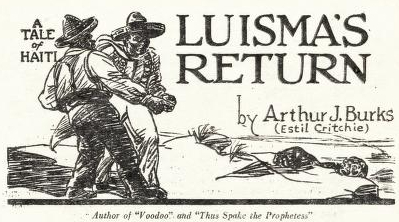
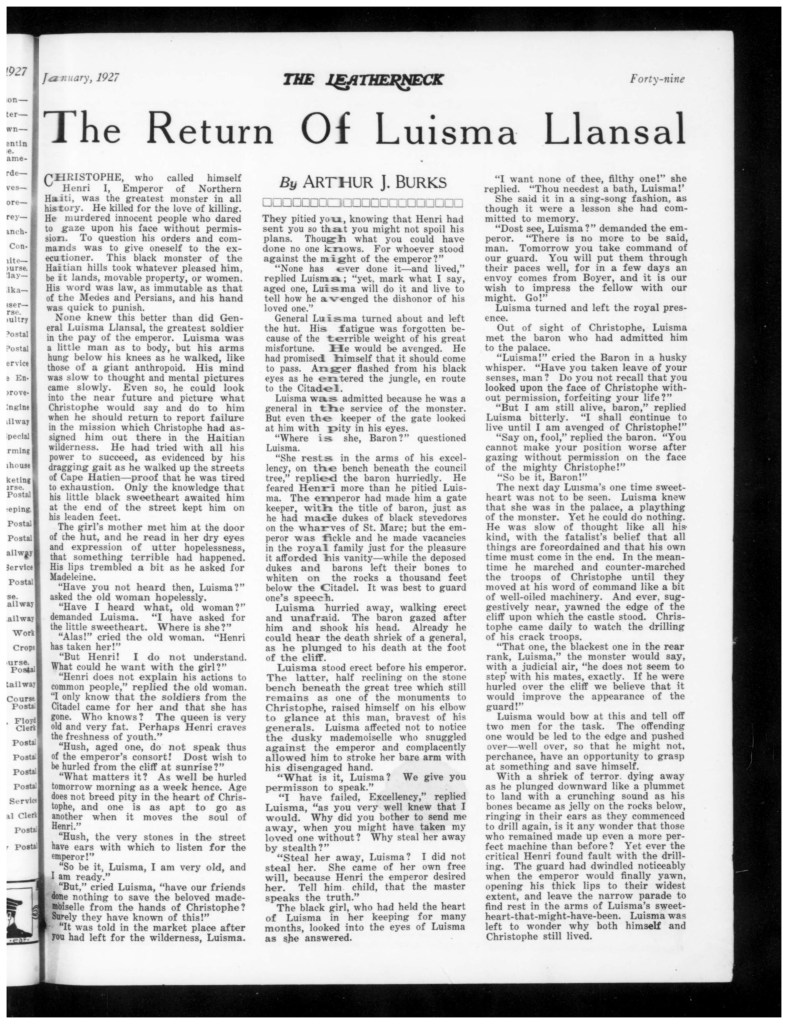
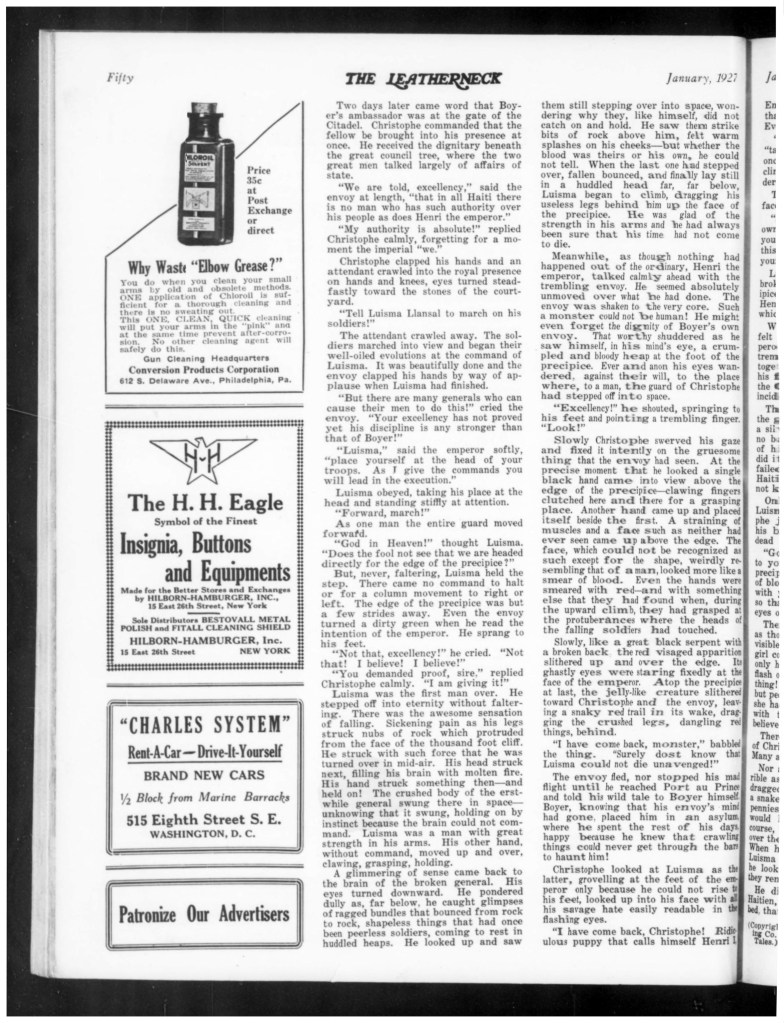
First published in The Leatherneck January 1927; variation of “Luisma’s Return” (Weird Tales Jan 1925).
For more details, please see the The Lost Weird Tales of Arthur J. Burks.
※
The Return of Luisma Llansal
by Arthur J. Burks
CHRISTOPHE, who called himself Henri I, Emperor of Northern Haiti, was the greatest monster in all history. He killed for the love of killing. He murdered innocent people who dared to gaze upon his face without permission. To question his orders and commands was to give oneself to the executioner. This black monster of the Haitian hills took whatever pleased him, be it lands, movable property, or women. His word was law, as immutable as that of the Medes and Persians, and his hand was quick to punish.
None knew this better than did General Luisma Llansal, the greatest soldier in the pay of the emperor. Luisma was a little man as to body, but his arms hung below his knees as he walked, like those of a giant anthropoid. His mind was slow to thought and mental pictures came slowly. Even so, he could look into the near future and picture what Christophe would say and do to him when he should return to report failure in the mission which Christophe had assigned him out there in the Haitian wilderness. He had tried with all his power to succeed, as evidenced by his dragging gait as he walked up the streets of Cape Haitien—proof that he was tired to exhaustion. Only the knowledge that his little black sweetheart awaited him at the end of the street kept him on his leaden feet.
The girl’s mother met him at the door of the hut, and he read in her dry eyes and expression of utter hopelessness that something terrible had happened. His lips trembled a bit as he asked for Madeleine.
“Have you not heard then, Luisma?” asked the old woman, hopelessly.
“Have I heard what, old woman?” demanded Luisma. “I have asked for the little sweetheart. Where is she?”
“Alas!” cried the old woman. “Henri has taken her!”
“But Henri! I do not understand. What could he want with the girl?”
“Henri does not explain his actions to common people,” replied the old woman. “I only know that the soldiers from the citadel came for her and that she has gone. Who knows? The queen is very old and very fat. Perhaps Henri craves the freshness of youth.”
“Hush, aged one, do not speak thus of the emperor’s consort! Dost wish to be hurled from the cliff at sunrise?”
“What matters it? As well be hurled tomorrow morning as a week hence. Age does not breed pity in the heart of Christophe, and one is as apt to go as another when it moves the soul of Henri.”
“Hush, the very stones in the street have ears with which to listen for the emperor!”
“So be it, Luisma; I am very old, and I am ready.”
“But,” cried Luisma, “have our friends done nothing to save the beloved mademoiselle from the hands of Christophe? Surely they have known of this!”
“It was told in the market place after you had left for the wilderness, Luisma. They pitied you, knowing that Henri had sent you so that you might not spoil his plans. Though what you could have done no one knows. For whoever stood against the might of the emperor?”
“None has ever done it—and lived,” replied Luisma, “Yet mark what I say, aged one, Luisma will do it and live to tell how he avenged the dishonor of his loved one.”
General Luisma turned about and left the hut. His fatigue was forgotten because of the terrible weight of his great misfortune. He would be avenged. He had promised himself that it should come to pass. Anger flashed from his black eyes as he entered the jungle, en route to the Citadel.
Luisma was admitted because he was a general in the service of the monster. But even the keeper of the gate looked at him with pity in his eyes.
“Where is she, Baron?” questioned Luisma.
“She rests in the arms of his Excellency, on the bench beneath the council tree,” replied the baron hurriedly. He feared Henri more than he pitied Luisma. The emperor had made him a gatekeeper, with the title of baron, just as he had made dukes of black stevedores on the wharves of St. Marc; but the emperor was fickle and he made vacancies in the royal family just for the pleasure it afforded his vanity—while the deposed dukes and barons left their bones to whiten on the rocks a thousand feet below the Citadel. It was best to guard one’s speech.
Luisma hurried away, walking erect and unafraid. The baron gazed after him and shook his head. Already he could hear the death shriek of a general, as he plunged to his death at the foot of the cliff.
Luisma stood erect before his emperor. The latter, half reclining on the stone bench beneath the great tree which still remains as one of the monuments to Christophe, raised himself on his elbow to glance at this man, bravest of his generals. Luisma affected not to notice the dusky mademoiselle who snuggled against the emperor and complacently allowed him to stroke her bare arm with his disengaged hand.
“What is it, Luisma? We give you permission to speak.”
“I have failed, Excellency,” replied Luisma, “as you very well knew that I would. Why did you bother to send me away, when you might have taken my loved one without? Why steal her away by stealth?”
“Steal her away, Luisma? I did not steal her. She came of her own free will, because Henri the emperor desired her. Tell him, child, that the master speaks the truth.”
The black girl, who had held the heart of Luisma in her keeping for many months, looked into the eyes of Luisma as she answered.
“I want none of thee, filthy one!” she replied. “Thou needest a bath, Luisma!”
She said it in a sing-song fashion, as if it were a lesson she had committed to memory.
“Dost see, Luisma?” demanded the emperor. “There is no more to be said, man. Tomorrow you take command of our guard. You will put them through their paces well, for in a few days an envoy comes from Boyer, and it is our wish to impress the fellow with our might. Go!”
Luisma turned and left the royal presence.
Out of sight of Cliristophe, Luisma met the baron who had admitted him to the palace.
“Luisma!” cried the Baron in a husky whisper. “Have you taken leave of your senses, man? Do you not recall that you looked upon the face of Christophe without permission, forfeiting your life?”
“But I am still alive, baron,” replied Luisma bitterly. “I shall continue to live until I am avenged of Christophe!”
“Say on, fool,” replied the baron. “you cannot make your position worse after gazing without permission on the face of the mighty Christophe!”
“So be it, Baron!”
The next day Luisma’s one-time sweetheart was not to be seen. Luisma knew that she was in the palace, a plaything of the monster. Yet he could do nothing. He was slow of thought like all his kind, with the fatalist’s belief that all things are foreordained and that his own time must come in the end. In the meantime he marched and counter-marched the troops of Christophe until they moved at his word of command like a bit of well-oiled machinery. And ever, suggestively near, yawned the edge of the cliff upon which the castle stood. Christophe came daily to watch the drilling of his crack troops.
“That one, the blackest one in the rear rank, Luisma,” the monster would say, with a judicial air, “he does not seem to keep step with his mates, exactly. If he were hurled over the cliff we believe that it would improve the appearance of the guard!”
Luisma would bow at this and tell off two men for the task. The offending one would be led to the edge and pushed over—well over, so that he might not, perchance, have an opportunity to grasp at something and save himself.
With his shriek of terror dying away as he plunged downward like a plummet to land with a crunching sound as his bones became as jelly on the rocks below, ringing in their ears as they commenced to drill again, is it any wonder that those who remained made an even more perfect machine than before? Yet ever the critical Henri found fault with the drilling. The guard had dwindled noticeably when the emperor would finally yawn, opening his thick lips to their widest extent, and leave the narrow parade to find rest in the arms of Luisma ’s sweetheart-that-might-have-been. Luisma was left to wonder why both himself and Christophe still lived.
Two days later came word that Boyer’s ambassador was at the gate of the Citadel. Christophe commanded that the fellow be brought into his presence at once. He received the dignitary beneath the great council tree, where the two great men talked largely of affairs of state.
“We are told, Excellency,” said the envoy at length, “that in all Haiti there is no man who has such authority over his people as does Henri the Emperor.”
“My authority is absolute!” replied Christophe calmly, forgetting for a moment the imperial “we.”
Christophe clapped his hands and an attendant crawled into the royal presence on hands and knees, eyes turned steadfastly toward the stones of the courtyard.
“Tell Luisma Llansal to march on his soldiers!”
The attendant crawled away. The soldiers marched into view and began their well-oiled evolutions at the command of Luisma. It was beautifully done and the envoy clapped his hands by way of applause when Luisma had finished.
“But there are many generals who can cause their men to do this!” cried the envoy. “Your Excellency has not proved yet that his discipline is any stronger than that of Boyer!”
“Luisma,” said the emperor softly, “place yourself at the head of your troops. As I give the commands you will lead in the execution.”
Luisma obeyed, taking his place at the head and standing stiffly at attention.
“Forward, march!”
As one man the entire guard moved forward.
“God in Heaven!” thought Luisma. “Does the fool not see that we are headed directly for the edge of the precipice?”
But, never faltering, Luisma held the step. There came no command to halt or for a column movement to right or left. The edge of the precipice was but a few strides away. Even the envoy turned a dirty green when he read the intention of the emperor. He sprang to his feet.
“Not that, Excellency!” he cried. “Not that! I believe! I believe!”
“You demanded proof, sire,” replied Christophe calmly. “I am giving it!”
Luisma was the first man over. He stepped off into eternity without faltering. There was the awesome sensation of falling. Sickening pain as his legs struck nubs of rock which protruded from the face of the thousand foot cliff. He struck with such force that he was turned over in mid-air. His head struck next, filling his brain with molten fire. His hand struck something then—and held on! The crushed body of the erstwhile general swung there in space, unknowing that it swung, holding on by instinct because the brain could not command. Luisma was a man with great strength in his arms. His other hand, without command, moved up and over, clawing, grasping, holding.
A glimmering of sense came back to the brain of the broken general. His eyes turned downward. He pondered dully as, far below, he caught glimpses of ragged bundles that bounced from rock to rock, shapeless things that had once been peerless soldiers, coming to rest in huddled heaps. He looked up and saw them still stepping over into space, wondering why they, like himself, did not catch on and hold. He saw them strike bits of rock above him, felt warm splashes on his cheeks—but whether the blood was theirs or his own, he could not tell. When the last one had stepped over, fallen, bounced, and finally lay still in a huddled heap far, far below, Luisma began to climb, dragging his useless legs behind him up the face of the precipice. He was glad of the strength in his arms and he had always been sure that his time had not come to die.
Meanwhile, as though nothing had happened out of the ordinary, Henri the Emperor, talked calmly ahead with the trembling envoy. He seemed absolutely unmoved over what he had done. The envoy was shaken to the very core. Such a monster could not be human! He might even forget the dignity of Boyer’s own envoy! That worthy shuddered as he saw himself, in his mind’s eye, a crumpled and bloody heap at the foot of the precipice. Ever and anon his eyes wandered, against their will, to the place where, to a man, the guard of Christophe had stepped off into space.
“Excellency!” he shouted, springing to his feet and pointing a trembling finger. “Look!”
Slowly Christophe swerved his gaze and fixed it intently on the gruesome thing that the envoy had seen. At the precise moment that he looked, a single black hand came into view above the edge of the precipice—clawing fingers clutched here and there for a grasping place. Another hand came up and placed itself beside the first. A straining of muscles and a face such as neither had ever seen came up above the edge. The face, which could not be recognized as such except for the shape, weirdly resembling that of a man, looked more like a smear of blood. Even the hands were smeared with red—and with something else that they had found when, during the upward climb, they had grasped at the protuberances where the heads of the falling soldiers had touched.
Slowly, like a great black serpent with a broken back, the red-visaged apparition slithered up and over the edge. Its ghastly eyes were staring fixedly at the face of the emperor. Atop the precipice at last, the jelly-like creature slithered toward Christophe and the envoy, leaving a snaky red trail in its wake, dragging the crushed legs, dangling red things, behind.
“I have come back, monster,” babbled the thing. “Surely dost know that Luisma could not die unavenged!”
The envoy fled, nor stopped his mad flight until he reached Port an Prince and told his wild tale to Boyer himself. Boyer, knowing that his envoy’s mind had gone, placed him in an asylum, where he spent the rest of his days, happy because he knew that crawling things could never get through the bars to haunt him!
Christophe looked at Luisma as the latter, groveling before the emperor only because he could not rise to his feet, looked up into his face with all his savage hate easily readable in the flashing eyes.
“I have come back, Christophe! Ridiculous puppy that calls himself Henri I, Emperor of the North! I am stronger than you! I have cheated death itself! Even you cannot do that!”
“Baron!” called Christophe softly. “Take this fellow and hurl him over once more. He has disobeyed me! He climbed back instead of falling, as ordered!”
The thing leered up into his master’s face.
“Stay, monster! I shall go back of my own accord. I only came back to tell you that, even though I fall to the rocks this time, I shall yet be avenged for your cruelties!”
Luisma turned, like a snake with a broken back, and slithered to the precipice edge and over—out of sight! Had Henri followed and looked over, that which followed might never have been.
Why, when all his life he had never felt a tremor of fear, did the great emperor suddenly get a fit of the ague and tremble so that his very knees knocked together? He wiped the fine dew from his forehead and wondered. He entered the citadel and tried to forget the whole incident.
This night was the one during which the great Christophe killed himself with a silver bullet, because he believed that no baser metal should touch that brain of his! No one really knows why he did it. Some say it was because he had failed to make himself emperor of all Haiti. Many stories are told. One does not know what to believe.
Only the dishonored sweetheart of Luisma heard the last words of Christophe just before that monster blew out his brains. She was awakened in the dead of night by his wild ravings.
“Go back, Luisma! Go back! Go back to your dead body at the foot of the precipice! How dare you leave splotches of blood on the floor of my bedchamber with your dragging limbs! Turn about so that I may not see those hate-filled eyes of yours!”
There followed the sounds of a scuffle, as if the emperor fought with invisible devils, there in the darkness. The girl cowered beneath her covers, leaving only her widening eyes exposed. In the flash of Christophe’s pistols she saw the thing! She babbled her story the next day, but people thought her demented because she had spent the night in the chamber with the dead emperor—and did not believe her.
There are many stories of the death of Christophe. Many of them are queer. Many are horrible.
Nor are any of them as queer or horrible as that told by the aged idiot who dragged himself about Cape Haitien like a snake with a broken back, begging for pennies, telling his story to all who would listen. They never believed, of course, for people whom Christophe cast over the cliff never came back, they said. When he told them that his name was Luisma Llansal, they only laughed. For he looked not at all like the Luisma they remembered.
He died a few years ago, in Cape Haitien, insisting, even on his deathbed, that his story was true.
※
In The Leatherneck, the tale ends with the notice “Copyright 1925, by Popular Fiction Publishing Co. Reprinted by permission of Weird Tales.,” and is the only such tale to deserve the notice. The first two stories Burks published in Weird Tales were under the pseudonym “Estil Critchie,” this was the first published under his own name. The differences between the two texts are relatively minor; the title changed, and there are some variations in wording and punctuation. For example:
| None knew this better than did General Luisma Llansal, the greatest soldier in the pay of the emperor. Luisma was a little man as to body, but his arms hung below his knees as he walked, like those of a giant anthropoid ape. His mind was slow to thought, and mental pictures came slowly. Even so, he could look into the near future and picture what Christophe would say and do to him when he should return to report failure in the mission which Christophe had assigned him out there in the Haitian wilderness. He had tried with all his power to succeed, as evidenced by his dragging gait as he walked up the streets of Cap Haitien—proof that he was tired to exhaustion. Only the knowledge that his little black sweetheart awaited him at the end of the street kept him on his leaden feet. | None knew this better than did General Luisma Llansal, the greatest soldier in the pay of the emperor. Luisma was a little man as to body, but his arms hung below his knees as he walked, like those of a giant anthropoid. His mind was slow to thought and mental pictures came slowly. Even so, he could look into the near future and picture what Christophe would say and do to him when he should return to report failure in the mission which Christophe had assigned him out there in the Haitian wilderness. He had tried with all his power to succeed, as evidenced by his dragging gait as he walked up the streets of Cape Haitien—proof that he was tired to exhaustion. Only the knowledge that his little black sweetheart awaited him at the end of the street kept him on his leaden feet. |
| Weird Tales Jan 1925 | The Leatherneck Jan 1927 |
It isn’t clear if the Weird Tales text is closer to Burks’ original, or the Leatherneck text. In Black Medicine, which collected Burks’ early Weird Tales fiction, the story uses the WT title but a text which has features of both—for example, the Black Medicine text and Weird Tales use “Cap Hatien” throughout, which is correct, but also retains “anthropoid ape” in the second paragraph. The difference probably amounts to little more than different editors working on Burks’ original text.
Henri Christophe, President and later King of Haiti, existed; as do the legends of his suicide via a silver bullet; Burks would refer to Christophe and his end in other tales set in Haiti. Burks himself only visited Haiti for a very brief period during the end of his deployment to Hispaniola
Bobby Derie is the author of Weird Talers: Essays on Robert E. Howard and Others and Sex and the Cthulhu Mythos.
Deep Cuts in a Lovecraftian Vein uses Amazon Associate links. As an Amazon Associate I earn from qualifying purchases.

