Historical Racism
This story contains racist historical stereotypes and language.
Reader discretion advised.
First published in The Leatherneck August 1926.
For more details, please see the Lost Weird Tales of Arthur J. Burks.
※
The Sniper
by Arthur J. Burks
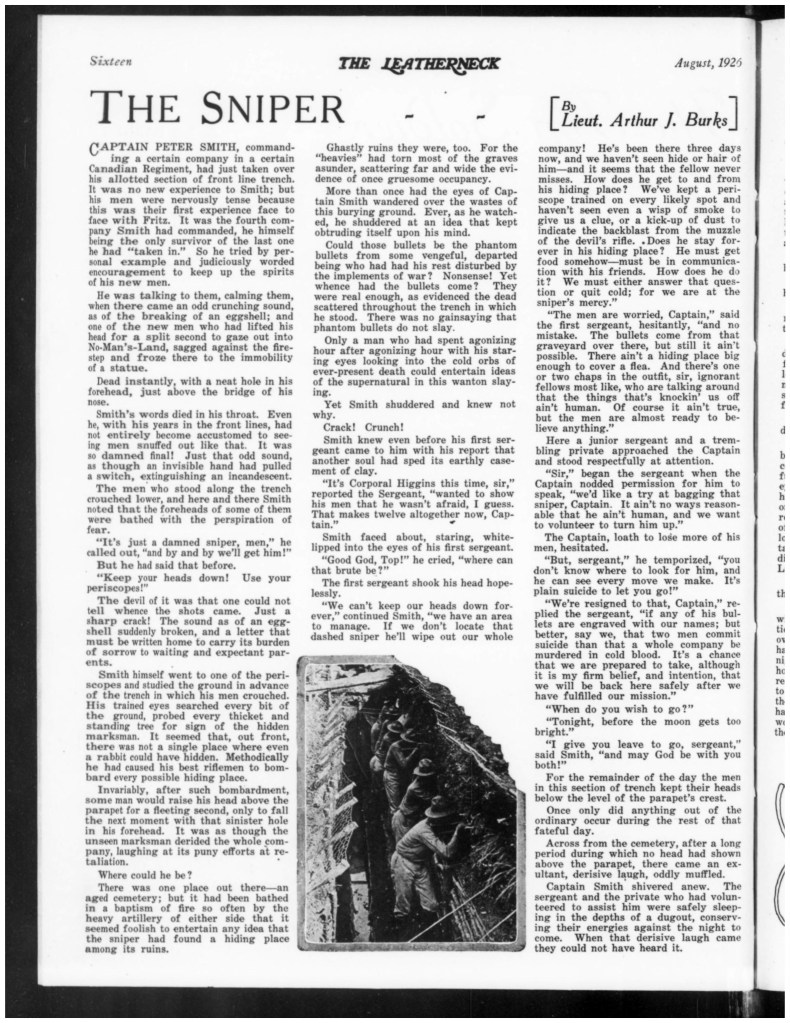
CAPTAIN PETER SMITH, commanding a certain company in a certain Canadian Regiment, had just taken over his allotted section of front line trench. It was no new experience to Smith; but his men were nervously tense because this was their first experience face to face with Fritz. It was the fourth company Smith had commanded, he himself being the only survivor of the last one he had “taken in.” So he tried by personal example and judiciously worded encouragement to keep up the spirits of his new men.
He was talking to them, calming them, when there came an odd crunching sound, as of the breaking of an eggshell; and one of the new men who had lifted his head for a split second to gaze out into No-Man’s-Land, sagged against the firestep and froze there to the immobility of a statue.
Dead instantly, with a neat hole in his forehead, just above the bridge of his nose.
Smith’s words died in his throat. Even he, with his years in the front lines, had not entirely become accustomed to seeing men snuffed out like that. It was so damned final! Just that odd sound, as though an invisible hand had pulled a switch, extinguishing an incandescent.
The men who stood along the trench crouched lower, and here and there Smith noted that the foreheads of some of them were bathed with the perspiration of fear.
“It’s just a damned sniper, men,” he called out, “and by and by we’ll get him!”
But he had said that before.
“Keep your heads down! Use your periscopes!”
The devil of it was that one could not tell whence the shots came. Just a sharp crack! The sound as of an eggshell suddenly broken, and a letter that must be written home to carry its burden of sorrow to waiting and expectant parents.
Smith himself went to one of the periscopes and studied the ground in advance of the trench in which his men crouched. His trained eyes searched every bit of the ground, probed every thicket and standing tree for sign of the hidden marksman. It seemed that, out front, there was not a single place where even a rabbit could have hidden. Methodically he had caused his best riflemen to bombard every possible hiding place.
Invariably, after such bombardment, some man would raise his head above the parapet for a fleeting second, only to fall the next moment with that sinister hole in his forehead. It was as though the unseen marksman derided the whole company, laughing at its puny efforts at retaliation.
Where could he be?
There was one place out there—an aged cemetery; but it had been bathed in a baptism of fire so often by the heavy artillery of either side that it seemed foolish to entertain any idea that the sniper had found a hiding place among its ruins.
Ghastly ruins they were, too. For the “heavies” had torn most of the graves asunder, scattering far and wide the evidence of once gruesome occupancy.
More than once had the eyes of Captain Smith wandered over the wastes of this burying ground. Ever, as he watched, he shuddered at an idea that kept obtruding itself upon his mind.
Could those bullets be the phantom bullets from some vengeful, departed being who had had his rest disturbed by the implements of war? Nonsense! Yet whence had the bullets come? They were real enough, as evidenced the dead scattered throughout the trench in which he stood. There was no gainsaying that phantom bullets do not slay.
Only a man who had spent agonizing hour after agonizing hour with his staring eyes looking into the cold orbs of ever-present death could entertain ideas of the supernatural in this wanton slaying.
Yet Smith shuddered and knew not why.
Crack! Crunch!
Smith knew even before his first sergeant came to him with his report that another soul had sped its earthly casement of clay.
“It’s Corporal Higgins this time, sir,” reported the Sergeant, “wanted to show his men that he wasn’t afraid, I guess. That makes twelve altogether now, Captain.”
Smith faced about, staring, white-lipped into the eyes of his first sergeant.
“Good God, Top!” he cried, “where can that brute be?”
The first sergeant shook his head hopelessly.
“We can’t keep our heads down forever,” continued Smith, “we have an area to manage. If we don’t locate that dashed sniper he’ll wipe out our whole company! He’s been there three days now, and we haven’t seen hide or hair of him—and it seems that the fellow never misses. How does he get to and from his hiding place? We’ve kept a periscope trained on every likely spot and haven’t seen even a wisp of smoke to give us a clue, or a kick-up of dust to indicate the backblast from the muzzle of the devil’s rifle. Does he stay forever in his hiding place? He must get food somehow—must be in communication with his friends. How does he do it? We must either answer that question or quit cold; for we are at the sniper’s mercy.”
“The men are worried, Captain,” said the first sergeant, hesitantly, “and no mistake. The bullets come from that graveyard over there, but still it ain’t possible. There ain’t a hiding place big enough to cover a flea. And there’s one or two chaps in the outfit, sir, ignorant fellows most likely, who are talking around that the things that’s knockin’ us off ain’t human. Of course it ain’t true, but the men are almost ready to believe anything.”
Here a junior sergeant and a trembling private approached the Captain and stood respectfully at attention.
“Sir,” began the sergeant when the Captain nodded permission for him to speak, “we’d like a try at bagging that sniper, Captain. It ain’t no ways reasonable that he ain’t human, and we want to volunteer to turn him up.”
The Captain, loath to lose more of his men, hesitated.
“But, sergeant,” he temporized, “you don’t know where to look for him, and he can see every move we make. It’s plain suicide to let you go!”
“We’re resigned to that, Captain,” replied the sergeant, “if any of his bullets are engraved with our names; but better, say we, that two men commit suicide than that a whole company be murdered in cold blood. It’s a chance that we are prepared to take, although it is my first belief, and intention, that we will be back here safely after we have fulfilled our mission.”
“When do you wish to go?”
“Tonight, before the moon gets too bright.”
“I give you leave to go, sergeant,” said Smith, “and may God be with you both!”
For the remainder of the day the men in this section of trench kept their heads below the level of the parapet’s crest.
Only once did anything out of the ordinary occur during the rest of that fateful day.
Across from the cemetery, after a long period during which no head had shown above the parapet, there came an exultant, derisive laugh, oddly muffled.
Captain Smith shivered anew. The sergeant and the private who had volunteered to assist him were safely sleeping in the depths of a dugout, conserving their energies against the night to come. When that derisive laugh came they could not have heard it.
But both of them moved complainingly as they slept and the sergeant whispered something:
“It ain’t no ways reasonable that he ain’t human!”
The laugh did not come again.
That night, when the light of the moon was hidden behind a bank of sullen black clouds, the sergeant and the private after a whispered goodbye to the Captain and the first sergeant, and a silent handshake all around, crept softly to the top of the parapet and glided, like a pair of serpents, into No-Man’s-Land.
Many hours passed before they came back.
But come back they did, in the darkest hour before dawn.
The Captain was sleeping and they did not waken him, returning instead to their regular posts.
But when Smith came forth from the dugout in the morning, he asked at once for the two volunteers. His orderly looked queerly at the Captain, and his manner was hesitant as he reported the safe return of the two who had gone forth into No-Man’s-Land.
“Send them to me, here,” Smith ordered sharply.
The sergeant, with the private at his back, came at once and stood before the commander. Smith studied them carefully before asking questions. In the eyes of each he read horror such as he had never before read in the eyes of one of his soldiers. Beads of sweat rolled unheeded down the rough cheeks of the two men. Ever and anon they looked furtively away from their Captain, their eyes flashing fearfully in the direction of the graveyard in No-Man’s Land.
“Did you get him, sergeant?” asked the Captain hoarsely.
“Captain,” replied the sergeant, “there will be no more bullets from that particular sniper. But, for the sake of your own peace of mind, don’t ask us what happened in the still watches of last night! Both of us wish to forget the horror of it all—if ever we may. Yet, rest assured, Sir, that whatever we did to him, it was not enough to pay him for the death of twelve of our buddies; that had he had twelve lives to give that would still have been insufficient—for the twelve he killed hadn’t a Chinaman’s chance. On his part, it was cold blooded murder!”
“But I am your Captain, sergeant,” cried Smith, “and I demand that you tell me!”
“Then the Captain must court-martial us for disobedience of orders—for we refuse to tell! Believe me, sir, it is best for us all. He will kill no more of us; let that be sufficient.”
Further than this the two volunteers refused to say anything.
Smith noted, however, that they kept their hands carefully out of sight behind them.
“Let me see your hands, both of you!” he commanded.
Reluctantly the two men thrust forth their hands for inspection.
The hands of each were covered with dried blood, and there were many punctures upon them, whence the blood had come—as though the two, crawling through No-Man’s-Land, had scarred and wounded them while passing through some hidden cactus-bed—or while cutting their way through the wife.
“What did that?” persisted the Captain.
“Rusty wire, sire,” replied the sergeant, with a warning glance at the perspiration-bedewed private.
Abruptly Smith dismissed them, and as they walked away he looked after them thoughtfully. perhaps it were best, he decided, that he did not know all the details. The sergeant had so stated, and he had faith in the sergeant.
That ended the story for the dime being.
Years later, in Lusamitan, Dominican Republic, ex-Captain Smith told me the rest of the story.
“Aboard the boat, enroute to Blighty,” he said, “the sergeant told me something of what had happened in the old cemetery that night. He could afford to tell me then, for we were both being mustered out and the war was over. What he told me filled me with an irresistible desire to return sometime to that particular section to see for myself. I decided, eventually, to come to America, stopping for a time in France-at-peace enroute. I am sorry now that I did—now that it is too late to do anything.”
Ex-Captain Smith heaved a deep sigh, as though reluctant to continue.
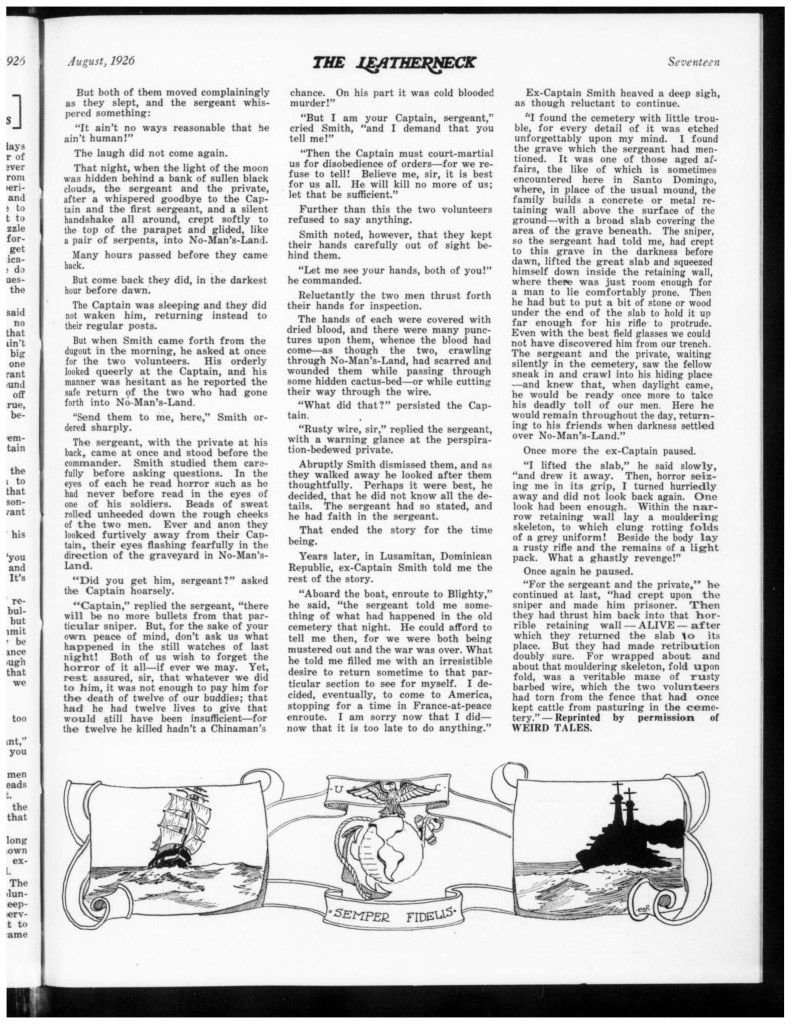
“I found the cemetery with little trouble, for every detail of it was etched unforgettably upon my mind. I found the grave which the sergeant had mentioned. It was one of those aged affairs, the like of which is sometimes encountered here in Santo Domingo, where, in place of the usual mound, the family builds a concrete or metal retaining wall above the surface of the ground—with a broad slab covering the area of the grave beneath. The sniper, so the sergeant had told me, had crept to this grave in the darkness before dawn, lifted the great slab and squeezed himself down inside the retaining wall, where there was just room enough for a man to lie comfortably prone. Then he had but to put a bit of stone or wood under the end of the slap to hold it up far enough for his rifle to protrude. Even with the best field glasses we could not have discovered him from our trench. The sergeant and the private, waiting silently in the cemetery, saw the fellow sneak in and crawl into his hiding place—and knew that, when daylight came, he would be ready once more to take his deadly toll of our men. Here he would remain throughout the day, returning to his friends when Darkness settled over No-Man’s-Land.”
Once more the ex-Captain paused.
“I lifted the slab,” he said slowly, “and drew it away. Then, horror seizing me in its grip, I turned hurriedly away and did not look back again. One look had been enough. Within the narrow retaining wall lay a mouldering skeleton, to which clung rotting folds of a grey uniform! Beside the body lay a rusty rifle and the remains of a light pack. What a ghastly revenge!”
Once again he paused.
“For the sergeant and the private,” he continued at last, “had crept up on the sniper and made him prisoner. Then they had thrust him back into that horrible retaining wall—ALIVE—after which they returned the slab to its place. But they had made retribution doubly sure. For wrapped about and about that mouldering skeleton, dolf up on fold, was a veritable maze of rusty barbed wire, which the two volunteers had torn from the fence that had once kept cattle from pasturing in the cemetery.”
※
In The Leatherneck, the tale ends with the notice “Reprinted by permission of WEIRD TALES.” Arthur J. Burks published six “Strange Tales of Santo Domingo” in the pages of Weird Tales, but this is not one of them. Again, probably not quite weird enough for Farnsworth Wright.
Arthur J. Burks did serve during World War I, but he was never sent overseas and never saw combat, and this is really in every respect a Great War tale, with just a bit of a framing device at the end to make it part of the Santo Domingo series.
Bobby Derie is the author of Weird Talers: Essays on Robert E. Howard and Others and Sex and the Cthulhu Mythos.
Deep Cuts in a Lovecraftian Vein uses Amazon Associate links. As an Amazon Associate I earn from qualifying purchases.

