Historical Racism
This story contains racist historical stereotypes and language.
Reader discretion advised.
First published in The Leatherneck April 1927.
For more details, please see the Lost Weird Tales of Arthur J. Burks.
※
The Brass Dachshund
by Arthur J. Burks
THE BARAHONA store of Amablis, the Syrian, was a house of mystery. It was a long rambling wooden structure and, except for a wee bit of space before the greasy counter over which he made his sales, it was crammed and jammed with everything, almost, that the fertile mind of a tradesman could imagine. Machetes, spurs, native tobacco, native hats and bags, knives, bread, aged bologna. And kinds and classes of hardware such as could only be conjured out of the mind of a person such as Amablis, the Syrian. One could spend a week in that store and come up on new surprises minute by minute.
It was in a dark corner of this store that I found the brass dachshund.
I dragged it forth and studied it curiously. It was a foot scraper about two feet in length, fashioned in the shape of a dachshund with elevated tail and pointed ears. It had long spikes at either end, by which it could be secured to wooden rails or blocks to carry out the purpose for which it had been intended.
“How much for this, Amablis?” I demanded.
“Five dollars, Sir,” he said hopefully, “it is a very valuable work of art, Sir.”
“Yes, Amablis, I note that myself. Which moves me to offer you seventy-five cents for it.”
“It is an outrage, sir; but since you are the commandante here, I must let you have it.”
“Now, Amablis,” I said, after I had paid for my purchase, “tell me just how much profit you made on that deal.”
Amablis grinned all over his swarthy face.
“Seventy-one cents, captain,” he replied, “I got it from a poor Haitian for two native biscuits!”
“And he probably stole it from before the door of some white employee of the sugar company.”
Amablis shrugged his shoulders and his face became as stolid of expression as that of a Digger Indian.
“If it is stolen I do not know, captain. Nor could I identify the Haitian who traded it to me—they all look alike, you know.”
I did know. I haven’t been warden of the prison for Haitian evaders of the immigration laws for two years without learning something about these dull and stupid blacks.
I walked out of Amablis’ store with the brass dachshund under my arm and, though I did not know it, right into adventure such as you read about. From the store I walked half a block south to the prison, for a look around before going home and calling it a day. It is quite a job to be commandante over a company of Dominican soldiers whom you have to father, pet, and cajole into doing your bidding—to say nothing of finding food for a hundred and sixty Haitians prisoners who, though the Cuban calls the Haitian that creation nearest resembling man, are in reality human beings requiring food. Take it from me, such a job is no sinecure, especially if one is an almost-expatriated American, strictly on his own among people whom no white man ever really learns to understand, to say nothing of being compelled to take orders from octaroons in authority who, out of jealousy perhaps, take pleasure in unduly “riding” the foreign official.
I had the brass contraption under my arm when the gate of the stockade was swung open for me to enter. I stepped inside and the sentry closed and locked the gate behind me, shutting out the clean air which comes landward from Naiba Bay, and giving me the benefit of the variegated odors to be encountered about a prison habitually used for the confinement of Haitians. If you have ever visited one, I can see you smile as you read!
The stupid blacks were out of the prison proper, busily engaged in cleaning up the stockade for the day, supervised by a half dozen Dominican privates with grounded Krags. I believe in discipline in a prison. Usually when I enter this prison the first Haitian to note my presence lets out a yell in his crazy lingo and the blacks drop everything to line up for inspection with the best speed of which they are capable.
But not this time.
The black who first saw me started to yell. He even had his mouth open. But the words never came out. The fellow froze there as he stared at me, his eyes momentarily seeming to bulge larger, showing their fishy whites. In a brace of seconds his ebony skin, all I could see of it, was dotted with perspiration.
I turned to the interpreter who always stands at my elbow when I am inside the stockade.
“Ask that black ape what ails him.”
The interpreter spoke, supposedly translating what I had said.
The Haitian who started at me might have been all alone in some silent mountain fastness for all the attention he paid the interpreter. Odd circumstances when one considers the usual docility of the Haitian. He just stood there and stared.
Not at me, I know, for the blacks fear me because I am white; but at the brass dachshund which I carried under my arm.
I looked around at the other blacks.
To see that they, too, were starting at the brass foot scraper—and that the faces of most of them had changed to that muddy gray which is the Haitian’s facial manifestation of fright.
I brought the thing around before my own eyes and studied it. What was there about the thing to do affect the negroes? Probably no one of them had ever seen a dachshund in the flesh. Probably no one of them had ever seen this brass one before. It might have been in the store of Amablis, the Syrian, for four or five years. But I soon gave it up—which one usually does when trying to unravel the mental processes of the Haitian. It can’t be done.
Yet what made them act that way?
I finally herded them into line and looked them over, noting particularly that as I passed each man in line his eyes went to that brass dachshund under my arm, and that he drew his body as far back from me as he could. What was it? It doesn’t hurt my conscience to frighten a Haitian—so when I got to the end of the line I suddenly thrust the dachshund under the nose of the last Haitian to be inspected.
The result was all that could be desired. He let out an unearthly yell that could have been heard halfway out in Neiba Bay and bolted for the gate, absolutely disregarding the sentry’s command to halt, seeming not to see the bare bayonet that was thrust forth to bar his flight. He ducked under the extended bayonet with the agility of a monkey, reached the gate of the stockade, where he turned like a wild animal at bay, his arms flung wide along the side of the enclosure. I saw his scrawny chest rise and fall swiftly and could partially guess at the abject gear which seemed to look out of his eyes.
As I approached the stockade gate to leave the compound he fled from me as though I had had the plague. I could guess at the sigh of relief which must have gone up from the stockade after I had left. yet I could not guess why this brass dachshund should have had such an effect upon the stupid blacks. Outside the stockade I paused in the street and studied the scraper anew. Nothing but a brass foot scraper—dirty, as things usually are which remain for very long in the store of Amablis, the Syrian. Something that looked like an irregular dab of rust stained that part of the scraper which represented the ears of the dachshund. Of course that stain might have been blood of some kind. It looked a bit like it; but why should there be blood stains on a foot scraper? Again, I did not recall for a moment whether or not brass was subject to rust.
I gave it up and strode away, stopping at the Hotel Marina for my customary evening bottle of beer.
Now, as I have hinted just above, I have been in the habit for two years of stopping at the Marina for a bottle of beer as I go home. The beer is the best made. It has never caused me a moment of sickness, nor left me with a feeling of nausea in the morning.
Yet, for the first time since coming to Santa Domingo, I was held that night in the grip of horrible nightmares. All night long, it seemed to me, I dreamed until I would start up in the darkness with perspiration dampening my forehead. Convincing myself of my folly by reasoning, I would go back to sleep, only to dream again. Such dreams! Dreams of valleys, precipice-bordered, in which lived naked black savages whose only domesticated animals were scores of lanky dachshunds. In one part of the sequence of dreams, the blacks captured me and found me hand and foot, and I lay for hours in the darkness, with a long lean dachshund squatting upon my chest, lolling out his tongue as he looked into my starting eyes. I would start awake suddenly then, and stare wildly around my darkened quarters.
Was it fancy? Or could I really hear the rustling of bare feet on the wooden porch outside my room? Boards creaked suddenly, causing me to start nervously. This happened twice, my nightmares and the realities of awakening blending so curiously that they seemed to make a weird whole of some dream of terror. The third time I leaped out of bed, stumbled over the brass dachshund which I had left on the floor beside my bed, and flung wide my door. Gripping my pistol firmly I slipped the catch on my flashlight.
There was absolutely nothing in the yard before my little wooden house. Scarce had that pencil of light swept searchingly across the yard than my Dominican sentry was at my side, coming noiselessly up like a cat, his rifle at the ready.
“What is it, captain?” he whispered.
“Did you hear nothing, Felipe?” I asked.
“Nothing at all, captain,” he replied.
“Must have been the wind then, Felipe,” I muttered. “I’ll go back to bed.”
I was conscious that he looked at me curiously as I said this. For there was no wind. It was one of those nights which are frequent in the tropics during certain seasons. A night when there was nothing abroad but silence, through which, at intervals, come little puffs of wind which sound like eery whispers from nowhere. A pale moon about the Bahorucos, shadows among the palm trees, phosphorescent gleams upon the bosom of Neiba Bay.
I stepped back inside my room, listening there until I heard the retreating footsteps of the faithful sentry.
Moving silently, then. I searched about until I found a little box of common carpet tacks. I opened the door slowly, an inch at a time so that the sentry would not notice. Holding my hand close to the porch I scattered the carpet tacks before my door. Aside from a narrow window in my bedroom—a window high up from the floor—there was no other entrance to my sleeping quarters. Satisfied with my precautions I went back to bed.
To more and startling nightmares.
Always in my dreams there would be brass dachshunds, or dachshunds in the flesh.
Once I came awake to find myself standing erect in the center of the room, in the path of moonlight which came in from the high window, my automatic tight-gripped in my right hand.
In reality there was nothing at that window; in my dream I had seen a black shadow blot out the light in the window, had made out the outline of a negro’s head!
I was trembling when I awoke on the floor there. Perspiring as though I had had malaria. Had there, just prior to my awakening, been a face at that window? I could only guess. I believed that there had been and that my subconscious mind had reacted to that living picture.
Once more I composed myself for sleep. But could not sleep for a long time. Then my senses began to dull and I was halfway between sleeping and waking—
When a horrible yell came from outside on my porch—followed by the rustling retreat of bare feet. There followed the swift patter of bare feet all around my house then, as though the place had been surrounded by people who wore no shoes. With an oath, uttered in a shout to hide my fear, I sprang to the door and swung it wide. A black shadow, swift as the wind, disappeared around the corner of the house next to mind. I swung my light down to look at the porch where I had spread those carpet tacks. Some of them were gone out of the pattern I had made there, and here and there were bright red drops of blood which the prowler had left in their stead.
What had the prowler wanted?
The brass dachshund? Nonsense! When the Haitians had shown such fear of the thing in daylight, why would they come around my house—fearing me as they did to boot—to look for it after dark?
The sentry did not appear this time—and I must confess that I feared to make a search for him. He was part and parcel of this country, groomed from birth to take care of himself. He had Haitian blood in his veins, like most of his countrymen, and knew Haitians. But I wondered why he did not come at my shout.
Oh, well. I turned back to my room, closed and locked the door—and sat up, wide awake, until morning came.
The first report that was brought to me next morning was a surprise. My most trusted Dominican sergeant explained excitedly that, during the night just past, Three Haitians, using their fingers and some bits of cocoanut [sic] shell smuggled past the sentries, had dug under the wall and escaped. Though this had happened in plain view of over a hundred and fifty other Haitians, not one of the latter could tell a thing about it. If a Haitian won’t talked it is useless to “third degree” him, for you will get nothing from him but the most transparent and astounding lies. And he’ll stick to his story until Hades becomes a pleasure report.
After the sergeant had made his report he turned to go back to his duty at the prison.
“By the way, Sir,” he said, “where is your sentry?”
Odd, at that, I hadn’t seen him since that time last night.
Well, we found him in short order. Dead by violence, rifled of all his clothing, his rifle gone.
He was not a pleasant sight to look upon. For he had practically been disemboweled.
That day I compelled the frightened negroes to put the brass foot scraper in place below my porch, securing it by sinking its prints deep in a heavy block of concrete—the making of which I myself supervised.
The concrete would set before night. The brass dachshund was anchored to stay. There is a bit of stubborness in my makeup.
II
I SPENT MUCH of the day in and about the prison, using my interpreter freely in an effort to learn something of why the Haitians had made their escape. This was not the first escape in my experience with the Barahona prison. Two prisoners had gone once before, only to return of their own accord the following morning when the usual breakfast of beans and plantains was being served. They had come back because they knew of no place to go where they would be better off than in prison. They freely admitted to the interpreter that the prison was far preferable to their own homes, and when I pictured a hundred and sixty odd of them confined in a building intended to hold half that number—piled up like sheep in a blizzard—I could fancy just about what their home life must have been.
But I knew instinctively that this escape was different. I knew at once that these three who had left did not intend to return and that, somehow, the brass dachshund which I had purchased from Amablis had something to do with it. It was quite a puzzle; but it is useless to try to figure out a Haitian. Did I say that before? Well, don’t forget it.
I passed the word around among the prisoner “chasers” to be more than usual on the alert with the various working parties which they superintended. There was a feeling in the air that I did not like. Ugly looks in my direction when the blacks did not think that I saw. Extraordinary absence of guile when I was looking. To my wrought-up imagination it seemed that the time was ripe for a concerted jail delivery. This would never have been particularly hard, for the jail was just a wooden excuse for a jail. They might all have gone last night had not a half-witted black given the alarm before the rest could crawl through the hole which had been dug under the wall. The looks that the other blacks cast at him were certainly far from brotherly. I told the sergeant to put this one in a cell by himself in the Dominican section of the jail if he would save himself the trouble of managing an untimely funeral.
It happened to be Saturday, the regular bathing day for the prisoners, and I was half minded to pass up this part of the routine for this week, until everything cooled down somewhat. I would have passed it up except that I did not wish to show openly that I heard the negroes one whit. When the blacks were lined up, two and two, inside the stockade, for the half mile jaunt to the shore of Neiba Bay, I could see more than one of them glance furtively at the sentries who would accompany them. When I spoke a word to the sentries and these fixed bayonets quietly, there were queer glints in the eyes of the blacks as they glanced at me.
I didn’t like it.
The door of the stockade was flung open and the blacks herded out and turned into the street leading to the beach by the half dozen sentries posted at vantage points outside the door. The Dominican guards were on the job with a vengeance and I knew quite well that not a one of them but would have welcomed a jail delivery as a good excuse to show the white captain, me, how proficient they were with their firearms. The Haitians knew this, too, and were quite docile. Not a black put forward an excuse to keep from taking his weekly bath—which was quiet unusual, as most of them try to get out of bathing if humanly possible.
Just out of a sight of Barahona, around the spit of land to the south of the town, the Haitians were ordered to cast off their clothes—not a very difficult operation, as most of them were half naked anyway—and get into the water. Double guards patrolled the beach on either hand, while other sentries stood quietly within the palm grove, rifles at the ready. The only avenue of escape was straight out to sea, where the only land visible was a small island some two hundred yards from shore.
Yet one of the Haitians attempted escape in this direction—and made it! He dove under the water and swam straight out, coming up after a full minute and a half underneath the surface, gulped a breath of air and dove again. We did not see him come up a second time. But shortly we noticed a slight commotion among the undergrowth at the edge of the island. The other bathers had been hurried ashore and lined up before the lowered rifles of the guards. Two of my best marksmen were ordered off on either hand, out of line with the bulk of the prisoners. These knelt swiftly, and methodically swept that little island with a veritable hail of bullets. Yet no cry of pain came from the island.
Leaving a guard to see that our man did not return to the mainland, I went back with the prisoners and saw them safely locked up again. Then I hunted out a negro fisherman and was rowed out to the island. Scarce fifteen could have elapsed. The guard I had left on the beach was as trustworthy as any Dominican can be. That islan’t wasn’t much larger than a fair-sized blanket. Yet that Haitian had made good his escape, and we couldn’t learn exactly how he had done it.
There was something uncanny about it, even to a fellow who knew—or thought, that he knew—Haitians. Where had the black fellow gone?
That night, for the first time in over two years, I omitted the bottle of beer at the Hotel Marina. I was worried and felt that I needed all my faculties.
You wonder, perhaps, why I made no effort to capture the three blacks who had escaped the night before. Here is the answer: Off the beaten trails of the Province of Barahona there is nothing but peculiarly unprepossessing wilderness, in which only the Haitian is perfectly at home. It would have been the old story of the needle and the haystack.
I dreaded the night which was to come. Before I turned in I scattered carpet tacks on my porch once more, even though I knew it to be rather a forlorn hope. The Haitians, if it were Haitians that had visited me the night before, would look for tracks if they came again, and could quietly remove them before stepping up on the porch.
I had a new sentry tonight, and I knew instantly that he was scared half to death. He trembled visible when I spoke to him, and his bulging eyes swerved to that corner of my compounds where his predecessor had been found that morning. This man was faithful to me—but not faithful enough to disregard the very evident danger of being disemboweled. And he looked fearfully at the brass dachshund in its block of green concrete below the steps. It was plain that the soldiers had been talking among themselves and that, almost as superstitious as the Haitians, they were wearing all sorts of weird fancies around the thing.
“Captain,” quavered the sentry, “why did you buy that thing?”
“Is there any good reason, Octavio,” I replied, “why I should not have bought it?”
“I don’t know, Captain; but the men are wondering. Why do the Haitians fear that brass dog of the long body and short legs? We think there is something ‘voodoo’ about it! The Haitians think it is a good of some kind. And they were talking in prison today about how, four or five years ago——”
Here, the sentry paused and looked fearfully about him. Shadows were creeping into the palmgroves, were deepening at the southern end of Punta Martin Barcia, and the sun was just at the crest of the Bahorucos. An eery blue hazel filled the valley which leads into the west toward invisible Lake Rincon. Something, I could not guess what, kept the Dominican from going on with what he would have said.
“Yes, yes, Octavio,” I prompted, “what were the Haitians saying in prison?”
But Octavio would not tell the rest, whatever it was.
“I shouldn’t have spoken, captain,” he said, “it was just a story anyway!”
I knew that he was hiding the real cause of his fear, and that he was hiding it because he believed in his superstitious heart that unseen ears might hear his disclosures and—well, his predecessor had gone the way of no returning, and had gone the way of no returning, and would be laid to rest in the cemetery ere another sunset. Octavio did not wish to follow him. Mysterious things happen in Santo Domingo.
Believing that it would bolster up his courage I sent for additional sentries, so that there could be a double guard about my house. Don’t think that I am afraid in Santo Domingo; but one early learns to exercise care where one’s personal safety is concerned. But I made a mistake; for the sentries talked among themselves, making mountains out of mole hills, I’ll Wagner, until they half scared one another to death with their stories.
I went to bed around midnight, opening my door to look out before dousing my light—and knew blame well that every last sentry had slipped away to the barracks, a quarter of a mile away. They preferred a courtmartial to remaining in the presence of that brass dachshund. Understanding them, I did not really blame them, even though their going made it rather unpleasant for me.
I turned my flashlight upon the brass dachshund below the steps, noticing the brassy sheen which told me that the odd foot scraper was still in place. I shot the beam all around and saw no one. Then I stepped hurriedly down and tested the green concrete with the toe of my boot. It was quite hard, and the strongest men could not have torn the brass dachshund from its foundation. I turned about and started up the steps.
And fairly leaped inside the lighted room. Why? I cannot say exactly; but the instant I turned my back up on the darkness, I felt unseen eyes boring into the back of my neck, had a feeling as of slinking figures surging forward with the tread of prowling cats. It is not a pleasant sensation. Perhaps a lot of it is imagination; but a chap gets that way after too long in Latin America. The ghost of Le Clerc—who tried to bring Haiti back to French rule—could tell you the feeling, eloquently.
I closed the door, locked it, and placed a chair-back under the knob. I even fastened the great hooks with which most Dominican doors are equipped. And I cursed myself for a coward even as I did it. But there was no one to see my fear except myself, and as this thought came to me I went to my mirror and studied my own face. It was drawn and pale but, analyzing it, I saw that there was stubbornness, too. I grinned, but the grin was crooked and unconvincing.
I placed my automatics, one on either side of my bed, so that my hands would fall upon them naturally if need were. I had trained myself in this manner just as some people train themselves to awaken at a certain hour in the morning. I knew when I lay down at night that, should need arise, I would be erect and with my automatics in my hand when I came awake.
Then I slipped into bed and blew out the lamp on the chair beside it.
To my great surprise I went directly to sleep.
And, just as I had done the night before, dreamed dreams which brought me wide awake, with the perspiration bathing my body. I was sitting up in bed with my automatics trained upon that window, high up above the floor. Just as I had done last night. It was uncanny. Why had I done this two nights in succession? I had never done it prior to my purchase of the brass dachshund.
Then I raised one of the automatics and fired through the window. I had seen a weird shadow there for a fleeting instant. As though a curly polled negro had slowly raised his head to look in. I fired before his eyes could have reached the proper height. The poll disappeared instantly and there was not a sound. No sound of footfalls, shod or bare. Nothing. I began to tremble. Damn this silence! Curse a vivid imagination!
I strained my ears as I listened for sounds from the barracks which should tell me that my men were coming in answer to the signal of my shot. I wished them to come—and I didn’t. I wished them to come because I was honestly in a blue funk. Wished them to come because I did not wish the quadroons to snicker because the white captain was afraid and discharged his weapons at shadows.
No sound from the barracks.
But my straining to hear such sounds was productive of results.
For I heard, after a strained moment or two, an eery whispering! Disconcerting and bothersome, in that I could not tell whence it came, nor could I understand the words. Yet I knew that the whispers came from human lips. There was a rustling of the loose sand beneath my floor, accompanied by whispering. Then I turned my head and listened carefully, ear against the north wall of my room. The whispering seemed to come from outside that wall now; but when I straightened up slowly, it seemed to come from beneath the floor. It seemed to be travelling, now here, now there—as though some skillful ventriloquist was playing pranks upon me. Once I thought I could hear it in the very room with me, in the center of the room about the height of an average man’s lips—but I could see nothing, could hear nothing but that elusive whispering.
Then I was sure that it came from directly beneath my feet. I drew a bead on the floor and emptied a clip through the boards. The result was nothing, except that, after the echoes had died away inside my room, the whispering seemed louder, as though it came up more easily through the bullet holes.
A board in the floor of the porch outside cracked suddenly, like a pistol shot, and I was against the door instantly, ear to the keyhole, listening for the sound of footsteps. There was none.
But through the keyhole came the sound of that eery whispering!
As silently as possible I slipped a new clip into the pistol I had emptied. Taking my courage in hand with a distinct effort of will, I slipped the hooks on the door free, unlocked it silently, hurled the door suddenly and forcibly open.
My flashlight showed not a thing that moved out there. My ears heard never a sound, except the soughing of the wind in the bayohunda trees a short distance from my door. Even that eery whispering had stopped.
A back shadow moved in the deep Shadow beneath a bayohunda. The beam from my light showed a standing Haitian, motionless as a post. I fired hurriedly, aiming swiftly at his black, naked chest. He did not move and, cursing softly in exasperation, I sprang from the porch and ran toward him, firing as I ran. I didn’t take my eyes off that Shadow, by my father, I swear it! But when I reached the bayohunda there was no one. I saw the marks of broad splay feet—footprints leading away into the night. But no drops of blood. I had missed completely.
I turned to retrace my steps.
Idly, as I started to mount to the porch once more I switched the beam of my light up on the brass dachshund.
Only there was no dachshund! Just the hole, empty as an eye-socket, where the concrete foundation had been! Foundation and foot scraper together had weighed all of two hundred pounds; yet the whole had been wrenched away and carried off, as though snatched up by the hand of a ruthless giant!
What?
I confess it, freely. I ran, frightened and unashamed of my fear, to the barracks, where my senior sergeant had already prepared a service bed in readiness for my coming!
III
BUT THE next morning I was ashamed.
Things always do appear differently in daylight. But, studying the faces of my soldiers I could not see that they thought me a coward. But I never could excuse myself later for having fled into the night from a bunch of shadows. But do shadows whisper? I KNEW that I had heard whispers, whispers which came from human lips. And it was certainly no dream that the brass dachshund had been literally torn up from its roots in that block of concrete and carried away.
At the same time, while I guessed that Haitians had done this, I knew that it had required more than those four blacks who had escaped from the prison. That whispering had come from all around my house. But then there is always a “Haitian Town” in every Dominican town, and I knew quite well that the blacks stick together—especially against folks of another race. It had been an easy matter to enlist the aid of the free blacks in Barahona town and in the sugar company nearby, which employs large numbers of these cheap laborers.
I breakfasted at the barracks and went to the prison. Where I learned at once that four other blacks had escaped during the night. How, or at what hour, no one knew. But the count was four short at checking up time before breakfast. The four missing ones had vanished as though the earth had opened up and swallowed them. And I knew that my Dominican sentries were more than average in intelligence, too proud of their calling to sleep on the job. Yet the blacks were gone, there was no gain-saying that.
I went over the roster, checking off the names of the missing: Adan Tebo, Cerimarie Leontes, Chal Yac, and Divue David. Those names don’t mean a great deal, for to a Haitian a name is like a garment which he slips off and on as he sees fit. He forgets his name as soon as he gives it to you. I have known Haitians to remain in prison far beyond the time of their sentence, solely because, when their name was called, they did not recognize it—and they all look as like as a pan of black peas, if such there be.
As a matter of habit I scolded my Dominican sentries, after which I quitted the prison en route to my quarters which I had fled so ignominiously the night before. it it was some time before I really reached the house. For as soon as the door of the stockade closed behind me I noted a crowd of Dominicans in the street before the store of Amablis the Syrian. A mailing crowd, an expectant crowd. The natives, men, women and children, whispered excitedly among themselves.
For the first time within my memory of Barahona, the mysterious store of Amablis was closed. Its two windows which gave up on the street looked like the sightless eyes of a blind man. No smoke arose from the chimney to indicate that Amablis was preparing his rice and beans for breakfast. Passing strange.
The Dominican can scent tragedy further than the mongrel which yowls in the presence of death. They knew—and I guessed at once—that the closed door of the store, and the sightless eyes of windows, masked tragedy of some sort.
My heart went down into my boots. As a commandant of the constabulary and Provost Marshal of the Province, it was my duty to ascertain the reason why Amablis’ door was closed. The Dominicans began to form a Lane to the door for me even before I arrived on the scene. They looked at me curiously, mutely telling me that they knew all about last night. There are no secrets in the constabulary—the native soldiers know too many Dominican maidens to whom they tell everything they know. But these people did not regard me as a coward. They could fancy things from which even the “inevitable white man” might run.
I imagine that my face was a bit grim, for they gave back respectfully, even further than was really necessary. It was not fear of me, for the Dominicans look up on me as friend and father confessor.
I knocked on the door and shouted for Amablis.
There was no answer. The Dominicans fell silent, scarcely breathing. I listened for several moments, hearing nothing but a slight crackling inside as of a floor board shifting. Then nothing, not even echoes.
I put my shoulder to the door and heaved.
The door leaped open so suddenly and unexpectedly that I almost fell as I lurched over the threshold.
Amablis was not in the half darkened shop.
But even so, the store was occupied. Two black men, Haitians, lay sprawled on the floor at my feet. Dead, both of them. One of them was the fellow who escaped us by swimming out into Neiba Bay. Crimson dyed was his throat, where a gaping wound told what manner of death he had died. The wound was clean-cut, as though it had been made with a razor. Yet, somehow, I knew that no razor had done it.
The second Haitian had a bullet wound in his breast above the heart, and though I had never before seen this man to know him, something inside me shouted aloud that this was the man who had stood like a post last night in the shadow of the bayohunda. The bullet hole was about where I had seen the front sight of my pistol when I had fired at the fellow’s breast. Yet, with a bullet hole through his heart, the Haitian had escaped into the night! The Haitian is hard to kill, I knew quite well. Only a week or two before I had seen a Haitian stabbed twice through the heart walk calmly down a flight of four steps, turn up the street and walk all of fifty yards, ere he fell to the ground like a steer that has been pole-axed. The internet in the sugar company’s hospital had thrust two fingers into one of the wounds—deep. Believe it or not; but you know, if you know Haitians, that I speak the truth.
Where was Amablis, the Syrian?
It was a long time before the question was answered.
With the aid of some of the Dominicans I turned the store of Amablis upside down; but the Syrian, or any sign of hurried departure on his part, could not be found.
Then, slowly and thoughtfully, I went back to my house.
The whole thing seemed like some weird nightmare, and it really required that I see the gaping hole where the brass dachshund had been to make me realize that this was no dream. Possibly I had half expected to find the brass dachshund in place in its foundation of concrete, and it was a bit of a shock to me to discover that this faint hope was vain. There, below my steps, was the proof. And it filled me with a feeling of dread which I could not easily cast off. Down in my heart I knew that I would again hear of the brass dachshund.
The interior of my house was just as I had left it. I entered and looked all around. Then I went back outside and stooped to look beneath my floor. In the sand there were numerous footprints—of broad splay feet. From here I went to the bayounda tree where the black man had stood to receive my bullet in his breast, and followed the trail he had left in his flight. It did not lead far. I shortly found the unmistakable marks of where he had fallen at full length and lay still. it was an unbelievable distance from where he had stood—when one considered where the bullet had struck the black. There was dry blood in the sand, and marks of many other feet—footprints of those who had borne their fellow away.
Why had they taken him to the house of Amablis, the Syrian?
I shuddered as my mind went back to last night. How would I have felt, scared as I had been, had I followed that trail with my flashlight last night and stumbled upon the stark body of the black? To say nothing of what those other blacks, in the darkness there, watching me, might have done. The Haitian is but slightly removed from cannibalism, and when angered his thoughts follow strange channels.
Why had that other Haitian in Amablis’ store been slain?
Certainly there were numerous questions to be answered before I should get to the bottom of this mystery.
But what could I do? I made a report of the whole affair for my superiors at Santo Domingo City, and sat me down to wait for something to happen. For over a week I lived in my house as formerly, untroubled by phantom footfalls. No eery whispers troubled my sleep. Whoever had done all this had apparently decided to bother me no more.
I knew it would be long before my superiors at Santo Domingo would take action. Dominican officials are best at procrastination.
The first message received from the commandant of the constabulary apparently had nothing to do with the case. It was a phoned telegram, worded as follows:
“Word has been received here that Cerimarie Leontes, notorious Haitian voodoo priest, has crossed into Santo Domingo. Watch for him, and for signs of activity among the Haitian laborers on the sugar estate.”
Cerimarie Leontes! Where, and under what circumstances, had I heard or read that name before? Slowly it came back to me. I fished among the numerous odds and ends of papers in my pocket and finally found what I sought—the names of the last four Haitians to escape from the prison which I managed.
If you will go back and read over those names you will see at once that Cerimarie Leontes had been one of the four who had escaped that night when the weird whispering under my floor had sent me in full flight to the barracks—scared half out of my wits. The night which had witnessed the double killing of Haitians and the disappearance of Amablis the Syrian. For 15 days, according to my records, I had had Cerimarie Leontes under my thumb, while ignorant of the fact that I held an important prisoner—a prisoner moreover, I know remembered, who was badly wanted by the Haitian authorities for the practice of the voodoo rites among his countrymen across the Border! I cursed myself in that the name had meant nothing to me when I had first seen it on the report of the confined. For Cerimarie Leontes was a notorious character. And I couldn’t even recall what he had looked like.
“Arturo,” I said to my senior sergeant that morning, “what sort of a man was Cerimarie Leontes?”
Cerimarie Leontes, the voodoo priest, meant nothing to Arturo; but Cerimarie Leontes, escaped prisoner, did mean something. Arturo Hernandez never forgets a face, even a Haitian face.
“Just a half witted Haitian, Sir,” he replied, “it was he who gave the alarm the night those three escaped. Only to leave himself a short time later. Why?”
I did not enlighten him. Even the Dominican gets scared when “voodoo” is mentioned—and I might need Arturo in my business later on. With the list of those who had escaped still in my hand, I strode to my desk in the company office and sat down to think things over.
My orderly came in shortly to report that a Syrian woman and a half dozen grimy children were outside waiting to see me. I knew before they came in that they were the family of Amablis. I was all interest at once, swearing at myself to having failed to interview the family before this. But than I had known nothing of the family connections of Amablis.
The woman was dry-eyed, woebegone. The kids were the dirtiest I had ever seen. The woman, from long residence in Santo Domingo, spoke Spanish fluently.
“What can I do for you, madam?” I asked, “Do you seek Amablis?”
She nodded dully.
“Why didn’t you come to me before?”
“Because,” she said. “I thought that Amablis would come back soon. I did not wish to trouble the authorities.”
The Syrians in Santo Domingo are like the Dominicans in this, going to the authorities only when there seems nothing else to do. And it is useless to get angry with them. They are doubtful of uniforms, knowing as they do that the uniform is often prostituted to uses for which it was never intended. I knew that, had there been food in the house of Amablis, the woman would have remained in her home, silent as the grave, until Amablis came back or word was received that he was dead. This family was hungry. I could read it in the face of the woman, and in the whimpering children.
“I do not know where Amablis has gone,” I said gently, “can you not help me a little?”
“I can only guess,” she replied, “but I believe that it is the brass dog which has caused this. I was in the store when Amablis bought it from a Haitian, only two months ago. The man was scared half to death,, looking behind him as Amablis put the thing away as though he feared that someone would see him. I begged Amablis not to buy it; but you can’t pull a Syrian away from a bargain. He kept it out of sight because I asked it, and I firmly believe that Amablis would be with me now had you not found the brass dog and carried it away—openly, so that anyone might see it?”
“But what,” I asked in exasperation, “could a simple brass foot scraper have to do with the disappearance of Amablis?”
“I do not know,” she wailed, “but something tells me HERE that the brass dog is the cause of all the trouble!”
She pressed a dirty hand to her ample person over her heart.
That was all she could tell me.
I gave her money to buy food, and told her to come back when she needed more. She smiled gratefully and went away.
Two days later a trail spent native from far Enriquillo, south on the Peninsula, came staggering into my office with a strange story to tell.
“There is a terrible presence among us of Enriquillo!” he gasped, “burros belonging to us, running in pasture at La Rabiza, have been found dead from no cause at all, apparently. Our cattle come home with dry udders, having been milked while running in the hills. We know that our chickens lay eggs, for we can hear them cackle in the woods around the town; but when we go to hunt the eggs we do not find them—only scattered twigs where their nests have been robbed and destroyed! Yesterday my brother saw a half naked Haitian in the woods, who ran like a deer when discovered. He soon distanced my brother, who is fat; and my brother started up on his trail, following the marks of his feet. My poor brother did not come back!”
“Yes, yes,” I encouraged, “what became of him?”
“I came here to tell you, captain, travelling all night, even though I was very much afraid. When he did not come back my father sent me to seek him.”
He paused dramatically. Your true Dominican recognizes drama, crude as may be some of its guises.
“I found him” he continued sadly, “on the trail between Enriquillo and Los Patos—dead! He had been badly hacked and slashed, as though he had been slain with machetes. Most of the wounds were on his stomach!”
I started to my feet with a cry of horror. I was remembering the sentry who had been all but disemboweled that first weird night after I had purchased the brass dachshund. The spent native was put to bed for a short rest.
I ordered that my saddlebags be filled for a journey, together with those of Sergeant Hernandez. The latter did not wish to go.
He had stood, unnoticed by me, in the doorway of my office, while the native of Enriquillo had told me his story.
IV
WE WAITED for evening before taking the southward trail—six solid hours of steady riding. Skirting the sea, climbing along the faces of aged talus slopes, up and down, up and down—over rim rock and through Danke woods where the light seldom falls even at midday, because the limbs of scraggy trees unite above the path to create gloomy, shadowy hallways. Not a pleasant journey, even in daytime—calling for surefooted steeds and steady riders. I was going over the trail during darkness.
I decided upon this for one excellent reason. The people along the way would be in bed, and the knowledge of my coming would not precede me. Travel as fast as you may while the sun is up, and the natives know you are coming hours before you actually arrive. The “grapevine telegraph” we call it. You catch a glimpse of a startled native on the trail ahead. He vanishes and you see him no more; yet the people further along are waiting to receive you when you pass through their little towns. Ride as swiftly as you may, the tale of your coming is miles ahead of you.
For several miles we followed a fair travel along the coast, beginning our first climb near the little town-by-courtesy called Juan Estaban. A short climb which caused us to follow a trail along the edge of a cliff looking fifty or seventy-five feet down into the Caribbean. We could make out the sea below us when the waves broke against the cliff and broke into flying spume; but we could not see the trail we followed. There was forest on our right hand which cast a heavy Shadow in the trail and over us, making us feel as though we were inside some great subterranean pocket. We saw the trail again when we left the woods to Ford the historic Bahoruco River, that place where the aborigines held out so long against the Spaniards. Then we were in the pocket again until we arrived at La Cienega, in the even deeper Shadow of El Coronel, that stately mountain where the Bahorucos vanish into the sea. There were a few lights in La Cienega, twinkling like fireflies in the darkness. But the roar of incoming waves as they broke across a mile of rough shingle drowned out the sound of our approach until we had forded the Cienega River and entered the one street of the little town. We went through the town only because there was no other trail.
An aged crone came to the door of her hut and stared out at us, venting a scream of fright when she caught a gimpse of our uniforms against the foliage opposite her hut. She slammed the door and we could hear the heavy bolt crashed into place. The police, she she took us to be, could be abroad at night on no good business. I felt sorry for her, for I had been through here before, in daylight, and she had prepared excellent native coffee against my coming. But I did not enlighten her. Even now the word would go up and down the whole coast that police had ridden through in the night, following the trail into the south.
Then we were out of the village and following the trail, here bordered by hedges of Spanish bayonet, which led through the deep shadow of El Coronel, to the cliffs which we must skirt and climb ere we reached Paradis. Our roughest going lay ahead of us.
Too dark to see even our hands before our faces, we released the reins of our mules and allowed them their heads. A mule will not go into danger, ergo, if you are rider enough to remain astride him, you may go where you will—if it is agreeable to the mule.
The turbulent Petite Banane behind us we struck a trail steeper than all we had passed before—a trail which went up the mountain in sneaky spirals, the turns so sharp that the mules halted to turn, pivoting on bunched hoofs. All of this in total darkness. The ride from La Cienega to Paradise that night was the longest and most heartbreaking I have ever made—for I had been over the trail in daytime and knew the countless places where the slightest misstep meant a swift and terrifying drop for scores of feet, yet hundreds of feet—where one must end up in the sea or among the boulders cast off by the mountains.
Ever ahead of us in the darkness, invisible, trotted the native who had brought his weird tale out of the south. I could guess dimly at the courage it must have required of this native to go over this trail alone in the darkness of last night—especially with the view of his disemboweled brother fresh in his mind. The Dominican peon usually fears the darkness as the abode of all sorts of evil things. Yet this untutored quadroon had risen above his fears and come in with his report. It made me feel humble, and thought of it kept me buoyed up throughout that terrifying ride through the night and the Dominican jungle.
Paradis was in total darkness when we rode through, followed by a chorus of the mongrels which always haunt Dominican hill towns. They bark at everything and the native sleeps on, feeling that their barking means nothing.
South of Paradis the way is close to the sea again, seldom rising to more than ten feet above the sea until Los Patos has been passed. But all along here is the never-ending roar of the waves across the shingle, inducing eery and melancholy moods. Nothing but this sound, and the dragging of mules’ hoofs through the sand above where the waves break. Before Los Patos is reached there is a mile or two of white cliffs, to skirt which one must ride into the surf—for the water surges to the very foot of the cliffs. It scarce comes to the muels’ fetlocks, but the waves are high when they break, menacing as they rush in against the cliffs. One momentarily expects to be hurled against the unyielding stone; yet the water through which one rides is scarcely disturbed.
Then the cliffs are passed and one rides out upon the long strip of beach at the southern end of which is Los Patos—still in the shadow of the hills.
The trail to the hilltop south of Los Patos is very steep, calling for mighty effort on the part of the mules. But when the summit is reached the roar of the sea below is muted with distance. Then the ride on into Enriquilo.
But at the top of this hill, ere we entered the trail which is here bordered by the little farms of the country people, our guide, visible now because of the pale moon overhead—paused for us to come up. Even as he paused there came to my nostrils the pungent odor of wood smoke—and with this the odor the almost indefinable—never-to-be-mistaken odor of Haitian. The Dominican fell back between Sergeant Hernandez and myself, walking beside my mul with his hand in the animal’s mane.
“What is it, boy?” I asked, “What do you fear?”
“The night, captain!” he replied, “The shadows! The odor of unwashed Haitian! Everything!”
He paused again, ever the dramatist.
“It is just about here that I found my brother, with his stomach slashed open—dead in the trail for me to find!”
In spite of myself a shiver shook me. Fearfully I started around in the darkness of the stunted trees on either hand. To my left, far below, invisible because of a fringe of trees at the edge of the cliff, I could hear the moaning of the sea. I knew that nearby was a bleak promontory, abrupt above the sea, where, in my mind’s eye, I had more than once seen a magnificent horse and rider leap into the sea for the benefit of a cameraman, and for the delectation of movie audiences at home in the States. But now I could not see the promontory and the woods about me seemed suddenly peopled by shifting and darting shadows. And ever the odor of wood smoke. Ever the odor of unwashed Haitian. I half drew my automatic and it required a distinct effort of will for me to keep from emptying the weapon into the shadows. Even the mules were uneasy, pricking up their ears as they strove to look into the shadows. Perhaps they saw things there which we could not see; for they tugged at the reins to be gone.
“Is there a Haitian village near here?” I asked the native.
“There are Haitians in Enriquillo, but that is some little distance ahead of us—and the wind is blowing out to sea. The odor from the town would not reach us.”
“Then why do we catch the odor of Haitian here?”
“I do not know, captain. Perhaps there are Haitians, watching us from the darkness. Maybe there is Haitian ‘voodoo’ in the woods on our right.”
The mule ridden by Hernandez, a few strides ahead, snorted suddenly—because he was tired. But it was so sudden that it caused a momentary chill of dread to caress my spine and stir the hair at the base of my skull. Hernandez set spurs to his mount and moved ahead, and I was glad to follow him without comment. The native stayed at my stirrup, his hand in my mule’s mane. Before we had reached Enriquillo I had made my plans.
We gave the mules into the keeping of the Dominican and, thought Hernandez liked what I proposed no better than I, we turned back a foot, en route for that spot where we had caught the elusive odor of wood smoke. We carried our rifles in our hands, having removed them from their boots upon dismounting. I felt at my hip to see that my knife—and my automatics—were in place and ready for use. Over our shoulders we carried our light packs filled with food. Canteens of water, fresh from the Petit Banane only a couple of hours before, swung silently at our belts.
Shortly we were again among the shadows where our Dominican had found his brother. As I thought of his story I fancied I could see his body there in the trail. I shivered anew and drew closer to Hernandez. Then, silently as a pair of ghosts, we parted the foliage below the trail, and edged toward the sea until the lip of the precipice above it yawned at our feet. We could even see where the white lace flew from the crests of hurtling waves a hundred feet below our hiding place. I could make out the bleak promontory across an arm of a little inlet. We composed ourselves in silence to await whatever might betide. The odor of wood smoke was in our nostrils—and the acrid odor of negro. And both of us were afraid, staring into the darkness which hung like a blanket over us. We dared neither smoke or talk. Nothing to do but wait, and when a vivid imagination peoples the shadows with other shadows that move, waiting is the hardest accomplishment of which I know. But we waited.
And froze like statues when we heard faint rustling sounds in the darkness about us.
“Listen, captain,” it was the trembling voice of Hernandez, his lips against my ear, “don’t you hear it—in the darkness there? Can’t you hear the whispering?”
When he stopped I COULD hear it. A wordless, uncanny, yet oddly human whispering! It was all about us—and in the air above our heads. More pungent at the same time was the odor of wood smoke. The whispering stopped at length, and a moaning that did not come from the sea was wafted to our straining ears—apparently from the very ground upon which we reclined. A moaning as of a beast, buried alive in some subterranean cavern, straining at his fetters in vain.
This stopped and the rustling in the woods about us could be heard again. Then the whispering, many-tongued yet wordless. But HUMAN! Even with all this uncertainty and mental strain my eyes were heavy from a night without sleep and I could feel the lids lowering over them.
“Arturo,” I whispered, and Hernandez started at my voice, “I shall try to sleep for a half hour. Watch carefully, and waken me if there is ANYTHING that makes you believe it necessary.”
Crossing my arms under my head, I turned on my stomach and closed my eyes.
To find that the odor of wood smoke now almost choked me. I turned on my back to keep from coughing. The odor, too, of Haitian, had been stronger.
“Arturo,” I whispered again excitedly, “we are lying right on the spot where a wood fire has been—a fire about which Haitians have squatted!”
I sat up as I spoke and Hernandez ran his hand hurriedly over the ground where I had lain, brushing aside the leaves to reach the soil beneath. He was wise in the ways of the woods, and I awaited his judgment eagerly.
“There has been no fire here,” he whispered, “not since before the falling of the leaves!”
“Then why did I catch the odor when my face was pressed against the ground?”
“It is a mystery, captain. I do not know.”
“I knew that Hernandez shivered beside me as he rendered judgment.
I sat up, wide-awake, weariness forgotten, until the first pink of the morning could be seen in the east.
Long ago the rustling in the woods had ceased. The whispering had come no more. Only once had fright set its cold seal upon us after my discovery of that odor which had seemed to huge the ground—that had been when, ripping the night like a thin-bladed knife, a shirek of terrible fear—as of an animal in mortal pain—had come down to us with the wind which swept to sea from the shadow shrouded hils which oom away to the Bahorucos in the west. Just that one shriek before the silence—silence that was significant—as though a tragedy had come and gone on speeding feet.
This had seemed hours before. Yet when that pink tinged the sky in the east it did not seem so long. Gradually the sun drove the shadows back, and the bird life in the woods awoke to sing to the new day. I swung my eyes to that Bleak promontory.
And almost cried aloud, even as I seized Arturo’s hand and pointed. A heavy bundle had been hurled over the cliff at the very end of the little inlet. I had not seen who, or what, had hurled it. But I recognized it before it struck the waters of the sullen sea below. It was a wild goat, its four feet bunched together and bound tightly, while a heavy stone tied to its binding added to the speed of its fall. The goat was dead, and somehow I knew that this creature it had been which had shrieked its death agony in the night.
It struck the water and was gone, carried down by the weight of that heavy stone. I tried to watch it as it sank, but the water was too deep and I looked from too great an angle.
Why had this dead goat, weighted with the stone, been hurled into the sea?
My eyes swung back to the promontory—and fastened upon a floating object in the water, some twenty feet or so from the shore. It was a neat bundle of fagots, bound together in a short raft which floated high above the surface! It floated! Yes, even though the sea was as smooth as glass, now, and not a bit of breeze was blowing it floated! It came around the end of the promontory, entering the inlet slowly as though it rode the bosom of some current which I could not detect. It came to rest almost in the exact spot where the wild goat had sunk out of sight. Beyond it I caught a flashing glimpse of something black—like a rising fish which leaves the surface and drops back at once. A gentle spat on the water came clearly up to our hiding place.
“Arturo,” I whispered, “what is in that bundle of wood? What does it mean? Why are the fish interested in it? Did you see the flash of black beyond the bundle of fagots—like a fish leaping up and diving again?”
“I saw it, yes,” there was excitement in his whisper, “but it was not a fish. It was the foot and ankle of a black man! He has gone under for something! Watch for him to come up! I wonder what he is doing?”
The mystery was not solved then. Rather another was added to it. For, as a bobbing cork is taken under when a fish takes the hook, the bundle of fagots was snatched beneath the surface!
There was only a ripple where it had lain, and this soon smoothed out.
Though we watched the spot for a good half hour, we saw neither the fagot or the black man again!
V
THE LITTLE thicket in which we had hidden effectively screened us from observation from the trail which led into Enriquillo, unless observers knew exactly just where to look for us—which I more than half believed. For that whispering last night had been meant for us to hear. One of the uncanny methods used by Haitians to engender fear. And with them its use, I imagine, is purely instinctive; the usual run of Haitians does not think along psychological lines.
But I did not believe that the Haitians, if, after all, those whom we sought were Haitians, would attack us during the day. The blacks of Haiti fear the inevitableness of “the inevitable white man.” If they knew we were here they knew that a white man was one of our number and that he would undoubtedly be well armed, to say nothing of the advantage of the fact that he was white! So we waited, quietly, for day to wear on and bring developments. And while we waited I planned again. I did not tell Hernandez exactly what I planned, but I believe from a question or two that I asked him he half guessed what I had in mind.
“Is this ground up on which we now are part of the COMUN of Enriquillo?” this in a whisper, as we had talked during the hours of darkness.
“It is, captain,” replied Hernandez.
“Do you know the old Haitian name for Enriquilo, given during the Haitian occupation?”
“Yes, captain, the old name is ‘Petit Trou,’ and the town is better known by that name than the Dominican, even now.”
“What is the translation of ‘Petit Trou’?”
“In the Haitian language it means ‘little hole.’ Why?”
“I’ll explain my idea later, Arturo. Have patience. How do you explain the Haitian choice of a name in the case of the town of Enriquillo, or Petit Trou?”
“Names were usually chosen for some outstanding feature easy to remember. When they named the place ‘Petit Trou,’ there must have been a ‘little hole’ somewhere to suggest the idea.”
“Do you know of any hole or cave in the vicinity of Enriquillo that might have suggested the name to the simple invaders from over the border?”
“I do not. Tell me, captain, what it is that you are thinking!”
But I ignored him. It would be better that he did not know my plans, since knowledge of them might weight upon his mind and steal away his courage when I most needed it. I knew that what I proposed would require really more courage than I possessed, even though I could see no other way out of the matter.
Twice more before noon bundles of fagots came around that promontory, came to rest where the goat had gone down and been snatched under the surface not to come up again. But we had seen no more black ankles and feet.
It must have been about six o’clock—in last night’s excitement I had failed to wind my watch—when we heard a wiling sound from the direction of Enriquillo. A sound I had heard many times before and would never be able to forget. A sound which may be mistaken for no other. The rising and falling chant of Dominicans who wail out their sorrow over their newly dead. hearing it I could picture the rude wooden coffin in the center of the native hut, the family gathered before it with dry eyes and saddened faces—the neighbors grouped around the doors and windows outside, talking and speculating upon the whys and wherefores of the taking off of the deceased. Frank discussions which took no account of what the family, hearing every word, might feel in the matter. The screaming, now articulate, now wordless, of the mourners:
“Oh God! Virgin of the Most High Grace! Father beyond the skies! Oh, Father, for the love of God!”
A meaningless jumble of oaths and prayers, yet strangely significant when the Spanish equivalent of the above is used. A terrible wailing when heard in some mountain fastness in the dead of night-time. Making one’s flesh crawl even when the sun is up. Not the oaths or prayers themselves—but the sadness unutterable of the tones in which the words are expressed.
I knew that during the night tragedy had stalked abroad in the title Peninsula town of Enriquillo. Knew it even more certainly when the trail became filled with straggling natives from Los Patos, hurrying a foot to Enriquillo to join in the wailing. I noted that all of these, when they reached the trail almost opposite our hiding place, quickened their steps to a run, looking wildly about them into the woods. For up and down the coast had gone of the story which the native of Enriquillo had brought to me at Barahona—that story of the brother who did not come back. This particular stretch of road would be cursed, to the native mind, for many years to come—until those who knew should die and the memory fade away.
I wished to step forth and question the natives concerning what had taken place in Enriquilo, but dared not do so. I felt that the Haitians who were terrorizing this section knew I was here; but I did not wish to step forth, on the off chance that they might not know.
We ate our lunch at noon and drank sparingly from our canteens.
The day wore on. The sun was at the western skyline when an aged Dominican walked along the trail in the direction of Los Patos. This one, when he reached this portion of trail, did not break into a run as had all others that day. His eyes were up on the ground as though he searched for something. I tried to puzzle out what this might be, without success. At that point where the man from Enriquillo had told me his brother had been found, the old man turned abruptly into the woods on our side of the trail and was standing beside us before we could leap to our feet.
“Sit down, friends,” he said quietly, “I am seeking you!”
He squatted on his heels, Dominican fashion, seemingly sure of his welcome. But his greeting was a whisper.
We waited for him to speak, sure that he came from our guide of the night before. Else how had he come so unerringly to our hiding place?
“I am the father of the boy who brought you to Enriquillo last night!”
“And why have you come to us?” I asked.
“To help you, Sir, and to warn you!”
“But why did not Horacio come? Why should he send his feeble Father into danger which he should brave?”
Horacio Carrasco had been the name of our guide.
“He could not come, captain. He is dead!”
I could guess how he had died even before the old man told us.
“He meant to come to you this morning, to offer his aid in laying this curse which has fallen upon our beloved Enriquilo. Horacio was a brave boy!”
Terrible grief looked out of the eyes of this old man. But he did not show it in his voice. He, too, was brave. The old man continued.
“He left his home before daylight this morning, to seek you—and when the sun came up and I opened the door, I found him in the street before the house, Dead! Slashed and mutilated as his brother had been! Time was important, so we buried him as soon as possible, and I am here in his stead!”
“Why was he killed?” I asked, divining the answer even as I spoke.
“He brought the white captain over the trail to Enriquillo! And my warning is this: If you would make sure that you follow not in his footsteps, return to Barahona at once and leave us with our troubles!”
I stared at the old man at this, and something he read in my eyes must have satisfied him, for he sighed a little as he said:
“Well, my son, I have warned you—though I knew you would not go! I am glad. I will gladly give my life to aid you, since you are risking your own. What do you intend?”
I told him all that had transpired during the night just passed. While I talked his eyes and those of Arturo Hernandez roved all around, ever watchful, ever alert. I looked around several times, satisfied in my mind that no one saw us or heard us—but in my innermost being I felt that unseen eyes were upon us, and that people we could not see listened to our words!
When I told the old man of that scream we had heard in the night I saw a shadow, as of mortal pain, Flint across his face. It was too late to take back the statement. Too late I realized that it had not been the death cry of a goat we had heard! I told him of the goat hurled into the sea, of the floating faogts at the end of the promontory. When I had finished, the old man threw himself flat on his back and, crawling like a snake, crept to the very edge of the precipice and looked over, keen Old eyes searching the face of the cliff. I knew that this old native could see things that I could not see.
He came back finally and sat down beside us, evidently prepared to wait. Had the same thought come to this old man which had come to me?
A half hour later and it was as dark as it had been when we had come to this place last night. The right time for an attack. Yet no attack came. The strategy of the Haitian calls for keeping the enemy on tenterhooks. We changed our hiding place, moving along the edge of the precipice toward the promontory.
“At what time do you make your attempt, captain?” asked the old man quietly at last.
“What do you think I intend doing?”
“You plan to swim, do you not, Sir?”
The old man had guessed, apparently, and, since the time had arrived, I was ready for Hernandez to know my plans. So I told them in as few words as possible. The old man grunted affirmatively when I had finished.
“Now is the best time, Captain,” he said, “before the moon is bright.”
The two Dominicans stripped to the skin at my word. Husky Arturo Hernandez. Aged Carrasco, thin and lean, like a bird of prey. I kept my trousers, doffing everything else. We made our clothing into bundles and left them there. We carried our knives in our hands. Carrasco strode swiftly to the edge of the precipice and looked over.
“We can move now,” he called softly, after a brief survey.
In a moment we were at his side, my bare feet already bleeding from the sharp rocks. The old man led the way along the edge, making no more noise than a cat. he had seized my wrist, guiding me as though I had been a child; so that I made little noise either. Once we paused before making the descent to the end of the inlet. Paused to listen, and heard no sound.
But I caught that odor of wood smoke again!
I shivered and pressed the old man’s hand. He led on and did not stop until we stood at the water’s edge, having come down to it by a steep descent, the last twenty feet or so down the very face of the cliff. The old man led the way, reaching back up to guide my groping feet. I in turn guided Hernandez, feeling his trembling each time I touched him. Or maybe it was my own.
At the water’s edge we paused again to listen. I imagined that I again heard that eery whispering, this time from a greater distance, sounding like the sighing of a breeze.
The old man pressed my wrist at last and slid into the water like an eel. I made as little splash as I could, and I am a good swimmer. Hernandez followed and we floated there for a moment, listening. Then we began to swim, straight out toward the promontory. I had a feeling that great depths fell away below me, and a momentary fear of sharks.
When I guessed that we were above the spot where the goat had gone down I touched the old man. he pressed my shoulder in return, drew a deep breath, turned over and went straight down. At least three minutes must have passed! He broke water beside me so suddenly and silently that I almost screamed.
“Can you hold your breath under water, and swim, for a full minute?”
“I can,” I replied. Hernandez grunted, which I took to mean that he could do the same. I knew that he could, anyway.
“When I turn over to go down, grasp my ankle; but help yourself all that you can. Hernandez is a Dominican—he can follow without aid.”
We took our knives in our teeth, Drew air into our lungs. Then the old man turned over as he had done before, and I grasped his ankle as he went under. He was a great swimmer, and swift. Yet my lungs were almost bursting when I felt him straighten from the vertical and swim on a level. I knew that we were deep down, and that we were swimming straight toward the face of the promontory. I was in agony when he ceased swimming and allowed his body to rise. I released his ankle. I felt Hernandez kick me in the side and knew that he had followed through.
Then we broke the surface together.
All around us were dark green walls, above us blackness. Over all the odor of wood smoke and unwashed Haitian. We had entered a cave whose opening was beneath the sea! And we must return that way; but I refused to think of that.
Ahead of us was a steep incline which seemed to ascend about fifteen feet. Over the top of this we could see the flickering of firelight upon the roof and walls of the cavern. Out of sight over this crest I knew that there were black people.
How many I could only guess at the time. It sounded like a score and they were all talking at once in the primitive PATOIS of Haiti. We breathed quickly, renewing our strength.
We could just see one another’s faces. I saw that the face of Hernandez was set in grim lines. He had forgotten his fear of mysterious ‘voodoo’ at the sound of those voices up there, and I was mighty glad. No longer was he an unknown quantity.
A pebble was loosened from the incline and rolled into the water beside us. A black face peered over, while we sank quietly with only the tops of our heads out of water. A naked Haitian slipped rapidly down and took to the water swiftly. I let him go. But I looked around in vain for Hernandez and Carrasco. When they broke water Hernandez was grinning, and he touched his knife significantly.
Then we crawled up the incline and looked over. I counted the blacks and there were eight of them, about a campfire, squatting upon their heels. Talking the most, evidently the leader, I recognized Cerimarie Leontes the half wit. Only now he did not look like a half wit. More like a savage brute beast.
As my eyes became accustomed to the shadows in the cave, which was about the same size as the Barahona prison, I made out the motionless figure of a brown man just beyond the fire. As I looked, however, he moved and turned on his side, face toward us.
It was Amabis, the Syrian, and his eyes as he looked at the Haitians, were wells of malevolence! Cerimarie Leontes turned and looked at him as he turned over, laughed—then deliberately kicked the Syrian in the face with his bare foot.
Then we three arose to our feet, with a shout that, echoing in the cavern, must have made the Haitians think us a score at least, and charged into the circle of the blacks. They leaped to their feet in terrible panic; but the voice of Cerimarie Leontes shrieked at them, calling for courage. Knives and machetes gleamed.
Carrasco charged at Leontes and died with his hands at the Haitian’s throat—his own throat a gaping gash where the negro’s knife had slashed.
“I’ll hold them, captain,” yelled Hernandez, “free Amablis!”
In a trice I had done his bidding and Amablis leaped to his feet, staggering on deadened limbs. Still that malevolence in his eyes.
Then I turned back to aid Hernandez. He was between the Haitians and the incline leading to freedom, and three dead blacks told of the harvest he had reaped. He was superb, and laughed as he wielded his deadly knife—unconscious that his own body was crimson from many wounds, that the blacks swarmed over him. Then I was at his side, and as I fought my eyes went back to Amablis. He had stepped back from the firelight for a moment, and when he had came back into my line of vision he held a terrible weapon in his hand.
It was the brass dachshund, freed now of its bed of concrete!
Grasping it near what would have been the dog’s tail, he swung the gruesome weapon over his head and struck. But not before I noted that the pointed metal ears of the thing were already a rusty brown.
If you can imagine what Amablis must have suffered from these blacks, can imagine what he owed them by way of revenge, you can guess at the havoc he wrought with that weapon.
Not a Haitian left that grotto alive. The last to fall was Cerimarie Leontes, who stood toe to toe at the end with Amablis, until almost decapitated from a sweeping blow of that foot scraper.
When there was no one left but we three we staggered back against the wall of the grotto, panting like spent runners, bleeding from many wounds.
And we had scarce dropped back out of the firelight when another negro, dripping seawater, came up out of the darkness as we had done and advanced toward the fire. He stopped aghast as he saw the carnage about the fire.
He was an excellent target. So Amablis must have thought, for with all his might he hurled the brass dachshund. It struck the Haitian between the eyes and he went down like a poled ox. The dachshund slid down into the sea and disappeared, while after it slumped the Haitian.
“Good God, Amablis!” I exclaimed, “I wonder if there are any more?”
“None, captain,” he answered quietly, “that was the last.”
We sat down by the fire to rest before the return to the outside world.
“Now, Amablis,” I said, “will you please explain?”
“I bought the thing from a Haitian, as I told you, two months ago. Later I tried to sell it to another Haitian, who was scared half to death when he saw it. I held him in the store and him tell me the thing’s history. It wasn’t much. A foot scraper shaped like a dachshund disappeared from before the door of an American family in Port-au-Prince. Later a man named Cerimarie Leontes was discovered in the woods north of Anses-a-Pitre who professed to be a great voodoo priest, able to turn animals into metal with his magic. As proof of what he said he showed the brass dachshund to the simple natives. He became powerful, even sacrificing children to the dachshund, which soon became a symbol for Cerimarie’s god. The military forces heard about him and tried to bring him in as a murderer. He hid the dachshund and, because of the general unreliability of Haitian testimony—Haitians were the only witnesses at the trial—he went free. But when he came back for his ‘god’ someone had stolen it. I bought it, unwittingly, from the thief. When I had heard the story I laughed at it and foolishly let the fellow go free who had told me. He must have gone back across the Border and reported the matter to Leontes, and when I saw among your prisoners a black man who answered the description of Leontes given me by this other Haitian, I knew that the voodoo priest had come to claim his own. I wanted no trouble for myself. So I put the dachshund where you found it. You bought it; but I had my troubles anyway!”
“Serves you right, Amabis, for trying to shunt it onto me!”
The Syrian grinned ruefully at this. He had made a clean breast of the whole thing and expected to be forgiven.
“Who killed those two Haitians in your store?”
“I killed one of them, captain, when they came to take me. They had the other one with them, already Dead. They left him there because I put up such a fight, and made so much noise, that the Haitians feared the arrival of the GUARDIA would prevent their retreat.”
“Why did they take you, and what did they intend doing with you?”
“Took me out of revenge. From what Cerimarie told me they meant to eat me!”
I grinned at this; but my grin froze when I recalled that there are two Haitians in prison at Santo Domingo City charged with cannibalism.
We kicked out the fire and left the grotto, swimming up and out of the “little hole” which once gave Petit Trou its name. We had nipped voodooism in the bud before it had really taken root in the soil of the COMUN of Enriquillo.
If you wish to go there, there are good native swimmers who will show you the “little hole” if you can swim under water and hold your breath for a minute or more.
But hold your breath as you may, and be you ever so strong a swimmer, you’ll never get down deep enough to reach the brass dachshund.
Oh, yes—Amabis the Syrian, always on the lookout for bargains, took back to Barahona with him the rope, with a hook on the end, by which the black renegades had drawn the dead goat and the fagots of wood up and into their grotto!
※
Once he became established as fast-writing pulp writer, Arthur J. Burks had a notable party piece:
WHEN Arthur J. Burks, who writes ’em while you wait, made his now famous statement that he could write a story about any object in his room, or make a plot from the said object for any writer then present, my assignment was the glass door-knob in Burk’s study. Pointing to the dull, machine-cut glass, Art said, “a man is found dead on the side-walk in a side street and when examined this door-knob was found clutched in his left hand.”
He then smiled cheerfully at me and said, “now you go on from there.
—Frederick C. Painton, “Wuxtry! Art Burks’ Plot Clicks” in Writer’s Digest Apr 1936 (23)
While I cannot prove, beyond a shadow of a doubt, that this is the origin of “The Brass Dachshund,” it feels like the kind of story that might be churned out when trying to write a novelette on the rather bare premise of a prosaic mass-manufactured item. And, despite the abundance of weird tropes that hint at possible supernatural goings-on, it feels like the kind of serial that Farnsworth Wright might have passed on as having too little story for the word count. Yet we aren’t sure if it was ever submitted to Weird Tales, much less rejected; while it holds all the hallmarks of the longer tales of Santo Domingo Burks had published in WT, unlike the other Leatherneck tales it lacks any attribution to WT. So we can be pretty sure if it was submitted, Farnsworth Wright didn’t buy it.
Elements of “The Brass Dachshund” reflect other bits and pieces from Burks’ previous works; “Ceremarie Leontes” is unmistakably similar to “Cerimarie Sam,” the voodoo high priest in “Voodoo” (Weird Tales Dec 1924), and the whole motif of the cliff recalls “Luisma’s Return” (Weird Tales Jan 1925). The Barahona setting came from his own experience as a warden of a prison in the Dominican Republic with many Haitian prisoners. Compare his description of Barhona above with the “non-fiction” version from his memoir:
It was a clapboard, white-washed building in the middle of town. It was surrounded by a board stockade topped by strandes of barbed wire. In the stockade there was a smaller building for the incarceration of Dominican prisoners. […]
The Haitian portion of the prison was built to hold sixty prisoners. It actually held a hundred and thirty odd. There were no cots, beds, bed clothing or lavatories, and when I made my midnight-to-morning visit of sentries and prison guards—an immitable law of the military—the odor oin the place could be cut with a knife. The Haitian is capable of going from the cradle to the grave unbathed.
—Arthur J. Burks, The Land of Checkerboard Families (1932) 17-18
So, too, probably came the prejudice; while nearly all of Burks’ tales of Hispaniola display racial prejudice or stereotypes and are essentially told from the viewpoint of colonizers, “The Brass Dachshund” stands out among the Leatherneck tales for how openly and repeatedly Burks relies on racial prejudice in nearly every characterization, and even as a plot point. This, too, reflects his experience in the Dominican Republic:
The Cuban calls the Haitian, “that animal nearest resembling man,” and it’s my personal opinion that the Cuban pays the Haitian a high compliment. […] When I began to write stories for juvenile magazines, deciding that with my lack of technique they must suffice for a time at least, I began on the Haitian prisoners as material for stories and articles. When they were herded to prison in droves, we took down their names in a book, through an interpreter of course, and in course of time that book became a mighty roster of Haitian names.
—Arthur J. Burks, The Land of Checkerboard Families (1932) 18-19
In many ways, it was the verisimilitude of Burks’ descriptions, taken from his lived experience, that provided the color and interest in this and other stories. They also showed Burk that he could effectively cannibalize his experiences for fiction, not just once but several times; a number of the details and anecdotes in “The Brass Dachshund” are identical to those that Burks relates in The Land of Checkerboard Families.
While many readers may wish this story had remained “lost” because of the racism, it is important to realize that this was not terribly different from the stories that pulp editors like Farnsworth Wright had bought and published in Weird Tales from Burks before—and would buy again, not just from Burks but many other pulp writers. It speaks to the cultural pervasiveness of racism, and the attitudes that allowed the United States to invade and occupy two sovereign states in the Caribbean, each for over a decade, that this sort of characterization was not just accepted but often commonplace.



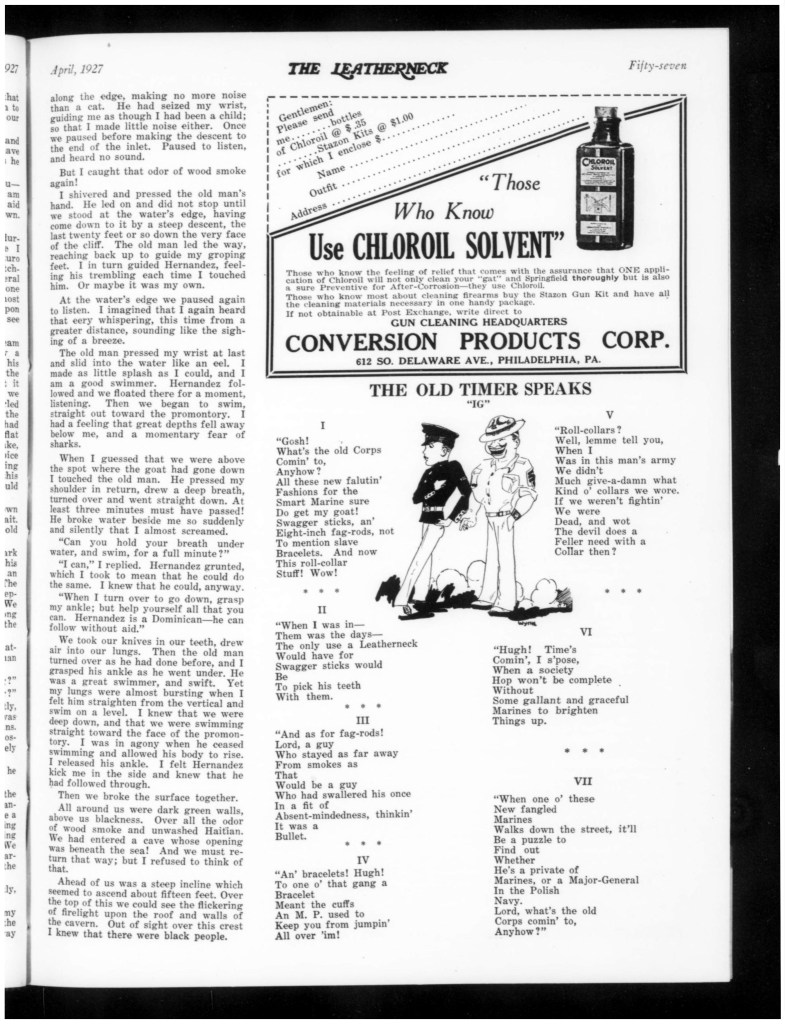
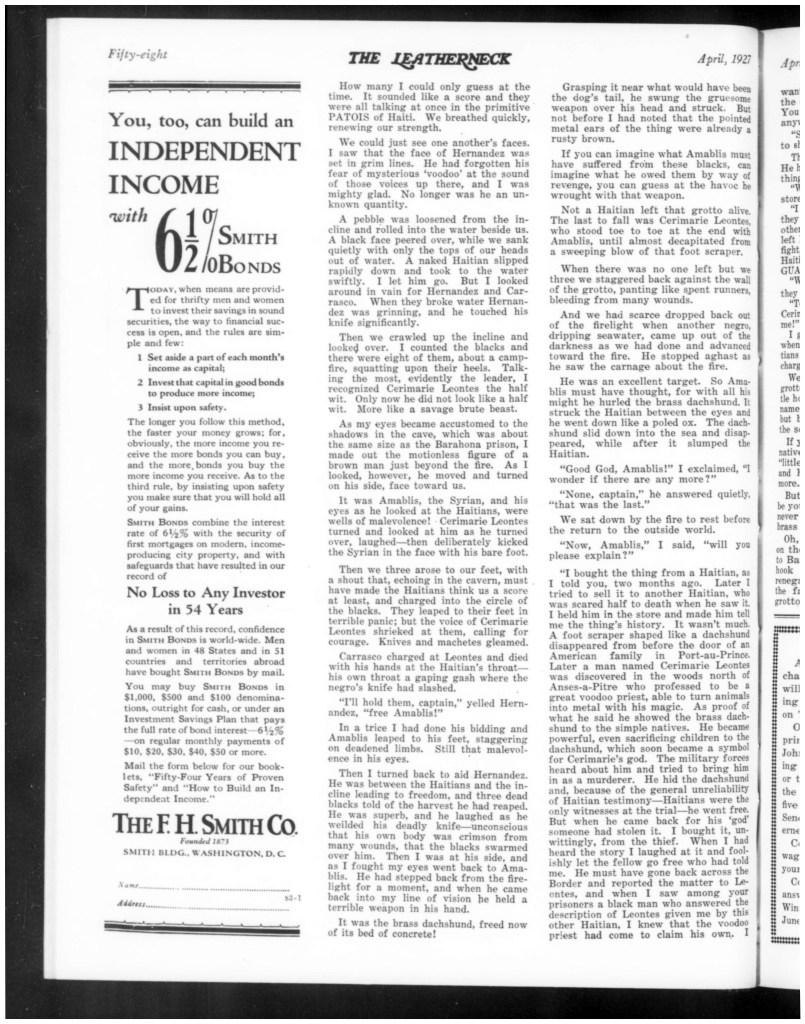

Bobby Derie is the author of Weird Talers: Essays on Robert E. Howard and Others and Sex and the Cthulhu Mythos.
Deep Cuts in a Lovecraftian Vein uses Amazon Associate links. As an Amazon Associate I earn from qualifying purchases.
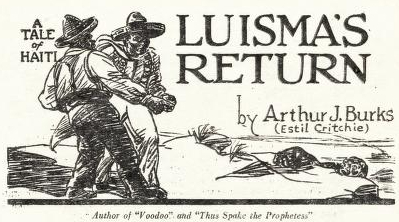
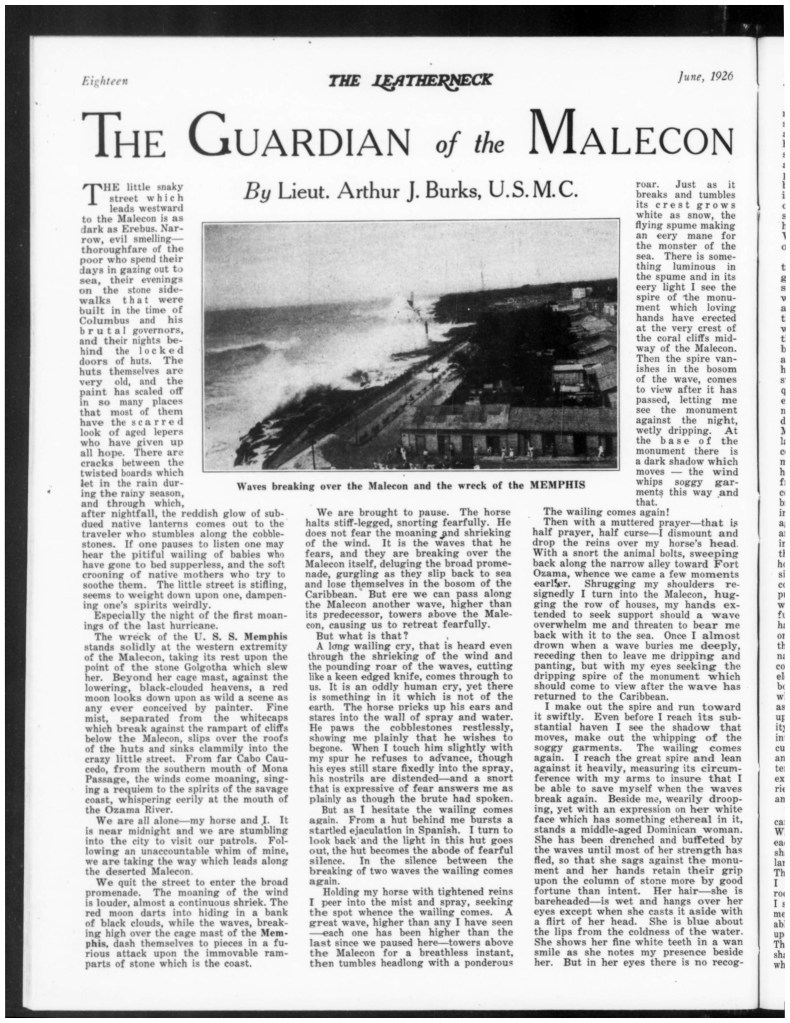
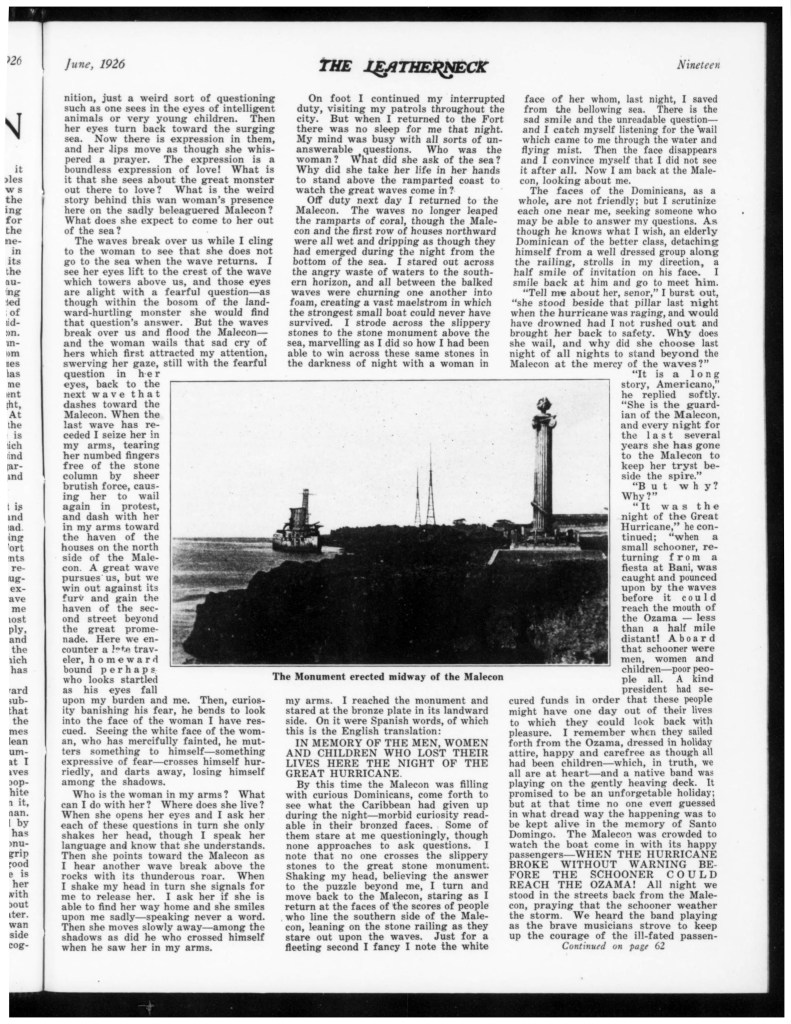

 Deep Cuts in a Lovecraftian Vein