[…] Burks had been a corporal in the U.S. Marine Corp[s]. After leaving the military in 1919 he joined the reserves as a 2nd Lieutenant. […] He returned to active duty in 1921 with the U.S. Marine Corp[s]. After training recruits at Parris Island, S.C., he was sent to the Dominican Republic, where he was involved in intelligence duty and the making of maps for the republic until 1924.
Although he had begun to write in 1920, it wasn’t until he was stationed in the Caribbean, where its people and native voodoo rituals fired his imagination, that he began to sell weird stories to Weird Tales. Many of those tales, often considered his best work in the field, eventually became the foundation for his 1967 Arkham House collection Black Medicine.
—Peter Ruber, Arkham’s Masters of Horror (2000) 251
In 1915, U.S. Marines landed in Port-au-Prince, capital of the Republic of Haiti on the island of Hispaniola; beginning an occupation that would last until 1934. The following year, U.S. Marines would invade and occupy the Dominican Republic, also on Hispaniola, which would last until 1924. The occupation would result in closer contact between the continental U.S. and Caribbean culture, and the local syncretic African diaspora religions of Haitian Vodou and Dominican Vudú strongly captured the public imagination through books like William Seabrook’s The Magic Island (1925), which sparked the zombie craze.
Among the leathernecks serving in the occupation was 2nd Lt. Arthur J. Burks, who had been attempting to launch a writing career for years. Now he took a writing course at the Palmer Institute of Authorship, which helped polish his style and set his feet on the path of a pulp fiction career—one he would so excel at in terms of speed and sales that he soon became one of the star pupils.
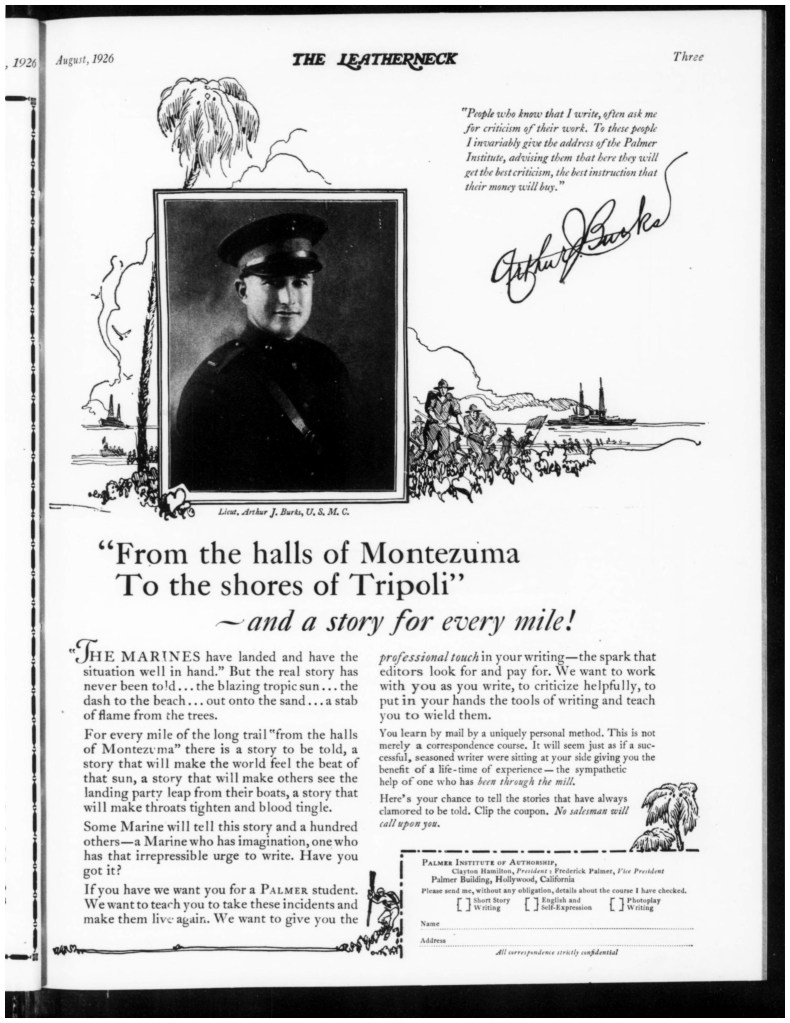
With the local color and lore picked up from his time in the Dominican Republic, Burks at last hit on a seam of material that could sell—and a magazine that would lap it up. Weird Tales had begun publication in 1923, and after a reorganization in 1924, it must have seemed a perfect market for Burks’ tales set on Hispaniola. His first published story in the magazine was in 1924, under the pseudonym Estil Critchie, and he soon became a prolific contributor:
Historical Racism
Please be aware that these works were written during a time when racism and racial stereotypes were extremely prevalent in U.S. society; all of the stories include characters who exhibit or embody these prejudices in some way. This was typical of Arthur J. Burks’ early works.
- “Thus Spake the Prophetess: A Tale of Haiti” (Weird Tales Nov 1924) as by Estil Critchie
- “Voodoo” (WT Dec 1924) as by Estil Critchie
- “Luisma’s Return” (WT Jan 1925)
- “A Broken Lamp-Chimney” (WT Feb 1925) *
- “Desert of the Dead” (WT Mar 1925) *
- “Daylight Shadows” (WT Apr 1925) *
- “The Sorrowful Sisterhood” (WT May 1925) *
- “The Phantom Chibo” (WT Jun 1925) *
- “Black Medicine” (WT Aug 1925)
- “Vale of the Corbies” (WT Nov 1925)
- “When the Graves Were Opened” (WT Dec 1925)
- “Something Toothsone” (WT Mar 1926)
- “The Ghosts of Steamboat Coulee” (WT May 1926)
- “Asphodel” (WT Jun 1926)
- “Orbit of Souls” (WT Dec 1926)
- “Faces” (WT Apr 1927) *
- “The Invading Horde” (WT Nov 1927)
- “Bells of Oceana” (WT Dec 1927)
…and so on. Burks recalled his start with Weird Tales:
[…] the time when I sold my first adult story. That was in 1924, and as long as I live I shall never forget the thrill of it, nor the letter which came to me accepting “Too Many Legs,” nor the name which was signed to that letter. Put it in capitals, that name, Mr. Editor, for it was the biggest, most important letter I ever received in all of my days: FARNSWORTH WRIGHT, editor then, and now, of Weird Tales. Weird Tales, and its editor, were having a hard time then, and Farnsworth Wright was very plainly a much overworked man. That was evident in all his letters, yet he still had time, knowing as he did that I was a newcomer, and that he was buying my first yarn, still found time to write me about my story, to ask for more, to offer friendly criticism, and to suggest revisions for stories which for one reason or another did not stick.
—Arthur J. Burks, “Are Editors Human?” (1929) in Pulp Fictioneers (2004) 25
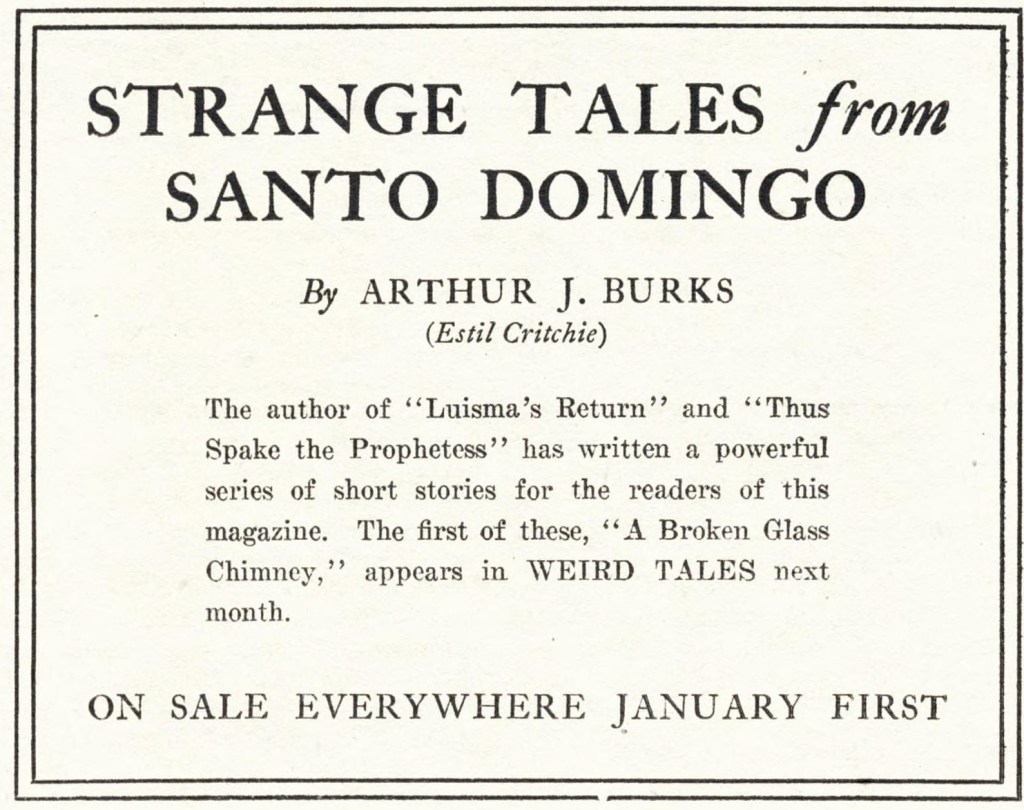
Wright managed to convince Burks to publish a series of short tales—not all of them weird in the traditional sense—as “Strange Tales of Santo Domingo.” These tales are marked with an asterisk in the list above.
No story under the title “Too Many Legs” was published in the pages of Weird Tales, but then Farnsworth Wright had a habit of editing titles to suit his own tastes. However, there is reason to believe that Burks actually sold more stories to Weird Tales than were published, because of a series that appeared in an oft-overlooked Marine Corps journal called The Leatherneck in 1926 and 1927.
Three of the four Leatherneck tales bear the curious notice at the end: “Reprinted by permission of WEIRD TALES” (or variant thereof), yet only one of them was published in the pages of that pulp: “The Return of Luisma Llansal,” which is a variant of “Luisma’s Return” (WT Jan 1925). All four are also plainly stories of Hispaniola, in the same vein as the tales Burks had published in Weird Tales in 1925, 1926, and 1927.
While we might speculate about the exact behind-the-scenes story, it’s worth remembering that Weird Tales only paid on publication, which could be months or, in extreme cases, years after the story was accepted. So it is quite possible that Burks “sold” a number of stories to Weird Tales, a handful of which went unpublished for a couple of years, and which Burks finally asked Wright for permission to print (or reprint) in Leatherneck. At least, that is one scenario that fits the facts at hand.
The Leatherneck tales have never, as far as I can determine, been collected or reprinted, and they are:
- “The Guardian of the Malecon” (Jun 1926)
- “The Sniper” (Aug 1926)
- “The Return of Luisma Llansal” (Jan 1927)
- “The Brass Dachshund” (Apr 1927)
Bobby Derie is the author of Weird Talers: Essays on Robert E. Howard and Others and Sex and the Cthulhu Mythos.
Deep Cuts in a Lovecraftian Vein uses Amazon Associate links. As an Amazon Associate I earn from qualifying purchases.
 Deep Cuts in a Lovecraftian Vein