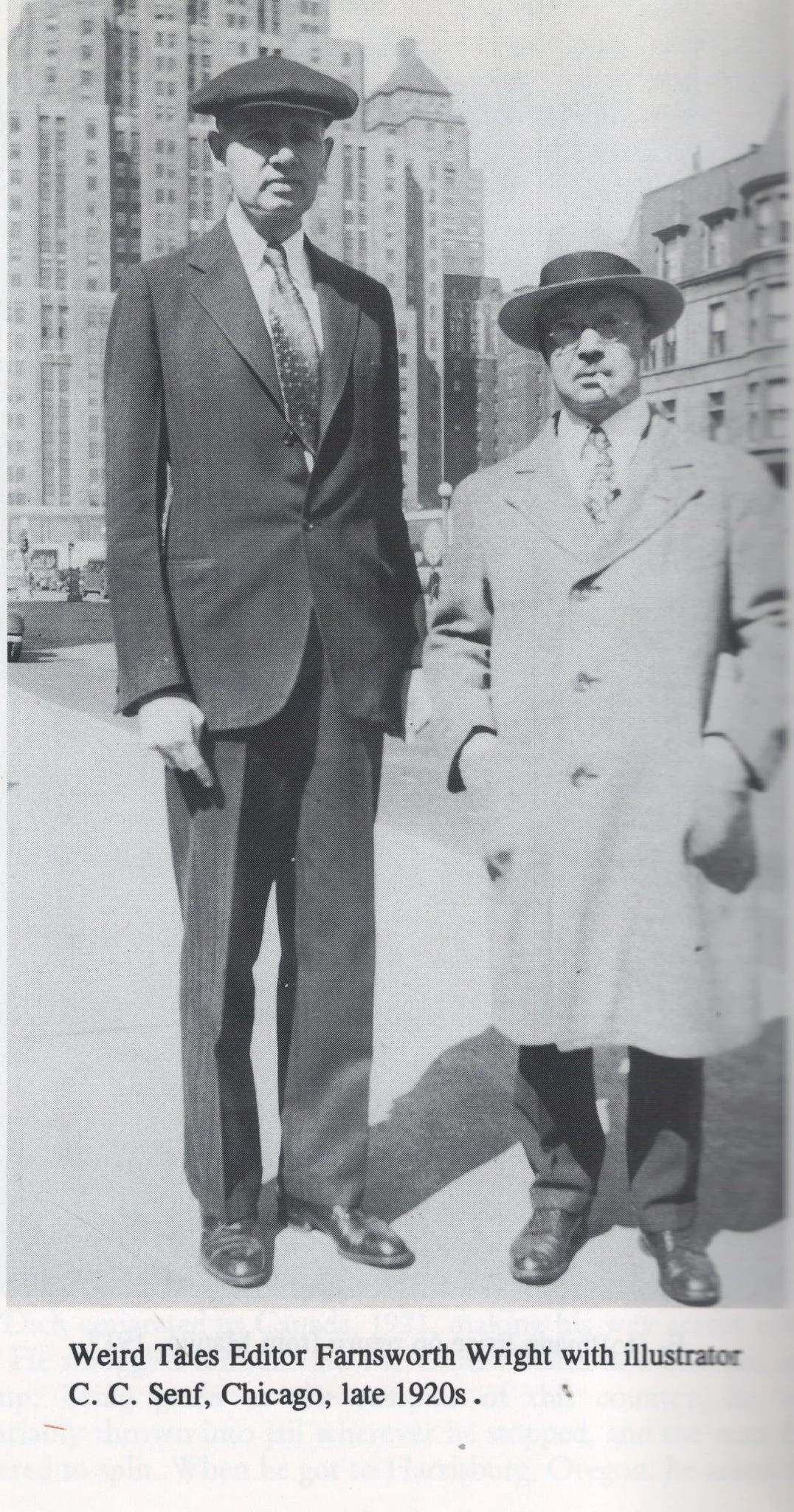
“Lonesome Time” by Farnsworth Wright was first published in The Overland Monthly Oct 1919.
※
Lonesome Time
by Farnsworth Wright
THE sun poised like a glowing cannon ball on top of the ridge, and slowly began to sink as the last of the airplanes lighted gently, like a bird, on the plain. Allen, whose machine had been the first to land, looked on and admired the light build of the planes and the easy grace of the landings. These were fighting craft, the wasps of the sky, the smallest and the fleetest of the squadron. They had been engaged that afternoon in mimic warfare—rearing like horses, looping, rolling, tumbling, two miles above the ground, to keep in trim for the reality of actual combat.
Allen was in love with the graceful little biplanes in which he had been playing war behind the fighting line for the last two weeks. Measuring only thirteen feet from tip to tip of the wings, built lightly, fitted with sturdy liberty engines, they responded instantly to their pilot’s touch, and were a welcome change from the large observation and bombing planes to which he was accustomed.
A swarm of mechanics and helpers ran the biplanes into the airdrome and commenced to overhaul them, while gunsmiths speedily dismounted the machine guns and began to clean them and make them ready for the next flight. The aviator that had just landed came over to Allen, and opened his cigarette case. Allen declined the proffered smoke, and the lieutenant passed on to the farther end of the shed, where a group of aviators were talking and laughing, and playing with a frolicsome spaniel that belonged to the squadron.
Allen did not join them, but sat alone, resting his chin on his hands. He was busy with his thoughts, and did not want his mood disturbed. The glowing disk of the sun disappeared, and the low crest of the ridge was sharply silhouetted against the western sky, with its little grove of shell torn trees standing out in relief like a wharf jutting into the water. Beyond that ridge was the Atlantic Ocean, and home. Allen heard only the laughter of his brother officers, the barking of the spaniel, and the distant irregular shouting of cannon. The sounds did not register on his consciousness. He heard them, but he did not notice them, for he was absorbed in his musings.
Allen did not need to feast his eyes on the little snapshot that he carried always with him, for the picture was graven on his memory. He saw Helen plainly in his mind’s eyes, her long yellow hair cascading over her shoulders in bewitching disarray, her blue eyes dancing with light, her face radiant with sunshine. He pictured her countenance as he liked it best, brimming with love, and he lived over in happy retrospect the
blissful vacation they had spent together, less than a year before. They had canoed and tramped much, and the acid test of spending a month almost constantly in each other’s company had only made him love her even more devotedly than before. He had studied her moods, her expression, her every gesture, longing, doubting, carefully noting each litle sign that perhaps she returned the love that filled his being.
It was at this same lonesome hour of the day, the restful period just after sunset, that he had found the courage to speak what was on his mind. Tonight there would be another big round moon, like the one that had made a long flashing lane across the lake to them that evening, as they drifted on in dreamy silence in the canoe, forgetting place, forgetting time, forgetting everything except that they loved each other.
Now he was a lieutenant in the aviation corps, fighting in France against his country’s enemies. She was immensely proud of her big soldier boy, but he knew that she watched every mail in dread, lest it bring news that would break her heart. She had smiled bravely when she bade him good-bye at the railroad station, but the trembling of her lips showed the effort she was making to keep back her tears. She knew how eager he was to go, after he received his commission, and she was ready to make the sacrifice, if need be, for her country’s good, but she dreaded to part from him lest he might never return.
To his mind, death was only an incident, a necessary risk, but not one to be weighed too gravely. But now he suddenly realized what it would mean to her. Most of the light and sweetness of life had gone when he went to France, for she loved him deeply.
He pictured her face at news of his death, and tried to realize the sickening catch at her heart, the growing sense of bereavement, the aching pain, the sleepless nights, the scalding tears, the void in her life that would never be entirely filled. The unutterable sadness of it so depressed him that he took out her picture,
which he always kept nearest his heart, and gazed long into the laughing eyes of the photograph.
His mood was interrupted by an outcry. Warning had come of the approach of hostile airplanes. Allen rushed to his machine, thrilled with the realization that he was at last to experience actual combat in the sky. Several black dots showed high up in the east, and he knew that these were his antagonists.
Twenty American planes skimmed over the ground and began to climb, not in spirals, but directly upwards, to reach the great height at which their foes were flying. Allen had made this climb many times during the past two weeks, to engage in mock battle, but never so eagerly as now, when he flew to meet the thrilling reality. Up, up, straight into the sky he shot. He paid no attention to the three large bombing planes that were approaching him for his game was high up in the sky above him.
Leading his comrades by a hundred yards, he plunged into a group of ten German planes, opened on one with his machine gun, and passed through to attack a lone German airplane that was flying a great distance above the rest.
Up, still up, he climbed, straight at the German aviator, who suddenly dived at him. They trained their machine guns on each other simultaneously, and the shots glanced from Allen’s engine as the German machine dipped beneath him. He turned, endeavoring to get his enemy in front of him, but the German skilfully maneuvered to keep Allen from opening fire. They flew around each other in circles, looking for an opening, and again the German raked Allen with his machine gun. Despite his slower airplane, he was
more skilfull than the American.
Allen dived repeatedly, trying to come up on the German from beneath, but he only exposed himself to attack, so he circled again to keep the German from facing him. Suddenly he depressed his right wing-tip, and began to roll over. The German, seeing his adversary apparently collapsing, turned and poured a hail of bullets into the American plane. They did not take effect, but Allen’s dangerous ruse brought his foe in front of him. As his plane righted, he shot upwards, like a hawk standing on its tail, and opened fire.
The German convulsively threw up his arms, for he was mortally hit. With a look of terrible agony on his face, he tore open his uniform and thrust his hand deep into his breast. He withdrew some small pasteboard object and pressed it passionately, to his lips. His plane fell earthwards, and Allen looped upwards just in time to avoid a collision.
The other enemy air scouts had been driven off, and the returning planes of Allen’s comrades were visible in the east. Beneath him the darkness was beginning to flow over the landscape, pouring over every ridge and low-lying hill, streaming out from the highland and filling the chinks and hollows. The airdrome was dimly visible directly underneath him, in the pool of darkness that was rising steadily higher.
He began to descend, for his work was done. Unaided, he had won his first air fight and shot down his foe from the sky, while his companions had merely driven their enemies away.
As his biplane gracefully sped over the field and came to a stop, his captain threw aside military restraint and hailed him joyously.
“It is Freihofen,” he shouted, “the best of the German aces, who has brought down more than sixty planes. You will be recommended for this, Lieutenant Allen, and the French will undoubtedly give you the Legion of Honor also, for most of Freihofen’s victims were French. I want to thank you and give you my heartiest congratulations. Freihofen has been the terror of the French and English airmen.”
Allen saluted, and strode silently over to the fallen airplane. The mechanicians were at work disentangling Freihofen’s body. The machine had been smashed to bits by its drop of more than two miles, but the body showed few traces of its fearful fall.
The hands were still pressed tightly to the dead man’s lips. Allen gently straightened the rigid fingers, one by one, and took from their grasp a small; oval portrait. The fading twilight disclosed the laughing features of a beautiful German girl.
Allen received the congratulations and handclasps of his fellow officers in silence. He went at once to his quarters, a fire in his, rain, and in his heart a fever. The girl of the portrait, to whom Freihofen’s thoughts had flown in the moment of his death agony, might cry her eyes out, but Freihofen would never come back to her. How many tens of thousands of girls in the warring countries must wait in vain for their soldiers? Allen sat on his cot a long time, meditating. His face was wet with tears.
※
Pilots were heroes during the early era of aviation, and that went doubly so for wartime pilots, whose lives were often brief and whose exploits made them fodder for romantic tales of duels in the sky, chivalry reborn on wings, giving rise to characters like G-8 and his Battle Aces, or the Hans von Hammer, the Enemy Ace. Farnsworth Wright’s brief war tale is contemplative and melancholy, despite the tense moment of action.
The empathetic story seemed to close the circle on any ideas Farnsworth may have taken into the war about “subduing the Hun.” Back was the internationalism of “The Vow,” in which all people are sons and daughters of the same humanity. […] “Lonesome Time” provided his last written words on the war, so far as we know. It became yet another subject he didn’t care to talk about.
—John Locke, The Thing’s Incredible! The Secret History of Weird Tales 49
I do not know if this is strictly true—enough bits and pieces about Wright’s service have emerged in memoirs that I think it is likely he discussed his service in France with a few close friends and associates—but he certainly does not seem to have left any substantial written record of his wartime experiences, and didn’t return to war stories.
Bobby Derie is the author of Weird Talers: Essays on Robert E. Howard and Others and Sex and the Cthulhu Mythos.
Deep Cuts in a Lovecraftian Vein uses Amazon Associate links. As an Amazon Associate I earn from qualifying purchases.

