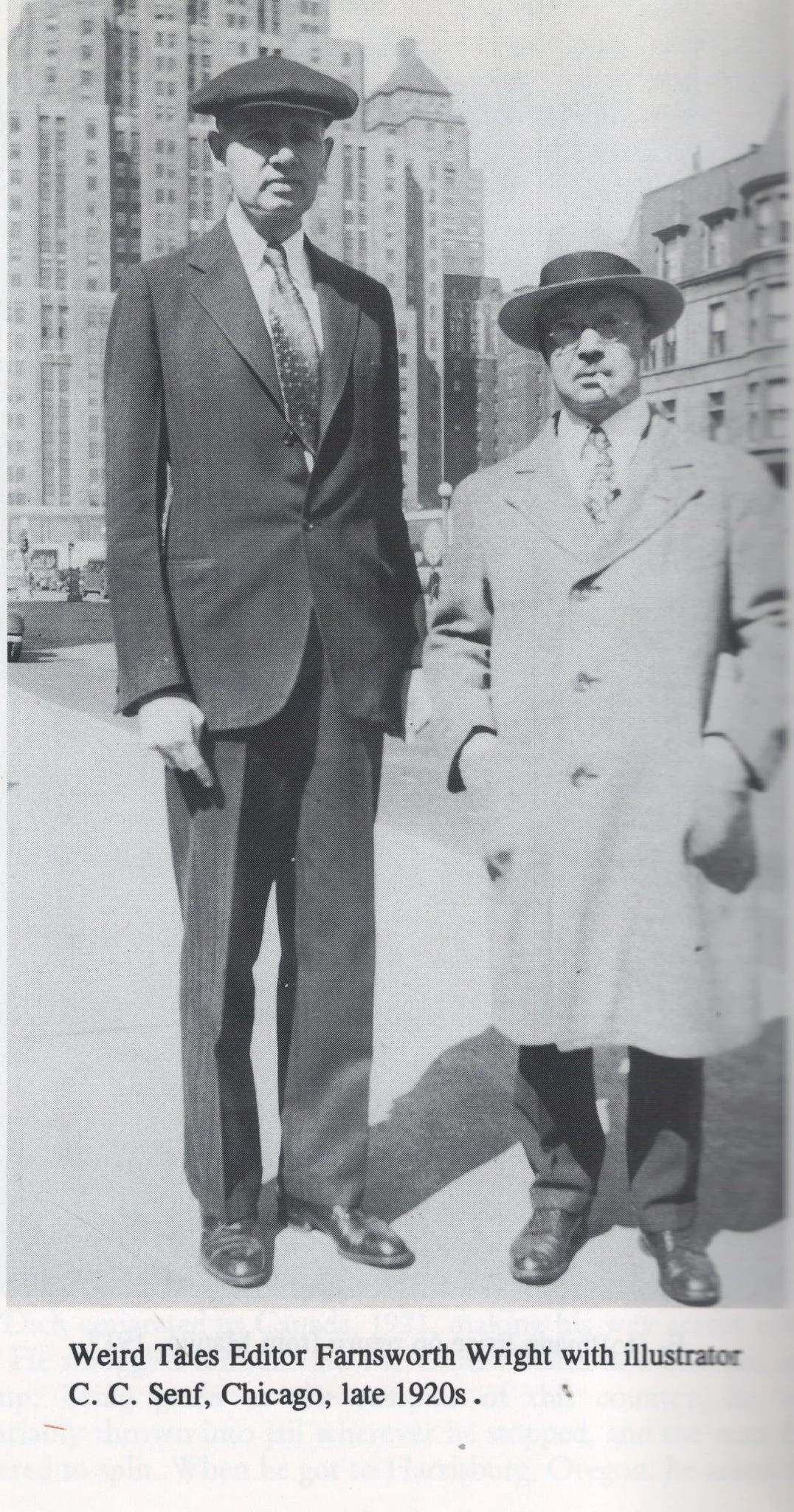
“The Stolen Melody” by Farnsworth Wright was published in The Overland Monthly (Nov 1920).
※
The Stolen Melody
by Farnsworth Wright
IT IS HARD TO BELIEVE that there ever was a time when Mascal was not a musician. Yet the world of music was an undiscovered country to him until after his twentieth birthday. He used to run the night elevator in the Occidental, an old-style apartment house in a part of the city formerly wealthy, and still retaining much of its gentility, though fallen on evil days. Somber gables stared a mute protest at the upstart modern flats which stood at the end of the block; the walls were chastely papered in a plain, dark pattern; and an elevator
jerked hesitatingly from floor to floor under the uncertain propulsion of an iron rope.
Hard though it is to believe that Mascal at one time in his life knew nothing about music, it is still more incredible that he lacked ambition. Such, however, is the fact. In the drowsy atmosphere of pride and decay which hung heavily on the apartment house, Mascal had seemingly no higher aspiration than to remain an elevator boy all his life. The guileless expression of face, which still characterizes him, seemed to contradict the nobility of his finely sculptured head; his gentle blue eyes contrasted strangely with his brick-red hair; and from these soft eyes gleamed at times the dreaming soul of a poet. Why Mascal, of all men, should bury his light in so trivial an occupation as running an elevator is beyond comprehension. How many unearthly sweet melodies must have been lost to the world by his utter lack of desire or ability to set them down on paper!
Mascal did not play any instrument. He could not sing, for his voice was unmusical. Written music was like Chinese hieroglyphics to him, and he had never heard an opera or a symphony orchestra. The music of the vaudeville theaters sounded tawdry and coarse to his sensitive ear, but he liked some of the old tunes, such as “Swanee River,” and “Old Black Joe,” and he used to whistle Dvorak’s “Humoresque” and an aria from “Il
Trovatore” until they became banal. He learned few new tunes, and most of these were torture to him.
Mascal was better pleased with the tunes that welled up out of his own brain—soulful melodies, which sang themselves to him, possessed him, and grew and developed as he whistled them. They came to him on walks in the suburbs, amid the roar of street traffic, or when he was alone in his elevator at night. Then they passed out of his mind, except the melody.
This particular melody was no better than many others that had come to Mascal, but he could not banish it from his thoughts. It haunted both his waking and sleeping hours, wove itself into his dreams, and molded his musings. Metz, the violin student who lived in the same boarding house, wanted to know the name of the tune he was whistling, and Mascal did not know what to tell him. Mascal took the melody, at the advice of Metz, to a musician who made his living by transcribing music, supplying parts for orchestras, arranging and harmonizing. He charged Mascal only five dollars, and for this he not only wrote out the melody on manuscript paper, as Mascal whistled it to him, but he also supplied a piano accompaniment for it.
Mascal was now, in a sense, a composer. Metz played the melody on his violin, and showed him what the notes meant on the keyboard of the boarding house piano. Mascal was fascinated at finding meaning in each little tail to the notes, and logic in every dot and line. The hieroglyphics were taking on significance.
He took enormous pains in mastering the characters on that sheet of music. He easily learned to play the melody with his forefinger; but the chords in the accompaniment, the synchronizing of his fingers, were so difficult that they almost disheartened him. His fingers refused to strike the right notes.
When he had learned to play the piece, in a manner of speaking, very slowly, with frequent pauses to rearrange his fingers on the keys, it annoyed-and depressed him. He began to experiment with different chords, and found that he could better the transcriber’s arrangement. But he did not know how to set down the harmonies that were in his mind, so he left it in its unsatisfactory shape, and whistled other tunes as he went up and down in the elevator—snatches of airs from the operas, as he had heard them in cafe orchestras, and old-time tunes; but mostly he whistled phrases that gushed unbidden from the depths of his own consciousness.
It was in a vaudeville theater that he heard his tune again. At first he thought it must be only a coincidence, in the opening measures; but no, it was his melody which the girl was singing in her throaty, disagreeable voice. All the beauty had gone from it. It was twisted and tortured out of its original form, set to disgusting verses, and the girl was ragging it, debasing it, shouting it at the audience, dancing to it and making eyes as she sang, to bring out the risque suggestiveness of the verses. The audience clapped and stamped and yelled for more, and the creature sang additional verses.
The tune was catchy, cheap and trashy! His brain was hot with anger. As he went out of the theater with the
throng, people were humming his melody. If it had only been sung in its original form, and set to noble verses! He was ashamed of it now, and enraged by the debasement of a theme that once had haunted him by its sheer beauty. Mascal sought out Mueller, the man to whom he had paid five dollars for transcribing his melody, and protested vigorously. He was met with insolence. Mueller defied him to prove the melody his.
“Mr. Mueller,” Mascal explained, a menacing glint steeling his gentle blue eyes, “it is not that I object to your
making money out of my melody. But you have robbed it of its beauty. You have set it to filthy words. My melody was majestic, singing, beautiful. You have made it a cheap thing, a nothing.”
Mascal’s accusation brought Mueller to his feet.
“You upstart!” he bellowed, the fat folds of his bullneck purpling, and his little pig eyes narrowing in the red ocean of his puffy face. “You, what do know about music, hey? You can’t play—you can’t read—you have to come to me to write your tune on paper. Now you try to tell me what to do with it, hey? I made it popular. Less than one month it is printed, and one hundred thousand copies are sold. Hey? In three more months I sell a million. Get out of here, you, you—”
Mueller was shaking a pudgy forefinger under Mascal’s nose, and Mascal’s anger flamed hot within him. His clenched fist caught the melody-thief under the chin, and knocked his across a chain. Mueller bellowed for help, and Mascal hastily retreated down the stairs.
Perhaps it needed just such a burst of anger to break the chains that bound the slumbering genius of this easy-going boy. Certain it is that ambition came to him then for the first time in his life. It was no selfish resolve that he made that day, for it brought him pain and suffering, sleepless nights and days of hunger. He would devote his life to vindicating his melody before the world. The tawdry thing was even now a torment in his ears, as whistled by the driver of a passing taxicab.
Mascal smiles reminiscently when he thinks of the months that followed. But he did little smiling then, for he spent the greater part of that disheartening time in shiny clothes, underfed, often wondering how he was going to get his next meal. But it is a glorious thing to be possessed by a dream.
Most of his little bank account went to pay his tuition at the musical college. He had to learn from the beginning. They let him take up piano and violin playing, but they told him it must be a year before he could begin the study of harmony, for he had no preparation for it. He never became a great player. He seldom touches his violin today, and he still finds his fingers stiff on the piano. But he studied hard, and read harmony and musical history on the side, and they let him begin harmony lessons within four months.
He soon discovered that he could read harmonies away from the piano. They sang themselves to his eye. He nearly fainted from excitement the first time that he ever read a measure of chords away from the piano and pictured the harmony in his mind. He rushed to the piano to verify the harmonies that his eye had sung into his brain. He began to be able to play all of his pieces in any key, for the notes that were written on the staff sang into his ear before he struck the ivory and ebony keys of the keyboard.
He possessed, far more valuable than familiarity with the classics, the ability to evolve melodies out of himself. Each new musical discovery thrilled him, and he never lost his enthusiasm, despite his privations. He applied himself so diligently to harmony and composition that he left the class behind him, and had to
take private lessons. These cost more money. His bank balance was used up, and the money he earned as night elevator boy was not enough to keep him properly and pay for his lessons also.
He moved into an attic room for which he paid one dollar a week, and another dollar each week went for the privilege of practicing two hours a day on a piano. He began going without his breakfasts, and occasionally he had to skip his evening meal. He became woefully thin, and darned his cheap cotton socks with coarse
thread when the holes got large, for he could not afford to throw them away. The Chinese laundry tore his shirts and saw-edged his collars. He did his own cleaning and pressing, and his clothes became smooth and shiny. He carefully polished his shoes each morning, but more than once he went to his lessons with his shoe laces knotted in three or four places, to postpone the expense of buying new ones.
His privations depressed him, because he could not see the end. But when he was studying he forgot everything except the beauty that was burning in his soul.
He earned his teacher’s praise for the intrinsic beauty of the original themes on which he elaborated, even when the elaboration was unskillfully done. His pet delight was to disguise the stolen melody and elaborate it, but always his teacher rebuked him, saying that the theme, which he recognized as the tune of a distressingly vulgar popular ragtime air, offended his ear whenever and wherever he heard it. Each such rebuke inspired in Mascal a gnawing dread lest his sacrifice and struggles be in vain. He lost hours of sleep trying to make noble arrangements of his melody, but the teacher’s eye sought them out under each disguise, and always branded them as tawdry.
Mascal had been studying a year before he ever heard a symphony. He plucked up courage to ask for his
teacher’s ticket for a day when he knew the teacher would be absent from the city. He did not realize what important results his request would bring, what further sacrifices and what marvelous joys were to be his.
He watched the different themes enter and leave as the orchestra played an overture, but it was simply greater playing than he had heard in the orchestra of the musical college. It was followed by Beethoven’s Fifth Symphony. Mascal heard the striking of the first four notes. They were repeated, in a lower pitch. Then the strings took them up, playing them quickly, in ascending series, and the first movement of the symphony finally came to an end without varying from the one little theme of four notes. Can four notes make a whole composition? he asked himself. But as he listened he realized that they were indeed the soul of the movement, now sung by the strings, now sounded by the brasses, now shouted in chorus by all the choirs at once. Little themes sprang from them, and the orchestra returned to them. The movement was a composite whole, as different as may be from those sugary impromptus that begin nowhere, end nowhere, and have no excuse for being. The world of harmony that followed the opening of these was predestined in the first four notes.
Mascal realized that this symphony would lose its glory if played on the piano. The color of the different instruments gave it life, soul, feeling and beauty. If a great master can develop a whole movement of a wonderful symphony from four notes, like a knocking at the door, why could not he do equally wonderful things with the wail of the wind, the roar of the waves, and the murmur of leaves in the trees?
He obtained a miniature score of the symphony from the library of the musical college before he went to his room that afternoon, and studied the staves that represented the different instruments. Now they played in unison, now in harmony; now each choir was divided off from the others; now one choir played a counterpoint against the others. He did not know the instruments well enough to hear in his mind their tone colors, but already he had decided that his melody, when it stood vindicated before the world, would not be written for piano. He would make of it a tone poem for orchestra.
Underfed though he was, yet he skipped two evening meals during the next week, and with the fifty cents thus saved he bought a seat up near the roof to hear the next symphony concert. The happiness that came to him that day with the realization of his own genius never left him from that time.
The symphony was Schubert’s Unfinished, the great song-writer’s orchestral masterpiece, discovered years after his death. Instead of hearing a plain theme majestically developed, Mascal’s ears drank melodic beauty from the first movement. The symphony sang straight into the beauty-loving soul of him, and tears rolled unabashed down his cheeks, for the great idea had come to him.
Beautiful melodies were uttered by the strings, and sung by the orchestra with a piercing sweetness of tone such as he had never dreamed. This man, this Schubert, must have gone to the angels in heaven for his themes, for the outpouring of beautiful sound ‘as far surpassed in sheer beauty anything within the narrow limits of his knowledge as the odor of wild roses on a country roadside surpass the smells of a city street. Every stroke of the violins, every chord of the music that sent the salt tears trickling down his cheeks, sang to him:
“You are another such master! No music, be it harmonized and developed to the uttermost limits of the theme, can move the unfeeling world unless it be founded on melody. To you the world looks for the supreme musical outpouring, for melody comes to you as easily as song to the throat of the meadowlark. You are the melodic master of the world.”
Mascal knew that it was true. All his life he had been thrilled by the beauty of his own themes. His mother, in those pleasant days before he was orphaned, used to smile happily when he came into the house whistling some stronge and lovely rhythm, and remark, “Ah, my boy, why do you not learn to play the flute? How pretty that would be on the flute!”
He did not hear the rest of the program. He threw himself on his bed and dreamed, until it was time for him to work. He dreamed while he was running the elevator; he dreamed in the early morning while he was undressing for bed; and when he fell asleep his melody was shouted to him by a bevy of flutes. He awoke to hear a passing teamster whistling it in its dance-hall garb.
Mascal no longer built on the stolen melody for his work at school, for he know that his teacher, having heard it in its street dress, would brand it as trivial no matter in what gorgeous apparel it were presented to him. But he starved himself further to take in the symphony concerts each week. He lived for them, and for his melody.
He studied the scores in the music room of the public library, and tried to pick out the different instruments as they sang the themes. He found that reading orchestral scores was a different matter from reading piano music. The themes jumped disconcertingly from the horns at one end of the page to the strings at the other, and other instruments came in between with notes that only careful study revealed as mere accompaniment or harmonic background. He had to learn a third clef. He found it hard to read the chords, for the notes were distributed among different instruments, on different staves. But by diligently comparing the scores with the actual playing of the orchestra he began to find order in the chaos. Best of all, he began to recognize the tone-colors of the different instruments, to learn what was uttered to the ear by different combinations of instruments, and to divine the function of each of the tone scheme.
Even before he learned this he was working on his symphony. He tried to orchestrate his melody the same week he heard Schubert’s symphony, and he failed because he did not know the meaning of the different instruments. A piccolo to him was a small flute, and he could not differentiate between the parts owing to the obo, and those that should be given to the clarinets. Yet he worked on until he had completed a first movement to his symphony. The foundation of it was the melody that had been hammered out in every dance hall from Florida to Alaska.
It must not be supposed that Mascal’s First Symphony at that time was more than remotely similar to the great work which the world now knows as the Melodic Symphony. The same melody dominated the first movement, but the melodic theme was the only likeness between the two. However, the completion of this movement gave him a sense of triumph, and in the joy of it his mind sang with melodies that welled up joyously like a gurgling fountain. He wrote four more movements within as many weeks, and every page of the score was permeated by beautiful themes. One will look in vain through Mascal’s First Symphony for the amazing counterpoint that distinguishes his later works, but it still remains the favorite of all his compositions, for even Mascal has written no more melodically wonderful symphony than this, which is a way of saying that it is the most melodious composition in orchestral literature.
But the writing of a symphony could not be accomplished by one so inexperienced. Mascal had to work at it through many months, and he discarded practically all of the scoring that had cost him so much effort, leaving only the bare melodies that sang so sweetly in his dreams. That wonderful variation in the first movement, where the pilfered melody is shouted full-voiced by the entire choir of woodwinds, with a counter melody picked out on the strings, was not added until the very week before his interview with Koruloff.
The first meeting between Mascal and Koruloff should be marked as the happiest date in music since Wagner decided to build operas on the German myth-lore. One year and a half before that meeting Mascal could not read the notes on the staff, and neither he nor Koruloff had heard of each other. On the one hand a boy, not yet twenty-two years old, holding out with faltering hands the score of his symphony, and stammering a frightened explanation of why he had dared to take up the time of the conductor; on the other hand the bluff old musician, who for fifteen years had guided one of the world’s greatest symphony orchestras.
Mascal turned the pages and showed the master where the theme changed from one group of instruments to another, and hummed each new theme and variation. The master smiled as the boy turned page after page, but he said nothing until Mascal came to the end of the first movement.
“You have never studied the instruments of the orchestra, I perceive,” he commented, a peculiar smile playing on his face.
Mascal gulped. Was his work in vain?
“I—I am learning to play the violin,” he stammered, “and I—I have come often to the concerts, and I have followed the instruments with the scores.”
“The general effect is good,” smiled the master reassuringly. “But you have given to the trumpets and horns notes that they cannot play. This passage runs too low for them, and you repeat your mistake on the next page. If the brasses tried to play this passage here, of a sudden you would have stopped notes, exactly as if they had caught cold. And here, in this passage for the bassoons—what effect are you trying to get?”
“Wh—why, the bassoon adds richness and beauty to the passage,” he explained.
“Then put the passage down. The bassoon can serve your purpose very well, but not in this range. It can give depth and richness to the tone picture, but it is a fickle instrument, and its upper tones are ghastly. If your symphony pictured a gloomy castle, with bats flying around the haunted windows, and you wanted an
uncanny and ghostly effect, you could get it from the upper notes of the bassoon. Put this phrase down into the lower part of the bassoon’s range, and you will obtain the rich effect you want.”
Mascal was reassured, and Koruloff began to examine the other movements. The wealth of melody in them was beyond the range of his experience, although he knew by heart and could conduct without his scores more symphonies than any other conductor in the world. So prolific in singing melodies had been the brain of the young composer that he had not taken the trouble to develop many of them, but had written them as simple themes or introductions to other themes, and passed on to new side themes in his recapitulation of the leading melodies.
Koruloff gave him much advice as to the scoring, showed him why different instrumentation in parts of the work would bring out its beauties better, and even pruned away several choice melodies, which are now among the best of Mascal’s songs. He suggested changes in the treatment of certain of the themes. But the fabric itself, the framing, the melodic and harmonic structure, and even the scoring, were fundamentally sound, and Koruloff promised to produce the symphony in the autumn. He was so impressed that he postponed his vacation several days to help Mascal, and within two weeks the work was scored. Koruloff took the manuscript with him that summer.
The symphony was not presented until late in the winter, and what happened at its presentation is common knowledge. The number of times Mascal was called out to acknowledge the demonstration can be equaled only in the annals of grand opera, when a Patti or a Galli-Curci is forced to show herself twenty times in front of the curtain after repeating some unusually lovely aria.
How the critics hailed the work as the supreme triumph of orchestral music, how the composer leaped at one bound to be the recognized leader of the musical world, how this super-Beethoven brought American music into its own—all these things are well known. But what the world has never known is why Mascal chose a tawdry ragtime melody as the theme of his symphony. Some critics have seen in it an attempt to prove that no melody is tawdry, and they use specious reasoning to show that Mascal took the most trivial tune he could find and developed it into one of the majestic themes of music. Others argue, with equal heat, that Mascal built on a popular theme to prove that the music of the people is really the only great music after all. But what none of them has understood—and that is why this account is written—is that the melody was never tawdry. It was a noble melody from the first, and Mascal simply restored it to its primal state.
※
When I was an undergraduate student at university, I minored in electronic music. One of my professors was teaching the first course in music composition and asked me to enroll. I didn’t have any of the theory prerequisites, and no traditional musical education, but he approved my enrollment anyway. It was the most difficult course of my undergraduate studies, working my fingers to the bone to learn music notation and the basics of composition, copying and re-copying scores, learning how to listen—and I came away with a greater appreciation for what music students do and the challenges they face, though I knew I’d never be a composer.
Which is a long way to say, I recognize the pitfalls and personalities in this piece. Farnsworth Wright, who long worked as a music journalist, was drawing from real life.
John Locke, reviewing the piece in brief, comments:
[…] Farnsworth Wright uses music as a metaphor for social class. A composer, Mascal, writes a great symphony whose central theme is a “tawdry ragtime melody.” […] The story suggests that Farnsworth may have enjoyed summing to the popular music of vaudeville, though remaining reluctant to sign his name to such sentiments. Additionally, “The Stolen Melody” may be where the thoughts inspired by the African-American soldiers finally found a home.
—John Locke, The Thing’s Incredible! The Secret History of Weird Tales 50
I don’t agree; at least, to my reading, “The Secret Melody” is less a metaphor for class than it is a realistic depiction of a layman with an ear for music but lacking the education to express the music inside of him. There is a class element: the reason Mascal lacks musical education is poverty, but Mascal overcomes that with hard work—a basic rags-to-riches tale, but played out through self-expression.
Elements of popular styles like ragtime and jazz were already being incorporated into Classical compositions during this period, and Wright was probably aware of that. Claude Debussy’s “Children’s Corner” (1908), for example, incorporates ragtime.
Bobby Derie is the author of Weird Talers: Essays on Robert E. Howard and Others and Sex and the Cthulhu Mythos.
Deep Cuts in a Lovecraftian Vein uses Amazon Associate links. As an Amazon Associate I earn from qualifying purchases.

