Lost Tale: “Lonesome Time” (1919) by Farnsworth Wright

“Lonesome Time” by Farnsworth Wright was first published in The Overland Monthly Oct 1919. Reprinted in The Snake Fiend and Other Stories (2023).

※

Lonesome Time

by Farnsworth Wright

THE sun poised like a glowing cannon ball on top of the ridge, and slowly began to sink as the last of the airplanes lighted gently, like a bird, on the plain. Allen, whose machine had been the first to land, looked on and admired the light build of the planes and the easy grace of the landings. These were fighting craft, the wasps of the sky, the smallest and the fleetest of the squadron. They had been engaged that afternoon in mimic warfare—rearing like horses, looping, rolling, tumbling, two miles above the ground, to keep in trim for the reality of actual combat.

Allen was in love with the graceful little biplanes in which he had been playing war behind the fighting line for the last two weeks. Measuring only thirteen feet from tip to tip of the wings, built lightly, fitted with sturdy liberty engines, they responded instantly to their pilot’s touch, and were a welcome change from the large observation and bombing planes to which he was accustomed.

A swarm of mechanics and helpers ran the biplanes into the airdrome and commenced to overhaul them, while gunsmiths speedily dismounted the machine guns and began to clean them and make them ready for the next flight. The aviator that had just landed came over to Allen, and opened his cigarette case. Allen declined the proffered smoke, and the lieutenant passed on to the farther end of the shed, where a group of aviators were talking and laughing, and playing with a frolicsome spaniel that belonged to the squadron.

Allen did not join them, but sat alone, resting his chin on his hands. He was busy with his thoughts, and did not want his mood disturbed. The glowing disk of the sun disappeared, and the low crest of the ridge was sharply silhouetted against the western sky, with its little grove of shell torn trees standing out in relief like a wharf jutting into the water. Beyond that ridge was the Atlantic Ocean, and home. Allen heard only the laughter of his brother officers, the barking of the spaniel, and the distant irregular shouting of cannon. The sounds did not register on his consciousness. He heard them, but he did not notice them, for he was absorbed in his musings.

Allen did not need to feast his eyes on the little snapshot that he carried always with him, for the picture was graven on his memory. He saw Helen plainly in his mind’s eyes, her long yellow hair cascading over her shoulders in bewitching disarray, her blue eyes dancing with light, her face radiant with sunshine. He pictured her countenance as he liked it best, brimming with love, and he lived over in happy retrospect the
blissful vacation they had spent together, less than a year before. They had canoed and tramped much, and the acid test of spending a month almost constantly in each other’s company had only made him love her even more devotedly than before. He had studied her moods, her expression, her every gesture, longing, doubting, carefully noting each litle sign that perhaps she returned the love that filled his being.

It was at this same lonesome hour of the day, the restful period just after sunset, that he had found the courage to speak what was on his mind. Tonight there would be another big round moon, like the one that had made a long flashing lane across the lake to them that evening, as they drifted on in dreamy silence in the canoe, forgetting place, forgetting time, forgetting everything except that they loved each other.

Now he was a lieutenant in the aviation corps, fighting in France against his country’s enemies. She was immensely proud of her big soldier boy, but he knew that she watched every mail in dread, lest it bring news that would break her heart. She had smiled bravely when she bade him good-bye at the railroad station, but the trembling of her lips showed the effort she was making to keep back her tears. She knew how eager he was to go, after he received his commission, and she was ready to make the sacrifice, if need be, for her country’s good, but she dreaded to part from him lest he might never return.

To his mind, death was only an incident, a necessary risk, but not one to be weighed too gravely. But now he suddenly realized what it would mean to her. Most of the light and sweetness of life had gone when he went to France, for she loved him deeply.

He pictured her face at news of his death, and tried to realize the sickening catch at her heart, the growing sense of bereavement, the aching pain, the sleepless nights, the scalding tears, the void in her life that would never be entirely filled. The unutterable sadness of it so depressed him that he took out her picture,
which he always kept nearest his heart, and gazed long into the laughing eyes of the photograph.

His mood was interrupted by an outcry. Warning had come of the approach of hostile airplanes. Allen rushed to his machine, thrilled with the realization that he was at last to experience actual combat in the sky. Several black dots showed high up in the east, and he knew that these were his antagonists.

Twenty American planes skimmed over the ground and began to climb, not in spirals, but directly upwards, to reach the great height at which their foes were flying. Allen had made this climb many times during the past two weeks, to engage in mock battle, but never so eagerly as now, when he flew to meet the thrilling reality. Up, up, straight into the sky he shot. He paid no attention to the three large bombing planes that were approaching him for his game was high up in the sky above him.

Leading his comrades by a hundred yards, he plunged into a group of ten German planes, opened on one with his machine gun, and passed through to attack a lone German airplane that was flying a great distance above the rest.

Up, still up, he climbed, straight at the German aviator, who suddenly dived at him. They trained their machine guns on each other simultaneously, and the shots glanced from Allen’s engine as the German machine dipped beneath him. He turned, endeavoring to get his enemy in front of him, but the German skilfully maneuvered to keep Allen from opening fire. They flew around each other in circles, looking for an opening, and again the German raked Allen with his machine gun. Despite his slower airplane, he was
more skilfull than the American.

Allen dived repeatedly, trying to come up on the German from beneath, but he only exposed himself to attack, so he circled again to keep the German from facing him. Suddenly he depressed his right wing-tip, and began to roll over. The German, seeing his adversary apparently collapsing, turned and poured a hail of bullets into the American plane. They did not take effect, but Allen’s dangerous ruse brought his foe in front of him. As his plane righted, he shot upwards, like a hawk standing on its tail, and opened fire.

The German convulsively threw up his arms, for he was mortally hit. With a look of terrible agony on his face, he tore open his uniform and thrust his hand deep into his breast. He withdrew some small pasteboard object and pressed it passionately, to his lips. His plane fell earthwards, and Allen looped upwards just in time to avoid a collision.

The other enemy air scouts had been driven off, and the returning planes of Allen’s comrades were visible in the east. Beneath him the darkness was beginning to flow over the landscape, pouring over every ridge and low-lying hill, streaming out from the highland and filling the chinks and hollows. The airdrome was dimly visible directly underneath him, in the pool of darkness that was rising steadily higher.

He began to descend, for his work was done. Unaided, he had won his first air fight and shot down his foe from the sky, while his companions had merely driven their enemies away.

As his biplane gracefully sped over the field and came to a stop, his captain threw aside military restraint and hailed him joyously.

“It is Freihofen,” he shouted, “the best of the German aces, who has brought down more than sixty planes. You will be recommended for this, Lieutenant Allen, and the French will undoubtedly give you the Legion of Honor also, for most of Freihofen’s victims were French. I want to thank you and give you my heartiest congratulations. Freihofen has been the terror of the French and English airmen.”

Allen saluted, and strode silently over to the fallen airplane. The mechanicians were at work disentangling Freihofen’s body. The machine had been smashed to bits by its drop of more than two miles, but the body showed few traces of its fearful fall.

The hands were still pressed tightly to the dead man’s lips. Allen gently straightened the rigid fingers, one by one, and took from their grasp a small; oval portrait. The fading twilight disclosed the laughing features of a beautiful German girl.

Allen received the congratulations and handclasps of his fellow officers in silence. He went at once to his quarters, a fire in his, rain, and in his heart a fever. The girl of the portrait, to whom Freihofen’s thoughts had flown in the moment of his death agony, might cry her eyes out, but Freihofen would never come back to her. How many tens of thousands of girls in the warring countries must wait in vain for their soldiers? Allen sat on his cot a long time, meditating. His face was wet with tears.

※

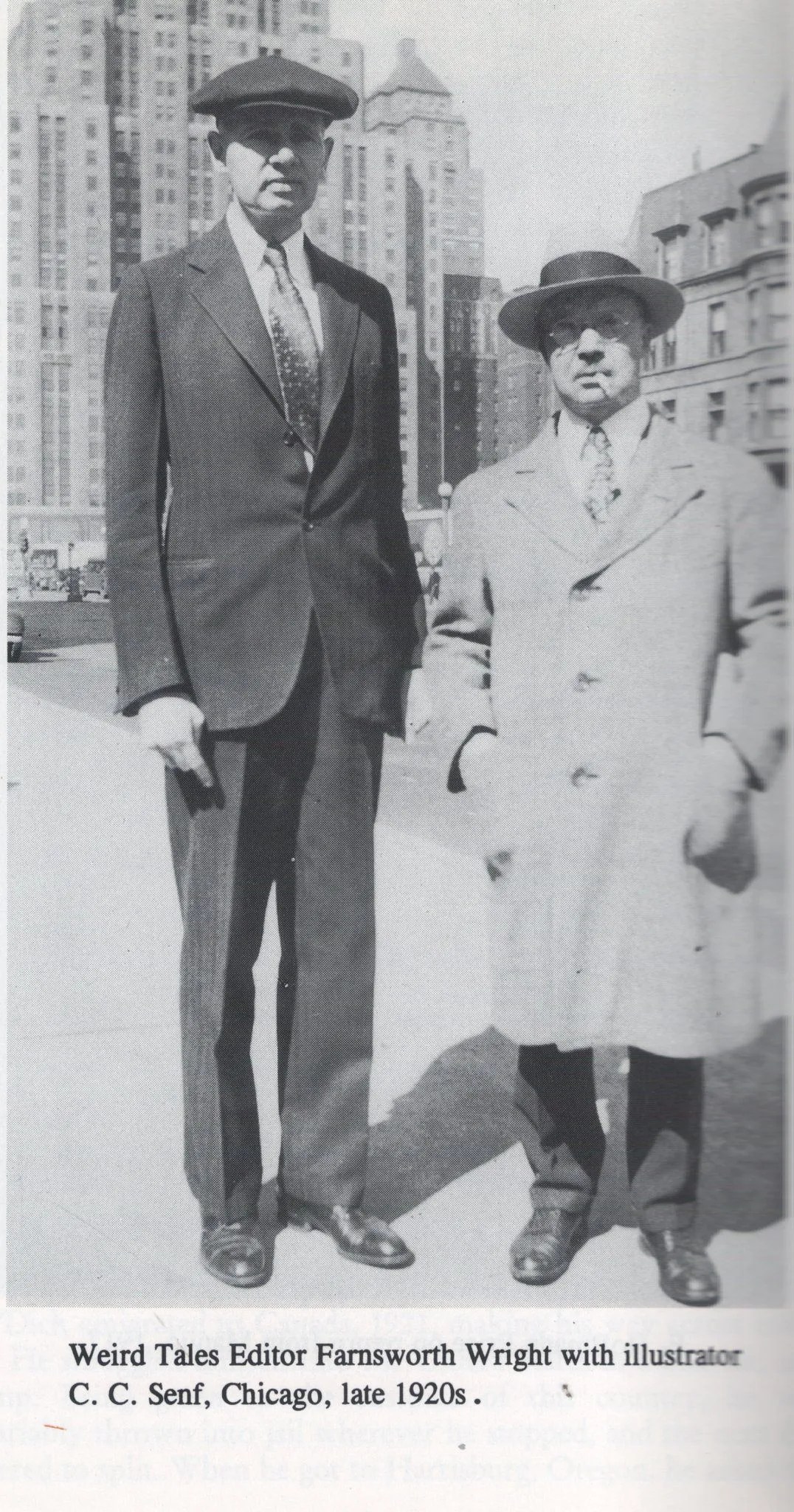
Pilots were heroes during the early era of aviation, and that went doubly so for wartime pilots, whose lives were often brief and whose exploits made them fodder for romantic tales of duels in the sky, chivalry reborn on wings, giving rise to characters like G-8 and his Battle Aces, or the Hans von Hammer, the Enemy Ace. Farnsworth Wright’s brief war tale is contemplative and melancholy, despite the tense moment of action.

The empathetic story seemed to close the circle on any ideas Farnsworth may have taken into the war about “subduing the Hun.” Back was the internationalism of “The Vow,” in which all people are sons and daughters of the same humanity. […] “Lonesome Time” provided his last written words on the war, so far as we know. It became yet another subject he didn’t care to talk about.
—John Locke, The Thing’s Incredible! The Secret History of Weird Tales 49

I do not know if this is strictly true—enough bits and pieces about Wright’s service have emerged in memoirs that I think it is likely he discussed his service in France with a few close friends and associates—but he certainly does not seem to have left any substantial written record of his wartime experiences, and didn’t return to war stories.


Bobby Derie is the author of Weird Talers: Essays on Robert E. Howard and Others and Sex and the Cthulhu Mythos.

Deep Cuts in a Lovecraftian Vein uses Amazon Associate links. As an Amazon Associate I earn from qualifying purchases.
Lost Tale: “In the Depths” (1919) by Farnsworth Wright

“In the Depths” by Farnsworth Wright was published in The Overland Monthly Dec 1919. It was reprinted in The Thing’s Incredible! The Secret History of Weird Tales and The Snake Fiend and Other Stories (2023).

※

In the Depths

by Farnsworth Wright

DAN CARLSON looked down at the oily waters of Puget Sound and wondered what strange creatures lived in its slimy depths, and whether they were not really happier, after all, than he. A whirlwind racked his brain, for he faced involuntary separation from his job, and, being young, he was not used to it. For three days he had been a reporter on one of the city dailies—his first job, and he had failed on three assignments, so the city editor told him that he lacked aptitude and could not be used as a reporter. The boy pleaded for one more chance.

“I’ll give you another chance,” the city editor finally promised him, “if you go down to the waterfront and find a deepsea diver named Angus McLeod and get his story of his fight with a devilfish three weeks ago. Look up the story in the files. Myers should have been able to interview him, for he has been marine reporter for years and ought to know everybody on the waterfront. But Myers hasn’t been able to find him, and I can’t
tell you where you can locate him except that he ought to be somewhere on the waterfront. McLeod’s story would have been a corker three weeks ago, but we can still use it.”

Myers, the marine reporter, had learned only by chance of the diver’s thrilling struggle with a giant octopus, and his rescue after he had lost consciousness, for McLeod was little known on the waterfront. The newspaper account of the battle under the waves was for the most part drawn by Myers from his imagination, for he had been unable to find and interview the dour Scot who was the hero of it.

Dan set out at once in search of McLeod, and he found that the old Scotch diver had moved from his lodgings several days before he was sent out on the job which so nearly cost him his life. Nobody seemed to know where he was living.

“He’s about your height and pretty well tanned,” the man in the salvage company’s office described him to Dan. “He’s got a grayish-reddish beard and he don’t wear a mustache. He’s an oldish fellow, a little bit deaf from being under the water so much, and he’s got red hair and blue eyes.”

On this meagre information Dan made the rounds of the waterfront saloons, but failed to find the man he was seeking. He did not want to go back to his city editor and report failure, so he stood on the wharf and speculated on the things that live under the water, and on his own drowning career.

The mystery of the ocean depths had always fired his imagination, but now it depressed him. He compared himself to the diver. The world was an enormous octopus, twisting its arms about his neck to drag him down. The breaking of the diver’s air-tube was the fell stroke of chance, which had caused him to fail on his assignments and now prevented him from finding MeLeod. Dan’s star of hope, which had lit up his sky for an instant when he had been given this last chance to make good was sinking fast behind vast clouds of gloom. Hardly a ray now lighted the muddy depths of his despondency.

Looking up from his gloomy musings he noticed a roughly-dressed, ragged man, unshaven, dirty and hatless, leaning against a pile. His torn shirt was open at the throat. A queer moaning gurgle came from his half-opened mouth. He reeled as if he were drunk.

Dan feared the old fellow would fall into the bay, so he seized him quickly from behind, by the arms, just below the shoulders. The man shrank from his grasp with a moaning cry, and would have fallen from the dock had Dan not pulled him quickly back from the edge.

The stranger twisted around to face the youth, and he struck Dan’s hands away as he did so. He gazed for an instant full into Dan’s eyes with the fright of a hunted animal showing on his face. Then his gaze roved, and a puzzled, intent expression came over his face, as if he were vainly trying to recall something to his memory. He ran his fingers through his long, coarse hair and stared into Dan’s eyes again. Dan noticed that the man’s eyes were blue.

“You almost fell into the water,” laughed Dan, reassuringly. “I guess you’re sick, but at first I thought you were drunk when I saw you hanging to that post and reeling.”

“Drunk,” asked the stranger. The intent, puzzled expression came over his face again and he rubbed his fingertips over his stubby, reddish-gray beard.

“Drunk?” he repeated, and his bewildered look became pitiful in its intensity and suffering.

“Oh, no! I mean I thought so at first—the way you staggered! Of course you’re not drunk. But you did nearly
fall into the water,” Dan went on, hastening to change the subject. “You don’t want to make fish-food of yourself, and be washed out into the sound where the devilfish can twist his snaky tentacles around your neck and little fishes come and swim through the holes in your skull, where your eyes are now.”

“Fishes?” the man asked. “Oh, ay, there are millions of ’em, lad, millions of ’em! I’ve seen whole armies of ’em come and look at me while I worked, and one big fish came and looked in the little window to see what made the bubbles come up. But he swam away quick when I tried to grab him.”

Dan was still deep in his gloom and took in the import of the old man’s strange words only vaguely as in a
dream. He looked up wonderingly.

“There are strange things down there in the depths,” he said slowly.

“In the depths,” moaned the old man. “Oh, ay, in the depths!” His eyes opened big and he stared at Dan as at some dreadful specter.

A flash of comprehension came to the youth as he pondered the stranger’s peculiar utterance about the fish armies and the big fish that looked into the little window; and Dan suddenly noticed that the stranger’s close-cut beard was reddish and that he did not possess a mustache. But his hair was not red—it was snow-white!

Dan’s heart jumped and the star of hope suddenly flooded his firmament with light again. The clouds of gloom were dissipated as if by the fresh wind which was springing up from the sound. Dan’s thoughts were no longer vague and wandering.

“Is your name Angus McLeod?” he asked his odd acquaintance.

“Ay,” answered the diver, his eyes intently searching Dan’s face.

“Carlson’s my name—Dan Carlson,” Dan introduced himself, his eyes sparkling. “Come over and have a glass of beer with me.”

McLeod did not answer, neither did he clasp Dan’s outstretched hand.

“Come on,’ urged Dan, and he took the diver by the arm.

McLeod struck the boy’s hand away as if in terror, but he followed him to the saloon. They were soon seated at a table and the bartender brought some beer.

“Now,” demanded Dan eagerly, “tell me all about it.”

“All about what?” asked McLeod.

“Why, about your fight with the devilfish up near Anacortes, of course.”

“Oh, ay, the devilfish!”

The diver’s eyes wandered; he looked terrified, and he passed his hands several times through his hair, then rubbed his stubby beard with his fingertips.

“Set ’em up again,” called Dan to the bartender, for McLeod had drained his glass at a gulp.

“You were exploring an old wreck, weren’t you?” he went on. “How long had the wreck been there?”

“Ay, a wreck it was. Several years old. It wasn’t so awful deep, but I stayed too long.”

McLeod ran his fingers through his hair again and horror was written in scarehead letters on his face.

“Come, come; you’re all right now.” Dan tried to calm him. “Drink your beer. Now go on. How deep was it?”

“Not too deep, for the sunlight was shimmering and shivering over the bones o’ the ship, according as the waves was rippling and curling on top o’ the water. It wasn’t too deep, and there was a lot o’ little fishes kept looking, and then they’d scamper away all of a sudden when they was frighted, like a lot o’ minnows. But down in the ship it was dark and there was strange creatures there.”

The diver shuddered and beads of sweat stood out on his furrowed forehead.

“Drink some more beer,” Dan urged.

The former intense bewilderment again furrowed McLeod’s face as if something he was seeking kept hiding just beyond reach of his memory. He drank the beer and wiped the foam from his lips and chin on his sleeve.

“How did the octopus get hold of you? Tell me all about your fight with it. Nobody knows anything about it except what you told them through your diver’s telephone while you were slicing the beast’s arms off,” Dan explained.

“Got hold on me? Oh, ay, it got hold on me all right,” answered McLeod. “It must have got me from behind, because I didn’t see it till it was around my neck. Long arms, like snakes, and it gets hold on me with two of ’em at once. First thing I knows about it, it draws me to one side, and I try to get away, but my feet are weighted and I can’t move fast enough. But I’m just as cool as a clam. ‘Never lose your head now or you’ll never see Seattle again,’ I says to myself. But it’s hard to saw through those slippery, tough arms with my knife, though they look so soft and easy when the thing’s captured and lying on shore, dead. But I’ve lost my knife,” he moaned. “I tell you it’s gone, and I can’t pick it up.”

The intent, bewildered look had again given place to horror.

“Come, come,” Dan soothed him, “what ails you? Here, let me pour you some more beer. You say you had a knife?”

“I tell you I dropped it,” exclaimed the diver with growing excitement. “Pick it up! Quick, I tell you!”

Pressing one knee against the table as if he were still struggling in the tight grip of the eight-armed monster, the diver gave a sudden push, upsetting the beer onto Dan, and sending his own chair backward onto the floor. He struggled to his feet with a frightened oath. As Dan sprang to help him, the diver seized his arms, pinning them to his sides and stared hard into his face, panting and shrieked—

“Where’s that knife? I dropped it, I tell you!”

Dan struggled to free himself, but the diver with wild, livid, staring eyeballs, held him fast. The sweat poured from the old man’s face. Dan was thoroughly frightened and was about to call loudly for help when McLeod relaxed his hold and sank to the floor, moaning as if in agony.

Dan lifted him up and helped him to a chair. McLeod was as weak as a kitten. He stared helplessly around the room, while the sweat ran down his face in tiny rivulets. Boisterous laughter from the barroom explained why nobody had heard the struggle.

“Come, now,” urged Dan. “You had a knife, you tell me, and you lost it. How did the air-hose break?’

“I cut it,” McLeod answered, very slowly. “I didn’t mean to, but the beast. drew me towards him, and kept shooting a black, inky stuff at me, so by and by I couldn’t see him for the dark clouds of it in the water. I sawed through three of its ugly hands, and I’ll get away all right, only it’s got me by the arm, and I’ve cut into the air-tube over my head, and I’ve dropped my knife and I can’t pick it up.

“Where is that knife, lad?” he whined. “There’s no time to lose, for I’ve got no air, I tell you! They’re pulling on the ropes up there, can’t you feel ’em? Give me that knife! I’ve got to cut loose, I tell you! They’re trying to pull me up, and the air-tube’s cut, and I can’t breathe, and I’ve got to cut away! Don’t you hear me?”

He covered his face with his hands, moaning piteously.

“It’s no use! It’s no use!” he whimpered. “I’ve lost the knife.”

His unkempt, coarse white hair was wet with perspiration. Understanding began to dawn on Dan.

“Come, now,” Dan said at last. ‘“Nobody’s going to hurt you. You’re all right now. Tell me, how did you get to
the surface?”

McLeod took his hands from his face and stared at Dan blankly.

“How did they get you up? How did you get to the top?” Dan repeated.

“Get to the top?” the diver moaned. “I didn’t.”

He covered his face again with his hands.

Dan felt a strange sinking of the stomach as he looked at the moaning creature before him, who was still fighting hopelessly on in his mind, with blank horror always at the end of his tale. For the diver’s mind had given way under the strain of the desperate struggle under the waves and recorded no memories beyond that terrific combat, nor gave any glimmer of hope as to the outcome.

Dan had his story. And that same day tender hands took McLeod into their care and ministered to his overwrought nerves and anguished brain.

※

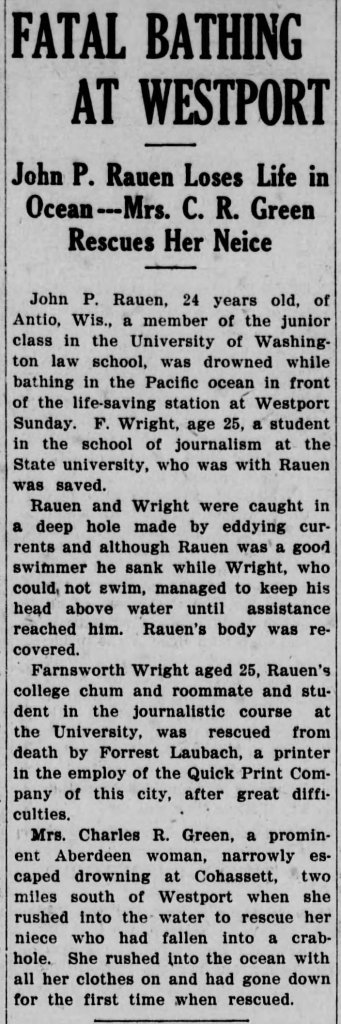
Octopodes were a professional hazard of diving in the Pacific Northwest, which eventually gave way to the “sport” of octopus wrestling. Farnsworth Wright likely picked up this element during his time in Seattle, and the reporter protagonist likely represents some of his own experiences as a journeyman journalist. Yet there is one more critical element that goes into this story: in 1913, Farnsworth Wright’s roommate at university, John P. Rauen, drowned while they were out in the water. Wright himself barely survived.

Locke finds this story very psychologically revealing:

“In the Depths” is a story about being saved. Carlson’s career is saved because he “had his story.” The driver is saved, not just from the octopus, but from his trauma when, as observed int eh closing sentence, Carlson’s “tender and anguished brain.” Within the story, Carlson and McLeod save each other by giving what the other needs most. Outside of the story, knowing of the drowning tragedy in the author’s life, we get a broader suggestion. A deeply depressed Farnsworth needed saving from his own painful memories. he was a haunted man, haunted by memories of the earthquake, the splitting up of the family, the drowning of Raeun, his own near-death experience, and who knows what else.
—John Locke, The Thing’s Incredible! The Secret History of Weird Tales 44

We don’t actually know what Wright’s feelings were in writing this story—he never describes the writing of it in any of his autobiographical material—but the influence from his personal life adds psychological depth to this story. It might be the best of his non-weird fiction.


Bobby Derie is the author of Weird Talers: Essays on Robert E. Howard and Others and Sex and the Cthulhu Mythos.

Deep Cuts in a Lovecraftian Vein uses Amazon Associate links. As an Amazon Associate I earn from qualifying purchases.

Lost Tale: “The Cookery Queen” (1919) by Farnsworth Wright

“The Cookery Queen” by Farnsworth Wright was published in The Overland Monthly Dec 1919. Reprinted in The Snake Fiend and Other Stories (2023).

※

The Cookery Queen

by Farnsworth Wright

TIME was when Standish MacNab was a tireless explorer among Chicago’s eating houses. Memories of San Francisco drove him from one to another in search of something to remind him of the sea-girt city of the Golden West. For San Francisco is the best fed city on the continent, while Chicago, for its size, is the poorest fed.

On food, Standish spent careful thought and most of the income from his law practice. The greater part of what he ate he termed “grub.” As for the rest, the service was slow, or the table cloths dirty, or the waiters surly; anyway, he found it hard to imagine himself in the Techau Tavern or Tait-Zinkand’s. His gastronomic ramblings carried him into every cafe on Michigan boulevard, from the palatial Blackstone, where the waiters
take themselves very seriously, to the Russian Tea Room and other pleasant sample establishments where one can enjoy the dainty portions served to him, if his appetite is not too big. In Marshall Field’s tea room he sat among ladies who wore earrings and sealskin coats and stuck out their little fingers when they ate; he dined in cafes where heavy-jowled gourmands with bald heads and fat necks drank the juice from their
oyster shells and gnawed the last speck of meat from their broiled lobsters; he also ate where hungry shop-girls counted out pennies for their meals, for his quest took him to the tops of skyscrapers and down into basement cafeterias. He nibbled at egg “fo young” in the Mandarin Inn and King Joy Lo’s in search of something as tasty as the chop suey and bird’s nest hoong chop blooey of Chinatown-by-the-Golden-Gate, but Chicago’s almond-eyed waiters soon saw him no more. He manipulated spaghetti in Italian restaurants over saloons, and mourned the days before the earthquake (this word has disappeared from California lexicons) when for two-bits in the Fior d’Italia on the Barbary Coast he could eat a meal that shamed anything Chicago could offer for a dollar. He tried goulash in four or five Little Hungary restaurants, swallowed chicken and lamb a la Greek at Protopapa’s, and wandered far from the “loop” to taste Venetian chicken at the Bismarck Garden. Time was when the young Chicago lawyer changed his eating-place thrice daily, but that was before he met Sadie.

Sadie was without doubt the most divine waitress that ever slung hash in a restaurant. She wasn’t a raving beauty, yet despite that she had wonderful blue eyes like the sky seen from the top of Mt. McKinley; her smile was a stunner; her little pug nose was fascinating, and as for grace, she made all other waitresses look like Zeppelins and dreadnaughts cruising among the tables.

Standish stuffed a slice of bread into his ample mouth and stared in astonishment at finding such a sylph in a hashery. She was of that buxom type of women whose age cannot be judged from their looks. She might be twenty-three, or she might be over forty. Standish surmised that the lower limit was about correct.

His search for an eating-house was ended, and attacking forty-cent table d’hotes became henceforth his favorite pastime. The food was not better than otherwhere; in fact, an unprejudiced judge might have pronounced it a great deal worse. But Standish would not have rolled the College Inn, Kunz-Remmler’s
and the Boston Oyster House into one and taken the choicest viands from each in exchange for a daily seat in the Quality Lunchroom, after he first met Sadie waiting on the tables there.

“Whatcha going to eat?” she smacked.

“Just a minute—hm!—now let me see—nice restaurant you have here huh?”

“Want our businessmen’s lunch?” she questioned. “It costs forty cents, but it’s real good.”

She took his order, stuck her pencil into her hair—light brown, flavored with golden—and walked away, leaving Standish with his head in a whirl. He never had been in love before, at least not seriously, but this time the little winged boy had twanged an arrow with terrific force through his chest. Henceforth he thought and dreamed and lived for Sadie.

Yet he dared not make love at once. She had not yet learned to reciprocate his affection, and besides, she might think he was flirting, and lose respect for him. So for the present he must be satisfied to leave a quarter for her on his plate, and get better acquainted later on.

Every day Standish ate in the Quality Lunchroom, except when urgent business called him elsewhere. He opened his thoughts to Sadie, told her his business; confided in her that he was making nearly $200 a month from his law practice, and would soon be able to get married.

But she never allowed him to talk of what lay uppermost in his thoughts. She would often sit opposite him and chat while he ate, after he had learned to come in during the slack hours, but she always found something to occupy her and take her away from him whenever he began talking about his heart…

Sometimes it seemed to him that the cashier, a man about the same age as Standish, was narrowly eyeing his tete-a-tetes with Sadie, and he attributed it to jealousy. It worried him, too, for he feared lest the young man, with his handsome face and gracile mustache, might already have the key to Sadie’s heart. So he determined to bring matters to a head and declare his love.

Fifteen cents for breakfast and a quarter each noon and evening. This was the unvarying amount of his daily tips. Sixty-five cents a day. Sadie did not lack spending money. Three-dollars and ninety cents a week. She bought new hats, and sometimes forsook the movies for the Follies. Sixteen dollars a month. She could pay her entire confectionery bill with the lawyer’s tips. Forty-eight dollars in three months. But here Sadie’s pin money suddenly ceased, as it now becomes my heavy duty to relate.

At half-past three one afternoon Standish entered the lunchroom. Experience had taught him that the restaurant business was slackest at that hour. Luck seemed to be with him, for the other girls were out (gone to lunch, probably), and there was not another soul in the place besides Sadie and the good-looking, but
jealous cashier.

Standish ordered eggs and coffee, and Sadie sat down opposite him to gather an earful of talk.

“Sadie,” Standish began, “Sadie, what’s the use of going on like this? You weren’t meant to work in a restaurant. I want you to be my wife, and we can get a cozy flat up on the north side, and I’ll buy a flivver, and—”

“Stop it,” Sadie interrupted, rising. “Not another word about love. Not a word.”

“But Sadie, don’t you care for me?” Standish pleaded.

The cashier frowningly left his desk and strode toward them,

“I like you well enough, Mr. MacNab, but I can’t marry you. Because—”

She burst out laughing, and sank weakly into a chair.

“Frank,” she gasped, when her mirth had somewhat subsided, “Mr. MacNab has asked me to marry him. Can you beat it?”

A sudden suspicion flashed Standish’s brain as he saw the angry face and threatening fists of the cashier.

“You aren’t—already—married?” he gasped.

“You said it,” she “You can’t blamee for laughing, Mr. MacNab, although I know it isn’t a bit funny to you. I kind of thought you were in love with me; but—can’t you see how funny it is?”

“I am deeply mortified,” Standish confessed. “I apologize most humbly to you, and to your husband.”

“My husband!” Sadie exclaimed.

“Yes. Isn’t he your husband?”

The cashier shook with silent laughter, and Standish gravely surveyed him from the points of his patent leathers to the tips of his neatly curled mustache.

“My husband,” said Sadie, “is the chef who owns the lunchroom. Frank is my youngest son.”

Time was when Standish MacNab forgot San Francisco and her cafes de luxe and was content to eat forty-cent dinners in a lunchroom under the elevated. But that time is also past, and a ceaseless hunger drives him from cafe to cafe, for the fire of hope burns bright in the breast of youth, and he still dreams that some
day he may find a real San Francisco restaurant in Chicago.

※

The most notable element of this story is that the protagonist is a gourmand from San Francisco seeking equal dining in Chicago; this echoes Farnsworth Wright’s own background, from his youth in San Francisco to his working as a journalist in Chicago—and, if E. Hoffmann Price’s memoir on Wright in Book of the Dead: Friends of Yesteryear: Fictioneers & Others can be trusted, his penchant for good food. John Locke sees this as a personally revealing story:

His reference to the earthquake reflects his own behavior: it’s an event you scarcely hint at. More telling, the story is drenched in nostalgia—mourning—for the good life that existed before Fate stole it away. The earthquake occurred when Farnsworth was three months shy of his eighteenth birthday. Most of us can blame the loss of our youth on the passage of time. he could blame his on the earthquake, lending a false sense that it could be recaptured. The earthquake was his dividing line between youth and experience.
—John Locke, The Thing’s Incredible! The Secret History of Weird Tales 41-42

Which may be true, but this is still a rather one-note joke of a comic story, one that might make the reader cringe in sympathy for the well-meaning gourmand. It only gains an extra dimension if you’re aware of Wright’s own background.


Bobby Derie is the author of Weird Talers: Essays on Robert E. Howard and Others and Sex and the Cthulhu Mythos.

Deep Cuts in a Lovecraftian Vein uses Amazon Associate links. As an Amazon Associate I earn from qualifying purchases.

“The Mould Shade Speaks” (1919) by Winifred Virginia Jackson

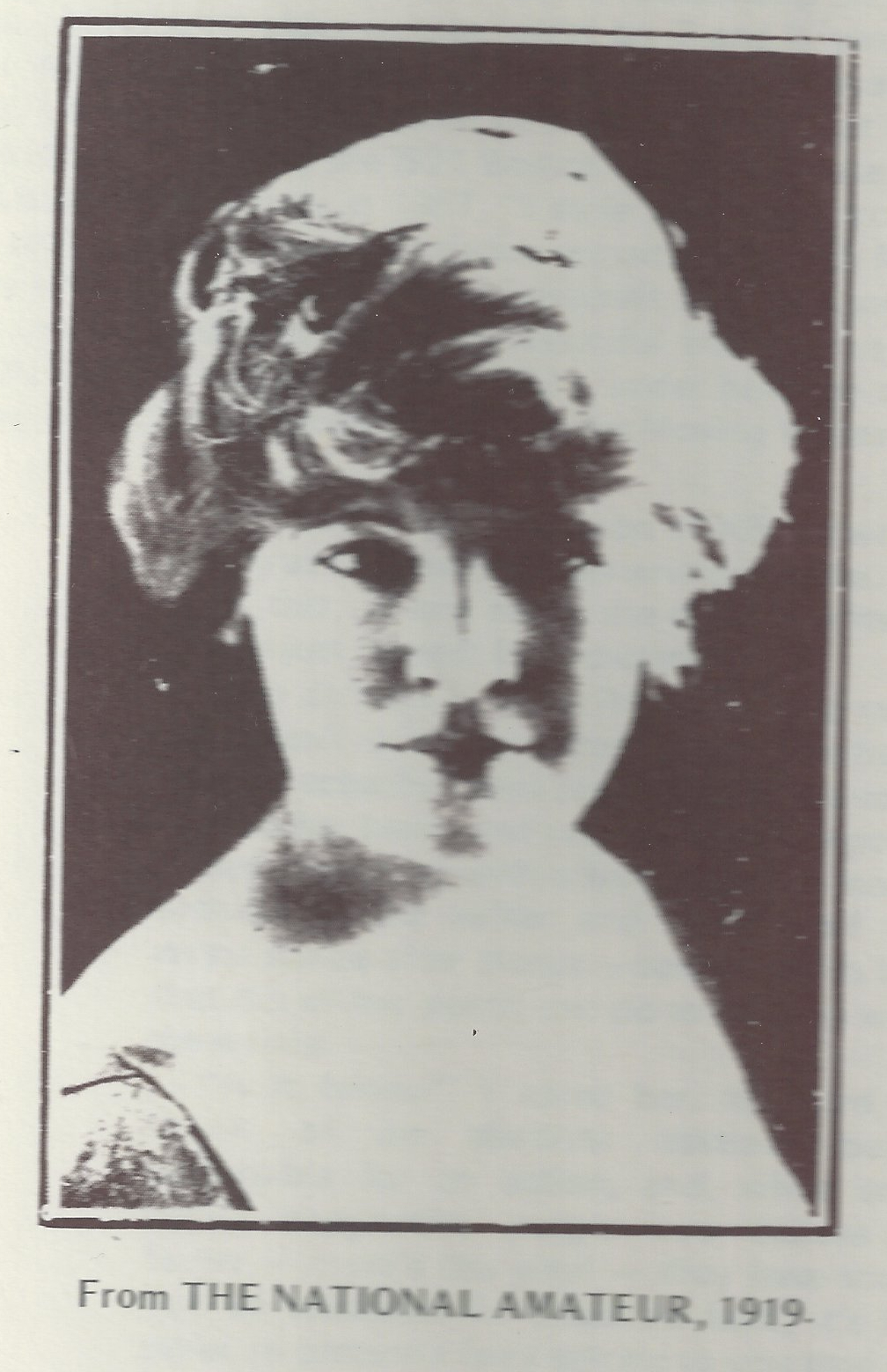
Mrs. Jordan’s serious literary work is all poetical, and her poems may br roughly grouped in six classes: Lyrics of ideal beauty, including delightful Nature poems replete with local colour; delicate amatory lyrics; rural dialect lyrics and vigorous colloquial pieces; poems of sparkiling optimism; child verse; and poems of potent terror and dark suggestion.

H. P. Lovecraft, “Winifred Virginia Jordan: Associate Editor” (1919) in Collected Essays 1.228

In 1919, Winifred Virginia Jackson was still married to Horace Jordan, and so it is under that name that Lovecraft knew her and her poetry. Lovecraft’s appreciation for her poetry appears genuine, and perhaps he had read enough of her verse to form a solid opinion. Although little-remembered and little-reprinted these days, during her life Winifred Virginia Jackson was a fairly prolific poet, both in amateur journals and in newspapers, publishing well over a hundred poems, some of which were collected in the collections Backroads: Maine Narratives, with Lyrics (1927) and Selected Poems (1944), now both quite rare.

Indeed, very little of Jackson’s poetry has been reprinted, and much of it is uncollected or largely inaccessible for those without access to newspaper archives and obscure and expensive amateur journals, although a selection of poems have been republished in the appendix to Letters to Rheinhart Kleiner and Others. What’s notable about the selection of Jackson’s poems that survive and are accessible is that very few are of that final category that Lovecraft delineated: “poems of potent terror and dark suggestion.” Lovecraft expanded on this in a subsequent essay:

It remains to speak of the singular power of Miss Jackson in the realm of the gruesome and the terrible. With that same sensitiveness to the unseen and the nreal which lends witchery to her gayer productions, she has achieved in darker fields of verse results inviting comparison with the best prost work of Ambrose Bierce or Maurice Level.

H. P. Lovecraft, “Winifred Virginia Jackson: A ‘Different’ Poetess” (1921) in Collected Essays 2.50

One such poem Lovecraft thought to mention in his letters:

Cook’s Vagrant did not specialise in the weird, & was in general very variable. […] However, quite a few weird things appeared. In June 1918 my verses “Nemesis” (later in W.T.) & my old juvenile tale “The Beast in the Cave” (written in 1905) appeared. July 1918 contained a long piece of my weird blank verse which I presented in the guise of comedy, with a comic rhymed framework around it. […] Oct. 1919 contained our old friend “Psychopompos”, & also a shorter piece of weird verse, “The City”, which I contributed under the pseudonym of “Ward Phillips.” Furthermore—an exotic Chinese piece called “Tea Flowers” (based on Wilde & suggesting Lesbianism) by Roswell George Mills, & a rather powerful ghoul-poem, “The Mould-Shade Speaks” by Winifred V. Jackson. A rather bizarre issue on the whole.

H. P. Lovecraft to Robert H. Barlow, 17 Dec 1933, O Fortunate Floridian! 91-92

“The Mould Shade Speaks” has never been reprinted since it first appeared in The Vagrant #10—which is a shame, because as Lovecraft says, it is a ghoul-poem, darker and more suggestive than most of Jackson’s verse:


The Mould Shade Speaks
by Winifred Virginia Jordan

I hide at early dawn, gray-clothed,
 I rub my fingers cold
Against my face, dark-browned and loathed,
 To better see the world
I loved and walked in some old dream,
 That hangs about me still,
And wonder if ‘neath sunshine’s gleam,
 I forged my silent will.

My voice you hear when storm-fiends sack
 The sunbeams from the sky;
I shriek with joy when earth grows black
 And jangling thunders cry.
I clutch with glee the raindrops white
 For my will’s evil hap,
I hold them, shiv’ring in their fright,
 Within my musty lap.

I hate the noon-high sun whose eyes
 Seek out my spawn, my moss,
With smiles for ferns, where lizards rise
 And crawl the leaves across.
I hate the murmurs that reel round
 When sunbeams get within
My slimy gulches, without sound,
 That I keep black as sin.

But when night strikes the sunbeam’s doom
 I wrap myself in black,
And stalk, a hydra-headed gloom,
 Red fears astride my back;
Then I set out my tumorous plague,
 I seed my foul decay:
My touch has feel of menace vague
 That gnaws at edge of day!

And I climb up the heights of air
 To spray my poisoned breath,
I swish my skirts upon trees where
 I leave the mark of death;
I never sleep, I never rest
 I cherish but life’s tears,
And hug close to my sexless breast
 The scourge of charnel fears!


Gravestones, particularly older ones which have been long exposed to the elements and uncared for, tend to become host to lichen, molds, fungi, moss, creeping vines like ivy or kudzu, even algae if the environment is wet enough. Even as the bones and flesh that moulder in the grave are slowly consumed, the names and inscriptions may be covered or effaced by the decay of the grave itself—and that is the “mould shade” of Winifred Virginia Jackson’s poem, the animate spirit of that decay made manifest, anthropomorphized with fingers and skirts, shrinking from the sun, leaving its mark on stone and wood, setting up baleful miasmas. There is an almost Poe-esque quality that recalls “The Conquerer Worm” which has a similar structure and may well have inspired it.

It is easy to see why Lovecraft may have liked this poem, ghoulish as it was.

Thanks and appreciation to David E. Schultz for his help and assistance.


Bobby Derie is the author of Weird Talers: Essays on Robert E. Howard & Others (2019) and Sex and the Cthulhu Mythos (2014).

Deep Cuts in a Lovecraftian Vein uses Amazon Associate links. As an Amazon Associate I earn from qualifying purchases.