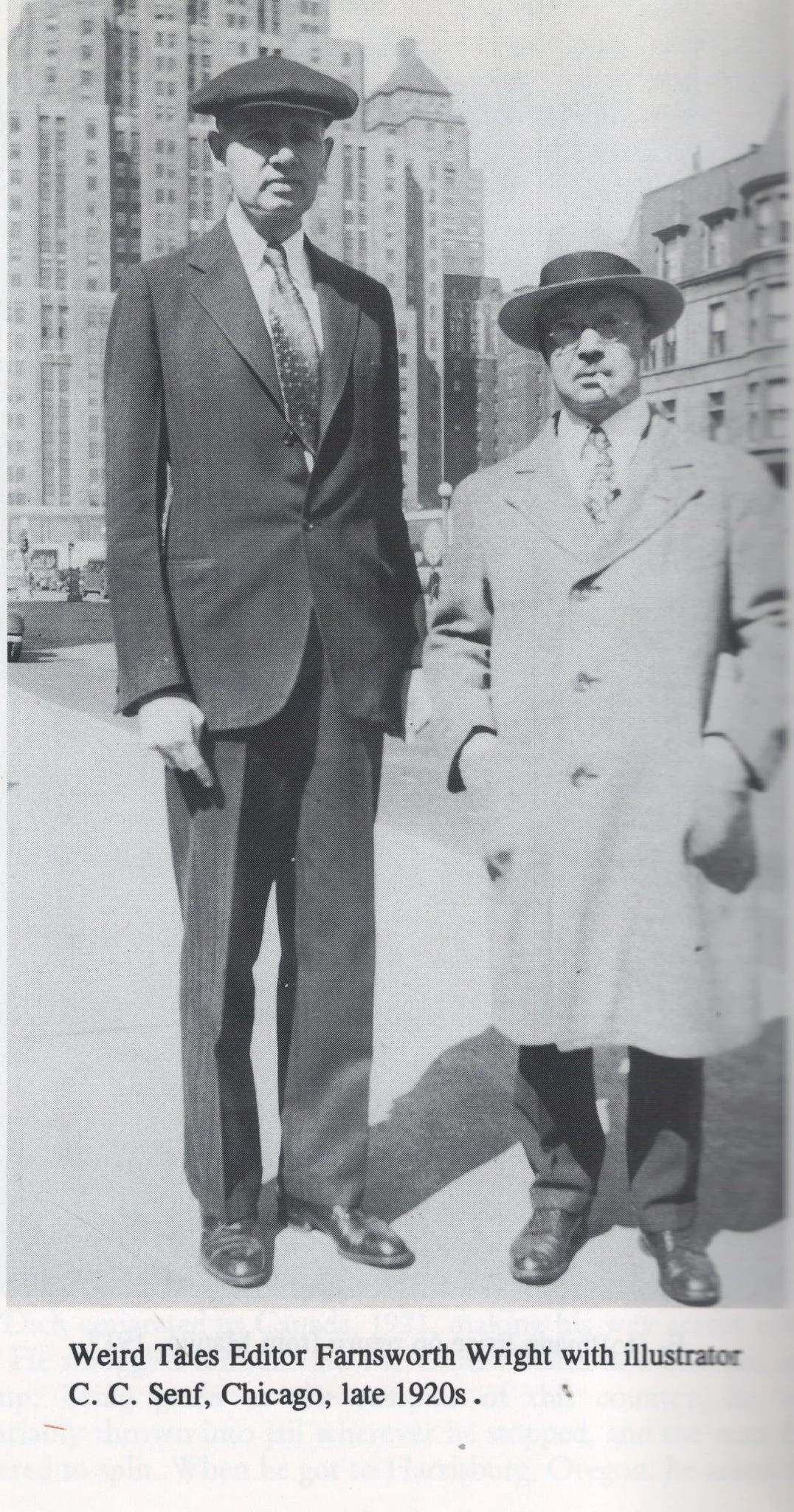
“Out of the Frying Pan” by Farnsworth Wright was published in The Overland Monthly May 1920.
※
Out of the Frying Pan
An Operatic Tragedy
by Farnsworth Wright
FORTUNIO DUO was an operatic tenor. That does not explain how he happened to be owing a thousand dollars to his hotel, for he received that much every night he sang, according to the newspapers, and he therefore ought to have found it easy to pay his bills. But the tenor was all but broke, and the hotel was guarding his trunks until he should pay up.
He was promised two thousand dollars for a two weeks’ engagement as guest artist in a neighboring city, where he was to make his first appearance in opera the next day. This was twice as much money as was needed to pay his bill at the hotel. But the hotel managers, who were pigs without appreciation of art, would not release his trunks. So Signor Duo, he of the musical name, laid his head to his pillow and wept. He wailed aloud in his anguish of soul, and called down curses on the pigs who treated him so shamefully.
How came the tenor to be penniless when he received one thousand dollars a night? He had sung fifteen times during the operatic season just ended, and simple arithmetic shows that he should have been paid fifteen thousand dollars.
Unfortunately, the rules of arithmetic did not apply. The newspapers simply were misinformed about Signor Duo’s salary, for they had accepted the statements of the opera company’s publicity man at their face value. Signor Duo’s contract called for fifteen performances, but three of these were to be sung gratis, and for
the other twelve he was to be paid two hundred and fifty dollars each, or one-fourth what the newspapers declared he received. Out of this he had to pay his manager ten per cent.
And he gave Mr. Doppler fifty dollars a week to furnish paid applauders. Of course he did not need a claque! It was an insult to suggest that he, the great Italian tenor, could not get applause without buying it! But—suppose the claquers should hiss him if he refused to pay? That was different, and Signor Duo was very
grateful to Mr. Doppler, who knew the ways of these Americans, for saving his singing from being ruined by a wicked and unprincipled claque. He also gave Mr. Doppler fifty dollars a week to bribe the newspaper critics into saying pleasant things about him. In his simple soul he supposed there would be not the slightest
difficulty in buying favorable notices. But Mr. Doppler knew better, and put the money into the Doppler bank account, the newspapers saw not a cent of it all.
Mr. Doppler was secretary and assistant to Signor Parmese Pescatore, the great Italian maestro and operatic director. The maestro was of course too exalted a personage to stoop to graft, but—he hired Mr. Doppler as his secretary.
Of the three thousand dollars allowed to Signor Duo in his contract, the tenor received in actual cash only seventeen hundred dollars. He had to advertize in several musical journals, as all important singers do. He had to buy many high-priced costumes. He had been mulcted by a fellow patriot who wanted funds to back a benefit for Italian war orphans, and ran away with his collections. But why enumerate all the ways in which a
tenor spends money? Suffice it to say that he still owed the money due to the musical papers that carried his advertising, that he owed money to his tailor, his hotel, his music teacher, and everybody else who had dealings with him. The only people that had collected from him were his manager and Mr. Doppler. The manager was paid only through the courtesy of Mr. Doppler, who deducted the managers commission from Signor Duo’s salary and sent it to this gentleman after he (Doppler) had first taken one-fourth of it as a collection fee. Alas that there are so many Dopplers in this vale of tears!
One might well ask why the tenor did not leave his trunks and his troubles, board the train, sing his two weeks as guest tenor, and then get his baggage back by paying his hotel bill. The reason he could not do so is because his costumes were in those trunks, and without costumes an operatic tenor is of no more use than a drum major in overalls.
Many schemes went through his perplexed brain, but one after another he had to abandon them all. He wiped his perspiring forehead on a richly perfumed handkerchief, sprayed perfumery on his clothes, sat down on his bed, and wept.
Then a dread assailed him—what if this superfluity of sobs were affecting his voice? So he opened his mouth and began to shake forth Canio’s lament from “I. Pagliacci,” the opera in which he was billed to open the next night. He stopped, dismally, as the import of the words was borne in on him: “Tu sei pagliaccio!”
(You are a clown!)
“No, pagliaccio non son!” he sang, and resumed his interrupted flow of tears.
There came a knock at his door, and he hastily powdered his face to conceal the stains of weeping, sprayed perfume on his hair, and quavered, “Come in.”
It was his friend, Carter, a newspaper reporter who sometimes breezed around the opera house in search of stories and features about the “nuts,” as he called them. He blew into the tenor’s room at this dismal minute like a breath of fresh air.
“Ah, Meester Carter,” exclaimed the tenor, in his inimitable French-Italian accent; “I am in trooble, Meester Carter, mooch trooble, and I wish you should help-a me. Ah, you will aid me! Now I can be happy once more, for I have leaved it to you! You will find-a ze way! Tra-la-la!”
“What’s up?” Carter queried.
“Ah, Meester Carter, I must to sing in ‘Pagliacci’ tomorrow night. But I cannot to take ze trunks from zis hotel. And all my costumes, zay are in ze trunks, and I must not leave ze city wizzout ze costumes. I owe it to ziss hotel mooch money, and zay hold ze trunks until zay have ze money. But now I leave it all to you, and you will make it arrange. Oh tra-la-la,” he sang merrily.
Carter thought the tenor was giving him a pretty stiff assignment, but he tackled it with spirit.
“You be here in your room tonight at 10 o’clock, without fail, and I’ll fix it for you,” he promised after a minute of reflection, which was punctuated by the tenor’s warblings.
Carter reserved a room, as he went out, for Miss Cecily Jones of Milwaukee, and about 10 that evening he came into the hotel with a young woman of the operatic chorus, who registered under the name he
had chosen for her. She ordered her trunk and two suit-cases taken up to her room. Carter smuggled the key to the tenor. Then he accompanied the young woman to the nearest elevated station, and escorted her to her home.
Signor Duo worked hard that night. Packing trunks and suit-cases is a tedious job for a tenor who has no valet to assist him. In the morning he came down to the hotel desk.
“I eat here no more where nobody not trust me,” he snapped to the hotel clerk. “I go eat-a my breakfast outside in ze restaurant. Some time, | make you mooch trooble—mooch trooble!”
In the morning Carter’s friend of the chorus also made her appearance at the hotel, and paid her bill—out of the little money yet remaining to the tenor. She ordered her trunk and suit-cases sent to the railroad station, and Signor Duo took charge of them there. A happy smile lighted his face.
“Ah, zoze hotel peegs!” he exploded. “Now zay will wait wan long time for ze money! You will see.”
The tenor’s soul was at peace. He sat in the parlor car and enjoyed the beauties of the landscape. Joy had returned to his world. And he would get his revenge on those grasping hotelkeepers, for they would wait, wait, wait, a m-ee-leon year, before they got any money from him.
Signor Duo arrived in good time at his destination. He sent his trunk to the theater and his suit-cases to the hotel, and notified the opera company by telephone of his arrival. Then he went to his hotel and washed for dinner.
Never had life seemed so rosy. He was about to conquer a new city, to bring new hundreds of music lovers under the potent spell of his voice. He pictured to himself the many curtain calls he would receive, the salvos of applause, the cries of “bravo,” the adoration of the women, the handclaps of the orchestra. He glanced at the pictures of himself as Canio and Don Jose, in the evening newspapers, and read the exaggerated reports, prepared by the press agent of the local opera company, which seemed to him truthfully accurate, of his successes in New York and other cities. He ate his dinner with more than usual relish, tipped the waiter bountifully, and set out on foot for the theater where he was to sing, stopping several times to admire the announcements on the billboards heralding him as “Italy’s Golden-voiced Tenor.” It was indeed a happy day for Signor Fortunio Duo.
As he neared the theater, the crowds increased.
“They come early to the opera here,” thought the proud tenor. “The press agent his work well done.”
He quickened his pace. There were more people in the streets, and still more, hundreds of them, thousands, and all hurrying in the same direction.
“Where stands the opera house?” he asked an excited urchin who came rushing by him.
“Just around the corner,” shouted the boy, “before it took fire. The front wall is just fell in.”
Signor Duo, staggered under the blow and almost fell between the wheels of a fire-engine rushing up to answer a general alarm.
He wiped his damp brow with his perfumed handkerchief and reflected that it was indeed a most merciful dispensation of a kind Providence which made him a waiter before he took to the grand opera stage.
※
A comic piece, it displays Farnsworth’s inside knowledge of the music business, good and I’ll, and the relationship of performers to reporters.
—John Locke, The Thing’s Incredible! The Secret History of Weird Tales 50
We have limited evidence for Farnsworth Wright’s sense of humor, though he definitely had one. E. Hoffmann Price in Book of the Dead: Friends of Yesteryear: Fictioneers & Others recalls Wright’s devastating comic timing and his skill with double (and even a triple) entendre. His comic fiction, however, involves broad stereotypes and a very dry wit at the end.
Bobby Derie is the author of Weird Talers: Essays on Robert E. Howard and Others and Sex and the Cthulhu Mythos.
Deep Cuts in a Lovecraftian Vein uses Amazon Associate links. As an Amazon Associate I earn from qualifying purchases.

