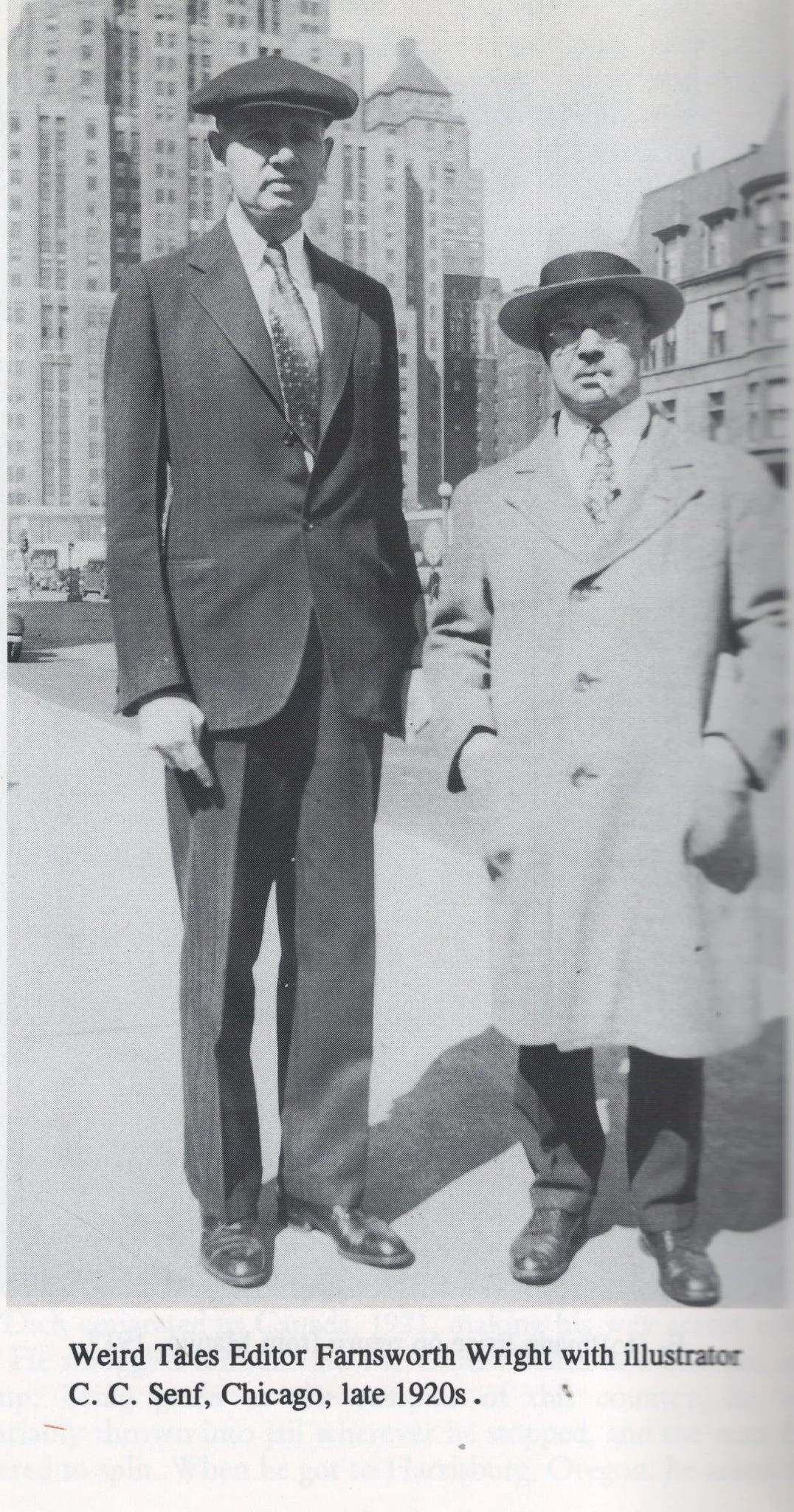
“The Silent Shot” by Farnsworth Wright was published in The Overland Monthly (Feb 1920).
※
The Silent Shot
by Farnsworth Wright
“YOU say you heard no shot, Dr. Burns?” Wyatt asked.
“No,” replied the young physician. “She must have held the revolver so close to her head that it muffled the sound.”
“Strange,” muttered the reporter. “Where was she when she shot herself?”
“Here in my office. I had just returned from some professional calls, and Helen got me some medicine to take up to my wife, who was ill in bed. The girl seemed despondent, but I didn’t dream that she was planning to kill herself. I took the medicine upstairs, and neither my wife nor I heard the shot. I had not been gone ten minutes when the doorbell rang, and I came down to let in George Locke and his wife. The door into my waiting room was open, and we looked in as we went through the hall. Beyond, on the floor of my office, we saw poor Helen lying dead, and my pearl-handled revolver lay beside her. She had shot herself through the head.”
“Helen Hume lived here in the house, then?” asked the reporter.
“Yes. She was an attendant in my office, and she stayed here. Her father and brothers live about four blocks down the street, but I don’t think she got along very well with them. I think that’s what made her despondent.”
“How did she happen to have your revolver?”
“I suppose she took it to kill herself. Or maybe she wanted it for protection against burglars. I kept it under my pillow.”
“How could Miss Hume take the revolver without being seen, if your wife was lying in the room sick in bed?”
“She could easily do that when she was making the beds. She helped around the house when there was nothing else to do. But you have all the information you need, haven’t you?”
“Yes, I guess so. I have her father’s address, and her age, and—oh, yes; where was the body taken?”
Dr. Burns gave him the address of the undertaker.
“May I speak to your wife?” asked the reporter.
“No, you can’t go up there,” Dr. Burns replied. “My wife is so terribly upset by the tragedy that she is on the verge of a nervous breakdown. She is so ill anyway that she was out of her head for a time, and this has given her a relapse.”
“All right, Dr. Burns. Just one question more: do you think Miss Hume could have been shot by a burglar?”
“Oh, no, absolutely not,” declared the physician emphatically. “She killed herself. I told you that she was despondent, didn’t I?” he went on, growing slightly excited. “This is a plain case of suicide, and you won’t get anywhere by trying to make a murder mystery out of it. Burglars wouldn’t enter a house as early as 10 o’clock, anyway.”
• • •
Ordinarily the reporter would not have gone to the undertaker’s, especially so late at night. The case seemed to be an ordinary suicide, and he knew that at that hour, when the mail edition had already gone to press, a suicide story could get only a few lines unless it possessed very unusual features, or concerned a prominent person. But the girl’s name sounded strangely familiar to him.
“Helen Hume, Helen Hume,” he mused. “Why, that’s the name of the little girl I used to play with in Cincinnati. I think I’ll run over and see. But it’s probably only a coincidence in names, for I haven’t heard that Helen was living in Chicago.”
The undertaker was just going to bed, but he let Wyatt into his morgue when the reporter explained his errand. The girl was Helen, beyond any doubt, although she had changed much since he had last seen her. Now she was eighteen years old, comely, well formed, just blossoming into young womanhood.
Wyatt looked closely at her face. Suddenly his eyes opened wide.
“Look there!” he exclaimed, pointing to Helen’s temple. “Did that girl kill herself?”
“You know as much about it as I do,” the undertaker answered, and shrugged his shoulders. “I’ve seen many people that have shot themselves, but never one like this.”
“So have I,” said Wyatt. “Let me use your telephone.”
“This is Wyatt talking,” he told his city editor over the wire. “That girl didn’t commit suicide. She was murdered.”
“Who murdered her?” asked the city editor.
“I don’t know. But listen—this girl didn’t have any powder burns, and there isn’t a hair singed, although the bullet went in at the temple, close to the hair. Did you ever see a person who had shot himself? Always terribly powder-burned, wasn’t he? This girl must have held the revolver at least three feet away.”
“That’s good work, Wyatt,” commented the city editor. “You may have a good story there. Keep after it, and see what else you can find. Ring me up if you get anything. Call back before half-past twelve, anyway, and turn in what you have.”
Wyatt examined the body again. The bullet hole was as clean as if it had been drilled with a gimlet. He recollected other suicides whose bodies he had examined.
Always the bullet had spread and made a larger hole where it came out than where it went in. This shot,
then, had been fired from across the room. It had taken a horizontal path, emerging at the same place on one side of the face where it had entered on the other side.
Wyatt held an imaginary revolver to his own temple, and found it hard to hold the weapon against his head with the barrel horizontal. While this fact in itself was not conclusive, yet, in connection with the clean, even bullet hole and the total absence of powder burns, it made Wyatt certain that Helen Hume had been murdered.
“Surely she was murdered,” affirmed the undertaker. “I knew that as soon as I saw her.”
Frank went over to see Helen’s father, ostensibly to get Helen’s photograph, but really to question him.
“So you’re little Frankie Wyatt that used to play with my Helen, are you? I never would have known you,” Hume greeted him. “Well, this is an awful shock to me. No sir, she hasn’t been despondent, as far as I know. No, she didn’t have any fellows, so it wasn’t a love affair. I can’t for the world imagine why she should want to kill herself. Surely she would have dropped some hint if she had been planning suicide. Oh no, sir, there was never any trouble between us. Was she murdered, did you say? Well now, sir, I’ll say this much: she didn’t have any reason to kill herself. If she was murdered, I want ’em to go to the bottom of it and find out who did it. No sir, I’m glad to hear you say that, because I’d hate to think poor little Helen had gone and killed herself.”
• • • •
Wyatt telephoned his story to one of the rewrite men on the newspaper, quoting both the father and the undertaker as charging that the girl had been murdered. He cast no suspicions, contenting himself with trying to show that the girl could not have killed herself. His story was given a column, whereas the other two morning papers printed only a few lines about a “suicide.”
Wyatt’s account caused the coroner’s inquest to be put over for ten days. The coroner was convinced that the girl was murdered; the undertaker was convinced; and the girl’s father was convinced. But the police detectives assigned to investigate her death reported that she had killed herself.
Wyatt asked some of his friends on the detective force:
“Is it possible for a person committing suicide to hold the revolver so close to his head that there will be no powder burns?”
From one and all he got an emphatic no.
“It can’t be done,” they declared. “There is bound to be a recoil, and there will be ugly powder burns, no matter how close you press the muzzle.”
“Can you muffle the noise by holding the revolver close?”
“Why, I suppose you can muffle it a little,” assented one. “But see here, young fellow, if you’re planning to kill
yourself I can show you a way that won’t hurt at all, and won’t leave a sign to show what happened to you. You’d make a beautiful corpse.”
“Thanks,” said Wyatt. “I don’t care to shuffle off just yet.”
“Helen Hume wasn’t killed in a love quarrel,” he told his city editor, “for she had no sweethearts. The theory that she was shot by burglars is silly. I don’t think Dr. Burns killed her, but there are some peculiar things about this case that make me suspicious. One is that neither the doctor nor his wife heard the shot, although he admits that the door was open into the office when he passed by with Mr. and Mrs. Locke. And then his preventing me from seeing Mrs. Burns set me wondering. Maybe she is really sick, but her husband gives
me the impression that he just doesn’t want anybody to question her.”
The coroner’s jury, when it finally sat on the case, refused to turn in a verdict of suicide, despite the police report. The jury found that Helen Hume came to her death “as the result of a shot from a revolver, fired by person or persons unknown,” and recommended that the police investigate further to find out who fired the fatal shot.
Wyatt’s convictions concerned the murder and not the murderer. As to who the slayer was he harbored only vague suspicions, which he could satisfy only by examining the physician’s house. This the physician forbade. So Wyatt put the girl’s death out of his mind as one of the unexplained murder mysteries which often crop up to puzzle reporters.
• • • •
“Do you think you can find out who killed that Hume girl, if I let you work on that alone for two or three days?” demanded the city editor, several days after the coroner’s jury turned in its verdict.
“I might. I’d like to try,” Wyatt answered.
He boarded a street car and went at once to Helen’s father.
“Mr. Hume,” he said, “I want to ask you frankly, have you any suspicions as to who murdered Helen?”
“I think Dr. Burns did it,” Hume replied. “I don’t know who else could have done it. Somebody did it.”
“What kind of a woman is Dr. Burns’ wife?”
“Why, she seems to be a nice little woman. But you surely don’t suspect her? I might think her husband did it, but not Mrs. Burns.”
A few minutes later, Wyatt tiptoed softly up the doctor’s front steps and tried the door, but found it locked. He could see a light in the parlor, and a newspaper, behind which he surmised Dr. Burns was sitting. Then the telephone bell rang, and Dr. Burns got up to answer it.
Wyatt silently withdrew into the shadow. The doctor came out, carrying his case in his hand. Wyatt slunk around to the rear door. This was unlocked, and he entered the house without knocking.
There was a back stairway leading down to the doctor’s office, as Wyatt had supposed. He turned the doorknob and entered, closing the door behind him. Then he opened the door from the office into the waiting room, and the door from there into the vestibule. The front stairway was in plain view from the office.
Did some strange acoustic vacuum intervene between him and the front stairs, so that a shot fired in the office could not be heard upstairs? This question was almost immediately answered for him by the voice of the doctor’s wife calling from upstairs. Lightly though he had moved, yet she had heard him.
“Robert,” she called down. “I thought you had gone out.”
A minute of silence ensued.
“Robert,” she called again. “I wish you would come up to me.”
He returned no answer. Presently he heard her coming up the back stairs. He slunk behind the office door.
“Robert,” she called again. “Where are you?”
She entered the office and switched on the lights. She gave a little shriek when she saw Wyatt, and she stood in the middle of the floor in her nightgown, opening and closing her mouth, as if she wanted to speak. Her face was white, and Wyatt observed also that she was thin, that her eyes bore a haunted, scared look, that her face was drawn and careworn, although she was still a young woman.
“Who are you, and what do you want?” she finally found voice to ask.
Wyatt closed the door.
“I want to know why you killed Helen Hume.”
Mrs. Burns put her hands to her head as if in pain, and stood for more than a minute silently rocking back and forth on her heels. Then her strength left her, and she would have fallen if Wyatt had not caught her. He helped her to a chair, and brought a glass of cold water, which he held to her lips.
“Who are you? And why do you come here to torture me?” she exclaimed indignantly, pushing away the glass.
“Don’t excite yourself, Mrs. Burns. I see that it really was true that you were too ill to testify at the coroner’s inquest. I had thought it was merely a bluff to keep you away.”
“Who are you?” Mrs. Burns asked again.
“My name is Wyatt. I am an old friend of Helen Hume. Why did you kill her?”
“What right have you to enter my house this way, without warrant and without invitation?”
“In cases of this kind, Mrs. Burns, one does not wait for invitation—Helen Hume was standing over here when you shot, wasn’t she? And then you fled up the back stairs while your husabnd faced the police, while he shielded you and kept you from being interviewed, and invented a suicide story that can’t hold water. Why did you kill Helen Hume?”
“Mr. Wyatt, leave my house this instant. Such affrontry is unpardonable. The girl killed herself.”
“Did you see her do it?”
“No. I was just going upstairs when I heard the shot.”
“You HEARD the shot?”
“No, no, no! I don’t mean that. There wasn’t any shot. I didn’t HEAR the shot, I mean.”
“Then you were NOT upstairs sick in bed. You were down here.”
“I wasn’t down here, I tell you! I was going up the stairway when she shot herself.”
“That is enough, Mrs. Burns. Your husband said that you were both upstairs, and that you were in bed. But
you tell me that you were on the back staircase. Your husband says that neither of you heard the shot. You tell me that you heard the shot, and then, remembering that your husband’s story was different, you deny that you heard it. You say that you were there on the stairs and knew when it happened, but your husband pretended that he discovered the body when he came through the hall with Mr. and Mrs. Locke. As a matter of fact, your husband left the corpse of the girl to answer the door bell. He led his visitors through the hall, and then, when they saw the body lying in a pool of blood in his office, he pretended that he was seeing it for the first time.
Mrs. Burns, I am a reporter. If I print the statements you have just made, flatly contradicting your husband, he will be arrested. The police will naturally suppose that he was the girl’s murderer. Otherwise why should he lie and pretend that he had not heard the shot, and knew nothing about her death?”
“You say my husband would be suspected?” the doctor’s wife asked, her eyes big with fear.
“He will be convicted. He is already suspected, because of his fishy story about not hearing the shot when ail
doors were open between him and the office where Helen was killed. The fact that he perjured himself will execute him. Many men have been sent to the chair on less evidence.”
“You won’t do it! You shan’t do it! You mustn’t drag my husband into this! I swear to you that he had absolutely nothing to do with the shooting! His murder will lie on your soul if you bring this unjust suspicion on him!”
“I am only after facts, Mrs. Burns. If your husband is innocent, why does he conceal the facts? It is because he is protecting you. You were jealous of Helen Hume. You thought your husband was too fond of her, and so you shot her. Isn’t that so? You will do him a still greater wrong by keeping silent now. I can’t vouch for his fate if you still refuse to tell me why you killed Helen Hume.”
“I didn’t shoot her deliberately! I didn’t, I swear I didn’t! I am not a murderess! I was out of my head, but even
so I didn’t intend to kill her. I was arguing with her, and trying to scare her with the revolver. I didn’t even know it was loaded. Don’t, please don’t print anything, Mr. Wyatt! It was purely an accident! Enough unhappiness has been caused already, without adding this.”
“Wyatt heard a noise, and, turning he saw Dr. Burns standing in the doorway.
“You’re in mighty fine business!” the young physician exclaimed, shaking with wrath. “Mighty fine business, breaking into a house to make a sick woman confess to something that isn’t true! What are you going to do?”
“That depends on you and your wife,” answered the reporter. “I want to know all the details.”
“There are no details,’ replied the physician. “My wife and I were happy, until this tragedy happened. My wife has been very ill. She was not responsible for the shooting, for she was delirious when it occurred. You can’t get a conviction on the evidence you have, but the publication of a story such as you want to print would ruin our lives. There was an unnatural situation here—a beautiful girl, just developing into womanhood, living on terms of intimacy with a young married couple. The intimacy was nothing more than a strong friendship, but at that it was an unnatural situation to have her living in the same house. My wife’s illness made her supersensitive, supersuspicious. And she was out of her head when poor Helen was shot.
“There is nothing more to tell. But consider this—the coroner’s inquest is over, and unless you revive the matter the police will make no further investigation, and it will soon be forgotten except by us. You hold our happiness in your hands.”
• • • •
“What success did you have?” the city editor demanded when Wyatt showed up in the local room next day. “Did you find the murderer?”
“I have talked with the doctor’s wife,” Wyatt answered. “She was my last clue, and I have followed it out as far as I can. Please give me another assignment.”
※
The story offers a radical perspective on two levels. It features the selflessness of the reporter in forgoing headlines and glory while arguing for individual preemption of the cruelties of the press and legal system.
—John Locke, The Thing’s Incredible! The Secret History of Weird Tales 50
In broad outlines, “The Silent Shot” is a whodunit. Farnsworth Wright likely brought his personal experience as a reporter to play, illustrating the pressures put on journalists by editors, and balancing the needs of the job and the personal cost to individuals who become news. It isn’t a pleasant story; both the protagonist reporter and the married couple break the law in pursuit of their names, and while they declare the death accidental, it’s far from clear if that is the case—after all, they’re already lied about it.
So what starts off as a mystery has a noirish twist at the end, a moral dilemma that leaves a young woman murdered and her killer not brought to justice. The journalist has gotten as close to the truth as he could, but ultimately accomplishes nothing.
Bobby Derie is the author of Weird Talers: Essays on Robert E. Howard and Others and Sex and the Cthulhu Mythos.
Deep Cuts in a Lovecraftian Vein uses Amazon Associate links. As an Amazon Associate I earn from qualifying purchases.

