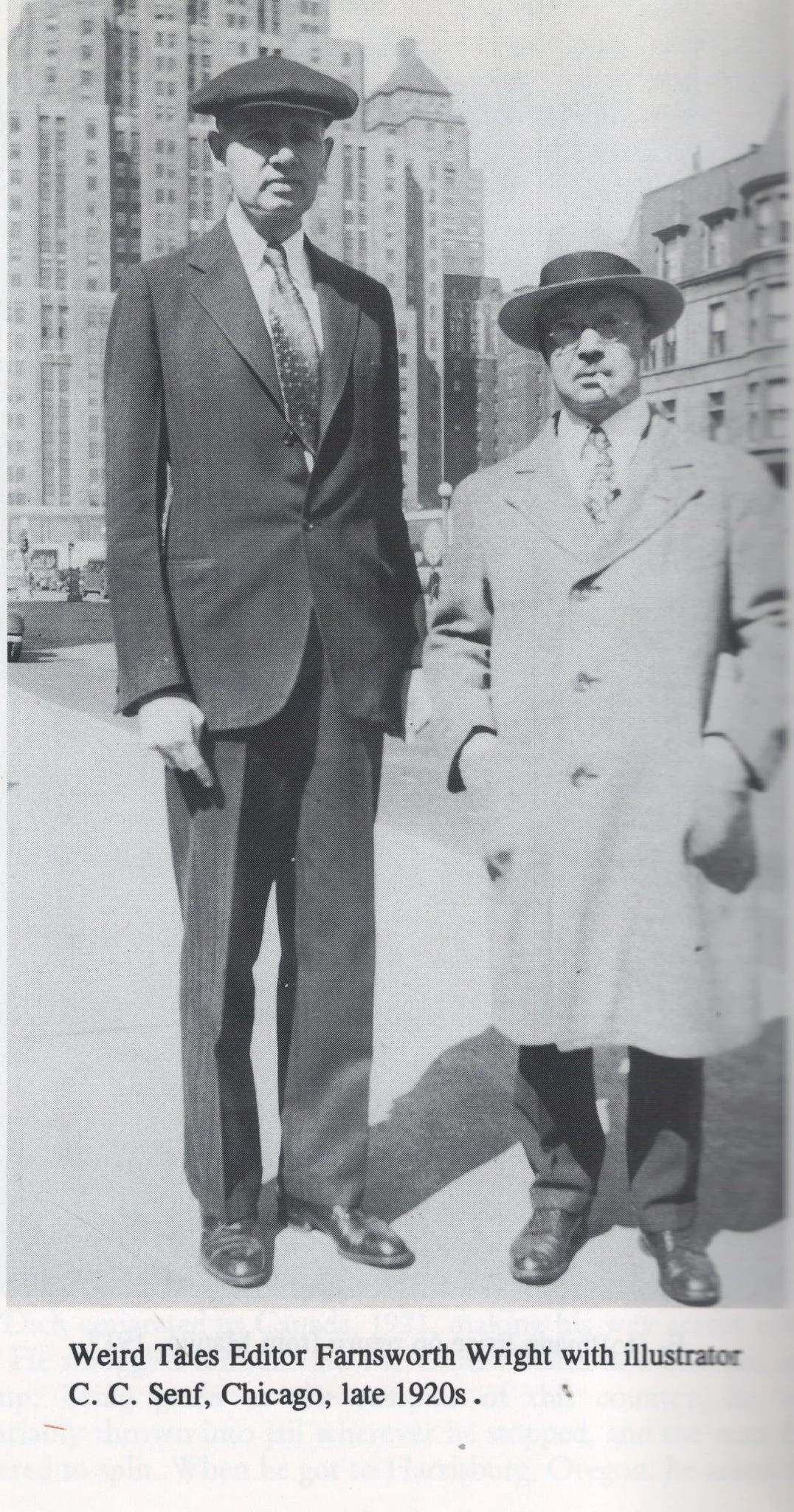
“The Cookery Queen” by Farnsworth Wright was published in The Overland Monthly Dec 1919. Reprinted in The Snake Fiend and Other Stories (2023).
※
The Cookery Queen
by Farnsworth Wright
TIME was when Standish MacNab was a tireless explorer among Chicago’s eating houses. Memories of San Francisco drove him from one to another in search of something to remind him of the sea-girt city of the Golden West. For San Francisco is the best fed city on the continent, while Chicago, for its size, is the poorest fed.
On food, Standish spent careful thought and most of the income from his law practice. The greater part of what he ate he termed “grub.” As for the rest, the service was slow, or the table cloths dirty, or the waiters surly; anyway, he found it hard to imagine himself in the Techau Tavern or Tait-Zinkand’s. His gastronomic ramblings carried him into every cafe on Michigan boulevard, from the palatial Blackstone, where the waiters
take themselves very seriously, to the Russian Tea Room and other pleasant sample establishments where one can enjoy the dainty portions served to him, if his appetite is not too big. In Marshall Field’s tea room he sat among ladies who wore earrings and sealskin coats and stuck out their little fingers when they ate; he dined in cafes where heavy-jowled gourmands with bald heads and fat necks drank the juice from their
oyster shells and gnawed the last speck of meat from their broiled lobsters; he also ate where hungry shop-girls counted out pennies for their meals, for his quest took him to the tops of skyscrapers and down into basement cafeterias. He nibbled at egg “fo young” in the Mandarin Inn and King Joy Lo’s in search of something as tasty as the chop suey and bird’s nest hoong chop blooey of Chinatown-by-the-Golden-Gate, but Chicago’s almond-eyed waiters soon saw him no more. He manipulated spaghetti in Italian restaurants over saloons, and mourned the days before the earthquake (this word has disappeared from California lexicons) when for two-bits in the Fior d’Italia on the Barbary Coast he could eat a meal that shamed anything Chicago could offer for a dollar. He tried goulash in four or five Little Hungary restaurants, swallowed chicken and lamb a la Greek at Protopapa’s, and wandered far from the “loop” to taste Venetian chicken at the Bismarck Garden. Time was when the young Chicago lawyer changed his eating-place thrice daily, but that was before he met Sadie.
Sadie was without doubt the most divine waitress that ever slung hash in a restaurant. She wasn’t a raving beauty, yet despite that she had wonderful blue eyes like the sky seen from the top of Mt. McKinley; her smile was a stunner; her little pug nose was fascinating, and as for grace, she made all other waitresses look like Zeppelins and dreadnaughts cruising among the tables.
Standish stuffed a slice of bread into his ample mouth and stared in astonishment at finding such a sylph in a hashery. She was of that buxom type of women whose age cannot be judged from their looks. She might be twenty-three, or she might be over forty. Standish surmised that the lower limit was about correct.
His search for an eating-house was ended, and attacking forty-cent table d’hotes became henceforth his favorite pastime. The food was not better than otherwhere; in fact, an unprejudiced judge might have pronounced it a great deal worse. But Standish would not have rolled the College Inn, Kunz-Remmler’s
and the Boston Oyster House into one and taken the choicest viands from each in exchange for a daily seat in the Quality Lunchroom, after he first met Sadie waiting on the tables there.
“Whatcha going to eat?” she smacked.
“Just a minute—hm!—now let me see—nice restaurant you have here huh?”
“Want our businessmen’s lunch?” she questioned. “It costs forty cents, but it’s real good.”
She took his order, stuck her pencil into her hair—light brown, flavored with golden—and walked away, leaving Standish with his head in a whirl. He never had been in love before, at least not seriously, but this time the little winged boy had twanged an arrow with terrific force through his chest. Henceforth he thought and dreamed and lived for Sadie.
Yet he dared not make love at once. She had not yet learned to reciprocate his affection, and besides, she might think he was flirting, and lose respect for him. So for the present he must be satisfied to leave a quarter for her on his plate, and get better acquainted later on.
Every day Standish ate in the Quality Lunchroom, except when urgent business called him elsewhere. He opened his thoughts to Sadie, told her his business; confided in her that he was making nearly $200 a month from his law practice, and would soon be able to get married.
But she never allowed him to talk of what lay uppermost in his thoughts. She would often sit opposite him and chat while he ate, after he had learned to come in during the slack hours, but she always found something to occupy her and take her away from him whenever he began talking about his heart…
Sometimes it seemed to him that the cashier, a man about the same age as Standish, was narrowly eyeing his tete-a-tetes with Sadie, and he attributed it to jealousy. It worried him, too, for he feared lest the young man, with his handsome face and gracile mustache, might already have the key to Sadie’s heart. So he determined to bring matters to a head and declare his love.
Fifteen cents for breakfast and a quarter each noon and evening. This was the unvarying amount of his daily tips. Sixty-five cents a day. Sadie did not lack spending money. Three-dollars and ninety cents a week. She bought new hats, and sometimes forsook the movies for the Follies. Sixteen dollars a month. She could pay her entire confectionery bill with the lawyer’s tips. Forty-eight dollars in three months. But here Sadie’s pin money suddenly ceased, as it now becomes my heavy duty to relate.
At half-past three one afternoon Standish entered the lunchroom. Experience had taught him that the restaurant business was slackest at that hour. Luck seemed to be with him, for the other girls were out (gone to lunch, probably), and there was not another soul in the place besides Sadie and the good-looking, but
jealous cashier.
Standish ordered eggs and coffee, and Sadie sat down opposite him to gather an earful of talk.
“Sadie,” Standish began, “Sadie, what’s the use of going on like this? You weren’t meant to work in a restaurant. I want you to be my wife, and we can get a cozy flat up on the north side, and I’ll buy a flivver, and—”
“Stop it,” Sadie interrupted, rising. “Not another word about love. Not a word.”
“But Sadie, don’t you care for me?” Standish pleaded.
The cashier frowningly left his desk and strode toward them,
“I like you well enough, Mr. MacNab, but I can’t marry you. Because—”
She burst out laughing, and sank weakly into a chair.
“Frank,” she gasped, when her mirth had somewhat subsided, “Mr. MacNab has asked me to marry him. Can you beat it?”
A sudden suspicion flashed Standish’s brain as he saw the angry face and threatening fists of the cashier.
“You aren’t—already—married?” he gasped.
“You said it,” she “You can’t blamee for laughing, Mr. MacNab, although I know it isn’t a bit funny to you. I kind of thought you were in love with me; but—can’t you see how funny it is?”
“I am deeply mortified,” Standish confessed. “I apologize most humbly to you, and to your husband.”
“My husband!” Sadie exclaimed.
“Yes. Isn’t he your husband?”
The cashier shook with silent laughter, and Standish gravely surveyed him from the points of his patent leathers to the tips of his neatly curled mustache.
“My husband,” said Sadie, “is the chef who owns the lunchroom. Frank is my youngest son.”
Time was when Standish MacNab forgot San Francisco and her cafes de luxe and was content to eat forty-cent dinners in a lunchroom under the elevated. But that time is also past, and a ceaseless hunger drives him from cafe to cafe, for the fire of hope burns bright in the breast of youth, and he still dreams that some
day he may find a real San Francisco restaurant in Chicago.
※
The most notable element of this story is that the protagonist is a gourmand from San Francisco seeking equal dining in Chicago; this echoes Farnsworth Wright’s own background, from his youth in San Francisco to his working as a journalist in Chicago—and, if E. Hoffmann Price’s memoir on Wright in Book of the Dead: Friends of Yesteryear: Fictioneers & Others can be trusted, his penchant for good food. John Locke sees this as a personally revealing story:
His reference to the earthquake reflects his own behavior: it’s an event you scarcely hint at. More telling, the story is drenched in nostalgia—mourning—for the good life that existed before Fate stole it away. The earthquake occurred when Farnsworth was three months shy of his eighteenth birthday. Most of us can blame the loss of our youth on the passage of time. he could blame his on the earthquake, lending a false sense that it could be recaptured. The earthquake was his dividing line between youth and experience.
—John Locke, The Thing’s Incredible! The Secret History of Weird Tales 41-42
Which may be true, but this is still a rather one-note joke of a comic story, one that might make the reader cringe in sympathy for the well-meaning gourmand. It only gains an extra dimension if you’re aware of Wright’s own background.
Bobby Derie is the author of Weird Talers: Essays on Robert E. Howard and Others and Sex and the Cthulhu Mythos.
Deep Cuts in a Lovecraftian Vein uses Amazon Associate links. As an Amazon Associate I earn from qualifying purchases.

