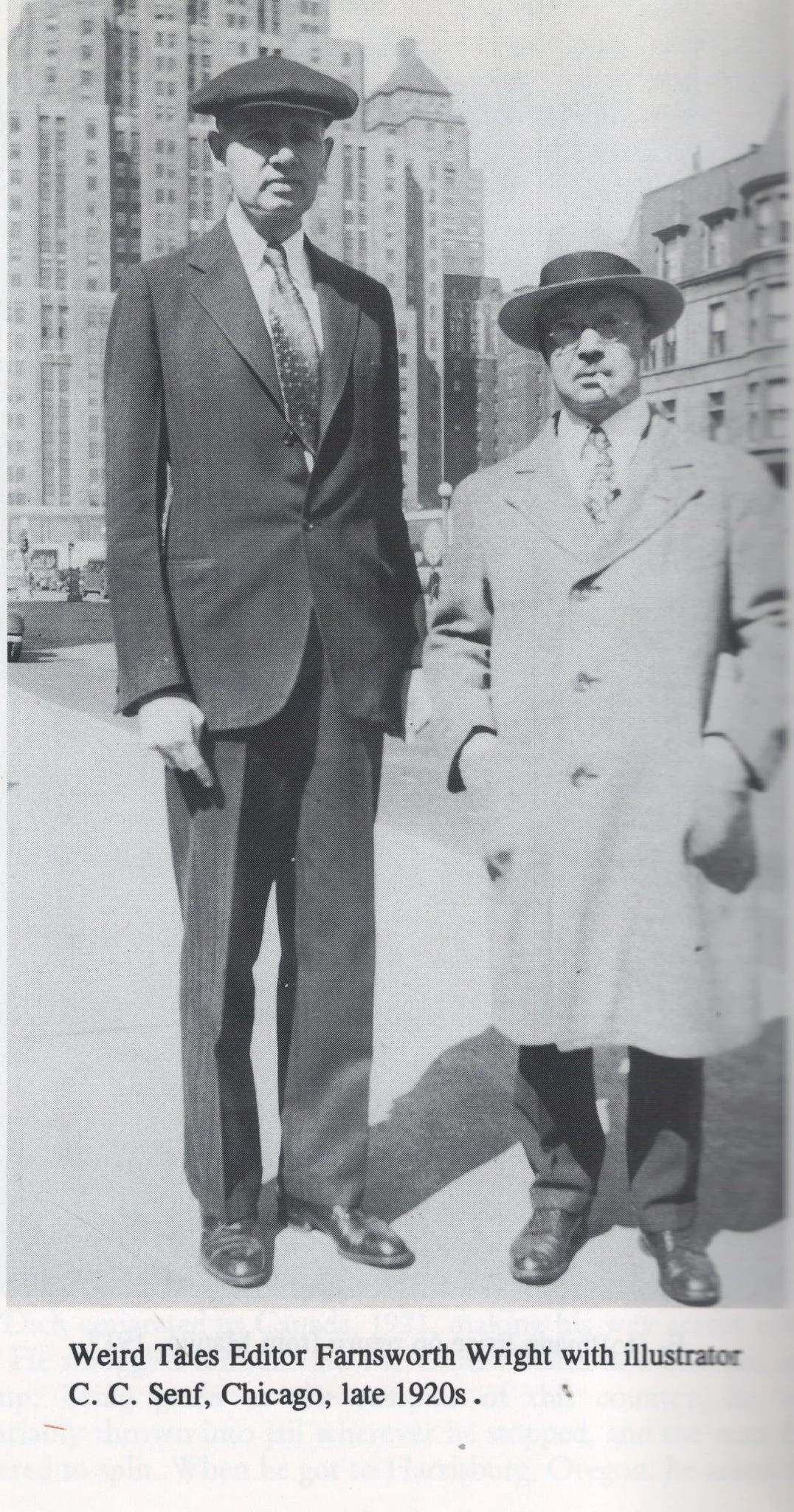
“The Vow” by Farnsworth Wright was first published in The Overland Monthly Aug 1917.
※
The Vow
by Farnsworth Wright
A COLD December rain was falling, but it was uncomfortably warm inside of the train that rolled slowly westward toward Liege. The gray haired, portly German who shared my compartment mopped his face with a handkerchief, rose and paced slowly back and forth. Then he abruptly resumed his seat, and stared out of the car window at the gently rolling fields, from which all traces of the great war had disappeared.
I had already studied him minutely. The nobility of his bearing attracted me, and something in his expression fascinated me. He seemed like one who had endured some terrible ordeal, which had impressed itself into his life and recorded itself indelibly on his face.
As if he felt my gaze, he suddenly looked up, and his eyes met mine. Abashed at being caught staring, I pulled from my pocket a newspaper and proceeded to peruse it, although I already had mastered its contents long before the German boarded the train at Aix-la-Chapelle.
The German noticed the newspaper, glanced at my face, and then looked at the paper again. All this I saw out of the corner of my eye.
“Pardon me, sir,” he said, in a rich, sonorous voice, his accent only slightly suggesting his German origin. “I notice that you are reading the Chicago Tribune. May I ask whether you are an American?”
“Yes,” I answered, thinking that he was probably a German who had lived in the United States.
“Your country fascinates me,” he continued, “and I always enjoy talking to Americans, or to my fellow countrymen who have lived in America. It is the world’s great melting pot, where peoples of different races and religions dwell in peace and amity together, animated by the same ideals, and co-operating one with another. The lesson of America will one day bring the International Republic.”
I looked at him intently, trying to form a correct estimate of him. He was plainly an idealist, yet he seemed also a man who had lived through great experiences.
“So you are an internationalist,” I remarked. “One meets them everywhere since the ending of the Great War.”
“I was an internationalist even before the war,” he said, somewhat proudly. “My belief in internationalism never faltered, even when the world was turned into a madhouse.”
“Then you were not a soldier?” I suggested.
“I was a soldier despite my beliefs,” he explained. ‘‘And yet my beliefs had much to do with my part in the war.
“I was with the first of the gray-clad legions that swept over this region. I took part in the first infantry charge against the cannon-battered forts of Liege, before the war became a siege-battle of trenches. But I went into battle without the spiritual exaltation that animated my comrades and made them glad to die for the Fatherland. My heart revolted at the part I was playing. It was not that my soul cried out against the wrong to little Belgium, for I would have felt the same way toward Russia or England or France. Before the forts of Liege I sought release from my soul-torment, but I bore a charmed life. Instead of death I received the Iron Cross for valor.”
His face displayed a noble dignity such as I have seldom seen. His soft gray eyes seemed to fill with memories, to embrace the past and not the present in their field of vision. Even his fierce, stubby gray mustache could not frustrate the tenderness of those compassionate eyes.
“I fought through the war without receiving a scratch,” he went on. “Once I nearly gained the death I coveted,
but it was denied me. I brought my dearest friend into the grave instead.”
“Some dear college chum?” I hazarded.
“Yes,” he answered. “He laid down his life for me, and I am going now to visit his grave. He died in Flanders.”
“You say you were friends in college,” I said. “Was it at Heidelberg?”
“At Oxford,” he replied.
“Then your ‘dead comrade was an Englishman!” I exclaimed.
“No. He was a Frenchman.”
“How on earth did you, a German, come to be the chum of a Frenchman in an English university? And how did you meet on the battlefield? As foes or as friends? By accident, or by tryst?”
“There were three of us,” he explained. “One was an Englishman, one a Frenchman, and I was a German. We represented three diverse races, three dissimilar languages, yet no comrades ever loved each other more whole-heartedly than we three. We were true Corda Fratres, which is Latin for ‘Brothers in Heart.’
“Filled with the spirit of internationalism and human brotherhood, we felt that our experience was but the forerunner of a similar feeling that some day would sweep over the world and break down the barriers of nationalism everywhere. So we met one night in my room and pledged ourselves to citizenship in the great World Commonwealth. Gone for us, we declared, were the ties that bound us to our native countries. Henceforward we would live for no single nation, but for the world. I solemnly renounced my allegiance to Germany, and my comrades renounced their devotion to France and England. We failed to see that nationalism must be the basis for internationalism. A man does not renounce his family to become a member
of his city or his country. He is at once a citizen of his nation and his district. If he is not a loyal member
of his family, a good citizen of his town, he cannot truly be a citizen of his country. We failed to see that we
must be true citizens of our nations to be citizens of the world. But I am digressing.
“We pledged ourselves never to bear arms for our individual countries, and we became citizens of the world
brotherhood. We named Christmas Day, the anniversary of our vow, as a day of tryst, and agreed to renew our vow each year on that day. We signed the pledge with pens dipped in our own veins, as a token that the same blood flowed through us in spite of our different nationalities. We affixed our names according to the alphabetical order of the Esperanto names of our countries, Anglujo, Francujo and Germanujo: Harold William Hazelwood, Alfred Bonnet, Heinrich Schmid.
“The next summer saw us each in his own country. Then came the thunderclap. Europe speedily became a slaughter-house.
“A wave of patriotic fervor swept each country, and even those pacificists and socialists who had preached the general strike as a preventive of war rushed to the colors. Among them was Hazelwood, my English comrade, stricken by the enlistment fever which hit the English universities like a pestilence. He entered an English drill camp, and became a soldier of the king. Alfred Bonnet and I had no choice. We were receiving military training from our governments at that time, and were at once rushed to the front.
“The months that followed were like a nightmare. At first we advanced rapidly, overrunning Belgium and northern France like an onrushing tidal wave, by sheer force of men and guns. Village after village, city after city, fell to us without offering much resistance, except at Liege and Namur, where the Belgians made a heroic stand. Then the Battle of the Marne was fought, and the opposing armies dug themselves into the earth. The trench lines stretched from Switzerland to the North Sea.
“One day I was ordered to report to my general. I was at that time in Flanders.
“‘Private Schmid,’ said the general, ‘I am informed that you speak both French and English like a native. Is
it true?’
“‘My pronunciation been praised by natives of those two countries,’ I replied.
“‘Private Schmid,’ the general continued, ‘you have received the Iron Cross for valor. Your courage is unquestioned, and we wish to make further use of it. You will be fitted with a French uniform, given a name and full details regarding the French regiment to which you will belong. The man whose name you will bear is a prisoner in our hands, and he bears a close resemblance to you. You will seek out his regiment, impersonate the captured Henri Martel, and bring back certain information which we require. Report to me at midnight in your French uniform, when you will receive final instructions and be passed through our lines.’
“The assignment pleased me because of its very danger. There seemed but little chance to impersonate Henri Martel successfully among those who knew him. I would cease to be an accredited murderer, for I would be put to death as a spy.
“I shaved off my mustache, got into the enemy’s lines, it matters not how, and found Henry Martel’s regiment.
So little of it was left that it was joined to another command, and there remained only one or two men who had known Henri Martel. They did not discover the deception.
“I obtained the information that my general wanted, and then I was ready to escape. I hid my notes in my
boots.
“It was Christmas Day. I was to go on sentry duty that night. I watched the great shells mount from the French guns behind me, and flit through the air with a dull whine, like foul bats, and now and then a German shell plopped into the ground near me. They made a hideous noise, plowing holes into the earth as if they wanted to get back to the infernal regions where they belonged. I watched the cannons spit fire. I heard an occasional dull roar, miles away to the north, from our huge German forty-twos, which the English soldiers called Jack Johnsons because of the clouds of black smoke which they belched. I had seen those monsters pounding Liege in the first days of the war, and I thought they must surely succeed in blasting a path to Calais and Paris, and even to Dover and London. Nothing seemed able to stand against them.
“My spirits sank lower and lower as my hour approached to go on sentry duty. At last the minute came. I
received the countersign, and took my place in a sort of listening pit, with a telephone by my side to give a quick alarm in case of attack.
“I was preparing to make my flight, when through the communicating trench a small group approached, in
command of a lieutenant. It was a party of newspaper correspondents. With them was an Englishman who
had been wounded in the arm. He was acting as interpreter between the French and British soldiers, for his
wound unfitted him for other military duty.
“I did not at first notice the young lieutenant, for my eyes were popping out of my head at sight of the interpreter. It was my English comrade, Hazelwood.
“He started when he saw me. Then he gazed intently into my face to assure himself that it was really I. He
strove to conceal his recognition of me, so as not to doom me, but even his impassive English face could not become a mask after that unexpected meeting.
“The lieutenant addressed him, but Hazelwood did not hear. The lieutenant saw the direction of his gaze, and raised a flashlight to my face. ‘Heinrich!’ he ejaculated, recoiling a pace.
“The lieutenant was Alfred Bonnet.
“‘Alfred!’ I exclaimed. ‘It is you! And Harold is here, too! Do you remember? This is our trysting day! But I am discovered, and now I will find the death I have sought ever since I was forced to bear arms against my brothers. I am a German spy.
“‘Oh, Heinrich, this is indeed the day of our tryst,’ put in Hazelwood, in English. ‘We swore eternal friendship,
but in this tragic moment we are met as enemies!’
“‘Wait for me in the communicating trench,’ Bonnet ordered. ‘I wish a few words with this German before I
give him into custody.’
“The soldiers and correspondents withdrew, and Hazelwood went with them, leaving me alone with Bonnet.
“‘Heinrich, I am desolated,’ he exclaimed. ‘I cannot let you perish. Promise that you will never use against
France any military information you have gained, and you shall escape.’
“‘Alfred,’ I replied, ‘I have violated all my ideals by fighting in this war, and I want to be allowed to die.’
“‘Heinrich,’ he replied with emotion, ‘I cannot permit it. You must at once run for your lines. Go now, while there is yet time.’
“At that he fired a shot into the air.
“‘Now they are coming. Run, run quickly,’ he entreated. “I stood still, and then he shot himself in the shoulder.
“‘Don’t wait! I will say that you shot me in trying to escape. Oh, Heinrich, run, for God’s sake, run!’ he implored, in an agony of impatience.
“He sank to the ground, and I ran blindly into the night. The shots of my pursuers whistled after me. I stumbled into one of our barbed wire entanglements, and went through it, leaving much of my clothing on the
wire.
“How I crawled through the remaining entanglements amid the hail of bullets is more than I can say. I passed the last barrier, then stood upright and walked slowly toward the German trenches. In the glare of the fire balloons my French uniform was recognized, and I became the target of German bullets. I suppose the men
in the trenches thought the French were attacking. But I bore a charmed life, as at all times during the war, and I stumbled into a German trench in a faint, but without a wound.
“When I came to, I was lying in a field hospital. My boots were gone, and I knew that the information which
they contained, and which Bonnet had asked me never to use against France, was even then before the general. I was congratulated for my work, and given a four weeks’ furlough.
“Not until the war was ended did I learn what had become of Alfred Bonnet. He fell ill of his self-inflicted
wound and of the excitement which my appearance and escape had caused him. In his delirium he called on me, pleading with me, implored and begged me to escape. Again and again he lived over his meeting with me, and exhorted me to run, run, and keep running.
“Out of his own mouth he was convicted of aiding an enemy spy to escape. He was tried and shot. On his
grave was placed this inscription:
“‘Traitre Il a perfide son pays.’
“Hazelwood was wounded again shortly afterwards, and took part in the war no more. Bonnet, rotting in
a traitor’s grave, at least was at rest. Only I, the most ardent internationalist of the three, was doomed to fight
on and on as a nationalist, until the very last day of the great conflict. I fought at Ypres, at Verdun, in Picardy,
sometimes against the British and sometimes against the French. Several times my regiment was decimated, and I was assigned to new commands, but I always came through without a wound.
“When the war was over, my first thought was of Bonnet, and then I learned from Hazelwood how he had lost his life in saving mine.
“I am now on my way to Bonnet’s grave in Flanders. Hazelwood and I have removed the lying epitaph which
stigmatized our comrade as a traitor, and we have built him a worthy monument. Each year, on Christmas Day, we clasp hands over his grave and offer prayers for his soul.
“Last Christmas, after our tryst, I went with Hazelwood to England, but this year he will spend several quiet weeks with me in Aix.
“It is good to have such a comrade,” he concluded, and smiled for the first time since he had been talking to me.
The sadness of his face modified his smile, making of it a smile of consecration rather than one of gladness.
The train was rolling into Liege when he finished his narration, and I had to change for the express to Paris. I bade farewell to my new-found friend with genuine regret at parting from him so soon.
Three weeks later I was motoring through the war zone with a friend.
We had been visiting the ruins at Ypres, and from there we turned southeast. A few miles west of the Belgian
frontier my gasoline gave out.
While my friend waited in the car, I took a pail and went to the nearest farmhouse, walking through a line of
trees that had been pollared by shellfire. I succeeded in getting a few gallons of gasoline, and started back with it, when I came across a grave with a marble headstone. I had seen so many soldiers’ graves in the field that they no longer interested me. Possibly it was the marble headstone that caused me to stop, or perhaps it was the weight of the gasoline.
The headstone bore the name of Alfred Bonnet.
Reverently I removed my hat, and knelt down in the falling rain to read the epitaph. In three languages—English, French and German—was scribed:
“A noble friend, a true patriot, he died a martyr to his country, which was the world. May his soul rest in peace.”
※
The United States of America entered the Great War on 6 Apr 1917. “The Vow” is set in the hypothetical period after the war ends. When all the killing and dying is done, and people can look back and reflect on what they did, then. It expresses the hope of internationalism and the ideals of Esperanto as a way to overcome linguistic barriers.
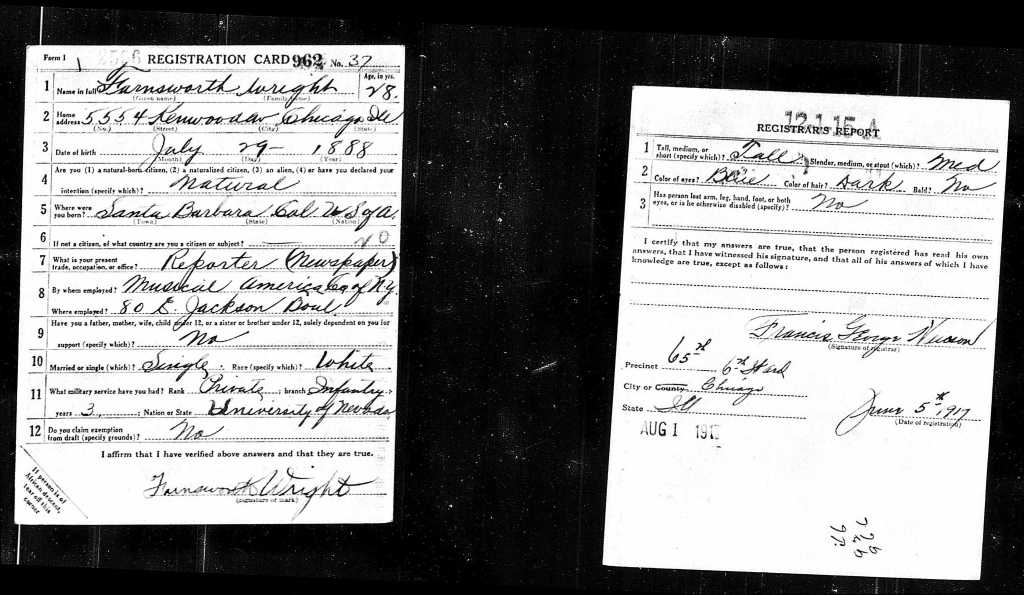
By the time “The Vow” was published, Farnsworth had just registered for the draft, which he did on June 5. Judging from the story, he was weighing his own feelings about participating in the grand conflict. For years, the dispatches from Europe had shocked American readers with tales of wanton carnage on the battlefields of the Western Front. At the same time, the Germans had emerged as the unqualified villains, an impression fueled by the rampant homefront propaganda which abetted American entry into the war.
—John Locke, The Thing’s Incredible! The Secret History of Weird Tales 47
Farnsworth Wright was drafted for the U.S. Army in 1918.
Bobby Derie is the author of Weird Talers: Essays on Robert E. Howard and Others and Sex and the Cthulhu Mythos.
Deep Cuts in a Lovecraftian Vein uses Amazon Associate links. As an Amazon Associate I earn from qualifying purchases.

