“The Medal of Virtue” by Farnsworth Wright was first published in Munsey’s Magazine (Dec 1920), and subsequently in The Detroit News 9 Dec 1923, and may have been published in additional newspapers.
※
The Medal of Virtue
by Farnsworth Wright
The Medal of Virtue (1923) by Farnsworth Wright
“A PACKAGE for Mlle. Josephine Duprez.”
The three men and three women who were making merry in the cage raised their eyes questioningly. A champagne cork was popped.
“A package for me?”
“For you, certainly, if you are Mlle. Josephine Duprez,” said the postman, shaking the rain from his cape.
THe girl lifted her glass for a quick sip of champagne and rose. Her gown was cut low in the front and back and the train dragged.
“A birthday present! A birthday present for Josephine!” shouted Yvette, letting herself fall sideways into the arms of her male companion.
Every one laughed uproariously, as if Yvette had done something immensely clever. It was evident that the liquor was evidently going to their heads, althought it was only midafertnoon and Josephine’s birthday party was to last far into the night.
“Is it from you, Amedee?” inquired Jospheine. “How original you are, to send it to me through the mail!”
She leaned over to plant a kiss on his cheek but her aim was bad and the kiss fell on his open mouth. Every one laughed again. Amedee threw his arms around her and squeezed her until she cried out. Struggling from his embrace, she ran to the postmand and snatched the package from his hand.
“Merci, monsier le facteur,” she thanked him. “But, parbleu, this looks more like a letter than a package. Are you sure it is for me?”
“It is for you, certainly. Ah, thank you, monsieur,” he added, as Amedee poured him a glass of champagne.
He shrugged his shoulders once again to shake up the rain and touched glasses around the table.
“To your very good health,” he said; “and to the felicity of mademoiselle for I perceive it is her birthday party.”
“I am 21,” said Josephine.
• • •
THE postman drank his champagne in little sips, smacking his lips and chewing the bottom of his mustache, not to lose a drop of the sweet liquor. He drained the glass; then, bowing low, he went out into the blustering storm that was drenching the city of Orleans.
“Open the package, Josephine.”
“Open it. A ring, I’ll wager!”
“From the Emperor of China!”
“No, the President of France!”
“From the hunchback of the Rue St. Hermain—the one that makes mooneyes at her!”
A peal of laughter greeted each of these sallies. Josephine succeeded in undoing the package. It contained a little bronze medal. The accompanying parchment proclaimed that the Society of Jeanne d’Arc for the Encouragement of Morality had bestowed on Mlle. Josephine Duprez the medal of virtue in recognition of her many good deeds.
“A medal of virtue for Josephine!”
Her companions shrieked hilariously and fat Albert’s voice went out in little flickering gasps at the top of the scale.
Yvette tore the medal and parchment from Josephine’s hands. Her comrades all tried to read at once.
“For the encouragement of morality!” Yvette proclaimed.
“Hail to our little St. Josephine!” cried Jacqueline with mock reverence.
“For virtue!” piped Albert between glasses.
Josephine stood bewildered. A crimson flush became visible under the rouge on her cheeks.
“A medal of virtue for Josephine!” gurgled Paul, convulsed as if he never had heard of anything so ridiculous.
“She is blushing! She is blushing!” screamed Jacqueline, clapping her hands.
A hot surge of anger flamed up in Josephine. She snatched the medal from Albert’s fat fingers.
“No matter what I am, I am not what you think!” she exclaimed.
Clasping the medal to her breast, she ran out into the street.
• • •
As she hurried furtively across the corner of a public square, her eyes fell upon an equestrian statue of Jeanne d’Arc, the patron saint of the city, whose life and death are portrayed in the cathedral’s stained-glass windows. The cheerful light of a Jeanne d’Arc bakery winked at her through the falling rain. She passed Jeanne d’Arc hotels, Jeanne d’Arc bookshops, Jeanne d’Arc cafes. The whole city seemed to do homage to the white soul of the maid, “La Pucelle d’Orleans.” She muttered a swift prayer to the saint whose memory she had dishonored, but checked herself with a pang of fright. Would that spotless maid receive a prayer from one so fallen?
She reached the convent in a state of agitation bordering on hysteria. She hesitated a minute on the steps. Then, summoning courage, she rang violently. A nun appeared.
“Sister Dolores!” exclaimed Josephine. “I must see Sister Dolores!”
Sister Dolores was out in the city, ministering to the poor. Josephine was told; but she insisted.
“I must see her!” she cried, almost fiercely, clutching the medal tightly to her breast. “I have come all this way in the rain to seek Sister Dolores. Where is she? When will she return?”
The nun, judging from the girl’s agitation that the matter was urgent, gave her three street addresses, and Josephine set out again on her search.
She passed through a squalid quarter, choosing the narrower and less frequented streets. The rain was driving down with increased violence, and Josephine’s wet clothes clung to her flesh. A panic fear assailed her lest she might not be able to find the good nun to whom the medal really belonged. A gnawing sense of depression followed the exhilaration caused by the champagne.
She found herself at last in a lane so narrow that she could touch the houses on both sides by merely extending her two arms. The walls seemed to press in on her, and a great weight lay on her heart.
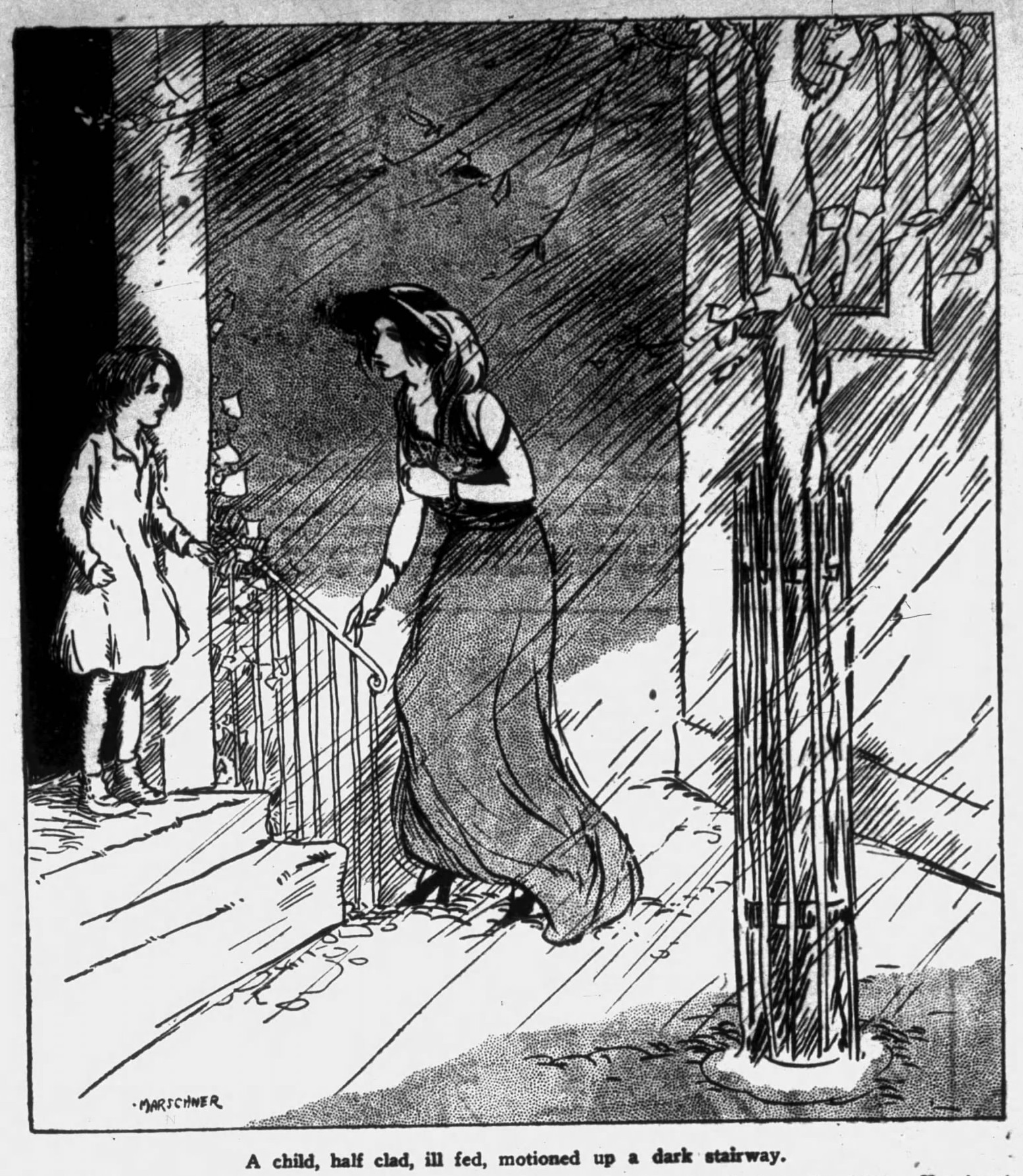
She knocked at the first of the addresses, and inquired whether a sister of charity had been there. A child, half-clad and ill fed, motioned up a dark stairway. Josephine crept up to the landing, and knocked at the door. Her heart was beating wildly. The door opened and she found herself face to face with Sister Dolores.
• • •
JOSEPHINE staggered weakly toward the sweet-faced nun, but for a minute she could not utter a word. Then she held out the medal in both hands. The parchment was crumbled and dripping.
“For you!” she cried. “The medal!”
Sister Dolores looked at her curiously. The plume of her hat sagged heavily across her face dripping water. Her gaudy gown was water-soaked and mud-spattered. Her train was soiled and tangled. Her bodice, cut low, showed the heaving of her breast as she held out the medal to the nun.
“For you! The medal of virtue!”
Sister Dolores seemed not to understand.
“Sit down, my poor girl,” she said. “Then you can tell me what it is all about.”
Josephine did not take the proffered chair. Two or three starved-looking children huddled in a corner, frightened at this sudden apparition. Josephine stood in the center of the room.
“They made fun of it—of your medal! The postman brought it—for Mlle. Josephine Duprez; but it is not for me—it is a medal of virtue. I—I knew your name was Josephine Duprez—like mine—and it must be for you. They all made fun of it—Amedee and Albert and Paul, Yvette and Jacqueline—so I took it away from them.”
Beseechingly she held out the medal and the damp, crumpled certificate. The water dripping from her garments formed a pool on the floor.
“It was my birthday party,” she continued. “I went to the convent, and they—they said you were here—and I came—to find you—to give you the medal.”
The nun gazed at her in pity, seeming puzzled.
“Don’t you see it must be for you?” Josephine implored. “Look!”
She opened the water-soaked parchment.
“‘Mlle. Josephine Duprez,'” she read. “‘For her many good deeds.’ Ah, that is for you! And the postman—he brought it to me—at my birthday party. I—I am a—a—but you would not understand! I am the worst! Yes, it has come to that! I steal at cards. I look over the men’s shoulders when they play. I signal to Amedee what cards they hold. For five years I have led this life. And I was bad before that. I steal—I lie—I sell myself. And the postman brought me a medal of virtue! But I knew it was for you.”
• • •
THE nun took the parchment, still uncomprehending. She smoothed it out and read it. Josephine turned to go.
“Wait, my sister; you must sit down and rest,” said Sister Dolores. “You are tired and wet. You have come a long way in the rain.”
“Yes, a long way,” repeated Josephine absently.
She remained standing.
“You have made a mistake,” said Sister Dolores tenderly, after a pause. “This medal is for you.”
“No, no, no! It is for virtue! See, where it is engraved: ‘The Medal of Virtue!’ It is given for good deeds!”
“Are you then incapable of good deeds?”
“Assuredly, for, look you, I am a—a bad woman. I live in sin—it is my occupation. I am lost beyond hope. Pray for me, sister!” she exclaimed, sinking to her knees in a sudden excess of terror. “Pray for me! I am lost, I am lost!”
“And yet—you left your birthday party to bring me this medal—in the rain—clothed as you are?”
“It was yours, Sister Dolores. I could not keep it.”
“Are you not Mlle. Josephine Duprez?”
“Yet, but the medal was for virtue! That could not be for me.”
“You could have kept the deal. You could have had much mirth over it. You could have ridiculed it with your companions, and added to the gaiety of your birthday party.”
“But it was not for me, sister! It belonged to you.”
Sister Dolores held out her arms.
“My poor child! You deceive yourself,” she said. “You say there is no good in you, yet you left your birthday party to restore this medal to me. You have spoiled your happiness and angered your friends; you have walked mile sin the rain; you have made yourself miserable to do a simple deed of duty that you could easily have left undone. Yet you call yourself lost to noble impulses. Do you not see the springs of good in your nature? In truth, the medal belongs to you. You have earned it.”
• • •
SHE forced the medal into Josephine’s hands. The girl’s pent-up feelings broke their gates, and swept away the reserve she had frantically tried to maintain. She flung her arms about the nun, sobbing violently. Her breast heaved; her heart was pounding. She poured her sorrow and remorse into the sympathetic ears of Sister Dolores. Her years of shame stood out like sickly specters before her awakened eyes, and she saw her wasted life in all its black ugliness.
But when the storm of tears had spent itself, and the passion of grief had moderated, her face was alight with new hope. The nun’s words had uncovered hidden waters, and Josephine realize that she was not incurably evil. She still had good aspirations; she still was capable of noble thoughts and actions. With that realization came the knowledge that her old life was gone like a tale that is told.
Arm in arm with Sister Dolores, she left the house, and these two daughters of Eve passed out into the storm together.
※
If Overland, his reliable magazine of choice, had rejected it, that would help explain why his fiction career faded out at this time. […] Farnsworth was “Exceedingly proud” of this story because it contained a “sacrilegious pun in French.”
—John Locke, The Thing’s Incredible! The Secret History of Weird Tales 50
I read one of his slick paper stories, done years before he took charge of Weird Tales. There were others, though I remember only that one, which, incidentally, he did not give me time to finish. He showed it to me for only one reason: the yarn contains a pun in French, and he was proud of that! And he dismissed his writing by saying that he had soon realized that while he could sell fiction, he could not produce sufficient quantities to make a living.
As to the correctness of his self-appraisal, no one could say, not even he himself, for he did not, as far as we know, ever put the question to the ultimate test.
That pun? The locale of the story was France, where he had served during World War I, as an interpreter. Whether he wore the Sphinx insignia from the start, or later got it as recognition of his linguistic ability, I never learned. But the pun: la plus sale d’Orleans, that is what he wrote when the context of course called for la pucelle, Jean d’Arc. He took a boyish pride in that quip, for he did love puns.
—E. Hoffmann Price, “Farnsworth Wright” in The Weird Tales Story: Expanded and Enhanced 12
Farnsworth Wright wasn’t editor of Weird Tales. Not yet. He had been selling to the magazine, he was reading the submissions, but he was still a journalist and a pulpster on the rise. “The Medal of Virtue” shows that Wright was still writing and selling stories. It is, at once, slightly daring—Josephine admits she’s a sex worker, even if she doesn’t name her profession—and immensely schmaltzy, with a happy ending that might have satisfied any confessions story editor. Plotwise, it’s little more than an episode; setting-wise, it may have been inspired by a visit to Orléans during Wright’s military service in France.
It is tempting in looking at “The Medal of Virtue” to see in it some of the attitudes that Wright would bring to the editorship. Unafraid of a little sex or nudity, tastefully alluded to; willing to court a little controversy, but with enough moral sense to resolve into a happy ending. A story that hinges on character and personality to drive the action, such as it is. A balancing act that produces nothing revolutionary, but good enough for publication. Or perhaps, more simply, the belief that every individual has something to offer, if properly encouraged.
Bobby Derie is the author of Weird Talers: Essays on Robert E. Howard and Others and Sex and the Cthulhu Mythos.
Deep Cuts in a Lovecraftian Vein uses Amazon Associate links. As an Amazon Associate I earn from qualifying purchases.

