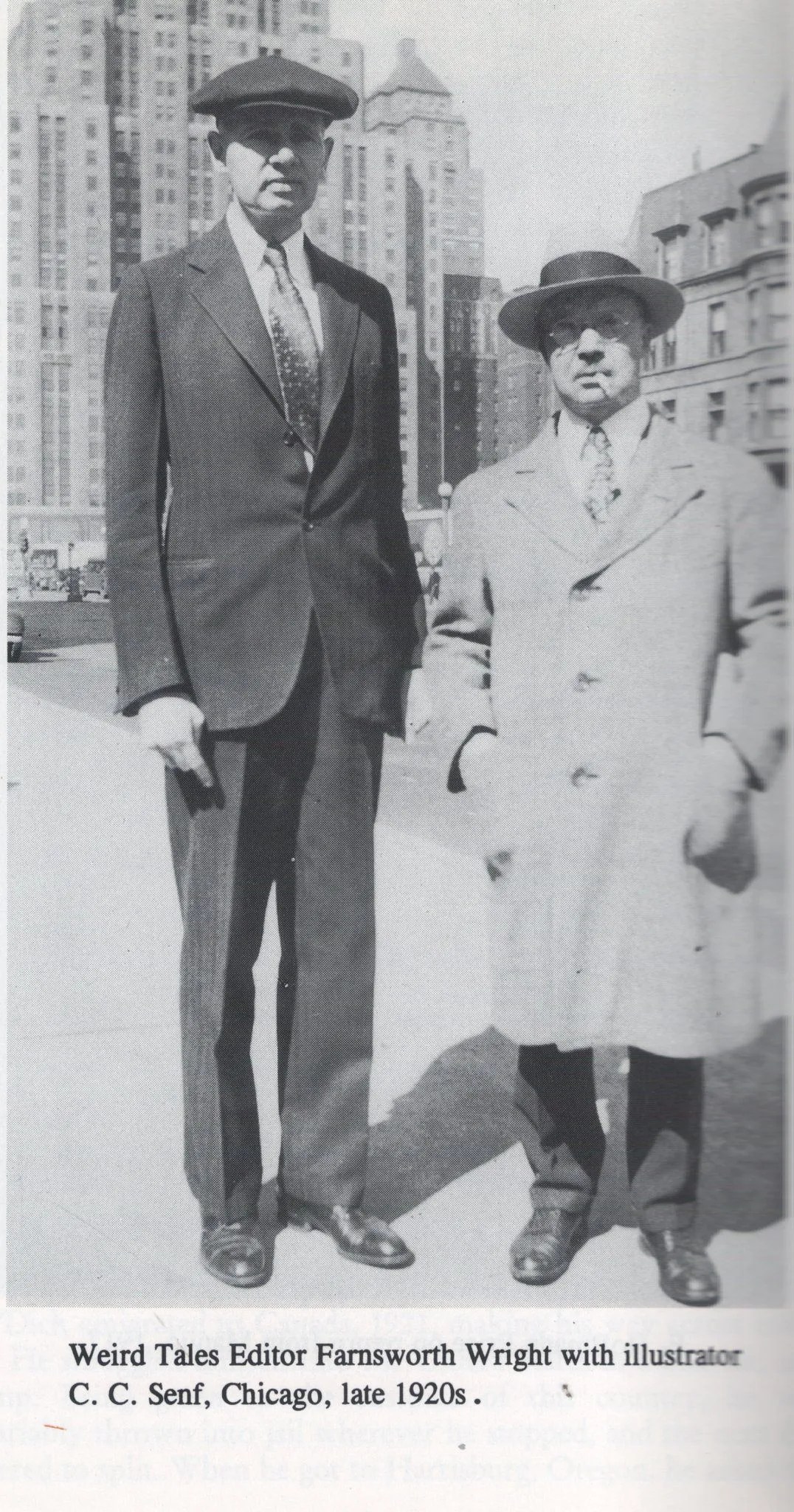
Lost Tale: “The Vow” (1917) by Farnsworth Wright

“The Vow” by Farnsworth Wright was first published in The Overland Monthly Aug 1917. Reprinted in The Snake Fiend and Other Stories (2023).

※

The Vow

by Farnsworth Wright

A COLD December rain was falling, but it was uncomfortably warm inside of the train that rolled slowly westward toward Liege. The gray haired, portly German who shared my compartment mopped his face with a handkerchief, rose and paced slowly back and forth. Then he abruptly resumed his seat, and stared out of the car window at the gently rolling fields, from which all traces of the great war had disappeared.

I had already studied him minutely. The nobility of his bearing attracted me, and something in his expression fascinated me. He seemed like one who had endured some terrible ordeal, which had impressed itself into his life and recorded itself indelibly on his face.

As if he felt my gaze, he suddenly looked up, and his eyes met mine. Abashed at being caught staring, I pulled from my pocket a newspaper and proceeded to peruse it, although I already had mastered its contents long before the German boarded the train at Aix-la-Chapelle.

The German noticed the newspaper, glanced at my face, and then looked at the paper again. All this I saw out of the corner of my eye.

“Pardon me, sir,” he said, in a rich, sonorous voice, his accent only slightly suggesting his German origin. “I notice that you are reading the Chicago Tribune. May I ask whether you are an American?”

“Yes,” I answered, thinking that he was probably a German who had lived in the United States.

“Your country fascinates me,” he continued, “and I always enjoy talking to Americans, or to my fellow countrymen who have lived in America. It is the world’s great melting pot, where peoples of different races and religions dwell in peace and amity together, animated by the same ideals, and co-operating one with another. The lesson of America will one day bring the International Republic.”

I looked at him intently, trying to form a correct estimate of him. He was plainly an idealist, yet he seemed also a man who had lived through great experiences.

“So you are an internationalist,” I remarked. “One meets them everywhere since the ending of the Great War.”

“I was an internationalist even before the war,” he said, somewhat proudly. “My belief in internationalism never faltered, even when the world was turned into a madhouse.”

“Then you were not a soldier?” I suggested.

“I was a soldier despite my beliefs,” he explained. ‘‘And yet my beliefs had much to do with my part in the war.

“I was with the first of the gray-clad legions that swept over this region. I took part in the first infantry charge against the cannon-battered forts of Liege, before the war became a siege-battle of trenches. But I went into battle without the spiritual exaltation that animated my comrades and made them glad to die for the Fatherland. My heart revolted at the part I was playing. It was not that my soul cried out against the wrong to little Belgium, for I would have felt the same way toward Russia or England or France. Before the forts of Liege I sought release from my soul-torment, but I bore a charmed life. Instead of death I received the Iron Cross for valor.”

His face displayed a noble dignity such as I have seldom seen. His soft gray eyes seemed to fill with memories, to embrace the past and not the present in their field of vision. Even his fierce, stubby gray mustache could not frustrate the tenderness of those compassionate eyes.

“I fought through the war without receiving a scratch,” he went on. “Once I nearly gained the death I coveted,
but it was denied me. I brought my dearest friend into the grave instead.”

“Some dear college chum?” I hazarded.

“Yes,” he answered. “He laid down his life for me, and I am going now to visit his grave. He died in Flanders.”

“You say you were friends in college,” I said. “Was it at Heidelberg?”

“At Oxford,” he replied.

“Then your ‘dead comrade was an Englishman!” I exclaimed.

“No. He was a Frenchman.”

“How on earth did you, a German, come to be the chum of a Frenchman in an English university? And how did you meet on the battlefield? As foes or as friends? By accident, or by tryst?”

“There were three of us,” he explained. “One was an Englishman, one a Frenchman, and I was a German. We represented three diverse races, three dissimilar languages, yet no comrades ever loved each other more whole-heartedly than we three. We were true Corda Fratres, which is Latin for ‘Brothers in Heart.’

“Filled with the spirit of internationalism and human brotherhood, we felt that our experience was but the forerunner of a similar feeling that some day would sweep over the world and break down the barriers of nationalism everywhere. So we met one night in my room and pledged ourselves to citizenship in the great World Commonwealth. Gone for us, we declared, were the ties that bound us to our native countries. Henceforward we would live for no single nation, but for the world. I solemnly renounced my allegiance to Germany, and my comrades renounced their devotion to France and England. We failed to see that nationalism must be the basis for internationalism. A man does not renounce his family to become a member
of his city or his country. He is at once a citizen of his nation and his district. If he is not a loyal member
of his family, a good citizen of his town, he cannot truly be a citizen of his country. We failed to see that we
must be true citizens of our nations to be citizens of the world. But I am digressing.

“We pledged ourselves never to bear arms for our individual countries, and we became citizens of the world
brotherhood. We named Christmas Day, the anniversary of our vow, as a day of tryst, and agreed to renew our vow each year on that day. We signed the pledge with pens dipped in our own veins, as a token that the same blood flowed through us in spite of our different nationalities. We affixed our names according to the alphabetical order of the Esperanto names of our countries, Anglujo, Francujo and Germanujo: Harold William Hazelwood, Alfred Bonnet, Heinrich Schmid.

“The next summer saw us each in his own country. Then came the thunderclap. Europe speedily became a slaughter-house.

“A wave of patriotic fervor swept each country, and even those pacificists and socialists who had preached the general strike as a preventive of war rushed to the colors. Among them was Hazelwood, my English comrade, stricken by the enlistment fever which hit the English universities like a pestilence. He entered an English drill camp, and became a soldier of the king. Alfred Bonnet and I had no choice. We were receiving military training from our governments at that time, and were at once rushed to the front.

“The months that followed were like a nightmare. At first we advanced rapidly, overrunning Belgium and northern France like an onrushing tidal wave, by sheer force of men and guns. Village after village, city after city, fell to us without offering much resistance, except at Liege and Namur, where the Belgians made a heroic stand. Then the Battle of the Marne was fought, and the opposing armies dug themselves into the earth. The trench lines stretched from Switzerland to the North Sea.

“One day I was ordered to report to my general. I was at that time in Flanders.

“‘Private Schmid,’ said the general, ‘I am informed that you speak both French and English like a native. Is
it true?’

“‘My pronunciation been praised by natives of those two countries,’ I replied.

“‘Private Schmid,’ the general continued, ‘you have received the Iron Cross for valor. Your courage is unquestioned, and we wish to make further use of it. You will be fitted with a French uniform, given a name and full details regarding the French regiment to which you will belong. The man whose name you will bear is a prisoner in our hands, and he bears a close resemblance to you. You will seek out his regiment, impersonate the captured Henri Martel, and bring back certain information which we require. Report to me at midnight in your French uniform, when you will receive final instructions and be passed through our lines.’

“The assignment pleased me because of its very danger. There seemed but little chance to impersonate Henri Martel successfully among those who knew him. I would cease to be an accredited murderer, for I would be put to death as a spy.

“I shaved off my mustache, got into the enemy’s lines, it matters not how, and found Henry Martel’s regiment.
So little of it was left that it was joined to another command, and there remained only one or two men who had known Henri Martel. They did not discover the deception.

“I obtained the information that my general wanted, and then I was ready to escape. I hid my notes in my
boots.

“It was Christmas Day. I was to go on sentry duty that night. I watched the great shells mount from the French guns behind me, and flit through the air with a dull whine, like foul bats, and now and then a German shell plopped into the ground near me. They made a hideous noise, plowing holes into the earth as if they wanted to get back to the infernal regions where they belonged. I watched the cannons spit fire. I heard an occasional dull roar, miles away to the north, from our huge German forty-twos, which the English soldiers called Jack Johnsons because of the clouds of black smoke which they belched. I had seen those monsters pounding Liege in the first days of the war, and I thought they must surely succeed in blasting a path to Calais and Paris, and even to Dover and London. Nothing seemed able to stand against them.

“My spirits sank lower and lower as my hour approached to go on sentry duty. At last the minute came. I
received the countersign, and took my place in a sort of listening pit, with a telephone by my side to give a quick alarm in case of attack.

“I was preparing to make my flight, when through the communicating trench a small group approached, in
command of a lieutenant. It was a party of newspaper correspondents. With them was an Englishman who
had been wounded in the arm. He was acting as interpreter between the French and British soldiers, for his
wound unfitted him for other military duty.

“I did not at first notice the young lieutenant, for my eyes were popping out of my head at sight of the interpreter. It was my English comrade, Hazelwood.

“He started when he saw me. Then he gazed intently into my face to assure himself that it was really I. He
strove to conceal his recognition of me, so as not to doom me, but even his impassive English face could not become a mask after that unexpected meeting.

“The lieutenant addressed him, but Hazelwood did not hear. The lieutenant saw the direction of his gaze, and raised a flashlight to my face. ‘Heinrich!’ he ejaculated, recoiling a pace.

“The lieutenant was Alfred Bonnet.

“‘Alfred!’ I exclaimed. ‘It is you! And Harold is here, too! Do you remember? This is our trysting day! But I am discovered, and now I will find the death I have sought ever since I was forced to bear arms against my brothers. I am a German spy.

“‘Oh, Heinrich, this is indeed the day of our tryst,’ put in Hazelwood, in English. ‘We swore eternal friendship,
but in this tragic moment we are met as enemies!’

“‘Wait for me in the communicating trench,’ Bonnet ordered. ‘I wish a few words with this German before I
give him into custody.’

“The soldiers and correspondents withdrew, and Hazelwood went with them, leaving me alone with Bonnet.

“‘Heinrich, I am desolated,’ he exclaimed. ‘I cannot let you perish. Promise that you will never use against
France any military information you have gained, and you shall escape.’

“‘Alfred,’ I replied, ‘I have violated all my ideals by fighting in this war, and I want to be allowed to die.’

“‘Heinrich,’ he replied with emotion, ‘I cannot permit it. You must at once run for your lines. Go now, while there is yet time.’

“At that he fired a shot into the air.

“‘Now they are coming. Run, run quickly,’ he entreated. “I stood still, and then he shot himself in the shoulder.

“‘Don’t wait! I will say that you shot me in trying to escape. Oh, Heinrich, run, for God’s sake, run!’ he implored, in an agony of impatience.

“He sank to the ground, and I ran blindly into the night. The shots of my pursuers whistled after me. I stumbled into one of our barbed wire entanglements, and went through it, leaving much of my clothing on the
wire.

“How I crawled through the remaining entanglements amid the hail of bullets is more than I can say. I passed the last barrier, then stood upright and walked slowly toward the German trenches. In the glare of the fire balloons my French uniform was recognized, and I became the target of German bullets. I suppose the men
in the trenches thought the French were attacking. But I bore a charmed life, as at all times during the war, and I stumbled into a German trench in a faint, but without a wound.

“When I came to, I was lying in a field hospital. My boots were gone, and I knew that the information which
they contained, and which Bonnet had asked me never to use against France, was even then before the general. I was congratulated for my work, and given a four weeks’ furlough.

“Not until the war was ended did I learn what had become of Alfred Bonnet. He fell ill of his self-inflicted
wound and of the excitement which my appearance and escape had caused him. In his delirium he called on me, pleading with me, implored and begged me to escape. Again and again he lived over his meeting with me, and exhorted me to run, run, and keep running.

“Out of his own mouth he was convicted of aiding an enemy spy to escape. He was tried and shot. On his
grave was placed this inscription:

“‘Traitre Il a perfide son pays.’

“Hazelwood was wounded again shortly afterwards, and took part in the war no more. Bonnet, rotting in
a traitor’s grave, at least was at rest. Only I, the most ardent internationalist of the three, was doomed to fight
on and on as a nationalist, until the very last day of the great conflict. I fought at Ypres, at Verdun, in Picardy,
sometimes against the British and sometimes against the French. Several times my regiment was decimated, and I was assigned to new commands, but I always came through without a wound.

“When the war was over, my first thought was of Bonnet, and then I learned from Hazelwood how he had lost his life in saving mine.

“I am now on my way to Bonnet’s grave in Flanders. Hazelwood and I have removed the lying epitaph which
stigmatized our comrade as a traitor, and we have built him a worthy monument. Each year, on Christmas Day, we clasp hands over his grave and offer prayers for his soul.

“Last Christmas, after our tryst, I went with Hazelwood to England, but this year he will spend several quiet weeks with me in Aix.

“It is good to have such a comrade,” he concluded, and smiled for the first time since he had been talking to me.

The sadness of his face modified his smile, making of it a smile of consecration rather than one of gladness.

The train was rolling into Liege when he finished his narration, and I had to change for the express to Paris. I bade farewell to my new-found friend with genuine regret at parting from him so soon.

Three weeks later I was motoring through the war zone with a friend.

We had been visiting the ruins at Ypres, and from there we turned southeast. A few miles west of the Belgian
frontier my gasoline gave out.

While my friend waited in the car, I took a pail and went to the nearest farmhouse, walking through a line of
trees that had been pollared by shellfire. I succeeded in getting a few gallons of gasoline, and started back with it, when I came across a grave with a marble headstone. I had seen so many soldiers’ graves in the field that they no longer interested me. Possibly it was the marble headstone that caused me to stop, or perhaps it was the weight of the gasoline.

The headstone bore the name of Alfred Bonnet.

Reverently I removed my hat, and knelt down in the falling rain to read the epitaph. In three languages—English, French and German—was scribed:

“A noble friend, a true patriot, he died a martyr to his country, which was the world. May his soul rest in peace.”

※
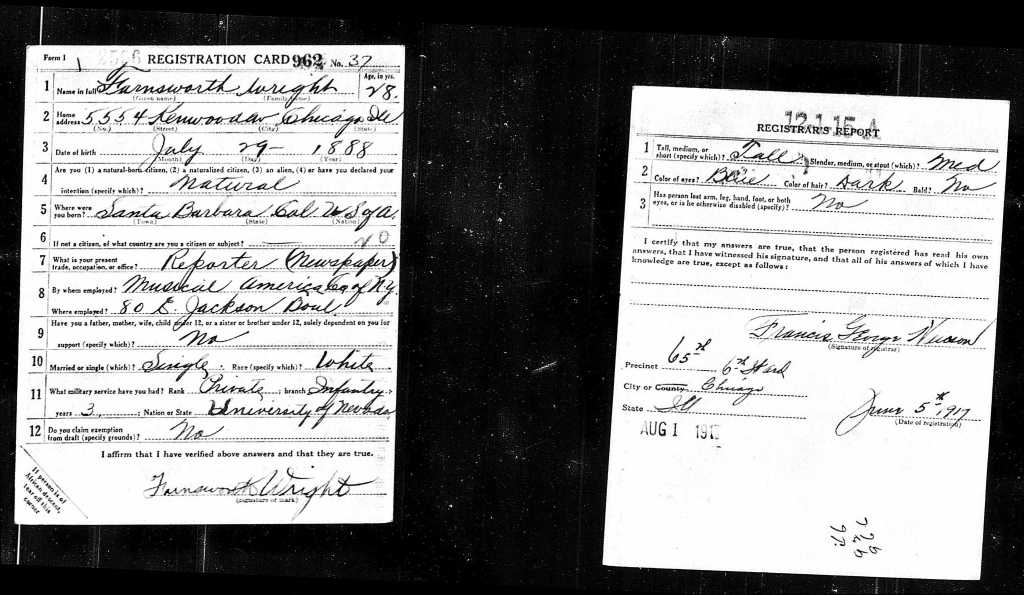
Farnsworth Wright’s Draft Registration

The United States of America entered the Great War on 6 Apr 1917. “The Vow” is set in the hypothetical period after the war ends. When all the killing and dying is done, and people can look back and reflect on what they did, then. It expresses the hope of internationalism and the ideals of Esperanto as a way to overcome linguistic barriers.

By the time “The Vow” was published, Farnsworth had just registered for the draft, which he did on June 5. Judging from the story, he was weighing his own feelings about participating in the grand conflict. For years, the dispatches from Europe had shocked American readers with tales of wanton carnage on the battlefields of the Western Front. At the same time, the Germans had emerged as the unqualified villains, an impression fueled by the rampant homefront propaganda which abetted American entry into the war.
—John Locke, The Thing’s Incredible! The Secret History of Weird Tales 47

Farnsworth Wright was drafted for the U.S. Army in 1918.


Bobby Derie is the author of Weird Talers: Essays on Robert E. Howard and Others and Sex and the Cthulhu Mythos.

Deep Cuts in a Lovecraftian Vein uses Amazon Associate links. As an Amazon Associate I earn from qualifying purchases.

Lost Tale: “Enemies” (1917) by Farnsworth Wright

“Enemies” by Farnsworth Wright was published in The Overland Monthly (Feb 1917). Reprinted in The Snake Fiend and Other Stories (2023).

※

Enemies

by Farnsworth Wright

ARMAND’S baggy red trousers, dirty though they were after weeks of fighting, shone resplendent in the rays of the rising Belgian sun. The French uniforms worn during the first months of the Great War, undoubtedly made a gorgeous show on parade, but they were excellent rifle targets—a fact which the French government had not yet learned.

Armand’s rifle was slung carelessly over his shoulder. He walked slowly towards a well in a deserted farmyard. All the farms in that region were abandoned. The panic-stricken Belgian peasants, taking with them what household goods they could carry, were in wild flight westward towards Antwerp or northward into Holland.

Armand was tired and thirsty. He had a slight wound on the back of his hand, hardly more than a scratch, it is true, but very dirty, and needing to be washed and bound. He was alone, for he had become separated from his regiment a few hours before, during a night encounter with the Germans.

When the Great War broke out with the suddenness of an earthquake, Armand had nearly completed the military training which the French republic requires from each of its able-bodied citizens. But now he must continue to serve until peace should be declared, unless he should be killed or crippled before that time.

He had been hurried into Belgium with the first French troops sent to that unhappy country. Pressed northward by the onsweep of the German tidal wave, his company found itself attached to a Belgian regiment near the frontier of Holland, with the whole of Belgium lying between it and the armies of France. Now he was separated even from the Belgian troops.

Inexpressible hate for the invaders filled his breast. They were trying to murder his country. They had brought this unwelcome change into his life. Had it not been for this inexcusable war (Armand swelled with rage at the thought) he would now be back in his native village in southern France, there to take charge of his father’s shop and live out the rest of his life in obscurity and peace.

One thing more. There was a not bad looking girl of his acquaintance in the village. She would make him an excellent wife. It was high time he was getting married, for would he not be master of his father’s shop and
thus be in business for himself? He was well able to support a wife, indeed, and this girl would not be bad! But now it could not be. The Germans—they were to blame for it all!

As Armand drew near the well a bullet hummed by him. He unslung his rifle at once, and looked around to locate his assailant. His first thought was that the farmhouse concealed a sniper, but the crack of the rifle did
not come from that direction. Another bullet made him hastily seek what shelter he could find behind a large bush.

Cursing the French government for making living targets of its soldiers, he attentively examined the landscape to find his enemy. At length he caught sight of a spiked helmet peering from behind the trunk of a lone poplar, not more than four hundred yards away.

He fired at once, but the helmet disappeared behind the tree trunk. Every time it appeared again, Armand fired, and each time the helmet was quickly withdrawn.

The German soldier who had made Armand the target for his fire at length hit on an expedient to outwit him. He carefully notched the tree with his knife. Then he placed his spiked helmet on his bayonet, and wedged the bayonet into the gash in the tree trunk. The helmet projected to one side, as if some one were trying to
peer around the trunk.

Armand fired twice, and missed. Then the German leaped to the opposite side of the tree and fired three times before he retired behind the trunk again.

All morning the duel continued. Every few minutes the German sprang out to one side or the other from behind the tree and fired at Armand.

Armand returned the fire. But the tension irritated him almost beyond measure, and at times he could hardly see the sights on his rifle, so full of rage was he.

Who was this German? Why did he keep up this senseless fray? Why did he not decently come out and surrender, or at least go away? He must see that his shooting was accomplishing nothing! He had no business in this country anyway! He was a Boche, an invader, a tool of that accursed military despotism which so long had threatened France, and now had little Belgium back against the wall, fighting for life!

A bitter smile curled Armand’s lips at the thought that the Boche was having equally as bad a time of it as he himself.

“The coward!” he thought. “He brought it on himself! To shoot at an unwarned man! No brave man would do such a thing. And he gave me no chance to defend myself!”

Then the thought intruded: “I would have done the same thing! If I had seen him first I would have shot, for this is war! But then he is a Boche! It is these red trousers that gave him his chance!”

Spitefully he blazed away at the German’s helmet until he knocked it down. Then he felt quite satisfied with himself, as if he had shot the German instead of only his helmet. But when his enemy sprang out and fired again, Armand was beside himself with rage.

He was hungry and thirsty, and very angry. The wound in his hand was beginning to pain him. Already the sun was past its zenith.

He decided to stop this foolish fray, in which neither side was winning. He took from his pocket a large handkerchief, but at once put it back again. He wanted something white, but one would never suspect that his handkerchief had once been of that color. He opened his uniform and tore a large piece from his shirt. This he tied to his bayonet, to be a flag of parley. Fixing the bayonet to his rifle, he slowly waved the gun from side to side, and waited for the German to show himself.

When the enemy again leaped from behind the poplar he caught sight of Armand’s improvised flag of truce and did not fire. Armand slowly advanced, waving the white flag.

As he approached the German, he groped in his memory for suitable German words in which to ask for an armistice. He had studied his enemy’s language and even had written to correspondents in Germany before the war broke out.

The German held his rifle ready for use in case Armand should make any threatening move. But Armand, although burning with suppressed anger and indignation, had not come to kill. He wanted to eat and drink and wash his wounded hand.

“Qu’est ce que c’est?” the German called out as Armand drew near.

“Sie sprechen Fransoesisch!”

Armand exclaimed in astonishment.

“Yes, I speak French a little bit,” the German answered slowly, in guttural French. “And you speak also my language, is it not so?”

“I have studied German a little,” Armand replied in German. “But I never have talked it.”

“This German may not be such a bad fellow, after all,” he thought. “He speaks French, too! Still, he tried to kill me when my back was turned! I had best be on my guard.”

Anger filled his heart.

He explained, in broken German, that he was tired of this shooting, and thought it might be well to declare an
armistice until they had eaten and drunk and rested. The German willingly fell in with the scheme.

“Je ne veux pas vous—vous—toeten,” he said.

So the two enemies suspended their strife and went together to the well. They shared each other’s food and
drank to each other’s health, yet each hated the other in his heart.

“Prosit!” said Armand, lifting his cup of water.

“A votre sante!” replied the German.

Armand washed his wounded hand, and was about to bind it with his dirty handkerchief, but the German prevented him. He took from his knapsack a bandage. He sterilized Armand’s wound, and bound the bandage tightly around the injured hand of his enemy.

Armand thanked him and asked him his name.

“Friedrich Krogoll,” replied his enemy; “but my acquaintances all call me Fritz.”

“Then I, too, will call you Fritz, Boche,” said Armand. “I am called Armand Roullier.”

“Freue mich,” said Fritz, relapsing into his own tongue. He extended his hand, and Armand grasped it.

“I was afraid you might try to kiss me,” laughed Fritz.

“Oh, I know where you get your idea of our customs,” said Armand. “You have been visiting the cinema! A
Frenchman doesn’t exchange kisses with a stranger, especially if the stranger is a German.”

And he thought: “This Boche is a good sport, even though he does murder our beautiful language. But he
will bear watching.”

“You come from Paris?” asked Fritz.

Each spoke in the language of the other, filling in the gaps in his vocabulary from his mother-tongue.

“No, I come from the south,” said Armand. “And you?”

“From Munich. I am a Bavarian. But for two years now I am an instructor in the University at Goettingen. I teach entomology.”

“So?” said Armand. “I never could go to the university. I had to work in my father’s shop. My father is old, and I will manage the shop when I get back, if I escape being killed.”

“Ah, this terrible slaughter!” said Fritz. “War is so terrible! The young men, they are the victims. No nation can spare its young men.”

“That is fine talk for a German!” thought Armand. “Why did they begin this war if that is the way they feel?”

But he did not say this aloud.

“Why are you not with your regiment?” asked Fritz, seating himself on the ground.

Armand explained how he had become separated from his comrades in arms.

“I got lost from my regiment because I was too deeply interested in my profession,” said Fritz. “In short, I was chasing a large night beetle. It flew several times, and each time I ran after it. It was not yet light, and I was behind our lines.

“Suddenly I heard the Belgians coming. They charged, yelling like all the devils of hell. They came between me and my command. I was afraid to fire, for fear I might hit my comrades. So I drew away, and thought only of how I could get back to my company. I went far back of the lines, out of the fighting, but it was darker than an Ethiopean Hades, and I did not go the right way. The firing stopped, and I walked a long distance trying to get back to my comrades. But when it was light, I found myself here. And the German soldiers—where are they? I don’t know.”

“I was one of the attacking party,” said Armand. “How the fight turned out I don’t know any more than you do. But—did you find that beetle?”

“Oh, no!” laughed Fritz. “I entirely forgot about the beetle when the Belgians charged. “You and the Belgians, I suppose I ought to say.”

“What were you going to do with it?”

“The beetle? Oh, I was only curious. I could not be certain, in the dark, whether I had seen one like it before. I have a big collection of beetles at Goettingen, beetles from all over the world. Do insects interest you? Your fellow countryman, Fabre, has made a marvelous study of insect life.”

“They don’t interest me very much,” said Armand. “I never collected them, not even butterflies. But I collect postage stamps and coins. It was to help my collecting that I studied German. I write to several collectors in your country, and I correspond regularly with a philatelist in Munich. That is, we corresponded before the war. His name is Franz Link. Did you know him?”

“No. Munich is a large city, and, besides, I have not lived there for several years. My father sent me to
Goettingen, where his brother is a professor of languages. There I did so well that I am now helping to teach in the entomology courses. It is a great study, entomology. But you should learn English, if you are a philatelist. In that language you can correspond all over the world—in Canada, India, the United States, Egypt, Africa and the islands of the Pacific Ocean. It must be very interesting, if one has the time to give to it. Tell me about your village. What is it like in that place?”

Armand told him all the interesting things he could think of about the village. “Professor” Fritz, as he dubbed the youthful looking assistant, then told long tales of the student life in his beloved Goettingen.

Each laughed at the other’s ridiculous errors of speech, for each was speaking a foreign tongue. In the absorbing interest of their conversation they took no note of the lapse of time.

“Hey, Professor Fritz,” Armand at last exclaimed, “I do believe the sun is about to set. It is time to eat again. Please give me some more of that delicious marmalade. And here is a big slice of that cheese you like so much. My father sent it to me out of his shop.”

“The marmalade was made by my mother in Munich,” said Fritz. “How she will laugh when I write her how I
shared it with a Frenchman! Won’t she, though!”

He threw back his head and laughed heartily.

“How my father would rage if he knew his cheese was being eaten by a Boche! He had to send it by way of
England to get it to me.”

Both laughed long and loudly. The German suddenly became very serious.

“Look!” he cried out. “The sun is setting! We must part.”

“Yes,” cried Armand. “We must part. Your way lies yonder. I must go west, but I don’t know whether there are Germans between me and the Belgian troops. If there are, then I must go north.”

“North!” cried Fritz. “That way lies Holland, and you can’t get back until the war is over, if you cross the Dutch frontier.”

“I must go west then,” Armand replied.

“The Dutch frontier is only four or five miles distant, for we have both come north since we left our regiments. And now, my friend”—his face became very grave—“I pray God we may never meet again while the war lasts. You are a good fellow, but we are enemies.”

“Enemies?” exclaimed Fritz. “We were enemies. But now? Tell me, my friend, do you really want to shoot me?”

“I have already said,” Armand answered with emotion, “that I pray God we may never meet again in this war.
It would be murder. It would be like killing one’s brother. It is a terrible thought.”

Fritz stood in silence and listened to the distant roar of cannon. He thought of the lives that were being
blotted out at the minute.

“Holland?” he said at last. “You say it is not far?”

“Not far,” said Armand. “Six miles—perhaps—but maybe only three.”

He saw his own thought reflected in the German’s face.

“Allons, mon ami,” said Fritz, after a minute of silence.

“Come!” said Armand.

* * * *

They had been walking perhaps an hour, in silence, when they heard the pounding of hoofs. Through the deepening darkness they made out a troop of Belgian lancers, galloping west.

“Ha,” said Armand to himself. “I am the master now. I will capture this fine fellow who was going to shoot me down without warning!”

But one look into his companion’s smiling face shamed him from the unworthy attempt. He did not hail the
cavalrymen, and they passed by in the dusk without seeing him.

The two continued north until they were stopped by a Dutch sentry. He could not converse with them, for he
knew neither French nor German. An officer was called.

Armand explained that they had crossed the border into Holland to avoid having to shoot each other. The
officer listened contemptuously, and sent them away under guard.

They were deserters, and their friends would call them traitors. Yet their minds were at peace, for a ray
of light from that nobler age of which poets dream had fallen into their souls. So they smiled as they were led away. The Dutch officer stood looking after them. Perhaps he was touched, perhaps he was only puzzled. At any rate, a mist came over his eyes, but it suddenly vanished, and he turned abruptly on his heel.

“Fools!” he muttered. ‘What would happen if all the soldiers should do that?”

※

While reporting for Musical America, he started selling fiction to the Overland Monthly, placing two well-crated short stories in 1917. Both are war stories centered in Belgium. Both express a staunchly pacifistic perspective and both incorporate the idea of language creating barriers that must be overcome, ideas that flow directly from his engagement with the universal language of Esperanto.
—John Locke, The Thing’s Incredible! The Secret History of Weird Tales 46

The world in 1917 was in the third year of the Great War. Farnsworth Wright, who had grown up during the peace and dedicated time and energy to Esperanto and its society and literature, wrote a war story where the heroic action was not to kill or maim the opponent, but just to end the ceaseless slaughter. It may seem an odd beginning for an editor that would one day deal with werewolves, vampires, cultists, and Conan the Cimmerian, but for all of its idealism, it also shows a solid understanding of the tension and drama in the scenario of two enemies meeting one another, and wondering how far either can trust the other.


Bobby Derie is the author of Weird Talers: Essays on Robert E. Howard and Others and Sex and the Cthulhu Mythos.

Deep Cuts in a Lovecraftian Vein uses Amazon Associate links. As an Amazon Associate I earn from qualifying purchases.

“The Peace Advocate” (1917) by Elizabeth Berkeley

It is true that I once used the pseudonym of “Elizabeth Berkeley” in conjunction with its more rightful owner W. V. J.—in 1916 the name covered certain verses by both authors, in an effort to mystify the public by having widely dissmilar work form the same nominal hand.

H. P. Lovecraft to the Gallomo, 12 Sep 1921, Miscellaneous Letters 121

Winifred Virginia Jackson was the normal owner of the pseudonym “Elizabeth Berkeley,” but Lovecraft borrowed it from his collaborator for two poems: “The Unknown” (1916) and “The Peace Advocate” which was published in the May 1917 issue of The Tryout.

On 4 April 1917, the U. S. Senate voted to declare war on Germany. Like many Americans, Lovecraft had followed news of the unfolding Great War since its opening stages. Lovecraft was firmly on the side of the Allies, no surprise given his ancestral affinity for the United Kingdom. Having joined amateur journalism in 1914 near the start of the war, Lovecraft found the amateur press an outlet for his thoughts and feelings with essays such as “The Crime of the Century” (The Conservative Apr 1915) and “The Renaissance of Manhood” (The Conservative Oct 1915), and once war was declared, poems such as “The Crime of Crimes: Lusitania 1915” (Interesting Items Jul 1915), “The Volunteer” (Providence Evening News 1 Feb 1918), and “To the Nurses of the Red Cross” (1917).

Lovecraft’s position with regard to the war was complicated. He was not in a normal sense an American patriot, reserving his greatest affinity for England and the British monarchy. His support for the British Empire meant his opposition to the Irish home rule movement and Irish nationalism; Lovecraft’s bitterest anti-Irish statements date from around the period of the Easter Rising in 1916 and its aftermath. Racial hierarchies and white supremacist doctrine in the early 20th century lauded the “Teutonic race,” to which the “Anglo-Saxons” of Britain were either a part or close cousins; which is why Lovecraft decried the war as “The Crime of Crimes”—because white people were fighting white people.

It should come as no surprise that Lovecraft was, once hostilities broke out, in favor of war with Germany, yet Lovecraft was not a war-hawk in the normal sense, later writing:

No—we can’t justly endorse any sort of killing except in defence of oneself, or of some racial or national fabric representing one’s larger self.

H. P. Lovecraft to Robert E. Howard, 7 May 1936, A Means to Freedom 2.929

This is to say, Lovecraft did not advocate wars of aggression, but was impassioned in his support for defensive wars, especially when it was his beloved England and its allies (and later, fellow Americans) who were attacked. The initial neutrality of the United States to the war in Europe incensed Lovecraft, who bitterly attacked Woodrow Wilson’s position, and wrote in letters and essays passages like this:

This neutrality hath been a source of the keenest distress and humiliation to me ever since the war began, since I believe that the rightful place of America is at the side of her mother nation, defending the Anglo-Saxon civilisation and ideals which both countries hold in common. In fact, I have more than once blushed at the base and selfish attitude of the States at a time when all the forces of humanity should be engaged in warding off the Hun. Never before was I more disposed to make ostentation of the legal provision which makes me still able, as the grandson in direct male line of a true-born Englishman, to call myself a rightful British subject. England is my country as well as America—let those call me “hyphenate” who so desire!

H. P. Lovecraft to the Kleikomolo, Oct 1916, Miscellaneous Letters 28

Lovecraft’s dislike of neutrality also found expression in his personal discontent with pacifists and anti-war protestors; those who argued either for concessions to the Central Powers to buy peace, or simply opposed the United States sending troops to join a foreign war, or selling weapons and materiel to the Allies, which would only extend the war and its suffering—or as in the case of the Irish-American John T. Dunn, who opposed aiding Britain because he supported Irish nationalism. Dunn would later be drafted, refused to serve, and was sentenced to prison.

When Lovecraft’s Jewish friend Samuel Loveman faced the draft, the man from Providence had no sympathy:

By the way—our mutual friend & fellow-bard Samuel Loveman is in CLass I Div. A, expecting to be called for active duty. In the first draft he was exempted for poor vision, but the requirements are now less strict. If I were Loveman I should enlist. I have no patience at all with a strong man sans dependents who deliberately stays home till dragged out from under the bed. Loveman admts he is “unpoetically robust” & that his sight is not at all seriously impaired. But Jews will be Jews, & I will judge neither harshly nor hastily. He is certainly a very pelasant & exceedingly gifted person, & now that he is subject to call, shews no sign of timidity or unrest. I trust his career may be honourable, & tht he will meet with an easier fate than the other soldier-poets, Brooke, Seeger, Ledwidge, et al.

H. P. Lovecraft to Rheinhart Kleiner, 23 Feb 1918, Letters to Rheinhart Kleiner & Others 103-104

As it happened, Loveman spent most of his military service 1918-1919 at Camp Gordon in Georgia, and did not serve overseas.

A recurring theme in Lovecraft’s war-poems, essays, and letters is masculine identity and its ties with white supremacist national identity. Anglo-Saxons and Teutons were in the racial rhetoric of the day supposed to be warriors and conquerors who had dominated the globe because racial superiority was synonymous with martial superiority. It was a white man’s place to show courage and gladly answer the call. For Lovecraft, these were not just armchair ideals: not long after “The Peace Advocate” was published he attempted to enlist.

Some time ago, impressed by my entire uselessness in the world, I resolved to attempt enlistment despite my almost invalid condition. I argued that if I chose a regiment soon to depart for France; my shear nervous force, which is not inconsiderable, might sustain me till a bullet or piece of shrapnel could more conclusively & effectively dispose of me. Accordingly I presented myself at the recruiting station of the R. I. National Guard & applied for entry into whichever unit should first proceed to the front. On account of my lack of technical or special training, I was told that I could not enter the Field Artillery, which leaves first; but was given a blank of application for the Coast Artillery, which will go after a short preliminary period of defence service at one of the forts of Narragansett Bay. The questions asked me were childishly inadequate, & so far as physical requirements are concerned, would have admitted a chronic invalid. The only diseases brought into discussion were specific ailments from which I had never suffered, & of some of which I had scarce ever heard. The medical examination related only to major organic troubles, of which I have none, & I soon found myself (as I thought) a duly enrolled private in the 9th Co. R.I.N.G.! As you may have deduced, I embarked upon this desperate venture without informing my mother; & as you may also have deduced, the sensation created at home was far from slight. In fact, my mother was almost prostrated with the news, since she knew that only by rare chance could a weakling like myself survive the rigorous routine of camp life. Her activities soon brought my military career to a close for the present. It required but a few words from our family physician regarding my nervous condition to annul the enlistment, though the army surgeon declared that such an annulment was highly unusual & almost against the regulations of the service. The fact is, I had really gotten the best of that astute medicus; for without making a single positive misstatement I had effectively concealed the many & varied weaknesses which have virtually blasted my career. Fortune had sided with me in causing no attack of blurred eyesight to come upon me during the physical examination. But my final status is that of a man “Rejected for physical disability.” On the appointed day I shall register for conscription, but I presume my services will not be desired. My mother has threatened to go to any lengths, legal or otherwise, if I do not reveal all the ills which unfit me for the army. If I had realised to the full how much she would suffer through my enlistment, I should have been less eager to attempt it; but being of no use to myself it was hard for me to believe I am of use to anyone else. […] And so I am still in civil life, scribbling as of old, & looking with envious eye upon the Khaki-clad men who are now so frequently seen upon the streets of the business section & in the cars everywhere. […] Had my enlistment matured successfully, I wonder how I should have kept up! And yet—I will wager that I would have kept up some way or other. Now that death is about to become the fashion, I wish that I might meet it in the most approved way, “Somewhere in France”.

H. P. Lovecraft to Rheinhart Kleiner, 23 May 1917, Letters to Rheinhart Kleiner & Others 83-84

The effect on Lovecraft was dejection. While readers today might be glad that Lovecraft did not die as part of the American Expeditionary Force, for Lovecraft it was as those who hold their manhood cheap on St. Crispin’s Day. In a subsequent letter, he lamented:

I am feeling desolate & lonely indeed as a civilian. Practically all my personal acquaintances are now in some branch of the service, mostly Plattsburg or R.I.N.G. Yesterday one of my closest friends entered the Medical (not as a doctor, but as an assistant—carrying stretchers, driving ambulances, &c. &c.) Corps of the regular army. The physical tests for this corps are very light, & in spite of my previous rejection for Coast Artillery I would try to enter, were it not for the almost frantic attitude of my mother; who makes me promise every time I leave the house that I will not make another attempt at enlistment! But it is disheartening to be the one non-combatant among a profusion of proud recruits.

H. P. Lovecraft to Rheinhart Kleiner, 22 Jun 1917, Letters to Rheinhart Kleiner & Others 85

As it was, Lovecraft had to content himself by offering what moral support he could, in the form of poems in praise of those who could serve. This is the context we must imagine for when Lovecraft was writing “The Peace Advocate”: fighting had been going on for almost three years, yet the United States retained its stubborn neutrality as the Allies and the Central Powers engaged in bloody trench warfare in Europe, allied shipping faced German submarines, Britain itself was bombed from the air by zeppelins, and around the world the colonies and allies of the two sides clashed in a truly global conflict.

“The Peace Advocate” is a narrative poem about a conscientious vicar who opposes war (implicitly on religious grounds), even as his son goes off to fight, until the invaders literally land on his doorstep, destroying his church. The vicar regains his masculine ferocity (“manhood’s thought,” “with the manhood he had found,” “wak’d to man’s estate”) and fights to defend his home—too late, for his wife and daughter both die in the fray.

The politics and philosophy are not complex, and would be counted as propaganda if published by some government outlet. The fore are faceless, the reasons and causes of the war utterly unknown and opaque. It’s enough that they are the invaders in the universe of the poem. Lovecraft makes no effort to understand the peace advocate’s position or give them any arguments for opposing war; the combat and loss, on the other hand, are effective and brutal to support the moral. In failing to join the fight in time, the vicar has failed as a husband and father…and perhaps importantly, burns his book.

Prieſt. Give peace in our time, O Lord;
Anſw. Becauſe there is none other that fighteth for us, but only thou, O God.

1662 Book of Common Prayer

Lovecraft was a materialist and atheist; while not militantly anti-Christian, he did oppose the passivity and turn-the-other-cheek theology as counter to his ideas of the natural character of white people. Influenced by Nietzsche and similar thinkers, Lovecraft attributed this attitude to the Jewish origin of Christianity. As he would put it after the war:

Semiticism has never done anything save harm when forced upon us or adopted by accident. It gave us the puling hypocrises of the Christian doctrine—us, who by every law of Nature are virile, warlike, and beauty-loving pagans and Northern polytheists!

H. P. Lovecraft to Frank Belknap Long, 21 Aug 1926, Selected Letters 2.67

It is a rhetorical trick to make the subject of the poem a Christian priest, because Lovecraft can imply a religious motivation for antiwar sentiment without actually engaging with any religious arguments.

Of all the stanzas in the poem, one in particular stands out in its imagery as possibly being inspired by another poem:

His son had buckled on his sword,
The first at the front was he;
But the vicar his valiant child ignor’d,
And his noble deeds in the field deplor’d,
For he knew not bravery.

While “buckled on his sword” could be a metaphor for joining the Army and taking up arms against the foe, there is a parallel with another very well-known war song:

The Minstrel-Boy to the war is gone,
 In the ranks of death you’ll find him;
His father’s sword he has girded on,
 And his wild harp slung behind him.
“Land of song!” said the warrior-bard,
“Tho’ all the world betrays thee,
One sword, at least, thy rights shall guard,
One faithful harp shall praise thee!”

Thomas Moore, “The Minstrel Boy”

This could be simply parallel imagery: Moore was after all writing specifically from an Irish nationalist perspective, while Lovecraft was in the midst of his anti-Irish period, and there wasn’t much common purpose there. On the other hand, there would be a certain irony in appropriating the image of the boy who clads on his father’s sword to go to war, when the father himself stays home as a take-that to Irish nationalists who refused to fight in Britain’s aid. Lovecraft’s letters are silent on the subject, no doubt to maintain the illusion that “Elizabeth Berkeley” had written the verses.

Lovecraft’s motivations and ideology in writing this piece were wrapped up in contemporary politics and ideas of masculinity, national identity, and racial identity; he failed to attempt to accurately understand or present anti-war arguments in his letters, essays, and poems, because his rhetorical purpose was in support of the side of the conflict he identified with. It is one thing to understand, from an intellectual standpoint and the distance of years, how Lovecraft’s ideas and rhetoric were shaped by the forces of his life…and there are flaws in both.

Yet how would “The Peace Advocate” be received in Ukraine if it was published in 2023? As the men and women of that nation strive to defend their people, their culture, and their borders from the invading military forces of the Russian Federation? Would they not see parallels between the parable of “Elizabeth Berkeley” and Russia’s indiscriminate bombing of civilians and the Transfiguration Cathedral in Odessa?

While Lovecraft’s ideology is flawed and his rhetoric ignores real tenets of and arguments for pacifism, or conscientious objection, there is an argument to be made that in the face of unprovoked aggression, there exists a moral justification to take up arms and resist. Every individual, and nation, has the right to self-defense—and if necessary, to meet deadly force with deadly force. Slava Ukraini.

“The Peace Advocate” is not one of Lovecraft’s more influential works, in part because he never openly acknowledged authorship and it has seldom been reprinted. There is nothing weird or supernatural about it, there are no connections to the Mythos, and it was written years before Weird Tales first hit the stands or Cthulhu was conceived. That it holds any resonance to events in 2023, over a century after it was first published, is due only to the fact that war is as much a reality today as it was then. In that respect at least, less has changed than we might have hoped.

“The Peace Advocate” may be read in its entirety at https://hplovecraft.com.


Bobby Derie is the author of Weird Talers: Essays on Robert E. Howard and Others and Sex and the Cthulhu Mythos.

Deep Cuts in a Lovecraftian Vein uses Amazon Associate links. As an Amazon Associate I earn from qualifying purchases.

The Supernatural in Modern English Fiction (1917) by Dorothy Scarborough & The Tale of Terror (1921) by Edith Birkhead

W. Paul Cook wants an article from me on the element of terror & weirdness in literature, but I shall take my time about preparing it.
—H. P. Lovecraft to Lillian D. Clark, 19 Nov 1925, Letters to Family & Family Friends 1.492

In November 1925, while living alone at 169 Clinton Street in Brooklyn, New York, H. P. Lovecraft was asked to write for his friend W. Paul Cook’s amateur journal, The Recluse. Up to this point, Lovecraft had been a fan of weird fiction and read many of the major works in the field, and a reader and contributor to Weird Tales for the last two years, but had never undertaken a systemic course of reading on weird fiction. Now without a wife or regular employment, he had an excuse to do so—as well as the resources of the New York Public Library and Brooklyn Public Library to draw on.

A significant chunk of this reading, and the initial chapters of what would become “Supernatural Horror in Literature” was completed by May 1926; in April of that year, he moved back to Providence, Rhode Island. The final sketching and typing of the long essay was delayed by further discoveries at the Providence Public Library, and Lovecraft continued to make last-minute alterations up until 1927; the essay was finally published in The Recluse in August 1927.

I want to get down to the publick library & read that Timothy Dexter book, (of which Tryout has just sent me another fine review) as well as Gemmill’s new work on the Salem witch trials, & a volume of two or three years ago on the tale of terror.
—H. P. Lovecraft to Lillian D. Clarke, 19 Nov 1925, LFF 1.493

[…] went out to the Bklyn. Library, got Birkhead’s history of “The Tale of Terror”, came home & read it through, & retired 7 a.m.
—H. P. Lovecraft to Lillian D. Clarke, 25 Nov 1925, LFF 1.495

Chapters III & IV of “Supernatural Horror in Literature” are devoted to Gothic literature, and while Lovecraft did peruse the Gothics, one of his major acknowledged sources for these early chapters was The Tale of Terror: A Study of the Gothic Romance (1921) by Edith Birkhead, an assistant lecturer in English literature at the University of Bristol. Birkhead’s study was pioneering in many ways, but as David Punter points out in The Literature of Terror, not only was it a very readable and accessible volume, but it was free of the defensive attitude toward genre fiction that characterized many other works on supernatural and Gothic fiction.

Even in the 1920s, there was something a little trashy and disreputable about such literary fare; penny dreadfuls and purple prose. Folks today still make fun of a novel starting “It was a dark and stormy night…” but that was the actual opening to Edward Bulwer-Lytton’s neo-Gothic novel Paul Clifford (1830), which Birkhead mentions in passing. Even Lovecraft was not above taking a shot at such works, referring in his essay to:

[…] the dreary plethora of trash like Marquis von Grosse’s Horrid Mysteries (1796), Mrs. Roche’s Children of the Abbey (1796), Miss Dacre’s Zofloya; or, The Moor (1806), and the poet Shelley’s schoolboy effusions Zastrozzi (1810) and St. Irvyne (1811) (both imitations of Zofloya) […]

While Lovecraft did read several Gothic novels in the course of his research, the ones listed above are not books which Lovecraft tracked down and read for himself: he was distilling Birkhead’s more detailed history of Gothic literature for his own purposes. No doubt Lovecraft also appreciated that Birkhead did not stint on attention to American Gothic authors such as Nathaniel Hawthorne and Edgar Allan Poe in her chapter on “American Tales of Terror,” and her description of Poe in particular has many echoes with Lovecraft’s own stylistic efforts:

But Poe’s psychology went deeper than that of the writers of romance. His art was much subtler, finer, and more self-conscious than theirs. He was a penetrating critic of his own work, and was deeply interested in craftsmanship. No doubt he analysed the structure of his tales as closely as that of his poem, The Raven, and studied constantly their precise effect on the mind of the reader. In his best tales we feel that he knows from the first sentence exactly what the end is to be. In choosing his subject, he intentionally shuns the normal and turns to the odd, the exceptional and the bizarre. He watches for the airy, gossamer filaments of sensation that float unrealised through most men’s minds and transfers them to his stories. He imagines obscure feelings as intensely as he imagines actual scenes. It seems as if he had brooded so long over his story and become so completely absorbed into its atmosphere that the fine shades of emotion are as real to him as the background he has conceived as a setting. He does not aim at depicting character. The people in his tales are little more than algebraical symbols. he prefers to follow the twists and turns of a brain working under some abnormal influence. His not interested in healthy human minds or hearts. […] His pictures are sometimes so vivid that they make the senses ache. Like Maturin, he even resorts to italics to enforce his effect. He crashes down heavily on a chord which would resound at a touch. […] While he was writing, Poe did not for a moment let his imagination run riot. the outline of the story was so distinctly conceived, its atmosphere so familiar to him, that he had leisure to choose his words accurately, and to dispose his sentences harmoniously, with the final effect ever steadily in view. the impression that he swiftly flashes across our minds is deep and enduring.
—Edith Birkhead, The Tale of Terror 219-220

Lovecraft’s opinion on Birkhead’s book was mixed. While he did not hesitate to recommend it to his friends and correspondents, notably August Derleth (who would write his thesis on “The Weird Tale in English Since 1890“) and Donald Wandrei (who was taking an honors course in Gothic fiction at university), to Wandrei he admitted:

I read the Birkhead book on “The Tale of Terror”, but found it exceedingly ill-proportioned & imaginatively unappreciative.
—H. P. Lovecraft to Donald Wandrei, 11 Dec 1926, Letters with Donald and Howard Wandrei 22

No doubt, this was due to the relative narrowness of the scope of The Tale of Terror, and because Lovecraft’s own tastes—reflected in “Supernatural Horror in Literature”—were focused on the uncanny and supernatural, more than the merely terrible or gruesome phases of literature, and because Birkhead’s remit ran out before she tackled contemporary weird fiction or writers such as Arthur Machen or M. R. James. In other places, Lovecraft was more effusive in his praise:

Do you know Railo’s “The Gothic Castle” & Birkhead’s “The Tale of Terror”? Both are excellent exposition of the earlier phases of horror-fiction in English—the Walpole-Radcliffe-Lewis-Maturin type. I could lend you the Birkhead book.
—H. P. Lovecraft to J. Vernon Shea, 22 Mar 1932, Letters to J. Vernon Shea 92

Eino Railo was a Finnish scholar whose treatise The Haunted Castle: A Study of the Elements of English Romanticism was published in English in 1927. Lovecraft would count his work along with Birkhead as one of the default textbooks on Gothic fiction, although he read it too late to incorporate into the first publication of his own article:

Speaking of Gothic source material—Cook has just lent me a brand new book by one Eino Railo (never heard of him before) which for thoroughness throws Birkhead altogether into the shade—although its scope is even narrower.
—H. P. Lovecraft to Donald Wandrei, 22 Oct 1927, LWP 171

Lovecraft did not cease collecting material after “Supernatural Horror in Literature” was published, but continued to collect notes with an eye toward a revised version of the text, incorporating more material he subsequently found on important authors like William Hope Hodgson. In this, Wandrei was very useful in pointing Lovecraft toward some other sources:

By the way, in looking through the bookstacks of the University library the other [day], I came across “The Supernatural in Modern English Fiction”, by Dorothy Scarborough; it does not seem to be especially good as a monograph but it mentions a great many books and tales which I do not know. I have also discovered at the U. a professor whose speciality is the eighteenth century and who is fond of Gothic literature. He says a French book on the subject has just been issued, under the title, I think, “Le Roman de Terreur”. I don’t remember the author’s name, but I’ll find it out. The book apparently has not come into the library as yet; hence I can’t say how good it is.
—Donald Wandrei to H. P. Lovecraft, 28 Feb 1927, LWP 59-60

Dorothy Scarborough, PhD., was an English instructor at Columbia University, and her work The Supernatural in Modern English Fiction (1917) is an extensive survey of the entire field of supernatural works in English, though even with this vast scope and a bibliography of some three thousand titles, she admits in her preface that it isn’t possible to mention every title, the field is simply too vast. Still, her volume represents one of, if not the, first major assay of the field of supernatural fiction in English. Her general expertise on ghost stories was acknowledged in several collections, notably The Best Psychic Stories (1920), Humorous Ghost Stories (1921), and Famous Modern Ghost Stories (1921)

The other work Wandrei mentions is Le roman “terrifiant”: ou, Roman noir de Walpole à Anne Radeliffe et son influence sur la littérature française jusqu’en 1840 (The ‘Terror’ Story, or the Black Novel from from Walpole to Anne Radeliffe and its influence on French literature until 1840,” 1923) by Alice M. Killen, a revision of her 1920 thesis. This is a strictly French-language work on the Gothic novel in much the same vein as Railo and Birkhead, although again with a narrower focus. Lovecraft didn’t read French and never saw Killen’s book, though he continued to cite her as an expert in the field—but he did read Scarborough.

Thanks tremendously for the Scarborough book, which I read with keen interest & am going to return the first moment I can get to a post office. It was certainly kind of you to send it. The material is really of great value, & I am immensely glad I had a chance to go through it. As you say, the weakest parts are those dealing with later work. The author does not mention M. R. James, & her prim distaste for Machen’s macabre suggestions is rather amusing. Likewise, her efforts to be continually jocose & flippant become a little strained as one reads on. There is no conflict with my article, because the scope & method of the work are entirely different. This book covers not only horror but all forms of the supernatural, & includes the comic & the lightly whimsical as well as the grotesque & the terrible. Also, its plan of development & system of emphasis is entirely different. What I am trying to do is give a  list of especially notable works containing supernatural horror; listing them by periods & authors & allotting them notice on the basis of their strength & merit in the given field. Dr. Scarborough, on the other hand, is trying to trace certain types of subject-matter through literature in a less critical way—being interested in the mere mention of a certain superstition by an author, & listing items simply because they deal with such-&-such—not because they have a special power to influence the emotions. This system involves a radically different form of outline, as you see. Instead of going ahead chronologically & treating the most powerful books of each period, Scarborough follows first one stream of subdivided subject-matter & then another—i.e., ghosts, devil, vampire, werewolf, wandering Jew, metempsychosis, alchemy, folklore, science, &c. &c. In the course of this scheme she lists many things so pallid & inane that one can hardly think of their deserving a place except from the standpoint of academic scholarship. And yet, for all that it’s a valuable book. It certainly brings out many essential facts & tendencies amazingly well, & will bear comparison with anything else on this theme ever written. The separate & perhaps encyclopaedic bibliography edited by Dr. S. must be another item of great importance. Let me know any time you want to see the Birkhead book. […] I obtained several hints from Scarborough, & also copied two tributes to the weird as a genre from the introduction—Lafcadio Hearn’s & the author’s own. Whether I’ll ever get around to preparing a second & amended edition of my article, I’m sure I don’t know.
—H. P. Lovecraft to J. Vernon Shea, 31 Mar 1932, Letters to J. Vernon Shea 95

As it happened, Lovecraft did get that chance. Charles D. Hornig, the editor of The Fantasy Fan fanzine, serialized the revised essay in parts from 1933-1935…at which point the series ended, having only published up to the revised chapter VIII. The full revised text was not published until two years after Lovecraft’s death, in The Outsider and Others (1939, Arkham House).

The influence that Scarborough had on Lovecraft’s revised version of “Supernatural Horror in Literature” is hard to measure. A comparison of the original 1927 text and the 1939 text show some substantial revisions, some of which might be due to additional authors and insights provided by Scarborough, but others which concern contemporary authors that Scarborough’s book doesn’t touch upon. Yet for the rest of his life, Lovecraft generally acknowledged the authority of Birkhead and Scarborough in passages like:

Weird elements have permeated literature since prehistoric times—flourishing in Elizabethan drama & forming a distinct school since the middle of the eighteenth century. (cf. “The Tale of Terror” by Edith Birkhead; “The Haunted Castle”, by Eino Railo; “The Supernatural in Modern English Fiction”, by Dorothy Scarborough—all presumably obtainable at the public library […]
—H. P. Lovecraft to C. L. Moore, 12 Apr 1935, Letters to C. L. Moore 30

Perhaps the most remarkable thing about Lovecraft’s acknowledgement of the expertise of these two women is how unremarkable it is. Lovecraft at no point makes any issue of their gender, and while he does not agree with them in all particulars, he also does not associate the source of that disagreement with their being women. He acknowledged their expertise and scholastic efforts, at least in their letters. While “Supernatural Horror in Literature” only credits Birkhead and not Scarborough, that is no doubt because he leaned much more heavily on Birkhead’s scholarship in the early chapters on the Gothics.

Since his death, Lovecraft’s “Supernatural Horror in Literature” has probably become his most influential essay, a survey and definition of the field of weird fiction which, while not as exhaustive as that of Birkhead, Railo, Killen, and Scarborough, is more focused on what we think of as the “weird tale” today. If Lovecraft saw a little further than other weird talers during his lifetime, it was because he stood on the shoulders of giants like Birkhead and Scarborough, and all those who cite his essay are in turn being influenced by these great women scholars of the weird.

Edith Birkhead’s The Tale of Terror: A Study of the Gothic Romance may be read for free online here.

Dorothy Scarborough’s The Supernatural in Modern English Fiction may be read for free online here.


Bobby Derie is the author of Weird Talers: Essays on Robert E. Howard & Others (2019) and Sex and the Cthulhu Mythos (2014).