
Historical Racism
This story contains racist historical stereotypes.
Reader discretion advised.
This story was first published in The Leatherneck, June 1926. The Malecón de Santo Domingo is the seafront boulevard that runs along the bay.
For more details, please see the Lost Weird Tales of Arthur J. Burks.
※
The Guardian of the Malecon
by Arthur J. Burks
The little sneaky street which leads westward to the Malecon is as dark as Erebus. Narrow, evil smelling—thoroughfare of the poor who spend their days in gazing out to sea, their evenings on the stone sidewalks that were built in the time of Columbus and his brutal governors, and their nights behind the locked doors of huts. The huts themselves are very old, and the paint has scaled off in so many places that most of them have the scarred look of aged lepers who have given up all hope. There are cracks between the twisted boards which let in the rain during the rainy season, and through which, after nightfall, the reddish glow of subdued native lanterns comes out to the traveler who stumbles along the cobblestones. If one pauses to listen one may hear the pitiful wailing of babies who have gone to bed supperless, and the soft crooning of native mothers who try to soothe them. The little street is stifling, seems to weight down upon one, dampening one’s spirits weirdly.
Especially the night of the first moanings of the last hurricane.
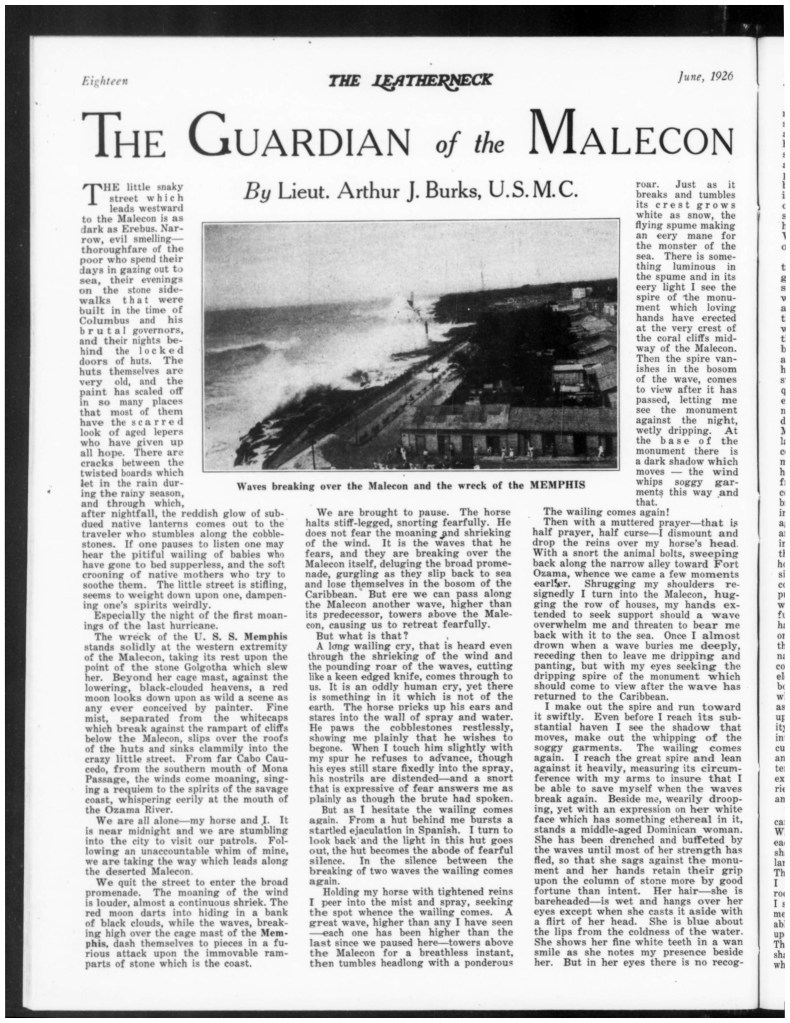
The wreck of the U. S. S. Memphis stands solidly at the western extremity of the Malecon, taking its rest upon the point of the stone Gogotha which slew her. Beyond her cage mast, against the lowering, black-clouded heavens, a red moon looks down upon as wild a scene as any ever conceived by a painter. Fine mister, separated from the whitecaps which break against the rampart of cliffs below the Malecon, slips over the roofs of the huts and sinks clammily into the crazy little street. From far Cabo Caucedo, from the southern mouth of Mona Passage, the winds come moaning, singing a requiem to the spirits of the savage coast, whispering eerily at the mouth of the Ozama River.
We are all alone—my horse and I. It is near midnight and we are stumbling into the city to visit our patrols. Following an unaccountable whim of mine, we are taking the way which leads along the deserted Malecon.
We quit the street to enter the broad promenade. The moaning of the wind is louder, almost a continuous shriek. The red moon darts into hiding in a bank of black clouds, while the waves, breaking high over the cage mast of the Memphis, dash themselves to pieces in a furious attack upon the immovable ramparts of stone which is the coast.
We are brought to pause. The horse halts stiff-legged, snorting fearfully. He does not fear the moaning and shrieking of the wind. It is the waves that he fears, and they are breaking over the Malecon itself, deluging the broad promenade, gurgling as they slip back to Sea and lose themselves in the bosom of the Caribbean. But ere we can pass along the Malecon another wave, higher than its predecessor, towers above the Malecon, causing us to retreat fearfully.
But what is that?
A long wailing cry, that is heard even through the shrieking of the wind and the pounding roar of the waves, cutting like a keen edged knife, comes through to us. It is an oddly human cry, yet there is something in it which is not of the earth. The horse pricks up his ears and stares into the wall of spray and water. He paws the cobblestones restlessly, showing me plainly that he wishes to be gone. When I touch him slightly with my spur he refuses to advance, though his eyes stare fixedly into the spray, his nostrils are distended—and a snort that is expressive of fear answers me as plainly as though the brute had spoken.
But as I hesitate the wailing comes against. From a hut behind me bursts a startled ejaculation in Spanish. I turn to look back and the light in this hut goes out, the hut becomes the abode of fearful silence. In the silence between the breaking of two waves the wailing comes again.
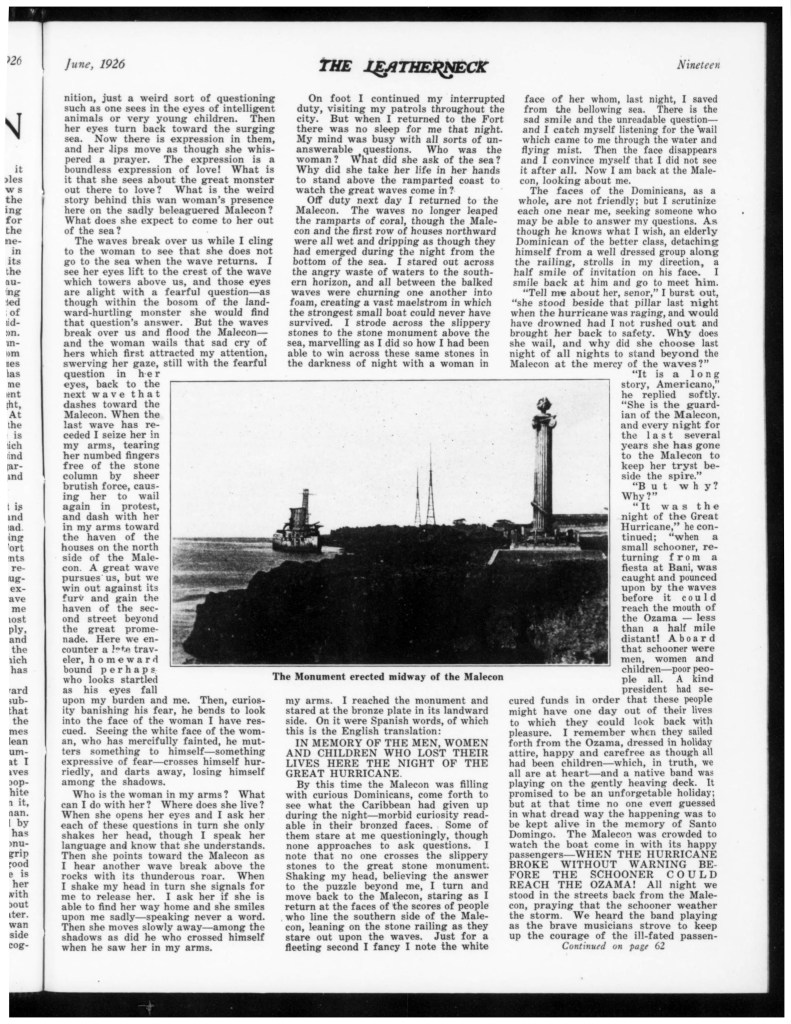
Holding my horse with tightened reins I peers into the mist and spray, seeking the spot whence the wailing comes. A great wave, higher than any I have seen—each one has been higher than the last since we paused here—towers above the Malecon for a breathless instant, then tumbles headlong with a ponderous roar. Just as it breaks and tumbles its crest grows white as snow, the flying spume making an eery mane for the monster of the sea. There is something luminous in the spume and in its every light I see the spirit of the monument which loving hands have erected at the very crest of the coral cliffs mid-way of the Malecon. Then the spire vanishes in the bosom of the wave, comes to view after it has passed, letting me see the monument against the night, wetly dripping. At the base of the monument there is a dark shadow which moves—the wind whips soggy garments this way and that.
The wailing comes again!
Then with a muttered prayer—that is half prayer, half curse—I dismount and drop the reins over my horse’s head. With a snort the animal bolts, sweeping back along the narrow alley toward Fort Ozama, whence we came a few moments earlier. Shrugging my shoulders resignedly I turn into the Malecon, hugging the row of houses, my hands extended to seek support should a wave overwhelm me and threaten to bear me back with it to the sea. Once I almost drown when a wave buries me deeply, receding then to leave me dripping and panting, but with my eyes seeking the dripping spire of the monument which should come to view after the wave has returned to the Caribbean.
I make out the spire and run toward it swiftly. Even before I reach its substantial haven I see the shadow that moves, make out the whipping of the soggy garments. The wailing comes again. I reach the great spire and lean against it heavily, measuring its circumference with my arms to insure that I be able to save myself when the waves break again. Besides me, wearily drooping, yet with an expression on her white face which has something ethereal in it, stands a middle-aged Dominican woman. She has been drenched and buffeted by the waves until most of her strength has fled, so that she sags against the monument and her hands retain their grip upon the count of stone more by good fortune than intent. Her hair—she is bareheaded—is wet and hangs over her eyes except when she casts it aside with a flirt of her head. She is blue about the lips from the coldness of the water. She shows her fine white teeth in a wan smile as she notes my presence beside her. But in her eyes there is no recognition, just a weird sort of questioning such as one sees in the eyes of intelligent animals or very young children. Then her eyes turn back toward the surging sea. Now there is expression in them, and her lips move as though she whispered a prayer. The expression is a boundless expression of love! What is it that she sees about the great monster out there to love? What is the weird story behind this wan woman’s presence here on the sadly beleaguered Malecon? What does she expect to come to her out of the sea?
The waves break over us while I cling to the woman to see that she does not go to the sea when the wave returns. I see her eyes lift to the crest of the wave which towers above us, and those eyes are alight with a fearful question—as though within the bosom of the landward-hurtling monster she would find that question’s answer. But the waves break over us and flood the Malecon—and the woman wails that sad cry of hers which first attracted my attention, swerving her gaze, still with the fearful question in her eyes, back to the next wave that dashes toward the Malecon. When the last wave has receded I seize her in my arms, tearing her numbed fingers free of the stone by sheer British force, causing her to wait again in protest, and dash with her in my arms toward the haven of the houses on the north side of the Malecon. A great wave pursues us, but we win out against its fury and gain the heaven of the second street beyond the great promenade. Here we encounter a later traveler, Howard bound perhaps, who looks startled as his eyes fall upon my burden and me. Then, curiosity banishing his fear, he bends to look into the face of the woman I have rescued. Seeing the white face of the woman, who has mercifully fainted, he mutters something to himself—something expressive of fear—crosses himself hurriedly, and darts away, losing himself among the shadows.
Who is the woman in my arms? What can I do with her? Where does she live? When she opens her eyes and I ask her each of these questions in turn she only shakes her head, though I speak her language and know that she understands. Then she points toward the Malecon as I hear another wave break above the rocks with its thunderous roar. When I shake my head in turn she signals for me to release her. I ask her if she is able to find her way home and she smiles upon me sadly—speaking never a word. Then she moves slowly away—among the shadows as did he who crossed himself when he saw her in my arms.
On foot I continued my interrupted duty, visiting my patrols throughout the city. But when I returned to the Fort there was no sleep for me that night. My mind was busy with all sorts of unanswerable questions. Who was the woman? What did she ask of the sea? Why did she take her life in her hands to stand above the ramparted coast to watch the great waves come in?
Off duty next day I turned to the Malecon. The waves no longer leaped the ramparts of coral, though the Malecon and the first row of houses northward were all wet and dripping as though they had emerged during the night from the bottom of the sea. I started out across the angry waste of waters to the southern horizon, and all between the balked waves were churning one another into foam, creating a vast maelstrom in which the strongest small boat could never have survived. I strode across the slippery stones to the stone monument above the sea, marvelling as I did so how I had been Abe to win across those same stones in the darkness of night with a woman in my arms. I reached the monument and stared at the bronze plate in its landward side. On it were Spanish words, of which this is the English translation:
IN MEMORY OF THE MEN, WOMEN AND CHILDREN WHO LOST THEIR LIVES HERE THE NIGHT OF THE GREAT HURRICANE.
By this time the Malecon was filling with curious Dominicans, come forth to see what the Caribbean had given up during the night—morbid curiosity readable in their bronzed faces. Some of them stare at me questioningly, though none approaches to ask questions. I note that no one crosses the slippery stones to the great stone monument. Shaking my head, believing the answer to the puzzle beyond me, I turn and move back to the Malecon, staring as I return at the faces of the scores of people who line the southern side of the Malecon, leaning on the stone railing as they stare out upon the waves. Just for a fleeting second I fancy I note the white face of her whom, last night, I saved from the bellowing sea. There is the sad smile and the unreadable question—and I catch myself listening for the wail which came to me through the water and flying mist. Then the face disappears and I convince myself that I did not see it after all. Now I am back at the Malecon, looking about me.
The faces of the Dominicans, as a whole, are not friendly; but I scrutinize each one near me, seeking someone who may be able to answer my questions. As though he knows what I wish, an elderly Dominican of the better class, detaching himself from a well dressed group along the railing, strolls in my direction, a half smile of invitation on his face. I smile back at him and go to meet him.
“Tell me about her, senor,” I burst out, “she stood beside that pillar last night when the hurricane was raging, and would have drowned had I not rushed out and brought her back to safety. Why does she wail, and why did she choose light night of all nights to stand beyond the Malecon at the mercy of the waves?”
“It is a long story, Americano,” he replied softly. “she is the guardian of the Malecon, and every night for the last several years she had gone to the Malecon to keep her tryst beside the spire.”
“But why? Why?”
“It was the night of the Great Hurricane,” he continued; “when a small schooner, returning from a fiesta at Bani, was caught and pounced upon by the waves before it could reach the mouth of the Ozama—less than half a mile distant! Aboard that schooner were men, women and children—poor people all. A kind president had secured funds in order that these people might have one day out of their lives to which they could look back with pleasure. I remember when they sailed forth from the Ozama, dressed in holiday attire, happy and carefree as though all had been children—which, in truth, we all are at heart—and a native band was playing on the gently heaving deck. It promised to be an unforgettable holiday; but at that time no one even guessed in what Dread the happening was to be kept alive in the memory of Santo Domingo. The Male one was crowded to watch the boat come in with its happy passengers—WHEN THE HURRICANE BROKE WITHOUT WARNING BEFORE THE SCHOONER COULD READ THE OZAMA! All night we stood in the streets back from the Malecon, praying that the schooner weather the storm. We heard the band playing as the brave musicians strove to keep up the courage of the ill-fated passengers. But the band stopped at last, and we saw that the lights of the schooner were slowly but surely moving landward—now hidden in a trough of the waves, now in plain view at the crest of a monster of the sea. Ever and anon we caught the wailing of those yet left alive aboard her. Then the lights vanished as a terrible wave engulfed the schooner; the wailing died out as disappears a candle flame in a wind—and silence settled over the Malecon save for the shrieking of the waves and the screaming of the wind. There was no way of going to the rescue! It would have been suicide to no avail, senor! One man tried to swim out of the schooner—we found his body next day in the middle of second street north of the Malecon—and with him were the bodies of many others. That monument yonder was erected in memory of one of the saddest pages in Dominican history.”
“But the woman! What of her?”
“All of her family, save her husband, was aboard the schooner. All save one of them returned—the youngest, a girl of twelve, best-beloved of her family—we found their bodies north of the Malecon. But the girl never came back! The sea took her and has never given her up.”
“But the woman’s husband, who you saw was not a board? Why does he permit her to visit the Malecon alone?”
“Her husband, senor,” replied the man, “was the only Dominican who tried to reach the foundering schooner. He failed, as I have told you. Now, there is no one of the family save the wife and mother—who comes nightly to the Malecon to pray that the sea give up her best-beloved. But there is no reason to fear her, senor. She is harmless, though all Santo Domingo knows that she has lost her mind—she does not even grow angry at the men and boys who follow her about, hurling gibes at her for a lunatic. So you can see that there is really no harm in her.”
“Yes,” I replied bitterly, “I can well understand. But do you?”
Many months later, when I stood on the deck of an outbound transport, leaving Santo Domingo behind to drop slowly out of sight below the horizon, I stood at the rail and looked back toward the Malecon. We had left the Ozama at nightfall and already lights had flashed on in the Capital City. A revolving light to guide mariners blinked on and off as it circled in its huge cage above the harbor. Its light flashed for an instant along the coast, causing the spire of the monument to stand out in startling relief as it passed. Just for an instant it was; but in its pathway, coming across the slippery stones from the Malecon, I fancied I could make out the shadowy outlines of a woman who walked slowly, with her great eyes fixed questioningly upon the sea. Then the light passed on and, after a long time, Santo Domingo dropped out of sight beneath the heaving waste.
※
In The Leatherneck, the tale ends with the notice “[Reprinted by permission of WEIRD TALES].” Arthur J. Burks published six “Strange Tales of Santo Domingo” in the pages of Weird Tales, but this is not one of them. Not quite weird enough, perhaps, for Farnsworth Wright.
The Carribean to the south, beyond the Malecon, was a mighty Sapphire mystery encircling the world. […] To the west of the Malecon the wrecked U. S. S. Memphis, often seen now in newsreels, rested solidly upon the stone Golgotha which had crucified her. And when the waves were running in their crests broke into creamy foam over the very top of her cage mast, which had not then been taken down by the salvaging interests.
—Arthur J. Burks, Land of Checkerboard Families (1932) 8-9
The U.S.S. Memphis was real, and wrecked in the harbor of Santo Domingo in 1916. The partially dismantled wreck would still have been visible in the 1920s when Burks was stationed there.

Bobby Derie is the author of Weird Talers: Essays on Robert E. Howard and Others and Sex and the Cthulhu Mythos.
Deep Cuts in a Lovecraftian Vein uses Amazon Associate links. As an Amazon Associate I earn from qualifying purchases.

